Simple Customization of Recursive Neural Networks
for Semantic Relation Classification
Kazuma Hashimoto†, Makoto Miwa††, Yoshimasa Tsuruoka†, and Takashi Chikayama†
†The University of Tokyo, 3-7-1 Hongo, Bunkyo-ku, Tokyo, Japan
{hassy, tsuruoka, chikayama}@logos.t.u-tokyo.ac.jp ††The University of Manchester, 131 Princess Street, Manchester, M1 7DN, UK
Abstract
In this paper, we present a recursive neural network (RNN) model that works on a syn-tactic tree. Our model differs from previous RNN models in that the model allows for an explicit weighting of important phrases for the target task. We also propose to average param-eters in training. Our experimental results on semantic relation classification show that both phrase categories and task-specific weighting significantly improve the prediction accuracy of the model. We also show that averaging the model parameters is effective in stabilizing the learning and improves generalization capacity. The proposed model marks scores competitive with state-of-the-art RNN-based models.
1 Introduction
Recursive Neural Network (RNN) models are promising deep learning models which have been applied to a variety of natural language processing (NLP) tasks, such as sentiment classification, com-pound similarity, relation classification and syntactic parsing (Hermann and Blunsom, 2013; Socher et al., 2012; Socher et al., 2013). RNN models can repre-sent phrases of arbitrary length in a vector space of a fixed dimension. Most of them use minimal syn-tactic information (Socher et al., 2012).
Recently, Hermann and Blunsom (2013) pro-posed a method for leveraging syntactic informa-tion, namely CCG combinatory operators, to guide composition of phrases in RNN models. While their models were successfully applied to binary senti-ment classification and compound similarity tasks,
there are questions yet to be answered, e.g., whether such enhancement is beneficial in other NLP tasks as well, and whether a similar improvement can be achieved by using syntactic information of more commonly available types such as phrase categories and syntactic heads.
In this paper, we present a supervised RNN model for a semantic relation classification task. Our model is different from existing RNN models in that impor-tant phrases can be explicitly weighted for the task. Syntactic information used in our model includes part-of-speech (POS) tags, phrase categories and syntactic heads. POS tags are used to assign vec-tor representations to word-POS pairs. Phrase cate-gories are used to determine which weight matrices are chosen to combine phrases. Syntactic heads are used to determine which phrase is weighted during combining phrases. To incorporate task-specific in-formation, phrases on the path between entity pairs are further weighted.
The second contribution of our work is the intro-duction of parameter averaging into RNN models. In our preliminary experiments, we observed that the prediction performance of the model often fluc-tuates significantly between training iterations. This fluctuation not only leads to unstable performance of the resulting models, but also makes it difficult to fine-tune the hyperparameters of the model. Inspired by Swersky et al. (2010), we propose to average the model parameters in the course of training. A re-cent technique for deep learning models of similar vein is dropout (Hinton et al., 2012), but averaging is simpler to implement.
Our experimental results show that our model
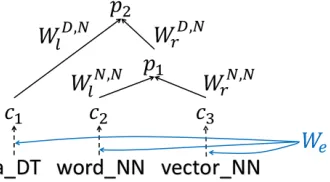
Figure 1: A recursive representations of a phrase “a word vector” with POS tags of the words (DT, NN and NN respectively). For example, the two word-POS pairs “word NN” and “vector NN” with a syntactic category Nare combined to represent the phrase “word vector”.
forms better than standard RNN models. By av-eraging the model parameters, our model achieves performance competitive with the MV-RNN model in Socher et al. (2012), without using computation-ally expensive word-dependent matrices.
2 An Averaged RNN Model with Syntax
Our model is a supervised RNN that works on a bi-nary syntactic tree. As our first step to leverage in-formation available in the tree, we distinguish words with the same spelling but POS tags in the vector space. Our model also uses different weight ma-trices dependent on the phrase categories of child nodes (phrases or words) in combining phrases. Our model further weights those nodes that appear to be important.
Compositional functions of our model follow those of the SU-RNN model in Socher et al. (2013).
2.1 Word-POS Vector Representations
Our model simply assigns vector representations to word-POS pairs. For example, a word “caused” can be represented in two ways: “caused VBD” and “caused VBN”. The vectors are represented as col-umn vectors in a matrixWe ∈ Rd×|V|, wheredis the dimension of a vector andVis a set of all word-POS pairs we consider.
2.2 Compositional Functions with Syntax
In construction of parse trees, we associate each of the tree node with itsd-dimensional vector represen-tation computed from vector represenrepresen-tations of its subtrees. For leaf nodes, we look up word-POS
vec-tor representations inV. Figure 1 shows an example of such recursive representations. A parent vector
p∈ Rd×1 is computed from its direct child vectors
clandcr∈Rd×1:
p= tanh(αlW Tcl,Tcr
l cl+αrW Tcl,Tcr
r cr+bTcl,Tcr),
whereWlTcl,Tcr andWrTcl,Tcr ∈ Rd×d are weight matrices that depend on the phrase categories ofcl andcr. Here, cl andcr have phrase categories Tcl
andTcr respectively (such as N, V, etc.). b
Tcl,Tcr ∈
Rd×1 is a bias vector. To incorporate the
impor-tance of phrases into the model, two subtrees of a node may have different weights αl ∈ [0,1] and
αr(= 1− αl), taking phrase importance into ac-count. The value of αl is manually specified and automatically applied to all nodes based on prior knowledge about the task. In this way, we can com-pute vector representations for phrases of arbitrary length. We denote a set of such matrices asWlrand bias vectors asb.
2.3 Objective Function and Learning
As with other RNN models, we add on the top of a nodexasoftmaxclassifier. The classifier is used to predict aK-class distributiond(x) ∈RK×1over a
specific task to train our model:
d(x) = softmax(Wlabelx+blabel), (1)
where Wlabel ∈ RK×d is a weight matrix and
blabel ∈ RK×1 is a bias vector. We denotet(x) ∈
RK×1 as the target distribution vector at node x. t(x)has a 0-1 encoding: the entry at the correct la-bel oft(x)is 1, and the remaining entries are 0. We then compute the cross entropy error betweend(x)
andt(x):
E(x) =−
K ∑
k=1
tk(x)logdk(x),
and define an objective function as the sum ofE(x)
over all training data:
J(θ) =∑
x
E(x) +λ 2∥θ∥
2,
To compute d(x), we can directly leverage any other nodes’ feature vectors in the same tree. We denote such additional feature vectors asx′i∈Rd×1, and extend Eq. (1):
d(x) = softmax(Wlabelx+∑
i
Wiaddx′i+blabel),
whereWadd
i ∈RK×dare weight matrices for addi-tional features. We denote these matricesWiadd as
Wadd. We also addWaddtoθ:
θ= (We,Wlr,b,Wlabel,Wadd,blabel).
The gradient ofJ(θ)
∂J(θ) ∂θ =
∑
x
∂E(x) ∂θ +λθ
is efficiently computed via backpropagation through structure (Goller and K¨uchler, 1996). To minimize
J(θ), we use batch L-BFGS1 (Hermann and Blun-som, 2013; Socher et al., 2012).
2.4 Averaging
We use averaged model parameters
θ= 1 T+ 1
T ∑
t=0 θt
at test time, whereθtis the vector of model parame-ters after t iterations of the L-BFGS optimization. Our preliminary experimental results suggest that averagingθexceptWeworks well.
3 Experimental Settings
We used the Enju parser (Miyao and Tsujii, 2008) for syntactic parsing. We used13phrase categories given by Enju.
3.1 Task: Semantic Relation Classification
We evaluated our model on a semantic relation clas-sification task: SemEval 2010 Task 8 (Hendrickx et al., 2010). Following Socher et al. (2012), we re-garded the task as a 19-class classification problem. There are 8,000 samples for training, and 2,717 for
1
[image:3.612.360.496.53.135.2]We used libLBFGS provided at http://www. chokkan.org/software/liblbfgs/.
Figure 2: Classifying the relation between two entities.
test. For the validation set, we randomly sampled 2,182 samples from the training data.
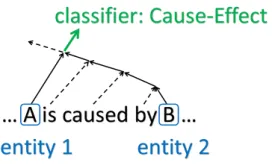
To predict a class label, we first find the minimal phrase that covers the target entities and then use the vector representation of the phrase (Figure 2).
As explained in Section 2.3, we can directly con-nect features on any other nodes to thesoftmax clas-sifier. In this work, we used three such internal fea-tures: two vector representations of target entities and one averaged vector representation of words be-tween the entities2.
3.2 Weights on Phrases
We tuned the weightαl (orαr) introduced in Sec-tion 2.2 for this particular task. There are two fac-tors: syntactic heads and syntactic path between tar-get entities. Our model puts a weightβ ∈ [0.5,1]
on head phrases, and 1−β on the others. For re-lation classification tasks, syntactic paths between target entities are important (Zhang et al., 2006), so our model also puts another weightγ ∈ [0.5,1]on phrases on the path, and1−γ on the others. When both child nodes are on the path or neither of them on the path, we setγ = 0.5. The two weight fac-tors are summed up and divided by2to be the final weightsαl andαr to combine the phrases. For ex-ample, we set αl = (1−β2)+γ and αr = β+(12−γ) when the right child node is the head and the left child node is on the path.
3.3 Initialization of Model Parameters and Tuning of Hyperparameters
We initialized We with 50-dimensional word vec-tors3 trained with the model of Collobert et
2Socher et al. (2012) used richer features including words
around entity pairs in their implementation.
Method F1 (%)
Our model 79.4
RNN 74.8
MV-RNN 79.1
RNN w/ POS, WordNet, NER 77.6
MV-RNN w/ POS, WordNet, NER 82.4
SVM w/ bag-of-words 73.1
[image:4.612.77.297.54.166.2]SVM w/ lexical and semantic features 82.2
Table 1: Comparison of our model with other methods on SemEval 2010 task 8.
Method F1 (%)
Our model 79.4
Our model w/o phrase categories (PC) 77.7 Our model w/o head weights (HW) 78.8 Our model w/o path weights (PW) 78.7 Our model w/o averaging (AVE) 76.9 Our model w/o PC, HW, PW, AVE 74.1
Table 2: Contributions of syntactic and task-specific in-formation and averaging.
al. (2011), and Wlr with I2 +ε, where I ∈ Rd×d is an identity matrix. Here,εis zero-mean gaussian random variable with a variance of 0.01. The ini-tialization of Wlr is the same as that of Socher et al. (2013). The remaining model parameters were initialized with0.
We tuned hyperparameters in our model using the validation set for each experimental setting. The hy-perparameters include the regularization parameters forWe,Wlr,WlabelandWadd, and the weightsβ andγ. For example, the best performance for our model with all the proposed methods was obtained with the values: 10−6, 10−4, 10−3, 10−3, 0.7 and
0.9respectively.
4 Results and Discussion
Table 1 shows the performance of our model and that of previously reported systems on the test set. The performance of an SVM system with bag-of-words features was reported in Rink and Harabagiu (2010), and the performance of the RNN and MV-RNN models was reported in Socher et al. (2012). Our model achieves an F1 score of 79.4% and outper-forms the RNN model (74.8% F1) as well as the simple SVM-based system (73.1% F1). More
no-Figure 3: F1 vs Training iterations.
tably, the score of our model is competitive with that of the MV-RNN model (79.1% F1), which is com-putationally much more expensive. Readers are re-ferred to Hermann and Blunsom (2013) for the dis-cussion about the computational complexity of the MV-RNN model. We improved the performance of RNN models on the task without much increasing the complexity. This is a significant practical advan-tage of our model, although its expressive power is not the same as that of the MV-RNN model.
Our model outperforms the RNN model with one lexical and two semantic external features: POS tags, WordNet hypernyms and named entity tags (NER) of target word pairs (external features). The MV-RNN model with external features shows bet-ter performance than our model. An SVM with rich lexical and semantic features (Rink and Harabagiu, 2010) also outperforms ours. Note, however, that this is not a fair comparison because those mod-els use rich external resources such as WordNet and named entity tags.
4.1 Contributions of Proposed Methods
[image:4.612.318.538.58.229.2]bet-ter than the RNN model alone. Without utiliz-ing these four properties, our model obtained only 74.1% F1. These results indicate that syntactic and task-specific information and averaging contribute to the performance improvement. The improvement is achieved by a simple modification of composi-tional functions in RNN models.
4.2 Effects of Averaging in Training
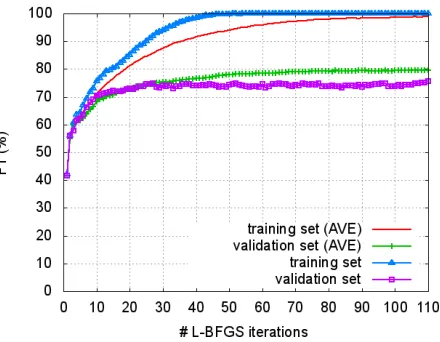
Figure 3 shows the training curves in terms of F1 scores. These curves clearly demonstrate that pa-rameter averaging helps to stabilize the learning and improve generalization capacity.
5 Conclusion
We have presented an averaged RNN model for se-mantic relation classification. Our experimental re-sults show that syntactic information such as phrase categories and heads improves the performance, and the task-specific weighting is also beneficial. The results also demonstrate that averaging the model parameters not only stabilizes the learning but also improves the generalization capacity of the model. As future work, we plan to combine deep learning models with richer information such as predicate-argument structures.
Acknowledgments
We thank the anonymous reviewers for their insight-ful comments.
References
Ronan Collobert, Jason Weston, L´eon Bottou, Michael Karlen, Koray Kavukcuoglu, and Pavel Kuksa. 2011.
Natural Language Processing (almost) from Scratch.
In JMLR, 12:2493–2537.
Christoph Goller and Andreas K¨uchler. 1996. Learning
Task-Dependent Distributed Representations by Back-propagation Through Structure. In ICNN.
Iris Hendrickx, Su Nam Kim, Zornitsa Kozareva, Preslav Nakov, Diarmuid ´O S´eaghdha, Sebastian Pad´o, Marco Pennacchiotti, Lorenza Romano and Stan Szpakowicz. 2010. SemEval-2010 Task 8: Multi-Way Classication
of Semantic Relations Between Pairs of Nominals. In SemEval 2010.
Karl Moritz Hermann and Phil Blunsom. 2013. The Role
of Syntax in Vector Space Models of Compositional Se-mantics. In ACL.
Geoffrey E. Hinton, Nitish Srivastava, Alex Krizhevsky, Ilya Sutskever and Ruslan R. Salakhutdinov. 2012.
Improving neural networks by preventing co-adaptation of feature detectors. In arXiv:1207.0580.
Yusuke Miyao and Jun’ichi Tsujii. 2008. Feature Forest
Models for Probabilistic HPSG Parsing. In Computa-tional Linguistics, 34(1):35–80, MIT Press.
Bryan Rink and Sanda Harabagiu. 2010. UTD:
Clas-sifying Semantic Relations by Combining Lexical and Semantic Resources. In SemEval 2010.
Richard Socher, Brody Huval, Christopher D. Manning and Andrew Y. Ng. 2012. Semantic Compositionality
Through Recursive Matrix-Vector Spaces. In EMNLP.
Richard Socher, John Bauer, Christopher D. Manning and Andrew Y. Ng. 2013. Parsing with Compositional
Vector Grammars. In ACL.
Kevin Swersky, Bo Chen, Ben Marlin and Nando de Fre-itas. 2010. A tutorial on stochastic approximation
al-gorithms for training Restricted Boltzmann Machines and Deep Belief Nets. In ITA workshop.
Min Zhang, Jie Zhang, Jian Su and Guodong Zhou. 2006.