A High-Precision Approach to Detecting Hedges and Their Scopes
Halil Kilicoglu and Sabine Bergler
Department of Computer Science and Software Engineering Concordia University
1455 de Maisonneuve Blvd. West Montr´eal, Canada
{h kilico,bergler}@cse.concordia.ca
Abstract
We extend our prior work on specula-tive sentence recognition and speculation scope detection in biomedical text to the CoNLL-2010 Shared Task on Hedge De-tection. In our participation, we sought to assess the extensibility and portability of our prior work, which relies on linguis-tic categorization and weighting of hedg-ing cues and on syntactic patterns in which these cues play a role. For Task 1B, we tuned our categorization and weight-ing scheme to recognize hedgweight-ing in bio-logical text. By accommodating a small number of vagueness quantifiers, we were able to extend our methodology to de-tecting vague sentences in Wikipedia arti-cles. We exploited constituent parse trees in addition to syntactic dependency rela-tions in resolving hedging scope. Our re-sults are competitive with those of closed-domain trained systems and demonstrate that our high-precision oriented methodol-ogy is extensible and portable.
1 Introduction
Natural language is imbued with uncertainty, vagueness, and subjectivity. However, informa-tion extracinforma-tion systems generally focus on ex-tracting factual information, ignoring the wealth of information expressed through such phenom-ena. In recent years, the need for information ex-traction and text mining systems to identify and model such extra-factual information has increas-ingly become clear. For example, online product and movie reviews have provided a rich context for analyzing sentiments and opinions in text (see Pang and Lee (2008) for a recent survey), while tentative, speculative nature of scientific writing, particularly in biomedical literature, has provided
impetus for recent research in speculation detec-tion (Light et al., 2004). The termhedgingis often used as an umbrella term to refer to an array of extra-factual phenomena in natural language and is the focus of the CoNLL-2010 Shared Task on Hedge Detection.
The CoNLL-2010 Shared Task on Hedge De-tection (Farkas et al., 2010) follows in the steps of the recent BioNLP’09 Shared Task on Event Extraction (Kim et al., 2009), in which one task (speculation and negation detection) was con-cerned with notions related to hedging in biomed-ical abstracts. However, the CoNLL-2010 Shared Task differs in several aspects. It sheds light on the pervasiveness of hedging across genres and do-mains: in addition to biomedical abstracts, it is concerned with biomedical full text articles as well as with Wikipedia articles. Both shared tasks have been concerned with scope resolution; however, their definitions of scope are fundamentally differ-ent: the BioNLP’09 Shared Task takes the scope of a speculation instance to be an abstract seman-tic object (an event), thus a normalized logical form. The CoNLL-2010 Shared Task, on the other hand, defines it as a textual unit based on syntac-tic considerations. It is also important to note that hedging in scientific writing is a core aspect of the genre (Hyland, 1998), while it is judged to be a flaw which has to be eradicated in Wikipedia ar-ticles. Therefore, hedge detection in these genres serves different purposes: explicitly encoding the factuality of a scientific claim (doubtful,probable, etc.) versus flagging unreliable text.
We participated in both tasks of the CoNLL-2010 Shared Task: namely, detection of sentences with uncertainty (Task 1) and resolution of uncer-tainty scope (Task 2). Since we pursued both of these directions in prior work, one of our goals in participating in the shared task was to assess how our approach generalized to previously unseen texts, even genres. Towards this goal, we adopted
an open-domain approach, where we aimed to use previously developed techniques to the extent pos-sible. Among all participating groups, we distin-guished ourselves as the one that fully worked in an open-domain setting. This approach worked reasonably well for uncertainty detection (Task 1); however, for the scope resolution task, we needed to extend our work more substantially, since the notion of scope was fundamentally different than what we adopted previously. The performance of our system was competitive; in terms of F-measure, we were ranked near the middle in Task 1, while a more significant focus on scope reso-lution resulted in fourth place ranking among fif-teen systems. We obtained the highest precision in tasks focusing on biological text. Considering that we chose not to exploit the training data pro-vided to the full extent, we believe that our system is viable in terms of extensibility and portability.
2 Related Work
Several notions related to hedging have been pre-viously explored in natural language processing. In the news article genre, these have included
certainty, modality, and subjectivity. For ex-ample, Rubin et al. (2005) proposed a four di-mensional model to categorizecertainty in news text: certainty level, focus, perspective andtime. In the context of TimeML (Pustejovsky et al., 2005), which focuses on temporal expressions in news articles, event modality is encoded us-ing subordination links (SLINKs), some of which (MODAL,EVIDENTIAL) indicate hedging (Saur´ı et al., 2006). Saur´ı (2008) exploits modality and polarity to assess the factuality degree of events (whether they correspond to facts, counter-facts or possibilities), and reports on FactBank, a corpus annotated for event factuality (Saur´ı and Puste-jovsky, 2009). Wiebe et al. (2005) consider subjectivity in news articles, and focus on the notion of private states, encompassing specula-tions, opinions, and evaluations in their subjectiv-ity frames.
The importance of speculative language in biomedical articles was first acknowledged by Light et al. (2004). Following work in this area focused on detecting speculative sentences (Med-lock and Briscoe, 2007; Szarvas, 2008; Kilicoglu and Bergler, 2008). Similar to Rubin et al.’s (2005) work, Thompson et al. (2008) proposed a categorization scheme forepistemic modalityin
biomedical text according to the type of infor-mation expressed (e.g., certainty level, point of view,knowledge type). With the availability of the BioScope corpus (Vincze et al., 2008), in which negation, hedging and their scopes are annotated, studies in detecting speculation scope have also been reported (Morante and Daelemans, 2009; ¨Ozg¨ur and Radev, 2009). Negation and uncer-tainty of bio-events are also annotated to some ex-tent in the GENIA event corpus (Kim et al., 2008). The BioNLP’09 Shared Task on Event Extraction (Kim et al., 2009) dedicated a task to detecting negation and speculation in biomedical abstracts, based on the GENIA event corpus annotations.
Ganter and Strube (2009) elaborated on the link betweenvaguenessin Wikipedia articles indicated by weasel words and hedging. They exploited word frequency measures and shallow syntactic patterns to detect weasel words in Wikipedia ar-ticles.
3 Methods
Our methodology for hedge detection is essen-tially rule-based and relies on a combination of lexical and syntactic information. Lexical infor-mation is encoded in a simple dictionary, and rel-evant syntactic information is identified using the Stanford Lexicalized Parser (Klein and Manning, 2003). We exploit constituent parse trees as well as corresponding collapsed dependency represen-tations (deMarneffe et al., 2006), provided by the parser.
3.1 Detecting Uncertainty in Biological Text
of 1-5, where 5 is assigned to cues most central to hedging and 1 to those that are most periph-eral. For example, the modal auxiliary may has a weight of 5, while a relatively weak hedging cue, the epistemic adverbapparently, has a weight of 2. The weight sum of cues in a sentence in combination with a predetermined threshold de-termines whether the sentence in question is un-certain. Syntax, generally ignored in other stud-ies on hedging, plays a prominent role in our ap-proach. Certain syntactic constructions act as cues (e.g.,whether- andif-complements), while others strengthen or weaken the effect of the cue associ-ated with them. For example, athat-complement taken by an epistemic verb increases the hedging score contributed by the verb by 2, while lack of any complement decreases the score by 1.
For the shared task, we tuned this categoriza-tion and weighting scheme, based on an analy-sis of the biomedical full text articles in training data. We also adjusted the threshold. We elim-inated some hedging cue categories completely and adjusted the weights of a small number of the remaining cues. The eliminated cue categories included approximative adverbs (e.g., generally,
largely, partially) and approximative adjectives
(e.g., partial), often used to “manipulate preci-sion in quantification” (Hyland, 1998). The other eliminated category included verbs ofeffort(e.g.,
try,attempt,seek), also referred to asrationalising narrators(Hyland, 1998). The motivation behind eliminating these categories was that cues belong-ing to these categories were never annotated as hedging cues in the training data. The elimination process resulted in a total of 147 remaining hedg-ing cues. Additionally, we adjusted the weights of several other cues that were not consistently anno-tated as cues in the training data, despite our view that they were strong hedging cues. One example is the epistemic verbpredict, previously assigned a weight of 4 based on Hyland’s analysis. We found its annotation in the training data somewhat incon-sistent, and lowered its weight to 3, thus requiring a syntactic strengthening effect (an infinitival com-plement, for example) for it to qualify as a hedging cue in the current setting (threshold of 4).
3.2 Detecting Uncertainty in Wikipedia Articles
Task 1W was concerned with detecting uncer-tainty in Wikipedia articles. Unceruncer-tainty in this
context refers more or less tovaguenessindicated by weasel words, an undesirable feature accord-ing to Wikipedia policy. Analysis of Wikipedia training data provided by the organizers revealed that there is overlap between weasel words and hedging cues described in previous section. We, therefore, sought to adapt our dictionary of hedg-ing cues to the task of detecthedg-ing vagueness in Wikipedia articles. Similar to Task 1B, changes involved eliminating cue categories and adjusting cue weights. In addition, however, we also added a previously unconsidered category of cues, due to their prominence in Wikipedia data as weasel words. This category (vagueness quantifiers (Lap-pin, 2000)) includes words, such assome,several,
many and various, which introduce imprecision when in modifier position. For instance, in the ex-ample below, bothsomeandcertaincontribute to vagueness of the sentence.
(1) Even today, some cultures have certain in-stances of their music intending to imitate natural sounds.
For Wikipedia uncertainty detection, eliminated categories included verbs and nouns concerning
tendencies (e.g., tend, inclination) in addition to verbs ofeffort. The only modal auxiliary consis-tently considered aweasel wordwasmight; there-fore, we only keptmightin this category and elim-inated the rest (e.g., may, would). Approxima-tive adverbs, eliminated in detecting uncertainty in biological text, not only were revived for this task, but also their weights were increased as they were more central to vagueness expressions. Be-sides these changes in weighting and categoriza-tion, the methodology for uncertainty detection in Wikipedia articles was essentially the same as that for biological text. The threshold we used in our submission was, similarly, 4.
3.3 Scope Resolution for Uncertainty in Biological Text
earlier steps and the speculation cue. The cate-gory of the hedging cue constrained the depen-dency relations that are deemed appropriate. For example, consider the sentence in (2a), where in-volvesis a bio-event trigger for a Regulation
event and suggest is a speculation cue of epis-temic verb type. The first dependency relation in (2b) indicates that the epistemic verb takes a clausal complement headed by the bio-event trig-ger. The second indicates thatthat is the comple-mentizer. This cue category/dependency combi-nation licenses the generation of a speculation in-stance where the event indicated by the event trig-ger represents the scope.
(2) (a) The results suggest that M-CSF induc-tion of M-CSFinvolvesG proteins, PKC and NF kappa B.
(b) ccomp(suggest,involves) complm(involves,that)
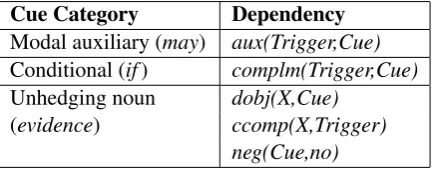
Several other cue category/dependency combi-nations sought for speculation scope resolution are given in Table 1. Xrepresents a token that is nei-ther a cue nor a trigger (aux: auxiliary,dobj: direct object,neg: negation modifier).
Cue Category Dependency
Modal auxiliary (may) aux(Trigger,Cue)
Conditional (if) complm(Trigger,Cue)
Unhedging noun dobj(X,Cue)
[image:4.595.73.291.442.527.2](evidence) ccomp(X,Trigger) neg(Cue,no)
Table 1: Cue categories with examples and the de-pendency relations to search
In contrast to this notion of scope being an ab-stract semantic object, Task 2 (BioScope corpus, in general) conceptualizes hedge scope as a con-tinuous textual unit, including the hedging cue it-self and the biggest syntactic unit the cue is in-volved in (Vincze et al., 2008). This fundamen-tal difference in conceptualization limits the di-rect applicability of our prior approach to this task. Nevertheless, we were able to use our work as a building block in extending scope resolution heuristics. We further augmented it by exploiting constituent parse trees provided by Stanford Lex-icalized Parser. These extensions are summarized below.
3.3.1 Exploiting parse trees
The constituent parse trees contribute to scope resolution uniformly across all hedging cue cate-gories. We simply determine the phrasal node that dominates the hedging cue and consider the tokens within that phrase as being in the scope of the cue, unless they meet one of the following exclusion criteria:
1. Exclude tokens within post-cue sentential complements (indicated by S and SBAR nodes) introduced by a small number of discourse markers (thus, whereas, because,
since,if, anddespite).
2. Exclude punctuation marks at the right boundary of the phrase
3. Exclude pre-cue determiners and adverbs at the left boundary of the phrase
For example, in the sentence below, the verb phrase that included the modal auxiliarymayalso included the complement introduced by thereby. Using the exclusion criteria 1 and 2, we excluded the tokens followingSPACERfrom the scope:
(3) (a) . . . motifsmaybe easily compared with the results from BEAM, PRISM and SPACER, thereby extending the SCOPE ensemble to include a fourth class of motifs.
(b) CUE:may
SCOPE: motifs may be easily compared with the results from BEAM, PRISM and SPACER
3.3.2 Extending dependency-based heuristics
The new scope definition was also accommodated by extending the basic dependency-based heuris-tics summarized earlier in this section. In addition to finding the trigger word that satisfies the ap-propriate dependency constraint with the hedging cue (we refer to this trigger word as scope head, henceforth), we also considered the other depen-dency relations that thescope head was involved in. These relations, then, were used in right ex-pansionandleft expansionof the scope. Right ex-pansioninvolves finding the rightmost token that is in a dependency relation with thescope head. Consider the sentence below:
programs are only a firstapproximationto bi-ologicalsignificance.
The epistemic verb indicate has as its scope headthe tokenapproximation, due to the existence of a clausal complement dependency (ccomp) be-tween them. On the other hand, the rightmost to-ken of the sentence, significance, has a preposi-tional modifier dependency (prep to) with approx-imation. It is, therefore, included in the scope of
indicate. Two dependency types, adverbial clause modifier (advcl) and conjunct (conj), were ex-cluded from consideration when the rightmost to-ken is sought, since they are likely to signal new discourse units outside the scope.
In contrast to right expansion, which applies to all hedging cue categories, left expansion ap-plies only to a subset. Left expansion involves searching for a subject dependency governed by the scope head. The dependency types descend-ing from the subject (subj) type in the Stanford de-pendency hierarchy are considered: nsubj (nom-inal subject), nsubjpass (passive nominal sub-ject), csubj(clausal subject) and csubjpass (pas-sive clausal subject). In the following example, the first token,This, is added to the scope oflikely
through left expansion (cop: copula).
(5) (a) This is most likely a conservative esti-mate since a certain proportion of inter-actions remain unknown . . .
(b) nsubj(likely,This) cop(likely,is)
Left expansion was limited to the following cue categories, with the additional constraints given:
1. Modal auxiliaries, only when their scope head takes a passive subject (e.g., they is added to the scope ofmayinthey may be an-notated as pseudogenes).
2. Cues in adjectival categories, when they are in copular constructions (e.g., Example (5)). 3. Cues in several adjectival ad verbal
cate-gories, when they take infinitival comple-ments (e.g.,thisis added to the scope of ap-pearsinHowever, this appears to add more noise to the prediction without increasing the accuracy).
After scope tokens are identified using the parse tree as well as via left and right expansion, the al-gorithm simply sets as scope the continuous tex-tual unit that includes all the scope tokens and the
hedging cue. Since,likely is the hedging cue and
Thisandestimateare identified as scope tokens in Example (5), the scope associated withlikely be-comesThis is most likely a conservative estimate. We found that citations, numbers and punc-tuation marks occurring at the end of sentences caused problems in scope resolution, specifically in biomedical full text articles. Since they are rarely within any scope, we implemented a simple stripping algorithm to eliminate them from scopes in such documents.
4 Results and Discussion
The official evaluation results regarding our sub-mission are given in Table 2. These results were achieved with the threshold 4, which was the opti-mal threshold on the training data.
Prec. Recall F-score Rank
Task 1B 92.07 74.94 82.62 12/24
Task 1W 67.90 46.02 54.86 10/17
Task 2 62.47 49.47 55.21 4/15
Table 2: Evaluation results
In Task 1B, we achieved the highest precision. However, our relatively low recall led to the place-ment of our system in the middle. Our system al-lows adjusting precision versus recall by setting the threshold. In fact, setting the threshold to 3 af-ter the shared task, we were able to obtain overall better results (Precision=83.43, Recall=84.81, F-score=84.12, Rank=8/24). However, we explicitly targeted precision, and in that respect, our submis-sion results were not surprising. In fact, we iden-tified a new type of hedging signalled by coordi-nation (either . . . or . . . as well as just or) in the training data. An example is given below:
(6) (a) It will beeither a sequencing errorora pseudogene.
(b) CUE:either-or
SCOPE: either a seqeuncing error or a pseudogene
In participating in Task 1W, our goal was to test the ease of extensibility of our system. In that regard, our results show that we were able to exploit the overlap between our hedging cues and the weasel words. The major difference we noted between hedging in two genres was the class of vagueness quantifiers, and, with little ef-fort, we extended our system to consider them. We also note that setting the threshold to 3 after the shared task, our recall and F-score improved significantly (Precision=63.21, Recall=53.67, F-score=58.05, Rank=3/17).
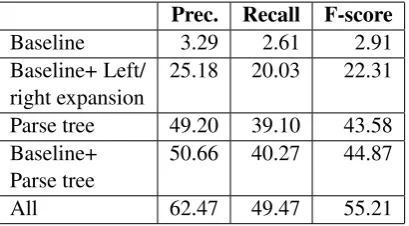
Our more substantial effort for Task 2 resulted in a better overall ranking, as well as the highest precision in this task. In contrast to Task 1, chang-ing the threshold in this task did not have a pos-itive effect on the outcome. We also measured the relative contribution of the enhancements to scope resolution. The results are presented in Ta-ble 3. Baseline is taken as the scope resolution al-gorithm we developed in prior work. These results show that: a) scope definition we adopted earlier is essentially incompatible with the BioScope def-inition b) simply taking the phrase that the hedg-ing cue belongs to as the scope provides relatively good results c) left and right expansion heuristics are needed for increased precision and recall.
Prec. Recall F-score
Baseline 3.29 2.61 2.91
Baseline+ Left/ right expansion
25.18 20.03 22.31
Parse tree 49.20 39.10 43.58
Baseline+
Parse tree 50.66 40.27 44.87
[image:6.595.73.278.441.554.2]All 62.47 49.47 55.21
Table 3: Effect of scope resolution enhancements
4.1 Error Analysis
In this section, we provide a short analysis of the errors our system generated, focusing on biologi-cal text.
Since our dictionary of hedging cues is incom-plete and we did not attempt to expand it for Task 1B, we had a fair number of recall errors. As we mentioned above, either-or constructions oc-cur frequently in the training and evaluation data, and we did not attempt to handle them. Addition-ally, some lexical cues, such as feasible and im-plicate, do not appear in our dictionary, causing
further recall errors. The weighting scheme also affects recall. For example, the adjective appar-enthas a weight of 2, which is not itself sufficient to qualify a sentence as uncertain (with a thresh-old of 4) (7a). On the other hand, when it takes a clausal complement, the sentence is considered uncertain (7b). The first sentence (7a) causes a re-call error.
(7) (a) An apparent contradiction between the previously reported number of cycling genes . . .
(b) . . . it isapparent that the axonal termini contain a significantly reduced number of varicosities . . .
In some cases, syntactic constructions that play a role in determining the certainty status of a sen-tence cannot be correctly identified by the parser, often leading to recall errors. For example, in the sentence below, the clausal complement construc-tion is missed by the parser. Since the verb indi-catehas weight 3, this leads to a recall error in the current setting.
(8) . . .indicating that dMyc overexpression can substitute for PI3K activation . . .
Adjusting the weights of cues worked well gen-erally, but also caused unexpected problems, due to what seem like inconsistencies in annotation. The examples below highlight the effect of low-ering the weight of predict from 4 to 3. Exam-ples (9a) and (9b) are almost identical on surface and our system predicted both to be uncertain, due to the fact that predicted took infinitival comple-ments in both cases. However, only (9a) was an-notated as uncertain, leading to a precision error in (9b).
(9) (a) . . . include all protein pairspredicted to have posterior odds ratio . . .
(b) Protein pairspredicted to have a poste-rior odds ratio . . .
be found between the noun phrase head screens
and either of the modifiers,fruitandfly.
(10) . . . was to investigate whether fruit fly RNAi screens of conserved genes could be asso-ciated with similar tick phenotypes and tick gene function.
In general, the simple mechanism to exploit constituent parse trees was useful in resolving scope. However, it appears that a nuanced ap-proach based on cue categories could enhance the results further. In particular, the current mecha-nism does not contribute much to resolving scopes of adverbial cues. In the following example, parse tree mechanism does not have any effect, leading to both a precision and a recall error in scope res-olution.
(11) (a) . . . we will consider tightening the defi-nitions and possiblysplitting them into different roles.
(b) FP: possibly
FN: possibly splitting them into differ-ent roles
Left/right expansion strategies were based on the analysis of training data. However, we en-countered errors caused by these strategies where we found the annotations contradictory. In Exam-ple (12a), the entire fragment is in the scope of
thought, while in (12b), the scope of suggested
does not include it was, even though on surface both fragments are very similar.
(12) (a) . . . the kinesin-5 motor isthoughtto play a key role.
(b) . . . it was suggested to enhance the nu-clear translocation of NF-κB.
Post-processing in the form of citation stripping was simplistic, and, therefore, was unable to han-dle complex cases, as the one shown in the exam-ple below. The algorithm is only able to remove one reference at the end.
(13) (a) . . . it is possible that some other sig-nalling system may operate with Semas to confine dorsally projecting neurons to dorsal neuropile [3],[40],[41].
(b) FP: may operate with Semas to con-fine dorsally projecting neurons to dor-sal neuropile [3],[40],
FN: may operate with Semas to con-fine dorsally projecting neurons to dor-sal neuropile
5 Conclusions
Rather than developing a dedicated methodology that exclusively relies on the data provided by or-ganizers, we chose to extend and refine our prior work in hedge detection and used the training data only in a limited manner: to tune our sys-tem in a principled way. With little tuning, we achieved the highest precision in Task 1B. We were able to capitalize on the overlap between hedging cues and weasel words for Task 1W and achieved competitive results. Adapting our pre-vious work in scope resolution to Task 2, how-ever, was less straightforward, due to the incom-patible definitions of scope. Nevertheless, by re-fining the prior dependency-based heuristics with left and right expansion strategies and utilizing a simple mechanism for parse tree information, we were able to accommodate the new definition of scope to a large extent. With these results, we con-clude that our methodology is portable and easily extensible.
While the results show that using the parse tree information for scope resolution benefited our per-formance greatly, error analysis presented in the previous sections also suggests that a finer-grained approach based on cue categories could further improve results, and we aim to explore this exten-sion further.
References
Marie-Catherine deMarneffe, Bill MacCartney, and Christopher D. Manning. 2006. Generating typed dependency parses from phrase structure parses. In
Proceedings of the 5th International Conference on Language Resources and Evaluation, pages 449– 454.
Rich´ard Farkas, Veronika Vincze, Gy¨orgy M´ora, J´anos Csirik, and Gy¨orgy Szarvas. 2010. The CoNLL-2010 Shared Task: Learning to Detect Hedges and their Scope in Natural Language Text. In Proceed-ings of the Fourteenth Conference on Computational Natural Language Learning (CoNLL-2010): Shared Task, pages 1–12, Uppsala, Sweden, July. Associa-tion for ComputaAssocia-tional Linguistics.
Christiane Fellbaum. 1998. WordNet: an electronic lexical database. MIT Press, Cambridge, MA.
Ken Hyland. 1998. Hedging in scientific research ar-ticles. John Benjamins B.V., Amsterdam, Nether-lands.
Halil Kilicoglu and Sabine Bergler. 2008. Recogniz-ing speculative language in biomedical research ar-ticles: a linguistically motivated perspective. BMC Bioinformatics, 9 Suppl 11:s10.
Halil Kilicoglu and Sabine Bergler. 2009. Syntac-tic dependency based heurisSyntac-tics for biological event extraction. In Proceedings of Natural Language Processing in Biomedicine (BioNLP) NAACL 2009 Workshop, pages 119–127.
Jin-Dong Kim, Tomoko Ohta, and Jun’ichi Tsujii. 2008. Corpus annotation for mining biomedical events from literature. BMC Bioinformatics, 9:10. Jin-Dong Kim, Tomoko Ohta, Sampo Pyysalo,
Yoshi-nobu Kano, and Jun’ichi Tsujii. 2009. Overview of BioNLP’09 Shared Task on Event Extraction. In Proceedings of Natural Language Processing in Biomedicine (BioNLP) NAACL 2009 Workshop, pages 1–9.
Dan Klein and Christopher D Manning. 2003. Ac-curate unlexicalized parsing. InProceedings of the 41th Meeting of the Association for Computational Linguistics, pages 423–430.
Shalom Lappin. 2000. An intensional parametric se-mantics for vague quantifiers. Linguistics and Phi-losophy, 23(6):599–620.
Marc Light, Xin Y. Qiu, and Padmini Srinivasan. 2004. The language of bioscience: facts, speculations, and statements in between. InBioLINK 2004: Linking Biological Literature, Ontologies and Databases, pages 17–24.
Alexa T. McCray, Suresh Srinivasan, and Allen C. Browne. 1994. Lexical methods for managing vari-ation in biomedical terminologies. InProceedings of the 18th Annual Symposium on Computer Appli-cations in Medical Care, pages 235–239.
Ben Medlock and Ted Briscoe. 2007. Weakly su-pervised learning for hedge classification in scien-tific literature. In Proceedings of the 45th Meet-ing of the Association for Computational LMeet-inguis- Linguis-tics, pages 992–999.
Roser Morante and Walter Daelemans. 2009. Learn-ing the scope of hedge cues in biomedical texts. In
Proceedings of the BioNLP 2009 Workshop, pages 28–36.
Arzucan ¨Ozg¨ur and Dragomir R. Radev. 2009. Detect-ing speculations and their scopes in scientific text. In Proceedings of the 2009 Conference on Empiri-cal Methods in Natural Language Processing, pages 1398–1407.
Bo Pang and Lillian Lee. 2008. Sentiment Analysis and Opinion Mining. Now Publishers Inc, Boston, MA.
James Pustejovsky, Robert Knippen, Jessica Littman, and Roser Saur´ı. 2005. Temporal and event in-formation in natural language text. Language Re-sources and Evaluation, 39(2):123–164.
Victoria L. Rubin, Elizabeth D. Liddy, and Noriko Kando. 2005. Certainty identification in texts: Cat-egorization model and manual tagging results. In James G. Shanahan, Yan Qu, and Janyce Wiebe, ed-itors, Computing Attitude and Affect in Text: The-ories and Applications, volume 20, pages 61–76. Springer Netherlands, Dordrecht.
Roser Saur´ı and James Pustejovsky. 2009. FactBank: a corpus annotated with event factuality. Language Resources and Evaluation, 43(3):227–268.
Roser Saur´ı, Marc Verhagen, and James Pustejovsky. 2006. Annotating and recognizing event modality in text. In Proceedings of 19th International FLAIRS Conference.
Roser Saur´ı. 2008. A Factuality Profiler for Eventual-ities in Text. Ph.D. thesis, Brandeis University.
Gy¨orgy Szarvas. 2008. Hedge classification in biomedical texts with a weakly supervised selection of keywords. In Proceedings of the 46th Meeting of the Association for Computational Linguistics, pages 281–289.
Paul Thompson, Giulia Venturi, John McNaught, Simonetta Montemagni, and Sophia Ananiadou. 2008. Categorising modality in biomedical texts. In
Proceedings of LREC 2008 Workshop on Building and Evaluating Resources for Biomedical Text Min-ing.
Veronika Vincze, Gy¨orgy Szarvas, Rich´ard Farkas, Gy¨orgy M´ora, and J´anos Csirik. 2008. The Bio-Scope corpus: biomedical texts annotated for uncer-tainty, negation and their scopes.BMC Bioinformat-ics, 9 Suppl 11:S9.