Proceedings of the 2019 Conference on Empirical Methods in Natural Language Processing and the 9th International Joint Conference on Natural Language Processing, pages 4175–4185,
4175
Language Modeling for Code-Switching:
Evaluation, Integration of Monolingual Data, and Discriminative Training
Hila Gonen1 and Yoav Goldberg1,2
1Department of Computer Science, Bar-Ilan University 2Allen Institute for Artificial Intelligence
{hilagnn,yoav.goldberg}@gmail.com
Abstract
We focus on the problem of language model-ing for code-switched language, in the con-text of automatic speech recognition (ASR). Language modeling for code-switched lan-guage is challenging for (at least) three rea-sons: (1) lack of available large-scale code-switched data for training; (2) lack of a repli-cable evaluation setup that is ASR directed yet isolates language modeling performance from the other intricacies of the ASR system; and (3) the reliance on generative modeling. We tackle these three issues: we propose an ASR-motivated evaluation setup which is decoupled from an ASR system and the choice of vo-cabulary, and provide an evaluation dataset for English-Spanish code-switching. This setup lends itself to a discriminative training ap-proach, which we demonstrate to work better than generative language modeling. Finally, we explore a variety of training protocols and verify the effectiveness of training with large amounts of monolingual data followed by fine-tuning with small amounts of code-switched data, for both the generative and discrimina-tive cases.
1 Introduction
This work deals with neural language modeling of code-switched language, motivated by an ap-plication to speech recognition. Code-switching (CS) is a linguistic phenomenon defined as “the alternation of two languages within a single dis-course, sentence or constituent.” (Poplack,1980). Since CS is widely used in spoken platforms, deal-ing with code-switched language becomes an im-portant challenge for automatic speech recognition (ASR) systems. To get a feeling how an ASR system trained on monolingual data performs on code-switched language, we fed the IBM English
and Spanish systems1 with audio files of code-switched conversations from the Bangor Miami Corpus (see Section 7). The results (examples available in Table 1) exhibit two failure modes: (1) Words and sentences in the opposite language are not recognized correctly; and (2) Code-switch points also hurt recognition of words from the main language. This demonstrates the need for designated speech recognition systems for CS. A crucial component in such a CS ASR system is a strong CS language model, which is used to rank the bilingual candidates produced by the ASR sys-tem for a given acoustic signal.
Language models are traditionally evaluated with perplexity. However, this measure suffers from several shortcomings, in particular strong de-pendence on vocabulary size and lack of ability to directly evaluate scores assigned to malformed sentences. We address these deficiencies by pre-senting a new evaluation scheme for LM that sim-ulates an ASR setup. Rather than requiring the LM to produce a probability for a gold sentence, we instead present the LM with a set of alterna-tive sentences, including the gold one, and require it to rank the gold one higher. This evaluation is more realistic since it simulates the role a lan-guage model plays in the process of converting au-dio into text (Section3). We create such an eval-uation dataset for English-Spanish CS – Spangli-shEval (Section4).
Additionally, LM for CS poses a unique chal-lenge: while data for training monolingual LMs is easy to obtain in large quantities, CS occurs primarily in spoken language. This severely lim-its data availability, thus, small amounts of train-ing data are an intrinsic property of CS LM. A natural approach to overcome this problem is to train monolingual language models—for which
1https://www.ibm.com/watson/services/
Original sentence (audio) English model output Spanish model output
no pero vino porque he came to check on my machine
No but we no longer he came to check on my machine
Cual provino de que en dicha c´amara chino
yo le invit´e pa Easter porque me daba pena el pobre aqu´ı solo sin familia ni nada
feeling betrayed by eastern lap and I bought a new solo seem funny any now
[image:2.595.70.525.61.119.2]y el envite pa´ıs tampoco nada pero por aqu´ı solo sin familia ni nada
Table 1:Examples of the output of IBM’s English and Spanish speech recognition systems on code-switched audio.
we have huge amounts of data—for each lan-guage separately, and combine them somehow into a code-switched LM. While this is rela-tively straightforward to do in an n-gram language model, it is not obvious how to perform such an LM combination in a non-markovian, RNN-based language model. We use a protocol for LSTM-based CS LM training which can take advantage of monolingual data (Baheti et al.,2017) and ver-ify its effectiveness (Section5).
Based on the new evaluation scheme we present, we further propose to learn a model for this ranking task using discriminative training. This model, as opposed to LMs, no longer depends on estimating next-word probabilities for the en-tire vocabulary. Instead, during training the model is introduced with positive and negative examples and is encouraged to prefer the positive examples over the negative ones. This model gives signifi-cantly better results (Section6).
Our contributions in this work are four-fold: (a) We propose a new, vocabulary-size inde-pendent evaluation scheme for LM in general, motivated by ASR. This evaluation scheme is ranking-based and also suits CS LM; (b) We describe a process for automatically creating such datasets, and provide a concrete evaluation dataset for English-Spanish CS (SpanglishEval); (c) We present a model for this new ranking task that uses discriminative training and is decou-pled of probability estimations, this model sur-passes the standard LMs; (d) We verify the ef-fectiveness of pretraining CS LM for this rank-ing task with monolrank-ingual data and show signif-icant improvement over various baselines. The CS LM evaluation dataset and the code for the model are available at https://github. com/gonenhila/codeswitching-lm.
2 Background
Code-Switching Coswitching (CS) is de-fined as the use of two languages at the same discourse (Poplack, 1980). The mixing of different languages in various levels has been
widely studied from social and linguistic point of view (Auer, 1999; Muysken, 2000; Bullock and Toribio,2009), and started getting attention also in the NLP community in the past few years (Solorio and Liu,2008;Adel et al.,2013a;Cotterell et al.,
2014).
Below is an example of code-switching between Spanish and English (taken from the Bangor Mi-ami corpus described in Section7). Translation to English follows:
• “thates su t´ıo that has lived with him like I don’t know how likeyaseveral years...” that his uncle who has lived with him like, I don’t know how, like several years already...
Code-switching is becoming increasingly pop-ular, mainly among bilingual communities. Yet, one of the main challenges when dealing with CS is the limited data and its unique nature: it is usu-ally found in non standard platforms such as spo-ken data and social media and accessing it is not trivial (C¸ etino˘glu et al.,2016).
Shortcomings of Perplexity-based Evaluation for LM The most common evaluation measure of language models is perplexity. Given a lan-guage model M and a test sequence of words
w1, ..., wN, the perplexity ofMover the sequence
is defined as:
2
−N1PN
i=1log2M(wi)
whereM(wi)is the probability the model assigns
towi.
This highlights a shortcoming of perplexity-based evaluation: the method is rewarded for as-signing high probability to gold sentences, but is not directly penalized for assigning high probabil-ity to highly implausible sentences. When used in a speech recognition setup, the LM is expected to do just that: score correct sentences above incor-rect hypotheses.
Another shortcoming of perplexity-based eval-uation is that it requires the compared models to have the same support (in other words, the same vocabulary). Simply adding words to the vocab-ulary, even if no additional change is done to the model, will likely result in higher perplexity for the same dataset. It is also sketchy to compare per-plexities of word-based LMs and character-based LMs for the same reason.
Problem with WER-based evaluation Evalu-ating LM models based on the final WER of an ASR system side-steps these two issues: it eval-uates the LM on incorrect sentences, and seam-lessly compares LMs with different support. How-ever, this makes the evaluation procedure highly dependent on a particular ASR system. This is highly undesirable, as ASR systems are hard to set up and tune and are not standardized. This both conflates the LM performance with perfor-mance of other aspects of the ASR system, and makes it hard to replicate the evaluation procedure and fairly compare results across different publi-cations. Indeed, as discussed in Section10, most previous works on CS LM use an ASR system as part of their evaluation setup, and none of them compares to any other work. Moreover, no stan-dard benchmark or evaluation setup exists for CS LM.
3 An Alternative Evaluation Method
We propose an evaluation technique for language models which is ASR-system-independent, that does take into account incorrect sentences and al-lows to compare LMs with different support or OOV handling techniques.
We seek a method that meets the following re-quirements: (1) Prefers language models that pri-oritize correct sentences over incorrect ones; (2) Does not depend on the support (vocabulary) of the language model; (3) Is independent of and not coupled with a speech recognition system.
To meet these criteria, we propose to assemble a dataset comprising of gold sentences, where each
gold sentence is associated with a set of alternative sentences, and require the LM to identify the gold sentence in each set. The alternative sentences in a set should be related to the gold sentence. Follow-ing the ASR motivation, we take the alternative set to contain sentences that are phonetically re-lated (similar-sounding) to the gold sentence. This setup simulates the task an LM is intended to per-form as a part of an ASR system: given several candidates, all originating from the same acoustic signal, the LM should choose the correct sentence over the others.
A New Evaluation metric Given this setup, we propose to use theaccuracymetric: the percentage of sets in which the LM (or other method) suc-cessfully identified the gold sentence among the alternatives.2 The natural way of using an LM for identifying the gold sentences is assigning a prob-ability to each sentence in the set, and choosing the one with highest probability. Yet, the scor-ing mechanism is independent of perplexity, and addresses the two deficiencies of perplexity based evaluation discussed above.
Our proposed evaluation method is similar in concept to the NMT evaluation proposed by Sen-nrich (2016). There, the core idea is to measure whether a reference translation is more probable under an NMT model than a contrastive transla-tion which introduces a specific type of error.
4 Evaluation Dataset
We now turn to construct such an evaluation dataset. One method of obtaining sentence-sets is feeding acoustic waves into an ASR system and tracking the resulting lattices. However, this re-quires access to the audio signals, as well as a trained system for the relevant languages. We pro-pose instead a generation method that does not re-quire access to an ASR system.
The dataset we create is designed for evaluating English-Spanish CS LMs, but the creation process can be applied to other languages and language pairs.3
2We chose accuracy over WER as the default metric since
in our case, WER should be treated with caution: the alterna-tives created might be “too close” to the gold sentence (e.g. when only a small fraction of the gold sentence is sampled and replaced) or “too far” (e.g. a Spanish alternative for an English sentence), thus affecting the WER.
3The requirements for creating an evaluation dataset for a
(lan-Example 1:
Gold: peroi thoughtella fuelike very good Alt-CS:peroi thought allev´oalike very good Alt-EN:peru i thought a of alike very could Alt-SP:pero azote la fue la que rico Example 2:
[image:4.595.308.525.63.153.2]Gold: vamos a ser juntostwenty four seven Alt-CS:vamos a ser juntoswhen de forsaben Alt-EN:follows a santos twenty for seven Alt-SP:vamos hacer junto sent´ı for saben
Figure 1: Examples from SpanglishEval – the English-Spanish evaluation dataset. The first sentence in each example is the gold sentence, followed by a generated code-switched alternative, a generated English alterna-tive, and a generated Spanish one. Blue (normal) marks English, while red (italic) marks Spanish.
The process of alternative sentence creation is as follows: (1) Convert a sequence of language-tagged words (either CS or monolingual) into a sequence of the matching phonemes (using pro-nunciation dictionaries); (2) Decode the sequence of phonemes into new sentences, which include words from either language (possibly both); (3) When decoding, allow minor changes in the se-quence of phonemes to facilitate the differences between the languages.
These steps can be easily implemented using composition of finite-state transducers (FSTs).4
For each gold sentence (which can be either code-switched or monolingual) we create alterna-tives of all three types: (a) code-switched sen-tences, (b) sentences in L1 only, (c) sentences in L2 only.
We created such a dataset for English-Spanish with gold sentences from the Bangor Miami Cor-pus (Section 7). Figure 1 shows two examples from the dataset. In each, the gold sentence is fol-lowed by a single code-switched alternative, a sin-gle English alternative, and a sinsin-gle Spanish one (a subset of the full set).
guage ID is not mandatory, but helps in cases in which a word is found in the vocabulary of both languages and is pro-nounced differently), compatible pronunciation dictionaries and unigram word probabilities for each of the languages.
4
Specifically, we compose the following FSTs: (a) an FST for converting a sentence into a sequence of phonemes, (b) an FST that allows minor changes in the phoneme sequence, (c) an FST for decoding a sequence of phonemes into a sentence, the inverse of (a).
dev set test set
no. of sets 1000 1000
no. of sentences 30884 30811
no. of CS alternatives 10000 10000
no. of English alternatives 9999 9993
no. of Spanish alternatives 9885 9818
no. of CS gold sentences 250/1000 250/1000
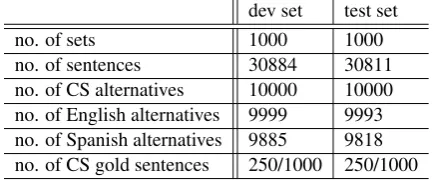
Table 2:Statistics of the dataset.
4.1 Technical details
When creating code-switched alternatives, we want to encourage the creation of sentences that include both languages, and that differ from each other. This is done with scores determined by some heuristics, such as preferring sentences that include more words from the language that was less dominant in the original one and vice versa. As part of this we also try to avoid noise from ad-dition of short frequent words, by encouraging the average word length to be high5. We create 1000-best alternatives from the FST, re-score them ac-cording to the heuristic and keep the top 10.
We discard sets in which the gold sentence has less than three words (excluding punctuation), and also sets with less than 5 alternatives in one of the three types.
We randomly choose 250 sets in which the gold sentence is code-switched, and 750 sets in which the gold sentence is monolingual, both for the de-velopment set and for the test set. This percentage of CS sentences is higher than in the underlying corpus in order to aid a meaningful comparison between the models regarding their ability to pre-fer gold CS sentences over alternatives. The statis-tics of the dataset are detailed in Table2.
Further details regarding the implementation can be found in the Appendix.
5 Using Monolingual Data for CS LM
Data for code-switching is relatively scarce, while monolingual data is easy to obtain. The question then ishow do we efficiently incorporate monolin-gual data when training a CS LM?
We use an effective training protocol (FINETUNED) for incorporating monolingual data into the language model, similar to the best protocol introduced in (Baheti et al., 2017). We first pre-train a model with monolingual sentences
5The implementation of these heuristics is part of our code
[image:4.595.78.289.64.201.2]from both English and Spanish (with shared vocabulary for both languages). This essentially trains two monolingual models, one for English and one for Spanish, but with full sharing of parameters. Note that in this pre-training phase, the model is not exposed to any code-switched sentence.
We then use the little amount of available code-switched data to further train the model, making it familiar with code-switching examples that mix the two languages. This fine-tunning procedure enables the model to learn to correctly combine the two languages in a single sentence.
We show in Section 8that adding the CS data only at the end, in the described manner, works substantially better than several alternatives, veri-fying the results from (Baheti et al.,2017).
6 Discriminative Training
Our new evaluation method gives rise to training models that are designated to the ranking task. As our main goal is to choose a single best sentence out of a set of candidate sentences, we can fo-cus on training models that score whole sentences with discriminative training, rather than using the standard probability setting of LMs. Discrimina-tive approach unbinds us from the burden of esti-mating probability distributions over all the words in the vocabulary and allows us to simply create representations of sentences and match them with scores.
Using negative examples is not straight forward in LM training, but is essential for speech recog-nition, where the language model needs to distin-guish between “good” and “bad” sentences. Our discriminative training is based on the idea of us-ing both positive and negative examples durus-ing training. The training data we use is similar in na-ture to that of our test data: sets of sentences in which only a single one is a genuine example col-lected from a real CS corpus, while all the others are synthetically created.
During training, we aim to assign the gold sen-tences with a higher score than the scores of the others. For each sentence, we require the differ-ence between its score and the score of the gold sentence to be as large as its WER with respect to the gold sentence. This way, the farther a sentence is from the gold one, the lower its score is.
Formally, let s1 be the gold sentence, and s2, ..., sm be the other sentences in that set.
The loss of the set is the sum of losses over all sentences, except for the gold one:
Pm
i=2max(0,WER(s1, si)−[score(s1)−score(si)])
where score(si)is computed by the multiplication
of the representation ofsiand a learned vectorw:
score(si) =w·repr(si)
A sentence is represented with its BiLSTM rep-resentation – the concatenation of the final states of forward and backward LSTMs. Formally, a sentences=w1, ..., wnis represented as follows:
repr(s) =LST M(w1, ..., wn)◦LST M(wn, ..., w1)
where◦is the concatenation operation.
Incorporating monolingual data In order to use monolingual data in the case of discrimina-tive training, we follow the same protocol: as a first step, we create alternative sentences for each monolingual sentence from the monolingual cor-pora. We train a model using this data, and as a next step, we fine-tune this model with the sets of sentences that are created from the CS corpus.
7 Empirical Experiments
Models and Baselines We report results on two models that use discriminative training:
CS-ONLY-DISCRIMINATIVEonly trains on data that is
created based on the small code-switched corpus, while FINE-TUNED-DISCRIMINATIVEfirst trains on data created based on the monolingual corpora and is then fine-tuned using the data created from the code-switched corpus.
We compare our models to several base-lines, all of which use standard LM train-ing: ENGLISHONLY-LM and SPANISHONLY-LM
train on the monolingual data only. Two addi-tional models train on a combination of the code-switched corpus and the two monolingual cor-pora: the first (ALL:SHUFFLED-LM) trains on all sentences (monolingual and code-switched) pre-sented in a random order. The second (ALL :CS-LAST-LM) trains each epoch on the monolin-gual datasets followed by a pass on the small code-switched corpus. The models CS-ONLY
-LM and FINE-TUNED-LM are the equivalents of CS-ONLY-DISCRIMINATIVE and FINE-TUNED
Code-switching corpus We use the Bangor Mi-ami Corpus, consisting of transcripts of conversa-tions by Spanish-speakers in Florida, all of whom are bilingual in English.6
We split the sentences (45,621 in total) to train/dev/test with ratio of 60/20/20 respectively, and evaluate perplexity on the dev and test sets.
The dataset described in Section 4is based on sentences from the dev and test sets, and serves as our main evaluation method.
Monolingual corpora The monolingual cor-pora used for training the English and Spanish monolingual models are taken from the OpenSub-titles2018 corpus (Tiedemann,2009),7of subtitles of movies and TV series.
We use 1M lines from each language, with a split of 60/20/20 for train/dev/test, respectively. The test set is reserved for future use. For dis-criminative training we use 1/6 of the monolin-gual training data (as creating the data results in roughly 30 sentences per gold sentence).
Additional details on preprocessing and statis-tics of the data can be found in the Appendix.
Training We implement our language models in DyNet (Neubig et al., 2017). Our basic config-uration is similar to that of Gal and Ghahramani (2016) with minor changes. It has a standard ar-chitecture of a 2-layer LSTM followed by a soft-max layer, and the optimization is done with SGD (see Appendix for details).
Tuning of hyper-parameters was done on the PTB corpus, in order to be on par with state-of-the-art models such as that of Merity et al. (2017). We then trained the same LM on our CS corpus with no additional tuning and got perplexity of 44.06, better than the 52.99 of Merity et al. (2017) when using their default parameters on the CS cor-pus.8 We thus make no further tuning of
hyper-parameters.
When changing to discriminative training, we perform minimal necessary changes: discarding weight decay and reducing the learning rate to 1. The weight vector in the discriminative setting is learned jointly with the other parameters of the network.
6
http://bangortalk.org.uk/speakers. php?c=miami
7http://opus.nlpl.eu/
OpenSubtitles2018.php
http://www.opensubtitles.org/
8https://github.com/salesforce/
awd-lstm-lm
dev test
[image:6.595.307.527.62.162.2]perp↓ acc↑ wer↓ perp↓ acc↑ wer↓ SPANISH-ONLY-LM 329.68 26.6 30.47 322.26 25.1 29.62 ENGLISH-ONLY-LM 320.92 29.3 32.02 314.04 30.3 32.51 ALL:CS-LAST-LM 76.64 47.8 14.56 76.97 49.2 14.13 ALL:SHUFFLED-LM 68.00 51.8 13.64 68.72 51.4 13.89 CS-ONLY-LM 43.20 60.7 12.60 43.42 57.9 12.18 CS-ONLY+VOCAB-LM 45.61 61.0 12.56 45.79 58.8 12.49 FINE-TUNED-LM 39.76 66.9 10.71 40.11 65.4 10.17 CS-ONLY-DISC – 72.0 6.35 – 70.5 6.70 FINE-TUNED-DISC – 74.2 5.85 – 75.5 5.59
Table 3: Results on the dev set and on the test set. “perp” stands for perplexity, “acc” stands for accuracy (in percents), and “wer” stands for word-error-rate.
As done in previous work, in order to be able to give a reliable probability to every next-token in the test set, we include all the tokens from the test set in our vocabulary and we do not use the “<unk>” token. We only train those that ap-pear in the train set. Handling of unknown to-kens becomes easier with discriminative training, as scores are assigned to full sentences. However, we leave this issue for future work.
8 Results
The results of the different models are presented in Table3. For each model we report both perplexity and accuracy (except for discriminative training, where perplexity is not valid), where each of them is reported according to the best performing model on that measure (on the dev set). We also report the WER of all models, which correlates perfectly with the accuracy measure.
8.1 Using monolingual data
As mentioned above, both in standard LM and in discriminative training, using monolingual data in a correct manner (FINE-TUNED-LM and FINE -TUNED-DISCRIMINATIVE) significantly improves over using solely the code-switching data. In stan-dard LM, adding monolingual data results in an improvement of 7.5 points (improving from an ac-curacy of 57.9% to 65.4%), and in the discrim-inative training it results in an improvement of 5 points (improving from an accuracy of 70.5% to 75.5%). Even though both ALL:SHUFFLED
-LM and ALL:CS-LAST-LM use the same data as the FINE-TUNED-LM model, they perform even worse than CS-ONLY-LM that does not use the monolingual data at all. This emphasizes that the manner of integration of the monolingual data has a very strong influence.
im-25% train 50% train 75% train full train dev test dev test dev test dev test
CS-ONLY 58.4 58.9 65.2 63.6 70.8 68.8 72.0 70.5 FINE-TUNED 68.4 67.7 71.9 70.1 72.8 73.0 74.2 75.5
Table 4:Results on the dev set and on the test set using dis-criminative training with only subsets of the code-switched data.
proves perplexity. As perplexity is significantly affected by the size of the vocabulary—and to en-sure fair comparison—we also add the additional vocabulary from the monolingual data to
CS-ONLY-LM (CS-ONLY+VOCAB-LM). Extending the vocabulary without training those additional words, results in a 2.37-points loss on the per-plexity measure, while our evaluation metric (ac-curacy) stays essentially the same. This demon-strates the utility of our proposed evaluation pared to using perplexity, allowing it to fairly com-pare models with different vocabulary sizes.
In order to examine the contribution of the monolingual data, we also experimented with sub-sets of the code-switching training data. Table4
depicts the results when using subsets of the CS training data with discriminative training. The less code-switching data we use, the more the ef-fect of using the monolingual data is significant: we gain 8.8, 6.5, 4.2 and 5 more accuracy points with 25%, 50%, 75% and 100% of the data, re-spectively. In the case of 25% of the data, the FINE-TUNED-DISCRIMINATIVE model improves
over CS-ONLY-DISCRIMINATIVE by 17 relative percents.
8.2 Standard LMs vs. Discriminative Training
In the standard training setting, The FINE
-TUNED-LM baseline is the strongest baseline, outperforming all others with an accuracy of 65.4%. Similarly, when using discriminative train-ing, the FINE-TUNED-DISCRIMINATIVE model outperforms the CS-ONLY-DISCRIMINATIVE
model. Note that using discriminative training, even with no additional monolingual data, leads to better performance than that of the best language model: the CS-ONLY-DISCRIMINATIVE model
achieves an accuracy of 70.5%, 5.1 points more than the accuracy of the FINE-TUNED-LM model. We gain further improvement by adding monolingual data and get an even higher accuracy of 75.5%, which is 10.1 points higher than the best language model.
Limitations Our evaluation setup in the dis-criminative training case is not ideal: the nega-tive samples in both the train and test sets are ar-tificially created by the same mechanism. Thus, high performance on the test set in the discrimina-tive case may result from “leakage” in which the model learns to rely on idiosyncrasies and artifcats of the data generation mechanism. As such, these results may not transfer as is to a real-world ASR scenario, and should be considered as an opti-mistic estimate of the actual gains.9 Nevertheless, we do believe that the accuracy improvements of the discriminative setup are real, and should trans-late to improvements also in the real-world sce-nario.
To alleviate the concerns to some extent, we consider the case in which the leakage is in the induced negative words distribution.10 We re-train the discriminative model using a BOW representa-tion of the sentence. This results in accuracies of 52.1% and 47.4% for dev and test, respectively, far below those of the basic model. A model that leaks in word distribution would score much higher in this evaluation, indicating that the im-provement is likely not due to this form of leakage, and that most of the improvement of the discrim-inative training is likely to translate to a real ASR scenario.
9 Analysis
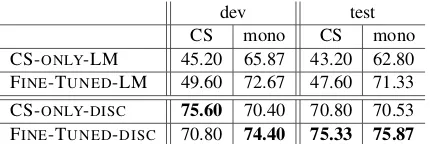
Table 5 breaks down the results of the different models according to two conditions: when the gold sentence is code-switched, and when the gold sentence is monolingual.
As expected, the FINE-TUNED
-DISCRIMINATIVE model is able to prioritize the gold sentence better than all other models, under both conditions. The improvement we get is most significant when the gold sentence is CS: in those cases we get a dramatic improvement of 27.73 accuracy points (a relative improvement of 58%). Note that for the standard LMs, the cases
9
An ideal evaluation setup will use an artificial dataset for training, and a dataset obtained from an acoustic model of a code-switched ASR system for testing. However, such an evaluation setup requires access to a high-quality code-switched acoustic model, which we do not posses nor have the means to obtain. Furthermore, it would also tie the evalu-ation to a specific ASR system, which we aim to avoid.
10As our generation process, much like an acoustic model,
dev test
CS mono CS mono
CS-ONLY-LM 45.20 65.87 43.20 62.80
FINE-TUNED-LM 49.60 72.67 47.60 71.33
[image:8.595.75.290.62.134.2]CS-ONLY-DISC 75.60 70.40 70.80 70.53 FINE-TUNED-DISC 70.80 74.40 75.33 75.87
Table 5:Accuracy on the dev set and on the test set, accord-ing to the type of the gold sentence in the set: code-switched (CS) vs. monolingual (mono).
in which the gold sentence is CS are much harder, and they perform badly on this portion of the test set. However, using discriminative learning enable us to get improved performance on both portions of the test set and to get comparable results on both parts.
A closer examination of the mistakes of the FINE-TUNED-LM and FINE-TUNED
-DISCRIMINATIVE models reveals the superiority of the discriminative training in various cases. Table6presents several examples in which FINE -TUNED-LM prefers a wrong sentence whereas FINE-TUNED-DISCRIMINATIVE identifies the
gold one. In examples 1–4 the gold sentence was code-switched but FINE-TUNED-LM forced an improbable monolingual one. Examples 5 and 6 show mistakes in monolingual sentences.
While discriminative training is significantly better than the standard LM training, it can still be improved quite a bit. Table7lists some of the mistakes of the FINE-TUNED-DISCRIMINATIVE
model: in examples 1, 2 and 3, the gold sen-tence was code-switched but the model preferred a monolingual one, in example 4 the model prefers a wrong CS sentence over the gold monolingual one, and in 5 and 6 the model makes mistakes in monolingual sentences.
10 Related Work
CS Most prior work on CS focused on Language Identification (LID) (Solorio et al., 2014;Molina et al., 2016) and POS tagging (Solorio and Liu,
2008;Vyas et al., 2014;Ghosh et al.,2016; Bar-man et al.,2016). In this work we focus on lan-guage modeling, which we find more challenging.
LM Language models have been traditionally created by using the n-grams approach (Brown et al.,1992;Chen and Goodman,1996). Recently, neural models gained more popularity, both using a feed-forward network for an n-gram language
model (Bengio et al., 2003; Morin and Bengio,
2005) and using recurrent architectures that are fed with the sequence of words, one word at a time (Mikolov et al.,2010;Zaremba et al., 2014; Gal and Ghahramani,2016;Foerster et al.,2017;Melis et al.,2017).
Some work has been done also on optimizing LMs for ASR purposes, using discriminative train-ing. Kuo et al. (2002), Roark et al. (2007) and Dikici et al. (2013) all improve LM for ASR by maximizing the probability of the correct candi-dates. All of them use candidates of ASR systems as “negative” examples and train n-gram LMs or use linear models for classifying candidates. A closer approach to ours is used by Huang et al. (2018). There, they optimize an RNNLM with a discriminative loss as part of training an ASR sys-tem. Unlike our proposed model, they still use the standard setting of LM. In addition, their training is coupled with an end-to-end ASR system, in par-ticular, as in previous works, the “negative” exam-ples they use are candidates of that ASR system.
pretrain-no. type Gold sentence Choice of FINE-TUNED-LM model 1 CS→mono and in front of everybodyme salt´o. and in front of everybody muscle too. 2 CS→mono porquethe sewer system has them in thereporque. porque de ser sistemas de mil de porque.
3 CS→mono entonceswhat i had done is gone ahead and printed it out. and all says what i had done is gone ahead and printed it out. 4 CS→mono es que creo que quedan como novecientos oportunidades parabeta testers. es que creo que que del como novecientos oportunidad esperaba de estar. 5 mono→mono we we stop beyond getting too cruel. we we stop be and getting to cruel.
[image:9.595.79.523.62.122.2]6 mono→mono en mi casa tengo tanto huevo duro. en mi casa tengo tanto a futuro.
Table 6: Examples of sentences the FINE-TUNED-DISCRIMINATIVEmodel identifies correctly while the FINE-TUNED-LM model does not.
no. type Gold sentence Choice of FINE-TUNED-DISCRIMINATIVEmodel 1 CS→mono queby the wayse vino ilegal. que va de esa vino ilegal.
2 CS→mono son unwebsite there. so noon website there.
3 CS→mono no i have never felt nothing close to theesp´ıritu santonever. no i have never felt nothing close to the a spirits on to never. 4 mono→CS T´u sabes que que el cuerpo empieza a sentirse raro. T´u sabes que que el cuerpo empieza sentir serarrow. 5 mono→mono bueno ya son las las y cuarenta casi casi. bueno ya son las lassie cuarenta que si casi. 6 mono→mono we have a peter lang. we have a bitter lung.
Table 7:Examples of sentences that the FINE-TUNED-DISCRIMINATIVEmodel fails to identify.
ing on monolingual data works best. Finally, an-other line of works suggests using a dual language model, where two monolingual LMs are combined by a probabilistic model (Garg et al.,2017,2018). No standard benchmark or evaluation setup ex-ists for CS LM, and most previous works use an ASR system as part of their evaluation setup. This makes comparison of methods very challeng-ing. Indeed, all the works listed above use differ-ent setups and don’t compare to each other, even for works coming from the same group. We be-lieve the evaluation setup we propose in this work and our English-Spanish dataset, which is easy to replicate and decoupled from an ASR system, is a needed step towards meaningful comparison of CS LM approaches.
11 Conclusions and Future Work
We consider the topic of language modeling for code-switched data. We propose a novel ranking-based evaluation method for language models, motivated by speech recognition, and create an evaluation dataset for English-Spanish code-switching LM (SpanglishEval).
We further present a discriminative training for this ranking task that is intended for ASR pur-poses. This training procedure is not bound to probability distributions, and uses both positive and negative training sentences. This significantly improves performance. Such discriminative train-ing can also be applied to monoltrain-ingual data.
Finally, we verify the effectiveness of the train-ing protocol for CS LM presented in Baheti et al. (2017): pre-training on a mix of monolin-gual sentences, followed by fine-tuning on a
code-switched dataset. This protocol significantly out-performs various baselines. Moreover, we show that the less code-switched training data we use, the more effective it is to incorporate the monolin-gual data.
Our proposed evaluation framework and dataset will facilitate future work by providing the ability to meaningfully compare the performance of dif-ferent methods to each other, an ability that was sorely missing in previous work.
Acknowledgments
The work was supported by The Israeli Science Foundation (grant number 1555/15).
References
Heike Adel, Katrin Kirchhoff, Dominic Telaar,
Ngoc Thang Vu, Tim Schlippe, and Tanja Schultz. 2014. Features for factored language models for code-switching speech. InProceedings of SLTU.
Heike Adel, Ngoc Thang Vu, Katrin Kirchhoff, Do-minic Telaar, and Tanja Schultz. 2015. Syntactic and semantic features for code-switching factored
language models. IEEE Transactions on Audio,
Speech, and Language Processing, 23(3).
Heike Adel, Ngoc Thang Vu, Franziska Kraus, Tim Schlippe, Haizhou Li, and Tanja Schultz. 2013a. Recurrent neural network language modeling for code switching conversational speech. In Proceed-ings of ICASSP, IEEE International Conference.
[image:9.595.76.523.171.241.2]Peter Auer. 1999. From codeswitching via language mixing to fused lects: Toward a dynamic typology of bilingual speech. International journal of bilin-gualism, 3(4):309–332.
Ashutosh Baheti, Sunayana Sitaram, Monojit Choud-hury, and Kalika Bali. 2017. Curriculum design for code-switching: Experiments with language iden-tification and language modeling with deep neu-ral networks. In Proceedings of the 14th Interna-tional Conference on Natural Language Processing (ICON-2017).
Utsab Barman, Joachim Wagner, and Jennifer Foster. 2016. Part-of-speech tagging of code-mixed social media content: Pipeline, stacking and joint mod-elling. InProceedings of the Second Workshop on Computational Approaches to Code Switching.
Yoshua Bengio, R´ejean Ducharme, Pascal Vincent, and Christian Jauvin. 2003. A neural probabilistic lan-guage model. Journal of machine learning research, 3:1137–1155.
Peter F Brown, Peter V Desouza, Robert L Mercer, Vincent J Della Pietra, and Jenifer C Lai. 1992. Class-based n-gram models of natural language. Computational linguistics, 18(4):467–479.
Barbara E. Bullock and Almeida Jacqueline Toribio. 2009. The Cambridge handbook of linguistic code-switching. Cambridge University Press Cambridge.
¨
Ozlem C¸ etino˘glu, Sarah Schulz, and Ngoc Thang Vu. 2016. Challenges of computational processing of code-switching. In Proceedings of the 2nd Work-shop on Computational Approaches to Linguistic Code Switching, EMNLP.
Joyce YC Chan, Houwei Cao, PC Ching, and Tan Lee. 2009. Automatic recognition of cantonese-english
code-mixing speech. Computational Linguistics
and Chinese Language Processing, 14(3):281–304.
Stanley F Chen and Joshua Goodman. 1996. An em-pirical study of smoothing techniques for language modeling. InProceedings of ACL, pages 310–318.
Ryan Cotterell, Adithya Renduchintala, Naomi Saphra,
and Chris Callison-Burch. 2014. An algerian
arabic-french code-switched corpus. In Workshop on Free/Open-Source Arabic Corpora and Corpora Processing Tools Workshop Programme.
Erinc¸ Dikici, Murat Semerci, Murat Saraclar, and Ethem Alpaydin. 2013. Classification and ranking approaches to discriminative language modeling for asr. IEEE Transactions on Audio, Speech, and Lan-guage Processing, 21(2):291–300.
Jakob N Foerster, Justin Gilmer, Jan Chorowski, Jascha Sohl-Dickstein, and David Sussillo. 2017. Intelli-gible language modeling with input switched affine networks. arXiv preprint arXiv:1611.09434.
Yarin Gal and Zoubin Ghahramani. 2016. A theoret-ically grounded application of dropout in recurrent neural networks. InProceedings of NIPS.
Saurabh Garg, Tanmay Parekh, and Preethi
Jyothi. 2017. Dual language models for code
switched speech recognition. arXiv preprint
arXiv:1711.01048.
Saurabh Garg, Tanmay Parekh, and Preethi Jyothi. 2018. Code-switched language models using dual rnns and same-source pretraining. arXiv preprint arXiv:1809.01962.
Souvick Ghosh, Satanu Ghosh, and Dipankar Das. 2016. Part-of-speech tagging of code-mixed social media text. InProceedings of the Second Workshop on Computational Approaches to Code Switching.
Jiaji Huang, Yi Li, Wei Ping, and Liang Huang. 2018. Large margin neural language model. In Proceed-ings of EMNLP.
Hong-Kwang Jeff Kuo, Eric Fosler-Lussier, Hui Jiang, and Chin-Hui Lee. 2002. Discriminative training of language models for speech recognition. In Acous-tics, Speech, and Signal Processing (ICASSP), 2002 IEEE International Conference on, volume 1. IEEE.
Ying Li and Pascale Fung. 2012. Code-switch lan-guage model with inversion constraints for mixed language speech recognition. In Proceedings of COLING, pages 1671–1680.
Ying Li and Pascale Fung. 2014. Language model-ing with functional head constraint for code switch-ing speech recognition. InProceedings of EMNLP, pages 907–916.
G´abor Melis, Chris Dyer, and Phil Blunsom. 2017. On the state of the art of evaluation in neural language models. arXiv:1707.05589.
Stephen Merity, Nitish Shirish Keskar, and Richard Socher. 2017. Regularizing and optimizing lstm lan-guage models. arXiv:1708.02182.
Tomas Mikolov, Martin Karafi´at, Lukas Burget, Jan Cernock`y, and Sanjeev Khudanpur. 2010. Recurrent neural network based language model. In Proceed-ings of Interspeech.
Giovanni Molina, Fahad AlGhamdi, Mahmoud
Ghoneim, Abdelati Hawwari, Nicolas
Rey-Villamizar, Mona Diab, and Thamar Solorio. 2016. Overview for the second shared task on language identification in code-switched data. In Proceed-ings of the Second Workshop on Computational Approaches to Code Switching.
Pieter Muysken. 2000. Bilingual speech: A typology of code-mixing, volume 11. Cambridge University Press.
Graham Neubig, Chris Dyer, Yoav Goldberg, Austin Matthews, Waleed Ammar, Antonios Anastasopou-los, Miguel Ballesteros, David Chiang, Daniel Clothiaux, Trevor Cohn, et al. 2017. Dynet: The dynamic neural network toolkit.arXiv:1701.03980.
Shana Poplack. 1980. Sometimes i’ll start a sentence in spanish y termino en espa˜nol: toward a typology of code-switching. Linguistics, 18(7-8):581–618.
Adithya Pratapa, Gayatri Bhat, Monojit Choudhury, Sunayana Sitaram, Sandipan Dandapat, and Kalika Bali. 2018. Language modeling for code-mixing: The role of linguistic theory based synthetic data. In Proceedings of ACL.
Brian Roark, Murat Saraclar, and Michael Collins. 2007. Discriminative n-gram language modeling. Computer Speech & Language, 21(2):373–392.
Rico Sennrich. 2016. How grammatical is
character-level neural machine translation? assessing
MT quality with contrastive translation pairs. arXiv:1612.04629.
Thamar Solorio, Elizabeth Blair, Suraj
Mahar-jan, Steven Bethard, Mona Diab, Mahmoud
Ghoneim, Abdelati Hawwari, Fahad AlGhamdi, Ju-lia Hirschberg, Alison Chang, and Pascale Fung. 2014. Overview for the first shared task on language identification in code-switched data. InProceedings of the First Workshop on Computational Approaches to Code Switching.
Thamar Solorio and Yang Liu. 2008. Part-of-speech tagging for english-spanish code-switched text. In Proceedings of EMNLP, pages 1051–1060.
Ganji Sreeram and Rohit Sinha. 2017. Language mod-eling for code-switched data: Challenges and ap-proaches. arXiv:1711.03541.
J¨org Tiedemann. 2009. News from OPUS - A collec-tion of multilingual parallel corpora with tools and interfaces. In N. Nicolov, K. Bontcheva, G. An-gelova, and R. Mitkov, editors,Recent Advances in Natural Language Processing, pages 237–248.
Ke Tran, Arianna Bisazza, and Christof Monz. 2018. The importance of being recurrent for modeling hi-erarchical structure.arXiv:1803.03585.
Ngoc Thang Vu, Dau-Cheng Lyu, Jochen Weiner, Do-minic Telaar, Tim Schlippe, Fabian Blaicher, Eng-Siong Chng, Tanja Schultz, and Haizhou Li. 2012. A first speech recognition system for mandarin-english code-switch conversational speech. In Pro-ceedings of ICASSP, IEEE International Confer-ence, pages 4889–4892.
Yogarshi Vyas, Spandana Gella, Jatin Sharma, Kalika Bali, and Monojit Choudhury. 2014. POS tagging of English-Hindi code-mixed social media content. In Proceedings of EMNLP.