2241
Evaluating Text GANs as Language Models
Guy Tevet∗∗,1,2 Gavriel Habib∗,1,2 Vered Shwartz3 Jonathan Berant1,4
1School of Computer Science, Tel-Aviv University
2Department of Electrical Engineering, Tel-Aviv University
3Computer Science Department, Bar-Ilan University
4Allen Institute for Artificial Intelligence
{guytevet@mail,gavrielhabib@mail,joberant@cs}.tau.ac.il
Abstract
Generative Adversarial Networks (GANs) are a promising approach for text generation that, unlike traditional language models (LM), does not suffer from the problem of “exposure bias”. However, A major hurdle for under-standing the potential of GANs for text gen-eration is the lack of a clear evaluation met-ric. In this work, we propose to approxi-mate the distribution of text generated by a GAN, which permits evaluating them with tra-ditional probability-based LM metrics. We ap-ply our approximation procedure on several GAN-based models and show that they cur-rently perform substantially worse than state-of-the-art LMs. Our evaluation procedure pro-motes better understanding of the relation be-tween GANs and LMs, and can accelerate progress in GAN-based text generation.
1 Introduction
Neural networks have revolutionized the field of text generation, in machine translation (Sutskever et al., 2014; Neubig, 2017; Luong et al., 2015;
Chen et al., 2018), summarization (See et al.,
2017), image captioning (You et al., 2016) and many other applications (Goldberg,2017).
Traditionally, text generation models are trained by going over a gold sequence of symbols (char-acters or words) from left-to-right, and maximiz-ing the probability of the next symbol given the history, namely, a language modeling (LM) ob-jective. A commonly discussed drawback of such LM-based text generation is exposure bias( Ran-zato et al.,2015): during training, the model pre-dicts the next token conditioned on the ground truth history, while at test time prediction is based on predicted tokens, causing a train-test mismatch. Models trained in this manner often struggle to overcome previous prediction errors.
Generative Adversarial Networks (Goodfellow et al., 2014) offer a solution for exposure bias.
∗
The authors contributed equally
Originally introduced for images, GANs leverage a discriminator, which is trained to discriminate between real images and generated images via an adversarial loss. In such a framework, the genera-tor is not directly exposed to the ground truth data, but instead learns to imitate it using global feed-back from the discriminator. This has led to sev-eral attempts to use GANs for text generation, with a generator using either a recurrent neural network (RNN) (Yu et al., 2017; Guo et al., 2017; Press et al., 2017; Rajeswar et al., 2017), or a Convo-lutional Neural Network (CNN) (Gulrajani et al.,
2017;Rajeswar et al.,2017).
However, evaluating GANs is more difficult than evaluating LMs. While in language model-ing, evaluation is based on the log-probability of a model on held-out text, this cannot be straight-forwardly extended to GAN-based text genera-tion, because the generator outputs discrete to-kens, rather than a probability distribution. Cur-rently, there is no single evaluation metric for GAN-based text generation, and existing metrics that are based on n-gram overlap are known to lack robustness and have low correlation with semantic coherence (Semeniuta et al.,2018).
In this paper, we propose a method for evaluat-ing GANs with standard probability-based evalu-ation metrics. We show that the expected predic-tion of a GAN generator can be viewed as a LM, and suggest a simple Monte-Carlo method for ap-proximating it. The approximated probability dis-tribution can then be evaluated with standard LM metrics such as perplexity or Bits Per Character (BPC).
To empirically establish our claim, we imple-ment our evaluation on several RNN-based GANs: (Press et al., 2017; Yu et al., 2017; Guo et al.,
text generation. Our results are also in line with recent concurrent work by Caccia et al. (2018), who reached a similar conclusion by comparing the performance of textual GANs to that of LMs using metrics suggested for GAN evaluation.
Our code is available at: http: //github.com/GuyTevet/SeqGAN-eval and http://github.com/GuyTevet/ rnn-gan-eval.
2 Background
Following the success of GANs in image gen-eration, several works applied the same idea to texts using convolutional neural networks ( Gul-rajani et al., 2017; Rajeswar et al., 2017), and later using RNNs (Press et al., 2017; Yu et al.,
2017). RNNs enable generating variable-length sequences, conditioning each token on the tokens generated in previous time steps. We leverage this characteristic in our approximation model (§4.1).
A main challenge in applying GANs for text is that generating discrete symbols is a non-differentiable operation. One solution is to per-form a continuous relaxation of the GAN output, which leads to generators that emit a nearly dis-crete continuous distribution (Press et al., 2017). This keeps the model differentiable and enables end-to-end training through the discriminator. Al-ternatively, SeqGAN (Yu et al.,2017) and Leak-GAN (Guo et al.,2017) used policy gradient meth-ods to overcome the differentiablity requirement. We apply our approximation to both model types.
3 Evaluating GANs and LMs
LM Evaluation. Text generation from LMs is commonly evaluated using probabilistic metrics. Specifically, given a test sequence of symbols
(t1, . . . , tn), and a LM q, the average cross-entropy over the entire test set is computed:
ACE = −1
n
Pn
i=1log2q(ti |t1...ti−1). For
word-based models, the standard metric is per-plexity: P P = 2ACE, while for character-based models it isBP C=ACE directly.
Intrinsic improvement in perplexity does not guarantee an improvement in an extrinsic down-stream task that uses a language model. However, perplexity often correlates with extrinsic measures (Jurafsky and Martin, 2018), and is the de-facto metric for evaluating the quality of language mod-els today.
GAN-based Text Generation Evaluation. By definition, a text GAN outputs a discrete sequence of symbols rather than a probability distribution. As a result, LM metrics cannot be applied to eval-uate the generated text. Consequently, other met-rics have been proposed:
• N-gram overlap: (Yu et al.,2017;Press et al.,
2017): Inspired by BLEU (Papineni et al.,
2002), this measures whether n-grams gener-ated by the model appear in a held-out corpus. A major drawback is that this metric favors con-servative models that always generate very com-mon text (e.g., “it is”). To mitigate this, self-BLEU has been proposed (Lu et al., 2018) as an additional metric, where overlap is measured between two independently sampled texts from the model.
• LM score: The probability of generated text ac-cording to a pre-trained LM. This has the same problem of favoring conservative models.
• Zhao et al. (2017) suggested an indirect score by training a LM on GAN-generated text, and evaluating it using perplexity. The drawback in this setting is the coupling of the performance of the GAN with that of the proxy LM.
• Heusel et al.(2017) used Frechet InferSent Dis-tance (FID) to compute the disDis-tance between distributions of features extracted from real and generated samples. However, this approach re-lies on a problematic assumption that features are normally distributed.
• Rajeswar et al.(2017) used a context-free gram-mar (CFG) to generate a reference corpus, and evaluated the model by the likelihood the CFG assigns to generated samples. However, sim-ple CFGs do not fully capture the comsim-plexity of natural language.
• To overcome the drawbacks of each individual method,Semeniuta et al.(2018) proposed a uni-fied measure based on multiple evaluation met-rics (N-grams, BLEU variations, FID, LM score variations and human evaluation). Specifically, they argue that the different measures capture different desired properties of LMs, e.g., qual-ity vs. diversqual-ity.
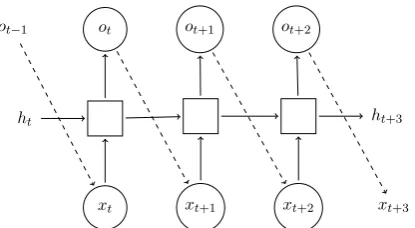
xt xt+1 xt+2 xt+3
ht ht+3
ot
[image:3.595.78.286.60.174.2]ot−1 ot+1 ot+2
Figure 1: Generator recurrent connections.{ht}is the
internal state sequence and{ot}is the generator
predic-tion sequence (one-hot). During inference, the outputs
{ot} are fed back as the input for the next time step
(dashed lines). During LM approximation, the input
{xt}is a sequence of one-hot vectors from the test set.
Overall, current evaluation methods cannot fully capture the performance of GAN-based text generation models. While reporting various scores as proposed bySemeniuta et al.(2018) is possible, it is preferable to have a single measure of progress when comparing different text generation models.
4 Proposed Method
We propose a method for approximating a distri-bution over tokens from a GAN, and then eval-uate the model with standard LM metrics. We will describe our approach given an RNN-based LM, which is the most commonly-used architec-ture, but the approximation can be applied to other auto-regressive models (Vaswani et al.,2017).
4.1 Language Model Approximation
The inputs to an RNN at time stept, are the state vectorhtand the current input tokenxt. The out-put token (one-hot) is denoted by ot. In RNN-based GANs, the previous output token is used at inference time as the inputxt(Yu et al.,2017;Guo
et al., 2017; Press et al., 2017; Rajeswar et al.,
2017). In contrast, when evaluating with BPC or perplexity, the gold tokenxt is given as input. Hence, LM-based evaluation neutralizes the prob-lem of exposure bias addressed by GANs. Nev-ertheless, this allows us to compare the quality of text produced by GANs and LMs on an equal foot-ing. Figure1illustrates the difference between in-ference time and during LM approximation.
We can therefore define the generator function at time step tas a function of the initial state h0
and the past generated tokens (x0. . . xt), which we denote as ot = Gt(h0, x0...xt) (x0 is a start
token). Given a past sequence (x0. . . xt), Gt is a stochastic function: the stochasticity ofGt can
Algorithm 1LM Evaluation of RNN-based GANs
Input: Gt(·): the generator function at time stept
(x0, ..., xt): previous gold tokens
xt+1: the gold next token (as ground truth)
f(·,·): a LM evaluation metric
N: number of samples 1: forn←1toNdo
2: gt,n←−sample fromGt(x0...xt) 3: G˜t,N= N1ΣNn=1gt,n
4: return f( ˜Gt,N, xt+1)
be gained either by using a noise vector as the ini-tial state h0 (Press et al., 2017), or by sampling
from the GAN’s internal distribution over possi-ble output tokens (Yu et al., 2017; Guo et al.,
2017). Since h0 is constant or a noise vector
that makes Gt stochastic, we can omit it to get
Gt(x0. . . xt). In such a setup, the expected value
E[Gt(x0. . . xt)] is a distributionq over the next vocabulary tokenat:
q(at|a0. . . at−1) ={E[Gt(x0. . . xt)]}at
To empirically approximate q, we can sample from itN i.i.d samples, and compute an approx-imation G˜t,N = N1ΣNn=1gt,n, where gt,n is one sample fromGt(x0...xt). Then, according to the strong law of large numbers:
E[Gt(x0. . . xt)] = lim N→∞
˜
Gt,N (1)
Given this approximate LM distribution, we can evaluate a GAN using perplexity or BPC. We sum-marize the evaluation procedure in Algorithm1.1
4.2 Approximation Bound
We provide a theoretical bound for choosing a number of samples N that results in a good ap-proximation ofG˜t,N toE[Gt].
Perplexity and BPC rely on the log-probability of the ground truth token. Since the ground truth token is unknown, we conservatively define the bad event B in which there exists v ∈ V such that|{E[Gt]}v − {G˜t,N}v| > γ, where V is the vocabulary. We can then bound the probability of
Bby some. We define the following notations:
1. The probability of a tokenat to bev is pv
∆ = q(at=v|a0. . . at−1) ={E[Gt(x0. . . xt)]}v.
2. χv,n
∆
= {gt,n}v is a random variable repre-senting the binary value of the v’th index of
gt,n which is a single sample of Gt. Note that the average of χv,n over N samples is
Xv =∆ N1 PNn=1χv,n =
n 1
N
PN
n=1gt,n o
v =
{G˜t,N}v.
Using the above notation, we can re-define the probability of the bad eventB with respect to the individual coordinates in the vectors:
P r(B) =P r
kE[Gt]−G˜t,Nk∞> γ
=P r [
v∈V
|pv−Xv|> γ !
!
<
(2)
We note that χv,n ∼ Bernoulli(pv), and given that {χv,n}Nn=1 are i.i.d., we can apply
the Chernoff-Hoeffding theorem (Chernoff et al.,
1952;Hoeffding, 1963). According to the theo-rem, for every v ∈ V, P r(|Xv −pv| > γ) <
2e−2N γ2. Taking the union bound overV implies:
P r(B) =P r S
v∈V|Xv−pv|> γ<2|V|e−2N γ 2
< (3)
Hence, we get a lower bound onN:
N > 1 2γ2ln
2|V|
(4)
As a numerical example, choosing γ = 10−3
and = 10−2, for a character-based LM over the text8 dataset, with |V| = 27, we get the bound: N > 4.3 ·106. With the same γ and , a typical word-based LM with vocabulary size
|V|= 50,000would requireN >8.1·106. In practice, probability vectors of LMs tend to be sparse (Kim et al.,2016). Thus, we argue that we can use a much smallerN for a good approxi-mationG˜t,N. Since the sparsity of LMs is difficult to bound, as it differs between models, we suggest an empirical method for choosingN.
The approximation G˜t,N is a converging se-quence, particularly overk · k∞(see Equation1). Hence, we can empirically choose anN which sat-isfieskG˜t,N−α−G˜t,Nk∞< γ0, α∈N. In
Sec-tion5we empirically measurekG˜t,N−α−G˜t,Nk∞ as a function of N to choose N. We choose a globalN for a model, rather than for every t, by averaging over a subset of the evaluation set.
5 Evaluation
5.1 Models
We focus on character-based GANs as a test-case for our method. We evaluate two RNN-based
GANs with different characteristics. As opposed to the original GAN model (Goodfellow et al.,
2014), in which the generator is initialized with random noise, the GANs we evaluated both lever-age gold standard text to initialize the generator, as detailed below.
Recurrent GAN (Press et al.,2017) is a contin-uous RNN-based generator which minimizes the improved WGAN loss (Gulrajani et al.,2017). To guide the generator, during training it is initial-ized with the firsti−1characters from the ground truth, starting the prediction in the ith character. Stochasticity is obtained by feeding the generator with a noise vectorz as a hidden state. At each time step, the input to the RNN generator is the output distribution of the previous step.
SeqGAN (Yu et al., 2017) is a discrete RNN-based generator. To guide the generator, it is pre-trained as a LM on ground truth text. Stochastic-ity is obtained by sampling tokens from an internal distribution function over the vocabulary. To over-come differentiation problem, it is trained using a policy gradient objective (Sutton et al.,2000).
We also evaluatedLeakGAN(Guo et al.,2017), another discrete RNN-based generator, but since it is similar to SeqGAN and performed worse, we omit it for brevity.
5.2 Evaluation Settings
To compare to prior work in LM, we follow the common setup and train on the text8 dataset.2 The dataset is derived from Wikipedia, and includes 26 English characters plus spaces. We use the stan-dard 90/5/5 split to train/validation/test. Finally, we measure performance with BPC.
We tuned hyper-parameters on the validation set, including sequence length to generate at test time (7 forPress et al.(2017), 1000 forYu et al.
(2017)). We chose the number of samples N
empirically for each model, as described in Sec-tion 4.2. We set α to 10, and the boundary to
γ0 = 10−3 as a good trade-off between accuracy and run-time. Figure2plots the approximate error
kG˜t,N−α−G˜t,Nk∞as a function ofN. For both models, N > 1600 satisfies this condition (red line in Figure2). To be safe, we usedN = 2000.
5.3 Results
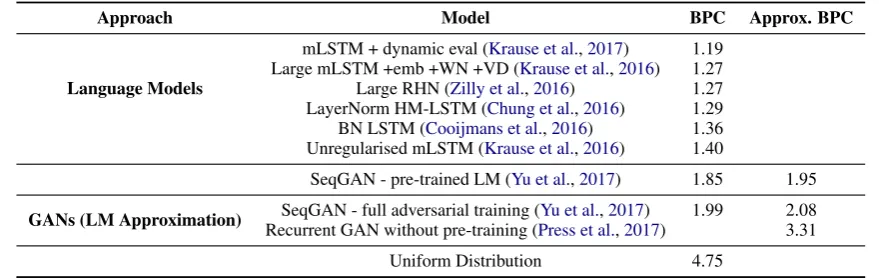
Table1shows model performance on the test set.
Approach Model BPC Approx. BPC
Language Models
mLSTM + dynamic eval (Krause et al.,2017) 1.19 Large mLSTM +emb +WN +VD (Krause et al.,2016) 1.27 Large RHN (Zilly et al.,2016) 1.27 LayerNorm HM-LSTM (Chung et al.,2016) 1.29 BN LSTM (Cooijmans et al.,2016) 1.36 Unregularised mLSTM (Krause et al.,2016) 1.40
SeqGAN - pre-trained LM (Yu et al.,2017) 1.85 1.95
GANs (LM Approximation) SeqGAN - full adversarial training (Yu et al.,2017) 1.99 2.08 Recurrent GAN without pre-training (Press et al.,2017) 3.31
[image:5.595.77.517.62.201.2]Uniform Distribution 4.75
Table 1: Test set evaluation of different character-based models on the text8 dataset. State-of-the-art results are taken fromhttps://github.com/sebastianruder/NLP-progress/blob/master/language_ modeling.md. The uniform distribution is equivalent to guessing the next character out of|V|= 27characters.
Model Samples
SeqGAN Pre-trained LM
1. rics things where a weeks thered databignand jacob reving the imprisoners could become poveran brown 2. nine other set of of one eight one two by belarigho and singing signal theus to accept natural corp 3. ragems the downran maintain the lagar linear stream hegels p in five six f march one nine nine nine
SeqGAN Full adversarial training
1. four zero five two memaire in afulie war formally dream the living of the centuries to quickly can f 2. part of the pract the name in one nine seven were mustring of the airports tex works to eroses exten 3. eight four th jania lpa ore nine zero zero zero sport for tail concents englished a possible for po
Recurrent GAN
1. nteractice computer may became were the generally treat he were computer may became were the general 2. lnannnnnnnnnnnnnnnnnnnnnnnnnnnnnnnnnne and and and and and and and and and and and and and and and a 3. perors as as seases as as as as as as as as as selected see see see see see see see see see see see
Table 2: Random samples of 100 characters generated by each model.
0
500 1000 1500 2000 2500 3000
Number of generator runs (N)
10
310
2Error (infinity norm)
Recurrent GAN
seqGAN
Figure 2: Approximate errorkG˜t,N−α−G˜t,Nk∞as a
function of samplesN.α= 10,γ0= 10−3.
Because SeqGAN models output a distribution over tokens at every time step, we can measure the true BPC and assess the quality of our approxima-tion. Indeed, we observe that approximate BPC is only slightly higher than the true BPC.
GAN-based models perform worse than state-of-the-art LMs by a large margin. Moreover, in SeqGAN, the pre-trained LM performs better than the fully trained model with approximate BPC scores of 1.95 and 2.06, respectively, and the BPC deteriorates as adversarial training continues.
Finally, we note that generating sequences larger than 7 characters hurts the BPC of Press et al. (2017). It is difficult to assess the quality of generation with such short sequences.
In Table 2 we present a few randomly
gener-ated samples from each model. We indeed observe that adversarial training slightly reduces the qual-ity of generated text for SeqGAN, and find that the quality of 100-character long sequences generated fromPress et al.(2017) is low.
6 Conclusions
We propose an evaluation procedure for text GANs that is based on approximating the GAN output distribution and using standard LM metrics. We provide a bound for the number of samples re-quired for the approximation and empirically show in practice as few as2000 samples per time-step suffice. We evaluate character-based GAN mod-els using our procedure, and show their perfor-mance is substantially lower than state-of-the-art LM. We hope our simple evaluation method leads to progress in GAN-based text generation by shed-ding light on the quality of such models.
Acknowledgements
References
Massimo Caccia, Lucas Caccia, William Fedus, Hugo Larochelle, Joelle Pineau, and Laurent Charlin. 2018. Language gans falling short. arXiv preprint arXiv:1811.02549.
Mia Xu Chen, Orhan Firat, Ankur Bapna, Melvin Johnson, Wolfgang Macherey, George Foster, Llion Jones, Niki Parmar, Mike Schuster, Zhifeng Chen, et al. 2018. The best of both worlds: Combining re-cent advances in neural machine translation. arXiv preprint arXiv:1804.09849.
Herman Chernoff et al. 1952. A measure of asymp-totic efficiency for tests of a hypothesis based on the sum of observations. The Annals of Mathematical Statistics, 23(4):493–507.
Junyoung Chung, Sungjin Ahn, and Yoshua Bengio. 2016. Hierarchical multiscale recurrent neural net-works. arXiv preprint arXiv:1609.01704.
Tim Cooijmans, Nicolas Ballas, C´esar Laurent, C¸ a˘glar G¨ulc¸ehre, and Aaron Courville. 2016. Re-current batch normalization. arXiv preprint arXiv:1603.09025.
Yoav Goldberg. 2017. Neural network methods for nat-ural language processing. Synthesis Lectures on Hu-man Language Technologies, 10(1):1–309.
Ian Goodfellow, Jean Pouget-Abadie, Mehdi Mirza, Bing Xu, David Warde-Farley, Sherjil Ozair, Aaron Courville, and Yoshua Bengio. 2014. Generative ad-versarial nets. In Advances in neural information processing systems, pages 2672–2680.
Ishaan Gulrajani, Faruk Ahmed, Martin Arjovsky, Vin-cent Dumoulin, and Aaron C Courville. 2017. Im-proved training of wasserstein gans. In Advances in Neural Information Processing Systems, pages 5767–5777.
Jiaxian Guo, Sidi Lu, Han Cai, Weinan Zhang, Yong Yu, and Jun Wang. 2017. Long text generation via adversarial training with leaked information. arXiv preprint arXiv:1709.08624.
Martin Heusel, Hubert Ramsauer, Thomas Unterthiner, Bernhard Nessler, G¨unter Klambauer, and Sepp Hochreiter. 2017. Gans trained by a two time-scale update rule converge to a nash equilibrium. arXiv preprint arXiv:1706.08500.
Wassily Hoeffding. 1963. Probability inequalities for sums of bounded random variables. Journal of the American statistical association, 58(301):13–30.
Dan Jurafsky and James H Martin. 2018. Speech and language processing: Third Edition, volume 3. Pearson London.
Yoon Kim, Yacine Jernite, David Sontag, and Alexan-der M Rush. 2016. Character-aware neural language models. InAAAI, pages 2741–2749.
Ben Krause, Emmanuel Kahembwe, Iain Murray, and Steve Renals. 2017. Dynamic evaluation of neural sequence models. arXiv preprint arXiv:1709.07432.
Ben Krause, Liang Lu, Iain Murray, and Steve Renals. 2016. Multiplicative lstm for sequence modelling. arXiv preprint arXiv:1609.07959.
Sidi Lu, Yaoming Zhu, Weinan Zhang, Jun Wang, and Yong Yu. 2018. Neural text genera-tion: Past, present and beyond. arXiv preprint arXiv:1803.07133.
Minh-Thang Luong, Quoc V Le, Ilya Sutskever, Oriol Vinyals, and Lukasz Kaiser. 2015. Multi-task sequence to sequence learning. arXiv preprint arXiv:1511.06114.
Graham Neubig. 2017. Neural machine translation and sequence-to-sequence models: A tutorial. arXiv preprint arXiv:1703.01619.
Kishore Papineni, Salim Roukos, Todd Ward, and Wei-Jing Zhu. 2002. Bleu: a method for automatic eval-uation of machine translation. In Proceedings of the 40th annual meeting on association for compu-tational linguistics, pages 311–318. Association for Computational Linguistics.
Ofir Press, Amir Bar, Ben Bogin, Jonathan Berant, and Lior Wolf. 2017. Language generation with re-current generative adversarial networks without pre-training. In1st Workshop on Learning to Generate Natural Language at ICML 2017.
Sai Rajeswar, Sandeep Subramanian, Francis Dutil, Christopher Pal, and Aaron Courville. 2017. Adver-sarial generation of natural language.arXiv preprint arXiv:1705.10929.
Marc’Aurelio Ranzato, Sumit Chopra, Michael Auli, and Wojciech Zaremba. 2015. Sequence level train-ing with recurrent neural networks. arXiv preprint arXiv:1511.06732.
Abigail See, Peter J Liu, and Christopher D Manning. 2017. Get to the point: Summarization with pointer-generator networks.
Stanislau Semeniuta, Aliaksei Severyn, and Syl-vain Gelly. 2018. On accurate evaluation of gans for language generation. arXiv preprint arXiv:1806.04936.
Ilya Sutskever, Oriol Vinyals, and Quoc V Le. 2014. Sequence to sequence learning with neural net-works. InAdvances in neural information process-ing systems, pages 3104–3112.
Ashish Vaswani, Noam Shazeer, Niki Parmar, Jakob Uszkoreit, Llion Jones, Aidan N Gomez, Łukasz Kaiser, and Illia Polosukhin. 2017. Attention is all you need. InAdvances in Neural Information Pro-cessing Systems, pages 5998–6008.
Quanzeng You, Hailin Jin, Zhaowen Wang, Chen Fang, and Jiebo Luo. 2016. Image captioning with seman-tic attention. InProceedings of the IEEE conference on computer vision and pattern recognition, pages 4651–4659.
Lantao Yu, Weinan Zhang, Jun Wang, and Yong Yu. 2017. Seqgan: Sequence generative adversarial nets with policy gradient. InAAAI, pages 2852–2858.
Junbo Jake Zhao, Yoon Kim, Kelly Zhang, Alexan-der M Rush, and Yann LeCun. 2017. Adversari-ally regularized autoencoders for generating discrete structures. CoRR, abs/1706.04223.