Proceedings of PROHITEC 09 – Mazzolani editor, 2009, Taylor and Francis Group, London, 1609-1615.
1 INTRODUCTION
Lime mortars declined in popularity during most of the 20th Century. Most historic masonry mortars were made with lime. There is currently a move to-wards the use of lime mortar, and lime has become one of the principal materials used in the conserva-tion and restoraconserva-tion of historic buildings, Bryan et al. (2004). Masonry codes no longer present any strength data for masonry built using lime mortars, Hughes, Taylor (2005).
Masonry is a layered composite which consists of mortar and masonry units. A good bond between the units and the binding material is essential and de-termines how the masonry transfers and resists stresses due to various applied loads, Venkatarama (2008). Masonry failure is generally accompanied by bond failure in situations where very low brick-mortar bond strengths are noted. Results presented by Sarangapani et al. (2005) clearly show a relation-ship between masonry prism compressive strength and bond strength. They indicate that an increase in bond strength, while keeping the mortar strength constant, results in an increase in the compressive strength of the masonry. It is hence interesting to explore the increase of in compressive, flexural and bond strengths of masonry over time and compare this to the strength gains both in flexural and com-pressive strength of the mortar over the same time frame.
There are a large number of studies on the strength of masonry. Gumeste et al. (2006) conclude that the crushing of weakest brick in a wallet speci-men often determines the masonry strength rather than the interaction between brick and mortar and
may mask the influence of the mortar strength on the masonry strength. Gumeste et al (2006) also con-clude that the failure of masonry specimens using weak mortar is primarily due to loss of bond be-tween mortar and brick units and in the case of stronger mortars failure is due to splitting of bricks.
Venkatarama and Uday Vyas (2008) results show that masonry compressive strength is not sensitive to bond strength variations when the masonry unit is stiffer than the mortar.
Francis et al. (1971) discuss the nature of stresses developed in the masonry unit and the mortar. The development of the brick-mortar bond is generally attributed to the mechanical inter-locking of cement hydration products into the surface pores of the bricks.
Rao et al. (1995) have carried out research on the influence of flexural bond strength on masonry compressive strength. Their experimental results show that the flexural bond strength and the ma-sonry compressive strengths are not significantly impacted by the mortar strength. Mortars with dis-tinctly different compressive strength but having the same bond strength resulted in similar masonry compressive strengths, Rao et al. (1995).
Several factors affecting brick-mortar bond were studied by Groot (1993). This study highlights the importance of moisture transport between mortar and brick in influencing hydration of cementation products. Groot suggests that the rate of absorption in the brick and the moisture retention in the mortar play an important role.
Compressive, flexural and bond strength of brick/lime mortar
masonry
A Costigan*, S Pavía*
* Department of Civil, Structural and Environmental Engineering, Trinity College Dublin. Dublin 2. Tel: +353 1 896 2516, FAX: 00 353 1 677 3072, e-mail: [email protected], [email protected].
ABSTRACT:
Due to their physical and chemical properties, mortars made with lime are considered to be more compatible with historic fabrics than those made with artificial cements. This paper intends to contribute to the know-ledge of the behavior of lime mortar masonry, by exploring the mechanical properties of clay brick masonry bound with both hydraulic and non-hydraulic lime mortars. Masonry wallettes built with a (non-hydraulic) low-strength, calcium lime binder (CL90-s) and a natural-hydraulic-lime of hydraulic strength 5 MPa. (NHL 5) were tested for compressive and flexural strength. The strength of the bond between the mortar and the brick was also measured.
2 SCOPE OF THIS STUDY
In this study, the bond strength, flexural strength and compressive strength of masonry wallets were de-termined after both one and two months curing time. The flexural strength and compressive strength of the mortar at one and two months curing time was also determined. Two types of mortar and one brick-type were used. The flexural strength of the masonry was determined by way of four-point loading in both the vertical and horizontal directions. The bond strength of the masonry was found utilising the bond wrench test. The main objective of this paper is to examine the ultimate strength results of the masonry as the mortar cures over a two month period and compared with strength predictions by BS 5628-1.
3 MATERIALS AND METHODS
3.1 Materials
In this investigation masonry wallettes were built with a (non-hydraulic) calcium lime binder (CL90-s) and a natural-hydraulic-lime of hydraulic strength 5 MPa. (NHL 5). A well graded aggregate of siliceous composition, was used for all mortar mixes. The ag-gregate was passed through a sieve analysis in ac-cordance with the requirements of EN 196-1:2005. The results are presented in Table 1. The particle size distribution ranges within the limits specified by the standards.
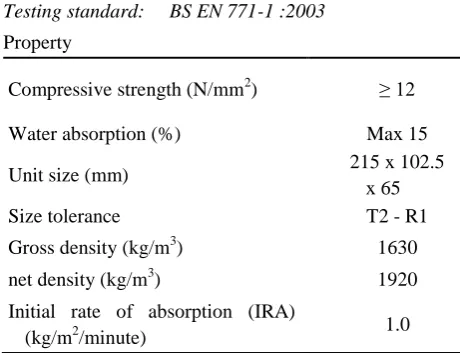
Winchester multi-stock bricks were used for all masonry wallets constructed. The properties of the bricks are set out in table 2.
3.2 Workability
The water content is one of the main contributing factors in the workability of a mortar and directly determines the initial flow of the mortar, Hanley, Pavia (2007). The Initial flow measurement takes into account various variables affecting workability, such as porosity, size and shape of aggregate, type of binder and relative proportions aggregate/binder, Hanley, Pavia (2007). It is known that it is not pos-sible to get the same workability by mixing CL90-s and NHL5 lime with the same amount of water be-cause CL90-s has a higher water demand than NHL5. Hence, for this paper a specific initial flow of 165±3mm, rather than water content was specified for the both mortar types. This allows the mason to ensure the final mix has the appropriate workability. Initial flow tests were carried out in accordance with EN 459-2:2001.
3.3 Mixing and wallette construction
The mortars were mixed in accordance with table 3 of EN 459-2:2001, which also refers to procedures
set out in EN 196-1:2005. The binder to aggregate ratio of 1:3 was kept constant for all mixes. Mortars were used within 1 hour of mixing. Twelve prisms of each mortar type were made in accordance with EN 196-1:2005 for testing for compressive and flex-ural strength.
[image:2.595.308.538.246.391.2]Each brick was brushed free from dust and im-mersed in water for 3 minutes prior to being laid. Masonry Wallettes were constructed in accordance with EN 1052-1:1999 for compressive strength, EN 2:1999 for flexural strength and to EN 1052-5:2005 for bond strength. Details of each of these tests are discussed in the following sections. Mortar joints were kept constant at 12mm for all wallettes.
Table 1 Sieve analysis of aggregate
Sieve size (μm) % Passing
5000 99.80%
2360 93.70%
1180 74.30%
600 45.40%
425 28.30%
300 16.30%
150 4.40%
75 1.10%
Table 2 Brick characteristics
Testing standard: BS EN 771-1 :2003
Property
Compressive strength (N/mm2) ≥ 12
Water absorption (%) Max 15
Unit size (mm) 215 x 102.5
x 65
Size tolerance T2 - R1
Gross density (kg/m3) 1630
net density (kg/m3) 1920
Initial rate of absorption (IRA)
(kg/m2/minute) 1.0
3.4 Curing
[image:2.595.306.539.435.612.2]Proceedings of PROHITEC 09 – Mazzolani editor, 2009, Taylor and Francis Group, London, 1609-1615. were placed into a curing chamber at 60±5% r.h. and
temperature of 20±2°C until tested.
3.5 Mortar testing
The mortar compressive strength tests were con-ducted according to EN 196-1:2005 with modifica-tions from EN 459-2:2001. Equation 1 below was used to determine compressive strength:
𝑅𝑐 = 𝐹𝑐
6400 (1)
where Rc is the compressive strength, in N/mm2; Fc
is the maximum load at fracture in Newtons; 6400 is the area of the prism face in millimetres(160x40).
The flexural strength of the mortar was deter-mined using the three point flexural test in accor-dance with EN 196-1:2005 using equation 2 below:
Rf =1.5 × Fb3 f×l (2)
where Rf is the flexural strength (N/mm2); Ff is the
[image:3.595.63.226.400.536.2]load applied to the middle of the prism at fracture, in Newtons; b is the side of the square section of the prism, in millimetres; l is the distance between the supports, in millimetres.
Figure 1 Masonry compression setup [13]
3.6 Compressive strength of masonry
As mentioned in section 3.3 the compressive strength of the wallets was carried out in accordance with EN 1052-1:1999. Lateral variable displacement transducers (L.V.D.Ts) were set-up on each wallette as shown in figures 1 and 3 to record the strain val-ues during compression.
Equation 3 was used to determine the compres-sive strength of each wallette:
𝑓𝑖 =𝐹𝑖,𝑚𝑎𝑥
𝐴𝑖 N/mm
2
(3)
where fi is the compressive strength of an individual
masonry specimen, (N/mm2); Fi,max is the maximum
load reached on an individual masonry specimen,
(N); Ai is the loaded cross-section of and individual
specimen, (N/mm2).
The characteristic compressive strength was de-termined using the following equation 4:
𝑓𝑘 = 1.2𝑓 or 𝑓𝑘 = 𝑓𝑖,𝑚𝑖𝑛 N/mm2 (4) (whichever is smaller)
3.6 Determination of flexural strength of masonry
The flexural strength was calculated for both a plane of failure parallel to the bed joints and one perpen-dicular to the bed joints (EN 1052-2:1999). Thus two different size wallets and two different testing rig setups are required (figure 2). Equation 5 was used to calculate the flexural strength:
𝑓𝑥𝑖 =3𝐹𝑖,max(𝑙1−𝑙2)
2𝑏𝑡𝑢2 N/mm2 (5)
where fix is the flexural strength of an individual
ma-sonry specimen, (N/mm2); Fi,max is the maximum
load reached on an individual masonry specimen, (N); b is the height or width of a masonry specimen perpendicular to the direction of span, (mm); tu is the
width of a masonry unit, (mm).
The characteristic flexural strength was calculated from equation 6:
𝑓𝑥𝑘 = 𝑓𝑚𝑒𝑎𝑛1.5 N/mm2 (for five specimens) (6)
Figure 2 Masonry flexural test setup [14]
3.7 Determination of bond strength of masonry.
The bond strength of the brick masonry was deter-mined by testing five-brick-high bonded prism stacks in accordance with EN 1052-5:2005.
4 RESULTS AND DISCUSSION
4.1 Mortar preparation and testing
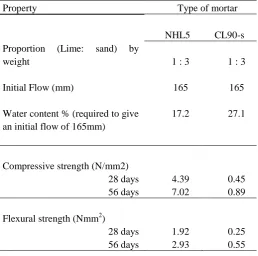
[image:3.595.307.516.418.569.2]Ini-tial testing of the NHL 5 and CL90-s limes found that a water content of 17.2% and 27.1% respec-tively was required to give an initial flow of 165 mm.
[image:4.595.30.289.375.631.2]Mortar prisms were tested for compressive and flexural strength at 28 days and 56 days. The results are included in table 3. The mortars were classified so that masonry test results could be compared with the predicted strengths from BS 5628-1. At 56 days CL90-s displays a compressive strength of 0.89 N/mm2 this places it in the M1 mortar strength class (EN 1052-1:1999) and M2 (BS 5628-1). However, the mortar strengths given by the standard for these classes are 1 and 2 N/mm2 respectively, slightly higher than those of the mortars tested. In relation to the NHL 5 mortar, a 28 day (mean) compressive strength value of 4.39 N/mm2 places this mortar in the M4-M6 mortar strength class (BS 5628-1). The compressive strength of the NHL 5 prisms increases by 60% to 7.02 N/mm2 between 28 and 56 days. This is a much larger increase than previous litera-ture might suggest, Hanley, Pavia (2007). The flex-ural strength of NHL 5 also increases by a large margin of 65% between 28 days and 56 days.
Table 3 Characteristics of mortars
Property Type of mortar
NHL5
CL90-s Proportion (Lime: sand) by
weight 1 : 3 1 : 3
Initial Flow (mm) 165 165
Water content % (required to give an initial flow of 165mm)
17.2 27.1
Compressive strength (N/mm2)
28 days 4.39 0.45
56 days 7.02 0.89
Flexural strength (Nmm2)
28 days 1.92 0.25
56 days 2.93 0.55
4.2 Compressive strength of brick masonry.
Quality of workmanship and consistency between masons has an enormous effect on the strength of all masonry structures, Ewing, Kowalsky (2004). To ensure consistency in this series of testing all wal-lettes and mortar batches were made by the same mason. The specimen size was kept constant for all masonry compression wallettes due to rigorous di-mensional checks during manufacture. The results of the compressive strength testing of masonry wal-lettes are presented in table 4. The missing data for CL90-s masonry at 28 days is because the masonry had not gained sufficient strength to test.
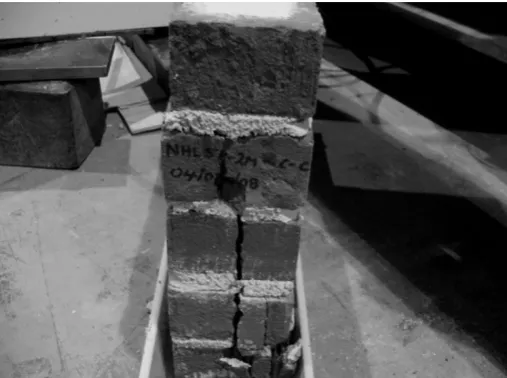
Failure of the CL90-s was generally due to failure of the mortar. The mortar was seen to spread out of the joints as the load was increased. Cracking did occur in the bricks above and below the vertical joints which can be seen in figure 3. This observa-tion supports conclusions made by Sarangapani et al (2005) where it is suggested that masonry failure is generally accompanied by bond failure in situations where very low brick-mortar bond strengths are noted.
The mode of failure of the NHL 5 brick masonry wallettes is quite different to that of the CL90-s lettes. Figure 4 shows that generally the NHL5 wal-lettes split down the centre as well as developing cracks above and below the vertical joints and also spalling of brick and mortar from the face of the specimen. Sarangapani et al. states that in this mode of failure the brick will be in tri-axial compression while the mortar will be in bi-axial tension and com-pression. The horizontal compression in the brick is the result of the stiff mortar pulling it inwards for strain compatibility. The shear stress of the brick-mortar interface also leads to horizontal compression in the brick. When bond failure finally occurs, the horizontal compression induced will disappear and the brick fails by the lateral tension, Sarangapani et al (2005). The increased stresses caused by the con-finement of the mortar in the brick’s frog may also influence this mode of failure.
The failure modes discussed above agree with the conclusions of Gumeste et al (2006) where the fail-ure of masonry specimens using weak mortar is pri-marily due to loss of bond between mortar and brick units and in the case of stronger mortars failure due
Table 4 Compressive strength of masonry wallettes
Mortar type Specimen
age Specimen size
Compressive strength (N/mm2) Characteristic compressive strength (N/mm2)
*Range Mean
NHL5 28 days
442 x 385 x 102.5
5.27-6.20 5.69 5.3
NHL5 56 days 5.39-6.80 6.32 5.4
Cl90 28 days - - -
Cl90 56 days 1.35-1.87 1.53 1.4
[image:4.595.32.545.692.791.2]Proceedings of PROHITEC 09 – Mazzolani editor, 2009, Taylor and Francis Group, London, 1609-1615. to splitting of bricks.
The compressive strength results for NHL 5 (bound) masonry are very high for both 28 day and 56 day tests at 5.69 and 6.32 N/mm2 respectively. This shows an increase of only 11% in strength be-tween 28 day and 56 day results. The compressive strength of the CL90-s wallettes at 56 days was 1.52 N/mm2. It is interesting to note that the compressive strength of this mortar at 56 days was determined at only 0.89 N/mm2.
[image:5.595.310.564.46.235.2]4.3 Masonry compressive strength as a function of mortar compressive strength
Figure 5 graphs the relationship between the mortar compressive strength and masonry compressive strength. As aforementioned, the compressive strength of the NHL5 masonry wallettes increases by 11% between 28 days and 56 days however, the cor-responding mortar strength increases by 60%. From this graph it can clearly be seen that significant in-creases in mortar compressive strength do not lead to significant increases in masonry compressive strength. The results show that after 56 days the NHL5 mortar is stronger in compression (7.0 N/mm2) than the NHL5 masonry (6.32 N/mm2) whe-reas the CL90-s mortar/ masonry compressive strengths show the opposite trend. These results support Rao et al (1995) and Reddy’s (2008) conclu-sions that masonry compressive strengths are not significantly impacted by the mortar strength.
Figure 3 CL90-s 56 day compression test failure
[image:5.595.308.554.260.435.2]Figure 4 NHL 5 56 day compression test failure
Figure 5 relationship between the mortar compressive strength and masonry compressive strength
4.4 Flexural and bond strength of masonry
Results from both the flexural and bond strength tests are presented in table 5. The bond wrench test (test 3) proved to be a relatively fast and accurate test. Results from which compare well with those obtained from the EN 1052-2:1999 [13] flexural strength parallel to horizontal bed joints tests (test1). The stacked brick prisms required for the bond wrench test were vastly faster and easier to manufac-ture than the more complex wallettes required for test 1. Test 1 does allow for measurement of the wal-lette’s deflection as the load is applied which is use-ful information for the determination it’s Modulus of Elasticity. Both tests show a large increase (70% test
4.39, 5.69
0.89, 1.53
7.02, 6.32
0 1 2 3 4 5 6 7
0 2 4 6 8
M
a
so
n
ry
Co
m
p
r
ess
iv
e
str
en
g
th
(N/m
m
2
)
Mortar Compressive strength (N/mm2)
NHL 5 28 days
CL 90-s 56 days
[image:5.595.34.290.474.666.2]NHL 5 56 days
Table 5 Flexural and bond strength of masonry wallettes
Mortar
Type Specimen Age
Flexural strength parallel to horizontal bed joints (N/mm2) (test 1)
Flexural strength perpendicular to bed joints (N/mm2) (test 2)
Bond strength (Bond wrench test) (N/mm2) (test 3)
NHL5 28 days 0.22 1.08 0.15
NHL5 56 days 0.42 1.23 0.26
Cl90-s 28 days - - -
[image:5.595.33.560.704.798.2]3, 90% test 1) of bond strength for NHL5 between 28 day and 56 day tests.
The results for the flexural strength perpendicular to the horizontal bedding joints cannot be compared with tests 1 and 3, due to the additional force re-quired to overcome the friction within contra-rotation portions of masonry (in a scissor like mo-tion, Hughes, Taylor (2005). In this test, the load in-creases and approaches a plateau where the wallette has clearly failed. As the load continues to be ap-plied, it is taken up by the wall as it hinges generally about two points.
4.5 Influence of flexural and bond strength on masonry compressive strength.
In section 4.3 it was discussed that large increases in the mortar strength did not lead to substantial in-creases in masonry compressive strength. As it can be seen from the results in table 6, large increases in the flexural bond strength of the mortar do not lead to substantial increases in masonry compressive strength. The flexural and bond strength of the NHL 5 mortar tends to increase by 80% on average be-tween 28 day and 56 day tests whereas the masonry compressive strength only increases by 11% over the same period.
The results in this paper agree with those of Venkatarama and Uday Vyas (1995) conclude that masonry compressive strength is not sensitive to bond strength variations when the masonry unit is stiffer than the mortar.
4.6 Comparison of masonry wallettes test results with predicted strengths from BS 5628-1
Table 6 compiles compression and flexural test of masonry wallettes constructed using two lime mor-tars, one strong and one of low strength as previous-ly described. The table also shows the predicted strength values as laid out in BS 5628-1. The mor-tars were classified as M4-M6 as described in sec-tion 5.1. The standard does not cater for a mortar
with a compressive strength less than 2 N/mm2 at 28 days; hence the CL90-s mortar is placed in the low-est class (M2). Strength values were predicted using the standard mortar classification and values for clay bricks with water absorptions greater than 12%.
As it can be seen from the results, the NHL 5 ma-sonry wallettes performed in compression almost as predicted by the standard; 20% above the predicted standard value in flexural perpendicular for the hori-zontal bed joints; and 27% below the predicted value for flexural strength parallel to the horizontal bed joints. In contrast, the CL90-s masonry wallettes do not compare well with the predicted strengths of its classification. Therefore, revised tables are required in order to take account lower strength lime mortars and masonry.
5 CONCLUSIONS
This paper examines the ultimate strength results of masonry, constructed with two types of mortar as they cure over a two month period. Test data was also compared with strength predictions in BS 5628-1. The following conclusions emerge from these ex-ploratory studies:
It was found that the compressive and flexural strength of a EN 459-2 standard, NHL5 mortar in-creases by 60-65% between 28 days and 56 days while its flexural bond strength increases by 80%. However, the compressive strength of the NHL5 bound masonry only increases by 11%. After 56 days the NHL 5 mortar is stronger in compression (7.0 N/mm2) than the NHL5 masonry (6.32 N/mm2) whereas the CL90-s mortar / masonry shows the op-posite trend.
This paper agrees with previous authors in that significant increases in mortar compressive strength do not lead to significant increases in masonry com-pressive strength and that masonry comcom-pressive strength is not sensitive to bond strength variations when the masonry unit is stiffer than that of the mor-tar.
Table 6 Comparison of measured characteristic compressive strength and flexural strengths of masonry wallettes with predicted strengths from BS 5628-1
Test direction Mortar
Type
Mortar strength class/ designation (BS 5628-1)
Measured strength (N/mm2) at: 28 days(NHL5) 56 days (CL90-s)
No of specimens
Predicted strength of masonry (BS 5628-1)
% of pre-dicted value
Compressive NHL 5
CL90-s
M4-M6 M2
5.4 1.4
4 5
5.2 3.85
104 36
Flexural parallel to hori-zontal bed joints
NHL 5 CL90-s
M4-M6 M2
0.22 0.1
4 5
0.3 0.25
73 40 Flexural perpendicular to
horizontal bed joints
NHL 5 CL90-s
M4-M6 M2
1.08 0.18
4 5
0.9 0.8
[image:6.595.34.562.61.194.2]Proceedings of PROHITEC 09 – Mazzolani editor, 2009, Taylor and Francis Group, London, 1609-1615. Two distinct modes of compressive failure
behav-iour were observed for masonry. The failure of ma-sonry specimens using weak mortar is primarily due to loss of bond between mortar and brick units and in the case of stronger mortars failure due to splitting of bricks induced by internal stresses.
This paper also concludes that the bond wrench test results compare well with those obtained from the EN 1052-2:1999 flexural strength parallel to ho-rizontal bed joints tests.
NHL 5 masonry wallettes perform very close to masonry strength values predicted in BS 5628-1 whereas CL90-s masonry wallettes do not compare well with the predicted strengths of its classification. Revised tables are required to take account of lower strength lime mortars used in masonry construction.
REFERENCES
BS 5628 – 1 (2005) Code of practice for use of masonry – Part 1: Structural use of unreinforced masonry.
EN 196 – 1 (2005) Method of testing cement. Part 1 – Deter-mination of strength.
EN 459-2 (2001) Building lime. Part 2. Test methods.
EN 771 – 1 (2003) (E) Specification for masonry units – Part 1: Clay masonry units.
EN 772 – 1 (2000) Method to test masonry units – Part 1: De-termination of compressive strength
EN 772 – 3 (2000) Method to test masonry units – Part 1: De-termination of net volume and % of voids of clay masonry units.
EN 772 – 13 (2000) Method to test masonry units – Part 1: De-termination of net & gross dry density of masonry units. EN 1052 – 1 (1999) Method of test masonry. Part 1 –
Deter-mination of compressive strength.
EN 1052 – 2 (1999) Method of test masonry. Part 2 – Deter-mination of flexural strength.
EN 1052 – 5 (2005) Method of test masonry. Part 5 – Deter-mination of bond strength (Bond wrench method).
Ewing Bryan D, Kowalsky Mervyn J (2004). Compressive be-havior of unconfined ad confined clay brick masonry. Jour-nal of structural engineering (ASCW):2004
Francis AJ, Horman CB, Jerrems LE (1971) “The effect of joint thickness and other factors on compressive strength of brickwork”. In: Proceedings of 2nd international brick ma-sonry conference, stoke-on-trent, pp 31–37.
Groot Caspar JWS (1993). Effects of water on mortar brick Bond. PhD thesis, University of Delft, Delft, The Nether-lands.
Gumeste K.S, Venkatarama Reddy BV, (2006). Strength and elasticity of brick masonry prisms and wallettes under compression. Materials & Structures (2007) – 29: 241-253. Hanley R, Pavia S. (2006). A study of the workability of
natu-ral hydraulic lime mortars and it influence on strength. Ma-terials & Structures (RILEM 2007).
Hughes John J, Taylor Adrian K. (2005). Compression and flexural strength testing of brick masonry panels con-structed with two contrasting traditionally produced lime mortars. International workshop 2005: Repair mortars for historic masonry. Faculty of Civil Engineering and Geos-ciences, Delft University of Technology, The Netherlands. Lawrence SJ, Cao HT (1987). An experimental study of the
in-terface between brick and mortar. In: Proceedings 4th N Am masonry conference, Dublin, pp 194–204
Lawrence SJ, Cao HT (1988). Microstructure of the interface between brick and mortar. In: Proceedings 8th international brick/block masonry conference, Dublin, pp 194–204 Pavía S. and Treacy E. (2006). A comparative study of the
du-rability and behaviour of fat lime and feebly-hydraulic lime mortars, Materials and Structures, 39, p359 – 365
Sarangapani G, Venkatarama Reddy BV, Jagadish KS (2005) Brick–mortar bond and masonry compressive Strength. J Mater Civil Eng (ASCE) 17(2):229–237
Venkatarama Reddy, B. V. Vyas Uday (2008). Influence of shear bond strength on the compressive strength and stress-strain characteristics of masonry. Materials & Structures (2008) – 41: 1697-1712.
Venumadhava Rao, K., Venkatarama Reddy, B. V., and Jaga-dish, K. S.(1995). Influence of flexural bond strength on the compressive strength of masonry. Proc., National Conf. on Civil Engineering Materials and Structures, Osmania Univ., Hyderabad, India, 103–108.
AKNOWLEDGEMENTS
![Figure 2 Masonry flexural test setup [14]](https://thumb-us.123doks.com/thumbv2/123dok_us/964340.609647/3.595.63.226.400.536/figure-masonry-flexural-test-setup.webp)