Proceedings of the 2019 EMNLP and the 9th IJCNLP (System Demonstrations), pages 1–6 1
ABSApp: A Portable Weakly-Supervised
Aspect-Based Sentiment Extraction System
Oren Pereg1, Daniel Korat1, Moshe Wasserblat1, Jonathan Mamou1, Ido Dagan2 1Intel AI Lab, Petah Tikva, Israel
2Department of Computer Science, Bar-Ilan University, Ramat Gan, Israel
Abstract
We present ABSApp, a portable system for weakly-supervised aspect-based sentiment ex-traction 1. The system is interpretable and user friendly and does not require labeled training data, hence can be rapidly and cost-effectively used across different domains in applied setups. The system flow includes three stages: First, it generates domain-specific as-pect and opinion lexicons based on an unla-beled dataset; second, it enables the user to view and edit those lexicons (weak supervi-sion); and finally, it enables the user to select an unlabeled target dataset from the same do-main, classify it, and generate an aspect-based sentiment report. ABSApp has been success-fully used in a number of real-life use cases, among them movie review analysis and con-vention impact analysis.
1 Introduction
Aspect Based Sentiment Analysis (ABSA) is the task of extracting, from a given corpus, opinion targets (aspect terms) and the sentiment expressed towards them. For example, in the sentence“The dessert was incredible”, the aspect term isdessert
and the sentiment towards it is positive. This fine-grained trait of ABSA makes it an effective ap-plication for measuring and monitoring the ratio between positive and negative opinions expressed towards specific aspects of a product or service.
Most work around ABSA focused on super-vised sequence tagging based systems. Liu et al. (2015) showed promising results when the train-ing and the inference data are from the same do-main. However, this approach is typically not ro-bust across different domains since aspect terms from two different domains are usually semanti-cally different hence separated in the embedding
1A demo video of ABSApp is available at https://drive.google.com/open?id=
1BLk0xkjIOqyRhNy4UQEFQpDF_KR_NMAd.
vector space. For example, frequent aspect terms in the restaurant domain, likefood, menu, starters
and salad, have little or no semantic relatedness to frequent aspect terms in the laptop domain, likescreen size, keyboard andbattery life. In ad-dition to aspect terms, many opinion terms are also domain-specific. For example, opinion terms like tasty (positive), yummy (positive), flavorful (positive) and tasteless (negative) are specific to the restaurant domain whereas opinion terms like
lightweight (positive), durable (positive), compat-ible (positive)andheavy (negative)are specific to the laptop domain. This makes domain-agnostic ABSA a challenging task, with little work address-ing it.
A recent line of work is based on transfer-learning methods, in which labeled data from a source domain is used for training a model to clas-sify data in a target domain.Ding et al.(2017) and Wang and Jialin Pan(2018) proposed using super-vised RNNs for cross-domain aspect term extrac-tion and for aspect and opinion term co-extracextrac-tion. This approach showed encouraging results, how-ever it requires a considerable amount of labeled data from the source domain which is often not practical in applied settings due to cost or legal considerations (relevant data is usually not avail-able for commercial use).
Figure 1: ABSApp workflow.
transfer-learning based supervised methods. The contribution of this paper is twofold. First, it presents ABSApp, a practical weakly-supervised system that does not require labeled data for training, hence can be rapidly and cost-effectively used across different domains for pro-ducing fine-grained sentiment reports. Second, it introduces a workflow that enables users to weakly-supervise the system, thus enhancing its precision. This workflow enables users to select an unlabeled input dataset from a completely new domain, produce domain-specific aspect and opin-ion lexicons, and edit the lexicons. The user can then select an unlabeled target dataset from the same domain, classify it, and obtain a detailed re-port regarding the positive and negative sentiments expressed towards each aspect in the corpus and browse through the results.
Our system has been successfully deployed in several real-life use cases. One of them is the anal-ysis of social media opinions towards specific as-pects of movies, preformed in collaboration with a major entertainment content provider. Another use case involves measuring the impact of social events, like conventions and conferences, based on opinions published in social media posts.
The system is distributed as open source soft-ware under the Apache license as part of NLP Ar-chitect by Intel AI Lab.2
2 System Workflow
This section describes the workflow of ABSApp, as depicted in Figure1.
Steps 1 & 2: Selecting a Dataset and Extracting Lexicons. The first step of the flow is to select an input dataset for lexicon extraction, performed by clicking theExtract lexicons button shown in Figure 2. Once a dataset is selected, the system performs the lexicon extraction process. This step extracts aspect terms and produces an aspect lexi-con. In addition, this step extracts candidate opin-ion terms, filters them and estimates their polarity, producing an opinion lexicon (see Section3.1).
2http://nlp_architect.nervanasys.com/
absa.html
Step 3: Lexicon Editing. Figure 2 shows the aspect and opinion lexicon management (editing) user interface. The user can choose to edit an as-pect lexicon or an opinion lexicon that was gener-ated in step 2. As shown in Figure2, in which the
Aspect Lexicon has been selected, the Term col-umn displays the aspect terms while theAlias1-3
columns display aspect terms that have the same semantic meaning.
Upon selecting a specific aspect, the Examples
view on the right-hand side of Figure 2 displays text snippets from the input dataset that include this term (highlighted in blue). The Examples
view enables the user to verify that the selected term indeed functions as an aspect term in var-ious contexts in the domain. Based on this, the user can delete (by unchecking the term’s check-box), add or modify the lexicon items. The rec-ommended best practice is to keep relevant aspect terms and delete non-relevant aspect terms. For example, keep terms like ’service’ and ’decor’ and delete terms like ’time’ and ’city’ from an aspect lexicon related to restaurant reviews.
In addition, the user can group together syn-onym aspects like ’drinks’ and ’beverages’ (see Figure 2). Finally, the user can save the edited lexicon. The opinion lexicon editor (not shown) functions similarly to the aspect lexicon editor except that it includes a Polarity column and a
Scorecolumn (see Section3.1) instead of theAlias
columns. Both the polarity and the score can be edited by the user.
Steps 4 & 5: Selecting a Target Dataset and Performing Sentiment Classification. A target dataset and its classification are performed by clicking theClassifybutton in Figure2. Once the dataset is selected the system starts the sentiment classification process (see Section3.2).
senti-Figure 2: ABSApp user interface for aspect and opinion lexicons management. The figure displays an aspect lexicon related to the restaurants domain.
Figure 3: ABSApp user interface for displaying the accumulated amount of positive & negative sentiment per aspect (top) and sentences containing sentiment towards a specific aspect (bottom).
ment mentions towards a specific aspect (see the blue rectangle in Figure 3). The displayed value is an aggregation of the sentiment mention count towards the aspect term and towards all of itsAlias
terms (as in Figure2).
Upon clicking a bar related to a specific aspect, a list of sentences containing positive and negative sentiment towards that aspect is displayed with the aspect terms colored blue and the positive and neg-ative opinion terms colored green and red, respec-tively (lower part of Figure3). This view enables the user to drill-down into the results and extract further insight.
3 Algorithmic Components
Our algorithmic approach is based on using un-labeled data from a new target domain to co-extract aspect and opinion terms, in order to gen-erate domain-specific aspect and opinion lexi-cons (Section3.1). Those lexicons are then used to extract aspect-opinion sentiment mentions in datasets from the same domain (Section3.2).
3.1 Lexicon Extraction
Pre-processing. The first lexicon extraction step includes applying tokenization, part-of-speech
tagging 3 and dependency parsing to the input data. For dependency parsing, we used the Bi-LSTM parser proposed byKiperwasser and Gold-berg(2016).
Aspect and Opinion Term Extraction. This step is based on applying the bootstrap opinion and aspect term co-extraction using the depen-dency relation rules algorithm, proposed by Qiu et al.(2011). The bootstrap process is initialized with a seed lexicon of generic opinion terms. New aspect and opinion terms are extracted based on the seed lexicon and the dependency relation rules. The extracted terms are then added to the seed lex-icon, and used for extracting additional terms in the next iteration. In order to initialize the boot-strap process, we used the opinion lexicon gener-ated byHu and Liu(2004), which contains around 6800 opinion terms along with their sentiment po-larity. Table 1 shows two of the 8 rules that are used along with example sentences. The exam-ple for ruleR1illustrates the extraction of the as-pect termdecorbased on the known opinion term
nice, while the example for ruleR2illustrates the extraction of the opinion termtasty based on the
[image:3.595.78.527.192.345.2]known aspect termfood.
RuleID Rule Example
R1 O−−−→amod A(NN) nice decor (nice−−−→amod decor) R2 A−nsubj−−−→O(ADJ) the food was super tasty
(food−nsubj−−−→tasty)
Table 1: Examples of the opinion and aspect terms ex-traction rules.Orepresents an opinion term andA rep-resents an aspect term.
Opinion Lexicon Scoring and Filtering. This step aims to filter the noisy candidate opinion terms extracted by the bootstrap process. It is based on using an MLP classifier for generating a score that represents the probability that a candi-date is indeed an opinion term. Candicandi-date opinion terms are qualified as opinion terms if their classi-fication score exceeds a threshold4.
The MLP classifier input features consists of the candidate term word embedding5 and the mean, standard-deviation, maximum and mini-mum word-embedding cosine similarities between the candidate term and a pre-determined set of generic opinion terms. The MLP consists of a sin-gle hidden layer and is trained once for a binary classification task using manually labeled data that consists of a set of opinion terms (positive class) and a set of non-opinion terms (negative class) from a specific domain6. Once the model is gener-ated it is then used for grading candidate opinion terms extracted in other domains. It is reasonable to use such model across domains, since the classi-fication features represent semantic similarity lev-els that are robust across domains.
Opinion Polarity Estimation The goal of this step is to set the binary sentiment polarity (posi-tive or nega(posi-tive) of the opinion terms. Following Pablos et al. (2016), an opinion term polarity is assigned based on estimating whether it is seman-tically closer to a set of generic positive opinion terms or to a set of generic negative opinion terms. To produce those sets we used a subset of 47 pos-itive terms and a subset of 47 negative terms
de-4
The threshold’s value was empirically determined based on precision-recall tradeoff.
5We used Stanford Glove embeddingshttps://nlp. stanford.edu/projects/glove/
6This training data can be downloaded fromhttps:// github.com/NervanaSystems/nlp-architect/ blob/master/nlp_architect/models/absa/ train/lexicons/RerankTrainingData.csv
rived from the opinion lexicon generated by Hu and Liu(2004). The semantic similarity between an opinion term and a positive or negative set is estimated by averaging the cosine similarity of the embedding of the opinion term and the embedding of each one of the terms in the positive or negative set.
In this module we used pre-trained embed-dings5 which produce overall good results but raise a drawback; some opinion terms may con-vey different sentiment polarities in different do-mains (e.g. ’delicate movie’ (positive) vs. ’del-icate cellphone’ (negative)), while a pre-trained embeddings setup is only capable of setting a sin-gle polarity per opinion term. A suggested solu-tion is to adapt the embeddings to the target do-main or to use context embeddings. We intend to address this challenge in future work.
3.2 Sentiment Classification
Sentiment classification uses the opinion and as-pect lexicons for detecting asas-pect-opinion pairs (sentiment mentions) within the input target dataset, and determining their sentiment polarity. Aspect-opinion pairs are extracted based on de-tecting a direct or second-order dependency re-lation of any type, between them. The aspect-opinion pair polarity is assigned according to the polarity of the opinion term. This step also uses a pre-determined negation lexicon containing nega-tion terms. Upon detecting a direct dependency relation between a negation term and the opinion term, the aspect-opinion pair polarity is reversed.
4 Evaluation
Our evaluation objective is to show that the differ-ent algorithmic steps, namely, lexicon extraction and sentiment classification, produce usable re-sults. An additional objective is to show that weak supervision of an aspect lexicon that was gener-ated in an unsupervised manner produces compa-rable results to the recent transfer-learning based methods (Ding et al.,2017;Wang and Jialin Pan, 2018). For this purpose, we leveraged the data of SemEval 2014 task 4 (Pontiki et al.,2014), which tests the two main ABSA sub-tasks: aspect term extraction and aspect term polarity detection.
the robustness of our system. Following previous work, the restaurant reviews dataset consists of the restaurant reviews from SemEval 2014 task 4 sub-task 1 (Pontiki et al., 2014) and from SemEval 2015 task 12 subtask 1 (Pontiki et al.,2015). The laptop domain consists of the laptop reviews from SemEval 2014 task 4 subtask 1. The gold data in-cludes manual labeling of the spans of aspect term mentions within each sentence in the dataset as well as the sentiment polarity (positive, negative, conflict or neutral) related to each aspect. The two domains consist of a total of 5841 and 3614 sen-tences, respectively.
Experimental Setup. Following the first two subtasks of the SemEval 2014 task 4, our exper-iment is split into two parts: First, we evaluate as-pect term extraction by generating an asas-pect lex-icon, using it for detecting aspect terms within the test set and comparing it against the gold la-bels. Second, we evaluate the sentiment polarity detected towards each extracted aspect by compar-ing between the aspect-opinion pairs detected with their assigned polarity and the gold labels.
The data from each domain was randomly split into 75% training and 25% testing. The training data was used (ignoring its annotation) for gener-ating the domain-specific opinion and aspect lexi-cons according to workflow steps 1-3 of Figure1. As a baseline to the aspect term extraction eval-uation, we tested the unsupervised output of AB-SApp, in which the lexicons were not manually edited. We also tested the weakly-supervised out-put of the system, in which the aspect lexicon was edited ; this manual process, which took about 15 minutes, involved deleting aspects that are non-relevant to the domain (see step 3 in Section2for detailed description of this process).
Following the settings in prior aspect term ex-traction work, only exact matches between the pre-dicted aspects and gold labels are counted as cor-rect. We also added a more lenient metric where partial matches are counted as correct, since, for many practical usages, partial matches are suffi-cient for extracting valuable insight. For example, in the restaurant domain, ’service’ and ’waiting service’ can be counted as the same aspect. This lenient metric was also used for the aspect term polarity evaluation task.
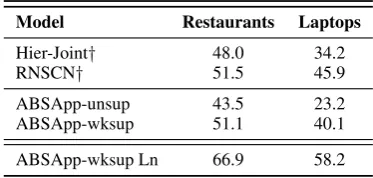
Results. Table 2 shows an F1 score evaluation of the aspect term extraction task. It includes a comparison between the unsupervised output
of the system (‘ABSApp-unsup’), its weakly-supervised output (‘ABSApp-wksup’) and two transfer-learning based methods: ‘Hier-joint’ by Ding et al. (2017) and ‘RNSCN’ by Wang and Jialin Pan(2018). ‘ABSApp-wksup Ln’ represents the weakly-supervised system lenient matches.
It is noticeable from Table 2that the results of the unsupervised output of the system (‘ABSApp-unsup’) are noisy, but that the weakly-supervised output results (‘ABSApp-wksup’) are quite com-parable to the cited transfer-learning based meth-ods, however, the latter require annotated data from a source domain (the results shown are av-eraged across tests using data from 2 different an-notated source domains), whereas ABSApp relies on a short weak supervision process but does not require any labeled data, which is often unavail-able in applied industrial settings.
Table 3 shows an evaluation of the weakly-supervised ABSApp lenient performance of the aspect term polarity task. This task relates to the sentiment polarity (positive, negative) detected to-wards each extracted aspect mention, hence it re-flects the quality of both algorithmic components: aspect and opinion lexicon extraction (Section3.1) and sentiment classification (Section3.2).
It is seen from Table3that although the recall in both tests is not high (because it reflects correct de-tection of an aspect term, an opinion term and a re-lation between them), the precision is above 70%. Such precision is often sufficient for practical pur-poses. Note that there is no transfer-learning work related to the aspect term polarity task, therefore no benchmarks to other systems are shown.
Model Restaurants Laptops
Hier-Joint† 48.0 34.2 RNSCN† 51.5 45.9
ABSApp-unsup 43.5 23.2 ABSApp-wksup 51.1 40.1
[image:5.595.322.509.527.616.2]ABSApp-wksup Ln 66.9 58.2
Table 2: Aspect term extraction evaluation (F1 score).
†average performance over evaluations using different random dataset splits of the test data, as reported by
Wang and Jialin Pan(2018).
Domain Precision Recall F1 score
Restaurants 70.3 44.5 54.6 Laptops 72.7 27.6 40.1
5 Field Use Cases
This section describes two use cases in which AB-SApp has been successfully used.
Movie Reviews Analysis. One of the main pre-dictors for the commercial success of a movie is the estimated hype effect of the movie’s pre-release in social media as measured using senti-ment analysis (Natarajan et al., 2019). ABSApp was used in collaboration with a major enter-tainment content provider for analyzing audience opinion in social media towards movies and trail-ers. The system detected the different characters, actors, scenes and music as aspects, and produced fine-grained sentiment reports periodically. These reports were used to fine-tune the content of future movie trailer releases.
Convention Impact Analysis. Analysis of sen-timent towards different aspects is useful also for measuring the impact of professional events, de-termining user impressions, and acting accord-ingly. ABSApp was used during the 2018 Intel AI development convention in San Francisco7 to extract aspects related to the convention and to an-alyze the sentiment towards them based on Twit-ter feeds. The system detected aspects like ses-sions, keynotes, demos, venue, etc., and provided the event organizers with valuable information re-garding the level of positive/negative sentiment to-wards them. In addition, it enabled organizers to browse through sentences containing sentiment to-wards specific aspects and draw conclusions as to what should be changed and what should be con-tinued at current and future conventions.
6 Conclusion
We presented ABSApp, a weakly-supervised sys-tem for Aspect Based Sentiment Analysis. We showed that weak supervision of lexicons, which were generated in an unsupervised manner, pro-duces comparable results to recent supervised transfer-learning based methods. This enables, rapid and cost-effective use across different do-mains in applied setups where labeled data is often unavailable.
References
Ying Ding, Jianfei Yu, and Jing Jiang. 2017. Recur-rent neural networks with auxiliary labels for
cross-7https://newsroom.intel.com/
press-kits/2018-ai-devcon/#gs.bejr0q
domain opinion target extraction. In Association for the Advancement of Artificial Intelligence, pages 3436–3442.
Minqing Hu and Bing Liu. 2004. Mining opinion fea-tures in customer reviews. InAmerican Association for Artificial Intelligence.
Eliyahu Kiperwasser and Yoav Goldberg. 2016. Sim-ple and accurate dependency parsing using bidirec-tional lstm feature representations. Transactions of the Association for Computational Linguistics, 4:313–327.
Pengfei Liu, Shafiq Joty, and Helen Meng. 2015. Fine-grained opinion mining with recurrent neural net-works and word embeddings. InProceedings of the 2015 Conference on Empirical Methods in Natural-Language Processing, EMNLP 2015, pages 1433– 1443.
V. Anantha Natarajan, K SaiHarsha, and M Santhosh Kumar. 2019. Box-office revenue estimation for tel-ugu movie industry using predictive analytic tech-niques. International Journal of Recent Technology and Engineering (IJRTE), 7(6):896–902.
Aitor Garc´ıa Pablos, Montse Cuadros, and German Rigau. 2016. A comparison of domain-based word polarity estimation using different word embed-dings. In Proceedings of the Tenth International Conference on Language Resources and Evaluation (LREC 2016), pages 54–60, Portoroˇz, Slovenia. Eu-ropean Language Resources Association (ELRA).
Maria Pontiki, Dimitris Galanis, Haris Papageorgiou, Suresh Manandhar, and Ion Androutsopoulos. 2015.
SemEval-2015 task 12: Aspect based sentiment analysis. In Proceedings of the 9th International Workshop on Semantic Evaluation (SemEval 2015), pages 486–495, Denver, Colorado. Association for Computational Linguistics.
Maria Pontiki, Dimitris Galanis, John Pavlopoulos, Harris Papageorgiou, Ion Androutsopoulos, and Suresh Manandhar. 2014. SemEval-2014 task 4: Aspect based sentiment analysis. InProceedings of the 8th International Workshop on Semantic Evalua-tion (SemEval 2014), pages 27–35, Dublin, Ireland. Association for Computational Linguistics.
Guang Qiu, Bing Liu, Jiajun Bu, and Chun Chen. 2011. Opinion word expansion and target extrac-tion through double propagaextrac-tion. Comput. Linguist., 37(1):9–27.