Bidirectional Inference with the Easiest-First Strategy
for Tagging Sequence Data
Yoshimasa Tsuruoka12 and Jun’ichi Tsujii231
1CREST, JST (Japan Science and Technology Corporation)
Honcho 4-1-8, Kawaguchi-shi, Saitama 332-0012 Japan
2 Department of Computer Science, University of Tokyo
Hongo 7-3-1, Bunkyo-ku, Tokyo 113-0033 Japan
3 School of Informatics, University of Manchester
POBox 88, Sackville St, MANCHESTER M60 1QD, UK
{tsuruoka,tsujii}@is.s.u-tokyo.ac.jp
Abstract
This paper presents a bidirectional in-ference algorithm for sequence label-ing problems such as part-of-speech tag-ging, named entity recognition and text chunking. The algorithm can enumerate all possible decomposition structures and find the highest probability sequence to-gether with the corresponding decomposi-tion structure in polynomial time. We also present an efficient decoding algorithm based on the easiest-first strategy, which gives comparably good performance to full bidirectional inference with signifi-cantly lower computational cost. Exper-imental results of part-of-speech tagging and text chunking show that the proposed bidirectional inference methods consis-tently outperform unidirectional inference methods and bidirectional MEMMs give comparable performance to that achieved by state-of-the-art learning algorithms in-cluding kernel support vector machines.
1 Introduction
The task of labeling sequence data such as part-of-speech (POS) tagging, chunking (shallow parsing) and named entity recognition is one of the most im-portant tasks in natural language processing.
Conditional random fields (CRFs) (Lafferty et al., 2001) have recently attracted much attention be-cause they are free from so-called label bias prob-lems which reportedly degrade the performance of
sequential classification approaches like maximum entropy markov models (MEMMs).
Although sequential classification approaches could suffer from label bias problems, they have sev-eral advantages over CRFs. One is the efficiency of training. CRFs need to perform dynamic pro-gramming over the whole sentence in order to com-pute feature expectations in each iteration of numer-ical optimization. Training, for instance, second-order CRFs using a rich set of features can require prohibitive computational resources. Max-margin methods for structured data share problems of com-putational cost (Altun et al., 2003).
Another advantage is that one can employ a vari-ety of machine learning algorithms as the local clas-sifier. There is huge amount of work about devel-oping classification algorithms that have high gener-alization performance in the machine learning com-munity. Being able to incorporate such state-of-the-art machine learning algorithms is important. In-deed, sequential classification approaches with ker-nel support vector machines offer competitive per-formance in POS tagging and chunking (Gimenez and Marquez, 2003; Kudo and Matsumoto, 2001).
(Toutanova et al., 2003) and achieved the best ac-curacy on POS tagging on the Wall Street Journal corpus. As they pointed out in their paper, however, their method potentially suffers from “collusion” ef-fects which make the model lock onto conditionally consistent but jointly unlikely sequences. In their modeling, the local classifiers can always use the in-formation about future tags, but that could cause a double-counting effect of tag information.
In this paper we propose an alternative way of making use of future tags. Our inference method considers all possible ways of decomposition and chooses the “best” decomposition, so the informa-tion about future tags is used only in appropriate situations. We also present a deterministic version of the inference method and show their effective-ness with experiments of English POS tagging and chunking, using standard evaluation sets.
2 Bidirectional Inference
The task of labeling sequence data is to find the se-quence of tagst1...tnthat maximizes the following
probability given the observationo=o1...on
P(t1...tn|o). (1)
Observations are typically words and their lexical features in the task of POS tagging. Sequential clas-sification approaches decompose the probability as follows,
P(t1...tn|o) = n Y
i=1
p(ti|t1...ti−1o). (2)
This is the left-to-right decomposition. If we make a first-order markov assumption, the equation becomes
P(t1...tn|o) = n Y
i=1
p(ti|ti−1o). (3)
Then we can employ a probabilistic classifier trained with the preceding tag and observations in order to obtainp(ti|ti−1o)for local classification. A common choice for the local probabilistic classifier is maximum entropy classifiers (Berger et al., 1996). The best tag sequence can be efficiently computed by using a Viterbi decoding algorithm in polynomial time.
t1
(a)
t2 t3
o
t1
(b)
t2 t3
t1
(c)
t2 t3 t1
(d)
t2 t3 o
[image:2.612.322.534.52.193.2]o o
Figure 1: Different structures for decomposition.
The right-to-left decomposition is
P(t1...tn|o) = n Y
i=1
p(ti|ti+1o). (4)
These two ways of decomposition are widely used in various tagging problems in natural language pro-cessing. The issue with such decompositions is that you have only the information about the preceding (or following) tags when performing local classifi-cation.
From the viewpoint of local classification, we want to give the classifier as much information as possible because the information about neighboring tags is useful in general.
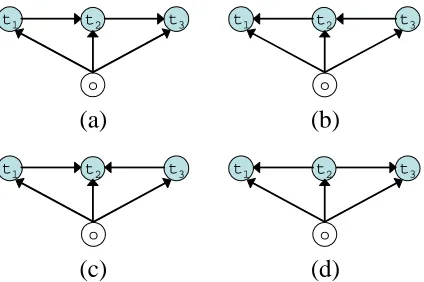
As an example, consider the situation where we are going to annotate a three-word sentence with part-of-speech tags. Figure 1 shows the four possi-ble ways of decomposition. They correspond to the following equations:
(a)P(t1...t3|o) =P(t1|o)P(t2|t1o)P(t3|t2o) (5)
(b)P(t1...t3|o) =P(t3|o)P(t2|t3o)P(t1|t2o) (6)
(c)P(t1...t3|o) =P(t1|o)P(t3|o)P(t2|t3t1o) (7)
(d)P(t1...t3|o) =P(t2|o)P(t1|t2o)P(t3|t2o) (8)
can use rich information when deciding the tag of the most difficult word. In general if we have an n-word sentence and adopt a first-order markov as-sumption, we have2n−1possible ways of decompo-sition because each of the n−1 edges in the cor-responding graph has two directions (left-to-right or right-to-left).
Our bidirectional inference method is to consider all possible decomposition structures and choose the “best” structure and tag sequence. We will show in the next section that this is actually possible in poly-nomial time by dynamic programming.
As for the training, let us look at the equa-tions of four different decomposiequa-tions above. You can notice that there are only four types of local conditional probabilities: P(ti|ti−1o), P(ti|ti+1o), P(ti|ti−1ti+1o), andP(ti|o).
This means that if we have these four types of lo-cal classifiers, we can consider any decomposition structures in the decoding stage. These local classi-fiers can be obtained by training with corresponding neighboring tag information. Training the first two types of classifiers is exactly the same as the train-ing of popular left-to-right and right-to-left sequen-tial classification models respectively.
If we take a second-order markov assumption, we need to train 16 types of local classifiers because each of the four neighboring tags of a classification target has two possibilities of availability. In gen-eral, if we take ak-th order markov assumption, we need to train22ktypes of local classifies.
2.1 Polynomial Time Inference
This section describes an algorithm to find the de-composition structure and tag sequence that give the highest probability. The algorithm for the first-order case is an adaptation of the algorithm for decoding the best sequence on a bidirectional dependency net-work introduced by (Toutanova et al., 2003), which originates from the Viterbi decoding algorithm for second-order markov models.
Figure 2 shows a polynomial time decoding al-gorithm for our bidirectional inference. It enumer-ates all possible decomposition structures and tag sequences by recursive function calls, and finds the highest probability sequence. Polynomial time is achieved by caching. Note that for each local clas-sification, the function chooses the appropriate local
function bestScore() {
return bestScoreSub(n+2,hend, end, endi,hL, Li); }
function bestScoreSub(i+1,hti−1, ti, ti+1i,hdi−1, dii) {
// memorization
if (cached(i+1,hti−1, ti, ti+1i,hdi−1, dii))
return cache(i+1,hti−1, ti, ti+1i,hdi−1, dii);
// left boundary case if (i = -1)
if (hti−1, ti, ti+1i=hstart, start, starti) return 1;
else return 0;
// recursive case
P= localClassification(i,hti−1, ti, ti+1i,hdi−1, dii);
returnmaxdi−2maxti−2P×
bestScoreSub(i,hti−2, ti−1, tii,hdi−2, di−1i);
}
function localClassification(i,hti−1, ti, ti+1i,hdi−1, dii) {
if (di−1=L&di=L) returnP(ti|ti+1, o);
if (di−1=L&di=R) returnP(ti|o);
if (di−1=R&di=L) returnP(ti|ti−1ti+1, o);
if (di−1=R&di=R) returnP(ti|ti−1, o);
}
Figure 2: Pseudo-code for bidirectional inference for the first-order conditional markov models. di is
the direction of the edge betweenti andti+1.
classifier by taking into account the directions of the adjacent edges of the classification target.
The second-order case is similar but slightly more complex. Figure 3 shows the algorithm. The recur-sive function needs to consider the directions of the four adjacent edges of the classification target, and maintain the directions of the two neighboring edges to enumerate all possible edge directions. In addi-tion, the algorithm rules out cycles in the structure.
2.2 Decoding with the Easiest-First Strategy
We presented a polynomial time decoding algorithm in the previous section. However, polynomial time is not low enough in practice. Indeed, even the Viterbi decoding of second-order markov models for POS tagging is not practical unless some pruning method is involved. The computational cost of the bidirec-tional decoding algorithm presented in the previous section is, of course, larger than that because it enu-merates all possible directions of the edges on top of the enumeration of possible tag sequences.
function bestScore() {
return bestScoreSub(n+3,hend, end, end, end, endi,hL, L, L, Li,hL, Li); }
function bestScoreSub(i+2,hti−2, ti−1, ti, ti+1ti+2i,hd0i−1, di−1, di, d0i+1i,hdi−2, d0ii) {
// to avoid cycles
if (di−1=di&di!=d0i) return 0;
// memorization
if (cached(i+2,hti−2, ti−1, ti, ti+1ti+2i,hd0i−1, di−1, di, d0i+1i,hdi−2, d0ii)
return cache(i+2,hti−2, ti−1, ti, ti+1ti+2i,hd0i−1, di−1, di, d0i+1i,hdi−2, d0ii);
// left boundary case if (i = -2)
if (hti−2, ti−1, ti, ti+1, ti+2i=hstart, start, start, start, starti) return 1;
else return 0;
// recursive case
P = localClassification(i,hti−2, ti−1, ti, ti+1, ti+2i,hd0i−1, di−1, di, d0i+1i);
returnmaxd0
i−2maxdi−3maxti−3P×bestScoreSub(i+1,hti−3, ti−2, ti−1, titi+1i,hd
0
i−2, di−2, di−1, d0ii,hdi−3, d0i−1i);
}
Figure 3: Pseudo-code for bidirectional inference for the second-order conditional markov models.diis the
direction of the edge betweentiandti+1.di0 is the direction of the edge betweenti−1andti+1. We omit the localClassification function because it is the obvious extension of that for the first-order case.
is extremely simple and significantly more efficient than full bidirectional decoding.
Instead of enumerating all possible decomposi-tion structures, the algorithm determines the struc-ture by adopting the easiest-first strategy. The whole decoding algorithm is given below.
1. Find the “easiest” word to tag.
2. Tag the word.
3. Go back to 1. until all the words are tagged.
We assume in this paper that the “easiest” word to tag is the word for which the classifier outputs the highest probability. In finding the easiest word, we use the appropriate local classifier according to the availability of the neighboring tags. Therefore, in the first iteration, we always use the local classi-fiers trained with no contextual tag information (i.e.
(P(ti|o)). Then, for example, ift3 has been tagged in the first iteration in a three-word sentence, we use P(t2|t3o)to compute the probability for taggingt2 in the second iteration (as in Figure 1 (b)).
A naive implementation of this algorithm requires O(n2)invocations of local classifiers, wherenis the number of the words in the sentence, because we need to update the probabilities over the words at
each iteration. However, a k-th order Markov as-sumption obviously allows us to skip most of the probability updates, resulting inO(kn) invocations of local classifiers. This enables us to build a very efficient tagger.
3 Maximum Entropy Classifier
Current word wi &ti
Previous word wi−1 &ti
Next word wi+1 &ti
Bigram features wi−1,wi &ti
wi,wi+1 &ti
Previous tag ti−1 &ti
Tag two back ti−2 &ti
Next tag ti+1 &ti
Tag two ahead ti+2 &ti
Tag Bigrams ti−2,ti−1 &ti
ti−1,ti+1 &ti
ti+1,ti+2 &ti
Tag Trigrams ti−2,ti−1,ti+1 &ti
ti−1,ti+1,ti+2 &ti
Tag 4-grams ti−2,ti−1,ti+1,ti+2 &ti
Tag/Word ti−1,wi &ti
combination ti+1,wi &ti
ti−1,ti+1,wi &ti
Prefix features prefixes ofwi &ti
(up to length 10)
Suffix features suffixes ofwi &ti
(up to length 10)
Lexical features whetherwihas a hyphen &ti
whetherwihas a number &ti
whetherwihas a capital letter &ti
[image:5.612.75.297.52.321.2]whetherwiis all capital &ti
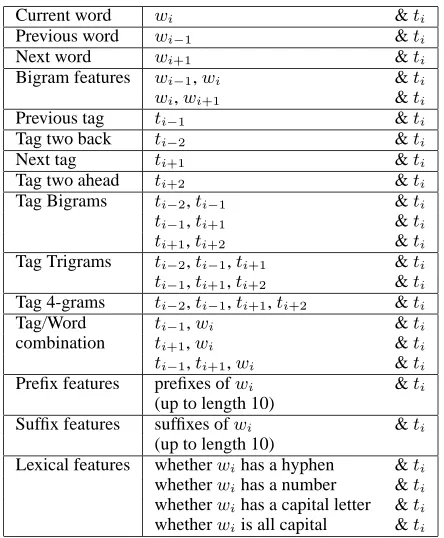
Table 1: Feature templates used in POS tagging ex-periments. Tags are parts-of-speech. Tag features are not necessarily used in all the models. For ex-ample, “next tag” features cannot be used in left-to-right models.
4 Experiments
To evaluate the bidirectional inference methods pre-sented in the previous sections, we ran experiments on POS tagging and text chunking with standard En-glish data sets.
Although achieving the best accuracy is not the primary purpose of this paper, we explored useful feature sets and parameter setting by using develop-ment data in order to make the experidevelop-ments realistic.
4.1 Part-of-speech tagging experiments
We split the Penn Treebank corpus (Marcus et al., 1994) into training, development and test sets as in (Collins, 2002). Sections 0-18 are used as the train-ing set. Sections 19-21 are the development set, and sections 22-24 are used as the test set. All the ex-periments were carried out on the development set, except for the final accuracy report using the best setting.
For features, we basically adopted the feature set
Method Accuracy Speed
(%) (tokens/sec)
Left-to-right (Viterbi) 96.92 844
Right-to-left (Viterbi) 96.89 902
Dependency Networks 97.06 1,446
Easiest-last 96.58 2,360
Easiest-first 97.13 2,461
[image:5.612.326.528.53.139.2]Full bidirectional 97.12 34
Table 2: POS tagging accuracy and speed on the de-velopment set.
Method Accuracy (%)
Dep. Networks (Toutanova et al., 2003) 97.24
Perceptron (Collins, 2002) 97.11
SVM (Gimenez and Marquez, 2003) 97.05
HMM (Brants, 2000) 96.48
Easiest-first 97.10
Full Bidirectional 97.15
Table 3: POS tagging accuracy on the test set (Sec-tions 22-24 of the WSJ, 5462 sentences).
provided by (Toutanova et al., 2003) except for com-plex features such as crude company-name detection features because they are specific to the Penn Tree-bank and we could not find the exact implementation details. Table 1 lists the feature templates used in our experiments.
We tested the proposed bidirectional methods, conventional unidirectional methods and the bidirec-tional dependency network proposed by Toutanova (Toutanova et al., 2003) for comparison. 1. All the models are second-order. Table 2 shows the accuracy and tagging speed on the development data2. Bidirectional inference methods clearly out-performed unidirectional methods. Note that the easiest-first decoding method achieves equally good performance as full bidirectional inference. Table 2 also shows that the easiest-last strategy, where we select and tag the most difficult word at each itera-tion, is clearly a bad strategy.
An example of easiest-first decoding is given be-low:
1For dependency network and full bidirectional decoding, we conducted pruning because the computational cost was too large to perform exhaustive search. We pruned a tag candidate if the zero-th order probability of the candidateP(ti|o)was lower
than one hundredth of the zero-th order probability of the most likely tag at the token.
[image:5.612.314.536.192.268.2]The/DT/4 company/NN/7 had/VBD/11 sought/VBN/14 increases/NNS/13 total-ing/VBG/12 $/$/2 80.3/CD/5 million/CD/8 ,/,/1 or/CC/6 22/CD/9 %/NN/10 ././3
Each token represents Word/PoS/DecodingOrder. Typically, punctuations and articles are tagged first. Verbs are usually tagged in later stages because their tags are likely to be ambiguous.
We applied our bidirectional inference methods to the test data. The results are shown in Table 3. The table also summarizes the accuracies achieved by several other research efforts. The best accuracy is 97.24% achieved by bidirectional dependency net-works (Toutanova et al., 2003) with a richer set of features that are carefully designed for the corpus. A perceptron algorithm gives 97.11% (Collins, 2002). Gimenez and Marquez achieve 97.05% with support vector machines (SVMs). This result indicates that bidirectional inference with maximum entropy mod-eling can achieve comparable performance to other state-of-the-art POS tagging methods.
4.2 Chunking Experiments
The task of chunking is to find non-recursive phrases in a sentence. For example, a chunker segments the sentence “He reckons the current account deficit will narrow to only 1.8 billion in September” into the fol-lowing,
[NP He] [VP reckons] [NP the current account deficit] [VP will narrow] [PP to] [NP only 1.8 bil-lion] [PP in] [NP September] .
We can regard chunking as a tagging task by con-verting chunks into tags on tokens. There are several ways of representing text chunks (Sang and Veen-stra, 1999). We tested the Start/End representation in addition to the popular IOB2 representation since local classifiers can have fine-grained information on the neighboring tags in the Start/End represen-tation.
For training and testing, we used the data set pro-vided for the CoNLL-2000 shared task. The training set consists of section 15-18 of the WSJ corpus, and the test set is section 20. In addition, we made the development set from section 213.
We basically adopted the feature set provided in
3We used the Perl script provided on
http://ilk.kub.nl/˜ sabine/chunklink/
Current word wi &ti
Previous word wi−1 &ti
Word two back wi−2 &ti
Next word wi+1 &ti
Word two ahead wi+2 &ti
Bigram features wi−2,wi−1 &ti
wi−1,wi &ti
wi,wi+1 &ti
wi+1,wi+2 &ti
Current POS pi &ti
Previous POS pi−1 &ti
POS two back pi−2 &ti
Next POS pi+1 &ti
POS two ahead pi+2 &ti
Bigram POS features pi−2,pi−1 &ti
pi−1,pi &ti
pi,pi+1 &ti
pi+1,pi+2 &ti
Trigram POS features pi−2,pi−1,pi &ti
pi−1,pi,pi+1 &ti
pi,pi+1,pi+2 &ti
Previous tag ti−1 &ti
Tag two back ti−2 &ti
Next tag ti+1 &ti
Tag two ahead ti+2 &ti
Bigram tag features ti−2,ti−1 &ti
ti−1,ti+1 &ti
[image:6.612.333.518.50.341.2]ti+1,ti+2 &ti
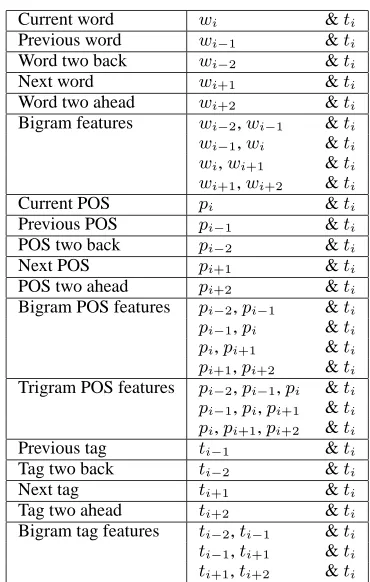
Table 4: Feature templates used in chunking experi-ments.
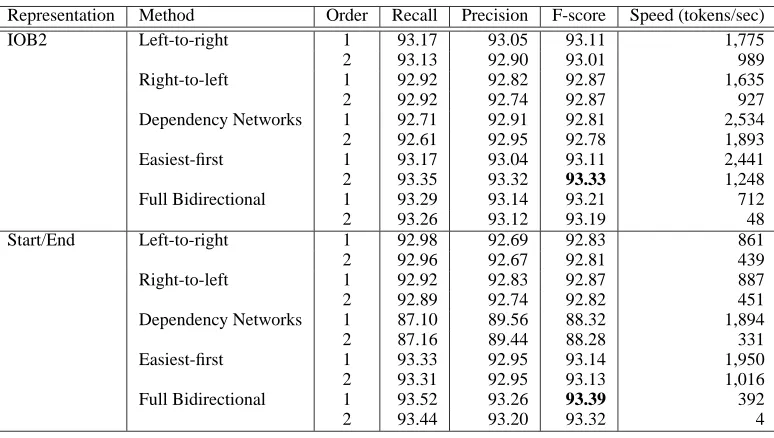
(Collins, 2002) and used POS-trigrams as well. Ta-ble 4 lists the features used in chunking experiments. Table 5 shows the results on the development set. Again, bidirectional methods exhibit better perfor-mance than unidirectional methods. The difference is bigger with the Start/End representation. Depen-dency networks did not work well for this chunking task, especially with the Start/End representation.
We applied the best model on the development set in each chunk representation type to the test data. Table 6 summarizes the performance on the test set. Our bidirectional methods achieved F-scores of 93.63 and 93.70, which are better than the best F-score (93.48) of the CoNLL-2000 shared task (Sang and Buchholz, 2000) and comparable to those achieved by other state-of-the-art methods.
5 Discussion
Representation Method Order Recall Precision F-score Speed (tokens/sec)
IOB2 Left-to-right 1 93.17 93.05 93.11 1,775
2 93.13 92.90 93.01 989
Right-to-left 1 92.92 92.82 92.87 1,635
2 92.92 92.74 92.87 927
Dependency Networks 1 92.71 92.91 92.81 2,534
2 92.61 92.95 92.78 1,893
Easiest-first 1 93.17 93.04 93.11 2,441
2 93.35 93.32 93.33 1,248
Full Bidirectional 1 93.29 93.14 93.21 712
2 93.26 93.12 93.19 48
Start/End Left-to-right 1 92.98 92.69 92.83 861
2 92.96 92.67 92.81 439
Right-to-left 1 92.92 92.83 92.87 887
2 92.89 92.74 92.82 451
Dependency Networks 1 87.10 89.56 88.32 1,894
2 87.16 89.44 88.28 331
Easiest-first 1 93.33 92.95 93.14 1,950
2 93.31 92.95 93.13 1,016
Full Bidirectional 1 93.52 93.26 93.39 392
2 93.44 93.20 93.32 4
Table 5: Chunking F-scores on the development set.
Method Recall Precision F-score
SVM (Kudoh and Matsumoto, 2000) 93.51 93.45 93.48
SVM voting (Kudo and Matsumoto, 2001) 93.92 93.89 93.91
Regularized Winnow (with basic features) (Zhang et al., 2002) 93.60 93.54 93.57
Perceptron (Carreras and Marquez, 2003) 93.29 94.19 93.74
Easiest-first (IOB2, second-order) 93.59 93.68 93.63
[image:7.612.113.500.52.271.2]Full Bidirectional (Start/End, first-order) 93.70 93.65 93.70
Table 6: Chunking F-scores on the test set (Section 20 of the WSJ, 2012 sentences).
pairwise voting between left-to-right and right-to-left taggers. Kudo et al. (2001) attained performance improvement in chunking by conducting weighted voting of multiple SVMs trained with distinct chunk representations. The biggest difference between our approach and such voting methods is that the lo-cal classifier in our bidirectional inference methods can have rich information for decision. Also, vot-ing methods generally need many taggvot-ing processes to be run on a sentence, which makes it difficult to build a fast tagger.
Our algorithm can be seen as an ensemble classi-fier by which we choose the highest probability one among the different taggers with all possible decom-position structures. Although choosing the highest probability one is seemingly natural and one of the simplest ways for combining the outputs of different taggers, one could use a different method (e.g. sum-ming the probabilities over the outputs which share the same label sequence). Investigating the methods
for combination should be an interesting direction of future work.
As for the computational cost for training, our methods require us to train22n types of classifiers when we adopt annth order markov assumption. In many cases a second-order model is sufficient be-cause further increase ofnhas little impact on per-formance. Thus the training typically takes four or 16 times as much time as it would take for training a single unidirectional tagger, which looks somewhat expensive. However, because each type of classi-fier can be trained independently, the training can be performed completely in parallel and run with the same amount of memory as that for training a single classifier. This advantage contrasts with the case for CRFs which requires substantial amount of memory and computational cost if one tries to incor-porate higher-order features about tag sequences.
min-ing. Our inference algorithm with the easiest-first strategy needs no Viterbi decoding unlike MEMMs and CRFs, and makes it possible to perform very fast tagging with high precision.
6 Conclusion
We have presented a bidirectional inference algo-rithm for sequence labeling problems such as POS tagging, named entity recognition and text chunk-ing. The algorithm can enumerate all possible de-composition structures and find the highest prob-ability sequence together with the corresponding decomposition structure in polynomial time. We have also presented an efficient bidirectional infer-ence algorithm based on the easiest-first strategy, which gives comparable performance to full bidi-rectional inference with significantly lower compu-tational cost.
Experimental results of POS tagging and text chunking show that the proposed bidirectional in-ference methods consistently outperform unidi-rectional inference methods and our bidiunidi-rectional MEMMs give comparable performance to that achieved by state-of-the-art learning algorithms in-cluding kernel support vector machines.
A natural extension of this work is to replace the maximum entropy modeling, which was used as the local classifiers, with other machine learning al-gorithms. Support vector machines with appropri-ate kernels is a good candidappropri-ate because they have good generalization performance as a single classi-fier. Although SVMs do not output probabilities, the easiest-first method would be easily applied by con-sidering the margins output by SVMs as the confi-dence of local classification.
References
Yasemin Altun, Ioannis Tsochantaridis, and Thomas Hofmann. 2003. Hidden markov support vector ma-chines. In Proceedings of ICML 2003, pages 3–10.
Adam L. Berger, Stephen A. Della Pietra, and Vincent J. Della Pietra. 1996. A maximum entropy approach to natural language processing. Computational Lin-guistics, 22(1):39–71.
Thorsten Brants. 2000. TnT – a statistical part-of-speech tagger. In Proceedings of the 6th Applied NLP Con-ference (ANLP).
Xavier Carreras and Lluis Marquez. 2003. Phrase recog-nition by filtering and ranking with perceptrons. In Proceedings of RANLP-2003.
Stanley F. Chen and Ronald Rosenfeld. 1999. A gaus-sian prior for smoothing maximum entropy models. Technical Report CMUCS -99-108, Carnegie Mellon University.
Michael Collins. 2002. Discriminative training meth-ods for hidden markov models: Theory and experi-ments with perceptron algorithms. In Proceedings of EMNLP 2002, pages 1–8.
Jesus Gimenez and Lluis Marquez. 2003. Fast and accu-rate part-of-speech tagging: The SVM approach revis-ited. In Proceedings of RANLP 2003, pages 158–165.
Jun’ichi Kazama and Jun’ichi Tsujii. 2003. Evaluation and extension of maximum entropy models with in-equality constraints. In Proceedings of EMNLP 2003.
Taku Kudo and Yuji Matsumoto. 2001. Chunking with support vector machines. In Proceedings of NAACL 2001.
Taku Kudoh and Yuji Matsumoto. 2000. Use of support vector learning for chunk identification. In Proceed-ings of CoNLL-2000, pages 142–144.
John Lafferty, Andrew McCallum, and Fernando Pereira. 2001. Conditional random fields: Probabilistic mod-els for segmenting and labeling sequence data. In Pro-ceedings of ICML 2001, pages 282–289.
Mitchell P. Marcus, Beatrice Santorini, and Mary Ann Marcinkiewicz. 1994. Building a large annotated cor-pus of english: The penn treebank. Computational Linguistics, 19(2):313–330.
Erik F. Tjong Kim Sang and Sabine Buchholz. 2000. In-troduction to the conll-2000 shared task: Chunking. In Proceedings of CoNLL-2000 and LLL-2000, pages 127–132.
Erik F. Tjong Kim Sang and Jorn Veenstra. 1999. Rep-resenting text chunks. In Proceedings of EACL 1999, pages 173–179.
Libin Shen and Aravind K. Joshi. 2003. A SNoW based Supertagger with Application to NP Chunking. In Proceedings of ACL 2003, pages 505–512.
Kristina Toutanova, Dan Klein, Christopher Manning, and Yoram Singer. 2003. Feature-rich part-of-speech tagging with a cyclic dependency network. In Pro-ceedings of HLT-NAACL 2003, pages 252–259.