TextRank: Bringing Order into Texts
Rada Mihalcea and Paul Tarau
Department of Computer Science University of North Texas
rada,tarau @cs.unt.edu
Abstract
In this paper, we introduce TextRank – a graph-based ranking model for text processing, and show how this model can be successfully used in natural language applications. In particular, we propose two innova-tive unsupervised methods for keyword and sentence extraction, and show that the results obtained com-pare favorably with previously published results on established benchmarks.
1 Introduction
Graph-based ranking algorithms like Kleinberg’s HITS algorithm (Kleinberg, 1999) or Google’s PageRank (Brin and Page, 1998) have been success-fully used in citation analysis, social networks, and the analysis of the link-structure of the World Wide Web. Arguably, these algorithms can be singled out as key elements of the paradigm-shift triggered in the field of Web search technology, by providing a Web page ranking mechanism that relies on the col-lective knowledge of Web architects rather than in-dividual content analysis of Web pages. In short, a graph-based ranking algorithm is a way of deciding on the importance of a vertex within a graph, by tak-ing into account global information recursively com-puted from the entire graph, rather than relying only on local vertex-specific information.
Applying a similar line of thinking to lexical or semantic graphs extracted from natural language documents, results in a graph-based ranking model that can be applied to a variety of natural language processing applications, where knowledge drawn from an entire text is used in making local rank-ing/selection decisions. Such text-oriented ranking methods can be applied to tasks ranging from auto-mated extraction of keyphrases, to extractive summa-rization and word sense disambiguation (Mihalcea et al., 2004).
In this paper, we introduce the TextRank graph-based ranking model for graphs extracted from nat-ural language texts. We investigate and evaluate the application of TextRank to two language processing tasks consisting of unsupervised keyword and
sen-tence extraction, and show that the results obtained with TextRank are competitive with state-of-the-art systems developed in these areas.
2 The TextRank Model
Graph-based ranking algorithms are essentially a way of deciding the importance of a vertex within a graph, based on global information recursively drawn from the entire graph. The basic idea im-plemented by a graph-based ranking model is that of “voting” or “recommendation”. When one ver-tex links to another one, it is basically casting a vote for that other vertex. The higher the number of votes that are cast for a vertex, the higher the importance of the vertex. Moreover, the importance of the vertex casting the vote determines how important the vote itself is, and this information is also taken into ac-count by the ranking model. Hence, the score asso-ciated with a vertex is determined based on the votes that are cast for it, and the score of the vertices cast-ing these votes.
Formally, let be a directed graph with
the set of vertices and set of edges , where is a
subset of . For a given vertex, let be
the set of vertices that point to it (predecessors), and
let be the set of vertices that vertex points
to (successors). The score of a vertex is defined as
follows (Brin and Page, 1998):
! #"%$#&'( *),+-.&/0-21 3
465879.:<;=?> @ ABDCFE:G;IHJ>A
K #"
4
&
whereL is a damping factor that can be set between
0 and 1, which has the role of integrating into the model the probability of jumping from a given vertex to another random vertex in the graph. In the context of Web surfing, this graph-based ranking algorithm implements the “random surfer model”, where a user
clicks on links at random with a probability L , and
jumps to a completely new page with probability MON
L . The factorL is usually set to 0.85 (Brin and Page,
Starting from arbitrary values assigned to each node in the graph, the computation iterates until
con-vergence below a given threshold is achieved1. After
running the algorithm, a score is associated with each vertex, which represents the “importance” of the ver-tex within the graph. Notice that the final values obtained after TextRank runs to completion are not affected by the choice of the initial value, only the number of iterations to convergence may be differ-ent.
It is important to notice that although the TextRank applications described in this paper rely on an al-gorithm derived from Google’s PageRank (Brin and Page, 1998), other graph-based ranking algorithms such as e.g. HITS (Kleinberg, 1999) or Positional Function (Herings et al., 2001) can be easily inte-grated into the TextRank model (Mihalcea, 2004).
2.1 Undirected Graphs
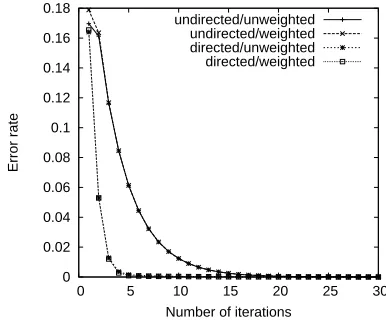
Although traditionally applied on directed graphs, a recursive graph-based ranking algorithm can be also applied to undirected graphs, in which case the out-degree of a vertex is equal to the in-out-degree of the ver-tex. For loosely connected graphs, with the number of edges proportional with the number of vertices, undirected graphs tend to have more gradual conver-gence curves.
Figure 1 plots the convergence curves for a ran-domly generated graph with 250 vertices and 250 edges, for a convergence threshold of 0.0001. As the connectivity of the graph increases (i.e. larger num-ber of edges), convergence is usually achieved after fewer iterations, and the convergence curves for di-rected and undidi-rected graphs practically overlap.
2.2 Weighted Graphs
In the context of Web surfing, it is unusual for a page to include multiple or partial links to another page, and hence the original PageRank definition for graph-based ranking is assuming unweighted graphs. However, in our model the graphs are build from natural language texts, and may include multiple or partial links between the units (vertices) that are ex-tracted from text. It may be therefore useful to in-dicate and incorporate into the model the “strength”
of the connection between two vertices and as
a weight added to the corresponding edge that
connects the two vertices.
1
Convergence is achieved when the error rate for any vertex in the graph falls below a given threshold. The error rate of a vertex" $
is defined as the difference between the “real” score of the vertex
K #"%$?&
and the score computed at iteration , #"%$#&
. Since the real score is not known apriori, this error rate is ap-proximated with the difference between the scores computed at two successive iterations:
#"%$#& +0. #"%$#& .
0 0.02 0.04 0.06 0.08 0.1 0.12 0.14 0.16 0.18
0 5 10 15 20 25 30
Error rate
Number of iterations
Convergence curves (250 vertices, 250 edges)
[image:2.612.325.518.39.199.2]undirected/unweighted undirected/weighted directed/unweighted directed/weighted
Figure 1: Convergence curves for graph-based
ranking: directed/undirected, weighted/unweighted graph, 250 vertices, 250 edges.
Consequently, we introduce a new formula for graph-based ranking that takes into account edge weights when computing the score associated with a vertex in the graph. Notice that a similar formula can be defined to integrate vertex weights.
K #"%$&'( *)!+-.&/0-21 3
;
H
5879.:<;=?>
H
=
3
H
H ! #"
4
&
Figure 1 plots the convergence curves for the same sample graph from section 2.1, with random weights in the interval 0–10 added to the edges. While the fi-nal vertex scores (and therefore rankings) differ sig-nificantly as compared to their unweighted alterna-tives, the number of iterations to convergence and the shape of the convergence curves is almost identical for weighted and unweighted graphs.
2.3 Text as a Graph
To enable the application of graph-based ranking algorithms to natural language texts, we have to build a graph that represents the text, and intercon-nects words or other text entities with meaningful
relations. Depending on the application at hand,
text units of various sizes and characteristics can be added as vertices in the graph, e.g. words, colloca-tions, entire sentences, or others. Similarly, it is the application that dictates the type of relations that are used to draw connections between any two such ver-tices, e.g. lexical or semantic relations, contextual overlap, etc.
1. Identify text units that best define the task at hand, and add them as vertices in the graph.
2. Identify relations that connect such text units, and use these relations to draw edges between vertices in the graph. Edges can be directed or undirected, weighted or unweighted.
3. Iterate the graph-based ranking algorithm until con-vergence.
4. Sort vertices based on their final score. Use the val-ues attached to each vertex for ranking/selection de-cisions.
In the following, we investigate and evaluate the application of TextRank to two natural language pro-cessing tasks involving ranking of text units: (1) A keyword extraction task, consisting of the selection of keyphrases representative for a given text; and (2) A sentence extraction task, consisting of the identi-fication of the most “important” sentences in a text, which can be used to build extractive summaries.
3 Keyword Extraction
The task of a keyword extraction application is to au-tomatically identify in a text a set of terms that best describe the document. Such keywords may consti-tute useful entries for building an automatic index for a document collection, can be used to classify a text, or may serve as a concise summary for a given doc-ument. Moreover, a system for automatic identifica-tion of important terms in a text can be used for the problem of terminology extraction, and construction of domain-specific dictionaries.
The simplest possible approach is perhaps to use a frequency criterion to select the “important” key-words in a document. However, this method was generally found to lead to poor results, and conse-quently other methods were explored. The state-of-the-art in this area is currently represented by super-vised learning methods, where a system is trained to recognize keywords in a text, based on lexical and syntactic features. This approach was first suggested in (Turney, 1999), where parametrized heuristic rules are combined with a genetic algorithm into a sys-tem for keyphrase extraction - GenEx - that automat-ically identifies keywords in a document. A different learning algorithm was used in (Frank et al., 1999), where a Naive Bayes learning scheme is applied on the document collection, with improved results ob-served on the same data set as used in (Turney, 1999). Neither Turney nor Frank report on the recall of their systems, but only on precision: a 29.0% preci-sion is achieved with GenEx (Turney, 1999) for five keyphrases extracted per document, and 18.3% pre-cision achieved with Kea (Frank et al., 1999) for fif-teen keyphrases per document.
More recently, (Hulth, 2003) applies a super-vised learning system to keyword extraction from
ab-stracts, using a combination of lexical and syntactic features, proved to improve significantly over previ-ously published results. As Hulth suggests, keyword extraction from abstracts is more widely applicable than from full texts, since many documents on the Internet are not available as full-texts, but only as abstracts. In her work, Hulth experiments with the approach proposed in (Turney, 1999), and a new ap-proach that integrates part of speech information into the learning process, and shows that the accuracy of the system is almost doubled by adding linguistic knowledge to the term representation.
In this section, we report on our experiments in keyword extraction using TextRank, and show that the graph-based ranking model outperforms the best published results in this problem. Similar to (Hulth, 2003), we are evaluating our algorithm on keyword extraction from abstracts, mainly for the purpose of allowing for a direct comparison with the results she reports with her keyphrase extraction system. Notice that the size of the text is not a limitation imposed by our system, and similar results are expected with TextRank applied on full-texts.
3.1 TextRank for Keyword Extraction
The expected end result for this application is a set of words or phrases that are representative for a given natural language text. The units to be ranked are therefore sequences of one or more lexical units ex-tracted from text, and these represent the vertices that are added to the text graph. Any relation that can be defined between two lexical units is a potentially useful connection (edge) that can be added between two such vertices. We are using a co-occurrence re-lation, controlled by the distance between word oc-currences: two vertices are connected if their corre-sponding lexical units co-occur within a window of
maximum words, where can be set anywhere
from 2 to 10 words. Co-occurrence links express relations between syntactic elements, and similar to the semantic links found useful for the task of word sense disambiguation (Mihalcea et al., 2004), they represent cohesion indicators for a given text.
The vertices added to the graph can be restricted with syntactic filters, which select only lexical units of a certain part of speech. One can for instance con-sider only nouns and verbs for addition to the graph, and consequently draw potential edges based only on relations that can be established between nouns and verbs. We experimented with various syntactic fil-ters, including: all open class words, nouns and verbs only, etc., with best results observed for nouns and adjectives only, as detailed in section 3.2.
Compatibility of systems of linear constraints over the set of natural numbers. Criteria of compatibility of a system of linear Diophantine equations, strict inequations, and nonstrict inequations are considered. Upper bounds for components of a minimal set of solutions and algorithms of construction of minimal generating sets of solutions for all types of systems are given. These criteria and the corresponding algorithms for constructing a minimal supporting set of solutions can be used in solving all the considered types systems and systems of mixed types.
types systems
linear
diophantine
constraints system
compatibility criteria
numbers natural
equations
strict inequations nonstrict
upper
bounds
components
algorithms solutions
sets
minimal
construction
Keywords assigned by TextRank:
Keywords assigned by human annotators:
linear constraints; linear diophantine equations; natural numbers; nonstrict inequations; strict inequations; upper bounds
[image:4.612.76.288.90.312.2]strict inequations; set of natural numbers; strict inequations; upper bounds linear constraints; linear diophantine equations; minimal generating sets; non−
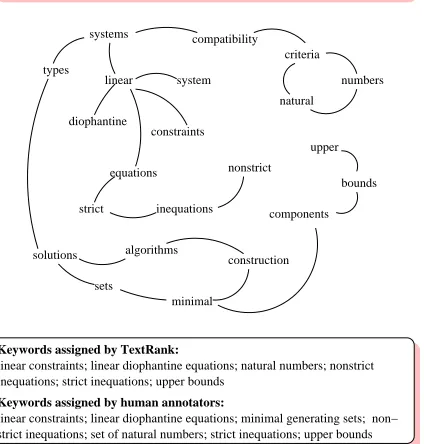
Figure 2: Sample graph build for keyphrase extrac-tion from an Inspec abstract
the text is tokenized, and annotated with part of speech tags – a preprocessing step required to enable the application of syntactic filters. To avoid exces-sive growth of the graph size by adding all possible combinations of sequences consisting of more than one lexical unit (ngrams), we consider only single words as candidates for addition to the graph, with multi-word keywords being eventually reconstructed in the post-processing phase.
Next, all lexical units that pass the syntactic filter are added to the graph, and an edge is added between those lexical units that co-occur within a window of words. After the graph is constructed (undirected unweighted graph), the score associated with each vertex is set to an initial value of 1, and the ranking algorithm described in section 2 is run on the graph for several iterations until it converges – usually for 20-30 iterations, at a threshold of 0.0001.
Once a final score is obtained for each vertex in the graph, vertices are sorted in reversed order of their
score, and the top vertices in the ranking are
re-tained for post-processing. While may be set to
any fixed value, usually ranging from 5 to 20 words (e.g. (Turney, 1999) limits the number of key-words extracted with his GenEx system to five), we are using a more flexible approach, which decides
the number of keywords based on the size of the text. For the data used in our experiments, which consists
of relatively short abstracts, is set to a third of the
number of vertices in the graph.
During post-processing, all lexical units selected as potential keywords by the TextRank algorithm are marked in the text, and sequences of adjacent key-words are collapsed into a multi-word keyword. For instance, in the text Matlab code for plotting
ambi-guity functions, if both Matlab and code are selected
as potential keywords by TextRank, since they are adjacent, they are collapsed into one single keyword
Matlab code.
Figure 2 shows a sample graph built for an abstract from our test collection. While the size of the ab-stracts ranges from 50 to 350 words, with an average size of 120 words, we have deliberately selected a very small abstract for the purpose of illustration. For this example, the lexical units found to have higher “importance” by the TextRank algorithm are (with the TextRank score indicated in parenthesis): num-bers (1.46), inequations (1.45), linear (1.29), dio-phantine (1.28), upper (0.99), bounds (0.99), strict (0.77). Notice that this ranking is different than the one rendered by simple word frequencies. For the same text, a frequency approach provides the fol-lowing top-ranked lexical units: systems (4), types (3), solutions (3), minimal (3), linear (2), inequations (2), algorithms (2). All other lexical units have a fre-quency of 1, and therefore cannot be ranked, but only listed.
3.2 Evaluation
The data set used in the experiments is a collection of 500 abstracts from the Inspec database, and the corresponding manually assigned keywords. This is the same test data set as used in the keyword ex-traction experiments reported in (Hulth, 2003). The
Inspec abstracts are from journal papers from
Com-puter Science and Information Technology. Each
abstract comes with two sets of keywords assigned by professional indexers: controlled keywords, re-stricted to a given thesaurus, and uncontrolled key-words, freely assigned by the indexers. We follow the evaluation approach from (Hulth, 2003), and use the uncontrolled set of keywords.
In her experiments, Hulth is using a total of 2000 abstracts, divided into 1000 for training, 500 for
de-velopment, and 500 for test2. Since our approach
is completely unsupervised, no training/development data is required, and we are only using the test
docu-2
Assigned Correct
Method Total Mean Total Mean Precision Recall F-measure
TextRank
Undirected, Co-occ.window=2 6,784 13.7 2,116 4.2 31.2 43.1 36.2
Undirected, Co-occ.window=3 6,715 13.4 1,897 3.8 28.2 38.6 32.6
Undirected, Co-occ.window=5 6,558 13.1 1,851 3.7 28.2 37.7 32.2
Undirected, Co-occ.window=10 6,570 13.1 1,846 3.7 28.1 37.6 32.2
Directed, forward, Co-occ.window=2 6,662 13.3 2,081 4.1 31.2 42.3 35.9
Directed, backward, Co-occ.window=2 6,636 13.3 2,082 4.1 31.2 42.3 35.9
Hulth (2003)
Ngram with tag 7,815 15.6 1,973 3.9 25.2 51.7 33.9
NP-chunks with tag 4,788 9.6 1,421 2.8 29.7 37.2 33.0
[image:5.612.93.512.39.163.2]Pattern with tag 7,012 14.0 1,523 3.1 21.7 39.9 28.1
Table 1: Results for automatic keyword extraction using TextRank or supervised learning (Hulth, 2003)
ments for evaluation purposes.
The results are evaluated using precision, recall, and F-measure. Notice that the maximum recall that can be achieved on this collection is less than 100%, since indexers were not limited to keyword extrac-tion – as our system is – but they were also allowed to perform keyword generation, which eventually re-sults in keywords that do not explicitly appear in the text.
For comparison purposes, we are using the results of the state-of-the-art keyword extraction system re-ported in (Hulth, 2003). Shortly, her system consists of a supervised learning scheme that attempts to learn how to best extract keywords from a document, by looking at a set of four features that are determined for each “candidate” keyword: (1) within-document frequency, (2) collection frequency, (3) relative po-sition of the first occurrence, (4) sequence of part of speech tags. These features are extracted from both training and test data for all “candidate” keywords, where a candidate keyword can be: Ngrams (uni-grams, bi(uni-grams, or trigrams extracted from the ab-stracts), NP-chunks (noun phrases), patterns (a set of part of speech patterns detected from the keywords attached to the training abstracts). The learning sys-tem is a rule induction syssys-tem with bagging.
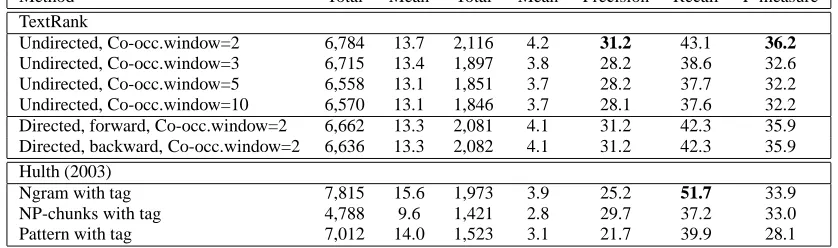
Our system consists of the TextRank approach de-scribed in Section 3.1, with a co-occurrence window-size set to two, three, five, or ten words. Table 1 lists the results obtained with TextRank, and the best re-sults reported in (Hulth, 2003). For each method, the table lists the total number of keywords assigned, the mean number of keywords per abstract, the total number of correct keywords, as evaluated against the set of keywords assigned by professional indexers, and the mean number of correct keywords. The table also lists precision, recall, and F-measure.
Discussion. TextRank achieves the highest preci-sion and F-measure across all systems, although the recall is not as high as in supervised methods –
pos-sibly due the limitation imposed by our approach on the number of keywords selected, which is not made
in the supervised system3. A larger window does not
seem to help – on the contrary, the larger the win-dow, the lower the precision, probably explained by the fact that a relation between words that are further apart is not strong enough to define a connection in the text graph.
Experiments were performed with various syntac-tic filters, including: all open class words, nouns and adjectives, and nouns only, and the best performance was achieved with the filter that selects nouns and ad-jectives only. We have also experimented with a set-ting where no part of speech information was added to the text, and all words - except a predefined list of stopwords - were added to the graph. The re-sults with this setting were significantly lower than the systems that consider part of speech information, which corroborates with previous observations that linguistic information helps the process of keyword extraction (Hulth, 2003).
Experiments were also performed with directed graphs, where a direction was set following the natu-ral flow of the text, e.g. one candidate keyword “rec-ommends” (and therefore has a directed arc to) the candidate keyword that follows in the text, keeping the restraint imposed by the co-occurrence relation. We have also tried the reversed direction, where a lexical unit points to a previous token in the text. Table 1 includes the results obtained with directed graphs for a co-occurrence window of 2. Regard-less of the direction chosen for the arcs, results tained with directed graphs are worse than results ob-tained with undirected graphs, which suggests that despite a natural flow in running text, there is no nat-ural “direction” that can be established between
co-3The fact that the supervised system does not have the
occurring words.
Overall, our TextRank system leads to an F-measure higher than any of the previously proposed systems. Notice that TextRank is completely unsu-pervised, and unlike other supervised systems, it re-lies exclusively on information drawn from the text itself, which makes it easily portable to other text col-lections, domains, and languages.
4 Sentence Extraction
The other TextRank application that we investigate consists of sentence extraction for automatic sum-marization. In a way, the problem of sentence extrac-tion can be regarded as similar to keyword extracextrac-tion, since both applications aim at identifying sequences that are more “representative” for the given text. In keyword extraction, the candidate text units consist of words or phrases, whereas in sentence extraction, we deal with entire sentences. TextRank turns out to be well suited for this type of applications, since it allows for a ranking over text units that is recursively computed based on information drawn from the en-tire text.
4.1 TextRank for Sentence Extraction
To apply TextRank, we first need to build a graph as-sociated with the text, where the graph vertices are representative for the units to be ranked. For the task of sentence extraction, the goal is to rank entire sen-tences, and therefore a vertex is added to the graph for each sentence in the text.
The co-occurrence relation used for keyword ex-traction cannot be applied here, since the text units in consideration are significantly larger than one or few words, and “co-occurrence” is not a meaningful rela-tion for such large contexts. Instead, we are defining a different relation, which determines a connection between two sentences if there is a “similarity” re-lation between them, where “similarity” is measured as a function of their content overlap. Such a rela-tion between two sentences can be seen as a process of “recommendation”: a sentence that addresses cer-tain concepts in a text, gives the reader a “recom-mendation” to refer to other sentences in the text that address the same concepts, and therefore a link can be drawn between any two such sentences that share common content.
The overlap of two sentences can be determined simply as the number of common tokens between the lexical representations of the two sentences, or it can be run through syntactic filters, which only count words of a certain syntactic category, e.g. all open class words, nouns and verbs, etc. Moreover, to avoid promoting long sentences, we are using a normalization factor, and divide the content overlap
10: The storm was approaching from the southeast with sustained winds of 75 mph gusting to 92 mph.
11: "There is no need for alarm," Civil Defense Director Eugenio Cabral said in a television alert shortly after midnight Saturday.
12: Cabral said residents of the province of Barahona should closely follow Gilbert’s movement. 13: An estimated 100,000 people live in the province, including 70,000 in the city of Barahona, about 125 miles west of Santo Domingo.
14. Tropical storm Gilbert formed in the eastern Carribean and strenghtened into a hurricaine Saturday night.
15: The National Hurricaine Center in Miami reported its position at 2 a.m. Sunday at latitude 16.1 north, longitude 67.5 west, about 140 miles south of Ponce, Puerto Rico, and 200 miles southeast of Santo Domingo.
16: The National Weather Service in San Juan, Puerto Rico, said Gilbert was moving westard at 15 mph with a "broad area of cloudiness and heavy weather" rotating around the center of the storm.
17. The weather service issued a flash flood watch for Puerto Rico and the Virgin Islands until at least 6 p.m. Sunday.
18: Strong winds associated with the Gilbert brought coastal flooding, strong southeast winds, and up to 12 feet to Puerto Rico’s south coast.
19: There were no reports on casualties.
20: San Juan, on the north coast, had heavy rains and gusts Saturday, but they subsided during the night.
21: On Saturday, Hurricane Florence was downgraded to a tropical storm, and its remnants pushed inland from the U.S. Gulf Coast.
22: Residents returned home, happy to find little damage from 90 mph winds and sheets of rain. 23: Florence, the sixth named storm of the 1988 Atlantic storm season, was the second hurricane. 24: The first, Debby, reached minimal hurricane strength briefly before hitting the Mexican coast last month.
8: Santo Domingo, Dominican Republic (AP)
9: Hurricaine Gilbert Swept towrd the Dominican Republic Sunday, and the Civil Defense alerted its heavily populated south coast to prepare for high winds, heavy rains, and high seas.
4: BC−Hurricaine Gilbert, 0348 3: BC−HurricaineGilbert, 09−11 339
5: Hurricaine Gilbert heads toward Dominican Coast 6: By Ruddy Gonzalez
7: Associated Press Writer
22 23
0.15
0.30
0.59
0.15
0.14
0.27
0.15 0.16
0.29 0.15 0.35 0.55 0.19 0.15
[1.83] [1.20]
[0.99]
[0.56] [0.70] [0.15] [0.15]
[0.93] [0.76] [1.09] [1.36] [1.65] [0.70]
[1.58]
[0.80]
[0.15] [0.84] [1.02]
[0.70]
24 [0.71] [0.50]
21
20
19
18
17 16
15 14 13
12 11
10 9 8 7 6 5 4
Hurricane Gilbert swept toward the Dominican Republic Sunday, and the Civil De− fense alerted its heavily populated south coast to prepare for high winds, heavy rains and high seas. The National Hurricane Center in Miami reported its position at 2 a.m. Sunday at latitude 16.1 north, longitude 67.5 west, about 140 miles south of Ponce, Puerto Rico, and 200 miles southeast of Santo Domingo. The National Weather Service in San Juan, Puerto Rico, said Gilbert was moving westward at 15 mph with a "broad area of cloudiness and heavy weather" rotating around the center of the storm. Strong winds associated with Gilbert brought coastal flooding, strong southeast winds and up to 12 feet to Puerto Rico’s south coast.
TextRank extractive summary
Hurricane Gilbert is moving toward the Dominican Republic, where the residents of the south coast, especially the Barahona Province, have been alerted to prepare for
Carribean and became a hurricane on Saturday night. By 2 a.m. Sunday it was about 200 miles southeast of Santo Domingo and moving westward at 15 mph with winds of 75 mph. Flooding is expected in Puerto Rico and in the Virgin Islands. The second hurricane of the season, Florence, is now over the southern United States and down− graded to a tropical storm.
Tropical storm Gilbert in the eastern Carribean strenghtened into a hurricane Saturday night. The National Hurricane Center in Miami reported its position at 2 a.m. Sunday to be about 140 miles south of Puerto Rico and 200 miles southeast of Santo Domingo. It is moving westward at 15 mph with a broad area of cloudiness and heavy weather with sustained winds of 75 mph gusting to 92 mph. The Dominican Republic’s Civil Defense
in San Juan, Puerto Rico issued a flood watch for Puerto Rico and the Virgin Islands until at least 6 p.m. Sunday.
alerted that country’s heavily populated south coast and the National Weather Service heavy rains, and high wind and seas. Tropical storm Gilbert formed in the eastern
Manual abstract I
[image:6.612.316.530.28.478.2]Manual abstract II
of two sentences with the length of each sentence.
Formally, given two sentences and , with a
sentence being represented by the set of words
that appear in the sentence:
$
,
the similarity of and is defined as:
K 2
$
4
!#"$%
$
&' !#"$%
4
&
Other sentence similarity measures, such as string kernels, cosine similarity, longest common subse-quence, etc. are also possible, and we are currently evaluating their impact on the summarization perfor-mance.
The resulting graph is highly connected, with a weight associated with each edge, indicating the strength of the connections established between var-ious sentence pairs in the text. The text is therefore represented as a weighted graph, and consequently we are using the weighted graph-based ranking for-mula introduced in Section 2.2.
After the ranking algorithm is run on the graph, sentences are sorted in reversed order of their score, and the top ranked sentences are selected for inclu-sion in the summary.
Figure 3 shows a text sample, and the associated weighted graph constructed for this text. The fig-ure also shows sample weights attached to the edges
connected to vertex 94, and the final TextRank score
computed for each sentence. The sentences with the highest rank are selected for inclusion in the abstract. For this sample article, the sentences with id-s 9, 15, 16, 18 are extracted, resulting in a summary of about 100 words, which according to automatic evaluation measures, is ranked the second among summaries produced by 15 other systems (see Section 4.2 for evaluation methodology).
4.2 Evaluation
We evaluate the TextRank sentence extraction algo-rithm on a single-document summarization task, us-ing 567 news articles provided durus-ing the Document Understanding Evaluations 2002 (DUC, 2002). For each article, TextRank generates an 100-words sum-mary — the task undertaken by other systems partic-ipating in this single document summarization task.
For evaluation, we are using the ROUGE
evalu-ation toolkit, which is a method based on Ngram statistics, found to be highly correlated with hu-man evaluations (Lin and Hovy, 2003). Two hu- manu-ally produced reference summaries are provided, and
used in the evaluation process5.
4
Weights are listed to the right or above the edge they cor-respond to. Similar weights are computed for each edge in the graph, but are not displayed due to space restrictions.
5
ROUGE is available at http://www.isi.edu/˜cyl/ROUGE/.
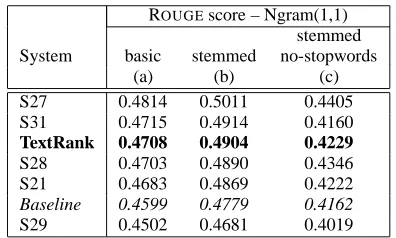
Fifteen different systems participated in this task, and we compare the performance of TextRank with the top five performing systems, as well as with the baseline proposed by the DUC evaluators – consist-ing of a 100-word summary constructed by takconsist-ing the first sentences in each article. Table 2 shows the results obtained on this data set of 567 news articles, including the results for TextRank (shown in bold), the baseline, and the results of the top five perform-ing systems in the DUC 2002 sperform-ingle document sum-marization task (DUC, 2002).
ROUGEscore – Ngram(1,1) stemmed
System basic stemmed no-stopwords
(a) (b) (c)
S27 0.4814 0.5011 0.4405
S31 0.4715 0.4914 0.4160
TextRank 0.4708 0.4904 0.4229
S28 0.4703 0.4890 0.4346
S21 0.4683 0.4869 0.4222
Baseline 0.4599 0.4779 0.4162
[image:7.612.326.524.169.288.2]S29 0.4502 0.4681 0.4019
Table 2: Results for single document summarization: TextRank, top 5 (out of 15) DUC 2002 systems, and baseline. Evaluation takes into account (a) all words; (b) stemmed words; (c) stemmed words, and no stop-words.
Discussion. TextRank succeeds in identifying the most important sentences in a text based on infor-mation exclusively drawn from the text itself. Un-like other supervised systems, which attempt to learn what makes a good summary by training on collec-tions of summaries built for other articles, TextRank is fully unsupervised, and relies only on the given text to derive an extractive summary, which repre-sents a summarization model closer to what humans are doing when producing an abstract for a given document.
Notice that TextRank goes beyond the sentence “connectivity” in a text. For instance, sentence 15 in the example provided in Figure 3 would not be iden-tified as “important” based on the number of connec-tions it has with other vertices in the graph, but it is identified as “important” by TextRank (and by hu-mans – see the reference summaries displayed in the same figure).
Another important aspect of TextRank is that it gives a ranking over all sentences in a text – which means that it can be easily adapted to extracting very short summaries (headlines consisting of one
sentence), or longer more explicative summaries,
consisting of more than 100 words. We are also
investigating combinations of keyphrase and sen-tence extraction techniques as a method for building short/long summaries.
Finally, another advantage of TextRank over previ-ously proposed methods for building extractive sum-maries is the fact that it does not require training cor-pora, which makes it easily adaptable to other lan-guages or domains.
5 Why TextRank Works
Intuitively, TextRank works well because it does not only rely on the local context of a text unit (vertex), but rather it takes into account information recur-sively drawn from the entire text (graph).
Through the graphs it builds on texts, TextRank identifies connections between various entities in a text, and implements the concept of
recommenda-tion. A text unit recommends other related text units, and the strength of the recommendation is re-cursively computed based on the importance of the units making the recommendation. For instance, in the keyphrase extraction application, co-occurring words recommend each other as important, and it is the common context that enables the identification of connections between words in text. In the process of identifying important sentences in a text, a sentence recommends another sentence that addresses similar concepts as being useful for the overall understand-ing of the text. The sentences that are highly recom-mended by other sentences in the text are likely to be more informative for the given text, and will be therefore given a higher score.
An analogy can be also drawn with PageRank’s “random surfer model”, where a user surfs the Web by following links from any given Web page. In the context of text modeling, TextRank implements what we refer to as “text surfing”, which relates to the con-cept of text cohesion (Halliday and Hasan, 1976):
from a certain concept in a text, we are likely to
“follow” links to connected concepts – that is, con-cepts that have a relation with the current concept (be that a lexical or semantic relation). This also re-lates to the “knitting” phenomenon (Hobbs, 1974): facts associated with words are shared in different parts of the discourse, and such relationships serve to “knit the discourse together”.
Through its iterative mechanism, TextRank goes beyond simple graph connectivity, and it is able to score text units based also on the “importance” of other text units they link to. The text units selected by TextRank for a given application are the ones most recommended by related text units in the text, with preference given to the recommendations made by
most influential ones, i.e. the ones that are in turn highly recommended by other related units. The un-derlying hypothesis is that in a cohesive text frag-ment, related text units tend to form a “Web” of con-nections that approximates the model humans build about a given context in the process of discourse un-derstanding.
6 Conclusions
In this paper, we introduced TextRank – a graph-based ranking model for text processing, and show how it can be successfully used for natural language applications. In particular, we proposed and eval-uated two innovative unsupervised approaches for keyword and sentence extraction, and showed that the accuracy achieved by TextRank in these applica-tions is competitive with that of previously proposed state-of-the-art algorithms. An important aspect of TextRank is that it does not require deep linguistic knowledge, nor domain or language specific anno-tated corpora, which makes it highly portable to other domains, genres, or languages.
References
S. Brin and L. Page. 1998. The anatomy of a large-scale hyper-textual Web search engine. Computer Networks and ISDN Systems, 30(1–7).
DUC. 2002. Document understanding conference 2002. http://www-nlpir.nist.gov/projects/duc/.
E. Frank, G. W. Paynter, I. H. Witten, C. Gutwin, and C. G. Nevill-Manning. 1999. Domain-specific keyphrase extrac-tion. In Proceedings of the 16th International Joint Confer-ence on Artificial IntelligConfer-ence.
M. Halliday and R. Hasan. 1976. Cohesion in English. Long-man.
P.J. Herings, G. van der Laan, and D. Talman. 2001. Measuring the power of nodes in digraphs. Technical report, Tinbergen Institute.
J. Hobbs. 1974. A model for natural language semantics. Part I: The model. Technical report, Yale University.
A. Hulth. 2003. Improved automatic keyword extraction given more linguistic knowledge. In Proceedings of the 2003 Con-ference on Empirical Methods in Natural Language Process-ing, Japan, August.
J.M. Kleinberg. 1999. Authoritative sources in a hyperlinked environment. Journal of the ACM, 46(5):604–632.
C.Y. Lin and E.H. Hovy. 2003. Automatic evaluation of sum-maries using n-gram co-occurrence statistics. In Proceedings of Human Language Technology Conference (HLT-NAACL 2003), Edmonton, Canada, May.
R. Mihalcea, P. Tarau, and E. Figa. 2004. PageRank on semantic networks, with application to word sense disambiguation. In Proceedings of the 20st International Conference on Compu-tational Linguistics (COLING 2004), Geneva, Switzerland. R. Mihalcea. 2004. Graph-based ranking algorithms for
sen-tence extraction, applied to text summarization. In Pro-ceedings of the 42nd Annual Meeting of the Association for Computational Lingusitics (ACL 2004) (companion volume), Barcelona, Spain.