A query tool for syntactically a n n o t a t e d corpora*
L a u r a K a l l m e y e r U F R L , Universit4 Paris 7
2, place Jussieu 75251 Paris cedex 05
l m a r a ,
kallmeyer@linguist, jussieu,
f rA b s t r a c t ;
This paper presents a query tool for syntacti- caUy ~.nnotated corpora. T h e query tool is de- veloped to search t h e Verbmobil treebanks an- notated at the University of Tfibingen. How- ever, in principle it also can be adapted to other corpora such as the Negra Corpus, the P e n n Treebank or the French treebank devel- oped in Paris. T h e tool uses a query language that allows to search for tokens, syntactic cat- egories, grammatical functions a n d binary re- lations of (immediate) dominance and linear precedence between nodes. T h e overall idea is to extract in an initializing phase the rele- vant information from the corpus and store it in a relational database. An incoming query is then translated into a corresponding SQL query that is evaluated on the database.
1 I n t r o d u c t i o n
1.1 S y n t a c t i c a n n o t a t i o n a n d l i n g u i s t i c r e s e a r c h
W i t h t h e increasing availability of large amounts of electronic texts, linguists have ac- cess to more and more material for empiri- cally based linguistic research. Furthermore, electronic corpora are more a n d more richly a n n o t a t e d and thereby more a n d more de- tailed and structured information contained in the corpora becomes accessable. Currently many corpora are tagged with morphosyntac- tic categories (part-of-speech) a n d there are already several syntactically a n n o t a t e d cor- pora. Examples are the Penn Treebank (Mar- cus et al., 1994; Bies et al., 1995) annotated at the University of Pennsylvania, the Ne- gra corpus (Brauts et al., 1999) developed in Saarbriicken, the Verbmobil treebank~ (Hin- richs et al., 2000) annotated in Tiibingen *The work presented here was done as part of a project in SFB 441 "Linguistic Data Structures" at the University of Tiibingen.
and the French treebank a n n o t a t e d in Paris (Abeill4 and C14ment, 1999).
However, in order to have access to these rich linguistic annotations, adequate query tools are needed.
In the following, an example of a linguisti- cally relevant construction is considered that illustrates how useful access to structural in- formation in a corpus might be.
fiber C h o m s k y h a b e ich ein Buch about C h o m s k y have I a book (1) gelesen
read
'I have read a book a b o u t Chomsky' Linguists are often concerned with con- structions t h a t seem not very natural and where intuitions about grammaticality fail. An example is (1) where we have an accusative object
(ein Buch)
which is positioned between the two verbal elements a n d whose modifier (the prepositional phraseiiber Chomsky)
is topicailzed.Some people claim (1) to be ungrammatical whereas other people are inclined to accept it. In these cases it is very useful to search in an adequate corpus for more natural data show- ing the same construction (see also (Meurers, 1999) for other ex~.mples of t h e use of corpora for linguistic research).
In order to find structures like (1) in a Ger- m a n corpus, one needs to search for
(a) a prepositional phrase modifying the ac- cusative object a n d preceding t h e finite verb (i.e. in the so-called
vorfeld), and
(b) an accusative object between finite verband infinite verb forms (i.e. in t h e so-
called rnittelfeld)
(a) and (b). On the other hand, one needs a query tool with a query language that allows to express the properties (a) and (b).
Corpora encoding features such as (a) and (b) are for example the Verbmobil treebanks. 1.2 C u r r e n t q u e r y t o o l s
Query tools such as xkwic (Christ, 1994) that allow to search on the tokens and their part- of-speech categories using regular expressions do not allow a direct search on the syntac- tic annotation structures of the corpus, i.e. a search for specific relations between nodes in the annotation such as dominance or linear precedence. Therefore many queries a linguist would like to ask using a syntactically anno- tated corpus either cannnot be expressed in a regular expression based language or at least cannot be expressed in an intuitive way.
Even more recent query languages as SgmlQL (Le Maitre et al., 1998) and XML-QL (Deutsch et al., 1999) that refer to the SGML or XML annotation of a corpus are in gen- eral not adequate for syntactically annotated corpora: if the annotations are trees and the nesting of SGML/XML elements encodes the tree structure, such query languages work nicely. With regular path expressions as sup- ported by XML-QL, it is possible to search not only for parent but also for dominance relations. However, in order to deal with discontinuous constituents, most syntactically annotated corpora do not contain trees b u t slightly different data structures. The P e n n Treebank for example consists of trees with an additional coindexation relation, Negra al- lows crossing branches and in Verbmobil, an element (a tree-like structure) in the corpus might contain completely disconnected nodes. In order to express these annotations in XML, one has to encode for example each node and each edge as a single element as in (Mengel and Lezius, 2000). But t h e n a query for a dominance relation can no longer be formu- lated with a regular p a t h expression.
In this paper, I propose a query tool that allows to search for parent, dominance a n d linear precedence relations even in corpora an- notated with structures slightly different from trees.
2 T h e V e r b m o b i l t r e e b a n k s
The German Verbmobil corpus (Stegmann et al., 1998; Hinrichs et al., 2000) is a tree- bank annotated at the University of Tiibingen
S I M P X
I
VF !
I
PX - - I
I
NX
I
D
I IA P P R NE
fiber C.
I
I I
LK VC
I
I
I
V X F I N N X V X I N F
I
I
I
I I [
V A F I N PPER VVPP
habe ich gel~en
±
I MF
I
I
NXI
I
I I ART NN
ein Buch
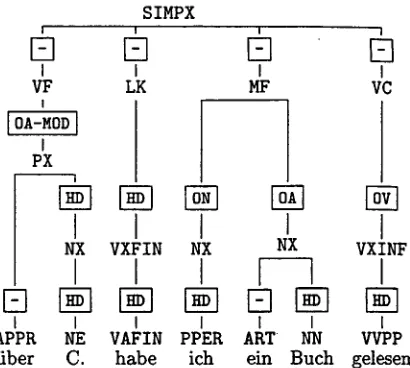
Figure 1: A n n o t a t i o n of (1) in Verbmobil for- mat
that contains approx. 38.000 trees (or rather tree-like annotation structures since, as al- ready mentioned, the structures are not al- ways trees). The corpus consists of spoken texts restricted to the d o m a i n of arrangement of business appointments.
The Verbmobil corpus is part-of-speech tagged using the S t u t t g a r t Tiibingen tagset (STTS) described in (Schiller et al., 1995).
One of the design decisions in Verbmobil was that for the purpose of reusability of the treebank, the annotation scheme should not reflect a c o m m i t m e n t to a particular syntac- tic theory. Therefore a surface-oriented am notation scheme was a d o p t e d that is inspired by the notion of topological fields in the sense of (HShle, 1985). T h e discontinuous position- ing of the verbal elements in verb-first and verb-second sentences (as in (1) for example) is the traditional reason to structure the Ger- m a n sentence by means of topological fields: T h e verbal elements have the categories LK
( linke Klammer)
and VC (verbal complex), and roughly everything preceding the LK forms the 'voffeld' VF, everything between LK and vc forms the 'mittelfeld' MF a n d t h e 'nachfeld' NF follows the verbal complex. [image:2.596.330.535.63.247.2]pendency relations are expressed within the • grammatical functions (e.g. OA-MOD for a con-
stituent modifying the accusative object). A sample annotation conformant to the Verbmobil annotation scheme is the annota- tion of (1) shown in Fig. 1. (The elements set in boxes are edge labels.)
In order to search for structures as in Fig. 1, one needs to search for trees containing a node n l with label PX and grammatical function 0A-MOD, a node n2 with label VF that domi- nates nl, a node n3 with label MF and a node n4 with label NX and gra.mmatical function 0A that is immediately d o m i n a t e d by n3.
Evaluating a query for structures as in Fig. 1 on the Verbmobil corpus gives results such as (2) t h a t sound much more natural t h a n the constructed example (1).
• t j a , fiber Flugverbindungen habe ich about flight connections have I (2) leider keine I n f o r m a t i o n .
unfortunately no information 'unfortunately I have no information about flight connections.'
This example illustrates the usefulness of syntactic annotations for linguistic research • a n d it shows the need of query languages and query tools that allow access to these annota- tions.
3 T h e q u e r y l a n g u a g e 3.1 S y n t a x
As query language for the G e r m a n Verbmo- bil corpus, a first order logic w i t h o u t quan- tification is chosen where variables are inter- preted as existentially quantified. Negation is only allowed for atomic formula. It seems t h a t even this very simple logic already gives a high degree of expressive power with respect to the queries linguists are interested in (see for example (Kallmeyer, 2000) for theoretical investigations of query languages). However, it might be t h a t at a later stage t h e query language will be extended.
Let C (the node labels, i.e. syntactic cate- gories and part-of-speech categories), E (the edge labels, i.e. grammatical functions) and T (the terminals, i.e. tokens) be pairwise disjoint finite sets. >, >>, . . are constants for the binary relations immediate dominance (par- ent relation), dominance (reflexive transitive closure of immediate dominance) and linear precedence. T h e set 1N of n a t u r a l numbers is
used as variables. Further, ~,
I,
! are logi- cal connectives (conjunction, disjunction, and negation).D e f i n i t i o n 1 ((C, E, T ) - q u e r i e s ) ( C, E , T)-queries are inductively defined:
(a) for all i E IN, t E T :
t o k e n ( i ) = t and t o k e n ( i ) !=t are queries,
(b) for all i E IN, cE C:
c a t ( i ) = c and c a t ( i ) !=c are queries, (c) for all i E IN, eE E :
f c t ( i ) = e and f c t ( i ) ! = e are queries, (d) for all i , j E IN:
i > j a n d i !> j are queries, i >> j a n d i !>> j are queries, i . . j a n d i ! . . j are queries, (e) for all queries ql, q2:
ql ~ q2 and (ql I q2) are queries. Of course, when a d a p t i n g this language to another corpus, d e p e n d i n g on the specific an- notation scheme, other u n a r y or binary pred- icates might be a d d e d to t h e query language. This does not change t h e complexity of the query language in general.
However, it is also possible t h a t at a later point negation needs to be allowed in a general way or t h a t quantification needs to be added to the query language for linguistic reasons. Such modifications would affect the complex- ity of the language a n d t h e performance of the tool. Therefore t h e decision was taken to keep the language as simple as possible in the beginning.
3.2 I n t e n d e d m o d e l s
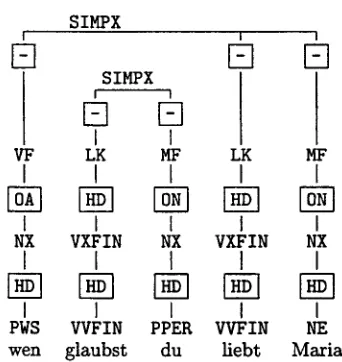
In the case of t h e G e r m a n Verbmobil corpus, the data structures are not trees, since struc- tures as in Fig. 2, which shows t h e annotation of the long-distance wh-movement in (3), can occur. T h e structure in Fig. 2 does not have a unique root node, a n d t h e two nodes with label SINPX have neither a dominance nor a linear precedence relation.
(3) wen glaubst d u liebt Maria w h o m believe you loves Maria 'whom do you believe Maria loves' Therefore, t h e models of our queries are de- fined as more general structures t h a n finite trees.
SIMPX
I I
D
D
VF MF
I
I
1 I
NX NX
I
I
I I
PWS NE
wen Maria
I
E3
SIMPX ]I I
D
[3
I I
LK MF LK
I
I
I
I I I
VXFIN NX VXFIN
I
I
I
I I I
W F I N PPER VVFIN glaubst du liebt
Figure 2: Annotation of (3) in Verbmobil for- mat
binary relations immediate dominance (par- ent), dominance and linear precedence, # is a function assigning syntactic categories or part-of-speech tags to nodes, r/ is a function mapping edges to grammatical functions, and a assigns tokens to the leaves (i.e. the nodes that do not dominate any other node).
, . ? ,
D e f i n i t i o n 2 ( Q u e r y model)
Let C, E and T be disjoint alphabets.
(ILl, 79, 73, £, #, rl, a) is a query model with cat- egories C, edge labels E and terminals T i f f
1. l~ is a finite set with Lt n (C U E U T ) = O, the set of nodes.
2. P , £ , 73 • ILl × U, such that:
(a) 79 is irreflexive, and for all x • ILl there is at most one v • ILl with
(v, x) • 79.
(b) 73 is the reflexive transitive closure of 79, and 73 is antisymmetric.
(c) £ is transitive.
(d) .for all x, y • lg: if (x, y) • £ , then
<~,
y) ¢ 73 and (u, x) ¢ 73.
(e)
for all
z , y • U:
(x,y) • £ i# for
all z, w • ld with (x, z), (y, w) • 73, (z, w) • £ holds.
(f) for all x, y, z • L(: i f (x, y), (x, z) • 73, then either (x, z) • 73 or (z, x) • 73 or
(x, z) • £ or (z, x) •
£.3. # : Lt ~ C is a total .function. 4. rl : 7 ~ ~ E is a total .function.
5. a : {u • Ltl there is no u' with (u,u') • 79} ~ T is a total .function.
With (b), (c) a n d (d), £ is also irreflexive and antisymmetric.
In contrast to finite trees, our query mod- els do not necessarily have a unique root node, i.e. a node that dominates all other nodes. Consequently, the so-called exhaus- tiveness property does not hold since two nodes in a query model might be completely disconnected. In other words, it does not hold in general that (x,y) • 73 or (y,x) • 73 or (x, y) • £ or (y, x) • £ for all x, y • / 4 . This holds only for nodes x, y • / 4 where a node z exists that dominates x and y.
3.3 S e m a n t i c s
Satisfiability of a query q by a query model M is defined in t h e classical model-theoretic way with respect to an injective assignment g mapping node variables to nodes in the query model.
D e f i n i t i o n 3 ( S a t i s f i a b i l i t y )
Let M = (Lt, P, 73, £ , #, rl, a) be a query model and let g : iN ~ Lt be an injective .function. For all i 6 iN, t 6 T, c6 C, e 6 E :
• M ~g t o k e n ( i ) = t i f f a ( g ( i ) ) = t .
• M ~ g t o k e n ( i ) ! = t i f f a ( g ( i ) ) #t.
• M ~g c a t ( i ) = c i f f # ( g ( i ) ) = c . • M ~g c a t ( i ) !=c iff ~(g(i)) ~ c .
• M ~ g f c t ( i ) = e iff there is a u 6 lg with ( u , g ( i ) ) 6 P and r/((u,g(i))) = e .
• M ~9 f c t ( ± ) !=e iffthere is no u 6 Lt with
(~,g(i)) e p and ~((~,g(i)>) = e
For all i , j 6 iN:
• i ~ g i > j iff ( g ( i ) , g ( j ) ) 6 7 9 (i.e. g(i) immediately dominates g ( j ) )
• M ~ 9 i !> j iff ( g ( i ) , g ( j ) ) ~ 79
• i ~g i >> j i f f ( g ( i ) , g ( j ) ) 6 73 (i.e. g(i) dominates g ( j ) )
• M E g i !>> j i f f ( g ( i ) , g ( j ) )
~73
• i ~ g i . . j iff ( g ( i ) , g ( j ) ) 6 £(i.e. gCi) is
le#
oSg(j))
• M ~ g
i
!..j
i f f ( g ( i ) , g ( j ) ) ~ £ For all queries ql, q2:• M ~ g q x a q2 i f f M ~ g q l a n d M ~ g q 2
• M ~a (ql I q2) i f f M ~ a ql o r M ~ g q2.
[image:4.596.98.269.59.240.2]node_pair_i[tree_id[no.dellnode2
[fi._id [
pair_class
[ clad [ n._idl [ ~ ~ pl[ p21 dl I d21 11[12 I
ode_c]ass [ n-id ] cat I fct I
tokens../[ tree_id [ n_A,d_.~ I word J
Figure 3: The relational database schema
As an example, consider the query for struc- tures as in (1) that is shown in (4). The struc- ture in Fig. 1 is a query model satisfying (4).
(4) cat(1)=PX & fct(1)=0A-MOD -g~ cat(2)=VF ~ 2>>1
c a t (3)=?IF ~ c a t (4) =NX & f c t ( 4 ) = 0 A ~ 3>>4
4 S t o r i n g t h e c o r p u s i n a d a t a b a s e As already mentioned, the general idea of the query tool is to store the information one wants to search for in a relational database and then to translate an expression in the query language presented in the previous sec- tion into an SQL expression that is evaluated on the database. The first part is performed by an initializing component and needs to be done only once per corpus, usually by the cor- pus administrator. The second part, i.e. the querying of the corpus, is performed by a query component.
The tool is implemented in Java with Java Database Connectivity (JDBC) as interface and mysql as database management system.
4.1 T h e r e l a t i o n a l d a t a b a s e s c h e m a The German Verbmobil corpus consist of sev- eral subcorpora. In the relational database there are two global tables, node_class and pair_class. Besides these, for each of the sub- corpora identified by i there are tables to- kens_/ and node_pair_/. The database schema is shown in Fig. 3. The arrows represent foreign keys. The colnmn cl_id in the ta- ble node_pair_/, for example, is a foreign key referring to the colnmn c l a d in the table pair_class. This means that each entry for clad in node_pair_/uniquely refers to One en- try for clad in pair_class.
The content of the tables is as follows:
• n o d e _ c l a s s contains node classes charac- terized by category (node label) and gram- matical function (edge label between the node and its mother). Each node class has a unique identifier, namely the column n_id.
• pair_class contains classes of node pairs characterized by the two node classes and the parent, dominance and linear prece- dence relation between the two nodes. The columns pl, p2, dl, d2, 11 and 12 stand for binary relations and have values 1 or 0 de- pending on whether the relation holds or not. p l signifies immediate dominance of the first node over the second, p2 immedi- ate dominance of the second over the first, d l dominance of the first over the second, etc. Each node pair class has a unique iden- tifier, namely its clad.
• tokens_/ contains all leaves from subcor- pus i with their tokens (word).
• n o d e _ p a i r _ / c o n t a i n s all node pairs from subcorpus i with their pair class. Of course, only pairs of nodes belonging to one single annotation structure are stored.
4.2 I n i t i a l i z i n g t h e d a t a b a s e
The storage of the corpus in the database is done by an initializing component. This com- ponent extracts information from the struc- tures in export format (the format used for the German Verbmobil corpus) and stores them in the database. The export format explicitly encodes tokens, categories and edge labels, linear precedence between leaves and the par- ent (immediate dominance) relation. Domi- nance and linear precedence in general how- ever need to be precompiled.
First the dominance relation is computed simply as reflexive transitive closure of the parent relation.
Linear precedence on the leaves can be im- mediately extracted from the export format. W h e n computing linear precedence for inter- nal nodes, the specific properties of the data structures in Verbmobil (see Section 3) must be taken into account. Unlike in finite trees, for two nodes Ul,U2, the fact that u l domi- nates some x and u2 dominates some y and x is left of y is not s,fl~cient to decide that Ul is left of u2. Instead (see axiom (e) in Def. 2) the following holds for two nodes ul, u2: ul is left of u2 iff for all x , y dominated by u l , u 2
respectively: x is left of y.
[image:5.596.91.330.63.194.2]s c h e i n b a r A D V - - H D 5 0 0
n i c h t P T K N E G - - H D 5 0 1
b e i d e s P I S - - H D 5 0 2
z u s a m m e n A D V - - HI) 503 $. - - - - 0
# 5 0 0 A D V X - - - 5 0 5
# 5 0 1 A D V X - - - 5 0 5 #502 N X - - H D 5 0 4 # 5 0 3 A D V X - - - 5 0 4
# 5 0 4 N X - - HI) 5 0 5
# 5 0 5 N X . . . . 0
# E 0 S 2 4
Corresponding structure: N X
I
I N X
I
.
B
B
@
I ] I I
ADVX ADVX NX ADVX
I l I I
I I I ]
A D V P T K N E G P I S A D V s c h e m b a r nicht beides zus.
Figure 4: E x p o r t format of sentence 24 in cd20 and corresponding structure
not reflect the concrete properties of the query model, in particular the properties of the bi- nary relations are not p a r t of the d a t a b a s e schema, e.g. considering only the database, the dominance and linear precedence relations are not necessarily trA.n~itive. Therefore, the query tool can b e easily a d a p t e d to other d a t a structures, for example to feature structures with reentrancy as annotations. In this case, a modification of the p a r t of the initializing component t h a t computes the binary relations would b e sufficient.
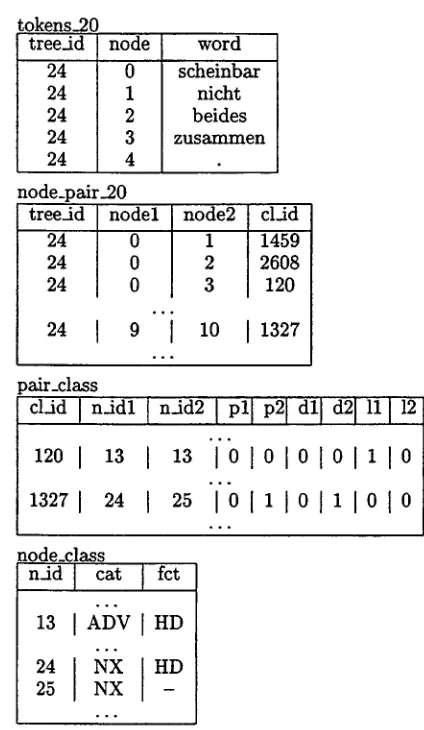
As an example, consider how sentence 24 in the s u b c o r p u s cd20 (identifier 20) is stored in the database. This sentence was chosen for the simple reason t h a t it is not t o o long b u t contains enough nodes to provide a useful example. Besides this, its construction and its tokens are not of any interest here.
Fig. 4 shows the sentence in its export for- mat, i.e. the way it originally occurs in the corpus, together with a picture of the corre- sponding structure. P a r t s of the tables in the
tokens_20 tree_id
24 24 24 24 24
node word 0 scheinbar
1 nicht
2 beides 3 zusammen 4
node_pair.20 treedd nodel
24 I 0
24 0
24 0
.,
24 I 9
pair_class
node2 clad 1 1459 2 2608
3 120
10 11327
did I nJdl nJd2 I pl I P21 dl I d21 11112
120 I 13
13 " l ' o l o l o l o l l l o
13271 24
25 I ' 0 1 1 1 0 1 1 1 0 1 0
°..node_class
n_id cat fct
...
13 ADV HD
°°.
24 NX HD
25 NX -
Figure 5: Sentence 24 in t h e d a t a b a s e
d a t a b a s e concerning sentence 24 are shown in Fig. 5. Each line in t h e export format cor- responds to one node. The nodes are as- signed numbers 0, 1, . . . in the order of the lines in the export format. T h e nodes with tokens (i.e. that are leaves) are inserted into the table tokens_20. Furthermore, each pair of nodes occurring in sentence 24 is inserted into the table node_pair_20 together with its pair class. Both orders of a pair are stored. 1 The pair classes and n o d e classes belonging to a pair can be found in t h e two global tables. Consider for example t h e nodes 9 a n d 10 in sentence 24 (the node labelled NX t h a t domi- nates beides z u s a m m e n and the t o p m o s t node with label NX). T h e c l a d of this pair is 1327. *In a previous version just one order was stored but it turned out that for some queries this causes an exponential time complexity depending on the number of variables occurring in the query. This problem is avoided storing both orders of a node pair.
[image:6.596.119.525.53.419.2] [image:6.596.318.530.55.420.2] [image:6.596.95.300.61.392.2]The corresponding entry in pair_class tells us that the second node is the :mother of the first, that the second dominates the first, and that there is no linear precedence relation between the two nodes. Furthermore, the node classes identified by n_idl a n d h a d 2 are such that the first node has label NX and grammatical func- tion HD whereas the second[ has label NX and no grammatical function.
4 . 3 T h e size o f t h e d a t a b a s e
So far, in order to test the tool, approximately one quarter of the G e r m a n Verbmobil corpus is stored in the database, namely the following subcorpora:
id sub- trees tokens pairs corpus
15 cdl5 1567 15474 1326416 20 cd20 2151 21069 1941056 21 cd21 2416 22360 1761082 22 cd22 1723 16587 1229324 24 cd24 2255 22763 2129548 The table pa~_class has 23024 entries and node_class has 213 entries. T h e following ta- ble shows the current size of the files:
Table d a t a file index file
(KS) (KB)
node_class pair_class tokens_15 tokens_20 tokens_21 tokens_22 tokens_24 node_pair_15 node_pair_20 node_pair_21 node_pair_22 node_pair_24
1 10
585 1500
303 293
413 403
439 423
325 311
446 430
9067 72556 13269 106377 12039 96383 8404 67153 14557 116694 5 S e a r c h i n g t h e c o r p u s
In order to search t h e corpus, one needs of course to know the specific properties of the annotation scheme. These are described in the STTS guidelines (Schiller et al., 1995) and the Verbmobil stylebook (Stegmann et al., 1998) that must be both available to any user of the query tool.
Currently, the query component does not yet process all possible expressions in the query language. In particular, it does not allow disjunctions a n d it does not allow to query for tokens. Other atomic queries com- bined with with negations and conjunctions are possible. In particular, complex syntac-
tic structures involving category and edge la- bels and binary relations can be searched. T h e query component will be completed very soon to process all queries defined in Section 3.
T h e query c o m p o n e n t takes an expression in the query language as i n p u t and trans- lates this into a corresponding SQL expres- sion, which is t h e n passed to t h e database.
As an example, consider again t h e query (4) repeated here as (5):
(5) cat(1)=PX & fct(1)=0A-MOD 8~ cat(2)=VF & 2>>1 & cat(3)=MF & cat(4)=NX ~ f c t ( 4 ) = 0 A & 3>>4
For query (5) as i n p u t performed on the subcorpus cd20, the query c o m p o n e n t pro- duces the following SQL query:
SELECT DISTINCT npl.tree_id
FROM
node_class AS ncl, node_class AS nc2, node_class AS nc3, node_class AS nc4, node_pair_20 AS npl, pair_class AS pc1, node_pair_20 AS np2, pair_class AS pc2 WHERE
ncl.cat='PX' AND ncl.fct='0A-MOD' AND nc2.cat='VF ' AND nc3.cat='MF'
AND n c 4 . c a t = ' N X ' AND n c 4 . f c t = ' 0 A ' AND pc1 . n _ i d l = n c 2 . n _ i d
AND pcl.n_id2=ncl.n_id AND pcl.dl=l AND pc2 .n_id1=nc3.n_id
AND pc2.n_id2=nc4.n_id AND pc2.dl=l AND npl. cl_id=pcl, c1_id
AND npl.tree_id=np2, tree_id AND np2. cl_id=pc2, cl_id;
As a second example consider t h e search for long distance wh-movements as in (3). T h e annotation of (3) using t h e Verbmobil annota- tion scheme was shown in Fig. 2. Such struc- tures might be characterized by t h e following properties: there is an interrogative p r o n o u n (part-of-speech tag PWS for s u b s t i t u t i n g inter- rogative pronoun) t h a t is part of a simplex clause and there is another simplex clause con- tainlng a finite verb such t h a t t h e two sim- plex clauses are not connected a n d t h e pro- n o u n precedes t h e finite verb. This leads to the query (6):
(6) cat(1)=PWS & cat(2)=SIMPX & 2>>1 & cat(3)=SIMPX & cat(4)=VVFIN & 2 ! > > 3 & 3 ! > > 2 & 2 ! . . 3 ~ 3 ! . . 2
Performed on cd20, (6) as input leads to the following SQL query:
SELECT DISTINCT npl.tree_id
FROM
node_class AS ncl, node_class AS nc2, node_class AS nc3, node_class AS nc4, node_pair_20 AS npl,
pair_class AS pcl, node_pair_20 AS np2, pair_class AS pc2, node_pair_20 AS np3, pair_class AS pc3, node_pair_20 AS np4, pair_class AS pc4 WHERE
ncl.cat='PWS' AND nc2.cat='SIMPX'
AND nc3.cat='SIMPX'
AND AND AND AND AND AND AND AND AND
.,AND
AND AND AND AND AND AND AND AND AND AND AND AND
nc4. cat='WFIN' pc I. n_idl=nc2, n_id
pcl.n_id2=ncl.n_id AND pcl.dl=l pc2.n_idl=nc2 .n_id
pc2. n_id2=nc3, n_id pc2.dl=O AND pc2.d2=O pc2.11=0 AND pc2.12=0 pc3. n_idl=nc 1.n_id
pc3.n_id2=nc4.n_id AND pc3.11=1 pc4. n_idl=nc3.n_id
pc4.n_id2=nc4.n_id AND pc4. d1=1 npl. cl_id=pc 1. cl_id
npl. nodel=np2, node 1 np 1. node2=np3, node 1 npl. tree_id=np2, tree_id np2. cl_id=pc2, cl_id np2. node2=np4, node 1 np2. tree_id=np3, tree_id np3. cl_id=pc3, cl_id np3. node 2=np4. node 2 np3. tree_id=np4, tree_id np4. cl_id=pc4, cl_id;
Currently the d a t a b a s e and the tool are running on a Pentium II PC 400MHz 128MB under Linux. On this machine, example (5) takes 1.46 sec to be answered by mysql, and example (6) takes 6.43 sec to be answered. This shows that although the queries, in par- ticular the last one, are quite complex and in- volve many intermediate results, the perfor- mauce of the system is quite efficient.
The performance of course depends cru- cially on the size of intermediate results. In cases where more than one node pair is searched for (as in the two examples above) the order of the pairs is important since the
result set of the first pair restricts the second pair. In (5) for example, first a node pair with a PX with function OA-MOD dominated by a VF is searched for. Afterwards, the search for the NX with function 0A in the lffF is restricted to those trees that were found when searching for the first pair. Obviously, the first pair is much more restrictive t h a n the second. If the order is reversed, the query takes much more time to process. Currently the ordering of the pairs needs to be done by the user, i.e. depends on the incoming query. However, we plan to implement at least partly an ordering of the binary conjuncts in the query depending on the frequency of the syntactic categories and grammatical functions involved in the pairs.
The obvious advantage of using a relational database to store the corpus is that some parts of the work are taken over by the database management system such as the search of the corpus. Furthermore, and this is crucial, the indexing functionalities of the database man- agement system can be used to increase the performance of the tool, e.g. indexes are put on clad in node_pair_/and on nAdl and had2 in pair_class.
6 C o n c l u s i o n a n d f u t u r e w o r k
In this paper, I have presented a query tool for syntactically annotated corpora that is devel- oped for the German Verbmobil treebank an- notated at the University of Tiibingen. The key idea is to extract in an initializing phase the information one wants to search for from the corpus and to store it in a relational database. The search itself is done by trans- lating an input query that is an expression in a simple quantifier free first order logic into an SQL query that is then passed to the database system.
An obvious advantage of this architecture is that a considerable amount of work is taken over by the database management system and therefore needs not to be implemented. Fur- thermore, the mysql indexing functionalities can be used to directly affect the performance of the search.
dering mechanism on binary conjuncts in or- der to ensure that the more restrictive node pairs are searched for first. Further, the de- sign of a graphical user-interface to enter the queries is planned, allowing to specify queries by drawing partial trees instead of typing in the expressions in the query language. Finally, we also want to implement a web-based user- interface for the query tool.
Besides these tasks that all concern the cur- rent query tool for the German Verbmobil cor- pus, a more general issue to persue in the fu- ture is to adapt the tool to other corpora. In some cases, this implies a modification of the way binary relations are precompiled, and in some other cases this would even lead to a modification of the query language and the database schema, namely in those cases where other binary relations are needed, e.g. the coindexation relation in the case of the Penn Treebank.
A c k n o w l e d g m e n t s
For fruitful discussions I would like to thank Oliver Plaehn and Ilona Steiner. Further- more, I am grateful to three anonymous re- viewers for their valuable comments.
R e f e r e n c e s
Anne Abeill~ and Lionel ClEment. 1999. A tagged reference Corpus for French. In Proceedings off EA CL-LINC, Bergen.
Ann Bies, Mark Ferguson, Karen Katz, and Robert MacIntyre. 1995. Bracketing Guidelines for Treebank II Style Penn Treebank Project. University of Pennsylvania.
Thorsten Brants, Wojciech Skut, and Hans Uszko- reit. 1999. Syntactic Annotation of a German Newspaper Corpus. In Journdes ATALA, 18- 19 juin 1999, Corpus annotds pour la syntaxe, pages 69-76, Paris.
Oliver Christ. 1994. A modular and flexible archi- tecture for an integrated corpus query system. In Proceedings o[ COMPLEX'9~.
Alin Deutsch, Mary Fernandez, Daniela Florescu, Alon Levy, and Dan Suciu. 1999. A Query Lan- guage for XML. In Proceedings of the Interna- tional World Wide Web Conference (WWW), volume 31, pages 1155-1169.
Erhard W. Hinrichs, Julia Bartels, Yasuhiro Kawata, Valia Kordoni, and Heike Telljohann. 2000. The VERBMOBIL Treebanks. In Pro- ceedings of KONVENS 2000, October. To ap- pear.
Tilman HShie. 1985. Der Begriff 'Mittelfeld'. An- merkungen fiber die Theorie der topologischen Felder. In A. SchSne, editor, Kontroversen alte
und neue. Akten des 7. Internationalen Ger- manistenkongresses G6ttingen, pages 329--340. Laura Kallmeyer. 2000. On the Complexity of
Queries for Structurally Annotated Linguistic Data. In Proceedings of ACIDCA'2000, pages 105-110, March.
Jacques Le Maitre, Elisabeth Murisasco, and Monique Rolbert. 1998. From Annotated Cor- pora to Databases: the SgmlQL Language. In John Nerbonne, editor, Linguistic databases. CSLI.
Mitchell Marcus, Grace Kim, Mary Arm Marcinkiewicz, Robert MacIntyre, Ann Bies, Mark Ferguson, Karen Katz, and Britta Schas- berger. 1994. The Penn Treebank: Annotating Predicate Argument Structure. In ARPA '94. Andreas Mengel and Wolfgang Lezius. 2000. An
XML-based encoding format for syntactically annotated corpora. In Proceedings of LREC
2000.
Detmar Meurers. 1999. Von pa~ie]len Kon-
stituenten, erstaunlichen Passiven und ver- wirrten Franken. zur Verwendung yon Korpora fiir die theoretische Linguistik. Handout at the DGfS Jahrestagung, February.
A. Schiller, S. Teufel, and C. Thielen. 1995. Guidelines fiir das Tagging deutscher Textcor- pora mit STTS. Manuskript Universit~t Stuttgart und Universit~t Tfibingen.