Question Answering with Subgraph Embeddings
Antoine BordesFacebook AI Research 112 avenue de Wagram,
Paris, France
Sumit Chopra Facebook AI Research
770 Broadway, New York, USA
Jason Weston Facebook AI Research
770 Broadway, New York, USA
Abstract
This paper presents a system which learns to answer questions on a broad range of topics from a knowledge base using few hand-crafted features. Our model learns low-dimensional embeddings of words and knowledge base constituents; these representations are used to score natural language questions against candidate an-swers. Training our system using pairs of questions and structured representations of their answers, and pairs of question para-phrases, yields competitive results on a re-cent benchmark of the literature.
1 Introduction
Teaching machines how to automatically answer questions asked in natural language on any topic or in any domain has always been a long stand-ing goal in Artificial Intelligence. With the rise of large scale structured knowledge bases (KBs), this problem, known as open-domain question an-swering (or open QA), boils down to being able to query efficiently such databases with natural language. These KBs, such as FREEBASE (Bol-lacker et al., 2008) encompass huge ever growing amounts of information and ease open QA by or-ganizing a great variety of answers in a structured format. However, the scale and the difficulty for machines to interpret natural language still makes this task a challenging problem.
The state-of-the-art techniques in open QA can be classified into two main classes, namely, infor-mation retrieval based and semantic parsing based. Information retrieval systems first retrieve a broad set of candidate answers by querying the search API of KBs with a transformation of the ques-tion into a valid query and then use fine-grained detection heuristics to identify the exact answer (Kolomiyets and Moens, 2011; Unger et al., 2012;
Yao and Van Durme, 2014). On the other hand, semantic parsing methods focus on the correct in-terpretation of the meaning of a question by a se-mantic parsing system. A correct interpretation converts a question into the exact database query that returns the correct answer. Interestingly, re-cent works (Berant et al., 2013; Kwiatkowski et al., 2013; Berant and Liang, 2014; Fader et al., 2014) have shown that such systems can be ef-ficiently trained under indirect and imperfect su-pervision and hence scale to large-scale regimes, while bypassing most of the annotation costs.
Yet, even if both kinds of system have shown the ability to handle large-scale KBs, they still require experts to hand-craft lexicons, grammars, and KB schema to be effective. This non-negligible hu-man intervention might not be generic enough to conveniently scale up to new databases with other schema, broader vocabularies or languages other than English. In contrast, (Fader et al., 2013) pro-posed a framework for open QA requiring almost no human annotation. Despite being an interesting approach, this method is outperformed by other competing methods. (Bordes et al., 2014b) in-troduced an embedding model, which learns low-dimensional vector representations of words and symbols (such as KBs constituents) and can be trained with even less supervision than the system of (Fader et al., 2013) while being able to achieve better prediction performance. However, this ap-proach is only compared with (Fader et al., 2013) which operates in a simplified setting and has not been applied in more realistic conditions nor eval-uated against the best performing methods.
In this paper, we improve the model of (Bor-des et al., 2014b) by providing the ability to an-swer more complicated questions. The main con-tributions of the paper are: (1) a more sophisti-cated inference procedure that is both efficient and can consider longer paths ((Bordes et al., 2014b) considered only answers directly connected to the
question in the graph); and (2) a richer represen-tation of the answers which encodes the question-answer path and surrounding subgraph of the KB. Our approach is competitive with the current state-of-the-art on the recent benchmark WEBQUES -TIONS(Berant et al., 2013) without using any lex-icon, rules or additional system for part-of-speech tagging, syntactic or dependency parsing during training as most other systems do.
2 Task Definition
Our main motivation is to provide a system for open QA able to be trained as long as it has ac-cess to: (1) a training set of questions paired with answers and (2) a KB providing a structure among answers. We suppose that all potential answers are entities in the KB and that questions are sequences of words that include one identified KB entity. When this entity is not given, plain string match-ing is used to perform entity resolution. Smarter methods could be used but this is not our focus.
We use WEBQUESTIONS(Berant et al., 2013) as our evaluation bemchmark. Since it contains few training samples, it is impossible to learn on it alone, and this section describes the various data sources that were used for training. These are sim-ilar to those used in (Berant and Liang, 2014). WebQuestions This dataset is built using FREE -BASE as the KB and contains 5,810 question-answer pairs. It was created by crawling questions through the Google Suggest API, and then obtain-ing answers usobtain-ing Amazon Mechanical Turk. We used the original split (3,778 examples for train-ing and 2,032 for testtrain-ing), and isolated 1k ques-tions from the training set for validation. WE -BQUESTIONS is built on FREEBASEsince all an-swers are defined as FREEBASE entities. In each question, we identified one FREEBASE entity us-ing strus-ing matchus-ing between words of the ques-tion and entity names in FREEBASE. When the same string matches multiple entities, only the en-tity appearing in most triples, i.e. the most popular in FREEBASE, was kept. Example questions (an-swers) in the dataset include “Where did Edgar Allan Poe died?” (baltimore) or“What degrees did Barack Obama get?” (bachelor of arts, juris doctor).
Freebase FREEBASE (Bollacker et al., 2008) is a huge and freely available database of general facts; data is organized as triplets (subject, type1.type2.predicate, object),
where two entities subject and object (identi-fied by mids) are connected by the relation type type1.type2.predicate. We used a subset, cre-ated by only keeping triples where one of the entities was appearing in either the WEBQUES -TIONStraining/validation set or in CLUEWEB ex-tractions. We also removed all entities appearing less than 5 times and finally obtained a FREEBASE set containing 14M triples made of 2.2M entities and 7k relation types.1 Since the format of triples does not correspond to any structure one could find in language, we decided to transform them into automatically generated questions. Hence, all triples were converted into questions “What is the predicate of the type2 subject?” (using the midof the subject) with the answer beingobject. An example is “What is the nationalityof the person barack obama?” (united states). More examples and details are given in a longer version of this paper (Bordes et al., 2014a).
ClueWeb Extractions FREEBASE data allows to train our model on 14M questions but these have a fixed lexicon and vocabulary, which is not real-istic. Following (Berant et al., 2013), we also cre-ated questions using CLUEWEB extractions pro-vided by (Lin et al., 2012). Using string match-ing, we ended up with 2M extractions structured as (subject, “text string”, object) with both subject and object linked to FREEBASE. We also converted these triples into questions by using simple patterns and FREEBASE types. An exam-ple of generated question is“Wherebarack obama was allegedly bear in?”(hawaii).
Paraphrases The automatically generated ques-tions that are useful to connect FREEBASEtriples and natural language, do not provide a satisfac-tory modeling of natural language because of their semi-automatic wording and rigid syntax. To overcome this issue, we follow (Fader et al., 2013) and supplement our training data with an indirect supervision signal made of pairs of question para-phrases collected from the WIKIANSWERS web-site. On WIKIANSWERS, users can tag pairs of questions as rephrasings of each other: (Fader et al., 2013) harvested a set of 2M distinct questions from WIKIANSWERS, which were grouped into 350k paraphrase clusters.
3 Embedding Questions and Answers
Inspired by (Bordes et al., 2014b), our model works by learning low-dimensional vector embed-dings of words appearing in questions and of enti-ties and relation types of FREEBASE, so that repre-sentations of questions and of their corresponding answers are close to each other in the joint embed-ding space. Letq denote a question andaa can-didate answer. Learning embeddings is achieved by learning a scoring functionS(q, a), so thatS
generates a high score ifais the correct answer to the question q, and a low score otherwise. Note that both q and a are represented as a combina-tion of the embeddings of their individual words and/or symbols; hence, learning S essentially in-volves learning these embeddings. In our model, the form of the scoring function is:
S(q, a) =f(q)>g(a). (1)
Let W be a matrix of Rk×N, where k is the di-mension of the embedding space which is fixed a-priori, andNis the dictionary of embeddings to be learned. LetNW denote the total number of words and NS the total number of entities and relation types. WithN =NW+NS, thei-th column ofW is the embedding of thei-th element (word, entity or relation type) in the dictionary. The function
f(.), which maps the questions into the embed-ding spaceRkis defined asf(q) =Wφ(q), where
φ(q)∈NN, is a sparse vector indicating the num-ber of times each word appears in the question q
(usually 0 or 1). Likewise the functiong(.)which maps the answer into the same embedding space
Rkas the questions, is given byg(a) = Wψ(a). Hereψ(a) ∈NN is a sparse vector representation of the answera, which we now detail.
3.1 Representing Candidate Answers
We now describe possible feature representations for a single candidate answer. (When there are multiple correct answers, we average these rep-resentations, see Section 3.4.) We consider three different types of representation, corresponding to different subgraphs of FREEBASEaround it.
(i) Single Entity. The answer is represented as a single entity from FREEBASE: ψ(a)is a 1-of-NS coded vector with 1 corresponding to the entity of the answer, and 0 elsewhere. (ii) Path Representation. The answer is
represented as a path from the entity
mentioned in the question to the answer entity. In our experiments, we consid-ered 1- or 2-hops paths (i.e. with either 1 or 2 edges to traverse): (barack obama, people.person.place of birth,honolulu) is a 1-hop path and (barack obama, people.person.place of birth,location. location.containedby, hawaii) a 2-hops path. This results in a ψ(a) which is a 3-of-NSor 4-of-NScoded vector, expressing the start and end entities of the path and the relation types (but not entities) in-between. (iii) Subgraph Representation. We encode both
the path representation from (ii), and the en-tire subgraph of entities connected to the can-didate answer entity. That is, for each entity connected to the answer we include both the relation type and the entity itself in the repre-sentationψ(a). In order to represent the an-swer path differently to the surrounding sub-graph (so the model can differentiate them), we double the dictionary size for entities, and use one embedding representation if they are in the path and another if they are in the sub-graph. Thus we now learn a parameter matrix
Rk×N whereN =N
W + 2NS(NSis the to-tal number of entities and relation types). If there areCconnected entities withDrelation types to the candidate answer, its representa-tion is a3+C+Dor4+C+D-of-NScoded vector, depending on the path length.
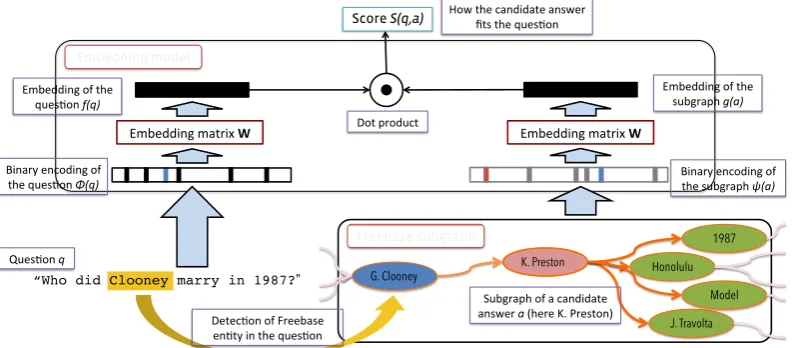
Our hypothesis is that including more informa-tion about the answer in its representainforma-tion will lead to improved results. While it is possible that all required information could be encoded in thek di-mensional embedding of the single entity(i), it is unclear what dimensionkshould be to make this possible. For example the embedding of a country entity encoding all of its citizens seems unrealis-tic. Similarly, only having access to the path ig-nores all the other information we have about the answer entity, unless it is encoded in the embed-dings of either the entity of the question, the an-swer or the relations linking them, which might be quite complicated as well. We thus adopt the sub-graph approach. Figure 1 illustrates our model. 3.2 Training and Loss Function
As in (Weston et al., 2010), we train our model using a margin-based ranking loss function. Let
“Who did Clooney marry in 1987?” Embedding matrix W
G. Clooney K. Preston
1987
J. Travolta Model Honolulu
Detec0on of Freebase en0ty in the ques0on
Embedding model
Freebase subgraph
Binary encoding of the subgraph ψ(a)
Embedding of the subgraph g(a)
Binary encoding of the ques0on Φ(q)
Embedding of the ques0on f(q)
Ques0on q
Subgraph of a candidate answer a (here K. Preston)
Score S(q,a) How the candidate answer fits the ques0on
Dot product
[image:4.595.101.498.65.239.2]Embedding matrix W
Figure 1: Illustration of the subgraph embedding model scoring a candidate answer: (i) locate entity in the question; (ii) compute path from entity to answer; (iii) represent answer as path plus all connected entities to the answer (the subgraph); (iv) embed both the question and the answer subgraph separately using the learnt embedding vectors, and score the match via their dot product.
of questionsqipaired with their correct answerai. The loss function we minimize is
|D| X
i=1 X
¯
a∈A¯(ai)
max{0, m−S(qi, ai)+S(qi,a¯)}, (2)
wheremis the margin (fixed to0.1). Minimizing Eq. (2) learns the embedding matrix W so that the score of a question paired with a correct an-swer is greater than with any incorrect anan-swer ¯a
by at leastm. ¯ais sampled from a set of incor-rect candidates A¯. This is achieved by sampling 50% of the time from the set of entities connected to the entity of the question (i.e. other candidate paths), and by replacing the answer entity by a ran-dom one otherwise. Optimization is accomplished using stochastic gradient descent, multi-threaded with Hogwild! (Recht et al., 2011), with the con-straint that the columns wi of W remain within the unit-ball, i.e.,∀i,||wi||2 ≤1.
3.3 Multitask Training of Embeddings Since a large number of questions in our training datasets are synthetically generated, they do not adequately cover the range of syntax used in natu-ral language. Hence, we also multi-task the train-ing of our model with the task of paraphrase pre-diction. We do so by alternating the training of
S with that of a scoring function Sprp(q1, q2) = f(q1)>f(q2), which uses the same embedding
ma-trix W and makes the embeddings of a pair of questions(q1, q2)similar to each other if they are
paraphrases (i.e. if they belong to the same para-phrase cluster), and make them different
other-wise. TrainingSprp is similar to that ofS except that negative samples are obtained by sampling a question from another paraphrase cluster.
We also multitask the training of the embed-dings with the mapping of themidsof FREEBASE entities to the actual words of their names, so that the model learns that the embedding of themidof an entity should be similar to the embedding of the word(s) that compose its name(s).
3.4 Inference
OnceW is trained, at test time, for a given ques-tionqthe model predicts the answer with:
ˆ
a=argmaxa0∈A(q)S(q, a0) (3)
whereA(q)is the candidate answer set. This can-didate set could be the whole KB but this has both speed and potentially precision issues. Instead, we create a candidate setA(q)for each question.
We recall that each question contains one identi-fied FREEBASEentity.A(q)is first populated with all triples from FREEBASE involving this entity. This allows to answer simple factual questions whose answers are directly connected to them (i.e. 1-hop paths). This strategy is denotedC1.
Method P@1 F1 F1 (%) (Berant) (Yao)
Baselines
(Berant et al., 2013) – 31.4 – (Bordes et al., 2014b) 31.3 29.7 31.8 (Yao and Van Durme, 2014) – 33.0 42.0 (Berant and Liang, 2014) – 39.9 43.0
Our approach
Subgraph &A(q) =C2 40.4 39.2 43.2
Ensemble with (Berant & Liang, 14) – 41.8 45.7 Variants
Without multiple predictions 40.4 31.3 34.2 Subgraph &A(q) =All 2-hops 38.0 37.1 41.4 Subgraph &A(q) =C1 34.0 32.6 35.1
Path &A(q) =C2 36.2 35.3 38.5
[image:5.595.75.290.59.235.2]Single Entity &A(q) =C1 25.8 16.0 17.8
Table 1: Results on the WEBQUESTIONStest set. a beam search, and hence avoid scoring all can-didates. Specifically, our model first ranks tion types using Eq. (1), i.e. selects which rela-tion types are the most likely to be expressed in
q. We keep the top10 types (10 was selected on the validation set) and only add 2-hops candidates toA(q)when these relations appear in their path. Scores of 1-hop triples are weighted by1.5since they have one less element than 2-hops quadru-plets. This strategy, denotedC2, is used by default.
A prediction a0 can commonly actually be
a set of candidate answers, not just one an-swer, for example for questions like “Who are David Beckham’s children?”. This is achieved by considering a prediction to be all the en-tities that lie on the same 1-hop or 2-hops path from the entity found in the question. Hence, all answers to the above question are connected to david beckham via the same path (david beckham, people.person.children, *). The feature representation of the prediction is then the average over each candidate entity’s features (see Section 3.1), i.e.ψall(a0) = |a10|Pa0
j:a0ψ(a 0
j) where a0
j are the individual entities in the over-all predictiona0. In the results, we compare to a
baseline method that can only predict single can-didates, which understandly performs poorly.
4 Experiments
We compare our system in terms of F1 score as computed by the official evaluation script2 (F1 (Berant)) but also with a slightly different F1 def-inition, termed F1 (Yao) which was used in (Yao and Van Durme, 2014) (the difference being the way that questions with no answers are dealt with), 2Available from www-nlp.stanford.edu/software/sempre/
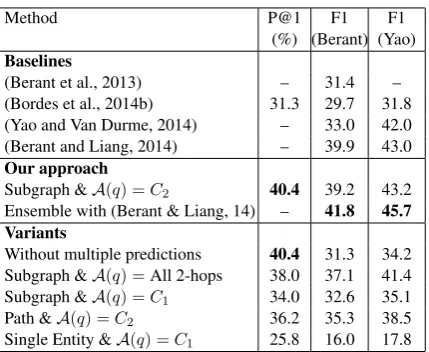
and precision @ 1 (p@1) of the first candidate en-tity (even when there are a set of correct answers), comparing to recently published systems.3 The upper part of Table 1 indicates that our approach outperforms (Yao and Van Durme, 2014), (Berant et al., 2013) and (Bordes et al., 2014b), and per-forms similarly as (Berant and Liang, 2014).
The lower part of Table 1 compares various ver-sions of our model. Our default approach uses the Subgraph representation for answers and C2
as the candidate answers set. Replacing C2 by C1 induces a large drop in performance because
many questions do not have answers thatare di-rectly connected to their inluded entity (not in
C1). However, using all 2-hops connections as
a candidate set is also detrimental, because the larger number of candidates confuses (and slows a lot) our ranking based inference. Our results also verify our hypothesis of Section 3.1, that a richer representation for answers (using the local subgraph) can store more pertinent information. Finally, we demonstrate that we greatly improve upon the model of (Bordes et al., 2014b), which actually corresponds to a setting with the Path rep-resentation andC1as candidate set.
We also considered an ensemble of our ap-proach and that of (Berant and Liang, 2014). As we only had access to their test predictions we used the following combination method. Our ap-proach gives a scoreS(q, a)for the answer it pre-dicts. We chose a threshold such that our approach predicts 50% of the time (whenS(q, a) is above its value), and the other 50% of the time we use the prediction of (Berant and Liang, 2014) instead. We aimed for a 50/50 ratio because both meth-ods perform similarly. The ensemble improves the state-of-the-art, and indicates that our models are significantly different in their design.
5 Conclusion
This paper presented an embedding model that learns to perform open QA using training data made of questions paired with their answers and of a KB to provide a structure among answers, and can achieve promising performance on the com-petitive benchmark WEBQUESTIONS.
3Results of baselines except (Bordes et al., 2014b) have been extracted from the original papers. For our experiments, all hyperparameters have been selected on the WEBQUES -TIONSvalidation set: kwas chosen among{64,128,256}, the learning rate on a log. scale between10−4and10−1and
References
Jonathan Berant and Percy Liang. 2014. Semantic
parsing via paraphrasing. In Proceedings of the
52nd Annual Meeting of the Association for Com-putational Linguistics (ACL’14), Baltimore, USA. Jonathan Berant, Andrew Chou, Roy Frostig, and Percy
Liang. 2013. Semantic parsing on Freebase from
question-answer pairs. In Proceedings of the 2013
Conference on Empirical Methods in Natural Lan-guage Processing (EMNLP’13), Seattle, USA. Kurt Bollacker, Colin Evans, Praveen Paritosh, Tim
Sturge, and Jamie Taylor. 2008. Freebase: a col-laboratively created graph database for structuring
human knowledge. InProceedings of the 2008 ACM
SIGMOD international conference on Management of data, Vancouver, Canada. ACM.
Antoine Bordes, Sumit Chopra, and Jason Weston. 2014a. Question answering with subgraph
embed-dings. CoRR, abs/1406.3676.
Antoine Bordes, Jason Weston, and Nicolas Usunier. 2014b. Open question answering with weakly
su-pervised embedding models. InProceedings of the
7th European Conference on Machine Learning and Principles and Practice of Knowledge Discovery in Databases (ECML-PKDD’14), Nancy, France. Springer.
Anthony Fader, Luke Zettlemoyer, and Oren Etzioni. 2013. Paraphrase-driven learning for open question
answering. InProceedings of the 51st Annual
Meet-ing of the Association for Computational LMeet-inguistics (ACL’13), Sofia, Bulgaria.
Anthony Fader, Luke Zettlemoyer, and Oren Etzioni. 2014. Open question answering over curated and
extracted knowledge bases. InProceedings of 20th
SIGKDD Conference on Knowledge Discovery and Data Mining (KDD’14), New York City, USA. ACM.
Oleksandr Kolomiyets and Marie-Francine Moens. 2011. A survey on question answering technology
from an information retrieval perspective.
Informa-tion Sciences, 181(24):5412–5434.
Tom Kwiatkowski, Eunsol Choi, Yoav Artzi, and Luke Zettlemoyer. 2013. Scaling semantic parsers with
on-the-fly ontology matching. InProceedings of the
2013 Conference on Empirical Methods in Natural Language Processing (EMNLP’13), Seattle, USA, October.
Thomas Lin, Mausam, and Oren Etzioni. 2012.
En-tity linking at web scale. InProceedings of the Joint
Workshop on Automatic Knowledge Base Construc-tion and Web-scale Knowledge ExtracConstruc-tion (AKBC-WEKEX’12), Montreal, Canada.
Benjamin Recht, Christopher R´e, Stephen J Wright, and Feng Niu. 2011. Hogwild!: A lock-free ap-proach to parallelizing stochastic gradient descent.
InAdvances in Neural Information Processing Sys-tems (NIPS 24)., Vancouver, Canada.
Christina Unger, Lorenz B¨uhmann, Jens Lehmann, Axel-Cyrille Ngonga Ngomo, Daniel Gerber, and Philipp Cimiano. 2012. Template-based question
answering over RDF data. In Proceedings of the
21st international conference on World Wide Web (WWW’12), Lyon, France. ACM.
Jason Weston, Samy Bengio, and Nicolas Usunier. 2010. Large scale image annotation: learning to
rank with joint word-image embeddings. Machine
learning, 81(1).
Xuchen Yao and Benjamin Van Durme. 2014. Infor-mation extraction over structured data: Question
an-swering with freebase. InProceedings of the 52nd