Break it Down for Me:
A Study in Automated Lyric Annotation
Lucas Sterckx*, Jason Naradowsky†, Bill Byrne‡,Thomas Demeester* and Chris Develder* * IDLab, Ghent University - imec [email protected]
†Language Technology Lab, DTAL, University of Cambridge
‡Department of Engineering, University of Cambridge
Abstract
Comprehending lyrics, as found in songs and poems, can pose a challenge to hu-man and machine readers alike. This moti-vates the need for systems that can under-stand the ambiguity and jargon found in such creative texts, and provide commen-tary to aid readers in reaching the correct interpretation.
We introduce the task of automated lyric annotation (ALA). Like text simplifica-tion, a goal of ALA is to rephrase the original text in a more easily understand-able manner. However, in ALA the sys-tem must often include additional infor-mation to clarify niche terminology and abstract concepts. To stimulate research on this task, we release a large collec-tion of crowdsourced annotacollec-tions for song lyrics. We analyze the performance of translation and retrieval models on this task, measuring performance with both au-tomated and human evaluation. We find that each model captures a unique type of information important to the task.
1 Introduction
Song lyrics and poetry often make use of ambi-guity, symbolism, irony, and other stylistic ele-ments to evoke emotive responses. These charac-teristics sometimes make it challenging to inter-pret obscure lyrics, especially for readers or lis-teners who are unfamiliar with the genre. To ad-dress this problem, several online lyric databases have been created where users can explain, con-textualize, or discuss lyrics. Examples include MetroLyrics1and Genius.com2. We refer to such
1http://www.metrolyrics.com 2http://genius.com
How does it feel? To be without a home Like a complete unknown,
Like a rolling stone
The proverb “A rolling stone gathers no moss” refers to people who are always on
the move, never putting down roots or accumulating responsibilities and cares.
Figure 1: A lyric annotation for “Like A Rolling Stone” by Bob Dylan.
commentary as a lyric annotation (Figure 1). In this work we introduce the task of auto-mated lyric annotation(ALA). Compared to many traditional NLP systems, which are trained on newswire or similar text, an automated system ca-pable of explaining abstract language, or finding alternative text expressions for slang (and other unknown terms) would exhibit a deeper under-standing of the nuances of language. As a result, research in this area may open the door to a va-riety of interesting use cases. In addition to pro-viding lyric annotations, such systems can lead to improved NLP analysis of informal text (blogs, so-cial media, novels and other literary works of fic-tion), better handling of genres with heavy use of jargon (scientific texts, product manuals), and in-creased robustness to textual variety in more tradi-tional NLP tasks and genres.
Our contributions are as follows:
1. To aid in the study of ALA we present a cor-pus of 803,720 crowdsourced lyric annota-tion pairs suitable for training models for this task.3
2. We present baseline systems using statisti-cal machine translation (SMT), neural
trans-3To obtain the data collection please contact the first
au-thor of this paper.
# Lyric Annotation pairs 803,720
Tokens per Lyric 15
Tokens per Annotation 43
|Vlyrics| 124,022
|Vannot| 260,427
Table 1: Properties of gathered dataset (Vlyricsand Vannotdenote the vocabulary for lyrics and
annota-tions,denotes the average amount).
lation (Seq2Seq), and information retrieval. 3. We establish an evaluation procedure which
adopts measures from machine translation, paraphrase generation, and text simplifica-tion. Evaluation is conducted using both hu-man and automated means, which we per-form and report across all baselines.
2 The Genius ALA Dataset
We collect a dataset of crowdsourced annotations, generated by users of the Genius online lyric database. For a given song, users can navigate to a particular stanza or line, view existing annotations for the target lyric, or provide their own annota-tion. Discussion between users acts to improve an-notation quality, as it does with other collaborative online databases like Wikipedia. This process is gamified: users earnIQpoints for producing high quality annotations.
We collect 736,423 lyrics having a total 1,404,107 lyric annotation pairs from all subsec-tions (rap, poetry, news, etc.) of Genius. We limit the initial release of the annotation data to be English-only, and filter out non-English anno-tations using a pre-trained language identifier. We also remove annotations which are solely links to external resources, and do not provide useful textual annotations. This reduces the dataset to 803,720 lyric annotation pairs. We list several properties of the collected dataset in Table 1.
2.1 Context Independent Annotation
Mining annotations from a collaborative human-curated website presents additional challenges worth noting. For instance, while we are able to generate large quantities of parallel text from Ge-nius, users operate without a single, predefined and shared global goal other than to maximize their own IQ points. As such, there is no moti-vation to provide annotations for a song in its en-tirety, or independent of previous annotations.
For this reason we distinguish between two types of annotations: context independent (CI) annotations are independent of their surrounding context and can be interpreted without it, e.g., ex-plain specific metaphors or imagery or provide narrative while normalizing slang language. Con-trastively, context sensitive(CS) annotations pro-vide broader context beyond the song lyric ex-cerpt, e.g., background information on the artist.
To estimate contribution from both types to the dataset, we sample 2,000 lyric annotation pairs and label them as either CI or CS. Based on this sample, an estimated 34.8% of all annotations is independent of context. Table 2 shows examples of both types.
While the goal of ALA is to generate annota-tions of all types, it is evident from our analysis that CS annotations can not be generated by mod-els trained solely on parallel text. That is, these an-notations cannot be generated without background knowledge or added context. Therefore, in this preliminary work we focus on predicting CI lyric annotations.
3 Baselines
We experiment with three baseline models used for text simplification and paraphrase generation.
• Statistical Machine Translation (SMT):
One approach is to treat the task as one of translation, and to use established sta-tistical machine translation (SMT) methods (Quirk et al., 2004) to produce them. We train a standard phrase-based SMT model to translate lyrics to annotations, using GIZA++ (Josef Och and Ney, 2003) for word alignment and Moses (Koehn et al., 2007) for phrasal alignment, training, and decoding.
• Seq2Seq: Sequence-to-sequence
Type annotations% of Examples
CI 34.8% [L] Gotta patch a lil kid tryna get at this cabbage
(Context [A] He’s trying to ignore the people trying to get at his money.
independent) [L] You know it’s beef when a smart brother gets stupid
[A] You know an argument is serious when an otherwise rational man loses rational. CS 65.2% [L] Cause we ain’t break up, more like broke down
(Context [A] The song details Joe’s break up with former girlfriend Esther.
sensitive) [L] If I quit this season, I still be the greatest, funk
[A] Kendrick has dropped two classic albums and pushed the artistic envelope fur-ther.
Table 2: Examples of context independent and dependent pairs of lyrics [L] and annotations [A].
additionally condition on tokens from the input sequence during decoding.
• Retrieval: In practice, similar lyrics may
reappear in different contexts with exchange-able annotations. We treat the training pus as a database of lyrics’ excerpts with cor-responding annotations, and at test time se-lect the annotation assigned to the most sim-ilar lyric. This baseline is referred to as the
retrieval model. We use standard TF-IDF weighted cosine distance as similarity mea-sure between lyrics’ excerpts.
4 Evaluation
4.1 Data
We evaluate automatic annotators on a selection of 354 CI annotations and partition the rest of the annotations into 2,000 instances for development and the full remainder for training. It is important to note that the annotations used for training and development include CI as well as CS annotations. Annotations often include multiple sentences or even paragraphs for a single lyrics excerpt (which does not include end marks), while machine trans-lation models need aligned corpora at sentence level to perform well (Xu et al., 2016). We there-fore transform training data by including each sen-tence from the annotation as a single training in-stance with the same lyric, resulting in a total of 1,813,350 sentence pairs.
We use this collection of sentence pairs (de-noted assent. in results) to train the SMT model. Seq2Seq models are trained using sentence pairs as well as full annotations. Interestingly, tech-niques encouraging alignment by matching length and thresholding cosine distance between lyric
and annotation did not improve performance dur-ing development.
4.2 Measures
For automated evaluation, we use measures commonly used to evaluate translation sys-tems (BLEU, METEOR), paraphrase generation (iBLEU) and text simplification (SARI).
BLEU (Papineni et al., 2002) uses a modi-fied form of precision to compare generated an-notations against references from Genius. ME-TEOR (Denkowski and Lavie, 2011) is based on the harmonic mean of precision and recall and, along with exact word matching, includes stem-ming and synonymy matching. iBLEU (Sun and Zhou, 2012) is an extension of the BLEU metric to measure diversity as well as adequacy of the annotation, iBLEU = 0.9 × BLEU(Annotation, Reference) − 0.1 × BLEU(Annotation, Lyric). SARI (Xu et al., 2016) measures precision and re-call of words that are added, kept, or deleted sepa-rately and averages their arithmetic means.
We also measure quality by crowdsourcing rat-ings via the online platform CrowdFlower.4 We
present collaborators with a song lyric excerpt an-notated with output from the annotation genera-tors as well as a reference annotation from Genius. Collaborators assign a 5-point rating for Fluency
which rates the quality of the generated language, andInformationwhich measures the added clarifi-cation by the annotation, a key aspect of this task. For each lyric annotation pair, we gather ratings from three different collaborators and take the av-erage.
4.3 Hyperparameters and Optimization
Here we describe implementation and some of the optimizations used when training the models.
Lyric: and when I slept, I dream g’s, son I need some
Human: he dreams about large amounts of money because he is in need of it . SMT: and when he slept, and he’s dream, g’s son, he needs some
Seq2Seq: when he sleeps , he dreams of getting money.
Retrieval: g’s refer to the ghetto gangsters in london that the kid has become involved with Lyric: Mossberg pump I’m ridin’ shotgun literally
Human: riding shotgun means to ride up front in the passenger seat
SMT: Mossberg pump - action shotgun, he’s saying he’s ridin’ shotgun literally. Seq2Seq: Mossberg is a firearms manufacturer. He is riding shotgun with his shotgun. Retrieval: he fully respects the people mentioned earlier and is riding for them. Lyric: and my eyes red cause of all that haze
Human: his eyes turn red due to lack of hydration from the weed one smokes (in this case , smoking purple haze) SMT: and his eyes are red because of all that haze.
Seq2Seq: his eyes are red because of all the weed he smokes.
[image:4.595.71.527.266.352.2]Retrieval: his eyes are red as a sign of the fatigue of travel and , possibly , from drugs and alcohol .
Table 3: Lyrics excerpts with annotations from Genius (‘Human’) and automated annotators.
Properties Automated Evaluation Human Evaluation
Length Ratio Profanity/Tok. BLEU iBLEU METEOR SARI Fluency Information
Human 1.19 0.0027 - - - - 3.93 3.53
SMT (Sent.) 1.23 0.0068 6.22 1.44 12.20 38.42 3.82 3.31
Seq2Seq (Sent.) 1.05 0.0023 5.33 3.64 9.28 36.52 3.76 3.25
Seq2Seq 1.32 0.0022 5.15 3.46 10.56 36.86 3.83 3.34
Retrieval 1.18 0.0038 2.82 2.27 5.10 32.76 3.93 2.98
Table 4: Quantitative evaluation of different automated annotators.
For Seq2Seq models, we use OpenNMT (Klein et al., 2017) and optimize for perplexity on the de-velopment set. Vocabulary for both lyrics and an-notations is reduced to the 50,000 most frequent tokens and are embedded in a 500-dimensional space.
We use two layers of stacked bi-directional LSTMs with hidden states of 1024 dimensions. We regularize using dropout (keep probability of 0.7) and train using stochastic gradient descent with batches of 64 samples for 13 epochs.
The decoder of the SMT model is tuned for op-timal BLEU scores on the development set using minimum error rate training (Bertoldi et al., 2009). 5 Results
To measure agreement between collaborators, we compute the kappa statistic (Fleiss, 1971). Kappa statistics for fluency and information are 0.05 and 0.07 respectively, which indicates low agreement. The task of evaluating lyric annotations was diffi-cult for CrowdFlower collaborators as was appar-ent from their evaluation of the task. For evalua-tion in future work, we recommend recruitment of expert collaborators familiar with the Genius plat-form and song lyrics.
Table 3 shows examples of lyrics with
annota-tions from Genius and those generated by baseline models.
A notable observation is that translation models learn to take the role of narrator, as is common in CI annotations, and recognize slang language while simplifying it to more standard English.
Automatic and human evaluation scores are shown in Table 4. Next to evaluation metrics, we show two properties of automatically generated annotations; the average annotation length relative to the lyric and the occurrence of profanity per to-ken in annotations, using a list of 343 swear words. The SMT model scores high on BLEU, ME-TEOR and SARI but shows a large drop in per-formance for iBLEU, which penalizes lexical sim-ilarity between lyrics and generated annotations as apparent from the amount profanity remaining in the generated annotations.
Standard SMT rephrases the song lyric from a third person perspective but is conservative in lex-ical substitutions and keeps close to the grammar of the lyric. A more appropriate objective func-tion for tuning the decoder which promotes lex-ical dissimilarity as done for paraphrase genera-tion, would be beneficial for this approach.
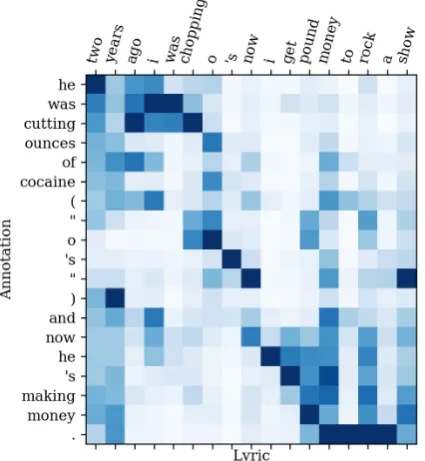
Figure 2: Attention visualization of Seq2Seq mod-els for ALA.
and Information scores. To visualize some of the alignments learned by the translation mod-els, Fig. 2 shows word-by-word attention scores for a translation by the Seq2Seq model.
While the retrieval model obtains quality anno-tations when test lyrics are highly similar to lyrics from the training set, retrieved annotations are of-ten unrelated to the test lyric or specific to the song lyric it is retrieved from.
Out of the unsupervised metrics, METEOR ob-tained the highest Pearson correlation (Pearson, 1895) with human ratings for Information with a coefficient of 0.15.
6 Related Work
Work on modeling of social annotations has mainly focused on the use of topic models (Iwata et al., 2009; Das et al., 2014) in which annotations are assumed to originate from topics. They can be used as a preprocessing step in machine learning tasks such as text classification and image recog-nition but do not generate language as required in our ALA task.
Text simplification and paraphrase generation have been widely studied. Recent work has high-lighted the need for large text collections (Xu et al., 2015) as well as more appropriate evalua-tion measures (Xu et al., 2016; Galley et al., 2015). They indicated that especially informal language,
with its high degree of lexical variation, e.g., as used in social media or lyrics, poses serious chal-lenges (Xu et al., 2013).
Text generation for artistic purposes, such as poetry and lyrics, has been explored most com-monly using templates and constraints (Barbieri et al., 2012). In regard to rap lyrics, Wu et al. (2013) present a system for rap lyric generation that produces a single line of lyrics that is meant to be a response to a single line of input. Most re-cent work is that of Zhang et al. (2014) and Potash et al. (2015), who show the effectiveness of RNNs for the generation of poetry and lyrics.
The task of annotating song lyrics is also related to metaphor processing. As annotators often ex-plain metaphors used in song lyrics, the Genius dataset can serve as a resource to study computa-tional modeling of metaphors (Shutova and Teufel, 2010).
7 Conclusion and Future Work
We presented and released the Genius dataset to study the task of Automated Lyric Annotation. As a first investigation, we studied automatic gener-ation of context independent annotgener-ations as ma-chine translation and information retrieval. Our baseline system tests indicate that our corpus is suitable to train machine translation systems.
Standard SMT models are capable of rephrasing and simplifying song lyrics but tend to keep close to the structure of the song lyric. Seq2Seq models demonstrated potential to generate more fluent and informative text, dissimilar to the lyric.
A large fraction of the annotations is heav-ily based on context and background knowledge (CS), one of their most appealing aspects. As future work we suggest injection of structured and unstructured external knowledge (Ahn et al., 2016) and explicit modeling of references (Yang et al., 2016).
Acknowledgments
References
S. Ahn, H. Choi, T. P¨arnamaa, and Y. Bengio. 2016. A Neural Knowledge Language Model. ArXiv e-prints https://arxiv.org/abs/1608.00318.
Dzmitry Bahdanau, Kyunghyun Cho, and Yoshua Bengio. 2014. Neural machine translation by jointly learning to align and translate. CoRR abs/1409.0473. http://arxiv.org/abs/1409.0473. Gabriele Barbieri, Franc¸ois Pachet, Pierre Roy, and
Mirko Degli Esposti. 2012. Markov constraints for generating lyrics with style. In ECAI 2012 - 20th European Conference on Artificial Intelli-gence. Including Prestigious Applications of Arti-ficial Intelligence (PAIS-2012) System Demonstra-tions Track, Montpellier, France, August 27-31 , 2012. pages 115–120. https://doi.org/10.3233/978-1-61499-098-7-115.
Nicola Bertoldi, Barry Haddow, and Jean-Baptiste Fouet. 2009. Improved minimum error rate training in moses. Prague Bull. Math. Linguistics 91:7–16. http://ufal.mff.cuni.cz/pbml/91/art-bertoldi.pdf. Mrinal Kanti Das, Trapit Bansal, and Chiranjib
Bhat-tacharyya. 2014. Going beyond corr-lda for de-tecting specific comments on news & blogs. In Seventh ACM International Conference on Web Search and Data Mining, WSDM 2014, New York, NY, USA, February 24-28, 2014. pages 483–492. https://doi.org/10.1145/2556195.2556231.
Michael Denkowski and Alon Lavie. 2011. Proceedings of the sixth workshop on sta-tistical machine translation pages 85–91. http://aclweb.org/anthology/W11-2107.
Joseph L Fleiss. 1971. Measuring nominal scale agree-ment among many raters. Psychological bulletin 76(5):378.
Michel Galley, Chris Brockett, Alessandro Sordoni, Yangfeng Ji, Michael Auli, Chris Quirk, Mar-garet Mitchell, Jianfeng Gao, and Bill Dolan. 2015. deltableu: A discriminative metric for generation tasks with intrinsically diverse targets. In Proceed-ings of the 53rd Annual Meeting of the Associa-tion for ComputaAssocia-tional Linguistics and the 7th In-ternational Joint Conference on Natural Language Processing (Volume 2: Short Papers). Associa-tion for ComputaAssocia-tional Linguistics, pages 445–450. https://doi.org/10.3115/v1/P15-2073.
Tomoharu Iwata, Takeshi Yamada, and Naonori Ueda. 2009. Modeling social annotation data with content relevance using a topic model. In Advances in Neural Information Processing Sys-tems 22: 23rd Annual Conference on Neural Information Processing Systems 2009. Proceedings of a meeting held 7-10 December 2009, Vancou-ver, British Columbia, Canada.. pages 835–843. http://papers.nips.cc/paper/3773-modeling-social- annotation-data-with-content-relevance-using-a-topic-model.
Franz Josef Och and Hermann Ney. 2003. A systematic comparison of various statistical alignment models. Computational Linguistics, Volume 29, Number 1, March 2003http://aclweb.org/anthology/J03-1002. G. Klein, Y. Kim, Y. Deng, J. Senellart, and A.M.
Rush. 2017. OpenNMT: Open-Source Toolkit for Neural Machine Translation. ArXiv e-prints https://arxiv.org/abs/1701.02810.
Philipp Koehn, Hieu Hoang, Alexandra Birch, Chris Callison-Burch, Marcello Federico, Nicola Bertoldi, Brooke Cowan, Wade Shen, Christine Moran, Richard Zens, Chris Dyer, Ondrej Bojar, Alexandra Constantin, and Evan Herbst. 2007. Moses: Open source toolkit for statistical machine translation. In Proceedings of the 45th Annual Meeting of the As-sociation for Computational Linguistics Companion Volume Proceedings of the Demo and Poster Ses-sions. Association for Computational Linguistics, pages 177–180. http://aclweb.org/anthology/P07-2045.
Kishore Papineni, Salim Roukos, Todd Ward, and Wei-Jing Zhu. 2002. Bleu: a method for au-tomatic evaluation of machine translation. In Proceedings of the 40th Annual Meeting of the Association for Computational Linguistics. http://aclweb.org/anthology/P02-1040.
Karl Pearson. 1895. Note on regression and inheritance in the case of two parents.Proceedings of the Royal Society of London58:240–242.
Peter Potash, Alexey Romanov, and Anna Rumshisky. 2015. Ghostwriter: Using an lstm for au-tomatic rap lyric generation. In Proceedings of the 2015 Conference on Empirical Meth-ods in Natural Language Processing. Association for Computational Linguistics, pages 1919–1924. https://doi.org/10.18653/v1/D15-1221.
Chris Quirk, Chris Brockett, and William Dolan. 2004. Proceedings of the 2004 conference on empirical methods in natural language processing. http://aclweb.org/anthology/W04-3219.
Ekaterina Shutova and Simone Teufel. 2010. Metaphor corpus annotated for source - target domain map-pings. InProceedings of the Seventh conference on International Language Resources and Evaluation (LREC’10). European Languages Resources Asso-ciation (ELRA). http://aclweb.org/anthology/L10-1419.
Hong Sun and Ming Zhou. 2012. Joint learning of a dual smt system for paraphrase generation. In Pro-ceedings of the 50th Annual Meeting of the Associa-tion for ComputaAssocia-tional Linguistics (Volume 2: Short Papers). Association for Computational Linguis-tics, pages 38–42. http://aclweb.org/anthology/P12-2008.
net-works. InAdvances in Neural Information Process-ing Systems 27: Annual Conference on Neural In-formation Processing Systems 2014, December 8-13 2014, Montreal, Quebec, Canada. pages 3104– 3112. http://papers.nips.cc/paper/5346-sequence-to-sequence-learning-with-neural-networks. Dekai Wu, Karteek Addanki, Markus Saers, and
Meriem Beloucif. 2013. Learning to freestyle: Hip hop challenge-response induction via trans-duction rule segmentation. In Proceedings of the 2013 Conference on Empirical Meth-ods in Natural Language Processing. Associa-tion for ComputaAssocia-tional Linguistics, pages 102–112. http://aclweb.org/anthology/D13-1011.
Wei Xu, Chris Callison-Burch, and Courtney Napoles. 2015. Problems in current text simplification re-search: New data can help. Transactions of the As-sociation of Computational Linguistics 3:283–297. http://aclweb.org/anthology/Q15-1021.
Wei Xu, Courtney Napoles, Ellie Pavlick, Quanze
Chen, and Chris Callison-Burch. 2016. Op-timizing statistical machine translation for text simplification. Transactions of the Associ-ation of ComputAssoci-ational Linguistics 4:401–415. http://aclweb.org/anthology/Q16-1029.
Wei Xu, Alan Ritter, and Ralph Grishman. 2013. Proceedings of the sixth workshop on build-ing and usbuild-ing comparable corpora. Associa-tion for ComputaAssocia-tional Linguistics, pages 121–128. http://aclweb.org/anthology/W13-2515.
Z. Yang, P. Blunsom, C. Dyer, and W. Ling. 2016. Reference-Aware Language Models. ArXiv e-prints https://arxiv.org/abs/1611.01628.