Sharp Models on Dull Hardware: Fast and Accurate Neural Machine
Translation Decoding on the CPU
Jacob Devlin
[email protected] Microsoft Research
Abstract
Attentional sequence-to-sequence models have become the new standard for ma-chine translation, but one challenge of such models is a significant increase in training and decoding cost compared to phrase-based systems. Here, we focus on efficient decoding, with a goal of achiev-ing accuracy close the state-of-the-art in neural machine translation (NMT), while achieving CPU decoding speed/through-put close to that of a phrasal decoder. We approach this problem from two an-gles: First, we describe several techniques for speeding up an NMT beam search de-coder, which obtain a 4.4x speedup over a very efficient baseline decoder with-out changing the decoder with-output. Sec-ond, we propose a simple but powerful network architecture which uses an RNN (GRU/LSTM) layer at bottom, followed by a series of stacked fully-connected lay-ers applied at every timestep. This ar-chitecture achieves similar accuracy to a deep recurrent model, at a small frac-tion of the training and decoding cost. By combining these techniques, our best system achieves a very competitive ac-curacy of 38.3 BLEU on WMT English-French NewsTest2014, while decoding at 100 words/sec on single-threaded CPU. We believe this is the best published ac-curacy/speed trade-off of an NMT system. 1 Introduction
Attentional sequence-to-sequence models have become the new standard for machine transla-tion over the last two years, and with the un-precedented improvements in translation accuracy
comes a new set of technical challenges. One of the biggest challenges is the high training and de-coding costs of these neural machine translation (NMT) system, which is often at least an order of magnitude higher than a phrase-based system trained on the same data. For instance, phrasal MT systems were able achieve single-threaded decod-ing speeds of 100-500 words/sec on decade-old CPUs (Quirk and Moore,2007), whileJean et al.
(2015) reported single-threaded decoding speeds of 8-10 words/sec on a shallow NMT system. Wu et al. (2016) was able to reach CPU decoding speeds of 100 words/sec for a deep model, but used 44 CPU cores to do so. There has been re-cent work in speeding up decoding by reducing the search space (Kim and Rush,2016), but little in computational improvements.
In this work, we consider a production sce-nario which requires low-latency, high-throughput NMT decoding. We focus on CPU-based de-coders, since GPU/FPGA/ASIC-based decoders require specialized hardware deployment and lo-gistical constraints such as batch processing. Ef-ficient CPU decoders can also be used for on-device mobile translation. We focus on single-threaded decoding and single-sentence processing, since multiple threads can be used to reduce la-tency but not total throughput.
We approach this problem from two angles: In Section 4, we describe a number of techniques for improving the speed of the decoder, and ob-tain a 4.4x speedup over a highly efficient base-line. These speedups do not affect decoding re-sults, so they can be applied universally. In Sec-tion5, we describe a simple but powerful network architecture which uses a single RNN (GRU/L-STM) layer at the bottom with a large number of fully-connected (FC) layers on top, and obtains improvements similar to a deep RNN model at a fraction of the training and decoding cost.
2 Data Set
The data set we evaluate on in this work is WMT English-French NewsTest2014, which has 380M words of parallel training data and a 3003 sen-tence test set. The NewsTest2013 set is used for validation. In order to compare our archi-tecture to past work, we train a word-based sys-tem without any data augmentation techniques. The network architecture is very similar to Bah-danau et al. (2014), and specific details of layer size/depth are provided in subsequent sections. We use an 80k source/target vocab and perform standard unk-replacement (Jean et al., 2015) on out-of-vocabulary words. Training is performed using an in-house toolkit.
3 Baseline Decoder
Our baseline decoder is a standard beam search decoder (Sutskever et al., 2014) with several straightforward performance optimizations:
• It is written in pure C++, with no heap allo-cation done during the core search.
• A candidate list is used to reduce the out-put softmax from 80k to ~500. We run word alignment (Brown et al.,1993) on the training and keep the top 20 context-free translations for each source word in the test sentence. • The Intel MKL library is used for matrix
mul-tiplication, as it is the fastest floating point matrix multiplication library for CPUs. • Early stopping is performed when the top
partial hypothesis has a log-score ofδ = 3.0 worse than the best completed hypothesis. • Batching of matrix multiplication is applied
when possible. Since each sentence is de-coded separately, we can only batch over the hypotheses in the beam as well as the input vectors on the source side.
4 Decoder Speed Improvements
This section describes a number of speedups that can be made to a CPU-based attentional sequence-to-sequence beam decoder. Crucially, none of these speedups affect the actual mathematical computation of the decoder, so they can be applied to any network architecture with a guarantee that they will not affect the results.1
1Some speedups apply quantization which leads to small random perturbations, but these change the BLEU score by less than 0.02.
The model used here is similar to the original implementation of Bahdanau et al. (2014). The exact target GRU equation is:
dij = tanh(Wahi−1+Vaxi)·tanh(Uasj)
αij = e
dij
P j0edij0 ci =
X
j
αijsj
ui = σ(Wuhi−1+Vuxi+Uuci+bu)
ri = σ(Wrhi−1+Vrxi+Urci+br) ˆ
hi = σ(ri(Whhi−1) +Vhxi+Uhci+bh)
hi = uihi−1+ (1−ui)ˆhi
WhereW∗,V∗,U∗,b∗are learned parameters,sj
is the hidden vector of thejthsource word,h i−1is
the previous target recurrent vector,xiis the target
input (e.g., embedding of previous word).
We also denote the various hyperparameters: b
for the beam size,rfor the recurrent hidden size,e
is the embedding size,|S|for the source sentence length, and|T|for the target sentence length,|E| is the vocab size.
4.1 16-Bit Matrix Multiplication
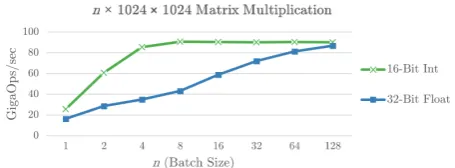
Although CPU-based matrix multiplication li-braries are highly optimized, they typically only operate on 32/64-bit floats, even though DNNs can almost always operate on much lower precision without degredation of accuracy (Han et al.,2016). However, low-precision math (1-bit to 7-bit) is dif-ficult to implement efficiently on the CPU, and even 8-bit math has limited support in terms of vectorized (SIMD) instruction sets. Here, we use 16-bit fixed-point integer math, since it has first-class SIMD support and requires minimal changes to training. Training is still performed with 32-bit floats, but we clip the weights to the range [-1.0, 1.0] therelu activation to [0.0, 10.0] to ensure that all values fit into 16-bits with high precision. A reference implementation of 16-bit multiplica-tion in C++/SSE2 is provided in the supplemen-tary material, with a thorough description of low-level details.2
are able to achieve greater than a 2x speedup in certain cases because we pre-process the weight matrix offline to have optimal memory layout, which is a capability BLAS libraries do not have.
Figure 1: Single-threaded matrix multiplication using our 16-bit fixed-point vs. Intel MKL’s 32-bit float, averaged over 10,000 multiplications. Both use the AVX2 instruction set.
4.2 Pre-Compute Embeddings
In the first hidden layer on the source and target sides,xi corresponds to word embeddings. Since
this is a closed set of values that are fixed af-ter training, the vectorsV xican be pre-computed
(Devlin et al.,2014) for each word in the vocabu-lary and stored in a lookup table. This can only be applied to the first hidden layer.
Pre-computation does increase the memory cost of the model, since we must storer×3floats per word instead ofe. However, if we only compute the k most frequently words (e.g., k = 8,000), this reduces the pre-computation memory by 90% but still results in 95%+ token coverage due to the Zipfian distribution of language.
4.3 Pre-Compute Attention
The attention context computation in the GRU can be re-factored as follows:
Uci=U( X
j
αijsj) = X
j
αij(Usj)
Crucially, the hidden vector representation sj is
only dependent on the source sentence, whileaij
is dependent on the target hypothesis. Therefore, the original computationUcirequires total|T| ×b
multiplications per sentence, but the re-factored versionUsjonly requires total|S|multiplications.
The expectation overαmust still be computed at each target timestep, but this is much less expen-sive than the multiplication byU.
4.4 SSE & Lookup Tables
For the element-wise vector functions use in the GRU, we can use vectorized instructions (SSE/AVX) for the add and multiply func-tions, and lookup tables forsigmoidandtanh.
Reference implementations in C++ are provided in the supplementary material.
4.5 Merge Recurrent States
In the GRU equation, for the first target hidden layer,xirepresents the previously generated word,
andhi−1 encodes the hypothesis up totwowords
before the current word. Therefore, if two par-tial hypotheses in the beam only differ by the last emitted word, their hi−1 vectors will be
identi-cal. Thus, we can perform matrix multiplication
W hi−1 only on the unique hi−1 vectors in the
beam at each target timestep. For a beam size of
b = 6, we measured that the ratio of uniquehi−1
compared to totalhi−1is approximately 70%,
av-eraged over several language pairs. This can only be applied to the first target hidden layer.
Words/Sec. Speedup Type (Single-Threaded) Factor
Baseline 95 1.00x
+ 16-Bit Mult. 248 2.59x + Pre-Comp. Emb. 311 3.25x + Pre-Comp. Att. 342 3.57x + SSE & Lookup 386 4.06x
+ Merge Rec. 418 4.37x
Table 1: Decoding speeds on an Intel E5-2660 CPU, pro-cessing each sentence independently.
4.6 Speedup Results
Cumulative results from each of the preceding speedups are presented in Table 1, measured on WMT English-French NewsTest2014. The NMT architecture evaluated here uses 3-layer 512-dimensional bidirectional GRU for the source, and a 1-layer 1024-dimensional attentional GRU for the target. Each sentence is decoded indepen-dently with a beam of 6. Since these speedups are all mathematical identities excluding quantiza-tion noise, all outputs achieve 36.2 BLEU and are 99.9%+ identical.
[image:3.595.311.528.307.425.2]Words/Sec System BLEU (Single-Threaded)
Basic Phrase-Based MT (Schwenk,2014) 33.1
-SOTA Phrase-Based MT (Durrani et al.,2014) 37.0
-RNN Search, 1-Layer Att. GRU, w/ Large Vocab (Jean et al.,2015) 34.6 †
Google NMT, 8-Layer Att. LSTM, Word-Based (Wu et al.,2016) 37.9 [
Google NMT, 8-Layer Att. LSTM, WPM-32k (Wu et al.,2016) 39.0‡ [
Convolutional Seq-to-Seq (Gehring et al.,2017) 40.5
-Transformer Network (Vaswani et al.,2017) 41.0
-(S1) Trg: 1024-AttGRU 36.2 418
(S2) Trg: 1024-AttGRU + 1024-GRU 36.8 242
(S3) Trg: 1024-AttGRU + 3-Layer 768-FC-Relu + 1024-FC-Tanh 37.1 271
(S4) Trg: 1024-AttGRU + 7-Layer 768-FC-Relu + 1024-FC-Tanh 37.4 229
(S5) Trg: 1024-AttGRU + 7-Layer 768-FC-Relu + 1024-GRU 37.6 157
(S6) Trg: 1024-AttGRU + 15-Layer 768-FC-Relu + 1024-FC-Tanh 37.3 163
(S7) Src: 8-Layer LSTM, Trg: 1024-AttLSTM + 7-Layer 1024-LSTM§ 37.8 28
(E1) Ensemble of 2x Model (S4) 38.3 102
[image:4.595.82.510.72.285.2](E2) Ensemble of 3x Model (S4) 38.5 65
Table 2: Results on WMT English-French NewsTest2014. Models (S1)-(S6) use a 3-layer 512-dim bidirectional GRU for the source side. The CPU is an Intel Haswell E5-2660. †Reported as ~8 words/sec on one CPU core. [Reported as ~100 words/sec, parallelized across 44 CPU cores.§Reproduction of Google NMT, Word-Based.
5 Model Improvements
In NMT, like in many other deep learning tasks, accuracy can be greatly improved by adding more hidden layers, but training and decoding time in-crease significantly (Luong et al., 2014; Zhou et al., 2016; Wu et al., 2016). Several past works have noted that convolutional neural net-works (CNNs) are significantly less expensive than RNNs, and replaced the source and/or tar-get side with a CNN-based architecture (Gehring et al.,2016;Kalchbrenner et al.,2016). However, these works have found it is difficult to replace the target side of the model with CNN layers while maintaining high accuracy. The use of a recurrent target is especially important to track attentional coverage and ensure fluency.
Here, we propose a mixed model which uses an RNN layer at the bottom to both capture full-sentence context and perform attention, followed by a series of fully-connected (FC) layers ap-plied on top at each timestep. The FC layers can be interpreted as a CNN without overlapping stride. Since each FC layer consists of a single ma-trix multiplication, it is1/6th the cost of a GRU
(or1/8th an LSTM). Additionally, several of the
speedups from Section4can only be applied to the first layer, so there is strong incentive to only use a single target RNN.
To avoid vanishing gradients, we use
ResNet-style skip connections (He et al.,2016). These al-low very deep models to be trained from scratch and do not require any additional matrix multi-plications, unlike highway networks (Srivastava et al.,2015). With 5 intermediate FC layers, target timestepiis computed as:
hB
i = AttGRU(hBi−1, xi, S)
h1
i = relu(W1hBi )
h2
i = relu(W2h1i)
h3
i = relu(W3h2i +h1i)
h4
i = relu(W4h3i)
h5
i = relu(W5h4i +h3i)
hT
i = tanh(WTh5i)orGRU(hTi−1, h5i)
yi = softmax(V hTi)
Wherexiis the target input embedding,Sis the
set of source hidden vectors used for attention, and
V is the target output vocabulary matrix. The su-perscriptshB andhT simply denote the “bottom”
and “top” hidden layers, while the numbered lay-ershnrepresent the intermediate fully-connected
layers.
(opposed totanh) for ResNet-style skip connec-tions. The GRUs still usetanh.
5.1 Model Results
Results using the mixed RNN+FC architecture are shown in Table 2, using all speedups. We have found that the benefit of using RNN+FC layers on the source is minimal, so we only perform ablation on the target. For the source, we use a 3-layer 512-dim bidi GRU in all models (S1)-(S6).
Model (S1) and (S2) are one and two layer base-lines. Model (S4), which uses 7 intermediate FC layers, has similar decoding cost to (S2) while doubling the improvement over (S1) to 1.2 BLEU. We see minimal benefit from using a GRU on the top layer (S5) or using more FC layers (S6). In (E1) and (E2) we present 2 and 3 model ensembles of (S4), trained from scratch with different random seeds. We can see that the 2-model ensemble im-proves results by 0.9 BLEU, but the 3-model en-semble has little additional improvment. Although not presented here, we have found these improve-ment from decoder speedups and RNN+FC to be consistent across many language pairs.
All together, we were able to achieve a BLEU score of 38.3 while decoding at 100 words/sec on a single CPU core. As a point of comparison,Wu et al.(2016) achieves similar BLEU scores on this test set (37.9 to 38.9) and reports a CPU decoding speed of ~100 words/sec (0.2226 sents/sec), but parallelizes this decoding across 44 CPU cores. System (S7), which is our re-implementation of
Wu et al.(2016), decodes at 28 words/sec on one CPU core, using all of the speedups described in Section4. Zhou et al.(2016) has a similar com-putational cost to (S7), but we were not able to replicate those results in terms of accuracy.
Although we are comparing an ensemble to a single model, we can see ensemble (E1) is over 3x faster to decode than the single model (S7). Addi-tionally, we have found that model (S4) is roughly 3x faster to train than (S7) using the same GPU re-sources, so (E1) is also 1.5x faster to train than a single model (S7).
References
Dzmitry Bahdanau, Kyunghyun Cho, and Yoshua Ben-gio. 2014. Neural machine translation by jointly
learning to align and translate. arXiv preprint
arXiv:1409.0473.
Peter F Brown, Vincent J Della Pietra, Stephen A Della
Pietra, and Robert L Mercer. 1993. The mathemat-ics of statistical machine translation: Parameter
esti-mation. Computational linguistics, 19(2):263–311.
Jacob Devlin, Rabih Zbib, Zhongqiang Huang, Thomas Lamar, Richard M Schwartz, and John Makhoul. 2014. Fast and robust neural network joint models
for statistical machine translation. InACL (1), pages
1370–1380. Citeseer.
Nadir Durrani, Barry Haddow, Philipp Koehn, and Kenneth Heafield. 2014. Edinburgh’s phrase-based
machine translation systems for wmt-14. In
Pro-ceedings of the Ninth Workshop on Statistical Ma-chine Translation, pages 97–104.
Jonas Gehring, Michael Auli, David Grangier, and Yann N Dauphin. 2016. A convolutional encoder
model for neural machine translation. arXiv preprint
arXiv:1611.02344.
Jonas Gehring, Michael Auli, David Grangier,
De-nis Yarats, and Yann N. Dauphin. 2017.
Con-volutional sequence to sequence learning. CoRR, abs/1705.03122.
Song Han, Huizi Mao, and William J. Dally. 2016. Deep compression: Compressing deep neural net-work with pruning, trained quantization and
huff-man coding. ICLR.
Kaiming He, Xiangyu Zhang, Shaoqing Ren, and Jian Sun. 2016. Deep residual learning for image
recog-nition. InProceedings of the IEEE Conference on
Computer Vision and Pattern Recognition, pages 770–778.
S´ebastien Jean, Kyunghyun Cho, Roland Memisevic, and Yoshua Bengio. 2015. On using very large target vocabulary for neural machine translation.
CoRR.
Nal Kalchbrenner, Lasse Espeholt, Karen Simonyan, Aaron van den Oord, Alex Graves, and Koray Kavukcuoglu. 2016. Neural machine translation in
linear time. arXiv preprint arXiv:1610.10099.
Yoon Kim and Alexander M Rush. 2016.
Sequence-level knowledge distillation. arXiv preprint
arXiv:1606.07947.
Minh-Thang Luong, Ilya Sutskever, Quoc V Le, Oriol Vinyals, and Wojciech Zaremba. 2014. Addressing the rare word problem in neural machine translation.
ACL 2015.
Chris Quirk and Robert Moore. 2007. Faster beam-search decoding for phrasal statistical machine
translation.Machine Translation Summit XI.
Holger Schwenk. 2014. http://www-lium.
univ-lemans.fr/schwenk/cslm_joint_ paper. [Online; accessed 03-September-2014]. Rupesh Kumar Srivastava, Klaus Greff, and J¨urgen
Schmidhuber. 2015. Highway networks. arXiv
Ilya Sutskever, Oriol Vinyals, and Quoc V. Le. 2014. Sequence to sequence learning with neural
net-works. NIPS.
Ashish Vaswani, Noam Shazeer, Niki Parmar, Jakob Uszkoreit, Llion Jones, Aidan N Gomez, Lukasz Kaiser, and Illia Polosukhin. 2017. Attention is all
you need. arXiv preprint arXiv:1706.03762.
Yonghui Wu, Mike Schuster, Zhifeng Chen, Quoc V. Le, Mohammad Norouzi, Wolfgang Macherey, Maxim Krikun, Yuan Cao, Qin Gao, Klaus Macherey, Jeff Klingner, Apurva Shah, Melvin Johnson, Xiaobing Liu, ukasz Kaiser, Stephan Gouws, Yoshikiyo Kato, Taku Kudo, Hideto Kazawa, Keith Stevens, George Kurian, Nishant Patil, Wei Wang, Cliff Young, Jason Smith, Jason Riesa, Alex Rudnick, Oriol Vinyals, Greg Corrado, Macduff Hughes, and Jeffrey Dean. 2016. Google’s neural machine translation system: Bridging the gap
between human and machine translation. CoRR,
abs/1609.08144.
Jie Zhou, Ying Cao, Xuguang Wang, Peng Li, and Wei Xu. 2016. Deep recurrent models with fast-forward
connections for neural machine translation. arXiv