Using Word Embedding for Cross-Language Plagiarism Detection
J´er´emy Ferrero
Compilatio 276 rue du Mont Blanc 74540 Saint-F´elix, France
LIG-GETALP
Univ. Grenoble Alpes, France [email protected]
Fr´ed´eric Agn`es
Compilatio 276 rue du Mont Blanc 74540 Saint-F´elix, France [email protected]
Laurent Besacier
LIG-GETALP
Univ. Grenoble Alpes, France [email protected]
Didier Schwab
LIG-GETALP
Univ. Grenoble Alpes, France [email protected]
Abstract
This paper proposes to use distributed rep-resentation of words (word embeddings) in cross-language textual similarity detec-tion. The main contributions of this paper are the following: (a) we introduce new cross-language similarity detection meth-ods based on distributed representation of words; (b) we combine the different meth-ods proposed to verify their complemen-tarity and finally obtain an overallF1score
of 89.15% for English-French similarity detection at chunk level (88.5% at sen-tence level) on a very challenging corpus.
1 Introduction
Plagiarism is a very significant problem nowa-days, specifically in higher education institutions. In monolingual context, this problem is rather well treated by several recent researches (Potthast et al., 2014). Nevertheless, the expansion of the Internet, which facilitates access to docu-ments throughout the world and to increasingly efficient (freely available) machine translation tools, helps to spreadcross-language plagiarism. Cross-language plagiarism means plagiarism by translation, i.e. a text has been plagiarized while being translated (manually or automatically). The challenge in detecting this kind of plagiarism is that the suspicious document is no longer in the same language of its source. We investigate how distributed representations of words can help to
propose new cross-lingual similarity measures, helpful for plagiarism detection. We use word embeddings (Mikolov et al., 2013) that have shown promising performances for all kinds of NLP tasks, as shown in Upadhyay et al. (2016), Ammar et al. (2016) and Ghannay et al. (2016), for instance.
Contributions. The main contributions of this paper are the following:
• we augment some state-of-the-art methods with the use of word embeddings instead of lexical resources;
• we introduce a syntax weighting in dis-tributed representations of sentences, and prove its usefulness for textual similarity detection;
• we combine our methods to verify their com-plementarity and finally obtain an overall F1score of 89.15% for English-French
simi-larity detection at chunk level (88.5% at sen-tence level) on a very challenging corpus (mix of Wikipedia, conference papers, prod-uct reviews, Europarl and JRC) while the best method alone hardly reachesF1 score higher
than 50%.
2 Evaluation Conditions
2.1 Dataset
The reference dataset used during our study is the new dataset recently introduced by Ferrero et al.
(2016)1. The dataset was specially designed for a rigorous evaluation of cross-language textual sim-ilarity detection.
More precisely, the characteristics of the dataset are the following:
• it is multilingual: it contains French, English and Spanish texts;
• it proposes cross-language alignment infor-mation at different granularities: document level, sentence level and chunk level;
• it is based on both parallel and comparable corpora (mix of Wikipedia, conference pa-pers, product reviews, Europarl and JRC);
• it contains both human and machine trans-lated texts;
• it contains different percentages of named en-tities;
• part of it has been obfuscated (to make the cross-language similarity detection more complicated) while the rest remains without noise;
• the documents were written and translated by multiple types of authors (from average to professionals) and cover various fields. In this paper, we only use the French and En-glish sub-corpora.
2.2 Overview of State-of-the-Art Methods
Plagiarism is a statement that someone copied text deliberately without attribution, while these methods only detect textual similarities. However, textual similarity detection can be used to detect plagiarism.
The aim of cross-language textual similarity detection is to estimate if two textual units in different languages express the same or not. We quickly review below the state-of-the-art methods used in this paper, for more details, see Ferrero et al. (2016).
Cross-Language Character N-Gram (CL-CnG)
is based on Mcnamee and Mayfield (2004) model. We use the Potthast et al. (2011) implementa-tion which compares two textual units under their 3-grams vectors representation.
Cross-Language Conceptual Thesaurus-based Similarity (CL-CTS)(Pataki, 2012) aims to mea-sure the semantic similarity using abstract
con-1https://github.com/FerreroJeremy/
Cross-Language-Dataset
cepts from words in textual units. In our imple-mentation, these concepts are given by a linked lexical resource calledDBNary(S´erasset, 2015).
Cross-Language Alignment-based Similarity Analysis (CL-ASA)aims to determinate how a tex-tual unit is potentially the translation of another textual unit using bilingual unigram dictionary which contains translations pairs (and their proba-bilities) extracted from a parallel corpus (Barr´on-Cede˜no et al. (2008), Pinto et al. (2009)).
Cross-Language Explicit Semantic Analysis (CL-ESA)is based on the explicit semantic anal-ysis model (Gabrilovich and Markovitch, 2007), which represents the meaning of a document by a vector based on concepts derived from Wikipedia. It was reused by Potthast et al. (2008) in the con-text of cross-language document retrieval.
Translation + Monolingual Analysis (T+MA)
consists in translating the two units into the same language, in order to operate a monolingual com-parison between them (Barr´on-Cede˜no, 2012). We use the Muhr et al. (2010) approach usingDBNary
(S´erasset, 2015), followed by monolingual match-ing based on bags of words.
2.3 Evaluation Protocol
We apply the same evaluation protocol as in Fer-rero et al. (2016)’s paper. We build a distance ma-trix of sizeNxM, withM = 1,000 andN =|S|
where S is the evaluated sub-corpus. Each tex-tual unit of S is compared to itself (to its cor-responding unit in the target language, since this is cross-lingual similarity detection) and to M-1 other units randomly selected fromS. The same unit may be selected several times. Then, a match-ing score for each comparison performed is ob-tained, leading to the distance matrix. Thresh-olding on the matrix is applied to find the thresh-old giving the bestF1 score. TheF1 score is the
3 Proposed Methods
The main idea of word embeddings is that their representation is obtained according to the context (the words around it). The words are projected on a continuous space and those with similar context should be close in this multi-dimensional space. A similarity between two word vectors can be measured by cosine similarity. So using word-embeddings for plagiarism detection is appeal-ing since they can be used to calculate similar-ity between sentences in the same or in two dif-ferent languages (they capture intrinsically syn-onymy and morphological closeness). We use the
MultiVec(Berard et al., 2016) toolkit for comput-ing and managcomput-ing the continuous representations of the texts. It includes word2vec (Mikolov et al., 2013), paragraph vector (Le and Mikolov, 2014) and bilingual distributed representations (Luong et al., 2015) features. The corpus used to build the vectors is the News Commentary2parallel cor-pus. For training our embeddings, we use CBOW model with a vector size of 100, a window size of 5, a negative sampling parameter of 5, and an alpha of 0.02.
3.1 Improving Textual Similarity Using Word Embeddings (CL-CTS-WEand CL-WES)
We introduce two new methods. First, we propose to replace the lexical resource used inCL-CTS(i.e. DBNary) by distributed representation of words. We call this new implementation CL-CTS-WE. More precisely,CL-CTS-WEuses the top 10 clos-est words in the embeddings model to build the BOW of a word. Secondly, we implement a more straightforward method (CL-WES), which performs a direct comparison between two sen-tences in different languages, through the use of word embeddings. It consists in a cosine similar-ity on distributed representations of the sentences, which are the summation of the embeddings vec-tors of each word of the sentences.
LetU a textual unit, thenwords of the unit are represented byuias:
U ={u1, u2, u3, ..., un} (1)
If Ux andUy are two textual units in two dif-ferent languages,CL-WESbuilds their (bilingual)
2http://www.statmt.org/wmt14/
translation-task.html
common representation vectorsVxandVy and ap-plies a cosine similarity between them.
A distributed representation V of a textual unitU is calculated as follows:
V =Xn i=1
(vector(ui)) (2)
where ui is the ith word of the textual unit and vector is the function which gives the word em-bedding vector of a word. This feature is available inMultiVec3(Berard et al., 2016).
3.2 Cross-Language Word Embedding-based Syntax Similarity (CL-WESS)
Our next innovation is the improvement of
CL-WES by introducing a syntax flavour in it. LetU a textual unit, then words of the unit are represented byuias expressed in the formula (1). First, we syntactically tagU with a part-of-speech tagger (TreeTagger (Schmid, 1994)) and we nor-malize the tags with Universal Tagset of Petrov et al. (2012). Then, we assign a weight to each type of tag: this weight will be used to compute the final vector representation of the unit. Fi-nally, we optimize the weights with the help of
Condor(Berghen and Bersini, 2005). Condor ap-plies a Newton’s method with a trust region al-gorithm to determinate the weights that optimize the F1 score. We use the first two folds of each
sub-corpus to determinate the optimal weights. The formula of the syntactic aggregation is:
V =Xn i=1
(weight(pos(ui)).vector(ui)) (3)
where ui is the ith word of the textual unit, pos is the function which gives the universal part-of-speech tag of a word,weightis the function which gives the weight of a part-of-speech,vectoris the function which gives the word embedding vector of a word and.is the scalar product.
IfUxandUy are two textual units in two differ-ent languages, we build their represdiffer-entation vec-torsVx andVy following the formula (3) instead of (2), and apply a cosine similarity between them. We call this methodCL-WESSand we have imple-mented it inMultiVec(Berard et al., 2016).
It is important to note that, contrarily to what is done in other tasks such as neural parsing (Chen
and Manning, 2014), we did not use POS informa-tion as an addiinforma-tional vector input because we con-sidered it would be more useful to use it to weight the contribution of each word to the sentence rep-resentation, according to its morpho-syntactic cat-egory.
4 Combining multiple methods
4.1 Weighted Fusion
We try to combine our methods to improve cross-language similarity detection performance. Dur-ing weighted fusion, we assign one weight to the similarity score of each method and we calculate a (weighted) composite score. We optimize the dis-tribution of the weights withCondor(Berghen and Bersini, 2005). We use the first two folds of each sub-corpus to determinate the optimal weights, while the other eight folds evaluate the fusion. We also try an average fusion,i.e. a weighted fusion where all the weights are equal.
4.2 Decision Tree Fusion
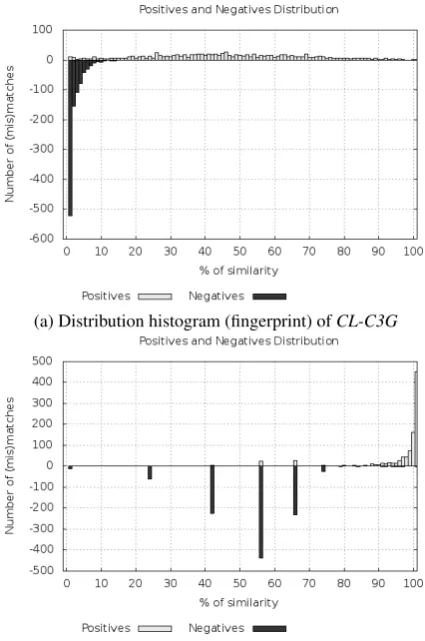
(a) Distribution histogram (fingerprint) ofCL-C3G
[image:4.595.73.286.394.715.2](b) Distribution histogram (fingerprint) ofCL-ASA Figure 1: Distribution histograms of two state-of-the-art methods for 1000 positives and 1000 nega-tives (mis)matches.
Regardless of their capacity to predict a (mis)match, an interesting feature of the methods is their clustering capacity, i.e. their ability to correctly separate the positives (similar units) and the negatives (different units) in order to minimize the doubts on the classification. Distribution his-tograms on Figure 1 highlight the fact that each method has its own fingerprint. Even if two meth-ods look equivalent in term of final performance, their distribution can be different. One explana-tion is that the methods do not process on the same way. Some methods are lexical-syntax-based, oth-ers process by aligning concepts (more semantic) and still others capture context with word vec-tors. For instance,CL-C3Ghas a narrow distribu-tion of negatives and a broad distribudistribu-tion for pos-itives (Figure 1 (a)), whereas the opposite is true forCL-ASA(Figure 1 (b)). We try to exploit this complementarity using decision tree based fusion. We use the C4.5 algorithm (Quinlan, 1993) im-plemented inWeka3.8.0 (Hall et al., 2009). The first two folds of each sub-corpus are used to de-terminate the optimal decision tree and the other eight folds to evaluate the fusion (same protocol as weighted fusion). While analyzing the trained decision tree, we see thatCL-C3G,CL-WESSand
CL-CTS-WEare the closest to the root. This con-firms their relevance for similarity detection, as well as their complementarity.
5 Results and Discussion
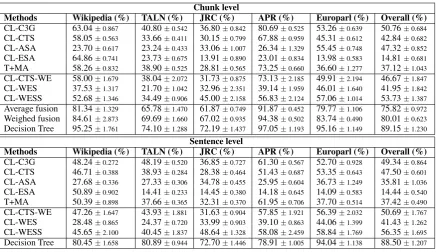
Use of word embeddings. We can see in Table 1 that the use of distributed representation of words instead of lexical resources improves CL-CTS
(CL-CTS-WEobtains overall performance gain of +3.83% on chunks and +3.19% on sentences). De-spite this improvement, CL-CTS-WE remains less efficient thanCL-C3G. While the use of bilingual sentence vector (CL-WES) is simple and elegant, its performance is lower than three state-of-the-art methods. However, its syntactically weighted ver-sion (CL-WESS) looks very promising and boosts theCL-WESoverall performance by +11.78% on chunks and +14.92% on sentences. Thanks to this improvement,CL-WESSis significantly better thanCL-C3G(+2.97% on chunks and +7.01% on sentences) and is the best single method evaluated so far on our corpus.
re-Chunk level
Methods Wikipedia (%) TALN (%) JRC (%) APR (%) Europarl (%) Overall (%) CL-C3G 63.04±0.867 40.80±0.542 36.80±0.842 80.69±0.525 53.26±0.639 50.76±0.684
CL-CTS 58.05±0.563 33.66±0.411 30.15±0.799 67.88±0.959 45.31±0.612 42.84±0.682
CL-ASA 23.70±0.617 23.24±0.433 33.06±1.007 26.34±1.329 55.45±0.748 47.32±0.852
CL-ESA 64.86±0.741 23.73±0.675 13.91±0.890 23.01±0.834 13.98±0.583 14.81±0.681
T+MA 58.26±0.832 38.90±0.525 28.81±0.565 73.25±0.660 36.60±1.277 37.12±1.043
CL-CTS-WE 58.00±1.679 38.04±2.072 31.73±0.875 73.13±2.185 49.91±2.194 46.67±1.847
CL-WES 37.53±1.317 21.70±1.042 32.96±2.351 39.14±1.959 46.01±1.640 41.95±1.842
CL-WESS 52.68±1.346 34.49±0.906 45.00±2.158 56.83±2.124 57.06±1.014 53.73±1.387
Average fusion 81.34±1.329 65.78±1.470 61.87±0.749 91.87±0.452 79.77±1.106 75.82±0.972
Weighed fusion 84.61±2.873 69.69±1.660 67.02±0.935 94.38±0.502 83.74±0.490 80.01±0.623
Decision Tree 95.25±1.761 74.10±1.288 72.19±1.437 97.05±1.193 95.16±1.149 89.15±1.230
Sentence level
Methods Wikipedia (%) TALN (%) JRC (%) APR (%) Europarl (%) Overall (%) CL-C3G 48.24±0.272 48.19±0.520 36.85±0.727 61.30±0.567 52.70±0.928 49.34±0.864
CL-CTS 46.71±0.388 38.93±0.284 28.38±0.464 51.43±0.687 53.35±0.643 47.50±0.601
CL-ASA 27.68±0.336 27.33±0.306 34.78±0.455 25.95±0.604 36.73±1.249 35.81±1.036
CL-ESA 50.89±0.902 14.41±0.233 14.45±0.380 14.18±0.645 14.09±0.583 14.44±0.540
T+MA 50.39±0.898 37.66±0.365 32.31±0.370 61.95±0.706 37.70±0.514 37.42±0.490
CL-CTS-WE 47.26±1.647 43.93±1.881 31.63±0.904 57.85±1.921 56.39±2.032 50.69±1.767
CL-WES 28.48±0.865 24.37±0.720 33.99±0.903 39.10±0.863 44.06±1.399 41.43±1.262
CL-WESS 45.65±2.100 40.45±1.837 48.64±1.328 58.08±2.459 58.84±1.769 56.35±1.695
Decision Tree 80.45±1.658 80.89±0.944 72.70±1.446 78.91±1.005 94.04±1.138 88.50±1.207
Table 1: Average F1 scores and confidence intervals of cross-language similarity detection methods
applied on EN→FR sub-corpora – 8 folds validation.
ported at chunk level. In each case, we com-bine the 8 previously presented methods (the 5 state-of-the-art and the 3 new methods). Weighted fusion outperforms the state-of-the-art and the embedding-based methods in any case. Neverthe-less, fusion based on a decision tree looks much more efficient. At chunk level, decision tree fu-sion leads to an overallF1 score of 89.15% while
the precedent best weighted fusion obtains 80.01% and the best single method only obtains 53.73%. The trend is the same at the sentence level where decision tree fusion largely overpasses any other method (88.50% against 56.35% for the best sin-gle method). In our evaluation, the best decision tree, for an overall higher than 85% of correct classification on both levels, involves at a mini-mumCL-C3G,CL-WESSandCL-CTS-WE. These results confirm that different methods proposed complement each other, and that embeddings are useful for cross-language textual similarity detec-tion.
6 Conclusion and Perspectives
We have augmented several baseline approaches using word embeddings. The most promising approach is a cosine similarity on syntactically weighted distributed representation of sentence (CL-WESS), which beats in overall the precedent
best state-of-the-art method. Finally, we have also demonstrated that all methods are comple-mentary and their fusion significantly helps cross-language textual similarity detection performance. At chunk level, decision tree fusion leads to an overall F1 score of 89.15% while the precedent
best weighted fusion obtains 80.01% and the best single method only obtains 53.73%. The trend is the same at the sentence level where decision tree fusion largely overpasses any other method.
Our future short term goal is to work on the im-provement ofCL-WESSby analyzing the syntactic weights or even adapt them according to the pla-giarist’s stylometry. We have also made a submis-sion at the SemEval-2017 Task 1,i.e. the task on Semantic Textual Similarity detection.
References
Waleed Ammar, George Mulcaire, Yulia Tsvetkov, Guillaume Lample, Chris Dyer, and Noah A. Smith. 2016. Massively Multilingual Word Embeddings. arXiv.org: http://arxiv.org/pdf/1602.01925v2.pdf. Computing Research Repository.
[image:5.595.82.522.60.312.2]Uncovering Plagiarism, Authorship and Social Soft-ware Misuse, pages 9–13, Patras, Greece.
Alberto Barr´on-Cede˜no. 2012. On the Mono- and Cross-Language Detection of Text Re-Use and Pla-giarism. InPhD thesis, Val`encia, Spain.
Alexandre Berard, Christophe Servan, Olivier Pietquin, and Laurent Besacier. 2016. MultiVec: a Multilin-gual and Multilevel Representation Learning Toolkit for NLP. InProceedings of the Tenth International Conference on Language Resources and Evalua-tion (LREC’16), pages 4188–4192, Portoroz, Slove-nia, May. European Language Resources Associa-tion (ELRA).
Frank Vanden Berghen and Hugues Bersini. 2005. CONDOR, a new parallel, constrained extension of Powell’s UOBYQA algorithm: Experimental results and comparison with the DFO algorithm.Journal of Computational and Applied Mathematics, 181:157– 175, September.
Danqi Chen and Christopher D. Manning. 2014. A Fast and Accurate Dependency Parser using Neural Networks. InProceedings of the 2014 Conference on Empirical Methods in Natural Language Pro-cessing, EMNLP 2014, pages 740–750, Doha, Qatar. J´er´emy Ferrero, Fr´ed´eric Agn`es, Laurent Besacier, and Didier Schwab. 2016. A Multilingual, Multi-style and Multi-granularity Dataset for Cross-language Textual Similarity Detection. InProceedings of the Tenth International Conference on Language Re-sources and Evaluation (LREC’16), pages 4162– 4169, Portoroz, Slovenia, May. European Language Resources Association (ELRA).
Evgeniy Gabrilovich and Shaul Markovitch. 2007. Computing Semantic Relatedness using Wikipedia-based Explicit Semantic Analysis. InProceedings of the 20th International Joint Conference on Artifical Intelligence (IJCAI’07), pages 1606–1611, Hyder-abad, India, January. Morgan Kaufmann Publishers Inc.
Sahar Ghannay, Benoit Favre, Yannick Est`eve, and Nathalie Camelin. 2016. Word Embedding Eval-uation and Combination. In Proceedings of the Tenth International Conference on Language Re-sources and Evaluation (LREC’16), pages 300–305, Portoroz, Slovenia, May. European Language Re-sources Association (ELRA).
Mark Hall, Eibe Frank, Geoffrey Holmes, Bernhard Pfahringer, Peter Reutemann, and Ian H. Witten. 2009. The WEKA Data Mining Software: An Up-date. In SIGKDD Explorations, volume 11, pages 10–18, July.
Quoc V. Le and Tomas Mikolov. 2014. Distributed Representations of Sentences and Documents. In
Proceedings of the 31th International Conference on Machine Learning (ICML’14), volume 32, pages 1188–1196, Beijing, China, June. JMLR Proceed-ings.
Minh-Thang Luong, Hieu Pham, and Christopher D. Manning. 2015. Bilingual Word Representations with Monolingual Quality in Mind. InProceedings of the 1st NAACL Workshop on Vector Space Mod-eling for Natural Language Processing, pages 151– 159, Denver, Colorado, USA, May.
Paul Mcnamee and James Mayfield. 2004. Character N-Gram Tokenization for European Language Text Retrieval. In Information Retrieval Proceedings, volume 7, pages 73–97. Kluwer Academic Publish-ers.
Tomas Mikolov, Ilya Sutskever, Kai Chen, Gregory S. Corrado, and Jeffrey Dean. 2013. Distributed Rep-resentations of Words and Phrases and their Compo-sitionality. InProceedings of the 27th Annual Con-ference on Neural Information Processing Systems (NIPS’13), pages 3111–3119, Lake Tahoe, USA, December. .
Markus Muhr, Roman Kern, Mario Zechner, and Michael Granitzer. 2010. External and Intrinsic Pla-giarism Detection Using a Cross-Lingual Retrieval and Segmentation System - Lab Report for PAN at CLEF 2010. In Martin Braschler, Donna Har-man, and Emanuele Pianta, editors, CLEF Note-book, Padua, Italy, September.
M`at´e Pataki. 2012. A New Approach for Searching Translated Plagiarism. In Proceedings of the 5th International Plagiarism Conference, pages 49–64, Newcastle, UK, July.
Slav Petrov, Dipanjan Das, and Ryan McDonald. 2012. A universal part-of-speech tagset. In Proceedings of the Eight International Conference on Language Resources and Evaluation (LREC’12), pages 2089– 2096, Istanbul, Turkey, May. European Language Resources Association (ELRA).
David Pinto, Jorge Civera, Alfons Juan, Paolo Rosso, and Alberto Barr´on-Cede˜no. 2009. A Statistical Approach to Crosslingual Natural Language Tasks. In CEUR Workshop Proceedings, volume 64 of
Journal of Algorithms, pages 51–60, January. Martin Potthast, Benno Stein, and Maik Anderka.
2008. A Wikipedia-Based Multilingual Retrieval Model. In 30th European Conference on IR Re-search (ECIR’08), volume 4956 ofLNCS of Lecture Notes in Computer Science, pages 522–530, Glas-gow, Scotland, March. Springer.
Martin Potthast, Alberto Barr´on-Cede˜no, Benno Stein, and Paolo Rosso. 2011. Cross-Language Plagiarism Detection. InLanguage Resources and Evaluation, volume 45, pages 45–62.
Martin Potthast, Matthias Hagen, Anna Beyer, Matthias Busse, Martin Tippmann, Paolo Rosso, and Benno Stein. 2014. Overview of the 6th Inter-national Competition on Plagiarism Detection. In
J. Ross Quinlan. 1993. C4.5: Programs for Machine Learning. The Morgan Kaufmann series in ma-chine learning. Morgan Kaufmann Publishers Inc., San Francisco, CA, USA.
Helmut Schmid. 1994. Probabilistic Part-of-Speech Tagging Using Decision Trees. In Proceedings of the International Conference on New Methods in Language Processing, pages 44–49, Manchester, UK.
Gilles S´erasset. 2015. DBnary: Wiktionary as a Lemon-Based Multilingual Lexical Resource in RDF. In Semantic Web Journal (special issue on Multilingual Linked Open Data), volume 6, pages 355–361.