warwick.ac.uk/lib-publications
Original citation:
Shaikh, Maha and Henfridsson, Ola. (2017) Governing open source software through coordination processes. Information and Organization, 27 (2). pp. 116-135.
Permanent WRAP URL:
http://wrap.warwick.ac.uk/87892
Copyright and reuse:
The Warwick Research Archive Portal (WRAP) makes this work by researchers of the University of Warwick available open access under the following conditions. Copyright © and all moral rights to the version of the paper presented here belong to the individual author(s) and/or other copyright owners. To the extent reasonable and practicable the material made available in WRAP has been checked for eligibility before being made available.
Copies of full items can be used for personal research or study, educational, or not-for-profit purposes without prior permission or charge. Provided that the authors, title and full bibliographic details are credited, a hyperlink and/or URL is given for the original metadata page and the content is not changed in any way.
Publisher’s statement:
© 2017, Elsevier. Licensed under the Creative Commons Attribution-NonCommercial-NoDerivatives 4.0 International http://creativecommons.org/licenses/by-nc-nd/4.0/
A note on versions:
The version presented here may differ from the published version or, version of record, if you wish to cite this item you are advised to consult the publisher’s version. Please see the ‘permanent WRAP URL’ above for details on accessing the published version and note that access may require a subscription.
GOVERNING OPEN SOURCE SOFTWARE THROUGH COORDINATION PROCESSES
Maha Shaikh
Warwick Business School The University of Warwick
United Kingdom
Ola Henfridsson
Warwick Business School The University of Warwick
United Kingdom
Abstract
Governance provides the authoritative framework for coordinating activities in open source development. Prior studies of open source governance have largely focused on its changing nature over time. In this work, we argue that the nature of governance varies across open source communities, and, in its evolution, mul-tiple traces of authority may co-exist. We propose that such multiplicity can be understood by close exam-ination of the authoritative structures embedded in coordexam-ination processes. We collected eight years of data on the coordination related to version control of the Linux kernel. Drawing on in-depth qualitative analysis, we investigate how coordination processes with different authoritative structures come together in the gov-ernance of open source software. We trace four coordination processes (autocratic clearing, oligarchic re-cursion, federated self-governance, and meritocratic idea-testing), each grounded in different authoritative structures (autocracy, oligarchy, federation, meritocracy) with their own form of legitimation. We offer a two-fold contribution in this paper. First, we enhance the open source governance literature by advancing a new theoretical perspective in which governance is seen as a configuration of coordination processes. Configurations give complementary support and are a source of tension and renewal. Second, we articulate a view on the conceptual relationship between governance and coordination where these concepts are un-derstood as a duality, both working together to give rise to efficient and dynamic organizing in open source.
INTRODUCTION
Open source development is a powerful means to create and maintain software. The most
signifi-cant open source communities such as the Linux Kernel successfully gather the contributions of
thou-sands of distributed developers to further evolve its software. To make such coordination possible,
ver-sion control software is used to track, trace and archive the complete development process. It essentially
allows distributed development to take place where the number of developers has grown beyond a small,
manageable number. At the same time, it is also imperative for realizing governance of the open source
community because access and different roles of responsibility are embedded within its design. In this
Prior open source literature pays attention to both aspects. First, there is a significant body of
re-search dealing with governance (De Noni et al. 2011; Markus 2007; O'Mahony 2007). Governance
pro-vides the authoritative framework for organizing open source software development (O'Mahony and
Fer-raro 2007). As an example, such authority might be reflected in the decision rights over changes in core
modules of the software. Second, in addition to this vertical dimension of open source, coordination of the
many developers involved is needed for preserving the software’s installed base in terms of prior
contri-butions of software code (Fogel 1999; Fogel 2005). It is also vital for effectuating new ones (von Hippel
2001; von Krogh et al. 2005). Yet, despite the significance of vertical authority and horizontal
coordina-tion, little has been done to investigate the close relationship between governance and coordination.
In this paper, we propose that governance and coordination can be seen as a duality where both
co-exist and work in parallel (Farjoun 2010), and both are required simultaneously to be effective. We also
propose coordination processes as a concept for understanding how this duality plays out in the course of
developing open source software. We refer to coordination processes as the common sets of rules,
instruc-tions, and activities that operationalize a specific authoritative structure. In open source software,
coordi-nation processes are embedded in the software tools used for version control (Cornford et al. 2010). In
addition, they are embedded in the social structures of the open source organization as reflected in
com-munication patterns (Bezroukov 1999; Raymond 1999) and values (Orek and Nov 2008).
Another significant aspect of open source communities with implications for governance relates to
its innate emphasis on contributors self-selecting their own tasks. Developers are not tied to a community
through a contract so there is no obligation to contribute, instead open source communities rely on
differ-ent motivations of developers like delayed extrinsic gratification, and a compelling intrinsic need to
con-tribute (Roberts et al. 2006; Spaeth et al. 2015; von Krogh et al. 2012). To cater for the manifold reasons
that might underlie developers’ commitment, there exist multiple, and sometimes heterogeneous,
authori-tative structures observed as the governance of open source software evolves (Aaltonen and Lanzara
2015; Markus 2007; Meyer and Montagne 2007; Midha and Bhattacherjee 2012; O'Mahony 2007;
al. 2014; Daily et al. 2003; Fielding 1999; Garud et al. 2006); and, as more than one form of governance
co-exist and eventually converge (O'Mahony and Ferraro 2007). In studies of open source governance, it
is therefore imperative to develop conceptions that can cater for the multiplicity of open source
govern-ance. We advance the view that in-depth examination of coordination processes and their underlying
au-thoritarian structures is significant for understanding this aspect of open source governance. We define
open source governance as a configuration of multiple authoritative structures (each embedded in a
coor-dination process) that guide and steer activities, tasks, motivations and effort towards a collective, and
mutually understood goal.
Rather than finding evidence of convergence (cf. O'Mahony and Ferraro 2007) towards a single
form of governance, our in-depth study of the Linux Kernel reveals how multiple coordination processes
reflecting heterogeneous authoritative structures collectively shaped the governance process. This
moti-vated us to further investigate coordination processes and the governance of open source software by
pos-ing the followpos-ing research question: how do coordination processes with different authoritative structures
come together in the governance of open source software?
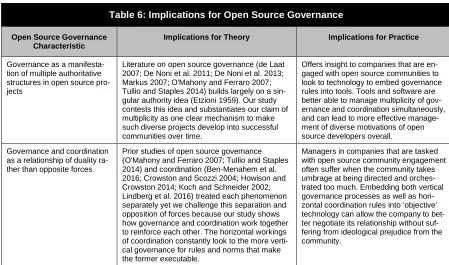
We offer a two-fold contribution in this paper. First, we enhance the open source governance
litera-ture by advancing a new theoretical perspective in which governance is seen as configurations of
coordi-nation processes, which gives both complementary support and triggers for tension and renewal.
Govern-ance is then multiple and not singular in such large, and complex projects and each configuration of
coor-dination processes encapsulates this multiplicity while allowing for complex coorcoor-dination to occur.
Sec-ond, we articulate a conception of the relationship between governance and coordination as a duality,
where they work together to reinforce each other to give rise to change.
CONCEPTUAL BACKGROUND
Governance is a shared basis of authority (O'Mahony and Ferraro 2007). Rooted in the ideas of
Weber (1946) and Etzioni (1959), authority in an organizational setting typically encompasses a mix of
seen significant research (Adler and Borys 1996; Crozier 1964; Kallinikos 2004; Meyer 1968; Ouchi
1980; Riccucci et al. 2016; Weber 1946). Some other examples include adhocracy (Miller 1987; Miller
1990; Mintzberg 1980; Mintzberg and McHugh 1985), alliances (Faems et al. 2008; Gulati 1998; Han et
al. 2012; Osborn and Hagedoorn 1997; Ring and van de Ven 1992), and networks (Davis and Eisenhardt
2011; Ingram and Torfason 2010; Peng et al. 2013; Sundararajan et al. 2013).
Perhaps because of its image of representing something profoundly new in terms of organizing
(Crowston et al. 2007; Crowston and Scozzi 2002; Dafermos 2001; Gallivan 2001), open source software
has attracted its own body of governance studies. However, a closer examination of this literature reveals
how governance in open source displays variety in terms of its underlying authority structure. In fact, our
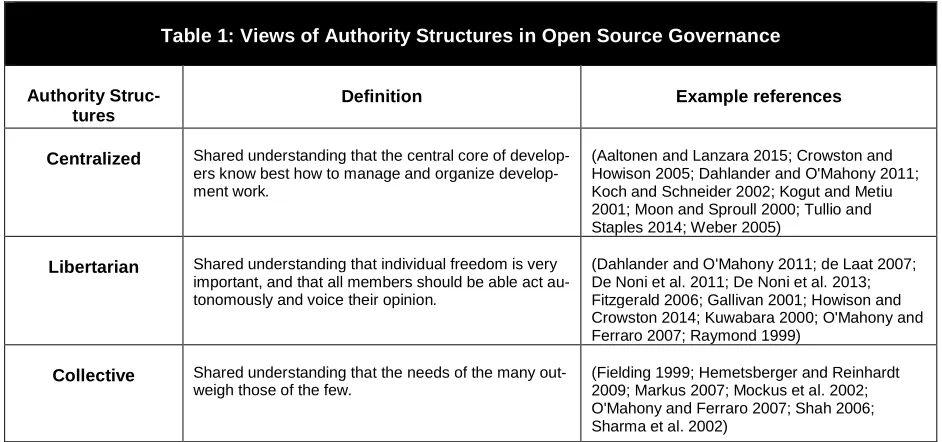
literature review helped us distinguish three types of authority reflected in this body of work: centralized,
[image:5.595.68.539.376.597.2]libertarian, and collective (see Table 1).
Table 1: Views of Authority Structures in Open Source Governance
Authority Struc-tures
Definition Example references
Centralized Shared understanding that the central core of ers know best how to manage and organize develop-ment work.
(Aaltonen and Lanzara 2015; Crowston and Howison 2005; Dahlander and O'Mahony 2011; Koch and Schneider 2002; Kogut and Metiu 2001; Moon and Sproull 2000; Tullio and Staples 2014; Weber 2005)
Libertarian Shared understanding that individual freedom is very important, and that all members should be able act au-tonomously and voice their opinion.
(Dahlander and O'Mahony 2011; de Laat 2007; De Noni et al. 2011; De Noni et al. 2013; Fitzgerald 2006; Gallivan 2001; Howison and Crowston 2014; Kuwabara 2000; O'Mahony and Ferraro 2007; Raymond 1999)
Collective Shared understanding that the needs of the many out-weigh those of the few.
(Fielding 1999; Hemetsberger and Reinhardt 2009; Markus 2007; Mockus et al. 2002; O'Mahony and Ferraro 2007; Shah 2006; Sharma et al. 2002)
Centralized authority reflects a shared understanding that the central core of actors, typically key
developers, know best how to manage and coordinate development work (Aaltonen and Lanzara 2015;
Dahlander and Frederiksen 2012; Dahlander and O'Mahony 2011; Koch and Schneider 2002; Kogut and
unless it is seen to cross radical boundaries of acceptability and ideology. A study of the online user
com-munity of Propellerhead in Sweden showcases how so-called "cosmopolitans" bring innovative ideas into
the community yet the core developers exercise a deep sense of centralized authority over the
commu-nity’s direction and well-being (Dahlander and O'Mahony 2011). This understanding is not resisted by
other community members because their belief is that the central core knows the project best and has
worked hard to earn their reputation and leadership roles. This authority structure also reveals the norms
of the community that allow less influential actors in the community the choice and ability to work
to-wards becoming more relevant through serious and innovative code contributions over time (Dahlander
and O'Mahony 2011).
Second, libertarian authority posits that individual level freedom is imperative, and that all
mem-bers should be able to act autonomously and voice their opinion freely as equals (de Laat 2007; De Noni
et al. 2011; De Noni et al. 2013; Feller and Fitzgerald 2002; Fitzgerald 2006; Gallivan 2001; Howison
and Crowston 2014; Kuwabara 2000; Raymond 1999). The BibDesk project offers conceptual clarity on
how numerous individual developers work to build quality software in a layered approach (Howison and
Crowston 2014). Software is built feature by feature by distinct developers with little focus on the larger
project but rather what is evident is a micro perspective on the code and work at hand. This individualistic
layering approach relies on what has been coded previously rather than attempting grand new designs
(Howison and Crowston 2014).
Collective authority, our third and final category, suggests a view where the needs of the many
out-weigh those of the few, so individual freedom may be curtailed if it is seen to be the right thing to do for
the common good (Fielding 1999; Hemetsberger and Reinhardt 2009; Markus 2007; O'Mahony and
Ferraro 2007; Sharma et al. 2002). A significant instance of collective authority has been provided by
O'Mahony and Ferarro (2007). Their study of the Debian project observes how the governance model in
different phases of an open source project is slowly evaluated and evolves to accommodate the changing
nature of the community and its needs. The need to evaluate the authority structure in their study was
manner. The belief system did not provide a good match with how work was being governed so the rules
of negotiation with management were questioned, evaluated and re-built to reveal a new collective order.
Duality of Governance and Coordination
As outlined above, the open source governance literature can be divided into three categories
de-pending on their view on authority: centralized, libertarian, and collective. However, consistent with
Etzioni's (1959) point that any organization can only have one seat of authority, existing studies tend to
presume a singularity in each governance model. Even in cases where hybrid governance is discussed, the
premise of the work is that a new singular authority structure emerges through the process of
hybridiza-tion (De Noni et al. 2013; Markus 2007; O'Mahony 2007; O'Mahony and Ferraro 2007; Shah 2006; Tullio
and Staples 2014). This rich literature also tellingly tends to conflate governance with coordination
(Alexy et al. 2013; Dahlander and O'Mahony 2011; Feller et al. 2008). Arguably, similar concerns have
been raised previously, especially in the CSCW literature (Malone 1987; Olson et al. 2001; Olson and
Olson 2000; Schmidt and Simonee 1996). In CSCW work the artefact, for the most part, is seen as
apoliti-cal and simply as a tool of coordination (Malone 1987; Schmidt and Bannon 1992; Schmidt and Simonee
1996). At the same time this work tends to emulate larger, management studies of governance where
[image:7.595.64.539.491.669.2]sin-gular authority is understood to be the norm.
Table 2: Conceptual Constructs
Concept Definition
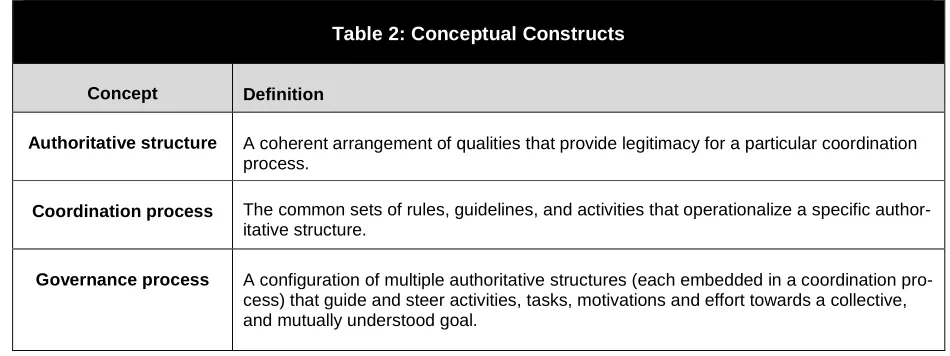
Authoritative structure A coherent arrangement of qualities that provide legitimacy for a particular coordination process.
Coordination process The common sets of rules, guidelines, and activities that operationalize a specific author-itative structure.
As we will outline in this paper, the link between governance and coordination is important in order
to accommodate the dynamically changing governance of a growing and evolving open source
commu-nity, and allowing multiple forms of coordinating governance processes to co-exist. We draw on the idea
of governance and coordination as a duality rather than dualism (Farjoun 2010). A dualism often
com-pares and relates two antithetical, or competing ideas where they work in contradiction to the other
(Farjoun 2010). Such ideas are evident in literature and practice on open source governance, yet our study
of the Linux Kernel case suggests a duality of governance and coordination. A duality, as opposed to a
dualism, draws a relationship between two concepts that are distinct yet in their unfolding over time work
together to strengthen, corroborate, and refine each other. Armed with this perspective we craft our idea
of coordination processes and provide empirical evidence to explain how these separate yet
interdepend-ent processes are interdepend-entangled and work to reinforce each other rather than only pull in opposition.
The concept of coordination process helps us to establish how governance unfolds in open source
development in every day work processes. We define coordination processes as the common sets of rules,
guidelines, and activities that operationalize a specific authoritative structure. Such processes consist of
rules that provide explicit and implicit guidelines for the coordinated activity. For instance, the shared and
openly accessible FAQ pages for all projects set out formal guidelines for working on, and contributing
to, an open source project. There are often wiki pages that offer input into the learning process of a new
open source developer. Also, there are informal guidelines, typically accessible through the ideologies (cf.
Barrett et al. 2013) underpinning the authority structure of an open source development project. Such
ide-ologies may be communicated and appreciated in the practice of coordinating in the open source
commu-nity, and they typically define what are seen as powerful contributions to the software. In this regard, the
common sets of rules are sanctioned in a particular understanding of how the community should function
(see Table 2).
Returning to our main research question of how coordination processes with different authoritative
structures come together in the governance of open source software, we embarked on a case study of the
RESEARCH DESIGN AND METHODS
To address the research question related to how coordination processes with different authoritative
structures come together in open source governance, we conducted an in-depth case study (Hargadon and
Douglas 2001; Kieser 1994; Mason et al. 1997a; Mason et al. 1997b) of version control use and adoption
in the development of the Linux Kernel. Version control is software used for coordinating software
devel-opment. It supports the development process by tracking and archiving revisions to the software over
time. Version control software ensures that code contributions will be handled effectively. There are
vari-ous version control options on the market, and the decision to adopt any one is often based on both
tech-nical as well as political reasons because each tool offers different types of governance.
Case Setting and Selection
The Linux Kernel is an ongoing, high-profile open source development project. Its success is rated
not simply by the number of developers it is able to attract, the persistence of the project (considering
how many open source projects simply die within a few months), but the fact that it has been taken up by
so many other communities and companies where different mutations of it have emerged. For instance,
Ubuntu, a very successful Debian based Linux operating system has been created and established by the
company called Canonical.
There were a number of reasons why we selected version control for the Linux Kernel as our
em-pirical focus. First, the setting offers the complexity needed for studying coordination processes and
gov-ernance over time. This enables generation of a rich account of dynamics related to coordination
pro-cesses. Second, it offers valuable and longitudinal data related to the evolution of governance. Linux
Ker-nel development began in 1991. There is public archival access to the entire email communication carried
out between the Linux Kernel developers from 1995 onwards to present. Like many, if not all open source
projects, the distributed nature of collaborating entails a greater dependence on such coordination tools
such as email and version control software. The mailing list in particular is accessible to the public and is
a rich and solid source of decisions, discussions and debates held by the community over time. This being
coordination tools, management style, as well as governance models for coordinating software
contribu-tions of developers. And finally, the Linux kernel case involved a multitude of events when parallel
coor-dination processes marked with different authoritative structures co-existed. The issue of version control
software was especially relevant then since the choice of version control to be adopted by the community
was contested and offers a useful setting for studying interaction of coordination processes.
Data Collection
The primary data for this research was gathered from the Linux Kernel mailing list archive
[LKML]. This site is kept up to date by the University of Indiana and claims to include every email
mes-sage passed between Linux kernel developers. Other LKML sites were also used to refine searches and
points of reference. Each site offered some unique facilities, which proved helpful when crosschecking
the completeness of the collected data material.
The data collection covered all the threads and messages related to version control from June 1995
to June 2003. The data was collected in chronological order to reduce the likelihood of missing any relevant
threads. Often one thread evolved into another one with a different title, and unless the researcher closely
immersed herself into the data material and its sequences of events (Langley 1999), important exchange
could have been missed. Each link on the LKML-Indiana website was searched by keywords. Eight years’
worth of data yielded a massive amount of information (word count: around 1,200,000), which covered the
most critical period of time in terms of version control and coordination. Prior to June 1995, the Linux
kernel project was not large enough to require significant version control. After June 2003, the version
control software question was less contested. However, to ensure that relevant data was not neglected, the
first author examined the list archive on this topic for some five years after.
The LKML website allows the messages on each page to be sorted in three different ways, date,
subject, and author-wise. In particular, the subject sort was helpful as it broke all the messages down into
their respective threads, thus making it possible to download each message related to every identified
of content analysis software, Atlas.ti. The first author continued this process for all the messages in the time
period of June 1995 – June 2003. The URLs were saved for each email to ensure the ability to return to the
original text should the need arise.
The search keywords were regularly adapted as the story unfolded. As the researcher became more
acquainted with the story and various threads she was able to adapt the search terms. This necessarily
en-tailed reading a number of threads that potentially could have been of use, but were later discarded for their
lack of direct contribution to this study. Over time saturation was achieved “whereby no additional data
could be found where the researcher could develop more properties” (Glaser and Strauss 1967, p61).
Still, it was an organizational narrative (Pentland 1999) and if a gap was felt and the developers
seemed to discuss something that had not been followed by the researcher, a number of steps were carried
out to retrace messages to ensure that valuable data had not been missed. These steps included ensuring
that all the relevant threads and messages were collected including simple repeated searches with keywords,
the use of derivative keywords, cross-searching across other LKML archive sites because their search
meth-ods offered specific facilities, and following up a number of emails from the key protagonists even with
seemingly unrelated thread titles just to confirm that they did not refer back to other themes of discussion.
Data Analysis
Table 3 depicts the process by which the data was analyzed. It broadly followed four steps. The
sheer size of the data dictated that we conducted a smaller focused data analysis before heading into the
entire text. In order to make this scaled-down data analysis less biased in terms of the sort of open codes
that might emerge, the first step included a selection of 100 sample email messages (they were in
se-quence, but were not the earliest emails chronologically). The first author then developed descriptive
con-cepts through open coding of these chosen 100 emails. The initial coding was done in line with the basic
rules of Glaser and Strauss (1967). This was useful as far as generating ideas was concerned but the coder
found that at the end of this one hundred emails open coding there were multiple and overlapping codes.
These were then evaluated by both authors and crosschecked against the entire code book bringing the
the first author then applied it to code the rest of the data. This stage took a fairly lengthy time but at its
end there were over 150 mutually exclusive descriptive concepts.
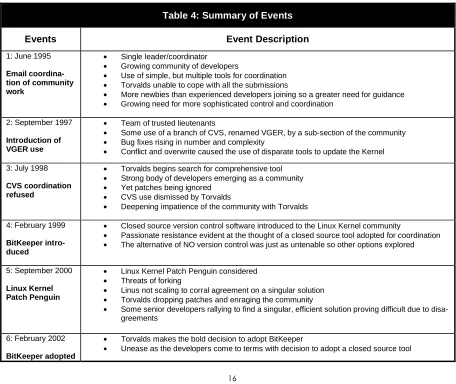
In Step 2, both authors created a timeline together to break down coordination into events as we saw
it shift and change at different moments of time (Strauss and Corbin 1998). In all cases in our story we
found such events to be centered on controversies of which version control software to adopt, and why
(Strauss 1987; Strauss and Corbin 1998). Each event was either something that transpired (occurrence) or
an event that was supposed to happen and was expected by the developers, but for some reason did not
occur. In both cases it led to debate and discussion where a serious flurry of emails moving back and forth
could be followed. The timeline was constructed and then crosschecked against the mailing list repository
for accuracy and discrepancies. The first author was more familiar with the data but the second author
forced the first one to remain objective by constant questioning of each event, and if it did indeed qualify
to be included. Twelve main events were found but the first and the last did not technically fall within the
period of our study so we focused on the ten in the center to demarcate the main coordination events.
To qualify as an event, the following conditions had to apply:
a) An occurrence/non-occurrence that is considered controversial by the developers in relation to
co-ordination,
b) Creates a sudden and increased flurry in email responses and discussion, and,
c) Something that has causal implications for the next event – i.e. is seen to be an input or catalyst for
the next event.
Step 3 involved the identification of coordination processes. This entailed a process of clustering
and identifying different types of relationships between the open codes – creating axial codes (Glaser
1992; Strauss and Corbin 1998). The first author made use of the memo facility in Atlas.ti to capture
con-ceptual notes throughout this process of axial coding. Concon-ceptual notes that were created built on current
literature in coordination and drew upon dynamic coordination ideas (Harrison and Rouse 2014;
Jarzabkowski et al. 2012; Kotlarsky et al. 2014; Langley et al. 2013). The data analysis gave rise to close
intense discussion between the authors that these memos were refined. They were not reduced by number
but each memo took on fuller shape with the second author guiding the process of looking for links to
lit-erature in the same area. This led us to the idea of dynamics of coordination because our data nudged us
sharply to notice how fluidly coordination moved at certain points of the Linux Kernel development.
However, this was partly made possible by the ability to discern more than one coordination process. The
process of coordination was fluid and dynamic both in its movement but also in its shape and essence.
Re-turning to the literature on coordination and authority structures both authors looked for particular
charac-teristics that set one type of coordination process apart from others. Open source literature emphasizes the
existence of the meritocratic coordination process (Capra et al. 2011; Demil and Lecocq 2006; O'Mahony
and Ferraro 2007; von Krogh and von Hippel 2006). Other forms of coordination processes such as
auto-cratic, which are found in more traditional organizational settings (Eisenhardt 1985; Ouchi 1980), are not
often cited in open source literature. Our work combines both to provide a more complete understanding
of different coordination processes made possible in digital settings that abound today. Another noticeable
difference in coordination processes was our discovery of a more nuanced breakdown in coordination
types than is evident in literature. Our memos and axial codes coalesced around four coordination
pro-cesses; autocratic clearing house, oligarchic recursion, federated self-governance and meritocratic idea
testing.
Our final step, Step 4, urged both authors to trace the journey of each coordination process over
the eight year period of our data. The process of disengaging one coordination process from another was
not straightforward. It led to a discussion between the authors and a change in data analysis strategy. Both
authors decided to work side by side but with their own computers. Focusing on the same data section we
began to note the point at which any one singular coordination process was obvious. We approached the
data through analytical time-slices to narrow down on the dynamics of coordination. It was during this
focus at the same time. Coordination behaved very much like a fluid where intertwined coordination
pro-cesses moved, changed, were fleetingly visible and sometimes disappeared completely. We mapped these
movements across different event periods of our data to make sense of digital coordination.
Table 3. Data analysis
Steps Tasks Outputs
1: Open coding a. Develop early descriptive concepts by cod-ing 100 messages from data
b. Re-evaluate and reduce the number of de-scriptive concepts by eliminating duplicates and merging closely related ones. c. Use this code book to analyze the entire
data material
• There were close to 100 mutu-ally exclusive descriptive con-cepts created from the pilot • Ended with over 150 open
codes when open coding of the entire data material was com-plete
2: Timeline of key events a. Establish a timeline of coordination events, version control changes, and points of con-tention raised about each VCS
b. Cross-check timeline with mailing reposi-tory, and each link
• A chronology of key events (see Table 4)
• Process of coordination analyti-cally decomposed into different processes evident in the data
3: Identify coordination processes (CP)
a. Clustered open codes and laid bare rela-tionships between them to build axial codes. This involved examining, categoriz-ing, and clustering concepts.
b. Memos emerged naturally during the course of coding. Conceptual ideas related to the data (and linked directly/indirectly with literature) were noted in some detail c. Elements of overlap and difference with
ex-tant literature on coordination processes gave rise to recognition of already known coordination processes but also the ability to discriminate new ones
d. Our four coordination processes were cate-gorized and named
• Built close to 30 theoretical memos1 related to coordination processes
• New coordination processes such as autocratic clearing, oli-garchic recursion, federated self-governance and merito-cratic idea testing. Codes and memos coalesced around each CP indicating the defining char-acteristics of each.
4: Distinguish concurrent coordination processes
a. When establishing the time-specific appear-ance of coordination processes proved frustrating due to a ‘moving target’ phenom-enon the analysis was reversed to seek lim-inal coordination processes
b. We used the notion of analytically slicing the data into time-frames to slow down the process of coordination movements c. This lead to the identification of a new
dy-namic of coordination where multiplicity of coordination was evident – strands of differ-ent coordination processes were followed in the emails to re-experience their separate moments, their intertwining, moments of liminality to disappearance even
• Identification of moments where the existence of multiple coordination processes were evident
• The liminal nature of tion where different coordina-tion processes were made visi-ble
FINDINGS: THE LINUX KERNEL DEVELOPMENT
In 1991, Linus Torvalds started what is now typically seen as the most significant open source
de-velopment project: the Linux Kernel2. In the first couple of years, the project was small and essentially
managed by Torvalds, using simple tools such as his university email account. However, the versions kept
changing and the number of developers and contributions grew. For instance, between December 1991
(version 0.11) and July 1995 (version 1.2), the number of contributors grew from three to more than 15,000
(Moon and Sproull 2000), making the open source project, and its outputs in the form of software code,
increasingly complex to coordinate.
From the outset, Torvalds managed to create and sustain a deep respect within the community of
developers, in which he had been described as the “benevolent dictator the whole community trusts” (Larry
Augustin, 2001). Yet, over time, the sheer complexity of managing the rapidly scaling software offered
many occasions where this ownership was contested, and showcased a range of coordination options that
were explored with mixed success. In what follows, we narrate the eight-year evolution in coordination
dynamics in the development of Linux Kernel software by zooming in on the main version control events
between 1995 and early 2004 (see Table 4). There are ten main events that we focus on and they are clearly
laid out in Table 4. After a brief historical narrative that provides background to our study we then develop
the coordination processes at play within the Linux Kernel project.
The Early Years (1991-1998): Early on, coordinating Linux was seemingly simple. Although a
software tool for version control called Concurrent Versions Systems (CVS) was in use by UNIX
develop-ers, the Linux project did not really merit such a tool, since it still lacked the critical mass of developers. In
fact, Torvalds was on top of much of the coordination, including making pre-patches and/or releases.
In-creasingly, however, trusted individuals, referred to as maintainers in the community were appointed to
serve as gatekeepers. This helped to protect Linux code and maintain “his tree”3 in the manner that was
closer to the liking of Torvalds.
Even though the group of maintainers had grown to at least a few hundred4, in 1996, the sheer volume
of patches made coordination problematic. A number of senior maintainers therefore voiced the need of a
version control tool. One of the most trusted maintainers, David Miller, even started to maintain a version
of kernel code, which he labelled VGER (pronounced “Voyager”), to support version control. Apparently,
this was significantly needed, since many developers started to use it as a point of reference in their software
development work.
However, Torvalds’ influence served as counter-force as he refused to synchronize Linux code
through VGER (Torvalds, 28th Sept 1998). His refusal was met with resistance from a section of the
com-munity that was led by Miller, who in turn stated clearly that he was not going to disable VGER or stop
using it for Linux development (Miller, 29th Sept 1998). This was a striking example of how maintainers,
using version control software, began to take on more responsibility than originally intended. Also, it
ex-emplified how new and more fine-tuned forms of coordination began to emerge. This was necessary
be-cause both software patches and the developer community were increasing in size. However, so was the
complexity of the Linux Kernel code, making new forms of coordination yet more critical that would help
to cope with the growing complexity.
While showing interest in the idea of version control software in general, Torvalds was decidedly
against the use of CVS in particular. CVS was used by a subset of Linux developers but Torvalds rejected
its use for his own work on the kernel. This resistance provoked a small but persistent outcry in the
com-munity: The developers wanted Torvalds to pay attention to their patches and to provide them with one
definitive tree of source code to pull from. It was a simple coordination issue, they argued, which any
version control tool could ameliorate. Coordination tools such as version control software could afford the
entire community more transparency and awareness of progress on any version and releases.
Roughly at this time, in late 1998, a number of other version control solutions were proposed. Each
of the tools promoted by one or many developers were discussed with regard to the functionality offered
and the needs of Linux development. Still, it was a different version control software, BitKeeper (BK) that
would soon become a point of both controversy and interest. Its creator, Larry McVoy had often thrown in
some minor comments seeking feedback from Linux developers as to what would be acceptable to them in
version control software. The developers were generally aware about his closed, and proprietary tool under
development, and showed their hesitancy about such license mixing. McVoy was still eager to please the
developers because he needed them to test the software, and even offered to bring BK under an open source
[image:17.595.70.526.374.758.2]license if the parent company got bought.
Table 4: Summary of Events
Events Event Description
1: June 1995
Email coordina-tion of community work
• Single leader/coordinator • Growing community of developers
• Use of simple, but multiple tools for coordination • Torvalds unable to cope with all the submissions
• More newbies than experienced developers joining so a greater need for guidance • Growing need for more sophisticated control and coordination
2: September 1997
Introduction of VGER use
• Team of trusted lieutenants
• Some use of a branch of CVS, renamed VGER, by a sub-section of the community • Bug fixes rising in number and complexity
• Conflict and overwrite caused the use of disparate tools to update the Kernel
3: July 1998
CVS coordination refused
• Torvalds begins search for comprehensive tool • Strong body of developers emerging as a community • Yet patches being ignored
• CVS use dismissed by Torvalds
• Deepening impatience of the community with Torvalds
4: February 1999
BitKeeper intro-duced
• Closed source version control software introduced to the Linux Kernel community
• Passionate resistance evident at the thought of a closed source tool adopted for coordination • The alternative of NO version control was just as untenable so other options explored
5: September 2000
Linux Kernel Patch Penguin
• Linux Kernel Patch Penguin considered • Threats of forking
• Linus not scaling to corral agreement on a singular solution • Torvalds dropping patches and enraging the community
• Some senior developers rallying to find a singular, efficient solution proving difficult due to disa-greements
6: February 2002
BitKeeper adopted
• Torvalds makes the bold decision to adopt BitKeeper
• BitKeeper’s introduction creates almost two clear factions in the community – so though Bit-Keeper makes coordination more efficient, it at the same time slows momentum through gener-ating discord
7: April 2002
Change in Bit-Keeper license
• Linux Kernel community dismayed to see a regressive change in BitKeeper’s license • Change in BitKeeper’s license brought the realization to even the more sanguine developers
that circumstances may well deteriorate
• A change in BitKeeper’s license rouses the community. Their mutual, and vociferous indigna-tion begins to unnerve even McVoy
• Many voices suggesting that the time for a replacement for BitKeeper has come and needs to be acted upon
8: February 2003
BitBucket an-nounced
• An open source copy of BitKeeper called BitBucket announced
• Questions of copyright and ethicality of a BitKeeper clone debated to make sense of the tool needs for the Linux community
• The Linux Kernel community is a good testing ground for BK so McVoy is loath to make a dras-tic move BitBucket forces him to make threats.
• McVoy determined to keep the community without changing the license conditions of BK looks for another solution.
9: March 2003
BitKeeper to CVS gateway an-nounced
• Anxious over possibility of BitKeeper replacement McVoy announces a technical gateway be-tween CVS and his own tool BK
• Generally the community acknowledges that a tool is VERY necessary for coordination and control of the Kernel’s work
• Creation of the gateway eyed very suspiciously by the community
• Community is not convinced that it can access 100% of the Linux Kernel material through the gateway thus bringing its integrity, existence and motivation into question
• When discussion does not prove to change McVoy’s ability to provide full access to the Linux code then the community turn to resistance.
10: July 2004
BKCVS gateway
breakdown
• Mistrust of McVoy and his company spreads to the gateway he has created for CVS users to access updates on Kernel development
• Few, if any developers use the gateway after harsh criticism of its integrity and providing full access and control to all the community
• The community not only resists BK control through a lack of use, it also begins multiple proac-tive changes (which are only known to a few at first)
• BK is reverse engineered by some members of the Linux Kernel community compelling McVoy to remove BK from community use. This breaks the relationship between BK and Linux. • Torvalds recognizes that a good tool is even more pertinent now decides to abide by the open
source way – and scratches ‘his own itch’ by initiating GIT.
BitKeeper (1999-2002): In early 1999, the need of version control software was widely recognized,
but the more crucial discussions flowed from the controversies around which tool to adopt. There were a
number of unofficial trees growing, which added to the coordination problems already faced by the
devel-opers. Developers were no longer sure as to which version control tool had the most up-to-date version of
the Linux Kernel, and which branches had been changed and where. Developers saw a duplication of
con-tribution as a real waste and there was growing frustration among the community with Torvalds. Indeed,
there were clear signs of Torvalds’ incapacity to manage version control. First, there were fewer new
forced to send the same patch for peer review numerous times before it was acknowledged, let alone
re-viewed. As a result, the community of developers began to fracture with a growing number of dissenting
voices. Linux Kernel development was at a critical juncture, and in great need of a good version control
tool. McVoy sensing discord and opportunity brought a new version control tool, BitKeeper, to the
com-munity’s attention.
Although Torvalds was aware of the risk that his developer community would take their code and
talent to another project, he was still not keen to accept BitKeeper without stronger persuasion. Indeed,
while considering BitKeeper use, Torvalds was also busy working on his own solution called the Linux
Kernel Patch Management System, launched as a project proposal on September 13, 2000. Despite much
initial interest, however, discussion amongst the developers steered off into a comparison of CVS and
Bit-Keeper rather than showing any genuine interest in the Linux Kernel Patch Management System. It was
now obvious that if the Linux Kernel project was to remain sustainable, Torvalds needed to appreciate
developer discontent and go with another solution. Accordingly, in February 2002, Torvalds declared
Bit-Keeper the official version tool for the kernel.
However, many in the community did not appreciate BitKeeper adoption due to its non-GPL license.
In early October 2002, the situation grew worse as some developers noticed that the BitKeeper license had
been changed to include a new clause, ‘...this License is not available to You if You…develop, produce,
sell, and/or resell a product which contains substantially similar capabilities of the BitKeeper Software’.
The substance of concern about BitKeeper not being GPL was expressed by another developer, Molnar
who clarified how the Linux Kernel code was both the source code and the developer comments (metadata)
and though the source code was under an open source compliant license (GPL), the metadata was not
(Molnar 2002 - Sun 6th Oct). The use of more than one version control tool at the same time by the Linux
community offered the ability to hide, hold, withhold, and manage both the developers and their code – in
essence, it was increasingly difficult to distinguish a clear locus of coordination in the Linux Kernel project.
The multiple version control tools in use made it difficult to distinguish where coordination activities
BitBucket (2003-2005): While BitKeeper slowly began to gain ground, this momentum was
partly broken when Pavel Machek (another Linux developer), in February 2003, started a project called
BitBucket. The project was framed as ‘(a) bitkeeper clone’ (Machek 2003 - Wed 26th Feb). Not
surpris-ingly Larry McVoy retaliated by telling Machek and the Linux community more generally that BitKeeper
was a trademark (McVoy 2003 - Sat 1st March). The announcement of BitBucket generated opposing
views. On the one hand, BitBucket was seen as a source of fragmentation in coordination. On the other,
certain developers argued that competition was necessary and that such competing coordination tools
should emulate the current tool being used in order to ensure a smooth changeover.
Torvalds believed that the key feature of BitKeeper was distribution rather than the repository format.
He explained that if two people, or more, would give the same name to their similar or different files, then
merging becomes very tricky. Distributed repositories imply that any developer that pulls code from the
tree in effect creates his own version, which can be renamed, and changed in other ways. Pushing the
changed version back into the tree can create serious complications because there will now be multiple
versions and no way to decide which one is better or more useful. With a version control tool which has a
central repository, like CVS, this is not a problem because conflicts in file naming and multiple commits
needs to be resolved before the final commit is made. The same was not true for BitKeeper, a distributed
version control software.
However, perhaps McVoy felt that he had made little headway with the community at large. Less
than a month later, he surprised developers by creating an interfacing gateway between CVS and BitKeeper
(McVoy, 2003 – Tue 11th March). While gateways in software are seen as very useful ways to access
ex-ternal code, at the same time they provide little incentive to any developer to create a competing product.
The BK to CVS gateway provided indirect access to BitKeeper to all the community, making working on
a competing tool unnecessary. However it did allow CVS users more access into what was happening in
Linux development.
The slender trust between the open source developers and the proprietary BitKeeper, in spite of
in terms of not gaining access to all Linux data but only about 90% of it, a fact that made the community
very uneasy (Collins 2003 - Tue 11th March). Larry McVoy insisted that nothing was missing from the
data and that some of the developers were just being paranoid and mistrustful.
In March 2003, Larry announced that the BK to CVS gateway had gone live and could be accessed
and used but the gateway was not maintained for long due to ‘disuse and security problems’ (Anvin 2004
- Thu 22nd July). A certain momentum had been building slowly but compellingly that indicated multiple
concerns with BK functions, form and use. The Linux Kernel developers were a strong community of
cre-ative and skilled programmers who believed that the open source way was to always try and find a
solu-tion to their own problem. They did not appreciate BK adopsolu-tion despite its strength as a version control
software. In April of 2005 McVoy accused some members of the Linux community of attempting to
re-verse engineer BK. He pulled BK use from the Linux Kernel collective. In response, Torvalds decided to
create his own version control software, which he named GIT.
ANALYSIS: COORDINATION PROCESSES IN THE LINUX KERNEL
The story of Linux Kernel development shows a dramatic and sustained growth in developer numbers
and their contributions. Growth of such proportion necessitated version control that both preserved the
Linux Kernel’s installed base from being fragmented and effectuating new contributions by developers.
The struggle over eight years shows a journey of trial and error with different tools for ensuring that patches
were managed, problems were flagged, multiple versions were possible, and large amounts of time-stamped
data were held and archived. What is evident from our story is that each tool was actually sampled by the
community for accomplishing specific forms of coordination. Such coordination forms were then amended
and tweaked to become a better fit for the ambitions of this growing open source project. In most cases, the
tweaks proved insufficient and the tool was eventually dropped. The adoption, tweaks and dismissal of
community. Our results indicate four unique coordination processes prominent in the Linux Kernel
devel-opment project. In what follows, we discuss autocratic clearing; oligarchic recursion; federated
self-gov-ernance; and meritocratic idea-testing.
Autocratic Clearing
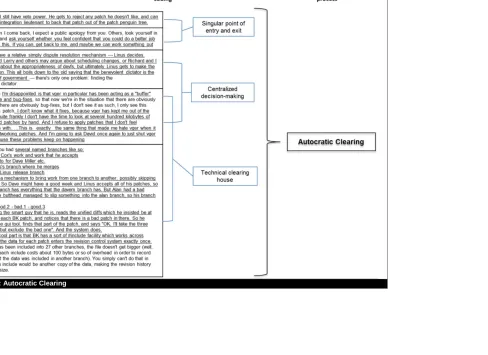
Our data analysis (see Figure 1) showed that a powerful basis for coordinating the development of
the Linux Kernel involved what we refer to as autocratic clearing. Autocratic clearing is a system of
man-agement with singular coordinating points that obliges other actors to channel all work and decisions
through a central ‘clearing house’ before accomplishment. First, this coordination process involves a
sin-gular point of entry and exit for access to significant resources for coordination. This means that the actor
who controls this point of entry will gain significant influence over the development work. In our case, it
was clear that what attracted Torvalds to any version control software, be it simple use of e-mail or more
sophisticated tools such as BitKeeper, was the provision of such a singular point of entry. For instance,
e-mail was eminently controllable by Torvalds, as he was the only one privy to his account. Second, it also
involved centralized decision-making where significant decisions for the future of the software were
con-centrated to a single actor. In the Linux Kernel case, Torvalds made many of the important decisions about
patch acceptance and version releases. Finally, such decision-making was supported through a technical
infrastructure that served as intermediary between proposed contributions and new releases of the software.
Such clearing exhibits market-like qualities where patches are exchanged and valued (and evaluated) by
developers. In our case, Torvalds was the regulator of this clearing-house, and could step in to effect a
decision, thus governing this marketplace of ideas.
<< Insert Figure 1 about here >>
Autocratic clearing appeared early in Linux history but its effect was felt throughout the study
pe-riod, and beyond. Centralized decision-making remained a strong idea in Linux development, and the
choice of version control coordination tool largely depended on the level of centrality and ownership
of-fered to the leader. Consider how the decision to either adopt CVS or BitKeeper essentially was one of
versions that were worked on in parallel, BitKeeper represented a way to accomplish a singular point of
entry and exist in the context of a much larger community of developers. Viewed from an autocratic
clearing perspective, parallel versions are essentially a sign of disorganization. Distributed version control
requires that all the developers that have write access should possess a degree of expertise but this is not
easy to engineer.
Whereas single point of entry and exit was a quality that could be designed into a digital tool,
keep-ing all decisions to be made centrally and as much as possible by Torvalds was increaskeep-ingly difficult as
the open source project grew. Clearly, more effective and new coordination techniques emerged in view
of the need of a resilient project.
The use of BitKeeper restored autocratic clearing especially compared to the e-mail system used as
the early version control of Linux Kernel. While BitKeeper seemingly gave multiple entry and exit points,
in practice however, multiple access and central decision-making rights were not given to any one
devel-oper at the same time. If a develdevel-oper was able to pull content and create a personal clone of Linux, and
make changes to his cloned version, this new and changed cloned version could not automatically be
pushed back into the main build of Linux. This is where BitKeeper supported centralized decision-making
and served as a technical clearing-house in coordinating open source development contributions.
Oligarchic Recursion
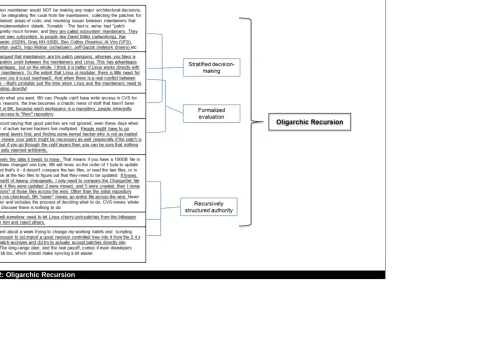
The second coordination process generated through our data analysis was that of oligarchic
recur-sion (see Figure 2). We define oligarchic recurrecur-sion as a system of management where decirecur-sion-making is
stratified and the aim is to strengthen the current controlling structures through recursive handling of code
peer evaluation. For a long time effective coordination meant reliance on a group of tools and actors
working together cooperatively to manage Linux development effectively. This involved stratified
deci-sion-making enabled by extra layers of design embedded into the digital tools to make coordination
frac-tionally more diffused yet still cordoned off into the control of a few actors. These actors were often close
allies and shared the same mental models of coordination or design specification. For instance, Patch
style provoking parallel versions, where different maintainers could oversee each one. This stratified
de-velopment, the key decisions-makers, and how the stratified versions would be brought together. The two
branches of similar code were worked on simultaneously but handled by different coordinating
maintain-ers. Yet, at some point, there was convergence of one branch towards another where both versions were
either (a) merged or (b) assessed for different use value and broken off to fulfill completely different
functions. Both the convergence and ability to work on multiple branches concurrently was made possible
by digital coordination tools like version control software.
<< Insert Figure 2 about here >>
Second, patches submitted by open source project members went through a formalized form of
evaluation before acceptance/rejection. Since the Linux project grew larger in code base size, developer
numbers, and complexity, evaluation of patches required different forms of scrutiny to avoid the danger
of having software updates overwritten or ignored. Various extra layers of management were therefore
introduced into Linux evaluation to ensure the safekeeping of code updates. The stratified nature of
deci-sion-making embedded into technology offered a comprehensive and rule-based process of evaluation.
With a set of routines and rules in place, the maintainers could help make decision-making more efficient.
Each maintainer, through privileged access to branches in the version control software, evaluated and
de-cided on different segments of code. The process of evaluating software, though always a key part of
open source development, had now been made far more formalized with distinct stages and routines to be
followed by both the maintainers and the developer community.
And finally, there were mutually cooperative structures, practices, rules, and tools purposefully
built to reinforce authority recursively. Designing coordinating power into technology was not as
compli-cated as keeping it from obvious view of the community. Technology is often embedded with rules and
structures that are seen as part of good design and requirements, yet in practice users are less able to
powerful actors, and further entrenched them into the Linux project through instituting nested and
recur-sive practices for code approval, shortlisting of patches or developers for different roles, or the choice of
new maintainers. The fact that BitKeeper only allowed privileged actors to “cherry pick” patches from the
main tree to accept/reject was not a facility offered to the rest of the community of contributors, and
fur-thered the needs of the already established elite.
Federated Self-Governance
We refer to the third coordination process in practice within the Linux project as federated
self-gov-ernance (see Figure 3). We define federated self-govself-gov-ernance as a management structure that establishes
semi-autonomous governing bodies that work together, making sovereign decisions until a re-merge is
made necessary. In the Linux Kernel case, federated self-governance emerged in response to patches not
being updated and accepted fast enough. One manner of achieving this was to break future code into
dif-ferent branches to create semi-autonomous governing bodies. We saw a benign and internal forking of
Linux into three different branches, all done to cater to the diverse needs of companies and developers. A
stable, beta and alpha branch of Linux emerged and a federated form of coordination to match. Each
branch was developed at a different pace and held slightly different code. Maintainers, with a group of
dedicated developers, governed each branch of the code. Decision-making for each branch was
semi-au-tonomous because each branch would be left alone to grow and change according to the needs of the
de-velopers working on it, and the maintainer who was in charge with little or no interference from Torvalds
and other maintainers.
<< Insert Figure 3 about here >>
The creation of self-governing structures was imperative to maintain growth in Linux. However, to
periodically draw the branches together, to remerge, was equally important. The version control software
was used to update the stable branch, differentiate and unpack the needs for the beta one, and reestablish
the tested (alpha) into the stable or beta branch as necessary. This was done to ensure compatibility and
sometimes to introduce elements into the stable branch from the beta or alpha that no longer required
various cycles of Linux such coordination often brought about a new release and version of the
Linux/GNU operating system. This is an example of a software driven need to reassess the underlying
de-sign norms and code. The branches are usually different but not completely unique, and thus can be
merged to make certain functionality more effective.
Meritocratic Idea-Testing
The final coordination process evident in our data analysis was that of meritocratic idea-testing
(see Figure 4). Meritocratic idea-testing embodies a style of management where mutually agreed
deci-sions able to accommodate multiple divergent views are negotiated in a transparent manner so as to
ena-ble open questioning and testing of ideas in order to make them strong. The salient categories that arose
pointed to firstly a more communitarian decision making amongst equal actors that technology facilitated
and made possible. Secondly, the aim of this diverse way of making decision was to achieve an
accom-modation of multiple views between different developers. Thirdly, meritocratic coordination entails the
need for technology to reinforce transparency into coordinating work so that all the developers can see
the most current changes, the process of work, and older versions to check for potential problems. And
finally, stress-testing of ideas is a crucial element of meritocratic coordination where multiple “eyeballs”
(developers) can be put to any patch and problem to recognize the problem quickly. This allows good
code to emerge efficiently as finding a solution to a problem becomes that much easier when the problem
is clear and known.
<< Insert Figure 4 about here >>
Communitarian decision-making was clearly manifested in the use and adoption of CVS by the
Linux community. CVS gave cloning access to all, and at the same time it offered all developers an equal
chance to submit their changed code back into Linux. Decisions at the point of conflict between two or
more patches sent to resolve the same issue would be made by the last developer to upload his/her
change. Version control software such as CVS ensured that all developers were equal in its eyes –
merito-cratic coordination structures were embedded into its very design making it possible for all developers to
An accommodation was necessary in meritocratic structures because all the voices had to be heard
but of course could not be acted upon at the same time. The Linux story is littered with examples of
ac-commodations found between different viewpoints; indeed each requirement in an open source project is
a consequence of communitarian deliberation and accommodation. The development of the BitKeeper to
CVS gateway is an example of how certain actors attempted to find an accommodation between the
Bit-Keeper and CVS users. If a developer was not allowed to use BitBit-Keeper or did not want to then he could
still work on Linux development so long as he had access to the code. The most updated versions of
Linux were held and controlled by BitKeeper so it was important to access this software. The gateway
was created after long negotiations amongst the community and made operable as an accommodation to
hold the community together over Linux code.
The creation of Linux Kernel Patch Penguin represented an attempt to establish meritocratic
idea-testing. The aim was to rebuild transparency into an open source project that had been dissipated through
a use of non-open source software for coordination. The very design of this version control tool was being
planned to reinforce transparency and to make communitarian decision making possible. This tool may
never have actually materialized yet a discussion of its possibility was central to the debate of what sort of
version control software the Linux community preferred. It was indicative of their needs but also their
preferences. And though it eventually turned into a discussion and comparison of CVS and BK, it did
cre-ate a much needed awareness of the strengths and weaknesses of both these tools. The debcre-ate was part of
the process of true meritocratic coordination where stress testing of ideas is carried out through debate in
a transparent and inclusive manner.
Stress testing of ideas is a basic premise of open source development. Linux development was no
exception, and it is evident in numerous examples where individual patches were scrutinized to evaluate
strength, functionality, and elegance. But it was not only the code that was stress-tested in Linux. The
software are also tested for their ability to cope with different issues such as the growing number of
soft-ware commits being made at one point of time, or who is designated as the final stress tester of ideas, and
has the power to make a decision between two or more patches submitted to solve the same problem.
Coordination Processes Coming Together
We distinguished four coordination processes (autocratic clearing, oligarchic recursion, federated
self-governance, and meritocratic idea-testing), each displaying common sets of rules, guidelines, and
ac-tivities that operationalize a specific authoritative structure. However, as our case story unfolds, it is clear
that the coordination processes were not standalone, plotted in a sequence replacing each other. Instead,
they co-existed at certain moments in the evolution of the Linux kernel. Two or more coordination
pro-cesses were typically active at any moment, sometimes offering complementary support by addressing
different coordination needs in the development of the software. Other times the co-existence spurred
ten-sion as the coordination processes collided. In other words, in addition to the direction unfolding within
each of the coordination processes over time, there also existed a dynamics as coordination processes
were coming together in the governance of the Linux Kernel. Table 5 summarizes the four configurations
[image:28.595.59.542.480.733.2]that we highlight here as representative ‘moments’, and each one is explained in the following section.
Table 5: The Configuring of Governance
Configuration
‘Moment’ Coordination Processes Complementary Support Opposing Tensions
A-M-F (VGER Shutdown)
• Autocratic clearing (A) • Federated self-governance (F) • Meritocratic idea-testing (M)
Autocratic clearing (A) and meri-tocratic idea-testing (M) gave complementary support to each other to help create transpar-ency – much needed in open source development processes.
At the same time, federated self-govern-ance (F) emerged through developers enacting their persistent use of VGER as their choice of version control software. This reduced transparency overall but at the same time allowed voicing of self-ex-pression and actual progress in develop-ment work.
A-O-M (Introduction of
BitKeeper)
• Autocratic clearing (A) • Oligarchic recursion (O) • Meritocratic idea-testing (M)
BitKeeper succeeded in institut-ing subtle emergence of oligar-chic recursion (O) alongside au-tocratic clearing (A) and merito-cratic idea-testing (M) where all these forms of processes even-tually worked in tandem to man-age synchronized work.
A-O-M (BitKeeper License
Change)
• Autocratic clearing (A) • Oligarchic recursion (O) • Meritocratic idea-testing (M)
The complementary support of autocratic clearing (A) and oli-garchic recursion (O) was an ef-fective way to manage different