PAPER • OPEN ACCESS
Probabilistic sensitivity analysis for multivariate
model outputs with applications to Li-ion batteries
To cite this article: V. Triantafyllidiis et al 2018 J. Phys.: Conf. Ser. 1039 012020
View the article online for updates and enhancements.
Related content
Uncertainty Quantification in Solidification Modelling
K Fezi and M J M Krane
-Parameter Identification of Equivalent Circuit Models for Li-ion Batteries Based on Tree Seeds Algorithm
W J Chen, X J Tan and M Cai
-A review on prognostics approaches for remaining useful life of lithium-ion battery
-Content from this work may be used under the terms of theCreative Commons Attribution 3.0 licence. Any further distribution
Probabilistic sensitivity analysis for multivariate
model outputs with applications to Li-ion batteries
V. Triantafyllidiis1, W.W. Xing1, P.K. Leung2, A. Rodchanarowan3, and A.A. Shah1
1School of Engineering, University of Warwick, Coventry CV4 7AL, UK 2Department of Materials, University of Oxford, Oxford, OX1 3PH, UK
3Department of Materials Engineering, Faculty of Engineering, Kasetsart University, 50 Ngamwongwan Rd., Ladyao, Chatuchak, Bangkok, 10900, Thailand
Abstract. Full battery models are highly complex, which limits their application to tasks such as optimization and uncertainty quantification. To lower the computational burden, sensitivity analysis (SA) can be used as a precursor to identify the most important parameters in the model, but SA itself relies on a high number of full model evaluations, which has motivated the use of emulators. For high-dimensional output problems, emulators are challenging to construct. In this paper we develop a probabilistic framework for SA of high-dimensional output models using a Gaussian process emulator based on dimensionality reduction. This allows us to perform SA under uncertainty for multi-ouput problems, providing error bounds for the emulator predictions of sensitivity measures. We show how this can be achieved using Monte Carlo sampling or possibly by using semi-analytical expressions with highly efficient sampling. Moreover, we can perform SA for multivariate outputs by ranking the sensitivity measures related to (uncorrelated) coefficients in a basis for the output space.
1. Introduction
The large number of parameters appearing in mathematical models and numerical codes for batteries complicates modelling efforts. Lowering the time cost of simulations by identifying the most influential parameters and studying their effects is an effective precursor to tasks such as design optimization and uncertainty quantification (UQ). This process is referred to assensitivity analysis (SA) [1]. SA methods can be categorized in different ways. In quantitative SA the influence of a parameter (usually referred to as “factor” of aninput) is assigned (reproducibly) a number called a sensitivity index orimportance measure. Inlocal SA, the output variability is studied by perturbing an input around a nominal (base) value, while methods that attempt to measure the output variability across the entire input space are termed global. For small variations in the inputs local methods may be more computationally efficient. In many cases involving complex nonlinear models, however, local SA methods are inadequate.
In the context of battery models, very little attention has been paid to SA. In the majority of cases, formal SA methods are not used; the model is simply run multiple times by varying factors individually and inspecting the outputs, using ad-hoc measures or by employing visualization tools [2]. In a small number of studies more rigorous approaches have been used, but almost invariably with highly simplified models. Applying formal SA methods to complex battery and fuel cells models is computationally burdensome and often not feasible, particularly with brute force Monte Carlo (MC) approaches. In order to overcome this issue an emulator or meta-model can be used. The emulator itself can be difficult to construct when the input and/or output space is high-dimensional (e.g., input and/or output fields). If the quantity of interest (QoI), which is derived from the output, is a scalar, an alternative is to use an emulator directly between the inputs and QoI. It may be the case, however, that there are multiple QoIs, in which case it would be ideal to emulate the output, especially when other tasks (e.g. UQ) involving different quantities, including perhaps the original output, are to be performed subsequently.
To address these issues, we develop an approach for SA of a nonlinear Li-ion battery model by employing a Gaussian process emulator based on dimensionality reduction to approximate entire charge-discharge curves. QoIs are extracted from the curves in order to perform a SA. We show how it is possible to perform an efficient probabilistic SA in the context of a variance-based approach [4], extending previous results for the scalar case considered by Oakley and O’Hagan [5] to linear functional QoIs derived from the multi-dimensional output. Lastly, using the emulation method we are able to perform a SA of multiple outputs (including in high dimensional spaces) by ranking coefficients in a low-dimensional subspace approximation of the output space.
2. Problem setup and sensitivity analysis
Suppose that the model output isy=η(x;ξξξ)∈ F for some function spaceF, wherexrepresents, e.g., space, time or space-time and ξξξT = (ξ1, ξ2, ..., ξk) ∈ X ⊂ Rk is a vector of input factors; that is, a spatial, temporal or spatio-temporal field, parameterized by inputsξξξ. The computer model (simulator), on the other hand, provides a finite-dimensional approximation of η(x;ξξξ), e.g., at a finite number of points in a spatial and/or temporal grid or in terms of a finite basis. We may write the simulator output as a vector y∈Rd, in which dis the number of degrees of freedom, e.g., thedcomponents ofyrepresent values of η(x;ξξξ) atdpointsx. We can therefore consider the simulator as a mapping ηηη :X → Y ⊂ Rd between a feasible input space X ⊂ Rk
and an output space Y, i.e., y=ηηη(ξξξ).
Let Q be a scalar QoI that is derived from y via a linear functional G :F → Q ⊂ R. We can instead consider Q as a mapping F = (G◦η)(ξξξ) :ξξξ → Q directly between X and Q, i.e.,
Q=F(ξξξ) =G(η(x;ξξξ)). In reality, we have an approximationq=f(ξξξ) of Q, where the mapping
f :X → Qis derived from a linear functionalg:Rd→ Q ⊂Rthat acts on the simulator outputs y, that is f(ξξξ) = (g◦ηηη)(ξξξ) =g(ηηη(ξξξ)). We develop a SA framework in which the outputs yare estimated by an emulator. We first describe the SA methods employed and the construction of the emulator. We then show how it is possible to perform SA on QoIs derived from the emulator output, before presenting a probabilistic SA analysis and a method for multi-output SA.
One approach to SA measures the sensitivity of the QoI by estimating the derivative ∂ξif
around a nominal (base) point ξξξ using finite differences [6]. The main weakness of such local methods is that they provide no information on how the sensitivity to a given ξi depends on the values of the other factors. In order to extend this method to a global analysis we may use multiple base points {ξξξj}r
j=1, which leads to the class of elementary effect tests (EETs).
Suppose thatX is the unit hypercube, and each direction ξi is discretized intoplevels (points). The elementary effect of ξi atξξξj = (ξj,1, . . . , ξj,k)T is: ‘
where Δi ∈ {1/(p−1), . . . ,1−1/(p−1)}. Typically, Δi = Δ, ∀i. Morris [3] proposed two sensitivities measures for each ξi, namely the mean and the standard deviation of the finite distributionFi over{EEi(j)}rj=1 (or|EEi(j)|). The meanμi of EEi measures the influence of ξi, while the standard deviation σi measures the degree of interaction with the other factors.
To calculate the statistics for each elementary effect, i.e.,μi andσi, we can randomly choose
M base points{ξξξj}M
j=1, then construct so-calledtrajectories inX ofk+1 pointsξξξj∪{ξξξj,n}kn=1 for
each j. Settingξξξj,0 =ξξξj, the trajectory point ξξξj,n is obtained by perturbing a randomly chosen factor of ξξξj,n−1 by ±Δ until all factors have been perturbed, but with the property that ξξξj,n
andξξξj,n−1 differ in only one factor. The model is run at every point in each of the trajectories (a total of M(k+ 1)) to obtainEEi,j,i= 1, . . . k,j = 1, . . . M, yielding estimates of μi and σi. A more sophisticated approach to SA, embedded in probability, involves treating the inputs as stochastic variables, which leads to a distribution over the QoI [4, 6]. A variance based first-order effect of each input factor is given by Varξi(Eξξξ∼i[q|ξi]), where E[·] and Var(·) denote expectation and variance operators with respect to the distribution over a subscripted random variable; or with respect to the distributionp(ξξξ) overξξξif no subscript is present, i.e. E[·]≡Eξξξ[·]. The quantity ξξξ∼i is the vector of all inputs factors excluding ξi (and similarly for multiple indices). The first order sensitivity index (or main effect index) for the input ξi is defined as
Si ≡ Varξi(Eξξξ∼i[q|ξi])/Var(q), which measures the contribution of the main effect of ξi to the total QoI variance. Another measure of sensitivity, defined below, is thetotal effect index, which incorporates interactions between the factors ξi:
STi ≡Eξξξ∼i[Varξi(q|ξξξ∼i)]/Var(q) = 1−Varξξξ∼i(Eξi[q|ξξξ∼i])/Var(q). (2)
The variance-based SA framework can be couched in terms of the decomposition of the variance of q. Suppose q =f(ξξξ)∈L2(X) (square integrable functions defined onX) and X is (without loss of generality) a unit hypercube X ={ξξξ|0≤ξi ≤1;i= 1, . . . , k}. We also assume that the factors are independently and uniformly distributed within X, so that the probability density functions satisfy p(ξi1, . . . , ξil) = 1[0,1]l for {i1, . . . , il} ⊂ {1, . . . , k}, where 1A is the indicator function on a set A. The expectation operators Eξξξ∼i
1...il[·] are then unweighted integrals over
ξi1, . . . , ξil. The functionf(ξξξ) can be decomposed in the following way (Hoeffding [7]):
f(ξξξ) =f0+
k
i=1
fi(ξi) +
k
i=1 k
j=i+1
fij(ξi, ξj) +. . .+f1...k(ξ1, . . . , ξk), (3)
where f0 is a constant, fi(ξi) (the main effect of ξi) is a function only of ξi,
fij(ξi, ξj) (the interaction) is a function only of ξi and ξj, and so on. The condition 1
0 fi1i2...is(ξi1, ξi2, . . . , ξis)dξiw = 0 is imposed for 1 ≤ i1 < i2 < . . . < is ≤ k and
iw ∈ {i1, i2, . . . , is}[7]. Thus, the summands are orthogonal, in the sense that:
X
fi1i2...im(ξi1, ξi2, . . . , ξim)fi
1i2...in(ξi1, ξi2, . . . , ξin)dξξξ= 0, (4)
for{i1, i2, . . . , im} ={i1, i2, . . . , in}. Moreover,f0=E[q] =Xf(ξξξ)dξξξ,fi=Eξξξ∼i[q|ξi]−f0,fij =
Eξξξ∼ij[q|ξi, ξj]−fi−fj−f0, etc.. By squaring and integrating Eq. (3) and using the orthogonality
property, we obtain a decomposition of the total variance V = Var(q) =Xf2(ξξξ)dξξξ−f02, that is,V =ki=1Vi+ki=1kj=i+1Vij+. . .+V1...k, in whichVi=Varξi(fi(ξi)) =Varξi(Eξξξ∼i[q|ξi]),
define higher order sensitivity indices by normalizing the Vi1...il, e.g. the second-order index
Sij =Vij/V, which measures the effect of interactions between ξi and ξj on q.
The main and total indices can be computed using a quasi MC method [1] by first generating a matrix X = [ξi,j], i = 1, . . . ,2k, j = 1, . . . , N, of N points in the 2k hypercube, using a low-discrepancy sequence such as a Latin hypercube. This is done according to the distribution
p(ξξξ) over the factors, e.g.,p(ξξξ) =1[0,1]k for independentξi ∼ U[0,1]. Xis then partitioned into a matrixA∈RN×k consisting of the first k columns and a matrix B∈RN×k consisting of the remaining kcolumns. This provides two independent sets of N samples in the khypercube. A third matrix Ci consists of the columns of matrixBexcept thei-th column, which is set to the
i-th column ofA. The next step is to compute the QoI q by running the model at the selected inputs contained in the sample matricesA,B, andCi to yields vectors qA=f(A),qB =f(B) and qCi =f(Ci) (f(A) is used to denote vectorizedq values from the set consisting of the rows of A). The indices Si and STi are then estimated as follows:
Si = (1/N)
N
j=1qA,jqCi,j−f02
(1/N)Nj=1q2A,j−f02 , STi =
(1/N)Nj=1qB,jqCi,j−f02
(1/N)Nj=1qA2,j−f02 , (5)
where qA,j is the j-th coordinate of qA (etc.) and f0 = (1/N)Nj=1qA,j is the sample mean. This procedure is repeated for each i = 1, . . . , k. The first of Eqs. (5) follows from the basic definition Varξi(Eξξξ∼i[q|ξi]) = [0,1]E2ξξξ
∼i[q|ξi]dξi−(
[0,1]Eξξξ∼i[q|ξi]dξi)2. The last term is E2[q] =
f02, while the first term can be written as: [0,1]E2ξξξ
∼i[q|ξi]dξi =
[0,1]k
[0,1]k−1f(ξ1, . . . , ξk) ×
f(x1, . . . , xk)dξξξdξξξ∼i, i.e., the expectation over ξξξ and ξξξ∼i of f(ξ1, . . . , ξk)×f(x1, . . . , xk), which explains the MC estimate in Eq. (5). A similar explanation can be given for the STi estimate.
The cost of this procedure is 2N runs of the model to generate the matricesAandB, and an additionalN kruns to obtain the QoIs corresponding toCi. This give a total ofN(k+2), which is much lower than the cost of brute-force MC estimates ofVarξi(Eξξξ∼i[q|ξi]) andVarξξξ∼i(Eξi[q|ξξξ∼i]). The former, e.g., would requireO(N) runs (N k) to estimate the inner expectation for a fixed
ξi, which we would be repeated O(N) times to estimate the outer variance, leading to O(N2) runs for each i.
3. Gaussian process emulation of the model outputs
Suppose we are given training points {yj}mj=1 ⊂ Y, which are values of y=ηηη(ξξξ) at the design points {ξξξj}m
j=1. Without loss of generality we mean centre the training points: yj → yj −y,
where y = mk=1yk. Assume that Y is a low-dimensional linear subspace of Rd. We derive an approximate basis for Y using principal component analysis (PCA) [8], i.e., we find a linear transformation w(ξξξ) = VTy, in which V ∈ Rd×d has orthogonal columns vi (a basis for Rd) and the uncorrelated components wi(ξξξ) ofw(ξξξ) have decreasing variance with i.
Let Σ = E[yyT] be the symmetric and positive definite variance-covariance matrix. The eigenvalue problemΣv=λvyields theviand corresponding positive eigenvaluesλ1 >· · ·> λd. The components of a point in this basis satisfyVar[wi(ξξξ)] =λi andE[wi(ξξξ)wj(ξξξ)] = 0 fori=j. Any point y ∈ Y can be written in the form y =Vw(ξξξ) =di=1wi(ξξξ)vi =di=1(vTi y)vi and an r-dimensional approximation yr ∈ Yr = span(v1, . . . ,vr) of y is given by yr = Vrwr(ξξξ) = r
i=1wi(ξξξ)vi, whereVr= [v1. . .vr] and wr(ξξξ) = (w1(ξξξ), . . . , wr(ξξξ))T. It can be demonstrated
Let us focus onwi(ξξξ) for somei∈ {1, . . . , r}. We wish to approximate wi(ξξξ) :X →Rgiven values of this function (from a PCA) at design points {ξξξj}mj=1. In GPR, we place a GP prior distributionindexed byξξξ∈ X overwi(ξξξ). The distributionp(wi(ξξξ1), . . . , wi(ξξξm)) for an arbitrary finite collection of indices{ξξξ1, . . . , ξξξm}is Gaussian. The GP prior iswi(ξξξ)|θθθi ∼ GP(0, c(ξξξ, ξξξ;θθθi)), which has a zero mean function (we set wi(ξξξj) → wi(ξξξj)−wi, where wi = (1/m)jwi(ξξξj)) and a covariance functionc(ξξξ, ξξξ;θθθi), dependent uponhyperparameters θθθi. We employ a square-exponential function for all i: c(ξξξ, ξξξ;θθθi) = θ0exp{−(ξξξ−ξξξ)Tdiag(θi,1, . . . , θi,k)(ξξξ−ξξξ)}, where
θθθi = (θi,0, . . . , θi,k)T, in which θi,1, . . . , θi,k are the inverse square correlation lengths.
The distribution of di ≡ (wi(ξξξ1), . . . , wi(ξξξm))T given θθθi (i.e., the likelihood) is p(di|θθθi) = N(0,Ci), with covariance matrix Ci = [c(ξξξi, ξξξj;θθθi)]mi,j=1. The predictive distribution at new inputsξξξ∈ X is obtained from the joint distribution p(wi(ξξξ),di|θθθi) by conditioning on di [10]:
wi(ξξξ)|di, θθθi ∼ GPmi(ξξξ), ci(ξξξ, ξξξ) ,
mi(ξξξ) =ci(ξξξ)TCi−1di+wi, ci(ξξξ, ξξξ) =c(ξξξ, ξξξ;θθθi)−ci(ξξξ)TC−i 1c(ξξξ), (6)
in which ci(ξξξ) = (c(ξξξ1, ξξξ;θθθi), . . . , c(ξξξm, ξξξ;θθθi))T. The hyperparameters can be specified by point estimates [10] such as the maximum log likelihood estimate (MLE): θθθi,M LE = arg maxθθθi(−ln|Ci|/2 −dTi C−i 1di/2). This procedure is repeated for each i = 1, . . . , r to obtain wr(ξξξ) = (w1(ξξξ), . . . , wr(ξξξ))T. Using MLE estimates, we obtain E[w
r(ξξξ)] = m(ξξξ) ≡
(m1(ξξξ), . . . , mr(ξξξ))T. The predicted variance of each coefficient is Var(wi(ξξξ)) = ci(ξξξ, ξξξ). The model outputs are therefore distributed as follows (noting thatCov (wi(ξξξ), wj(ξξξ)) = 0 fori=j):
yr−y=ηηηr(ξξξ) =Vrwr(ξξξ)∼ GPmyr,cyr(ξξξ, ξξξ)
myr(ξξξ) =E[ηηηr(ξξξ)] =Vrm(ξξξ),
cyr(ξξξ, ξξξ) =Covηηηr(ξξξ), ηηηr(ξξξ) =Vrdiag(c1(ξξξ, ξξξ), . . . , cr(ξξξ, ξξξ))VTr,
(7)
3.1. Probabilistic and multivariate sensitivity analysis
The emulation method described above extends Bayesian GP modelling to multiple outputs in a probabilistic manner, furnishing an explicit distribution over the output (Eqs. (7)). We can always extract estimates of the statistics of sensitivity measures using full MC sampling. Take for example the main effect index Si =Varξi(Eξξξ∼i[q|ξi])/Var(q). The expected value and variance of a quantity with respect to the distribution overηηηr are denoted Eηηηr[·] andVarηηηr(·), respectively. Since q =f(ξξξ) =g(ηηη(ξξξ)), a MC estimate of Eηηηr[Si] is given by:
Eηηηr[Si] =Eηηηr V
arξi(Eξξξ∼i[g(ηηη(ξξξ))|ξi])
Var(g(ηηη(ξξξ))
=Eηηηr ⎡ ⎣Eξi
E2
ξξξ∼i[g(ηηη(ξξξ))|ξi])
−E2[g(ηηη(ξξξ))]
E[g(ηηη(ξξξ))2]−E2[g(ηηη(ξξξ))] ⎤ ⎦
≈ 1
J
J
j=1
N−3Nl=1Nn=1g(ηηη(j)(ξξξ(∼ni), ξi(l))) 2
−N−2Nn=1g(ηηη(j)(ξξξ(n)) 2
N−1Nn=1g(ηηη(j)(ξξξ(n))2−N−2N
n=1g(ηηη(j)(ξξξ(n))
2
(8)
whereηηη(rj) is drawn from p(ηηηr) =GP(myr(ξξξ),cyr(ξξξ, ξξξ)) and the ξi ∼ U[0,1] are independent. The notation ηηη(j)(ξξξ∼(ni), ξi(l)) means that ηηη(j)(ξξξ) is evaluated at ξi = ξi(l), ξξξ∼i = ξξξ(∼ni) for some
i∈ {1, . . . , k}. The generic numberN in Eq. (8) need not be the same for all MC estimates. In this MC procedure we interpret Si ≡Si(ηηη) as a random function of the random vectorηηη
samples ofξξξ∼i andξi, and then sample from the distributions overwi(ξξξ),i= 1, . . . , r, to obtain partial realizations (at the sampled values of ξξξ) of wr(ξξξ), from which we can obtain (partial) realizations ofηηηr(ξξξ) =Vrwr(ξξξ). In fact, the last step is not necessary since we can work directly with wr(ξξξ) to obtain realizations of the QoI q =g(ηηη(ξξξ)), i.e., g(ηηη(ξξξ)) =g(Vrwr(ξξξ)). Varηηηr(Si) is estimated in the same way and the same procedure can be used forSTi or any other measure. In the scalar output case (the output being the QoI), Oakley and O’Hagan derived semi-analytical expressions for estimating the expectations Eηηηr[·] and possibly variances Varηηηr(·) of several sensitivity measures using only a very small number of MC runs (e.g. O(1)vs. O(N) for
Eηηηr[Si] as required in full MC to estimateVarξi(Eξξξ∼i[g(ηηη(ξξξ))|ξi])) [5]. Equivalent semi-analytical expressions can be established for certain types of scalar QoIs derived from the multivariate output emulator used in this paper, namely QoIs arising from a linear functional of the output. These expressions are derived in the Appendix. Another feature of this method is that we could investigate the sensitivity of multivariate outputs under uncertainty to the inputs by separately (due to their independence) ranking the sensitivity indices for the coefficientswi(ξξξ),i= 1, . . . , r, using the procedures described above, i.e., setting q = wi(ξξξ). Since the wi(ξξξ) are scalar GPs, the probabilistic analysis of Oakley and O’Hagan [5] is directly applicable.
4. Li-on battery model
We consider a Li-ion battery comprised of a LiMn2O4 positive electrode and a graphite LixC6 porous negative electrode. The electrolyte consists of a non-aqueous carbonate solvent mixture and a lithium salt LiPF6in a 1:1 mixture of ethylene carbonate and diethyl carbonate dispersed in an inert polymer matrix. The domain is 1-d (direction x) and the positive and negative current collectors are located at x = 0 andx =L, respectively. Intercalation of Li is described by a mass balance with diffusion in a pseudo dimension R (into spherical particles) [11]. The solid Li concentration in the positive (negative) electrode cps (cns) is given by:
∂tcsj =R−2∂R(R2Dsj∂Rcsj), (9) where Ds
j is the diffusion coefficient of Li in the active material. Here and below, j=pfor the
positive electrode, j =nfor the negative electrode and j=sfor the separator. The boundary conditions are ∂Rcsj|R=0= 0 and −Djs∂Rcsj|R=Rp = (1/aF)∂xi2, whereRp is the particle radius,
ais the specific active surface area and i2 is the current density in the electrolyte:
i2 =−κ2∂xφ2+κ2RUT F−1(1−t0+)(1 +∂lnclnfA)∂xlnc, (10)
where κ2 is the effective ionic conductivity, T is the temperature, F is Faraday’s constant, RU
is the universal gas constant, φ2 is the electrolyte potential, fA is the mean molar activity coefficient of the electrolyte, cis the lithium ion (Li+) concentration andt0+ is the transference number of Li+. The solid phase current density i1 is governed by Ohm’s law: i1 = −κ1∂xφ1, where κ1 is the effective conductivity of the solid and φ1 is the solid-phase potential. Charge conservation demands thati1+i2=I, for a total current densityI. The boundary conditions for the potentials (galvanostatic) are −κ1∂xφ1 =I atx= 0, L and −κ2∂xφ2 = 0 atx= 0, L, while the electronic charge fluxes are zero and the ionic charge fluxes are continuous at the separator interfaces. The mass balance for Li+ is:
j∂tc=∂x(jDj∂xc)−(1−t0+)(ν+F)−1∂xi2, (11)
where j is the volume fraction of electrolyte, Dj is the effective diffusion coefficient of the Li+ through the electrolyte, and ν+ is the number of cations into which a mole of electrolyte dissociates. The flux at both ends of the cell (−jDj∂xc by virtue of the zero ionic charge flux) is set to zero. The current density is given by the Butler-Volmer equation:
∂xij =−aF kj(c)αa,j(c
t−csj)αa,j(csj)αc,j
where αa and αc are the charge transfer coefficients,ct is the total concentration of lithium, kj
is the rate constant for the relevant reaction and ηj =φ1−φ2−Uj is the overpotential at the relevant electrode, in which Uj is the corresponding equilibrium potential.
5. Results and discussion
The Li-ion battery model was implemented in COMSOL Multiphysics [12]. A total of 500 simulations were performed by varying the initial state of charge SOCin (initial cs
n divided
by ct), the particle diameter in the positive electrode Rp and the positive electrode porosity
p. We set ξξξ = (SOCin, Rp, p)T ∈ X ⊂ Rk as the input, with the k = 3 factors given by the components. The inputs for the 500 simulations were selected using a Sobol sequence. A current pulse i(t) consisting of 12 s of 120 A discharge, followed by 12 s of relaxation (0 A load), and then 12 s of 120 A charge was simulated (galvanostatic operation). The output was taken to be the cell voltage Ecell(t)[V] at 0.5 s intervals, yielding a total of 73 values at t = 0,0.5,1, . . . ,35.5,36 s. These values were vectorized to form the outputs:
yT = ηηη(ξξξ) = (Ecell(0), Ecell(0.5), . . . , Ecell(35.5), Ecell(36)) ∈ Y ⊂ Rd, where ηηη as before represents the simulator and d = 73. The first 100 outputs were reserved for training the emulator and the remainingmt= 400 were used for testing the emulator. The training data set is denoted{(ξξξj,yj)}mj=1, as before, and the test data set is denoted{(ξξξ∗j,y∗j)}mt
j=1.
We consider two QoIs: (i) the energy efficiency q = f(ξξξ) = ηE =
[d]i(t)Ecell(t)dt
[c]i(t)Ecell(t)dt ∈ Q = [0,1], in which [d] ([c]) is the discharge (charge)
time interval; .and (ii) the voltage drop during discharge,q = ΔVc ∈ Q=R+
3 4 5 6 7 8 9 10
PCA basis dimension
10-9
10-8
10-7
10-6
Relative error
0 10 20 30
Time/s 3.4
3.6 3.8 4 4.2
[image:8.595.95.486.419.577.2]Cell voltage / V
Figure 1. (Left) Boxplots of the emulator error on the test set{(ξξξ∗j,y∗j)}mt
j=1 using the training
set {(ξξξj,yj)}jm=1 with m= 100. (Right) Example predictions y∗r,j (dashed lines) ofEcell during the discharge-charge cycley∗j (solid lines) usingr = 10. The worst case predictions (highest∗) are the thick lines and 4 further examples are shown.
Figure 1 shows Tukey boxplots of the relative errors on the test set {(ξξξ∗j,y∗j)}mt
j=1 using the training set {(ξξξj,yj)}m
j=1 with m = 100 for an increasing r. The errors were defined as
∗ =||y∗r,j−y∗j||/||y∗j||, in which y∗r,j is the mean GP prediction of y∗j using Eq. (7). Example predictions of the discharge-charge cycle are shown in Figure 1, for r = 10. The worst case predictions (highest ∗) are shown, alongside 4 further examples. For the SA below we used
5.1. Sensitivity analysis
The SA was performed using the SAFE package developed by Pianosi et al. [13]. For the variance-based method we placed a uniform distribution on the factors and sampled points
X= [ξi,j], i= 1, . . . ,2k,j= 1, . . . , N (N = 5000) in the 2k hypercube using a Latin hypercube design. The physical ranges were 0.1 ≤ p ≤ 0.4, 0.5 ≤ Rp[μm] ≤ 2 and 0.4 ≤ SOCin ≤ 0.6, and the factors were scaled to obtainX = [0,1]3. The sampled inputs were used to produce the three input matrices A∈ RN×k, B ∈RN×k and Ci ∈RN×k,i= 1, . . . , k, from which the QoI values qA=f(A),qB =f(B) andqCi =f(Ci) were extracted.
p R
p SOCin 0
0.2 0.4 0.6 0.8 1
Sensitivity
main effects total effects
p Rp SOCin
0 0.2 0.4 0.6 0.8 1
Sensitivity
[image:9.595.102.486.243.396.2]main effects total effects
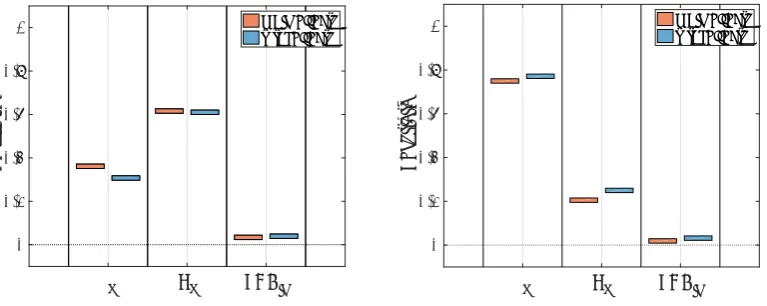
Figure 2. Main and total effects for ηE (left) and ΔVc (right).
400 800 1200 1600 2000
No of model evaluations 0
0.1 0.2 0.3 0.4 0.5
Mean of EEs
Rp p SOC
in
400 800 1200 1600 2000
No of model evaluations 0
0.05 0.1 0.15 0.2 0.25 0.3
Mean of EEs
[image:9.595.115.484.479.636.2]p R p SOCin
Figure 3. Convergence of the EEs for different numbers of model evaluations with 95% confidence intervals in the case ofηE (left) and ΔVc (right).
reaction rate depends upon the concentration (per unit volume of the electrode) of Li+according to the Butler-Volmer law (12), so a restricted supply of Li+in the positive electrode will lead to a large concentration overpotential for a fixed current (the overpotential in (12) must increase as
cdecreases in order to maintain a fixed left hand side, i.e, applied current density). The particle radius determines the level of mass transport resistance for the solid Li (which has to diffuse through the particle to react atR=Rp) as well as the specific surface area for reaction (smaller particles lead to higher specific areas). Thus, increasing the particle radius will lead to a higher concentration overpotential and, therefore, a deterioration in performance. For the voltage drop during discharge (ΔVc),phas the greatest influence, followed byRp and lastly SOCin, as seen in Figure 2. The combination of an increased Ohmic drop and a higher concentration overpotential on the total polarization caused by a lower p outweighs the effect of an increased concentration overpotential caused by lowering Rp.
For an EET, uniform distributions were selected for the three factors, which were again scaled to yield X = [0,1]3. A major difference between the variance-based method and the EET is the sampling strategy. The EET is highly efficient, requiring only M(k + 1) model evaluations vs. N(k + 2) to calculate the main effect indices; in the results above,
N(k+ 2) = 5000×(3 + 2) = 25000, which is much higher than typical values of M(k+ 1). The trends in the means of the μi with confidence intervals (CIs) are depicted in Figure 3 for an increasing number of model evaluations (M(k+ 1)). The CIs were established using bootstrapping [14], which consists of re-sampling the base points with replacement to produce
P copies of the trajectories and for each of theP copies to use the EET to estimateμi and σi. This provides empirical distributions over μi and σi from which means and confidence bounds can be estimated.
p Rp SOCin
0 0.2 0.4 0.6 0.8 1
Sensitivity
1st coefficient
main effects total effects
p Rp SOCin
0 0.2 0.4 0.6 0.8 1
Sensitivity
2nd coefficient
[image:10.595.105.486.435.597.2]main effects total effects
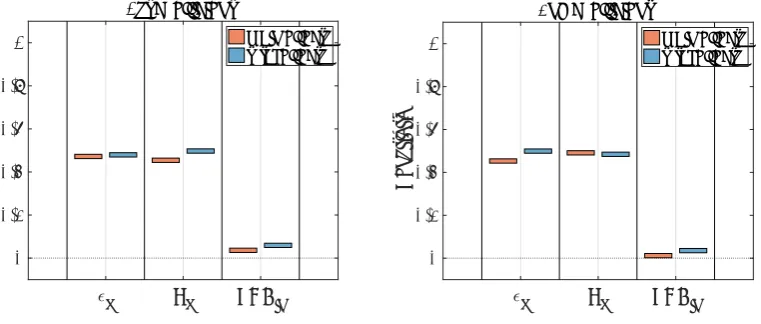
Figure 4. Main and total effects for the first two PCA coefficients (for the cell voltage curve).
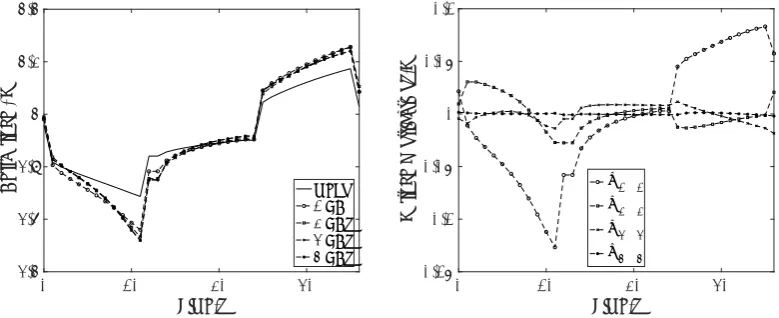
is used the much lower number of model runs for the EET represents an enormous advantage. To investigate the sensitivity of the charge-discharge curve, we examine the main and total effects of the PCA coefficientswi(ξξξ) using the same Latin hypercube design and N = 5000 (we replace, e.g.,ηE withwi(ξξξ),i∈ {1, . . . , r}). The results are depicted in Figure 4 forw1 and w2. Figure 5 shows an example (from the test set) of the contributions from the PCA eigenvectors (wivi, up toi= 4) towards the final (mean centred) voltage profile. The first two contributions can be seen to have by far the most influence. The sensitivities of the coefficientsw1 and w2 are highest forpandRp, with roughly equal contributions from each, while higher-order coefficients (w3 and w4) were more heavily influenced by SOCin.
6. Summary and conclusions
SA is often unfeasible with complex computer models. In such cases emulators, of varying degrees of sophistication, can be employed. Quantifying the uncertainty in the emulator predictions is desirable, but this is only achievable for certain approaches. For multivariate outputs (especially in high dimensional spaces), SA under uncertainty is especially challenging, even when the QoI is a scalar. In this paper we propose a GP emulator approach for performing SA under uncertainty when the model output is multivariate (possibly in a high-dimensional space). We present an example for a Li-ion battery, demonstrating that the method can be efficient and accurate. We are able to perform a probabilistic SA on scalar QoIs derived from the output (via a linear functional) and also on the output itself by focusing individually on each random principal coefficient. This can be achieved with either full MC sampling or by using semi-analytical expressions that are extensions of those derived by Oakley and O’Hagan [5] for scalar QoIs.
0 10 20 30
Time/s 3.4
3.6 3.8 4 4.2 4.4
Cell voltage / V mean
1 PC 2 PCs 3 PCs 4 PCs
0 10 20 30
Time/s -0.15
-0.1 -0.05 0 0.05 0.1
Voltage contributions/V
w1 v1
w 2 v2 w
3 v3 w
[image:11.595.97.487.403.562.2]4 v4
Figure 5. An example of the contributions from the PCA eigenvectors (wivi) towards the final (mean centred) voltage profile. In the left-hand figure,wivi is successively added to the mean.
References
[1] A. Saltelli, M. Ratto, T. Andres, F. Campolongo, J. Cariboni, D. Gatelli, M. Saisana, and S. Tarantola,
Global sensitivity analysis: the primer. John Wiley & Sons, 2008.
[2] D. Zhou, K. Zhang, A. Ravey, F. Gao, and A. Miraoui, Parameter sensitivity analysis for fractional-order modeling of lithium-ion batteries,Energies, 9, 123, 2016.
[3] M. D. Morris, Factorial sampling plans for preliminary computational experiments,Technometrics, 33, 161– 174, 1991.
[4] I. M. Sobol, Sensitivity estimates for nonlinear mathematical models,MMCE, 1, 407–414, 1993.
[5] J. E. Oakley and A. O’Hagan, Probabilistic sensitivity analysis of complex models: a Bayesian approach,R. Stat. Soc. Ser. B Stat. Methodol., 66, 751–769, 2004.
[7] A. Saltelli and I. M. Sobol’, Sensitivity analysis for nonlinear mathematical models: numerical experience,
Matematicheskoe Modelirovanie, 7, 16–28, 1995.
[8] I. Jolliffe,Principal Component Analysis. Springer Series in Statistics, Springer, 2002.
[9] D. Higdon, J. Gattiker, B. Williamsa, and M. Rightley, Computer model calibration using high-dimensional output,J Am. Stat. Assoc., 103, 570–583, 2008.
[10] C. Rasmussen and C. Williams, Gaussian Processes for Machine Learning. MIT Press, Cambridge MA, USA, 2006.
[11] M. Doyle, J. Newman, A. S. Gozdz, C. N. Schmutz, and J.-M. Tarascon, Comparison of modeling predictions with experimental data from plastic lithium ion cells,J. Electrochem. Soc., 143, 1890–1903, 1996. [12] https://www.comsol.
com/model/1d-lithium-ion-battery-model-for-internal-resistance-and-voltage-loss-determinat-19131, Last accessed 20 November 2017.
[13] F. Pianosi, F. Sarrazin, and T. Wagener, A matlab toolbox for global sensitivity analysis,Environ. Model. Softw., 70, 80–85, 2015.
[14] B. Efron, Bootstrap methods: Another look at the jackknife,Ann. Statist., 7, 1–26, 01 1979.
Appendix A. Efficient sampling for sensitivity analysis under uncertainty
We consider a scalar linear functional QoI Q= F(ξξξ) = (G◦η)(ξξξ) as defined in section 2. For example, we may considerG(y) =Rη(x;ξξξ)w(x)dμ(x), for some measureμon a compact subset RofRLrepresenting space or time. To keep matters simple, we setw(x)≡1/μ(R), use Lebesgue measure and assume thatη(x;ξξξ) is continuous; then the Riemann and Lebesgue integrals coincide and approximations to G(y) by Riemann sums or Gauss quadratures converge. In reality of course we have a discrete output yr = (y1, . . . , yd)T =ηηη
r(ξξξ) that approximates η(x;ξξξ) at, say,
points {xl}dl=1 ⊂ R. Correspondingly, we have a discrete approximation g(y) of G(y) defined by a quadrature g(yr) =μ(R)−1dj=1bjylj, where {ylj}dj=1 ⊂ {yl}dl=1 (approximating η(xlj;ξξξ),
j= 1, . . . , d) is a subset of the coefficients of yr and bj are quadrature weights. If we are using a Gauss quadrature, the pointsxlj are specified and must be included in the design{xl}dl=1. For ease of presentation, and without loss of generality, we use a mid-point Riemann sum, so that
f(ξξξ) =g(ηηηr(ξξξ)) =g(yr) =d−1dl=1yl.
Rather than a point estimate of yr we have a distribution over functions (7), which leads to distributions over q = f(ξξξ) and therefore over the sensitivity measures, as a consequence of the emulator uncertainty. The typical sensitivity measures employed are Si = Vi/V =
Varξi(Eξξξ∼i[q|ξi])/Var(q) and STi = 1−Varξξξ∼i(Eξi[q|ξξξ∼i])/Var(q). Oakley and O’Hagan [5] also propose the main effects fi =Eξξξ∼i[q|ξi]−f0 as useful graphical summaries of the influences of each variable. We derive approximate estimates of the means and variances of these various quantities, extending the analysis in [5] to multiple output problems. Recalling relationship (7), namely,yr =ri=1wi(ξξξ)vi, and denoting the l-th component ofvj by vjl, we obtain:
Eηηηr
Eξξξ∼i[q|ξi]
=Eηηηr
Eξξξ∼i 1 d d l=1
ylξi
= 1
dEηηηr
⎡ ⎣Eξξξ∼i
⎡ ⎣d
l=1 r
j=1
wj(ξξξ)vjlξi
⎤ ⎦ ⎤ ⎦
= 1
dEηηηr
⎡ ⎣Eξξξ
∼i ⎡ ⎣r
j=1
bjwj(ξξξ)ξi
⎤ ⎦ ⎤ ⎦= 1
dEξξξ∼i
⎡ ⎣r
j=1
bjEηηηr[wj(ξξξ)]ξi
⎤ ⎦
= 1
dEξξξ∼i
⎡ ⎣r
j=1
bjmj(ξξξ)ξi
⎤ ⎦= 1
d r j=1 bj
[0,1]k−1
mj(ξξξ)dξξξ∼i= 1
d
r
j=1
bjTj(ξi)
(A.1)
wherebj =dl=1vjland the functionsTj(ξi) are defined by the integrals in the last line. Similarly:
Eηηηr[E[q]] = (1/d)
r
j=1
bj
[0,1]k
mj(ξξξ)dξξξ= (1/d)
r
j=1
where Tj are now constants since the integration is over all input factors. Thus Eηηηr[fi] =
Eηηηr[Eξξξ∼i[q|ξi]]−Eηηηr[E[q]] = (1/d) r
j=1bj(Tj(ξi)−Tj). The integrals definingTj andTj can be
approximated numerically at a very low computational cost.
We denote by ξξξ∼I the vector of factors excluding those corresponding to the index set I ⊂ {1, . . . , k} and denote byξξξI the subset of factors corresponding to I. From the definition of covariance we have:
CovηηηrEξξξ∼I[q|ξξξI],Eξξξ∼J[q|ξξξJ]
=EηηηrEξξξ∼I[q|ξξξI]Eξξξ∼J[q|ξξξJ]−EηηηrEξξξ∼i[q|ξξξI]EηηηrEξξξ∼J[q|ξξξJ]
=
ξξξ∼J
ξξξ∼I
Eηηηr
f(ξξξ)f(ξξξ)dξξξ∼Idξξξ∼J −EηηηrEξξξ∼I[q|ξξξI]EηηηrEξξξ∼J[q|ξξξJ]
=
ξξξ∼J
ξξξ∼I
Covηηηrf(ξξξ), f(ξξξ) −Eηηηr[f(ξξξ)]Eηηηrf(ξξξ)dξξξ∼Idξξξ∼J
−Eηηηr
Eξξξ∼I[q|ξξξI]
Eηηηr
Eξξξ∼J[q|ξξξJ]
=
ξξξ∼J
ξξξ∼I
Covηηηrf(ξξξ), f(ξξξ) dξξξ∼Idξξξ∼J
=
ξξξ∼J
ξξξ∼I r j=1 r p=1
bjbpCovηηηrwj(ξξξ), wp(ξξξ) dξξξ∼Idξξξ∼J
= 1
d2
ξξξ∼J
ξξξ∼I
r
j=1
b2jcj(ξξξ, ξξξ)dξξξ∼Idξξξ∼J =U(ξξξI, ξξξJ)
(A.3)
in which the last step follows from the mutual independence of the wi, and the
posterior covariances cj(ξξξ, ξξξ) are given in Eqs. (6). Now, Varηηηr(fi) = Eηηηr[Eξξξ2
∼i[q|ξi]] − 2Eηηηr[Eξξξ∼i[q|ξi]E[q]]−Eηηηr[E2[q]]−E2ηηηr[fi] in which the last term on the right hand side is already known. The first to third terms are calculated by using the definition of covariance and Eq. (A.3) with (I,J) = ({i},{i}), ({i},∅) and (∅,∅), together with the previous expressions for
Eηηηr
Eξξξ∼i[q|ξi]
and Eηηηr[E[q]]. The integrals in Eq. (A.3) are again cheap to evaluate. The means of all thefi, evaluated separately for selected values of ξi in [0,1], can be combined on a single plot together with standard deviations to measure the influences of the factors [5] .
We next consider the partial variancesVi. We first note thatEηηηr[Vi] =Eηηηr[Varξi(Eξξξ∼i[q|ξi])] =
Eηηηr[Eξi[Eξξξ2∼i[q|ξi]]−E2ξi[Eξξξ∼i[q|ξi]]] =Eηηηr[Eξi[Eξξξ2∼i[q|ξi]]]−Eηηηr[E2[q]], the second term of which is already known. The first term is evaluated as follows:
Eηηηr
Eξi[Eξξξ2∼i[q|ξi]]
=Eηηηr
[0,1]
[0,1]k−1f(ξξξ
∗)dξξξ∗ ∼i
[0,1]k−1f(ξξξ)dξξξ∼i
dξi
=
[0,1]
[0,1]k−1
[0,1]k−1
Eηηηr[f(ξξξ)f(ξξξ∗)]dξξξ∗∼idξξξ∼idξi
=
[0,1]
[0,1]k−1
[0,1]k−1
{Covηηηr(f(ξξξ), f(ξξξ∗))−Eηηηr[f(ξξξ)]Eηηηr[f(ξξξ∗)]}dξξξ∗∼idξξξ∼idξi
= 1 d2 r j=1
[0,1]
[0,1]k−1
[0,1]k−1bj
⎧ ⎨
⎩bjcj(ξξξ, ξξξ∗)− r
p=1
bpwj(ξξξ)wp(ξξξ∗) ⎫ ⎬
⎭dξξξ∗∼idξξξ∼idξi
(A.4)