ISSN: 1816-949X
© Medwell Journals, 2020
User Competency and Its Effect of Accounting Information
System Implementation
Nelsi Wisna, Anak Agung Gde Agung, Irna Yuniar and Kastaman
Department of Computerized Accounting Telkom Appliance Science, Telkom University,
Bandung, Indonesia
Abstract: The application of good governance is an obligation in preparing local government financial reports. From the results of the audit opinion from the Supreme Audit Agency, there are several findings that explain that not all local governments can prepare financial statements in accordance with the government accounting standards specified. The purpose of this study is to examine the effect of apparatus competence (skills and knowledge) on the quality of accounting information systems. This study was conducted at the regional government in the city of Banjar Patroman, West Java province, Indonesia. Data are primary data collected through questionnaires. Data is processed using partial least square. The results of this study indicate that apparatus competencies (skills and knowledge) influence the accounting information system. The results of data processing for apparatus skills show that the path coefficient value is 0.063 which explains that for each standard deviation of one point in the skill score will result in an increase in the accounting information system score for the standard deviation of 0.063 points. This means that improving skills will contribute positively to the quality of accounting information systems. The path coefficient for employee knowledge is 0.381 which explains that for every one standard deviation point in the knowledge score will result in an increase in the accounting information system score for the standard deviation of 0.381 points. This means that increasing knowledge will contribute positively to the quality of accounting information systems.
Key words: Skills, knowledge, accounting information systems, competency, government, statements
INTRODUCTION
Some experts claim that the accounting standards cannot be applied in a company, caused by several issues, internally or externally. Internal factor such as the limited knowledge of accounting personnel, integrity of the personnel (process and/or data manipulation for personal gain). This fact is supported by later research which finds the quality of financial statements for the regional areas in Indonesia are still poor and this is caused by the quality of the human resource. Later research found that when the government compiling accrual-based financial report, not all the personnel involved came from accounting background. Competency is a knowledge that can be proven and consists of skills and behavior which can improve performance (Dessler, 2015). Competency is associated with skills, knowledge, abilities and personal characteristics which enable employee to work successfully (Hellenbeck and Wright, 2015). The competency is a worker characteristic which underlying successful performance or behavior at the workplace (Phillips and Gully, 2013).
Every information system requires competence person who uses the system or called user (Stair and Reynolds, 2010). The most important factor to successful information system is the availability of resource
including human resource and the knowledge of the system (O’Brien and Marakas, 2010). Accounting knowledge of manager and system owner influence greatly to the success of available accounting information system implementation (Hajiha, 2011). Analysis unit for this research is the city of Banjar Patroman, West Java. The reason for this city is chosen as analysis unit based on the statement of the statement of the major, UU which explained that the city still needed improvement of human resources in official environment. This statement was based by complains by the citizens for poor public services.
Every people who interacts with the system can be stated as user (Romney and Steinbart, 2009). Another view user as every people who use the system (O’Brien and Marakas, 2010). These statements then confirmed by Wiegers who define user as persons who interact and use the system (Wiegers, 2003). Competence refers to basic characteristic which describes behavior pattern, personal characteristic which is unique, self-concept, value, knowledge or expertise which leads to superior performance at the workplace (Palan, 2003).
Broader definition of competency is connected with skills, knowledge, abilities and personal characteristics which enable an employee to be successful in the workplace (Hellenbeck and Wright, 2015). Dessler (2015)
Nachailit ., et al and Pearlson and Saunders
(2010) Knowledge:
Palan (2003), Hellenbeck and Wright (2015) and
Mullins (2005)
Skills: Lee . et al(2006), Stair and Reynolds (2010) and Dessler
(2015)
AIS: Boczko (2007) and Laudon and Laudon
(2014)
Duggen and Reichgelt (2006), Moeller (2011) and
Belkoui (2002)
expressed that competency is expression of knowledge and skill which can increase work performance. Competency involves knowledge, experience, skills and access to information and practice experience to work more practical (Mullins, 2005).
Competency can be measured by knowledge, skill, capability, behavior and characteristic (Lee et al., 2006). With that definition, we can ensure that competency is related to employee’s skill, behavior and capability to perform certain task or organizational function. Other definition of suggest that user competency is a basic individual character which has casual interaction to effectivity and excellence in certain work environment (Stair and Reynolds, 2010; O’Brien and Marakas, 2010; Wiegers, 2003; Palan, 2003; Dessler, 2015; Mullins, 2005).
Accounting information system has two interconnected purpose, the first one is to provide meaningful information to its user and to support decision making. Other purpose is to facilitate monitoring or decision making (Boczko, 2007). Effective information system will provide accurate on time and relevant information to its user (Laudon and Jane, 2012). This information should be error free, available when it is needed. This information should also be useful for certain required type of work and decision.
In business environment, competency affect to advantageous business competitiveness (Laudon and Laudon, 2014). Information system requires competence personnel (Stair and Reynolds, 2010). People or in this case, user is an important element to successful of all information system (Duggen and Reichgelt, 2006). Competent user with their skill and experience to manage technical elements and information system behavior is very important to the successful implementation of information system (Bass, 2000).
Information system requires competent personnel (Stair and Reynolds, 2010). Manager and technical staff with information system competence will be needed to conduct planning and implementation of the system (Keil et al., 1998). Keil revealed in his research some reason why some of information system implementation are failed: the lack of top managerial commitment, the lack of competency of new technology, the lack of commitment to the system (Pearlson and Saunders, 2010). Competency influence the quality of managerial accounting information system (Moeller, 2011). Competency can be defined as basic character which include knowledge and skill to be used by a manager in conducting his/her job, resulting in superior performance (Belkoui, 2002) and affect to the success and efficiency of managerial accounting information system to achieve company goals (Madapusi and Ortiz, 2014).
Generally, to be involved in a business system, human resource competency is highly required. Human resource competency consists of knowledge, skill and capability (Belkoui, 2002). Result from research
conducted at several Indian company show that technical competency of human resource is influencing factor to the success of ERP system implementation (Madapusi and Ortiz, 2014). Another research show that competency of accountants and managers are important factors in the implementation of the accounting information system (Daoud and Triki, 2013).
Other study show that competency of managerial team affect to the effectiveness of accounting process. Furthermore, he explained the effectiveness of strategic accounting management will produce information of daily operational activities which support the growth of the company and provide insight of the company’s future. Strategic management accounting is a part of managerial accounting information system; therefore, managerial team competency will effect to the implementation of managerial accounting information system. This research was conducted to hotel industry in Thailand.
Along with the research above, Tayes conducted research to 119 telecommunications, manufacture, broadcasting and banking corporations in Malaysia. The result show that the implementation of accounting information system involves competency (Tayles et al., 2007). Similar results are shown in Campanale’s research which conducted at several health service units. The result explained that competency of the manager contribute to managerial accounting information system development and its implementation (Campanale et al., 2010).
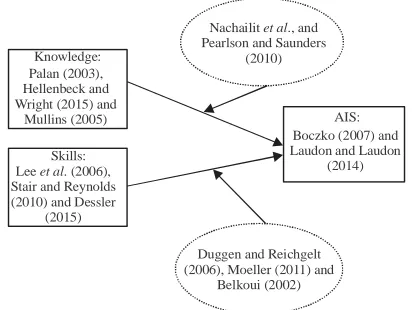
According to the description above, we can assume that competency will influence to the effectiveness/success/quality of accounting information system. Based on the prior discussion, the conceptual model/conceptual framework is shown in Fig. 1: The proposed hypothesis in this study are:
C H1: The knowledge influence the quality of accounting information systems
[image:2.612.324.530.546.701.2]C H2: The skills influence the quality of accounting information systems
x1
x2
x3
x4
x5
x6
x7
δ1
2
δ
3
δ
4
δ
5
δ
6
δ
7
δ φ23
φ12
φ13
γ12
λy62
η1 Skill
2
ξ
Know 1
ξ λx11
λx21
λx31
λx41
λx52
λx62
λx72
y1 y2 y3 y4 y5 Y6 Y7
[image:3.612.140.464.83.333.2]γ11 y11λ λy21 y31 y41 y51 y61 y71λ λ λ λ λ
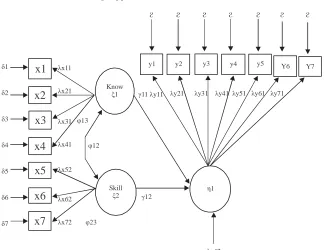
Fig. 2: Structural model
MATERIALS AND METHODS
The purpose of this study is to determine the effect of user competency (knowledge and skill) to the quality of information system. This study is a verify and explanatory research, since, this study aims to list factors and how much those factors effect a variable by testing the hypothesis. Research unit for this study is local government at Banjar, West Java. This study uses rule of thumb as the sampling method. Respondents of this research are 49 people. Data is then analyzed with Partial Least Square (PLS) method. This method does not base on assumption and the data cannot be normally distributed. Data scale should be various, with sample size between 30-50. Measurement and structural models can be seen in Fig. 2.
RESULTS AND DISCUSSION
The purpose of this study is to determine the effect of user competency (knowledge and skill) to the quality of information system. This study is a verify and explanatory research, since, this study aims to list factors and how much those factors effect a variable by testing the hypothesis. The demographic data of respondents are listed in Table 1.
[image:3.612.314.541.376.493.2]Respondents in this study amounted to 63.83% were male. The most recent education for most respondents was undergraduate, while the tenure in the current field (area of regional financial management) is between 5-10 years of service.
Table 1: The demographic data of respondents
Characteristics Percentage
Gender
Male 63.83
Female 36.17
Education
Diploma 23.40
Bachelor 46.81
Master 29.79
Experience (Years)
<5 10.64
5-10 46.81
>10 42.55
Table 2: The Average Variance Extracted (AVE) and composite realiability
Variables AVE CR
AIS 0.923 0.973
Skills 0.575 0.903
Knowledge 0.782 0.915
The data was reprocessed
Structural testing models: Based on Table 2, all indicators result in AVE more than 0.5 which means all indicators have acceptable convergence validity. All CR value for all indicators are above 0.7 which shows acceptable internal consistency.
Based on Table 3 the hypothesis can be arranged as follows: the effect of competency skill o accounting information system. Statistical hypothesis:
C H0: γ11 = 0 skill does not effect to accounting information system
[image:3.612.314.541.519.565.2]Table 3: Evaluation of structural model
Variables Coefficient effect
--- ---No. Exogenous Endogenous (O) (STDEV) t-stat (|O/STDEV|) p-value Sig.
(1) (2) (3) (4) (5) (6) (7) (8)
1 Skills AIS 0.063 0.081 8.740 0.00 Sig.
2 Know AIS 0.381 0.077 8.781 0.00 Sig.
The data was reprocessed
Statistic test conducted with: measurement and structural models:
11 11
ˆ t =
ˆ SE ( )
Criteria: Reject p-values if significance level <0.05. Table 2 shows that p-value 0.0, thus, the hypothesis is rejected. It can be concluded that skill does effect to accounting information system at 5% significance level. Path coefficient is 0.063 which explains that for every one-point standard deviation in skill score will result in the increase of the accounting information system score for 0.063-point standard deviation. This means that the increase in skill will contribute positively to the quality of the accounting information system. The effect of knowledge to accounting information system statistical hypothesis:
C H0: γ21 = 0 knowledge does not effect to accounting information system
C H1: γ21…0 knowledge does effect to accounting information system
Statistic test conducted with:
21 21
ˆ t =
ˆ SE ( )
Criteria: Reject p-values if significance level <0.05. Table 2 shows that p-value 0.0, thus, the hypothesis is rejected. It can be concluded that knowledge does effect to accounting information system, at 5% significance level.
Path coefficient is 0.381 which explains that for every one-point standard deviation in knowledge score will result in the increase of the accounting information system score for 0.381 point standard deviation. This means that the increase in knowledge will contribute positively to the quality of the accounting information system.
CONCLUSION
Accounting information system implementation will be better if the user equipped with appropriate competency. User competency can be derived to skill and
knowledge. Better skill and knowledge of accounting information system leads to smoother and better implementation of the system. This research uses SEM PLS. The result shows that user competency (skill and knowledge) effects the quality of the accounting information system implementation, at 5% significance level or it can be explained that: with 5% significance level, skill positively effects the quality of accounting information system: with 5% significance level, knowledge positively effects the quality of accounting information system.
REFERENCES
Bass, B.M., 2000. The future of leadership in learning organizations. J. Leadersh. Organizational Stud., 7: 18-40.
Belkoui, A.R., 2002. Behavioral Management Accounting. Quorum Books, London, England, ISBN:1-56720-443-0, Pages: 261.
Boczko, T., 2007. Corporate Accounting Information Systems. Financial Times Press, New York. Campanale, C., L. Cinquini and A. Tenucci, 2010. Do
management accounting systems influence organizational change or vice-versa? Evidence from a case of constructive research in the healthcare sector. MBA Thesis, Sant'Anna School of Advanced Studies, Pisa, Italy. https://papers.ssrn.com/sol3/ papers.cfm?abstract_id=1656943
Daoud, H. and M. Triki, 2013. Accounting information systems in an ERP environment and Tunisian firm performance. Int. J. Digital Accounting Res., 13: 1-35.
Dessler, G., 2015. Human Resource Management. 14th Edn., Pearson Education, London, UK., ISBN-13: 9780133545173.
Duggen, E.W. and H. Reichgelt, 2006. Measuring Information Systems Delivery Quality. Idea Group Publishing, USA., ISBN: 1-59140-857-1, Pages: 355.
Hajiha, Z., 2011. Effective factors on alignment of accounting information systems in manufacturing companies: Evidence from Iran. Inf. Manage. Bus. Rev., 3: 158-170.
Keil, M., P.E. Cule, K. Lyytinen and R.C. Schmidt, 1998. A framework for identifying software project risks. Commun. Acm., 41: 76-83.
Laudon, K.C. and J.P. Laudon, 2014. Management Information System: Managing the Digital Firm. 13th Edn., South-Western Cengage Learning, USA., ISBN13: 9780133050691.
Laudon, K.C. and P.L. Jane, 2012. Management Information Systems: Managing the Digital Firm. 12th Edn., Prentice Hall, Upper Saddle River, New Jersey, USA., ISBN:9780132142854, Pages: 557. Lee, Y.L., S.L. Hwang and E. Min-Yang Wang, 2006. An
integrated framework for continuous improvement on user satisfaction of information systems. Ind. Manage. Data Syst., 106: 581-595.
Madapusi, A. and D.A.C. Ortiz, 2014. The influence of technical competence factors in ERP system implementations. J. Appl. Bus. Econ., 16: 27-39. Moeller, R.R., 2011. COSO Enterprise Risk
Management: Establishing Effective Governance, Risk and Compliance (GRC) Processes. 2nd Edn., John Wiley and Sons, New Jersey, USA., ISBN-13: 9781118102527, Pages: 400.
Mullins, L.J., 2005. Management and Organisational Behaviour. 7th Edn., Pearson Education Limited, London, England, Pages: 1121.
O’Brien, J.A. and G.M. Marakas, 2010. Introduction to Information Systems. 15th Edn., McGraw Hill, New York, USA., ISBN:9780070167087, Pages: 592. Palan, R., 2003. Competency Management: A
Practitioner’s Guide. Rosetta Solutions, Inc., Arlington County, Virginia, USA., Pages: 119. Pearlson, K.E. and C.S. Saunders, 2010. Managing
and Using Information Systems: A Strategic Approach. 4th Edn., John Wiley and Sons, Inc., Hoboken.
Phillips, J.M. and S.M. Gully, 2013. Human Resource Management. 1st Edn., South-Western College Publisher South-Western, ISBN-13:978-1111533557, Pages: 528.
Romney, M.B. and P.J. Steinbart, 2009. Accounting Information System. 11th Edn., Pearson Prentice Hall, New York, USA.,.
Stair, R. and G. Reynolds, 2010. Principles of Information Systems, A Managerial Approach. 9th Edn., Cengage Learning, Boston, Massachusetts, United States, ISBN: 9780324665284, Pages: 652.
Tayles, M., R.H. Pike and S. Sofian, 2007. Intellectual capital, management accounting practices and corporate performance: Perceptions of managers. Account. Audit. Accountability J., 20: 522-548. Wiegers, K.E., 2003. Software Requirements. 2nd Edn.,