Does silence mediate the effect of team extraversion on team effectiveness?
G. Gortworst
S1340972
Faculty of Behavioral, Management and Social Sciences
Psychology of Conflict, Risk and Safety
Supervisors:
S. Zebel
S. de Laat
Abstract
This study examines the relation of team extraversion on team effectiveness and the mediating
role of silence in this relation. Team extraversion was operationalized by the mean, variance and an
interaction term (mean times variance). It was expected that the mean, variance and the interaction term
of team extraversion were positively related to team effectiveness. However, none of the expected results
were observed in this study. In contrast to what was expected, this research finds the average degree of
team extraversion to be negatively associated with team extraversion, such that a higher mean of team
extraversion predicted greater team effectiveness.
Furthermore, it was expected that more extraversion in a team and greater diversity of team
extraversion would result in fewer silence and, in turn, greater team effectiveness. This study finds no
mediating role of silence between team extraversion and team effectiveness. As was expected, the results
show that more silent segments predict less team effectiveness.
Team extraversion is measured by means of a questionnaire. Team effectiveness was analysed by
means of calculating the number of solved puzzles per minute, per team, during an escape game. In an
escape game, a team solves several puzzles in a specified time to escape a locked room. Silences during
the escape game were measured with sociometric badges worn by each participant during the game. The
study included 363 participants spread over 72 teams.
Does silence mediate the effect of team extraversion on team effectiveness?
The efficiency of teamwork has gained importance in organizational contexts due to economic and
technical changes (Bell, 2007; Cohen & Bailey, 1997; Devine, Clayton, Philips, Dunford, & Melner,
1999; Rothstein & Goffin, 2006). Organizations facing complicated tasks often adopt team strategies to
solve problems when the outcome is of importance or when a task is too difficult for an individual (Fay,
Borrill, Amir, Haward, & West, 2006; Salas, Cooke, & Rosen, 2008). One example is teams who develop
a new product need to apply different expertise or knowledge, such as from economics, engineering or
merchandising (Cohen & Bailey, 1997). A team is characterized as a social entity of two or more
individuals who depend on each other, share a common goal, execute tasks and are linked to
organizational boundaries or systems (Cohen & Bailey, 1997; Kozlowski & Ilgen, 2006; Salas et al.,
2008). An effective team is able to coordinate, plan and implement different tasks and practices (Zaccaro,
Gualtieri, & Minionis, 1995). Therefore, teams performing a task need to communicate for information
exchange, decision making and monitoring activities. According to Bell (2007), team effectiveness is
defined as ‘the extent to which a team accomplishes its goals or mission’. Knowing how teams cooperate
and effectively reach their goals might improve their effectiveness in achieving their goals. For instance,
effective teamwork is very important for patient safety in healthcare (Makary et al., 2006) or in other
critical safety workplaces such as in maritime and aviation (Sexton, Thomas, & Helmreich, 2000).
Furthermore, knowing how teams effectively function might result in more job satisfaction, turn resulting
in less absenteeism in the workplace (Makary et al., 2006).
One of the influencing factors for team effectiveness is personality (Barrick, Stewart, Neubert, &
Mount, 1998; Bell, 2007; Morgeson, Reider, & Campion, 2005), whereby extraversion is described as
one of the most influential personality traits for team effectiveness (Rothstein & Goffin, 2006). Little
information appears in the literature about how the association between extraversion and team
effectiveness arises (Halfhill, Sundstrom, Lahner, Calderone, & Nielsen, 2005). Studies have
operationalized team extraversion in different ways, the most common of which has been to calculate the
mean and variance degree of extraversion in a team (Bell, 2007; Neuman, Wagner, & Christiansen, 1999).
The present research both examines operationalization methods for extraversion and adds to the existing
literature the testing of the interaction effect of these two operationalizations (mean multiplied by
variance) on the possible extraversion–effectiveness relation in a team.
team might be expressed in communication behaviour that influences the way a team reciprocally
interacts and, in turn, might affect the effectiveness of a team. Not all characteristics of communication
are analysed in this study. This research focusses on silence in communication, because silences might
result in tension among team members, in turn influencing the effectiveness of a team (Poyatos, 1983).
All in all, this study analyses the role of possible predictors for team effectiveness which leads to
the following research question:
Is there an effect of team extraversion on team effectiveness, and is this
effect mediated by silence?
Theoretical framework
The direct effect of team extraversion on team effectiveness
An extraverted individual can be described as adventurous, assertive, sociable and talkative
(Colbert, Barrick, & Bradley, 2014). Extraversion refers to the extent to which people feel vital and
appreciate themselves. Highly extraverted individuals are likely to lead a group of people, enjoy social
gatherings and interactions, and be positive and enthusiastic about social gatherings and interactions. On
the other hand, lowly extraverted individuals (i.e., introverts) are inclined to be reserved in social
situations, generally feel less lively and enthusiastic, and take less pleasure in social activities compared
to extraverts. Moreover, introverts usually feel uncomfortable when they are at the centre of attention (De
Vries, Ashton, & Lee, 2009).
The studies of Morgeson, Reider, and Campion (2005) and Barrick et al. (1998) proposed three
characteristics of extraversion that might contribute to an effective team. First of all, extraverted
individuals prefer working in a team instead of working alone and feel secure in their ability to effectively
function in a team. Secondly, extraverted individuals are likely to be socially intelligent, and through their
communication, strategies can be debated and groups norms can be generated. Finally, extraverted
individuals are inclined to experience positive feelings and are energetic. Through a process of
‘contagion’, others possibly adapt this positive emotion and energy that might contribute to positive and
collaborative communication. These factors are related to team success (Morgeson et al., 2005; Barrick et
al.,1998). Therefore, it is expected that extraversion on an individual level might positively influence
team effectiveness. Moreover, the literature mentions that extraversion on team level is also related to
team effectiveness. Extraversion on a team level implies that an extraverted team is likely to be more
adventurous, assertive, sociable and talkative than is an introverted team. Team-level of extraversion does
not imply that each individual on the team is extraverted, but rather that at least a few individuals on the
team are extraverted (Morgeson, Reider, & Campion, 2005; Barrick et al., 1998).
reported similar findings but mentioned that this team extraversion–effectiveness relation depends on the
type of task a team has to perform. Extraversion in a team will be more effective when a task needs
leading figures and when team members are highly interdependent. Another reason for why an
extraverted team could be more effective is given by Porter et al. (2003), who analysed the relation of
backing up behaviour (the ability and willingness to help others) and personality. These researchers
concluded that teams who scored high on backing up behaviour also had a high mean score for team
extraversion. This conclusion implies that extraverted teams are on average more intended to help each
other that could further improve team effectiveness (Porter et al., 2003). In summary, it could be assumed
that the mean level of extraversion positively influences team effectiveness.
In addition, the literature contains analyses of team extraversion considering the diversity of
extraversion in a team. Neuman, Wagner and Christiansen (1999) have proposed that a (homogeneous)
team with less variance in extraversion negatively affects team effectiveness because many having
extraverted individuals in a team might result in conflict over role division or power, due to the possibility
that extraverted individuals are outgoing and are inclined to take the lead. Furthermore, a team with fewer
extraverted individuals (i.e., less variance of team extraversion) might be more reserved and lack
leadership, also disadvantageous for team performance (Neuman et al., 1999). Curşeu, Ilies, Vîrgă,
Maricuţoiu, and Sava (2018) have reported, furthermore, that extreme extraverts in a team might be
ostentatious, too talkative, and poor at listening, as well as likely to dominate others in the team, which
can disturb team communication. As a result, other team members might not speak up or may not be
listened to, and their ideas and knowledge of how to solve problems may be withheld (Curşeu, et al.,
2018). In such a case, more diversity of team extraversion may result in less team effectiveness, because
some team members speak more often than others, which is disadvantageous for a team performance
(Sherf, Sinha, Tangirala, & Awasty, 2018; Woolley, et al., 2010).
However, diversity of extraversion in a team might be positively related to team effectiveness. A
heterogeneous team, in which some team members are extraverted and some are not, might perform more
efficiently because some will take the lead while others will follow (Neuman et al., 1999). As a
The literature does not discuss whether the interaction of the average degree of team extraversion
and the diversity of team extraversion affects team effectiveness. In other words, it could be that the mean
level multiplied by the variance level of team extraversion is also related to the effectiveness of a team.
The mean and variance level of team extraversion could be interdependent and interactive, which might
mean that these operationalisations of team extraversion combined might be a predictor of team
effectiveness. For example, a team that scores on-average high on extraversion might simultaneously be a
team with both highly and lowly extraverted individuals (i.e., a team with high diversity). Then, this
composition of extraversion (i.e., a high mean and a high variance level) might be advantageous for team
effectiveness, due to greater information sharing among the team members and an efficient role division.
Contrarily, team scores that are on average low on extraversion and not diverse in extraversion (i.e., a low
mean and variance scores) might be disadvantageous for team effectiveness, due to the possibility of less
information sharing and missing leading figures (Barrick et al., 1998; Halfhill et al., 2005). Thus, it is
expected that the interaction of the mean multiplied by the variance degree of team extraversion
positively influences team effectiveness. Thus, if either the scores for the mean or variance of team
extraversion diminishes, the effectiveness of a team is expected to diminish as well.
The literature mentions that there is an extraversion–effectiveness relation during team
performances, but some studies have proposed that this relation is mediated by communication in a team.
A model that underlies this assumption and by which team effectiveness can be analysed is the
input-mediator-output-input model. The input factors mutually influence each other and include, for example,
task complexity, role division, personality, individual qualities and environmental characteristics. Outputs
are the result or product of team functioning (i.e., team effectiveness). The effect of the inputs on the
output is mediated by interactions in a team. Thus, communication characteristics should be considered
when exploring the concept of team effectiveness (Barrick et al., 1998; Mathieu et al., 2008).
The influence of silence on the team-extraversion–team-effectiveness relation
Communication deals with flow in a conversation, especially in small groups. Conversational
flow is defined as ‘the extent to which a conversation is experienced as smooth, efficient and mutually
engaging’ and is seen as the result of conjunctive interplay between team members that contributes to
team effectiveness (Koudenburg, Postmes, & Gordijn, 2014). Team members adjust to each other’s
communication to improve this flow, for instance by preventing awkward silences (Koudenburg,
Postmes, & Gordijn, 2017) because the longer a silence lasts, the more tension might occur in a
conversation (Poyatos, 1983).
A short silence in communication, for example pauses in speech, stuttering, or hesitations, are
most often perceived as normal (Kurzon, 2007), but longer silences can have advantages and
Greenberg, 2009). Long silent segments might be perceived as positive when this silence is seen as time
to think or to reflect on what has been said. In that case, a person who spoke up before the silence
occurred might feel listened to because that person’s words are reflected on, and the same silence might
be perceived by team members as useful. In addition, within a long silence team members have the choice
to hold their silence or to speak up. This gives each team member the opportunity to contribute to the
interaction (Pinder & Harlos, 2001). However, someone might be insecure or concerned to speak up and
therefore chooses to be silent. Long silences might then have negative consequences for team
performance, due to less information sharing and limited variety in perspective (Kirrane, O'Shea,
Buckley, Grazi, & Prout, 2017). Moreover, when a team member speaks up, and a long silence occurs,
this team member might perceive this silence as a sign of being ignored, excluded or not listened to,
because no one reacts to that team member’s words. In turn, this sense of being ignored might prompt
stress or dissatisfaction (Pinder & Harlos, 2001), whereby the tension that has emerged in the
conversation negatively affects the conversational flow (Poyatos, 1983). This hindrance might also
decrease a team’s effectiveness by diminishing the efforts of the unsatisfied team members (Medina &
Srivastava, 2016).
Certain studies have investigated that duration required for a silence to be perceived as long or
awkward. According to Koudenburg, Postmes, and Gordijn (2011), four seconds of silence is the minimal
duration of silence in which an individual might unconsciously perceive the silence as normal but at the
same time feel less comfortable. Hence, silences longer than four seconds could negatively affect the
smoothness of a conversation and the dynamics of information sharing (Koudenburg et al., 2017). These
silences are most often an intentional gap in interaction and can be seen as longer-held pauses which
indicate interruption or turn-taking (Kurzon, 2007; Pinder & Harlos, 2001).
Extraversion and silence. It could be that extraversion determines whether someone is talkative
in communication or prefers to remain silent, which in turn might cause more silences and silences longer
than four seconds. For instance, Ramsay (1966) concluded that, compared to introverts, extraverts speak
longer, are less silent and leave shorter silences between their utterances. Aside from Ramsay’s (1966)
study, there is little evidence in the literature that extraverted individuals are associated with less silences
in communication (Macht & Nembhard, 2005).
dominant, forceful and persuasive (Anderson & Kilduff, 2009; Bono & Judge, 2004). It could then be
assumed that extraverted individuals speak longer and more often and are therefore less silent during team
performance. On a team level, this assumption might further mean that a team scoring high on
extraversion is less silent than a team who scores low on extraversion. Therefore, it is expected that
extraverted teams experience fewer silences longer than four seconds than do introverted teams and, in
turn, this effect might influence the effectiveness of a team during team performance.
Mediation of silence
.
Two studies have established that verbal communication mediates the
positive relation between extraversion and team effectives (Macht & Nembhard, 2005; Macht, Nembhard,
Kim, & Rothrock, 2014). These studies operationalized verbal communication into the number of
messages, number of words per message and duration of the messages. However, they did not study
silences in communication as a possible mediating variable. The two studies concluded that extraverted
teams have longer and more speaking turns, and as a result, extraverted teams were more effective
because they communicated more. They found this result both when calculating the mean and variance
level for team extraversion. It could be that extraverted teams communicate more efficiently by
discussing more topics than do introverted teams (Macht et al., 2014). Therefore, it is expected that if a
team speaks more and fosters longer speaking turns, this team is less silent. It is further expected that
extraverted teams, compared to less extraverted teams, communicate more and are less silent, producing a
more effective team.
The current study
The main goal of this study is to explore the direct effect of team extraversion on team
effectiveness and to analyse whether this effect is mediated by silence. It is assumed that team
extraversion operationalised by mean (hypothesis 1 [H1]) and variance level (hypothesis 2 [H2])
positively influence team effectiveness. Furthermore, it is expected that the interaction of the mean
multiplied by the variance degree of team extraversion positively influences team effectiveness
(hypothesis 3 [H3]) such that if either the scores for the mean or variance of team extraversion
diminishes, the effectiveness of a team is expected to diminish as well. Analysing the mean, variance
level, and interaction term of team extraversion might give insight into the possible effect of team
extraversion on team effectiveness. In sum, the hypotheses are expressed as follows:
Furthermore, it is discussed that the effect of team extraversion on team effectiveness might be
mediated by silence in communication. It is expected that an extraverted team (i.e., with a high mean,
variance or interaction term) compared to a less extraverted team (i.e., a low mean, variance or interaction
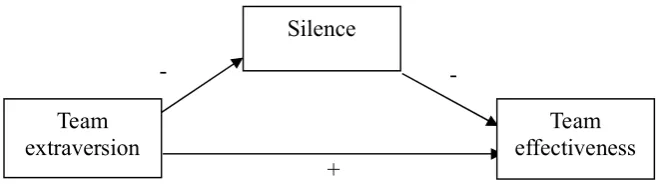
term) is less silent due to more communication, which results increases team effectiveness (see Figure 1).
In this assumption, team extraversion is subjected to the same three operationalizations (mean, variance
and their interaction) of the former hypotheses. To explore whether silence mediates the team
extraversion–effectiveness relation, the last and fourth hypothesis reads thus:
[image:9.595.136.471.339.431.2]H4:
The effect of team extraversion on team effectiveness is mediated by silence; high team
extraversion causes fewer silences than does lower team extraversion, and this decrease in
silences, in turn, causes high team effectiveness.
Figure 1.
Conceptual model for the expected mediation of silence between team extraversion and
team effectiveness.
Method
Design
The current study analyses by means of a mediation model whether silence mediates the relation
between team extraversion as independent variable and team effectiveness as dependent variable. The
data were gathered in two different time periods, with a gap of two years in between (i.e. in 2016 and
2018). In order to answer the research question, data were collected in three different escape rooms on
two locations in Enschede and included participants that booked a game in one of the escape rooms.
Escape rooms. An escape room is a group activity in which a group is locked up in a room and
has to find a way out of the room by solving puzzles and riddles. During this group activity, the group
collaborates and interacts with each other to achieve a successful escape.
This research was conducted in 2016 in three different Dutch Escape Rooms. The first was a
temporal room, named Turin, that was specifically set up at the campus of the University of Twente (UT)
to gather data for this research. Data gathered in an existing and commercial escape room, Roomescape
Enschede, which included two further rooms (Lab and Doka) made by the same designer. In 2018, data
Team
extraversion
Silence
Team
effectiveness
-
-
were gathered again in the two rooms at Roomescape Enschede. A team won the escape game at the UT if
they could escape within 45 minutes, whereas a team at the Roomescape Enschede won if they could
escape within 60 minutes. A team failed to escape if they exceeded the specified time of the escape game.
In all the escape rooms, the puzzles were similar in kind and were about finding codes or keys for a lock.
The puzzles could be solved by logical thinking, making connections, doing math or some combination of
these activities. The rooms differed in the number of puzzles that needed to be solved whereby the rooms
were developed in such a way that escaping within the specified time would be possible. In 2016, the
room Turin counted 30 puzzles, the room Doka counted 33 puzzles and the room Lab counted 32 puzzles.
In 2018, the number of puzzles for Lab changed from 32 into 30 due to the removal of two too-difficult
puzzles, whereas the number of puzzles in the Doka remained unchanged.
During the escape games, an employee of the escape room (i.e., leader of the escape game) kept
an eye on a participating team to help or assist the team, if necessary. In all the rooms, participants
received hints from the employee of the escape room when a team had difficulties in solving a puzzle or
in continuing the game. For example, a team received a hint when it took a team too long to solve a
puzzle or when a team had no clue how to solve a puzzle that was necessary to proceed in the game. A
team could also ask for hints, for instance by using an intercom or tablet. However, the employee of the
escape game decided whether a team would receive a hint or not.
Materials
In order to answer the research question, three different measures were used: a questionnaire, a
scoring form and sociometric badges. The questionnaire gathered data about team extraversion and was
available in Dutch, English and German. The scoring form was used to measure team effectiveness. By
means of sociometric badges, data were gathered to measure silences during the escape games.
Questionnaire. In this study, a questionnaire was used that asked participants for descriptive
statistics, group composition, earlier experiences with escape rooms and whether or not they had
consumed alcohol during or soon before their attempt to escape. Questions for the variables extraversion,
group cohesion and conscientiousness were furthermore administered. The 2018 questionnaire also asked
about agreeableness. Team extraversion is further discussed in the present study, whereas the other
variables were used to test hypotheses for other studies.
Likert scale, from 1 (
totally disagree
) to 5 (
totally agree
). For example, the participants in 2018 indicated
the degree to which they agreed with the following statement about extraversion, derived from the
HEXACO-PI-R: ’I feel reasonably satisfied with myself overall’ (De Vries et al., 2009).
Reliability was calculated for both questionnaires about extraversion. The extraversion scale in
2016 had high reliability for both the Cronbach’s alpha (
α
= 0.85) and Guttman’s Lambda-2 (
α
= 0.86).
Furthermore, the extraversion scale in 2018 was also reliable, for both Cronbach’s alpha (
α
= 0.72) and
Guttman’s Lambda-2 (
α
= 0.74). The individual scores for extraversion in 2016 and 2018 were computed
into an average score per participant for extraversion and were converted into
z
-scores because
z
-scores of
different questionnaires are comparable. Then, these
z
-scores were aggregated into team
z
-scores for the
mean and standard deviation. Thus, two variables on team level for extraversion were computed: the
z
-scores for the mean and for the standard deviation. Next, these two variables were multiplied by each
other to compute the interaction term for team extraversion. Finally, team extraversion was
operationalized by three variables computed with
z
-scores: the mean of extraversion in a team, the
variance of extraversion in a team and the interaction between these two factors (mean times standard
deviation). The Kolmogorov–Smirnov test showed that these three variables had the same non-significant
statistic (
p
= .20), which means that these variables were normally distributed.
Scoring form. The degree of team effectiveness was objectively scored on a scoring form that
one of the researchers and the employee of the escape room completed. The scoring forms filled in by the
researchers were more complete than the scoring forms of the employees of the escape room, because the
main focus of the employee was to guide a team in solving the puzzles during the game, which resulted in
missing data on the employee scoring forms. Therefore, only the scoring forms filled in by the researchers
were used in the present study, and no interrater reliability analysis was performed.
By means of a live-video stream, one of the researchers observed a participating team whereby
different variables were scored on the scoring form. The times at which a team started and finished a
game were noted. Additionally, a participating team could receive hints that gave instructions on how to
solve a puzzle. At the end of the game, the number of received hints and the number of solved puzzles
were counted. Furthermore, the time when a specific puzzle was solved and the time when a hint was
given were noted. With these variables, the effectiveness of a team was measured by calculating a
quotient for the number of puzzles solved per minute: the number of solved puzzles divided by the total
duration of a game in minutes. The higher this quotient was, the more efficient a team was.
The Kolmogorov–Smirnov test for team effectiveness was statistically significant (
p
< .001).
Transforming (
x
3,
x
2, log(
x
), ln(
x
), square root, reciprocal and reciprocal root) the variable of team
Sociometric badges
.
A sociometric badge is a wearable device with Bluetooth, infrared and a
microphone. Collecting data with sociometric badges is different from using traditional measurements
such as questionnaires, observations and interviews because the sociometric badges measure objective
behaviour on a large scale and in a real-time setting (Kim, McFee, Olguin, Waber, & Pentland, 2012; Uhl
et al., 2018). As a result, this technology has opened up new research possibilities for studying the
temporal and spatial characteristics of social interactions. In the current study, each participant wore a
sociometric badge during an escape game in order to derive a speech profile of each participant
(Sociometric Solutions, 2014). By means of the speech profiles of a participating team, the number of
silent segments that lasted at least four seconds were measured. As mentioned above, four seconds of
silence is the minimal duration of silence at which an individual might start to feel less comfortable in a
conversation (Koudenburg et al., 2011). This research calculated how many silent segments of four
seconds or more occurred during a team’s performance. The current study analysed the variable of
number of silent segments that lasted four seconds or longer (NSS).
The data derived from the sociometric badges were processed in the software programme
Sociometric DataLab. In Sociometric DataLab, settings were adapted to the purpose of this research. For
instance, the setting ‘noisy environment’ was applied because in the escape rooms, other noises than
speech could emerge, such as from moving objects, sounds from the tablet or a radio that could be turned
on. Another customized setting was the resolution for time which was set to 0.1 seconds to calculate the
silent segments of 4.0 seconds and further. By means of a script in R, it was calculated how often a team
was silent for four seconds or more during an escape game. Finally, the NSS data were exported to Excel
and were transferred to Statistical Package for the Social Sciences (SPSS).
The Kolmogorov–Smirnov test for NSS was statistically significant (
p
= .02). Transforming (
x
3,
x
2, log(
x
), ln(
x
), square root, reciprocal and reciprocal root) the variable NSS did not result in a normal
distribution, as transformation decreases the interpretability of the variable. Therefore, no transformation
for this variable was used in the analyses.
Participants
and sensation seeking (Donovan, 2004). This behaviour might affect interactions among team members
and their scores for team effectiveness, which could result in different relations between the variables and
the expected processes of group dynamics. Third, five teams were excluded due to missing time notations
on the scoring form, whereby the team effectiveness scores could not be calculated. Fourth, four teams
were excluded because one of the participants did not complete the questionnaire. Finally, one team was
excluded because this team had three team members with an autism-spectrum disorder whereby the
interactions among the members differed considerably from those of the other teams. In total, 52 teams
were excluded from this research.
The final dataset included 363 participants, spread over 72 teams, comprising 174 men (48%) and
189 women (52%). The mean age of the participants was 31 (
SD
= 12.12 years) but varied from 16 and
73. Most of the groups included both men and women (54%), but some groups consisted of only women
(26%) or only men (19%). The teams varied size: 26 teams (36%) included six participants, 23 teams
(32%) consisted of four participants and 19 teams (26%) contained five participants. Two teams (3%)
represented a group of three, and two teams included seven participants (3%). Most participants (63%)
had not previously played an escape game, whereas the other participants (37%) had. Half of the teams
successfully escaped the room within the specified time, while the other half did not. Of the teams, 26
(36%) played the room Turin; 25 (35%), Doka; and 21 (29%), Lab.
Procedure
A team that booked one of the escape rooms received a confirmation email with the notification
that researchers were present in the escape room. At the location of the escape room, one of the
researchers gave the team brief instructions concerning the current research and what was expected from
a participating team. By filling out an informed consent form, each participant indicated that they wanted
to participate in this study. If one of the team members did not provide informed consent, the whole team
was excluded from this research and could immediately start the escape game. A team received further
instruction if all the team members provided informed consent. Each participant received a sociometric
badge and chose a nickname to preserve anonymity. A nickname was matched to the badge number of the
sociometric badge that a participant received and was linked to the questionnaire that a participant would
complete after the escape game. A participating team was afterwards sent an email with a visualization of
the team’s interaction patterns. This visualization showed which nickname (i.e., which participant) spoke
how often during the game.
researcher, who switched the badges off. Next, each participant was asked to fill in the questionnaire on
paper that was linked to that participant’s badge number and nickname. Finally, the questionnaires were
submitted, and the participants were thanked for their participation.
Results
Descriptive statistics
The team effectiveness scores varied between 0.22 and 1.15 (
M
= .54,
SD
= .15). On average,
teams escaped in 53.65 min (
SD
= 8.91). The average degree of extraversion in 2016 was 3.76 (
SD
= .47)
and was 3.60 (
SD
= .54) in 2018. Silent segments lasted on average 30 s (
SD
= 83.36) and varied between
7 and 497 s (about 8 minutes). Furthermore, the scores of the variable NSS varied between 84 and 260
times per team during an escape game (
M
= 192.22,
SD
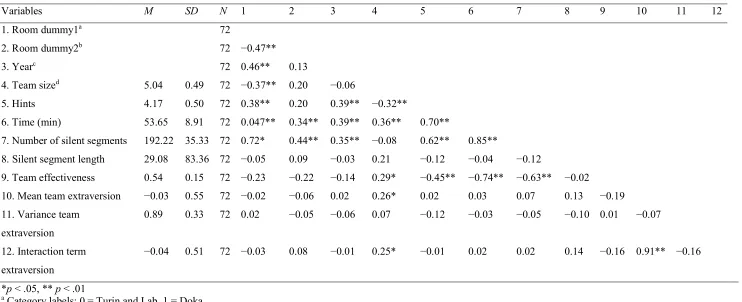
= 35.33). Table 1 gives an overview of the mean
and standard deviation for the variables used in the current study.
Pearson’s correlations (see Table 1) were computed to assess the relationship between the
variables used in the analyses. A statistically significant, strong and negative correlation exists between
team effectiveness and NSS (
r
= -.63,
p
< .001), meaning that a high score on team effectiveness is
associated with a smaller NSS. In addition, the number of hints that the teams received during the escape
games correlated significantly with both team effectiveness (
r
= -.45,
p
< .001) and NSS (
r
= .62,
p
< .001). Thus, more hints predicted less team effectiveness and higher NSS. The number of hints was
strongly related to the time in which the teams escaped (
r =
0.7,
p
< .001), meaning that more hints a
team received, the longer-lasting the escape game.
Moderated mediation model
[image:15.842.54.796.106.408.2]
(16)Table 1
Means
(M)
, Variances, and Correlation Between the Variables (n = 72)
Variables
M
SD
N
1
2
3
4
5
6
7
8
9
10
11
12
1. Room dummy1
a2. Room dummy2
b72
72
−0.47**
3. Year
c72 0.46**
0.13
4. Team size
d5.04
0.49
72 −0.37** 0.20
−0.06
5. Hints
4.17
0.50
72 0.38**
0.20
0.39** −0.32**
6. Time (min)
53.65
8.91
72 0.047** 0.34** 0.39** 0.36**
0.70**
7. Number of silent segments
192.22 35.33 72 0.72*
0.44** 0.35** −0.08
0.62**
0.85**
8. Silent segment length
29.08
83.36 72 −0.05
0.09
−0.03
0.21
−0.12
−0.04
−0.12
9. Team effectiveness
0.54
0.15
72 −0.23
−0.22
−0.14
0.29*
−0.45** −0.74** −0.63** −0.02
10. Mean team extraversion
−0.03
0.55
72 −0.02
−0.06
0.02
0.26*
0.02
0.03
0.07
0.13
−0.19
11. Variance team
extraversion
0.89
0.33
72 0.02
−0.05
−0.06
0.07
−0.12
−0.03
−0.05
−0.10 0.01
−0.07
12. Interaction term
extraversion
−0.04
0.51
72 −0.03
0.08
−0.01
0.25*
−0.01
0.02
0.02
0.14
−0.16 0.91** −0.16
*
p
< .05, **
p
< .01
a
Category labels: 0 = Turin and Lab, 1 = Doka
bCategory labels: 0 = Turin and Doka, 1 = Lab
cCategory labels: 0 = 2016, 1 = 2018
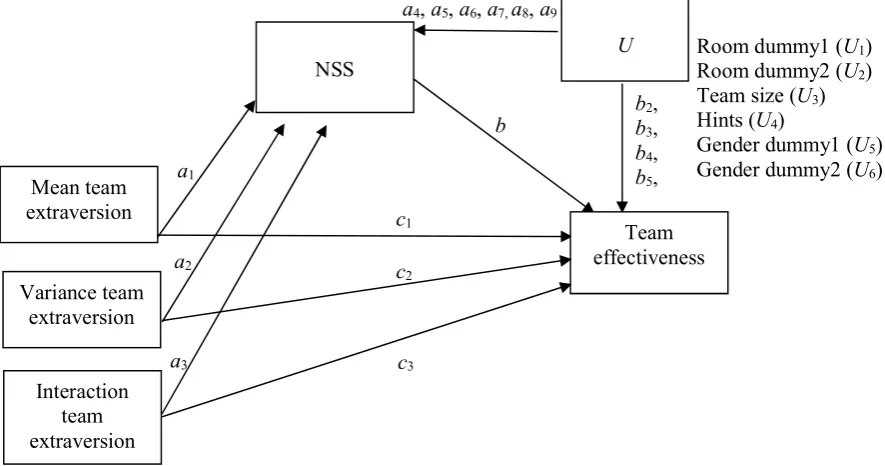
In the moderated mediation analysis, the direct effects of team extraversion on team effectiveness
were examined (
c
-paths). Furthermore, the effect of team extraversion on NSS (
a
-paths) and the effect of
the mediator on team effectiveness in the presence of team extraversion were analysed (
b
-path).
[image:16.595.73.516.256.489.2]Moreover, the analysis included whether the mediating effect (
ab
-path) was significant by exploring
whether the value zero lies within the bootstrap confidence interval. If the value zero is not included in
this confidence interval, the mediation analysis is significant, which means that NSS mediates the
relationship between team extraversion and team effectiveness.
Figure 2.
Statistical model of the moderated mediation analysis. NSS = number of silent segments that
lasted four seconds or longer.
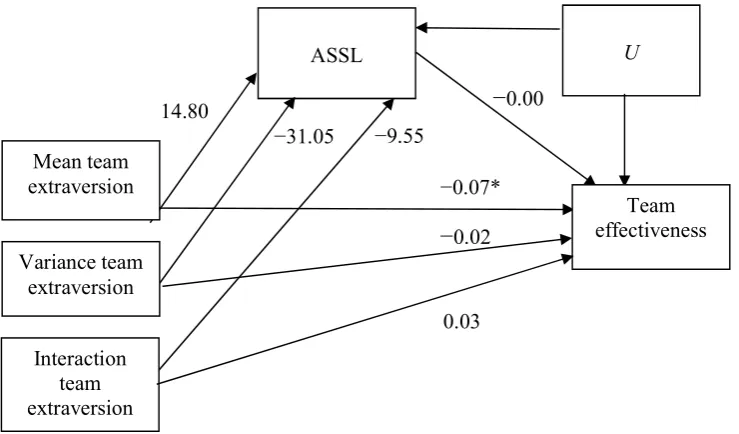
The direct effect (
c
-paths) for each variable of team extraversion (i.e., mean, variance and its
interaction) were analysed controlling for the covariates and the mediator NSS. The effect of the mean for
team extraversion on team effectiveness was negative and significant (
b
= −0.07,
t
(60) = −2.64,
p
= .011), which means that higher average scores on team extraversion predicted less team effectiveness.
Therefore, the H1 is rejected because it was expected that the average degree of team extraversion would
positively affect team effectiveness.
Further, the direct effect of variance (
b
=
−
0.03,
t
(60) =
−
0.68,
p
= .497) and the interaction term
(
b
=
−
0.04,
t
(60) =
−
0.52,
p
= .606) of team extraversion on team effectiveness were not significant.
Therefore, H2 and H3 are not confirmed, because a positive effect was expected of both the variance and
the interaction term of team extraversion on team effectiveness. The analysis showed that controlling for
NSS
Mean team
extraversion
U
Variance team
extraversion
Interaction
team
extraversion
Team
effectiveness
Room dummy1 (
U
1)
Room dummy2 (
U
2)
Team size (
U
3)
Hints (
U
4)
Gender dummy1 (
U
5)
Gender dummy2 (
U
6)
a
4,
a
5,
a
6,
a
7,a
8,
a
9b
2,
b
3,
b
4,
b
5,
a
1a
2a
3c
1c
2c
3the effect of the covariates and NSS, team extraversion had a significant total overall direct effect on team
effectiveness,
F
(10, 60) = 6.5,
p
< .001 with
R
2= .52. An explanation for this significant proportion of
the variance might be derived from the covariates that were added in the analysis. Specifically, there was
a significant effect of covariate team size on team effectiveness (
b
= 0.05,
t
(60) = 3.04,
p
= .004),
meaning that larger team size predicts higher team effectiveness scores. An overview of the results of the
moderated mediation analysis (i.e., the
a
-,
b
-, and
c
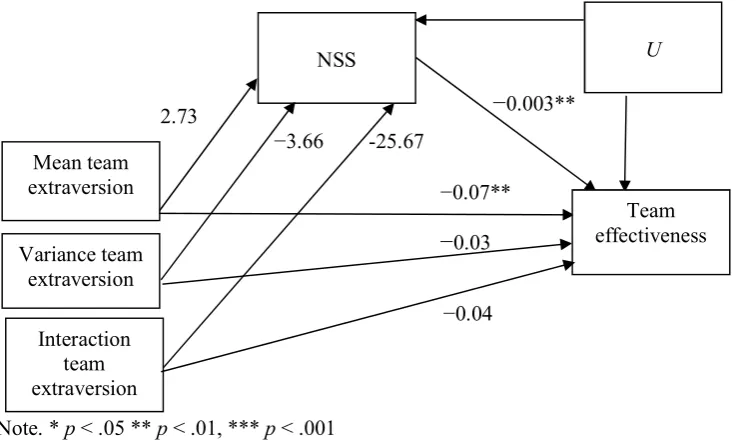
-paths) are presented in Figure 3 below.
[image:17.595.72.441.237.457.2]Note. *
p
< .05 **
p
< .01, ***
p
< .001
Figure 3.
Standardized regression coefficients for the relation between team extraversion and team
effectiveness as mediated by number of silent segments that lasted four seconds or longer (NSS).
In the moderated mediation analysis observed the possible role of the mediator NSS between
team extraversion (i.e., mean, variance and its interaction) and team effectiveness, controlling for the
covariates. The results showed, first, no significant effect of the variables for team extraversion (i.e.,
mean, variance and its interaction) on NSS (
a
-paths). Additionally, NSS was significantly related to team
effectiveness, in the expected direction (
b
-path) (
b
=
−
0.003,
t
(60) =
−
4.22,
p
< .001). In other words, for
every (extra) single silent segment that occurred, the team effectiveness score was diminished by 0.003.
Thus, more silent segments while performing the escape game predicted lower team effectiveness scores.
Within the analysis, a bootstrap confidence interval for the indirect effect (
ab
= 0.07) based on 10,000
bootstrap samples was likely to be around zero, 95% CI [
−
0.03, 0.15]. The mediation analysis thus
showed that when controlling for the covariates, team extraversion (i.e., mean, variance and its
NSS
Mean team
extraversion
U
Variance team
extraversion
Interaction
team
extraversion
Team
effectiveness
2.73
−3.66
-25.67
−0.07**
−
0.03
−0.04
interaction) had no significant indirect effect on team effectiveness via the mediator NSS. Thus, there is
no mediating effect of NSS, so H4 is rejected because a mediating role of NSS was expected.
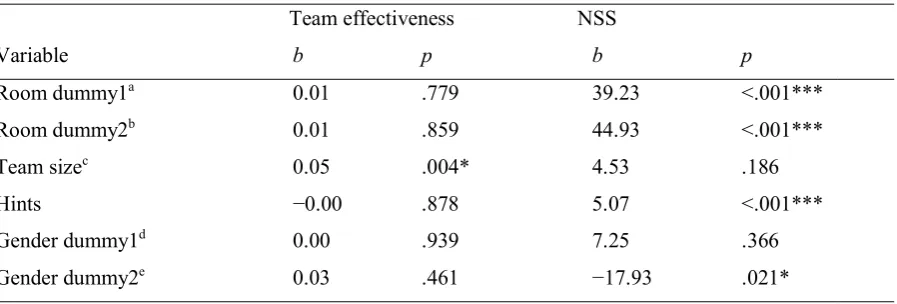
[image:18.595.78.527.344.496.2]The effect of the covariates on team effectiveness and NSS are shown in Table 2. Hints (
b
= 5.07,
t
(61) = 4.17,
p
< .001), room dummy 1 (
b
= 39.23,
t
(66) = 4.62,
p
<.001) and room dummy 2 (
b
= 44.93,
t
(61) = 5.74,
p
<.001) were both related to NSS. Thus, more hints predicted higher scores on NSS. The
team effectiveness scores differ per room type. The average score on team effectiveness in the room Doka
was 0.50 (
SD
= .13) and in Lab, 0.49 (
SD
= .09). For Turin, the effectiveness score was on average 0.63
(
SD
= .16). These results display that the team effectiveness scores were on average higher in the Turin
than were the effectiveness scores in Doka and Lab.
Table 2
Summary of the moderated mediation analysis for covariates predicting team effectiveness and number
of silent segments that lasted four seconds or longer (NSS)
Team effectiveness NSS
Variable
b
p
b
p
Room dummy1
aRoom dummy2
b0.01
0.01
.779
.859
39.23
44.93
<.001***
<.001***
Team size
c0.05
.004*
4.53
.186
Hints
−0.00
.878
5.07
<.001***
Gender dummy1
dGender dummy2
e0.00
0.03
.939
.461
7.25
−17.93
.366
.021*
*
p
< .05 **
p
< .01, ***
p
< .001
a
Category labels: 0 = Turin and Lab, 1 = Doka
bCategory labels: 0 = Turin and Doka, 1 = Lab
cCategory labels: 3 to 7 team members
d