Original citation:
LCHb Collaboration (Including: Back, J. J., Blake, Thomas, Craik, Daniel, Crocombe, Andrew, Dossett, D., Gershon, T. J., Kreps, Michal, Langenbruch, Christoph, Latham, Thomas, O'Hanlon, D. P., Pilar, T., Poluektov, Anton, Reid, Matthew M., Silva Coutinho, R., Wallace, Charlotte and Whitehead, M. (Mark)). (2015) Angular analysis of the B 0 → K *0 e + e − decay in the low-q 2 region. Journal of High Energy Physics, 2015 (4). 64. ISSN 1029-8479
Permanent WRAP url:
http://wrap.warwick.ac.uk/75364
Copyright and reuse:
The Warwick Research Archive Portal (WRAP) makes this work by researchers of the University of Warwick available open access under the following conditions.
This article is distributed under the terms of the Creative Commons Attribution 4.0 License (http://creativecommons.org/licenses/by/4.0/) which permits any use,
reproduction and distribution of the work without further permission provided the original work is attributed.
A note on versions:
The version presented in WRAP is the published version, or, version of record, and may be cited as it appears here.
JHEP04(2015)064
Published for SISSA by SpringerReceived: January 14, 2015 Revised: March 3, 2015
Accepted: March 11, 2015
Published: April 14, 2015
Angular analysis of the
B
0→
K
∗0e
+e
−decay in the
low-
q
2region
The LHCb collaboration
E-mail: [email protected]
Abstract: An angular analysis of the B0 → K∗0e+e− decay is performed using a data sample, corresponding to an integrated luminosity of 3.0 fb−1, collected by the LHCb experiment in pp collisions at centre-of-mass energies of 7 and 8 TeV during 2011 and 2012. For the first time several observables are measured in the dielectron mass squared (q2) interval between 0.002 and 1.120 GeV2/c4. The angular observables FL and AReT which are related to the K∗0 polarisation and to the lepton forward-backward asymmetry, are measured to be FL = 0.16±0.06±0.03 and AReT = 0.10±0.18±0.05, where the first uncertainty is statistical and the second systematic. The angular observables A(2)T and
AImT which are sensitive to the photon polarisation in this q2 range, are found to be
A(2)T =−0.23±0.23±0.05 andAImT = 0.14±0.22±0.05. The results are consistent with Standard Model predictions.
Keywords: Rare decay, Polarization, B physics, Flavour Changing Neutral Currents, Hadron-Hadron Scattering
JHEP04(2015)064
Contents
1 Introduction 1
2 The LHCb detector and data set 4
3 Selection of signal candidates 5
4 Exclusive and partially reconstructed backgrounds 7
5 Fit to the K+π−e+e− invariant mass distribution 8
6 Angular acceptance and angular modelling of the backgrounds 9
6.1 Angular acceptance 9
6.2 Angular modelling of the backgrounds 10
7 Measurement of the angular observables 11
7.1 Fit results 11
7.2 Systematic uncertainties 11
7.3 Effectiveq2 range of the selectedB0→K∗0e+e− signal events 13
8 Summary 14
The LHCb collaboration 18
1 Introduction
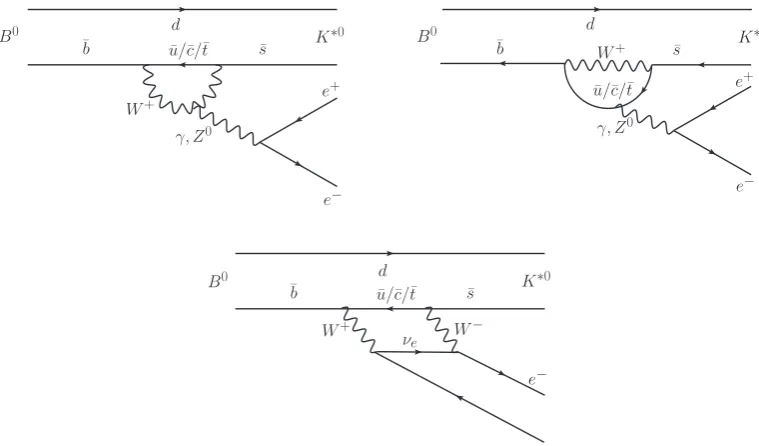
TheB0→K∗0e+e− decay is a flavour changing neutral current process that is mediated by electroweak box and loop diagrams in the Standard Model (SM). Charge conjugation is implied throughout this paper unless stated otherwise and theK∗0 represents the K∗0(892), reconstructed as K∗0→ K+π−. The angular distribution of the K+π−e+e− system is
JHEP04(2015)064
B0 ¯ b
d
W+
¯
s
¯
u/c/¯t¯
γ, Z0
e+
e−
K∗0 B0 ¯ b
d
W+ ¯s
¯
u/c/¯¯t
γ, Z0
e+
e− K∗0
B0 ¯ b
d
W+
¯ s ¯
u/c/¯t¯
e+ e− K∗0
[image:4.595.117.497.107.330.2]W− νe
Figure 1: Dominant Standard Model Feynman graphs for the electroweak loop and box diagrams involved in theB0
→K∗0e+e− decay.
The q2 region below 1 GeV2/c4 has previously been studied through the analysis of theB0→K∗0`+`− (`=e, µ) [9–11]. Experimentally, an analysis with muons rather than electrons in the final state produces a much higher yield at LHCb. This is primarily due to the distinctive signature that muons provide, which is efficiently exploited in the online selection, together with the better mass and energy resolutions and higher reconstruction efficiency of dimuon decays. However, as outlined in ref. [12], dielectron decays at low q2
provide greater sensitivity to the photon polarisation and therefore to theC7 andC
0
7 Wilson coefficients, which are associated with the left-handed and right-handed electromagnetic operators, respectively [3]. Due to the muon mass, the virtual photon contribution in dimuon decays is suppressed relative to dielectron decays. Additionally, the formalism for theB0→K∗0e+e− decay is greatly simplified as the electron mass can be neglected. Indeed, the decay with electrons allows for an angular analysis down to a q2 of 0.0004 GeV2/c4. However, above a q2 of 1 GeV2/c4, the muon mass terms become negligible and the electron and muon modes have essentially the same functional dependence on the Wilson coefficients (within the lepton flavour universality assumption).
This work is based on a previous analysis performed by the LHCb collaboration to measure theB0→K∗0e+e−branching fraction with an integrated luminosity of 1.0 fb−1[13], with the selection re-optimised for the angular analysis.
The partial decay width of the B0→K∗0e+e− decay can be described in terms ofq2
JHEP04(2015)064
the direction opposite to that of the B0 (B0) meson in the K∗0 (K∗0) rest frame. The angle φis the angle between the plane containing the e+ and e− and the plane containing the kaon and pion from the K∗0 (K∗0) in the B0 (B0) rest frame. The basis is designed such that the angular definition for theB0 decay is aCP transformation of that for the B0 decay. These definitions are identical to those used for the B0→ K∗0µ+µ− analysis [10]. As in ref. [10], the angle φis transformed such that ˜φ=φ+π ifφ <0, to compensate for the limited signal yield. This transformation cancels out the terms that have a sinφor cosφdependence and simplifies the angular expression without any loss of sensitivity to the remaining observables. In the limit of massless leptons and neglecting theK+π− S-wave contribution, which is expected to be negligible1 at lowq2 with the current sample size [14], theB0→K∗0e+e− angular distribution reads as
1 d(Γ + ¯Γ)/dq2
d4(Γ + ¯Γ) dq2dcosθ
`dcosθKd ˜φ
= 9
16π
3
4(1−FL) sin 2θ
K+FLcos2θK +
1
4(1−FL) sin 2θ
K−FLcos2θK
cos 2θ` +
1
2(1−FL)A (2)
T sin
2θ
Ksin2θ`cos 2 ˜φ +
(1−FL)AReT sin2θKcosθ` +
1
2(1−FL)A Im
T sin2θKsin2θ`sin 2 ˜φ
.
(1.1)
The four angular observablesFL,A(2)T ,AReT andAImT are related to the transversity amplitudes through [2]
FL = |
A0|2
|A0|2+|A|||2+|A⊥|2
A(2)T = |A⊥|
2− |A
|||2 |A⊥|2+|A|||2
AReT = 2Re(A||LA
∗
⊥L+A||RA∗⊥R)
|A|||2+|A⊥|2
AImT = 2Im(A||LA
∗
⊥L+A||RA∗⊥R)
|A|||2+|A⊥|2
,
(1.2)
where |A0|2 =|A0L|2+|A0R|2, |A⊥|2 =|A⊥L|2+|A⊥R|2 and|A|||2 =|A||L|2+|A||R|2. The amplitudes A0, A|| and A⊥ correspond to different polarisation states of the K∗0 in the
decay. The labelsL and R refer to the left and right chirality of the dielectron system. Given the definition of ˜φ, the observable A(2)T is averaged betweenB0 andB0 decays, while AImT corresponds to a CP asymmetry [15]. The observable FL is the longitudinal polarisation of the K∗0 and is expected to be small at low q2, since the virtual photon
1Using refs. [1,14] it can be shown that the ratio of the S-wave fraction to the fraction of longitudinal
JHEP04(2015)064
is then quasi-real and therefore transversely polarised. The observableAReT is related to the forward-backward asymmetry AFB by AReT = 43AFB/(1−FL) [2]. The observables
A(2)T andAIm
T , in the limit q2→ 0, can be expressed as simple functions of theC7 andC
0
7 coefficients [2]
A(2)T (q2 →0) = 2Re(C7C
0∗
7 )
|C7|2+|C
0
7|2
and AImT (q2 →0) = 2Im(C7C
0∗
7 )
|C7|2+|C
0
7|2
. (1.3)
These measurements therefore provide information on photon polarisation amplitudes, similar to that obtained by the CP asymmetry measured through time-dependent analyses inB0→K∗0(→KS0π
0)γ decays [16,17].
This paper presents measurements of FL, A(2)T , AImT and AReT of the B0→ K∗0e+e− decay in the bin corresponding to a reconstructed q2 from 0.0004 to 1 GeV2/c4.
2 The LHCb detector and data set
The study reported here is based on pp collision data, corresponding to an integrated luminosity of 3.0 fb−1, collected at the Large Hadron Collider (LHC) with the LHCb detector [18, 19] at centre-of-mass energies of 7 and 8 TeV during 2011 and 2012. The LHCb detector is a single-arm forward spectrometer covering the pseudorapidity range
2< η <5, designed for the study of particles containingborcquarks. The detector includes
a high-precision tracking system consisting of a silicon-strip vertex detector surrounding the
pp interaction region [20], a large-area silicon-strip detector located upstream of a dipole magnet with a bending power of about 4 Tm, and three stations of silicon-strip detectors and straw drift tubes [21] placed downstream of the magnet. The tracking system provides a measurement of momentum,p, with a relative uncertainty that varies from 0.5% at low momentum to 1.0% at 200 GeV/c. The minimum distance of a track to a primary vertex, the impact parameter (IP), is measured with a resolution of (15 + 29/pT)µm, wherepT is the component of the momentum transverse to the beam, in GeV/c. Different types of charged hadrons are distinguished using information from two ring-imaging Cherenkov detectors [22]. Photons, electrons and hadrons are identified by a calorimeter system consisting of scintillating-pad and preshower detectors, an electromagnetic calorimeter (ECAL) and a hadronic calorimeter. Muons are identified by a system composed of
alternating layers of iron and multiwire proportional chambers [23].
The trigger [24] consists of a hardware stage, based on information from the calorimeter and muon systems, followed by a software stage, which applies a full event reconstruction. For signal candidates to be considered in this analysis, all tracks from theB0→K∗0e+e−decay must have hits in the vertex detector and at least one of the tracks from theB0→K∗0e+e−
decay must meet the requirements of the hardware electron or hadron triggers, or the hardware trigger must be fulfilled independently of any of the decay products of the signal
JHEP04(2015)064
than 3.5 GeV. The software trigger requires a two-, three- or four-track secondary vertex with a significant displacement from the primary pp interaction vertices (PVs). At least one charged particle must have a transverse momentumpT >1.7 GeV/c and be inconsistent with originating from the PV. A multivariate algorithm [25] is used for the identification of secondary vertices consistent with the decay of a bhadron.
Samples of simulated B0→ K∗0e+e− events are used to determine the efficiency to
trigger, reconstruct and select signal events. In addition, specific samples of simulated events are utilised to estimate the contribution from exclusive backgrounds and to model their mass and angular distributions. Thepp collisions are generated usingPythia [26? ] with a specific LHCb configuration [28]. Decays of hadronic particles are described by
EvtGen[29], in which final-state radiation is generated usingPhotos[30]. The interaction of the generated particles with the detector, and its response, are implemented using the
Geant4 toolkit [31? ] as described in ref. [33]. The simulated samples are corrected for known differences between data and simulation in particle identification [22], detector occupancy and hardware trigger efficiency.
3 Selection of signal candidates
Bremsstrahlung radiation, if not accounted for, would worsen the B0 mass resolution. If the radiation occurs downstream of the dipole magnet, the momentum of the electron is correctly measured and the photon energy is deposited in the same calorimeter cell as the electron. If photons are emitted upstream of the magnet, the electron momentum is evaluated after photon emission, and the measured B0 mass is shifted. In general, these bremsstrahlung photons deposit their energy in different calorimeter cells than those hit by the electron. In both cases, the ratio of the energy detected in the ECAL to the momentum measured by the tracking system, an important variable in identifying electrons, remains unbiased. To improve the momentum reconstruction, a dedicated bremsstrahlung recovery is used. Contributions from photon candidates, neutral clusters with transverse energy greater than 75 MeV, found within a region of the ECAL defined by the extrapolation of the electron track upstream of the magnet, are added to the measured electron momentum.
Oppositely charged electron pairs formed from tracks withpT exceeding 350 MeV/cand with a good-quality vertex are used to form signal candidates. If the same bremsstrahlung photon is associated with both thee+ and thee−, its energy is added randomly to one of the tracks. The reconstructede+e− invariant mass is required to be in the range 20–1000
MeV/c2 (0.0004< q2<1 GeV2/c4). The choice of the lower bound is a compromise between
the gain in sensitivity to the photon polarisation from measuring as low as possible inq2 and a degradation of the resolution in ˜φasq2 decreases, due to multiple scattering, as shown in figure2. The lower bound requirement at 20 MeV/c2 on thee+e− invariant mass also serves to reduce the background from B0→K∗0γ decays followed by a photon conversion in the material, noted below asB0→K∗0γe+e−.
JHEP04(2015)064
] 2
c
/ [MeV )
−
e
+
e m(
0 50 100
[rad] φ∼
σ
0 0.5 1 1.5
2
LHCb
simulation
Figure 2: Resolution on the ˜φangle as a function of thee+e− invariant mass as obtained from
LHCb simulated events.
Candidate K∗0 mesons and e+e− pairs are required to have a common good-quality vertex to formB0 candidates. When more than one PV is reconstructed, the one giving the smallest IP χ2 for the B0 candidate is chosen. The reconstructed decay vertex of theB0 candidate is required to be significantly separated from the PV and the candidate momentum direction to be consistent with its direction of flight from the PV. TheB0 mass resolution, the angular acceptance and the rates of physics and combinatorial backgrounds depend on how the event was triggered. The data sample is therefore divided into three mutually exclusive categories: events for which one of the electrons from the B0 decay satisfies the hardware electron trigger, events for which one of the hadrons from the B0
decay satisfies the hardware hadron trigger and events triggered by activity in the event not due to any of the signal decay particles.
In order to maximise the signal efficiency while reducing the high level of combina-torial background, a multivariate classifier based on a boosted decision tree algorithm (BDT) [34,35] is used. The signal training sample is composed of simulatedB0→K∗0e+e−
events and the background training sample is taken from the upper invariant mass sideband (m(K+π−e+e−)>5600 MeV/c2) of B0→K∗0e+e− decays reconstructed in half of the data sample. Two separate BDTs are used, one each for half of the data sample. They are optimised separately and applied to the complementary half of the data in order to avoid any potential bias due to the use of the data upper sideband for the background sample. The BDT uses information about the event kinematic properties, vertex and track quality, IP andpT of the tracks, flight distance from the PV as well as information about isolation of the final state particles.2 The selection is optimised to maximiseNS/
√
NS+NB separately for the three trigger categories and the two BDTs through a grid search of the set of criteria for the particle identification of the four final state particles and the BDT response. The background yield (NB) is extrapolated into the signal range using the m(K+π−e+e−) dis-tribution outside a±300 MeV/c2 window around the knownB0 mass. The expected signal
2The isolation is defined as the number of good two-track vertices that one of the candidate signal tracks
JHEP04(2015)064
yield (NS) is obtained using the B0→K∗0e+e− simulation and the knownB0→K∗0e+e− branching fraction [13], and correcting for data-to-simulation differences in the selection efficiency obtained using the well knownB0→J/ψ(e+e−)K∗0 decay. The efficiency of this requirement on the selected signal is 93% while the background is reduced by two orders of magnitude. The expected values for NS/√NS+NB range from 3.9 to 7.5 depending on the trigger category.
4 Exclusive and partially reconstructed backgrounds
Several sources of background are studied using samples of simulated events, corrected to reflect the difference in particle identification performances between data and simulation.
A large non-peaking background comes from the B0 → D−e+ν decay, with D−→e−νK∗0 which has a combined branching fraction about four orders of magnitude larger than that of the signal. In the rare case where both neutrinos have low energies, the signal selection is ineffective at rejecting this background which tends to peak towards cosθ` ≈1. In order to avoid any potential bias in the measurement of theAReT parameter, a symmetric requirement of|cosθ`|<0.8 is applied to suppress this background, resulting in a loss of signal of the order of 10%.
To suppress background from Bs0→φe+e− decays, with φ→K+K−, where one of the kaons is misidentified as a pion, the two-hadron invariant mass computed under the K+K−
hypothesis is required to be larger than 1040 MeV/c2. Background from the decay Λ0
b→ pK−e+e− is suppressed by rejecting events where the pion is consistent with being a proton, according to the information from the RICH detectors.
The probability for a decay B0→K∗0e+e− to be misidentified as B0→ K∗0e+e− is estimated to be 1.1 % using simulated events and this background is therefore neglected.
Another important source of background comes from the B0→K∗0γ decay, where the photon converts into ane+e− pair. In LHCb, approximately 40% of the photons convert before reaching the calorimeter, and although only about 10% are reconstructed as ane+e−
pair with hits in the vertex detector, the resulting mass of the B0 candidate peaks in the signal region. Two very effective criteria for suppressing this background are the minimum requirement on thee+e− invariant mass, m(e+e−) >20 MeV/c2, and a requirement that the uncertainty of the reconstructedz coordinate of thee+e− pair,σz(e+e−), is less than 30 mm. These requirements reject more than 99% of simulated B0→K∗0γ events. The remaining contamination is estimated by normalising the simulatedB0→K∗0γ
e+e− to the
JHEP04(2015)064
Another possible source of contamination is the decay B0→ K∗0V(→ e+e−) where
V is a ρ, ω or φ meson. Expected rates for these backgrounds have been evaluated in refs. [4,38]. The effects of direct decays or interference with the signal decay are found to be negligible after integrating over theq2 range.
Partially reconstructed (PR) backgrounds arising from B0→K∗0e+e−X decays, where one or more of the decay products (X) from the B0 decay is not reconstructed, are also taken into account. These incomplete events are mostly due to decays involving higher
K∗ resonances, hereafter referred to as K∗∗. The decays B0→ K∗0η and B0→ K∗0π0
are also studied and several cases are considered: the case when the e+e− pair comes
from a converted photon in the material, the case when thee+ and e− originate from the conversions of the two photons and finally the case of the Dalitz decay of the η or theπ0. They contribute about 25% of the PR background in the angular fitting domain.
5 Fit to the K+π−e+e− invariant mass distribution
In a first step, a mass fit over a wide mass range, from 4300 to 6300 MeV/c2, is performed to estimate the size of the B0→K∗0e+e− signal, the combinatorial background and the PR background. The fractions of each component are determined from unbinned maximum likelihood fits to the mass distributions separately for each trigger category. The mass distribution of each category is fitted to a sum of probability density functions (PDFs), modelling the different components. Following the strategy of ref. [39], the signal PDF depends on the number of neutral clusters that are added to the dielectron candidate to correct for the effects of bremsstrahlung. The signal is described by the sum of a Crystal Ball function [40] (CB) and a wide Gaussian function accounting for the cases where background photons have been associated; the CB function accounts for over 90% of the total signal PDF. The shape of the combinatorial background is parameterised by an exponential function. Finally, the shape of the PR background is described by non-parametric PDFs [41] determined from fully simulated events passing the selection.
The signal shape parameters are fixed to the values obtained from fits to simula-tion but the widths and mean values are corrected for data simulasimula-tion differences using
B0→J/ψ(e+e−)K∗0 as a control channel. Since the photon pole contribution dominates in the low-q2 region, the PR background is expected to be similar for B0→K∗0e+e− and
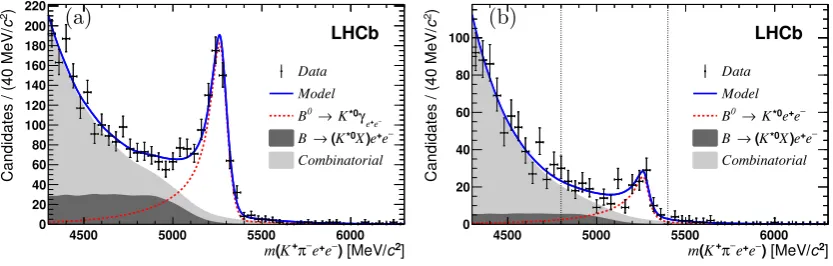
B0→ K∗0γ. The large branching fraction of the decay B0→ K∗0γ allows the fractions of PR background relative to the signal yield to be determined from the data. These fractions are extracted from a fit to a larger sample of events obtained by removing the requirements on the lower bound of thee+e−invariant mass and onσz(e+e−) and therefore dominated by B0→K∗0γe+e− events. The invariant mass distribution, together with the
PDFs resulting from this fit, is shown in figure3(a) for the three trigger categories grouped together. The corresponding distribution for theB0→K∗0e+e− fit is shown in figure3(b). There are 150±17 B0→ K∗0e+e− signal events, 106±16 PR background events and 681±32 combinatorial background events in the 4300−6300 MeV/c2 window.
JHEP04(2015)064
] 2 c / [MeV ) − e + e − π + K ( m4500 5000 5500 6000
)
2c
Candidates / (40 MeV/
0 20 40 60 80 100 120 140 160 180 200 220 Data Model − e + e γ 0 * K → 0 B − e + e ) X 0 * K ( → B Combinatorial LHCb (a) ] 2 c / [MeV ) − e + e − π + K ( m
4500 5000 5500 6000
)
2c
Candidates / (40 MeV/
[image:11.595.91.508.89.222.2]0 20 40 60 80 100 Data Model − e + e 0 * K → 0 B − e + e ) X 0 * K ( → B Combinatorial LHCb (b)
Figure 3: Invariant mass distribution for (a) the B0
→ K∗0γ
e+e− and (b) the B0→K∗0e+e−
decay modes and the three trigger categories grouped together. The dashed line is the signal PDF, the light grey area corresponds to the combinatorial background and the dark grey area is the PR background. The solid line is the total PDF. The two vertical dotted lines on theB0→K∗0e+e− plot indicate the signal window that is used in the angular fit.
on the kinematic properties of the background and may thus vary as functions of mass. Hence, the angular fit is performed in a narrower mass window from 4800 MeV/c2 to 5400 MeV/c2. In this restricted window there are 124 B0→K∗0e+e− signal events, 38 PR and 83 combinatorial background events, corresponding to a signal-to-background ratio of the order of one. About half of these events belong to the electron hardware trigger category and the rest are equally distributed between the other two categories.
6 Angular acceptance and angular modelling of the backgrounds
6.1 Angular acceptance
JHEP04(2015)064
6.2 Angular modelling of the backgroundsIn the mass window 4800< m(K+π−e+e−)<5400 MeV/c2 used in the angular analysis, about one third of the events are combinatorial background. The angular distribution of these events is described by the product of three independent distributions for cosθ`, cosθK and ˜φ. This background largely dominates at low m(K+π−e+e−): between 4300 MeV/c2
and 4800 MeV/c2, about 90% of the events are combinatorial background according to the mass fit shown in figure 3. However, the angular distributions of the background depend uponm(K+π−e+e−) and the information from the lower mass window cannot be used directly for modelling the signal region. The effect of this correlation is extracted from a sample of data events selected with a looser BDT requirement but excluding the region of the BDT response corresponding to the signal. With this selection the sample is dominated by background in the whole mass range. The cosθK background distributions are modelled as first order polynomials. The cosθ` background distributions are modelled with polynomial functions with third and fourth order terms. The ˜φ distributions are compatible with being uniform. This method assumes that there is no strong correlation between the BDT response andm(K+π−e+e−). This assumption is tested by subdividing the sample of events with looser BDT response and comparing the differences between the angular shapes predicted by this procedure and those observed. These differences are smaller than the statistical uncertainties of the parameters used to describe the angular shapes. The statistical uncertainties are thus used to assess the size of the systematic uncertainties due to the combinatorial background modelling.
The PR background accounts for about 15% of the events in the angular fit mass window. These events cannot be treated in the same way as the combinatorial ones. Since only one or two particles are not reconstructed, the observed angular distributions retain some of the features induced by the dynamics of the decay. Hence, they are modelled using the same functional shapes as the signal, but with independent physics parameters,
FL,PR, A
(2)
T,PR, AImT,PR and AReT,PR. The loss of one or more final-state hadrons leads to a smaller apparent polarisation of the K∗0. While on B0→K∗0γ simulated events theFL parameter is found to be zero, it reaches 17% for simulated B→ γK∗∗(→ KπX) events. Since in the SM one expects an FL value of the order of 15 to 20%, FL,PR is assumed to be equal to 1/3, which is equivalent to no polarisation. This parameter is varied between 17% and 50% to assess the size of the systematic uncertainty associated with this hypothesis. Similarly, the loss of information due to the unreconstructed particles leads to a damping of the transverse asymmetries of the PR background,A(2)T,PR,AIm
T,PR and AReT,PR, compared to those of the signal. The signal transverse asymmetries are expected to be small in the SM, therefore their values are set to zero to describe the angular shape of the PR background. For A(2)T,PR and AImT,PR the validity of this assumption is tested by comparing angular fits
toB→J/ψ K∗∗(→KπX) and B0→J/ψ K∗0 simulated events, which confirms a damping
factor compatible with zero. The systematic uncertainty associated with this assumption is estimated by varying A(2)T,PR and AImT,PR up to half of the fitted signal values of A(2)T and
JHEP04(2015)064
of AReT is zero. The systematic uncertainty is evaluated by allowing theAReT,PR parameter to be as high as theAReT value obtained from the B0→K∗0e+e− angular fit.
7 Measurement of the angular observables
7.1 Fit results
To measure the four angular observables, FL,A(2)T ,AImT and AReT , an unbinned maximum likelihood fit is performed on the m(K+π−e+e−), cosθ`, cosθK and ˜φ distributions in the signal window defined in section 5. The inclusion of m(K+π−e+e−) in the fit strongly improves its statistical power since the level of background varies significantly within the signal mass window. The fit is performed simultaneously on the three trigger categories sharing the fit parameters associated with the angular observables. The mass PDFs for the three components (signal, PR background and combinatorial background) are obtained from the fit described in section5. The angular PDFs for the signal are obtained by multiplying the formula of eq. 1.1 by the acceptance described in section 6. Similarly, the angular PDFs for the PR background are modelled by using eq.1.1 and the acceptance described in section 6and setting FL,PR = 0.33 andA
(2)
T,PR =AImT,PR =AReT,PR = 0. Finally, the angular PDFs for the combinatorial background are described in section 6. The combinatorial and PR background fractions are constrained to the values calculated from the mass fit described in section5. The fit is validated using a large number of pseudo-experiments that include all the components of the fits. Several input values for the angular observables,
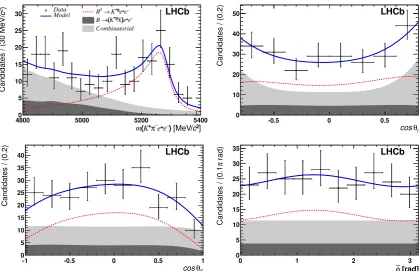
FL, A(2)T , AImT andAReT , are studied including those associated with NP models, and the fit results are in good agreement with the inputs. The fitting procedure is also verified using a large sample of fully simulated events; the fitted values of FL, A(2)T , AImT and AReT are in excellent agreement with the generated ones. This validates not only the fit but also the assumption that the angular acceptance factorises. The distributions ofm(K+π−e+e−), cosθ`, cosθK and ˜φ, together with the likelihood projections resulting from the fit, are shown in figure4 and the fit results are given in table1. The fitted values of FL, A(2)T , AImT and AReT are corrected for the (3.8±1.9)% contamination from B0→ K∗0γe+e− decays,
assuming that FL,K∗0γ, A(2)
T,K∗0γ,AImT,K∗0γ and AReT,K∗0γ are all equal to zero, and are used for the computation of the systematic uncertainties related to the angular description of the PR background. The fitted values are also corrected for the small fit biases due to the limited size of the data sample.
7.2 Systematic uncertainties
To evaluate the contributions from the possible sources of systematic uncertainty, pseudo-experiments with modified parameters are generated and fitted with the PDFs used to fit the data. Fit results are then compared with input values to assess the size of the uncertainties.
JHEP04(2015)064
Uncorrected values Corrected values
FL 0.15±0.06 0.16±0.06±0.03
A(2)T −0.22±0.23 −0.23±0.23±0.05
AImT +0.14±0.22 +0.14±0.22±0.05
[image:14.595.181.415.83.163.2]AReT +0.09±0.18 +0.10±0.18±0.05
Table 1: Fit results for the angular observables FL, A (2)
T , AImT and AReT. The second column
corresponds to the uncorrected values directly obtained from the fit while the third column gives the final results after the correction for the (3.8±1.9)% ofB0
→K∗0γ
e+e− contamination and for
the small fit biases due to the limited size of the data sample. The first uncertainty is statistical and the second systematic.
] 2 c / [MeV ) − e + e − π + K ( m
4800 5000 5200 5400
)
2c
Candidates / (30 MeV/
0 5 10 15 20 25
30 DataModel B0→K*0e+e−− e + e ) X 0 * K ( → B Combinatorial LHCb l θ cos
-0.5 0 0.5
Candidates / (0.2)
0 10 20 30 40 50 LHCb K θ cos
-1 -0.5 0 0.5 1
Candidates / (0.2)
0 5 10 15 20 25 30 35 40 LHCb [rad] φ∼
0 1 2 3
rad)
π
Candidates / (0.1
0 5 10 15 20 25 30 35 LHCb
Figure 4: Distributions of theK+π−e+e− invariant mass, cosθ
`, cosθK and ˜φvariables for the
B0
→K∗0e+e− decay mode and the three trigger categories grouped together. The dashed line is
the signal PDF, the light grey area corresponds to the combinatorial background, the dark grey area is the PR background. The solid line is the total PDF.
The uncertainties due to the description of the shape of the combinatorial background are obtained from the uncertainties on the parameters describing the shapes and by allowing for potential cos 2 ˜φand sin 2 ˜φmodulations.
To estimate the uncertainties due to the modelling of the PR background the FL,PR parameter is varied between 0.17 and 0.5. The systematic uncertainties related to the A(2)T
[image:14.595.88.509.255.526.2]JHEP04(2015)064
Source σ(FL) σ(A(2)T ) σ(AImT ) σ(AReT )
Acceptance modelling 0.013 0.038 0.035 0.031
Combinatorial background 0.006 0.030 0.029 0.038
PR background 0.019 0.011 0.007 0.009
B0→K∗0γ contamination 0.003 0.004 0.003 0.002
Fit bias 0.008 - - 0.010
Total systematic uncertainty 0.03 0.05 0.05 0.05
[image:15.595.135.465.84.206.2]Statistical uncertainty 0.06 0.23 0.22 0.18
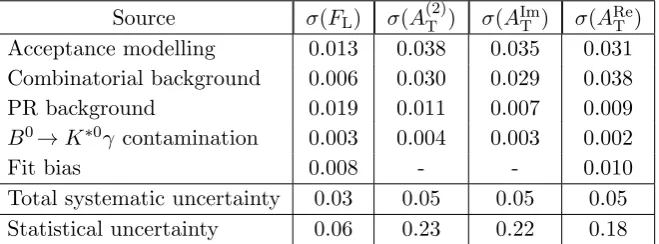
Table 2: Summary of the systematic uncertainties.
distribution of the PR background by a factor of two compared to the signal ones. For the
AReT parameter, the systematic uncertainty is estimated by varying AReT,PR up to the fitted value obtained forB0→K∗0e+e−.
The systematic uncertainties from the B0 → K∗0γe+e− background are due to the
uncertainty on the size of the contamination.
Finally, to estimate possible biases due to the fitting procedure, a large number of pseudo-experiments are generated with the number of events observed in data and are fitted with the default PDFs. While the A(2)T and AImT estimates are not biased, theFL and AReT observables exhibit small biases (less than 10% of the statistical uncertainties) due to the limited size of the data sample and are corrected accordingly. The values of the corrections are assigned as uncertainties (labelled as “Fit bias” in table2) .
The systematic uncertainties are summarised in table 2. The systematic uncertainties on the FL,A(2)T ,AImT and AReT angular observables in table 1are obtained by adding these contributions in quadrature. They are, in all cases, smaller than the statistical uncertainties.
7.3 Effective q2 range of the selected B0→K∗0e+e− signal events
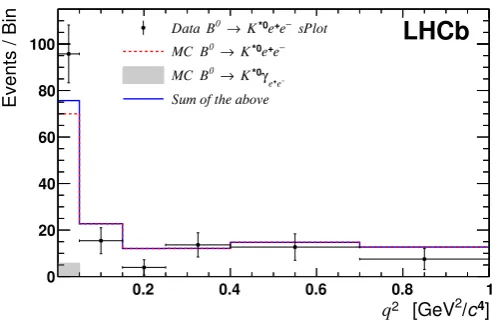
The distribution of the reconstructed q2 for the signal is obtained using the sPlot tech-nique [42] based on the B0 invariant mass spectrum and shown in figure 5. Taking into account the effect of event migration in and out theq2 bin, the average value of the trueq2 of the selected signal events is equal toq2 = 0.17±0.04 GeV2/c4. The acceptance as a function of the trueq2, obtained from the LHCb simulation, is uniform in a large domain except close to the limits of the reconstructedq2, 0.0004 and 1 GeV2/c4. Due to reconstruction effects, the q2 effective limits are slightly different. Because of reduced acceptance in the low-q2
JHEP04(2015)064
] 4 c / 2 [GeV 2 q0.2 0.4 0.6 0.8 1
Events / Bin
0 20 40 60 80 100 sPlot − e + e 0 * K → 0 B Data − e + e 0 * K → 0 B MC − e + e γ 0 * K → 0 B MC
Sum of the above
[image:16.595.176.424.88.249.2]LHCb
Figure 5: Distribution of the reconstructedq2 from ansPlotof data (black points). The dashed
line represents theB0
→K∗0e+e− contribution and the grey area corresponds to the 3.8%B0 →
K∗0γ
e+e− contamination. The solid line is the sum of the two.
the reconstructed q2 interval 0.0004 to 1 GeV2/c4. An uncertainty on theq2 effective limits is assigned as half of the q2 limit modification. The true q2 effective range is thus from 0.0020±0.0008 to 1.120±0.060 GeV2/c4. This range should be used to compare the F
L, A(2)T ,AImT and AReT measurements with predictions.
8 Summary
An angular analysis of the B0→K∗0e+e− decay is performed using proton-proton collision data, corresponding to an integrated luminosity of 3.0 fb−1, collected by the LHCb experi-ment in 2011 and 2012. Angular observables are measured for the first time in an effective
q2 range from 0.0020±0.0008 to 1.120±0.060 GeV2/c4. The results are
FL = 0.16±0.06±0.03
A(2)T = −0.23±0.23±0.05
AImT = +0.14±0.22±0.05
AReT = +0.10±0.18±0.05,
where the first contribution to the uncertainty is statistical and the second systematic. The results are consistent with SM predictions [2,43]. For the low average value ofq2 of this analysis, the formulae relatingA(2)T andAImT and C7 andC
0
7 in eq.1.3 are accurate at the 5% level, for SM values of the ratios of Wilson coefficients C9/C7 andC10/C7. At this level of precision and for SM values of C7, the ratio C
0
JHEP04(2015)064
Acknowledgments
We express our gratitude to our colleagues in the CERN accelerator departments for the excellent performance of the LHC. We thank the technical and administrative staff at the LHCb institutes. We acknowledge support from CERN and from the national agencies: CAPES, CNPq, FAPERJ and FINEP (Brazil); NSFC (China); CNRS/IN2P3 (France); BMBF, DFG, HGF and MPG (Germany); INFN (Italy); FOM and NWO (The Netherlands); MNiSW and NCN (Poland); MEN/IFA (Romania); MinES and FANO (Russia); MinECo (Spain); SNSF and SER (Switzerland); NASU (Ukraine); STFC (United Kingdom); NSF (USA). The Tier1 computing centres are supported by IN2P3 (France), KIT and BMBF (Germany), INFN (Italy), NWO and SURF (The Netherlands), PIC (Spain), GridPP (United Kingdom). We are indebted to the communities behind the multiple open source software packages on which we depend. We are also thankful for the computing resources and the access to software R&D tools provided by Yandex LLC (Russia). Individual groups or members have received support from EPLANET, Marie Sk lodowska-Curie Actions and ERC (European Union), Conseil g´en´eral de Haute-Savoie, Labex ENIGMASS and OCEVU, R´egion Auvergne (France), RFBR (Russia), XuntaGal and GENCAT (Spain), Royal Society and Royal Commission for the Exhibition of 1851 (United Kingdom).
Open Access. This article is distributed under the terms of the Creative Commons Attribution License (CC-BY 4.0), which permits any use, distribution and reproduction in any medium, provided the original author(s) and source are credited.
References
[1] F. Kr¨uger and J. Matias,Probing new physics via the transverse amplitudes of
B0→K∗0(→K+π−)at large recoil,Phys. Rev.D 71(2005) 094009 [hep-ph/0502060]
[INSPIRE].
[2] D. Becirevic and E. Schneider,On transverse asymmetries inB→K∗`+`−,Nucl. Phys.B
854(2012) 321[arXiv:1106.3283] [INSPIRE].
[3] Y. Grossman and D. Pirjol,Extracting and using photon polarization information in radiative
B decays,JHEP 06 (2000) 029[hep-ph/0005069] [INSPIRE].
[4] S. J¨ager and J. Martin Camalich,On B→V `` at small dilepton invariant mass, power
corrections and new physics,JHEP 05(2013) 043[arXiv:1212.2263] [INSPIRE].
[5] L.L. Everett, G.L. Kane, S. Rigolin, L.-T. Wang and T.T. Wang,Alternative approach to
b→sγ in the uMSSM,JHEP 01 (2002) 022[hep-ph/0112126] [INSPIRE].
[6] J. Foster, K.-i. Okumura and L. Roszkowski,New Constraints on SUSY Flavour Mixing in
Light of Recent Measurements at the Tevatron,Phys. Lett.B 641(2006) 452
[hep-ph/0604121] [INSPIRE].
[7] E. Lunghi and J. Matias,Huge right-handed current effects in B→K∗0(Kπ)`+`− in
supersymmetry,JHEP 04(2007) 058[hep-ph/0612166] [INSPIRE].
[8] T. Goto, Y. Okada, T. Shindou and M. Tanaka,Patterns of flavor signals in supersymmetric
JHEP04(2015)064
[9] CDFcollaboration, T. Aaltonen et al.,Measurements of the Angular Distributions in the
DecaysB→K(∗)µ+µ− at CDF,Phys. Rev. Lett.108(2012) 081807[arXiv:1108.0695]
[INSPIRE].
[10] LHCb collaboration, Differential branching fraction and angular analysis of the decay B0
→K∗0µ+µ−,JHEP 08(2013) 131[arXiv:1304.6325] [INSPIRE].
[11] J.-T. Wei et al., Measurement of the Differential Branching Fraction and Forward-Backward
Asymmetry forB→K(∗)l+l−,Phys. Rev. Lett.103(2009) 171801.
[12] J. Lefran¸cois and M.H. Schune,Measuring the photon polarization in b→sγ using the B0
→K∗0e+e− decay channel,LHCb-PUB-2009-008(2009).
[13] LHCb collaboration, Measurement of theB0
→K∗0e+e− branching fraction at low dilepton
mass,JHEP 05(2013) 159[arXiv:1304.3035] [INSPIRE].
[14] C.-D. Lu and W. Wang,Analysis ofB →KJ∗(→Kπ)µ+µ− in the higher kaon resonance
region,Phys. Rev.D 85 (2012) 034014[arXiv:1111.1513] [INSPIRE].
[15] C. Bobeth, G. Hiller and G. Piranishvili, CP Asymmetries in barB →K¯∗(→Kπ¯ )¯`` and
UntaggedB¯s,Bs→φ(→K+K−)¯`` Decays at NLO,JHEP 07(2008) 106[arXiv:0805.2525]
[INSPIRE].
[16] BaBar collaboration, B. Aubert et al.,Measurement of Time-Dependent CP Asymmetry in B0
→K0
Sπ0γ Decays,Phys. Rev.D 78(2008) 071102[arXiv:0807.3103] [INSPIRE].
[17] Bellecollaboration, Y. Ushiroda et al.,Time-Dependent CP Asymmetries in B0→KS0π
0γ
transitions, Phys. Rev.D 74(2006) 111104[hep-ex/0608017] [INSPIRE].
[18] LHCb collaboration, The LHCb Detector at the LHC,2008JINST 3S08005[INSPIRE].
[19] LHCb collaboration, LHCb Detector Performance, Int. J. Mod. Phys.A 30(2015) 1530022
[arXiv:1412.6352] [INSPIRE].
[20] R. Aaij et al.,Performance of the LHCb Vertex Locator,2014JINST 909007
[arXiv:1405.7808] [INSPIRE].
[21] LHCb Outer Tracker Group collaboration, R. Arink et al.,Performance of the LHCb Outer
Tracker,2014JINST 9P01002[arXiv:1311.3893] [INSPIRE].
[22] LHCb RICH Group collaboration, M. Adinolfi et al.,Performance of the LHCb RICH detector
at the LHC, Eur. Phys. J.C 73 (2013) 2431[arXiv:1211.6759] [INSPIRE].
[23] A.A. Alves Jr. et al.,Performance of the LHCb muon system,2013JINST 8P02022
[arXiv:1211.1346] [INSPIRE].
[24] R. Aaij et al.,The LHCb Trigger and its Performance in 2011, 2013JINST 8P04022
[arXiv:1211.3055] [INSPIRE].
[25] V.V. Gligorov and M. Williams, Efficient, reliable and fast high-level triggering using a bonsai
boosted decision tree,2013JINST 8P02013[arXiv:1210.6861] [INSPIRE].
[26] T. Sj¨ostrand, S. Mrenna and P.Z. Skands,PYTHIA 6.4 Physics and Manual,JHEP 05(2006)
026[hep-ph/0603175] [INSPIRE].
[27] T. Sj¨ostrand, S. Mrenna and P.Z. Skands,A Brief Introduction to PYTHIA 8.1,Comput. Phys. Commun.178(2008) 852[arXiv:0710.3820] [INSPIRE].
[28] I. Belyaev et al.,Handling of the generation of primary events in Gauss, the LHCb simulation
JHEP04(2015)064
[29] D.J. Lange,The EvtGen particle decay simulation package, Nucl. Instrum. Meth.A 462
(2001) 152[INSPIRE].
[30] P. Golonka and Z. Was,PHOTOS Monte Carlo: A Precision tool for QED corrections in Z
and W decays,Eur. Phys. J.C 45(2006) 97 [hep-ph/0506026] [INSPIRE].
[31] Geant4collaboration, J. Allison et al.,Geant4 developments and applications,IEEE Trans. Nucl. Sci.53(2006) 270.
[32] Geant4collaboration, S. Agostinelli et al., Geant4: A Simulation toolkit,Nucl. Instrum. Meth.A 506 (2003) 250[INSPIRE].
[33] M. Clemencic et al.,The LHCb simulation application, Gauss: Design, evolution and
experience,J. Phys. Conf. Ser.331(2011) 032023 [INSPIRE].
[34] L. Breiman, J.H. Friedman, R.A. Olshen and C.J. Stone, Classification and regression trees, Wadsworth international group, Belmont, California U.S.A. (1984)
[35] R.E. Schapire and Y. Freund,A decision-theoretic generalization of on-line learning and an
application to boosting,J. Comp. Syst. Sc. 55(1997) 119.
[36] CDF collaboration, A. Abulencia et al.,Search for Bs→µ+µ− and Bd→µ+µ− decays inpp¯
collisions with CDF II, Phys. Rev. Lett.95 (2005) 221805[Erratum ibid. 95(2005) 249905]
[hep-ex/0508036] [INSPIRE].
[37] A. Borsellino,Momentum Transfer and Angle of Divergence of Pairs Produced by Photons, Phys. Rev.89 (1953) 1023[INSPIRE].
[38] A.Y. Korchin and V.A. Kovalchuk,Contribution of low-lying vector resonances to polarization
observables in B0
→K∗0e+e− decay,Phys. Rev.D 82(2010) 034013[arXiv:1004.3647]
[INSPIRE].
[39] LHCb collaboration,Test of lepton universality using B+
→K+`+`− decays,Phys. Rev. Lett.
113(2014) 151601[arXiv:1406.6482] [INSPIRE].
[40] T. Skwarnicki,A study of the radiative cascade transitions between the Upsilon-prime and
Upsilon resonances, PhD thesis, Institute of Nuclear Physics, Krakow (1986)DESY-F31-86-02.
[41] K.S. Cranmer,Kernel estimation in high-energy physics,Comput. Phys. Commun.136(2001)
198[hep-ex/0011057] [INSPIRE].
[42] M. Pivk and F.R. Le Diberder,SPlot: A Statistical tool to unfold data distributions,Nucl. Instrum. Meth.A 555(2005) 356[physics/0402083] [INSPIRE].
[43] S. J¨ager and J. Martin Camalich,Reassessing the discovery potential of the B→K∗`+`−
decays in the large-recoil region: SM challenges and BSM opportunities,arXiv:1412.3183
JHEP04(2015)064
The LHCb collaboration
R. Aaij41, B. Adeva37, M. Adinolfi46, A. Affolder52, Z. Ajaltouni5, S. Akar6, J. Albrecht9, F. Alessio38, M. Alexander51, S. Ali41, G. Alkhazov30, P. Alvarez Cartelle37, A.A. Alves Jr25,38,
S. Amato2, S. Amerio22, Y. Amhis7, L. An3, L. Anderlini17,g, J. Anderson40, R. Andreassen57,
M. Andreotti16,f, J.E. Andrews58, R.B. Appleby54, O. Aquines Gutierrez10, F. Archilli38,
A. Artamonov35, M. Artuso59, E. Aslanides6, G. Auriemma25,n, M. Baalouch5, S. Bachmann11, J.J. Back48, A. Badalov36, C. Baesso60, W. Baldini16, R.J. Barlow54, C. Barschel38, S. Barsuk7,
W. Barter38, V. Batozskaya28, V. Battista39, A. Bay39, L. Beaucourt4, J. Beddow51, F. Bedeschi23,
I. Bediaga1, S. Belogurov31, I. Belyaev31, E. Ben-Haim8, G. Bencivenni18, S. Benson38, J. Benton46, A. Berezhnoy32, R. Bernet40, A. Bertolin22, M.-O. Bettler47, M. van Beuzekom41, A. Bien11,
S. Bifani45, T. Bird54, A. Bizzeti17,i, T. Blake48, F. Blanc39, J. Blouw10, S. Blusk59, V. Bocci25,
A. Bondar34, N. Bondar30,38, W. Bonivento15, S. Borghi54, A. Borgia59, M. Borsato7,
T.J.V. Bowcock52, E. Bowen40, C. Bozzi16, D. Brett54, M. Britsch10, T. Britton59, J. Brodzicka54, N.H. Brook46, A. Bursche40, J. Buytaert38, S. Cadeddu15, R. Calabrese16,f, M. Calvi20,k,
M. Calvo Gomez36,p, P. Campana18, D. Campora Perez38, L. Capriotti54, A. Carbone14,d,
G. Carboni24,l, R. Cardinale19,38,j, A. Cardini15, L. Carson50, K. Carvalho Akiba2,38,
RCM Casanova Mohr36, G. Casse52, L. Cassina20,k, L. Castillo Garcia38, M. Cattaneo38, Ch. Cauet9, R. Cenci23,t, M. Charles8, Ph. Charpentier38, M. Chefdeville4, S. Chen54,
S.-F. Cheung55, N. Chiapolini40, M. Chrzaszcz40,26, X. Cid Vidal38, G. Ciezarek41, P.E.L. Clarke50,
M. Clemencic38, H.V. Cliff47, J. Closier38, V. Coco38, J. Cogan6, E. Cogneras5, V. Cogoni15,e, L. Cojocariu29, G. Collazuol22, P. Collins38, A. Comerma-Montells11, A. Contu15,38, A. Cook46,
M. Coombes46, S. Coquereau8, G. Corti38, M. Corvo16,f, I. Counts56, B. Couturier38,
G.A. Cowan50, D.C. Craik48, A.C. Crocombe48, M. Cruz Torres60, S. Cunliffe53, R. Currie53,
C. D’Ambrosio38, J. Dalseno46, P. David8, P.N.Y. David41, A. Davis57, K. De Bruyn41,
S. De Capua54, M. De Cian11, J.M. De Miranda1, L. De Paula2, W. De Silva57, P. De Simone18,
C.-T. Dean51, D. Decamp4, M. Deckenhoff9, L. Del Buono8, N. D´el´eage4, D. Derkach55,
O. Deschamps5, F. Dettori38, B. Dey40, A. Di Canto38, A Di Domenico25, F. Di Ruscio24, H. Dijkstra38, S. Donleavy52, F. Dordei11, M. Dorigo39, A. Dosil Su´arez37, D. Dossett48, A. Dovbnya43, K. Dreimanis52, G. Dujany54, F. Dupertuis39, P. Durante6, R. Dzhelyadin35,
A. Dziurda26, A. Dzyuba30, S. Easo49,38, U. Egede53, V. Egorychev31, S. Eidelman34,
S. Eisenhardt50, U. Eitschberger9, R. Ekelhof9, L. Eklund51, I. El Rifai5, Ch. Elsasser40, S. Ely59, S. Esen11, H.M. Evans47, T. Evans55, A. Falabella14, C. F¨arber11, C. Farinelli41, N. Farley45,
S. Farry52, R. Fay52, D. Ferguson50, V. Fernandez Albor37, F. Ferreira Rodrigues1,
M. Ferro-Luzzi38, S. Filippov33, M. Fiore16,f, M. Fiorini16,f, M. Firlej27, C. Fitzpatrick39,
T. Fiutowski27, P. Fol53, M. Fontana10, F. Fontanelli19,j, R. Forty38, O. Francisco2, M. Frank38, C. Frei38, M. Frosini17, J. Fu21,38, E. Furfaro24,l, A. Gallas Torreira37, D. Galli14,d, S. Gallorini22,38,
S. Gambetta19,j, M. Gandelman2, P. Gandini59, Y. Gao3, J. Garc´ıa Pardi˜nas37, J. Garofoli59,
J. Garra Tico47, L. Garrido36, D. Gascon36, C. Gaspar38, U. Gastaldi16, R. Gauld55, L. Gavardi9, G. Gazzoni5, A. Geraci21,v, E. Gersabeck11, M. Gersabeck54, T. Gershon48, Ph. Ghez4,
A. Gianelle22, S. Gian`ı39, V. Gibson47, L. Giubega29, V.V. Gligorov38, C. G¨obel60, D. Golubkov31,
A. Golutvin53,31,38, A. Gomes1,a, C. Gotti20,k, M. Grabalosa G´andara5, R. Graciani Diaz36,
L.A. Granado Cardoso38, E. Graug´es36, E. Graverini40, G. Graziani17, A. Grecu29, E. Greening55, S. Gregson47, P. Griffith45, L. Grillo11, O. Gr¨unberg63, B. Gui59, E. Gushchin33, Yu. Guz35,38,
T. Gys38, C. Hadjivasiliou59, G. Haefeli39, C. Haen38, S.C. Haines47, S. Hall53, B. Hamilton58,
T. Hampson46, X. Han11, S. Hansmann-Menzemer11, N. Harnew55, S.T. Harnew46, J. Harrison54,
JHEP04(2015)064
W. Hulsbergen41, N. Hussain55, D. Hutchcroft52, D. Hynds51, M. Idzik27, P. Ilten56, R. Jacobsson38,
A. Jaeger11, J. Jalocha55, E. Jans41, A. Jawahery58, F. Jing3, M. John55, D. Johnson38,
C.R. Jones47, C. Joram38, B. Jost38, N. Jurik59, S. Kandybei43, W. Kanso6, M. Karacson38, T.M. Karbach38, S. Karodia51, M. Kelsey59, I.R. Kenyon45, M. Kenzie38, T. Ketel42, B. Khanji20,38,k, C. Khurewathanakul39, S. Klaver54, K. Klimaszewski28, O. Kochebina7,
M. Kolpin11, I. Komarov39, R.F. Koopman42, P. Koppenburg41,38, M. Korolev32, L. Kravchuk33,
K. Kreplin11, M. Kreps48, G. Krocker11, P. Krokovny34, F. Kruse9, W. Kucewicz26,o, M. Kucharczyk20,26,k, V. Kudryavtsev34, K. Kurek28, T. Kvaratskheliya31, V.N. La Thi39,
D. Lacarrere38, G. Lafferty54, A. Lai15, D. Lambert50, R.W. Lambert42, G. Lanfranchi18,
C. Langenbruch48, B. Langhans38, T. Latham48, C. Lazzeroni45, R. Le Gac6, J. van Leerdam41,
J.-P. Lees4, R. Lef`evre5, A. Leflat32, J. Lefran¸cois7, O. Leroy6, T. Lesiak26, B. Leverington11, Y. Li7, T. Likhomanenko64, M. Liles52, R. Lindner38, C. Linn38, F. Lionetto40, B. Liu15, S. Lohn38,
I. Longstaff51, J.H. Lopes2, P. Lowdon40, D. Lucchesi22,r, H. Luo50, A. Lupato22, E. Luppi16,f,
O. Lupton55, F. Machefert7, I.V. Machikhiliyan31, F. Maciuc29, O. Maev30, S. Malde55, A. Malinin64, G. Manca15,e, G. Mancinelli6, P Manning59, A. Mapelli38, J. Maratas5, J.F. Marchand4, U. Marconi14, C. Marin Benito36, P. Marino23,t, R. M¨arki39, J. Marks11,
G. Martellotti25, M. Martinelli39, D. Martinez Santos42, F. Martinez Vidal65, D. Martins Tostes2,
A. Massafferri1, R. Matev38, Z. Mathe38, C. Matteuzzi20, B. Maurin39, A. Mazurov45, M. McCann53, J. McCarthy45, A. McNab54, R. McNulty12, B. McSkelly52, B. Meadows57,
F. Meier9, M. Meissner11, M. Merk41, D.A. Milanes62, M.-N. Minard4, N. Moggi14,
J. Molina Rodriguez60, S. Monteil5, M. Morandin22, P. Morawski27, A. Mord`a6, M.J. Morello23,t,
J. Moron27, A.-B. Morris50, R. Mountain59, F. Muheim50, K. M¨uller40, M. Mussini14, B. Muster39, P. Naik46, T. Nakada39, R. Nandakumar49, I. Nasteva2, M. Needham50, N. Neri21, S. Neubert38,
N. Neufeld38, M. Neuner11, A.D. Nguyen39, T.D. Nguyen39, C. Nguyen-Mau39,q, M. Nicol7,
V. Niess5, R. Niet9, N. Nikitin32, T. Nikodem11, A. Novoselov35, D.P. O’Hanlon48, A. Oblakowska-Mucha27, V. Obraztsov35, S. Ogilvy51, O. Okhrimenko44, R. Oldeman15,e,
C.J.G. Onderwater66, M. Orlandea29, B. Osorio Rodrigues1, J.M. Otalora Goicochea2, A. Otto38,
P. Owen53, A. Oyanguren65, B.K. Pal59, A. Palano13,c, F. Palombo21,u, M. Palutan18, J. Panman38,
A. Papanestis49,38, M. Pappagallo51, L.L. Pappalardo16,f, C. Parkes54, C.J. Parkinson9,45, G. Passaleva17, G.D. Patel52, M. Patel53, C. Patrignani19,j, A. Pearce54,49, A. Pellegrino41,
G. Penso25,m, M. Pepe Altarelli38, S. Perazzini14,d, P. Perret5, L. Pescatore45, E. Pesen67,
K. Petridis46, A. Petrolini19,j, E. Picatoste Olloqui36, B. Pietrzyk4, T. Pilaˇr48, D. Pinci25,
A. Pistone19, S. Playfer50, M. Plo Casasus37, F. Polci8, A. Poluektov48,34, I. Polyakov31, E. Polycarpo2, A. Popov35, D. Popov10, B. Popovici29, C. Potterat2, E. Price46, J.D. Price52,
J. Prisciandaro39, A. Pritchard52, C. Prouve46, V. Pugatch44, A. Puig Navarro39, G. Punzi23,s,
W. Qian4, R Quagliani7,46, B. Rachwal26, J.H. Rademacker46, B. Rakotomiaramanana39, M. Rama23, M.S. Rangel2, I. Raniuk43, N. Rauschmayr38, G. Raven42, F. Redi53, S. Reichert54, M.M. Reid48, A.C. dos Reis1, S. Ricciardi49, S. Richards46, M. Rihl38, K. Rinnert52,
V. Rives Molina36, P. Robbe7, A.B. Rodrigues1, E. Rodrigues54, P. Rodriguez Perez54, S. Roiser38,
V. Romanovsky35, A. Romero Vidal37, M. Rotondo22, J. Rouvinet39, T. Ruf38, H. Ruiz36, P. Ruiz Valls65, J.J. Saborido Silva37, N. Sagidova30, P. Sail51, B. Saitta15,e,
V. Salustino Guimaraes2, C. Sanchez Mayordomo65, B. Sanmartin Sedes37, R. Santacesaria25,
C. Santamarina Rios37, E. Santovetti24,l, A. Sarti18,m, C. Satriano25,n, A. Satta24, D.M. Saunders46,
D. Savrina31,32, M. Schiller38, H. Schindler38, M. Schlupp9, M. Schmelling10, B. Schmidt38, O. Schneider39, A. Schopper38, M.-H. Schune7, R. Schwemmer38, B. Sciascia18, A. Sciubba25,m,
A. Semennikov31, I. Sepp53, N. Serra40, J. Serrano6, L. Sestini22, P. Seyfert11, M. Shapkin35,
JHEP04(2015)064
N.A. Smith52, E. Smith55,49, E. Smith53, J. Smith47, M. Smith54, H. Snoek41, M.D. Sokoloff57,
F.J.P. Soler51, F. Soomro39, D. Souza46, B. Souza De Paula2, B. Spaan9, P. Spradlin51,
S. Sridharan38, F. Stagni38, M. Stahl11, S. Stahl38, O. Steinkamp40, O. Stenyakin35, F Sterpka59, S. Stevenson55, S. Stoica29, S. Stone59, B. Storaci40, S. Stracka23,t, M. Straticiuc29, U. Straumann40, R. Stroili22, L. Sun57, W. Sutcliffe53, K. Swientek27, S. Swientek9, V. Syropoulos42,
M. Szczekowski28, P. Szczypka39,38, T. Szumlak27, S. T’Jampens4, M. Teklishyn7, G. Tellarini16,f,
F. Teubert38, C. Thomas55, E. Thomas38, J. van Tilburg41, V. Tisserand4, M. Tobin39, J. Todd57, S. Tolk42, L. Tomassetti16,f, D. Tonelli38, S. Topp-Joergensen55, N. Torr55, E. Tournefier4,
S. Tourneur39, K Trabelsi39, M.T. Tran39, M. Tresch40, A. Trisovic38, A. Tsaregorodtsev6,
P. Tsopelas41, N. Tuning41, M. Ubeda Garcia38, A. Ukleja28, A. Ustyuzhanin64, U. Uwer11,
C. Vacca15,e, V. Vagnoni14, G. Valenti14, A. Vallier7, R. Vazquez Gomez18, P. Vazquez Regueiro37, C. V´azquez Sierra37, S. Vecchi16, J.J. Velthuis46, M. Veltri17,h, G. Veneziano39, M. Vesterinen11,
JVVB Viana Barbosa38, B. Viaud7, D. Vieira2, M. Vieites Diaz37, X. Vilasis-Cardona36,p,
A. Vollhardt40, D. Volyanskyy10, D. Voong46, A. Vorobyev30, V. Vorobyev34, C. Voß63,
J.A. de Vries41, R. Waldi63, C. Wallace48, R. Wallace12, J. Walsh23, S. Wandernoth11, J. Wang59, D.R. Ward47, N.K. Watson45, D. Websdale53, M. Whitehead48, D. Wiedner11, G. Wilkinson55,38,
M. Wilkinson59, M.P. Williams45, M. Williams56, H.W. Wilschut66, F.F. Wilson49, J. Wimberley58,
J. Wishahi9, W. Wislicki28, M. Witek26, G. Wormser7, S.A. Wotton47, S. Wright47, K. Wyllie38, Y. Xie61, Z. Xing59, Z. Xu39, Z. Yang3, X. Yuan34, O. Yushchenko35, M. Zangoli14,
M. Zavertyaev10,b, L. Zhang3, W.C. Zhang12, Y. Zhang3, A. Zhelezov11, A. Zhokhov31, L. Zhong3.
1
Centro Brasileiro de Pesquisas F´ısicas (CBPF), Rio de Janeiro, Brazil
2
Universidade Federal do Rio de Janeiro (UFRJ), Rio de Janeiro, Brazil
3 Center for High Energy Physics, Tsinghua University, Beijing, China 4 LAPP, Universit´e de Savoie, CNRS/IN2P3, Annecy-Le-Vieux, France
5 Clermont Universit´e, Universit´e Blaise Pascal, CNRS/IN2P3, LPC, Clermont-Ferrand, France 6 CPPM, Aix-Marseille Universit´e, CNRS/IN2P3, Marseille, France
7 LAL, Universit´e Paris-Sud, CNRS/IN2P3, Orsay, France 8
LPNHE, Universit´e Pierre et Marie Curie, Universit´e Paris Diderot, CNRS/IN2P3, Paris, France
9
Fakult¨at Physik, Technische Universit¨at Dortmund, Dortmund, Germany
10
Max-Planck-Institut f¨ur Kernphysik (MPIK), Heidelberg, Germany
11
Physikalisches Institut, Ruprecht-Karls-Universit¨at Heidelberg, Heidelberg, Germany
12
School of Physics, University College Dublin, Dublin, Ireland
13
Sezione INFN di Bari, Bari, Italy
14
Sezione INFN di Bologna, Bologna, Italy
15 Sezione INFN di Cagliari, Cagliari, Italy 16 Sezione INFN di Ferrara, Ferrara, Italy 17 Sezione INFN di Firenze, Firenze, Italy
18 Laboratori Nazionali dell’INFN di Frascati, Frascati, Italy 19 Sezione INFN di Genova, Genova, Italy
20
Sezione INFN di Milano Bicocca, Milano, Italy
21
Sezione INFN di Milano, Milano, Italy
22
Sezione INFN di Padova, Padova, Italy
23
Sezione INFN di Pisa, Pisa, Italy
24
Sezione INFN di Roma Tor Vergata, Roma, Italy
25
Sezione INFN di Roma La Sapienza, Roma, Italy
26
Henryk Niewodniczanski Institute of Nuclear Physics Polish Academy of Sciences, Krak´ow, Poland
27 AGH - University of Science and Technology, Faculty of Physics and Applied Computer Science,
Krak´ow, Poland
28 National Center for Nuclear Research (NCBJ), Warsaw, Poland
JHEP04(2015)064
30 Petersburg Nuclear Physics Institute (PNPI), Gatchina, Russia
31 Institute of Theoretical and Experimental Physics (ITEP), Moscow, Russia 32
Institute of Nuclear Physics, Moscow State University (SINP MSU), Moscow, Russia
33
Institute for Nuclear Research of the Russian Academy of Sciences (INR RAN), Moscow, Russia
34
Budker Institute of Nuclear Physics (SB RAS) and Novosibirsk State University, Novosibirsk, Russia
35
Institute for High Energy Physics (IHEP), Protvino, Russia
36
Universitat de Barcelona, Barcelona, Spain
37
Universidad de Santiago de Compostela, Santiago de Compostela, Spain
38
European Organization for Nuclear Research (CERN), Geneva, Switzerland
39 Ecole Polytechnique F´ed´erale de Lausanne (EPFL), Lausanne, Switzerland 40 Physik-Institut, Universit¨at Z¨urich, Z¨urich, Switzerland
41 Nikhef National Institute for Subatomic Physics, Amsterdam, The Netherlands
42 Nikhef National Institute for Subatomic Physics and VU University Amsterdam, Amsterdam, The
Netherlands
43
NSC Kharkiv Institute of Physics and Technology (NSC KIPT), Kharkiv, Ukraine
44
Institute for Nuclear Research of the National Academy of Sciences (KINR), Kyiv, Ukraine
45
University of Birmingham, Birmingham, United Kingdom
46
H.H. Wills Physics Laboratory, University of Bristol, Bristol, United Kingdom
47
Cavendish Laboratory, University of Cambridge, Cambridge, United Kingdom
48
Department of Physics, University of Warwick, Coventry, United Kingdom
49
STFC Rutherford Appleton Laboratory, Didcot, United Kingdom
50 School of Physics and Astronomy, University of Edinburgh, Edinburgh, United Kingdom 51 School of Physics and Astronomy, University of Glasgow, Glasgow, United Kingdom 52 Oliver Lodge Laboratory, University of Liverpool, Liverpool, United Kingdom 53 Imperial College London, London, United Kingdom
54 School of Physics and Astronomy, University of Manchester, Manchester, United Kingdom 55
Department of Physics, University of Oxford, Oxford, United Kingdom
56
Massachusetts Institute of Technology, Cambridge, MA, United States
57
University of Cincinnati, Cincinnati, OH, United States
58
University of Maryland, College Park, MD, United States
59
Syracuse University, Syracuse, NY, United States
60
Pontif´ıcia Universidade Cat´olica do Rio de Janeiro (PUC-Rio), Rio de Janeiro, Brazil, associated to2
61
Institute of Particle Physics, Central China Normal University, Wuhan, Hubei, China, associated to3
62 Departamento de Fisica , Universidad Nacional de Colombia, Bogota, Colombia, associated to8 63 Institut f¨ur Physik, Universit¨at Rostock, Rostock, Germany, associated to11
64 National Research Centre Kurchatov Institute, Moscow, Russia, associated to31
65 Instituto de Fisica Corpuscular (IFIC), Universitat de Valencia-CSIC, Valencia, Spain, associated
to36 66
Van Swinderen Institute, University of Groningen, Groningen, The Netherlands, associated to41
67
Celal Bayar University, Manisa, Turkey, associated to38
a Universidade Federal do Triˆangulo Mineiro (UFTM), Uberaba-MG, Brazil b
P.N. Lebedev Physical Institute, Russian Academy of Science (LPI RAS), Moscow, Russia c
Universit`a di Bari, Bari, Italy d
Universit`a di Bologna, Bologna, Italy e
Universit`a di Cagliari, Cagliari, Italy f
Universit`a di Ferrara, Ferrara, Italy g
Universit`a di Firenze, Firenze, Italy h
Universit`a di Urbino, Urbino, Italy
i Universit`a di Modena e Reggio Emilia, Modena, Italy j Universit`a di Genova, Genova, Italy
JHEP04(2015)064
m Universit`a di Roma La Sapienza, Roma, Italyn Universit`a della Basilicata, Potenza, Italy o
AGH - University of Science and Technology, Faculty of Computer Science, Electronics and Telecommunications, Krak´ow, Poland
p
LIFAELS, La Salle, Universitat Ramon Llull, Barcelona, Spain q
Hanoi University of Science, Hanoi, Viet Nam r
Universit`a di Padova, Padova, Italy s
Universit`a di Pisa, Pisa, Italy t
Scuola Normale Superiore, Pisa, Italy