Please cite this article as: A. Manimaran, S. Seenu, P. T. Ravichandran, Stimulation Behaviour Study on Clay Treated with Ground Granulated Blast Slag and Groundnutshell Ash, International Journal of Engineering (IJE), IJE TRANSACTIONS B: Applications Vol. 32, No. 5, (May 2019) 673-678
International Journal of Engineering
J o u r n a l H o m e p a g e : w w w . i j e . i rStimulation Behaviour Study on Clay Treated with Ground Granulated Blast Slag
and Groundnutshell Ash
A. Manimaran, S. Seenu, P. T. Ravichandran*
Department of Civil Engineering, Faculty of Engineering and Technology, SRM Institute of Science and Technology, Kattankulath ur, Tamil Nadu, India
P A P E R I N F O
Paper history: Received 04 February 2019
Received in revised form 30 April 2019 Accepted 03 May 2019
Keywords:
Unconfined Compresive Strength California Bearing Ratio Ground Granulated Blast Slag Groundnutshell Ash
A B S T R A C T
T he major decision in construction process involves the selection of suitable site with best soil conditions, as structure resides in the soil. Most problematic soils like expansive soils hardly proved to be the best engineering subgrade profile for pavement constructions. T hus, this has undeniably led to the soil improvement options accompanying the reduction in resource depletion and solid waste management. Therefore, soil stabilization technique opted in the treatment of expansive soils. In concern of all these facts in this study, an effort was made in investigating the viability of utilizing industrial waste Ground Granulated Blast furnace Slag (GGBS) and agricultural waste Groundnut Shell Ash (GSA) as stabilizing agents. Two soils of different swell characteristics were treated with varying percentages of GGBS (2.5, 5, 7.5, and 10%) and GSA (2, 4, 6, 8, and 10%) at different curing periods of 28 and 60 days. T he ascending behaviour of strength was experimentally analyzed by conducting Unconfined Compressive Strength and California Bearing Ratio (CBR) tests. T he uptrend in peak stresses coupled with improved CBR value implicated the efficacy of cost -effective waste materials in ascending the strength nature of the soil, thereby amplifying the growth of construction sector. Thus, this study catalyzed in enhancing the bearing strength of clayey soil; in this manner making it well suitable for multitudinous geotechnical applications.
doi: 10.5829/ije.2019.32.05b.08
1. INTRODUCTION1
The site suitable for construction process has inhibited the usage of weak soil deposited areas. In recent days, suitable engineering profiles are more or less available. Thus unprecedently, more pressure was applied in using the weak soils along with suitable in-situ soil improvement methods. In all over the world , the expansive soil characteristics and problems associated with it have been documented. As the moisture regime changes, the expansive soil will undergo detrimental volume changes [1, 2]. The degree of expansion in expansive soil ranges from low to very high with respect to various factors including the mineralogical composition, expansive zone, and moisture interruption [3]. The most advantageous traditional options available
*Corresponding Author Email: ptrsrm @gm ail.com (P. T . Ravichandran)
for the expansive soil involves the excavation and refilling with imported good quality materials [4]. Recently, owing to new rules and regulations implemented by the government authorities in taxes led to the worsened condition of transportation, th ereby excavation became expensive. In search of the alternative solutions, the recent scenario raised the problems of solid waste as well as the disposal issues, all, in turn, ended up in global warming. So in a bid to downgrade the environmental crisis, new alternative solutions including the practice of using waste materials for other innovative works came in to function. With respect to road infrastructural development, the most economic solution is to treat the subgrade soil with calcium base stabilizers if it is a low volume road.
materials like Portland cement and lime involves the emission of carbon dioxide which is a key environmental concern as it cause the global warming problems [5]. Lime stabilisation involves the cation exchange reaction with the engagement of CaO when lime is added in proportion. But, the usage of traditional stabilizing agents like cement and lime is reducing because of the environmental hazards related to its production as well as the presence of sulphate which generates the minerals ettringite and thaumasite, thereby inducing high swelling in soil [6]. It has been also reported that the formation of ettringite crystals in lime stabilized subgrade base material induced further expansion [7]. The degree of expansion occurring in expansive soil is all due to the water intake, which arises as a part of differences in concentrations an d osmotic pressure gradients caused by the ions present in colloidal matrix coupled with encircling liquid phase. Thus, inorder to pacify the effect of expansion GGBS can be incorporated in clayey soil as it will aid in enhancing the strength [8].
Different researchers highlighted the usage of alternative materials by replacing lime and cement with industrial by-products like GGBS, Flyash, phosphogypsum, etc at varying dosages for soil stabilisation, with the well pronounced benefits of suppression in the s well, durability amplification and resource conservation [9-10].
The consumption of GGBS has been evaluated by a few researchers and the remarkable results showed that GGBS aids in arresting the expansive nature, furthermore prevents sulphate attack by the formation of cementitious matrix Calcium-Silicate-Hydrate (CSH) gel which causes the flocculation and agglomeration of fine particles in clayey soil [11-12]. Thus, the formation of CSH gel enhances the strength of low bearing clayey soil and imparts high durability and furthermore adds the advantage of effectiveness in cost and optimization in resources. A huge amount of agricultural waste are being produced which indirectly causes the environmental hazards [13]. A satisfying way of exploiting these agricultural wastes like Rice Husk Ash (RHA), Wood ash, Bagasse ash, GSA, etc in stabilization of soil promotes resource optimization and solid waste management [14-15].
In view of all the above-mentioned facts and emerging trends, in this study an intense investigation was performed to analyse the stimulation behaviour of Ground Granulated Blast furnace Slag (GGBS) and Groundnut Shell Ash (GSA) in upsurging the strength characteristics of two types of clayey soils with different swelling percentages .
2. MATERIALS AND METHODS
The target soils labeled as S1 and S2 were collected from Chennai and Nellore (India). It was then dried at
room temperature and pulverized. The expansive nature was ratified for both soils with green signal from the Free Swell Index as both samples had 240% and 160% swell percent. The Atterbergs limits exceeded for normal clay as liquid limit 68.5 and 63.3%, Plastic limit 24 and 32%, shrinkage limit 7.5 and 4.7%. Further gave the stamp of approval for a higher degree of expansion along with high plasticity, according to The Bureau of Indian Standards (BIS). The optimum moisture content and maximum dry density were achieved by applied compactive effort which made the virgin soils to achieve their closest packing. Thereby the values obtained are 1.61g/cm3 and 1.31g/cm3 Maximum Dry Density (MDD) occurs at an Optimum Moisture Content (OMC) 21 and 36% for soils S1 and S2. At an unstabilized stage, both the soils possessed low UCS values of 142 kPa for S1 and 116 kPa for S2, which was validated via laboratory UCS test. The CBR value obtained for soil samples S1 and S2 are 3.6 and 2.7% which is unsatisfying the minimum requirement required for pavement construction, according to Indian Road Congress (IRC).
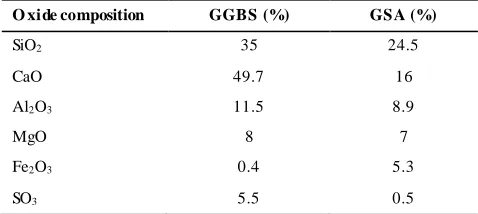
For evaluating the stimulation behaviour of waste materials in soil stabilization materials, in this study an effort was made to use (GGBS) and Groundnut Shell Ash (GSA) as soil stabilizers. The siliceous and aluminous residue remaining after the reduction and separation of the iron will be formed in molten liquid form at 1500°C during the fusion of limestone flux, which is tapped off, quenched and grinded to obtain Ground Granulated Blast furnace Slag. Iron blast furnace slag has a copious amount of silicates and alumino-silicates of lime and other bases [16]. The remaining waste shell after the removal of groundnut was collected from peanut production industries, and then dried and incinerated at 600°C to obtain Groundnut Shell Ash. The oxide composition of admixtures are tabulated below in Table 1.
It has been reported that, the degree of expansivity varies dependent upon the minerals present in the clay matrix.
The presence of montmorillonite often increases the swell-shrink behaviour of soil and the oxide composition of CaO is nearly 1.9%, thereby reducing the bearing capacity of soil [17]. Thus, the addition of
TABLE 1. Oxide composition of admixture GGBS and GSA
O xide composition GGBS (%) GSA (%)
SiO2 35 24.5
CaO 49.7 16
Al2O3 11.5 8.9
MgO 8 7
Fe2O3 0.4 5.3
GGBS reduce swelling and GSA will induce more calcium ion content reduce diffuse water layer, thereby enabling the cementitious properties.
2. 1. Methodolgy A set of all laboratory tests were
conducted to track the geotechnical properties of both soils in control, as well as a treated state. Strength variation of the soils were elucidated by conducting Unconfined Compressive Strength (UCS) test with varied dosages of GGBS (2.5, 5, 7.5, and 10%) and GSA (2, 4, 6, 8 and 10%) at curing periods of 28 and 60 days. The soil is subjected to a compaction test according to IS: 2720 (Part VII)-1983. The Un-Confind Compression (UCC) test size of the mould 38 mm diameter and 76 mm height, respectively adopted with aspect ratio 2, used for specimen preparation.
The samples were compacted at their Maximum Dry Density and Optimum Moisture Content, so as to reduce the inter-particle spaces [18].
Figures 1 and 2 show compaction characteristics curves of soil samples (S1) and (S2), respectively. The maximum values of density and corresponding moisture content was opted for all soil specimens which were expected to conduct UCS and CBR tests, so as to ensure the uniformity in bulk density for all soil-admixture matrix, thereby alleviating the experimental error to a great extent [19].
3. RESULTS AND DISCUSSIONS
3. 1. Influencial Behaviour of GGBS and GSA on
Compressive Strength The proposed study
Figure 1. Compaction characteristics curve of soil (S1)
Figure 2. Compaction characteristics curve of soil (S2)
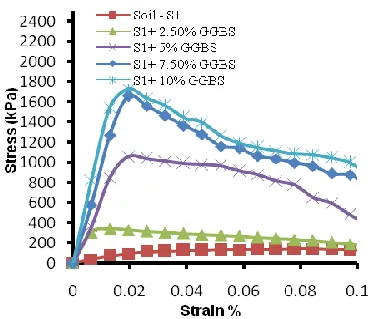
elucidated the stimulation behaviour of GGBS and GSA in uptrending the compressive strength nature of soils. Figure 3 shows the stress strain characteristics of soil sample 1 treated with GGBS. It can be observed that, a steady rise in the peak zone of a curve with 60 days curing as the UCS value increased to 1725kPa.This is found to be in agreement with the reported data in literature [20] that slag replacement increased Kimmeridge Clay strength to a maximum at 28 to 60 days curing. Thus, the gradual failure of samples highlights the brittle nature of GGBS treated soil. At this point, it can be justified that the addition of GGBS aroused the formation of more cementitious products due to its higher activation energy thus establishing exothermic reactions. When these reactions supposedly reach the endstage final output is the high strength.
The copious amount of CaO in GGBS ensured the cation exchange reaction and further flocculation and agglomeration. Higher strengths for cement can be attributed to two factors. As GGBS is a cementitious material, during the hydration process the calcium hydroxide crystals formed will be fine thus highly reactive and early stage strength will be encountered, thus a rigid network of reaction products forms and as the dosage increases, it will get connected to impart higher strength [21].
In Figure 4, the residual stress accumulation is easily noticeable with GSA treatment. As the GSA content increased, the slow attainment of strength can be viewed. The presence of readily available CaO during the hardening stage imparted rising zone in the curve.
The gradual failure in stress value after the peak shows the ductile failure of nature. Thus, this point coincides with the fact that during the completion stage of pozzolanic reactions, there is an only minimal supply of CaO in soil stabilizer composites. It is also noticeable that the percentage gain in strength is more for GGBS as compared to GSA treated soils.
Figure 4. Stress – Strain characteristics of soil sample (S2) treated with GSA of varying dosages at 28 day curing
It can be justified with respect to the facts established by various researchers [22-24] that stabilizers which are rich in calcium build up pozzolanic reactions between the exterior and interior parts of clay thus causing deeper diffusion of reaction products. Thus, it induces additional advantage to the clay stabilizer matrix by suppressing the swell, reduced permeability as well as enhanced strength. The remarkable results reperted in literature [25] recommend that at least 28 days curing is required for the stabilizer to effectively indulge in strength development criteria.
According to Obuzor et al. [26], the specimens prepared with lime showed low compressive strength than when replaced with GGBS as the various dosages of GGBS continued to give a higher rate of strength at varied curing periods and the justification extracted at this point is that the upsurge in strength could be accredited with the addition of GGBS, which procreated the synthesis of hydration products. The comparative study of gain in percentage of strength is tabulated for both soil samples in Tables 2 and 3.
From the Tables 2 and 3, it is clear that, the percentage gain in strength is more for GGBS treated soils as it went up to 1115% with curing period of 60 days and GGBS dosage of 10% as compared to GSA which ranges up to 100%. For the same dosage of admixtures, both GSA and GGBS are exhibiting a different rate of strength, it is all because of the availability of CaO in GSA is only 16% as compared to GGBS, which is 49%, for commencing the pozzolanic reactions.
3. 2. Influencial Behavior of GGBS and GSA on
California Bearing Ratio In order to investigate
the long term performance of GGBS and GSA in sub grade soil for pavements a bearing index test, CBR was performed on both soils with varied dosages of admixtures. The stabilizer treated samples were simultaneously placed for curing of 28 and 60 days and
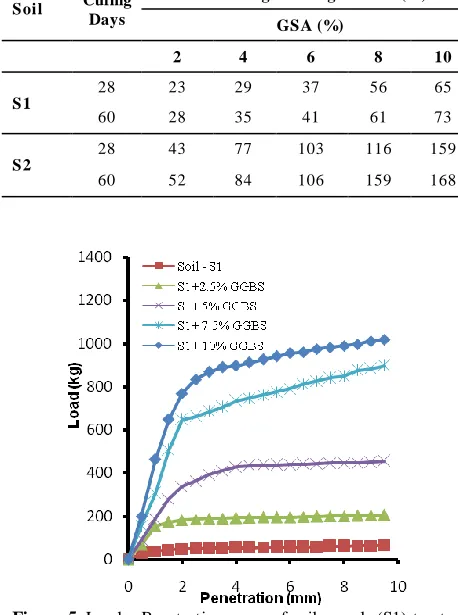
left at room temperature. In accordance with IS: 2720 (Part 16)-1987 specifications, the mould size were 150 mm diameter and 175 mm height, height of the soil specimen 125 mm, tested after soaking for 96 hours. The load penetration graph for GGBS is depicted in Figure 5. It can be seen that the higher dosage of GGBS highly influenced the CBR values as it raised up from 3.6 to 40%.
The uptrend in strength was due to the pozzolanic reactions which interlocked the particles and altered the micropore orientation.
TABLE 2. Percentage Strength Gainin soil samples with addition of GGBS admixtures
Soil C uring Days
Pe rce ntage Stre ngth Gain (%)
GGBS (%)
2.5 5 7.5 10
S1
28 73 462 708 747
60 142 646 1067 1115
S2
28 125 297 359 478
60 240 432 510 621
TABLE 3. Percentage Strength Gainin soil samples with additionof GSA admixtures
Soil Curing
Days
Pe rce ntage Stre ngth Gain (%)
GSA (%)
2 4 6 8 10
S1
28 23 29 37 56 65
60 28 35 41 61 73
S2
28 43 77 103 116 159
60 52 84 106 159 168
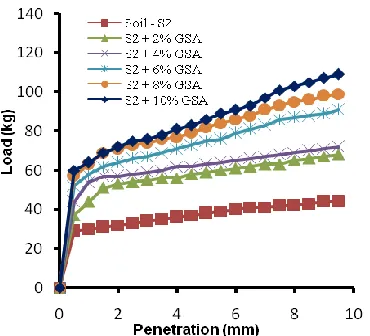
Figure 6. Load – Penetration curve of soil sample (S2) treated with GSA of varying dosages at 28 day curing
The CBR plot for GSA treated soil is given in Figure 6, which shows a slight variation in CBR values that is 5% from 2.7%. As compared to GSA, the CBR values of GGBS treated specimens are high which is due to less content of calcium. The investigation reported by Wild et al. [27] suggested a minimum of 28 days curing is mandatory for the stabilizer to effectively participate in strength development criteria.
A gradual rise in trend was observed in both admixture treated soils with lower dosages. The maximum value of CBR was observed, when the admixture percentage was 10% at a curing period of 28 days. The influential behaviour of admixtures with respect to curing periods is more visible from the graphs. Additionally, from the figure it can be outlined that both the admixtures aided in the strength attainment outdistanced the baseline strength of the system of conventional stabilizers [28].
4. CONCLUSIONS
The overall investigation on the stimulation behaviour of GGBS and GSA in altering the strength characteristics of soil can be summarized stated as following:
1. The clayey soils incorporated with admixture GGBS aided in altering the compressive strength from 142kPa to 1725kPa with 10% dosage at a curing period of 60 days.
2. As the curing period was increased, a dramatical rise in UCS value was observed for GSA treated soil which ranged from 116 kPa up to 200kPa. 3. It was also observed that, the overall gain in
percentage of strength was maximum for GGBS as compared to GSA because of its proactive potential in instating the pozzolanic reactions. Thus, this study unlatched the pathway for future advancements in soil stabilization with the formulation
of cost-effective admixtures GSA and GGBS in improving the bearing capacity of clayey soil, thus exposing the soil for geotechnical applications.
5. REFERENCES
1. Phanikumar,B.R., Rao,A.S., Suresh, K., "Compressive Load Response of Expansive Clay Beds Reinforced with Granular Pile-AnchorsIn-situ", GroundImprovement, Vol. 161, No. 3, (2008), 121–129.
2. Wang,F., Wang, H., F. Jin, Al-Tabbaa, A., "The performance of blended conventional and novel binders in the in-situ stabilisation/solidification of a contaminated site soil", Journal of Hazard.Mater, Vol. 285, (2015), 46–52.
3. Hewayde,E.H., "The Use of Lime Columns in Expansive Soil", M.Sc. thesis, University of T echnology, Baghdad, Iraq, (1994). 4. Yang, H. P. and Zheng J. L., "The New Engineering T reatment T echniques Of Expansive Soil Subgrade For GuangXi Nanning Youyi Guan Highway", Unsaturated Soil, Vol. 1, (2006), 439– 450.
5. Littleton, I. and Willavise, G., "Some observations on the use of lime to stabilise Kimmeridge Clay", Derbyshire, UK. 6. Rajasekaran, G., "Sulphate attack and ettringite formation in the
lime and cement stabilized marine clays",.Ocean Engineering, (2005), 1133–1159.
7. Hunter, D., "Lime-induced heave in sulfate-bearing clay soils", Journal of Geotechnical Engineering, Vol. 114, No. 2, (1988), 150–167.
8. Wild, S., Kinuthia, J. M., Robinson, R. B., Humphreys, I., "Effects of ground granulated blast furnace slag (GGBS) on strength and swelling properties of lime stabilised kaolinite in the presence of sulphates", Clay Miner, Vol. 31, No. 3, (1996), 423–433.
9. Gyanen, T akhelmayum, Savitha, A. L., and Krishna Gudi, "Laboratory study on soil stabilization using fly ash mixtures", International Journal of Engineering Science and Innovative Technology, Vol. 2, No. 1, (2013), 477–481.
10. Divya Krishnan K, Ravichandran, P. T., Janani, V, Annadurai, R, and Gunturi, M., "Effect of Phosphogypsum and Flyash Stabilization on the Strength and Microstructure of Clay", Indian Concrete Journal, Vol. 89, No. 7, (2015), 81–86. 11. Wild, S., Kinuthia, J.M., Jones, G.I., and Haggins, D.D.,
"Suppression of swelling associated with ettringite formation in lime stabilized sulphate bearing clay soils by partial substitution of lime with ground granulated blast furnace slag", Engineering. (1999).
12. Puppala, A. J., Wattanasanticharoen, E., Punthutaecha, K., "Experimental evaluations of stabilisation methods for sulphate-rich expansive soils", Ground Improvement, Vol. 1, (2003), 25– 35.
13. Chittaranjan, M., Vijay, M., and Keerthi, D., "Agricultural wastes as soil stabilizers", International Journal of Earth science and Engineering, Vol. 1, No. 4, (2011), 50–51.
14. Gharib, M., Arjomand, M.A., Abdi, M.R., and Arefnia, A., “Influence of Chitin Nanofiber and Rice Husk Ash on Properties and Bearing Resistance of Soft Clay Soils”, International Journal of Engineering – Transactions C: Aspects, Vol. 32, No. 3, (2019), 373–380.
15. Celestine, O., and Okagbue., "Stabilization of clay using wood ash", Journal of Materials in Civil Engineering, ASCE, (2007), 14–18.
17. Bell, F.G., "Lime stabilization of clay minerals and soils", Engineering Geology, Vol. 42, (1996), 223–237.
18. Rahmannejad, M., and T oufigh, V., "Influence of Curing T ime and Water Content on Unconfined Compressive Strength of Sand Stabilized Using Epoxy Resin", International Journal of Engineering – Transactions B: Applications, Vol. 31, No. 8, (2018), 1187–1195.
19. Javdanian, H., "T he Effect of Geopolymerization on the Unconfined Compressive Strength of Stabilized Fine-grained Soils", International Journal of Engineering – Transactions B: Applications, Vol. 30, No. 11, (2017), 1673–1680. 20. Wild, S., and T asong, W. A., "Influence of granulated blast
furnace slag on the sulphate resistance of lime-stabilised kaolinite", Magazine of Concrete Research, Vol. 51, No. 4, (1999), 257–277.
21. Prusinski, J. R., and Bhattacharja, S., "Effectiveness of Portland cement and lime in stabilizing clay soils", T ransportation Research Board, 1652. Portland Cement Associatio n, Washington, D.C., USA.
22. Shahbaa, S., Ghasemi, M., and Marandic, M. S., "Effects of Partial Substitution of Styrene-butadiene-styrene with Granulated Blastfurnace Slag on the Strength Properties of Porous Asphalt", International Journal of Engineering-Transactions A: Basics, Vol. 30, No. 1, (2017), 40–47.
23. Ramani Sujatha, E. R., Dharini, K., and Bharathi, V., "Influence of Groundnut Shell ash on strength properties of clay",.
Geomechanics and Geoengineering. An International Journal, (2015), 1–7.
24. Ijimdiya, T . S., Ashimiyu, A. L., and Abubakar D. K., "Stabilization of black cotton soil using Groundnut Shell Ash", Electronic Journal of Geotechnical Engineering, Vol. 17, No. 3, (2012), 645–652.
25. Ece Celik., and Zalihe Nalbantoglu., "Effects of Ground Granulated Blastfurnace Slag (GGBS) on the Swelling Properties of Lime-Stabilized Sulfate-Bearing Soils". Engineering Geology, (2013), 20–25.
26. Obuzor, G. N., Kinuthia, J. M, and Robinson, R. B., "Soil stabilisation with lime-activated-GGBS—A mitigation to flooding effects on road structural layers/embankments constructed on floodplains", Engineering Geology, Vol. 15, No. 1, (2012), 112–119.
27. T asong, W.A., Wild, S., and T illey, R. J. D, "Mechanisms by which Ground Granulated Blastfurnace Slag prevents sulphate attack of lime-stabilised kaolinite", Cement and Concrete Research, Vol. 29, (1999), 975–982.
28. Wild, S., Kinuthia, J. M., Jones, G. I., and Higgins, D. D., "Effects of partial substitution of lime with ground granulated blast furnace slag (GGBS) on the strength properties of lime-stabilised sulphate-bearing clay soils", Engineering Geology, Vol. 51, (1998), 37–53.
Stimulation Behaviour Study on Clay Treated with Ground Granulated Blast Slag
and Groundnutshell Ash
A. Manimaran, S. Seenu, P. T. Ravichandran
Department of Civil Engineering, Faculty of Engineering and Technology, SRM Institute of Science and Technology, Kattankulathur, Ta mil Nadu, India
P A P E R I N F O
Paper history: Received 04 February 2019
Received in revised form 30 April 2019 Accepted 03 May 2019
Keywords:
Unconfined Compresive Strength California Bearing Ratio Ground Granulated Blast Slag Groundnutshell Ash
هدیکچ
میمصت زاس و تخاس رد یلصا ینارمع
کاخ راتخاس اریز دشاب یم کاخ طیارش نیرتهب اب بسانم لحم باختنا لماش
زئاح ا تیمها تس زاس لکشم یاه کاخ رتشیب . هدوب
لیفورپ نیرتهب هک دوش یم تباث یتخس هب ناوارف یاه کاخ دننام
ب نیا ،بیترت نیا هب .تسا ور هدایپ یاه هزاس یارب یسدنهم ینیمزریز اب هارمه کاخ یاه هنیزگ دوبهب هب رجنم حوضو ه
هدرتسگ یاه کاخ تمواقم دوبهب رد ،کاخ تیبثت شور ،نیاربانب .تسا هدش دماج یاهدنامسپ تیریدم و عبانم شهاک
زا هدافتسا تیلباق یسررب یارب شلات ،هعلاطم نیا رد اه تیعقاو نیا همه زا ینارگن رد .تسا هتفای شرتسگ زین و هدوب
ابرس ( یتعنص راجفنا هر
GGBS)
یزرواشک یعارز تاعیاض و
(Shell Ash) (GSA)
،هدننک تیبثت لماوع ناونع هب
هتفر راکب ود .تسا عون توافتم دصرد اب مروت فلتخم یاه یگژیو زا ی زا GGBS ( 2.5 ، 5 ، 7.5 و ، 10 ٪ و ) GSA ( 2 ، 4 ، 6 ، 8 و 10 ٪
یاه هرود رد ) بنامز فلتخم یارب یروآ لمعب 28 و 60 یدوعص راتفر .دنتفرگ رارق نامرد تحت زور
( اینرفیلاک هربیلاک تظلغ و یراشف تمواقم یاه نومزآ زا هدافتسا اب تردق
CBR
) رد یدوعص دنور .تسا هدش شیامزآ
شزرا شیازفا اب هارمه شنت جوا
CBR
هفرص هب نورقم دئاز داوم رثا ات هدش بجوم و دوش رد تمواقم دوبهب هب ،کاخ یترت نیا دشر ب هعسوت و تیوقت ار زاس و تخاس شخب یم
رد قیقحت نیا ،نیاربانب .دنک تهج
تردق شیازفا تمواقم
تروص یسر کاخ عونتم رایسب کینکتوئژ یدربراک یاه همانرب یارب نآ تخاس بیترت نیا هب .تفریذپ
و .تسا بسانم
doi: 10.5829/ije.2019.32.05b.08