A
Comparative
Study
between
Link
Based
Simulation
Algorithm
and
Path
Based
Assignment
and
Generalization
to
Random
Coefficient
Approach
Milad Haghani1, Zahra Shahhoseini2, Majid Sarvi3
Received: 04.05.2014 Accepted: 20.12.2014
Abstract
The problem of path overlapping in network modelling has been one of the main issues to be
WDFNOHG'XHWRLWVÀH[LEOHFRYDULDQFHVWUXFWXUHSURELWPRGHOFDQDGHTXDWHO\DGGUHVVWKHSUREOHP
Despite that probit is one of the most appealing choice models, due to the lack of closed form
H[SUHVVLRQVIRUHYDOXDWLQJFKRLFHSUREDELOLWLHVLWKDVQRWUHFHLYHGH[WHQVLYHDWWHQWLRQE\QHWZRUN PRGHOLQJUHVHDUFKHUV7KLVVWXG\LVVHWRXWWRIRFXVRQWKLVDSSURDFKRIWUDI¿FDVVLJQPHQW
&RPSXWDWLRQDO GLI¿FXOW\ RI DSSOLFDWLRQ RI SURELW PRGHO LQ WKH ODUJHVFDOH QHWZRUN HTXLOLEULXP SUREOHPKDVWULJJHUHGGHYHORSPHQWRIVRPHOLQNEDVHGSURELWQHWZRUNORDGLQJPHWKRGVZKLFKH[
-HPSWWKHDQDO\VWIURPJHQHUDWLQJDQGPDLQWDLQLQJSDWKÀRZYDULDEOHVH[SOLFLWO\7KHELDVRIWKHVH
heuristic link-based methods has not been studied so far. This contribution primarily focuses on investigation of such potential bias in link-based probit assignment methods. In this research, this bias for a certain simulated link-based method is empirically considered and investigated through
FRPSDULVRQZLWKSDWKEDVHGSURELWHTXLOLEULXPVROXWLRQ
Capable of representing utility correlation and heteroscedasticity, probit model has always been one of the most theoretically attractive models for representing route choice behavior. However, this soundness of theory could further be enhanced through combining the ideas of probit and
UDQGRPFRHI¿FLHQWPRGHOLQJZKLFKHQDEOHVWKHDQDO\VWWRFDSWXUHUDQGRPWDVWHKHWHURJHQHLW\RYHU
travelers as well.
Keywords:
Probit Model, multivariate normal distribution, Monte Carlo Simulation,random-FRHI¿FLHQWFKRLFHPRGHOVOLQNEDVHGDQGSDWKEDVHGWUDI¿FDVVLJQPHQW
Corresponding author E-mail: [email protected]
1. Introduction
$V WKH ¿QDO VWDJH RI WUDGLWLRQDO IRXUVWHS WUDQVSRUWDWLRQSODQQLQJPRGHOVWUDI¿FDVVLJQ -ment (TA) plays a crucial role in prediction
RI ÀRZ DV ZHOODV WUDYHOHUV¶ UHVSRQVH WRDQ\
changes in the system and thereby making
RSWLPDOHI¿FLHQWGHFLVLRQVE\DQDO\VWV,QWKLV
sense, there has been a considerable effort to enhance precision of route choice modeling. Probabilistic approach of network modeling was primarily developed to address and repre-sent randomness in travelers’ behavior and to
SURYLGHDPRUHUHDOLVWLFDQGÀH[LEOHEDVLVIRU
modeling transportation networks.
Since the development of the notion of
sto-FKDVWLF XVHU HTXLOLEULXP 68( FRQFHSW E\ 'DJDQ]R DQG 6KHI¿ >@ GLIIHUHQW W\SHV
of choice models were employed in this
con-WH[W$OWKRXJKWKHUHKDVEHHQOLPLWHGVWXGLHV
in probabilistic network loading procedures prior to the introduction of SUE, their new formulation as a generalization to traditional
XVHUHTXLOLEULXP8(FULWHULDDVZHOODVWKHLU
comprehensive discussion on enumerating
WKH GH¿FLHQFLHV RI PXOWLQRPLDO ORJLW 01/ PRGHO>'LDO@IRUURXWHFKRLFHPRGHOLQJ
purposes triggered considerable further stud-ies in this area.
Theoretically, multinomial probit (MNP) model is one of the most appealing choice models enjoying sound underlying assump-tions which is able to not only capture correla-tion among random utilities but also is capable of representing heteroscedasticity property. In other words, probit model is potentially able to cover the main drawbacks of MNL
mod-HOLQ7$FRQWH[W'XHWRWKHODFNRIDQDO\WL
-FDO FORVHGIRUP H[SUHVVLRQV IRU -FDOFXODWLQJ
choice probabilities, however, this approach
RI7$KDVQRWUHFHLYHGVXI¿FLHQWDWWHQWLRQE\
comparison with logit-family models.
Never-WKHOHVV WR DOOHYLDWH FRPSXWDWLRQDO H[SHQGL
-ture of this model, some studies have been dedicated to development of heuristic link-based algorithms for probit network loading
>6KHI¿DQG3RZHOO0DKHU@7KLV DSSURDFK ZDV LQGHHG SULPDULO\ DLPHG WR H[ -empt the analyst from producing and
main-WDLQLQJSDWKÀRZYDULDEOHVLQVROYLQJQHWZRUN HTXLOLEULXPSUREOHP%XWDORQJZLWKWKHDG -vances in computing technology as well as
GHYHORSPHQW RI HI¿FLHQW SDWK JHQHUDWLRQ DO -gorithms, there has been a growing
recogni-WLRQRISDWKEDVHGDSSURDFK>IRUH[DPSOHVHH %HNKRUHWDO3UDWRDQG%HNKRU 3UDWRDQG%HNKRU%HNKRUHWDO@
Furthermore, there is now a general consensus that path-based approach of TA allows appli-cation of more advanced choice models. Due to the presence of the aforementioned link-based algorithms, there has not been
suf-¿FLHQW LPSHWXV IRU LQYHVWLJDWLQJ SDWKEDVHG
probit TA. In particular, to the best of our knowledge, the bias problem for these link-based methods has not been studied formerly. This study intends to investigate this problem for the Monte Carlo simulation algorithm
pro-SRVHG E\ 6KHI¿ DQG 3RZHOO >@ WKURXJK
numerical comparison with the path-based probit SUE solution.
Potential capacity of random-utility theory also allows further enhancement of theoretical
DWWUDFWLYHQHVVRISURELWPRGHOWKURXJKUHOD[D -tion of the remaining restrictive assump-tions,
LQ SDUWLFXODU WKH ³¿[HGFRHI¿FLHQW´ DVVXPS -tion. Although there has been considerable
VWXGLHV LQ PL[HG 01/ FRQGXFWHG LQ GLIIHU -ent areas of choice modeling (including route
FKRLFHEXWLQDYHU\OLPLWHGPDQQHU>%HNKRU HW DO @ WR WKH EHVW RI RXU NQRZOHGJH
this approach has not yet been generalized
WR PL[HG SURELW LQ WKH OLWHUDWXUH ,Q DGGLWLRQ
to the previously-mentioned theoretical
UDQGRPFRHI¿FLHQWSURELWFDQDOVRWDNHLQWR
account the fact that different travelers have different sensitivities with respect to the at-tributes of different paths, and in this sense there can be a random taste variation over the population of decision makers. This
represen-WDWLRQRIUDQGRPWDVWHKHWHURJHQHLW\IRUPL[HG
probit can potentially improve the precision of TA in describing behavior inasmuch as it
HQMR\VDPRUHJHQHUDOL]HGDQGUHOD[HGXQGHU -lying assumption than the traditional probit. This approach is formulated and applied to an illustrative network in this study.
The remaining parts of the paper are organ-ized as follows. Section 2 has been dedicated to a literature review. In section 3,
theoreti-FDOEDFNJURXQGVIRUSURELWDQGPL[HGSURELW PRGHOV DUH SURYLGHG 6HFWLRQ GH¿QHV WKH
methodology applied to conduct the compara-tive part of the study. In section 5, the bias of the link-based probit as well as application of
WKHSURSRVHGPL[HGSURELWPRGHOZLOOEHLQ -vestigated on an illustrative network together with some sensitivity analyses with respect to contributing parameters of the problem.
Sec-WLRQVXPPDUL]HVWKHSDSHUDQG¿QGLQJVDQG
proposes future research directions for further studies.
2. Literature Review
Preliminary studies in probabilistic approach of transportation network loading can be
at-WULEXWHG WR %XUUHOO >@ DQG 9RQ )DONHQ
-KDXVHQ>@ERWKFRQVWUXFWHGXSRQWKHQR
-WLRQ RI 0RQWH &DUOR VLPXOD-WLRQ 'LDO >@ DOVRSURSRVHGDQHI¿FLHQWOLQNEDVHGQHWZRUN
loading algorithm, supported by formal
math-HPDWLFDO SURRI ZKLFK ZLWKRXW UHTXLULQJ H[ -plicit path generation, assigns trip demands to the subsets of the universal paths in accord-ance with MNL formula. The algorithm, also known as STOCH in the literature, provoked
PDQ\VXEVHTXHQWVWXGLHVLQYHVWLJDWLQJVKRUW -comings of the STOCH algorithm or making attempts to propose improvements or
gener-DOL]DWLRQV>'DJDQ]RDQG6KHI¿)ORULDQ )ORULDQ DQG )R[ 7RELQ )LVN@6RPHRWKHUUHVHDUFKHVDOVRVWXG -ied the theoretical shortcomings of STOCH
DOJRULWKP FULWHULD IRU SDWK ¿OWUDWLRQ DQG WKH FRQFHSWRI³HI¿FLHQWSDWKV´LQWKLVDOJRULWKP >%HOO$NDPDWVX@
7KH PDMRU GH¿FLHQF\ RI WKH 01/ PRGHO LQ
network modeling purposes arises from the fact that this model does not allow the
topol-RJ\ RI WKH QHWZRUN WR EH UHÀHFWHG LQ HYDOX -ation of choice probabilities. In other words, given the values of representative utilities,
01/FKRLFHSUREDELOLWLHVDUHGH¿QLWHQRPDW -ter what the geometrical structure of network is. This problem gives rise to unrealistic
over-HVWLPDWLRQ RI WKH ÀRZ RQ KLJKO\ RYHUODSSHG SDWKVDQGXQGHUHVWLPDWLRQRIWKHÀRZRQPRUH
independent paths. In addition, due to the sim-ple diagonal homoscedastic structure of MNL
FRYDULDQFHPDWUL[DEVROXWHYDOXHVRIXWLOLWLHV VLPLODU WR FRUUHODWLRQV KDYH QR UHÀHFWLRQ WR
calculation of choice probabilities. In other words, when MNL is applied as the route
FKRLFHPRGHODIRUH[DPSOHPLQXWHVGLI -ference of travel time in a binary route choice situation, has the same effect in a short trip as it has in a long journey. Still, most of the
UHVHDUFKHU¶VDWWHQWLRQLQWKLVFRQWH[WKDVEHHQ
devoted to proposing solutions for the former shortcoming, that is to say, the problem of path overlapping. Miscellaneous models has been
SURSRVHGIURPVLPSOHPRGL¿FDWLRQVRI01/ PRGHO >&DVFHWWD HW DO %HQ$NLYD DQG %LHUODLUH%RY\HWDO@WRJHQHUDO
-L]HGH[WUHPHYDOXHW\SHPRGHOV>3UDVKNHUDQG %HNKRU@)XUWKHUGHWDLOVRIWKHGLIIHUHQW
DO@
Probit model, however, is theoretically capa-ble enough to address both correlation and heteroscedasticity problems. Application of
013LQ7$ZDV¿UVWIRUPXODWHGE\'DJDQ]R DQG 6KHI¿ >@ DQG IXUWKHU GHYHORSHG E\ 6KHI¿DQG3RZHOO>@ZKHUHWKH\SURSRVHG
a relevant covariance structure as well as a heuristic Monte Carlo link-based method for probit assignment. They formulated the MNP covariance structure by pertinently relating
WKHHOHPHQWVRIWKHPDWUL[WRQHWZRUNWRSRO -ogy. Nonetheless, Due to their proposed
link-EDVHGDSSURDFKWKH\GLGQRWQHHGWRH[SOLFLW -ly evaluate and maintain covariance matrices.
6WUXFWXULQJWKHFRYDULDQFHPDWUL[IRUSURELW
based TA is crucial from modeling purposes since due to the very large number of alter-natives in route choice problem it would not be neither practical nor possible to estimate all elements of free (unrestricted) covariance matrices from a choice data set. This way, the number of covariance-related estimation pa-rameters is substantially reduced.
0DKHU>@DQG0DKHUDQG+XJKHV>@
proposed another link-based method for pro-bit-based network loading as well as a
con-YH[ FRPELQDWLRQV DOJRULWKP EDVHG XSRQ LW IRUVROYLQJVWRFKDVWLFXVHUHTXLOLEULXP68(
problem. The steps of the algorithm and its node-by-node progression through network are highly analogous to the STOCH algo-rithm. Similar to the STOCH algorithm, link probabilities are evaluated through “forward-step” progression phase and network is loaded in “backward-step” phase. The major differ-ence is that normal distribution is assumed for “link utilities”, and rather than having closed
IRUP H[SUHVVLRQV IRU HYDOXDWLQJ ³OLQN SURE
-DELOLWLHV´&ODUNPHWKRG>&ODUN@LVDS
-SOLHGIRUDSSUR[LPDWLRQRIWKHVHSUREDELOLWLHV
In this sense, the algorithm can be regarded as
DPRGL¿HGYHUVLRQRIWKH672&+DOJRULWKP
for probit model. The main advantage of this
PHWKRGLQDGGLWLRQWRWKHHI¿FLHQF\DVDUH -sult of its link-based structure, is that during the progression of the algorithm through the network, some information is gathered which can be utilized for evaluation of the general
68(REMHFWLYHIXQFWLRQIRUPXODWHGE\6KHI¿ DQG 3RZHOO >@ DQG LWV GHULYDWLYHV WR DS
-SUR[LPDWHWKHRSWLPDOVWHSVL]HVLQWKHFRQYH[
combinations procedure. This property indeed
DGGV IXUWKHU HI¿FLHQF\ WR WKH DOJRULWKP 'H
-VSLWHWKHVHDGYDQWDJHVKRZHYHUWKHDGHTXDF\ RI SUHFLVLRQ RI &ODUN DSSUR[LPDWLRQ IRU WKLV
application needs to be scrutinized as
Horow-LW]HWDO>@GLVFXVVHGWKDWWKHSUHFLVLRQRI WKLV DSSUR[LPDWLRQ PHWKRG VLJQL¿FDQWO\ YDU
-LHVIURPVLWXDWLRQWRVLWXDWLRQ%XWPRUHLP -portantly, whether the algorithm actually
pro-GXFHVSURELWÀRZVLVDUJXDEOH&RQWUDU\WRWKH
STOCH algorithm, this algorithm has not been accompanied by any formal analytical proof.
)XUWKHUDVVWDWHGE\$NDPDWVX>@01/
assignment contains an implicit assumption called the “Markovian property” stating that “the pattern of route choice from an interme-diate node to the destination is independent of the pattern of route choice from the origin to
WKDW QRGH´ 7KLV LV H[DFWO\ WKH FKDUDFWHULVWLF
that allowed development of the STOCH
al-JRULWKP IRU 01/ QHWZRUN ORDGLQJ %XW WKH
presence of this property for MNP assignment has neither been proved nor investigated, and it seems to be hardly likely for this property to be valid for MNP as well. In other words, it seems that the intrinsic Markovian property of
WKH672&+DOJRULWKPKDVH[RJHQRXVO\EHHQ
imposed to MNP assignment in the method
SURSRVHGE\0DKHU>@
<DLDQGFRDXWKRUV>@HVWLPDWHGDVWUXF -tured-covariance MNP model for train route
:DWOLQJ>@FRQGXFWHGDVHQVLWLYLW\DQDO\
-VLVRIWKH01368(ÀRZZLWKUHVSHFWWRIDF
-WRUV VXFK DV GHPDQG DQG XWLOLW\ FRHI¿FLHQWV =KDQJHWDO>@XWLOL]HG013IRUG\QDPL -cal TA.
3. Theoretical Background
7KLV VHFWLRQ DLPV WR SURYLGH D TXLFN UHYLHZ RQWKHWKHRUHWLFDOFRQFHSWRI013DQGPL[HG
MNP choice modeling. Simulation methods for evaluation of probabilities are also
dis-FXVVHGDQGWKHVSHFL¿FDWLRQRIWKHPRGHOIRU
route choice is presented.
3.1 Multinomial Probit
Let us consider a typical trip maker n who faces a set including K paths for traveling be-tween the origin and destination of his jour-ney. Let us also represent the utility perceived by the person from a typical path k by Unk. This utility consists of a systematic part, Vnk,
DVZHOODVDUDQGRPGLVWXUEDQFHWHUPİnk(T
1), which the latter contains all the factors contributing to and affecting the decisions but not considered by the analyst in the systematic part. The probability distribution assumed for the random term plays an important role from modeling perspective as different probability distributions would lead to different choice models. For MNP model, error terms are as-sumed as a vector of random variables dis-tributed multivariate (or joint) normal (MVN) with mean vector of 0 and an arbitrary
covari-DQFHPDWUL[Ȉn(TVDQG
(1) (2)
(3)
Theoretically speaking, the assumption of joint normal distribution is a sound funda-mental assumption, notably in comparison with the assumption of identical and inde-pendent Gumbel distributions for MNL. This assumption is also supported by multivariate
FHQWUDOOLPLWWKHRUHP>5LFH@7KLVÀH[ -ible assumption also allows representation of substitution patterns of any type [Train,
@,QRWKHUZRUGVE\VSHFL¿FDWLRQRIWKH FRYDULDQFHPDWUL[WKHDQDO\VWLVDEOHWRWDNH
into account heteroscedasticity as well as any type of correlation structure between utilities.
,QJHQHUDOHDFKFRYDULDQFHPDWUL[LVDOZD\V V\PPHWULF DQG QRQQHJDWLYH GH¿QLWH RU HTXLYDOHQWO\ SRVLWLYH VHPLGH¿QLWH >(DWRQ @ $ 091 GLVWULEXWLRQ LV FDOOHG QRQ GHJHQHUDWHZKHQHYHULWVFRYDULDQFHPDWUL[LV VWULFWO\SRVLWLYHGH¿QLWH)RUDQRQGHJHQHU -ate MVN distribution, there is a closed-form probability distribution function. This closed form for distribution of error disturbances
VSHFL¿HGLQ(TLVDV(TZKHUH_Ȉn_VLJ
-QL¿HV GHWHUPLQDQW RI Ȉn. The probability for alternative k to provide the most utility and hence to be chosen by person n is also given
E\WKHPXOWLYDULDWHLQWHJUDOLQ(T7KHLQ -tegral generally cannot be solved analytically,
DQGDFFRUGLQJO\VLPXODWLRQRUDSSUR[LPDWLRQ PHWKRGVDUHUHTXLUHGIRUHYDOXDWLRQRI013 SUREDELOLWLHV'LIIHUHQWDSSUR[LPDWHPHWKRGV
(4)
have been proposed for this paper in the
litera-WXUHXSRQZKLFK5RVD>@KDVPDGHDFRP -prehensive review. Different simulation
meth-RGV DUH DOVR DYDLODEOH >7UDLQ @ DPRQJ
which we have implemented the accept-reject method because of its simplicity.
According to the accept-reject method, the major problem for simulation of MNP prob-abilities is to generate random draws from MVN distributions. In general, to generate a
.GLPHQVLRQDOYHFWRUȞIURPD091GLVWULEX
-WLRQ ZLWK PHDQ ȝ DQG FRYDULDQFH Ȉ WKH IRO
-ORZLQJVWHSVVKRXOGEHWDNHQ>(DWRQ@
1- Produce a vector of K standard normal random draws: zT=z
1,…,zK.
)LQGUHDOPDWUL[$LQVXFKDZD\WKDW
AAT Ȉ
6HWȞ ȝ$]
7KHUHIRUHWKHPDLQSUREOHPLVWR¿QGDPD
-WUL[$ZKLFKZKHQPXOWLSOLHGE\LWVWUDQVSRVH SURGXFHV WKH FRYDULDQFH PDWUL[ ,Q WKH FDVH WKDW WKH FRYDULDQFH LV SRVLWLYH GH¿QLWH WKH PDWUL[$FDQHDVLO\EHREWDLQHGE\&KROHVN\ IDFWRUL]DWLRQPHWKRG>+RUQ@,QWKHJHQ
-HUDO FDVH RI SRVLWLYH VHPLGH¿QLWHQHVV KRZ -ever, this can be done by the method called spectral decomposition (or
eigendecomposi-WLRQ>+RUQ@6LPSO\LQWKLVPHWKRG$ FDQEHFDOFXODWHGE\(TLQZKLFK0LVDQ RUWKRJRQDOPDWUL[IRUZKLFKWKHMWKFROXPQLV WKHMWKHLJHQYHFWRURIFRYDULDQFHPDWUL[ȈDQG ȁ LV D GLDJRQDO PDWUL[ FRQWDLQLQJ WKH FRUUH -sponding eigenvalues.
$ 0ȁ(1/2) (6)
2XU VSHFL¿FDWLRQ RI FRYDULDQFH PDWUL[ IRU
path utilities corresponding to a particular origin-destination (O-D) pair is compatible
ZLWK WKH LPSOLFLW VSHFL¿FDWLRQ RI 6KHI¿ DQG 3RZHOO>@7KHVWUXFWXUHGFRYDULDQFHPD
-WUL[LVJLYHQLQ(TLQZKLFKOBNUHSUHVHQWV
WKHOHQJWKRISDWKNDQGOBNMGHQRWHVWKHFRP -mon length of paths k and j. According to the
IRUPXODWLRQRI6KHI¿DQG3RZHOO>@WKH SDWK OHQJWK FDQ EH VXEVWLWXWHG E\ IUHHÀRZ SDWK WUDYHO WLPH DV ZHOO7KH SDUDPHWHU ȕ LV
to be calibrated and can be interpreted as the variance of utility perceived from a segment
RISDWKZLWKRQHXQLWOHQJWK6RWKLVVSHFL¿ -cation assumes that the variance of error (or utility) for each path is proportionate with the length of that path and the covariance between random utilities of each pair of paths is pro-portionate with their shared segment length.
7KHOHVVWKHYDOXHRIȕWKHPRUHVLPLODULVWKH ÀRZSDWWHUQWRWKHWUDGLWLRQDOXVHUHTXLOLEULXP
(UE) solution.
In univariate case, the systematic part of
util-LW\FDQDOVREHVSHFL¿HGDV(TLQZKLFKWBN GHQRWHV SDWK WUDYHO WLPH DQG Į LV LWV XWLOLW\ FRHI¿FLHQW ,Q DFFRUGDQFH ZLWK WKH VWXG\ RI 6KHI¿ DQG 3RZHOO >@ ZH KDYH VHW Į
Additionally, to compare the link-based and
SDWKEDVHG013DVVLJQPHQWVZHKDYHH[DP
-LQHG GLIIHUHQW YDOXHV RI ȕ LQ QX
-PHULFDOH[SHULPHQWV
(7)
(8)
3.2 Mixed Multinomial Probit
,QFODVVLFDO013WKHFRHI¿FLHQWĮLVDVVXPHG WREHD¿[HGYDOXHIRUWKHZKROHSRSXODWLRQ
of decision makers indicating that all travelers have a similar degree of sensitivity to travel time in their route choice. The more
probabil-LW\GLVWULEXWLRQIRUWKHFRHI¿FLHQWV7KLVZD\
he/she can take into consideration the fact that different decision makers have different tastes and as a result, there can be a distribution of tastes over the population of travelers.
There-IRUHWKHPL[HG013PRGHOLQJDSSURDFKDG -dresses random taste variation as well as the
DIRUHPHQWLRQHG WKHRUHWLFDO EHQH¿WV RI WKH
classical MNP model.
7RJHQHUDOL]HRXUURXWHFKRLFHPRGHOVSHFL¿HG LQ(TVDQGWRUDQGRPFRHI¿FLHQWPRGHO
a probability distribution should be attributed
WRĮ7KHRUHWLFDOO\GLIIHUHQWGLVWULEXWLRQVDUH
applicable. Two common assumptions, how-ever, are normal and log-normal distributions
>7UDLQ @ DW OHDVW IRU PL[HG 01/ PRG -eling which is the only available published
UDQGRPFRHI¿FLHQWPRGHOLQJDSSURDFKLQWKH FKRLFHPRGHOLQJOLWHUDWXUH%RWKWKHWZRQRU -mal and log-nor-mal distributions serve our
PRGHOLQJSXUSRVH%XWLQFDVHVVXFKDVURXWH
choice where the modeler has a prior assump-tion about the sign of a certain parameter, log-normal distribution provides a
theoreti-FDOEHQH¿WVLQFHLWWDNHVRQO\SRVLWLYHYDOXHV
While normal distribution allows both nega-tive and posinega-tive values, for variables such as travel time which the analyst believes that all decision makers are trying to avoid, log-normal distribution provides more theoretical soundness. In this study and in
implementa-WLRQRIPL[HG013PRGHOZHDVVXPHGĮWR EHGLVWULEXWHGORJQRUPDOO\DV(TZKHUHP
and s are parameters of the distribution, that is, mean and standard deviation respectively. For numerical implementations in the
follow-LQJVHFWLRQGLIIHUHQWGLVWULEXWLRQVZLOOEHH[ -amined setting m=1 and varying the value of
WKHVWDQGDUGGHYLDWLRQ:HKDYHDOVRVHWȕ IRUPL[HGPRGHO
OQĮa1PV2
,QRUGHUWRFDOFXODWHPL[HG013SUREDELOLWLHV D IXUWKHU VLPXODWLRQ SURFHGXUH LV UHTXLUHG 7KHRUHWLFDOO\PL[HG013SUREDELOLWLHV3 B NQDUHWKHVROXWLRQRIWKHLQWHJUDOJLYHQLQ(T
10 which is simply the integral of the classical MNP probabilities over the density
probabil-LW\ IXQFWLRQ RI Į$V WKLV LQWHJUDO FDQQRW EH
analytically solved as well, it has to be simu-lated. Simulation of the integral, however, is straightforward. One should draw random
VDPSOHVIURPWKHGHQVLW\IXQFWLRQRIĮWKHQ
simulate MNP probability for each random
GUDZ DV H[SODLQHG SUHYLRXVO\ UHSHDW WKLV SURFHGXUHIRUPDQ\WLPHVDQG¿QDOO\DYHUDJH
the results over the simulation iterations.
(10)
0HWKRGRORJ\'H¿QLWLRQ
In order to conduct the comparative study introduced in the previous sections between the Monte-Carlo simulation link-based MNP
WUDI¿F DVVLJQPHQW DQG LWV SDWKEDVHG FRXQ -terpart approach, we will apply both methods on a small illustrative network which allows
XV¿UVWWRFRQGXFWWKHSDWKEDVHGDVVLJQPHQW RQWKHIXOOVHWVRISDWKVH[KDXVWLYHSDWKHQX -meration), and second, allows us to represent
WKHGHWDLOHGYDOXHVRIOLQNRUSDWKÀRZVLQ
manageable-sized Tables. Then we will pro-vide some statistical comparisons to further clarify the potential bias that application of the link-based simulated method might engender. In other words, we are regarding the values
RI WKH SDWKEDVHG SURELW ÀRZV DV WKH ³WUXH´
probit values (as they have resulted from ap-plication of MNP in its standard fashion) and
WKHQ ZH ZLOO LQYHVWLJDWH WKH H[WHQW WR ZKLFK
the heuristic link-based method is capable of
the link-based algorithm is.
1XPHULFDO([DPSOHV
Numerical investigations and comparisons have been conducted on the illustrative
net-ZRUNSURSRVHGE\1JX\HQDQG'XSXLV>@
(Figure 1). The network was chosen as the basis of comparison since its manageable size facilitates representation of link and path
ÀRZVDVZHOODVVHQVLWLYLW\DQDO\VHV7KHSUR
-posed logit route choice models are applied in the pedagogical network of Nguyen and
'XSXLV ZLWK QRGHV OLQNV DQG
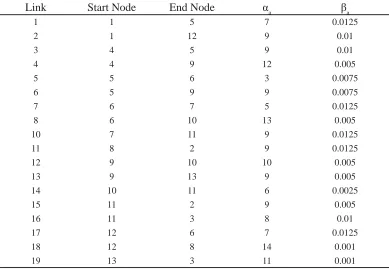
4 O-D pairs (Figure 1). O-D pairs of (1,2), (1,3), (4,2) and (4,3) have, respectively, travel demand of 400,800,600 and 200 units. The volume-delay function of Ta[a Įaȕa[a, in which (T)a LV WUDYHO WLPH DQG [a LV ÀRZ RQ
OLQNDLVXWLOL]HG7KHYDOXHVRISDUDPHWHUVĮa
DQGȕa are presented in Table 1.
Figure 1. Illustrative network
Table 1. Parameters of link volume-delay functions for illustrative network Link Start Node End Node Įa ȕa
1 1 5 7 0.0125
2 1 12 0.01
3 4 5 0.01
4 4 12 0.005
5 5 6 3 0.0075
6 5 0.0075
7 6 7 5 0.0125
8 6 10 13 0.005
10 7 11 0.0125
11 8 2 0.0125
12 10 10 0.005
13 13 0.005
14 10 11 6 0.0025
15 11 2 0.005
16 11 3 8 0.01
17 12 6 7 0.0125
18 12 8 14 0.001
5.1 Comparison of Link-based and Path-Based Probit Assignment
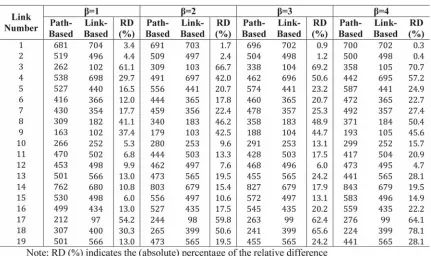
Table 2 illustrates the result of TA for path-based probit as well as the link-path-based Monte
&DUORPHWKRGSURSRVHGE\6KHI¿DQG3RZHOO (TXLOLEULXPOLQNÀRZVZHUHREWDLQHGE\SDWK
based and link-based versions of the method
RI VXFFHVVLYH DYHUDJHV 06$ >6KHI¿ DQG 3RZHOO@UHVSHFWLYHO\DQGE\LWHUD -tions of the algorithm. To mitigate the stochas-tic effects of simulation to the least possible
H[WHQWFKRLFHSUREDELOLWLHVZHUHREWDLQHGE\
10,000 number of simulation iteration which can be regarded as a fairly large number for this implementation. Also, as already men-tioned, in order to eliminate the effect of the generated choice set size on the result of com-parison between path-based and link-based
DVVLJQPHQW DQ H[KDXVWLYH SDWK HQXPHUDWLRQ
approach has been applied, that is to say, all possible paths between each pair of O-D have been produced and used in the path-based TA
procedure. For larger-scale networks, howev-er, utilizing a method for generating subsets of the universal sets of paths will be inevitable, the discussion of which is outside the scope
RIWKLVFRQWULEXWLRQ>3UDWRDQG%HNKRU 3UDWRDQG%HNKRU+DJKDQLHWDO@
As Table 2 shows, for each particular value
RIȕWKH68(ÀRZVREWDLQHGE\WKHKHXULVWLF
link-based method proves to be considerably
GLIIHUHQWIURPWKH01368(ÀRZV,QRUGHU
to facilitate the comparison, we also have cal-culated the absolute value of the percentage of relative difference between the corresponding
ÀRZV5HVXOWVGHPRQVWUDWHWKDWWKHDYHUDJHRI WKLVGLIIHUHQFHIRUȕ LVURXJKO\ DQG UHVSHFWLYHO\ DQG WKH PD[LPXPZRXOGDPRXQWWR
and 78%. This result has also been illustrated in Figure 2. Table 3 also represents the
MNP-68(SDWKÀRZVDORQJZLWKHTXLOLEULXPSDWK
times which are obviously associated with the path-based algorithm.
7DEOH(TXLOLEULXPSDWKÀRZVDQGSDWKWLPHVIRU013DVVLJQPHQW
)LJXUH&RPSDULQJWKHOLQNEDVHGDQGSDWKEDVHG013OLQNÀRZVLQWHUPVRIWKHDEVROXWH
5.2 Sensitivity Analysis
6HQVLWLYLW\DQDO\VHVRIHTXLOLEULXPÀRZVZLOO
be made in this section with respect to differ-ent parameters of the problem including the
YDOXHRIWKHSDUDPHWHUȕQXPEHURIVLPXOD -tion itera-tions and level of conges-tion.
6HQVLWLYLW\WRȕ
,QRUGHUWRLQYHVWLJDWHWKHHIIHFWRIȕRQSUH
-GLFWLRQRI01368(ÀRZDVHQVLWLYLW\DQDO\ -sis was conducted. Figure 3 illustrates
varia-WLRQRIHTXLOLEULXPOLQNÀRZVIRUVRPHFHUWDLQ OLQNVRIRXUH[DPSOHQHWZRUNZKHQȕLVYDU -ied from 0 to 20 for both path-based and link-based approaches. As can be seen, while the
SDWKEDVHGHTXLOLEULXPVROXWLRQLVVLJQL¿FDQW
-O\ GHSHQGHQW RQ WKH YDOXH RI ȕ SDUWLFXODU-O\ RQDQLQWHUYDORIȕ WRȕ WKHUHVXOWRIWKH
link-based algorithm is only slightly sensitive to this parameter.
Figure 4 depicts the sensitivity in terms of path
ÀRZVFRQQHFWLQJDSDUWLFXODU2'SDLU2'
pair 4-2), obviously for the path-based
meth-RG7KLVDGGLWLRQDO¿JXUHDLPVWRJUDSKLFDOO\
demonstrate the fact that, contrary to what has been mentioned in some previous studies [for
H[DPSOH3UDVKNHUDQG%HNKRU@DVWKH YDULDQFHRIHUURUVDSSURDFKHVWRLQ¿QLW\68( SDWKÀRZVFRUUHVSRQGHGZLWKHDFK2'SDLU GRQRWWHQGWRHTXDOYDOXHV7KHSURSRVLWLRQ
has mistakenly been stated in some published studies that when the variance of error terms
WHQGVWRLQ¿QLW\EDVHGRQDOOVWRFKDVWLFPRG -els forecast, travelers become indifferent to various paths and path utilities are perceived
HTXDOO\%XWDVWKH)LJXUHVKRZVWKLVVWDWH -ment is not true for MNP model. In general, the proposition is only valid for the simple MNL model due to its diagonal covariance structures. From the perspective of other mod-els which are able to represent correlation,
SDWKSUREDELOLWLHVDQGDVDUHVXOWSDWKÀRZV
are determined by the covariance structure
)LJXUH6HQVLWLYLW\RISURELWOLQNÀRZVWRWKHYDOXHRIȕ
6HQVLWLYLW\WRWKH1XPEHURI6LPXODWLRQ
Iterations
2QHLPSRUWDQWIDFWRUWKDWVLJQL¿FDQWO\DIIHFWV FRPSXWDWLRQDOH[SHQGLWXUHRISURELWEDVHG7$
is the number of simulation iterations which the analyst has to set to obtain probit probabil-ities. Table 3 represents the sensitivity of the
ÀRZWRWKHQXPEHURIVLPXODWLRQLWHUDWLRQVIRU
both path-based and link-based methods. The
UHVXOWV DUH FRUUHVSRQGHQW ZLWK ȕ $V FDQ
be observed, while path-based probit
simula-WLRQDSSURDFKHVWRLWVORQJUXQVROXWLRQTXLWH
rapidly, the result of the link-based method is considerably dependent on the number of simulations. Therefore, as a computational
EHQH¿WWKHSDWKEDVHGPHWKRGGRHVQRWEDVL
-7DEOH6HQVLWLYLW\RIWKH013OLQNÀRZVWRWKHQXPEHURIVLPXODWLRQLWHUDWLRQV
FDOO\UHTXLUHYHU\ODUJHQXPEHURILWHUDWLRQVLQ
Monte Carlo procedures while the link-based algorithm does. This property can indeed be considered as a compensation for the lower
GHJUHHRIHI¿FLHQF\IRUSDWKEDVHGDSSURDFK
in comparison with the link-based algorithm.
5.2.3 Sensitivity to the Level of Congestion
The level of congestion in the network is
an-RWKHU LQÀXHQWLDO IDFWRU LQ SUHGLFWLRQ RI 67$
models including MNP model. As discussed in the literature, when the network becomes
PRUHFRQJHVWHG68(ÀRZEHFRPHVPRUHDQG
more similar to UE. In other words, for highly congested networks, prediction of stochastic
than for lightly congested networks [Daganzo
DQG 6KHI¿ 6KHI¿ DQG 3RZHOO @
The reason is clear. When the level of travel demand and as a result, link travel times in-crease, the systematic part of utilities plays a more important role in determination of
prob-DELOLWLHVDQGLQDV\PSWRWLFFDVHWKHLQÀXHQFH RIHUURUGLVWXUEDQFHVSDOHVLQWRLQVLJQL¿FDQFH DQGSUHGLFWHGÀRZSDWWHUQWHQGVWR8(
Although analytically understandable, the aforementioned problem is important and needs to be numerically investigated in the
VHQVH WKDW LW FDQ LQ IDFW TXHVWLRQ WKH ORJLFDO
necessity for application of STA models for
KLJKO\FRQJHVWHGQHWZRUNV1XPHULFDOH[DPL
-QDWLRQVVHHPVWREHUHTXLUHGWRXQFRYHUWKDW
whether for highly congested networks SUE
PRGHOVDUHLQGHHGXQQHFHVVDU\7RTXDQWLWDWH
the problem, we considered different degrees of congestion level by multiplying the base
GHPDQG YHFWRU RI RXU H[DPSOH QHWZRUN E\ IDFWRUVȜ DQG$VWKHEDVHGHPDQG
of the network can be considered moderate,
Ȝ FDQ EH UHJDUGHG DV D YHU\ KLJK OHYHO RI
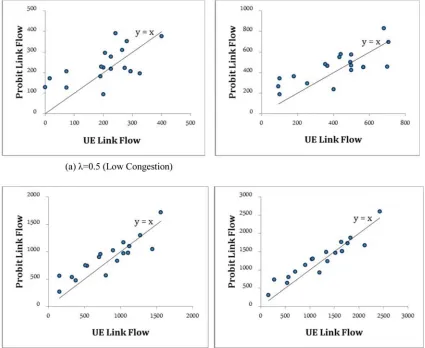
congestion. As Figure 5 shows, results
con-¿UPWKHSULRUDVVXPSWLRQDVWRWKHLQFUHDVHRI VLPLODULW\EHWZHHQ8(DQG01368(ÀRZV
Still, they also show that even for very large
OHYHOVRIFRQJHVWLRQWKHUHDUHVLJQL¿FDQWDQG
meaningful differences between the two app- roaches.
5.3 Mixed Probit SUE
0L[HG 01368( ÀRZV ZHUH REWDLQHG IRU
different probability distributions assumed for
WKHFRHI¿FLHQWRIWUDYHOWLPH3URELWSUREDELOL
-WLHVDVZHOODVPL[HGSUREDELOLWLHVHDFKZHUH
calculated by 1000 times of random draws. Number of MSA replications was also set to
(TXLOLEULXP OLQN DQG SDWK ÀRZV KDYH
been illustrated in Tables 5 and 6, respective-ly. As the results show, regardless of the value of the standard deviation, transition from
clas-VLFDOWRUDQGRPFRHI¿FLHQW013KDVPDGHD VLJQL¿FDQWFRQWULEXWLRQWRSUHGLFWLRQRIÀRZ
Although there are differences between the
re-VXOWVRIDSSO\LQJPL[HG013DVVLJQPHQWZLWK
different values of standard deviation, one can say that different values of standard deviation
KDVOHGWRE\DQGODUJHVLPLODUÀRZSDWWHUQV %\ FRPSDULVRQ KRZHYHU WKHUH LV D UHPDUN
-able difference between classical MNP-SUE
DQG PL[HG 01368( SUHGLFWLRQV &RPSDU
-LQJ WKH ¿JXUHV SUHVHQWHG LQ 7DEOHV DQG RQHFDQFRQFOXGHWKDWWKHPL[HGDSSURDFKKDV SURGXFHG D PRUH GLVSHUVH ÀRZ SDWWHUQ ZLWK KLJKHUGHJUHHVRIVWRFKDVWLFLW\LQURXWH¿QGLQJ WKDQ QRQPL[HG 013 ,Q RWKHU ZRUGV QRQ
shortest paths, are receiving bigger shares of
WKHWRWDOGHPDQGEDVHGXSRQPL[HG013SUH -diction than the classical version. This more intensity of stochasticity was anticipaTable
LQDVPXFKDVWKHPL[HGPRGHOFDSWXUHVDQDG -ditional source of randomness in route choice behavior.
6. Summary, Conclusion and Future
Research Directions
6.1 Summary
The study was centered on the application of MNP model in transportation network analy-sis. Different aspects of the approach were considered. One of the heuristic link-based algorithms proposed in the literature for solv-ing MNP-SUE problem was investigated. The bias of the method was studied through com-parison with the solution of classical MNP-SUE.
Sensitivity analyses were also conducted with respect to different parameters of MNP-SUE problem. In addition, the notion of
random-FRHI¿FLHQW 01368( ZDV LQWURGXFHG DV D
new terminology in econometrics area and was formulated for and applied to the route choice problem. While the covariance struc-ture of MNP can address correlation and
het-HURVFHGDVWLFLW\WKHPL[LQJSURFHGXUHLVDEOH
to represent random taste variation in
travel-HU¶VURXWH¿QGLQJ
6.2 Conclusion
7KHSULPDU\¿QGLQJVRIWKHVWXG\FDQEHRXW -lined as follows:
5HVXOWVVKRZHGDVLJQL¿FDQWOHYHORIELDVIRU
the studied link-based method in production
RI01368(ÀRZ
• Further analysis showed that while the
path-EDVHG013ÀRZLVTXLWHVHQVLWLYHWRWKHYDO -ue of the calibration parameter of the model appearing in its covariance formulation, the link-based method represents a very low de-gree of sensitivity.
$OWKRXJKPRUHHI¿FLHQWGXHWRLWVOLQNEDVHG
nature, the link-based method proved to be
VLJQL¿FDQWO\ GHSHQGHQW RQ WKH QXPEHU RI
Monte Carlo simulation iterations in
predic-WLRQRIÀRZZKLOHWKHSDWKEDVHGPHWKRGDS
-SURDFKHVWRWKHORQJUXQUHVXOWTXLFNO\7KLV
property makes application of classical probit approach in large-scale networks more
prom-ising.
• Investigations also demonstrated that even for very highly congested networks there are still logical reasons for transition from UE to SUE approach.
$SSOLFDWLRQRIUDQGRPFRHI¿FLHQWDSSURDFK
also illustrated a more degree of randomness
LQ SUHGLFWLRQ RI ÀRZ WKDQ WKH FODVVLFDO QRQ PL[HG013
6.3 Future Research Directions
• The main concentration of this study was
LQGHHGRQÀRZSUHGLFWLRQDQGPRGHOHVWLPD -tion problem was in fact beyond the scope the
SUHVHQWUHVHDUFK)XUWKHUVWXGLHVDUHUHTXLUHG
for estimation of structured-covariance MNP models for road network modeling based upon
H[SHULPHQWDOGDWD5HJDUGLQJWKHPL[HG013
modeling, however, it should be noted that owing to the novelty of the approach, to the
EHVW RI RXU NQRZOHGJH QRQH RI WKH H[LVWLQJ
choice modeling software packages are able to estimate this model and modelers have to develop their own codes. Further, estimation
RIPL[HG013PRGHOVGHPDQGVIDUPRUHULFK
data sets than the classical model.
• Numerical validation of SUE-type models
EDVHGRQÀRZREVHUYDWLRQVRIUHDOVL]HGQHW -works can still be regarded as a gap in the lit-erature.
• Other link-based probit assignment mod-els proposed in the literature needs to be nu-merically scrutinized as well to uncover that whether they actually produce MNP-SUE
ÀRZV
7RHQKDQFHH[SODQDWRU\SRZHURIWKHURXWH
choice model, other variables such as path length, fuel price and road tolls can be further introduced to utility functions.
,QDGGLWLRQWRUHOD[WKHLPSOLFLWUHVWULFWLYH DVVXPSWLRQ RI ¿[HG WUDYHO GHPDQG WKH 67$
model can be generalized to a stochastic
³PRGHFKRLFHWUDI¿FDVVLJQPHQW´PRGHO
• This study focused on theoretical aspects of SUE problem. Further studies, however, needs to be conducted as to the practical aspects of the problem notably choice set generation
DQG HI¿FLHQF\ RI WKH HTXLOLEULXP DOJRULWKP
Although the number of previous studies in these areas is rather considerable, but the is-sues are still open to research.
References
$NDPDWVX7³&\FOLFÀRZV0DUNRY SURFHVV DQG VWRFKDVWLF WUDI¿F DVVLJQPHQW´ 7UDQVSRUWDWLRQ5HVHDUFK%SS
%HNKRU67ROHGR7DQG/5H]QLNRYD/
(2008) “A path-based algorithm for the
cross-QHVWHG ORJLW VWRFKDVWLF XVHU HTXLOLEULXP WUDI
-¿F DVVLJQPHQW´ &RPSXWHU$LGHG &LYLO DQG
Infrastructure Engineering, Vol 24, pp. 15-25.
%HNKRU6%HQ$NLYD0(DQG5DPPLQJ
M. S.(2006) “Evaluation of choice set genera-tion algorithms for route choice models”, Ann Oper Res, 144, pp. 235-247.
%HNKRU 6 %HQ$NLYD0 6 DQG 5DP -ming, S. M. (2002) “Adaptation of logitker-nel to route choice situation”, Transportation
5HVHDUFK 5HFRUG-RXUQDO RI WKH 7UDQVSRUWD
-WLRQ5HVHDUFK%RDUG1R75%1DWLRQ -alResearch Council, Washington, D.C., pp.
±
%HOO0*+³$OWHUQDWLYHVWR'LDO¶V
logit assignment algorithm”, Transportation
5HVHDUFK%SS
%HQ$NLYD06DQG%LHUODLUH0
“Discrete choice methods and their applica-tions to short term travel decisions”, in: W. Hall (Ed.) “Handbook of Transportation
Sci-HQFH´SS±'RUGUHFKW.OXZHU
%RY\3+/%HNKRU6DQG3UDWR*
“The factor of revisited path size: Alternative derivation. In Transportation Research
Re-FRUG´-RXUQDORIWKH7UDQVSRUWDWLRQ5HVHDUFK %RDUG 1R 7UDQVSRUWDWLRQ 5HVHDUFK %RDUG RI WKH 1DWLRQDO$FDGHPLHV :DVKLQJ
-WRQ'&SS±
%XUUHOO-(³0XOWLSOHURDGDVVLJQ -ment and its application to capacity restraint”, Proc., 4th. International Symposium on the
7KHRU\RI7UDI¿F)ORZ.DUOVUXKH:HVW*HU
-PDQ\SS±
9LWHWWD $ ³$ PRGL¿HG ORJLW URXWH
choice model overcoming path overlapping
SUREOHPV6SHFL¿FDWLRQDQGVRPHFDOLEUDWLRQ
results for Interurban Networks”, In Proc., 13th International Symposium on
Transpor-WDWLRQ DQG 7UDI¿F 7KHRU\ 3HUJDPRQ /\RQ )UDQFHSS±
&ODUN&(³7KHJUHDWHVWRID¿QLWH
set of random variables”, Operation Research,
9ROSS
- Clark, S. D. and Watling,D. P. (2000) “Pro-bit-based sensitivity analysis for general
traf-¿F QHWZRUNV´ 7UDQVSRUWDWLRQ 5HVHDUFK 5H
-FRUGSS
'DJDQ]R&)DQG6KHI¿<³2QVWR
-FKDVWLFPRGHOVRIWUDI¿FDVVLJQPHQW´7UDQV
-SRUWDWLRQ6FLHQFH9ROSS±
'LDO5%³$SUREDELOLVWLFPXOWLSDWK WUDI¿F DVVLJQPHQW DOJRULWKP ZKLFK REYLDWHV
path enumeration”, Transportation Research,
9ROSS±
(DWRQ0/³0XOWLYDULDWHVWDWLVWLFV D YHFWRU VSDFH DSSURDFK´ -RKQ :LOH\ DQG
Sons..
)LVN & ³6RPH GHYHORSPHQWV LQ HTXLOLEULXP WUDI¿F DVVLJQPHQW´ 7UDQVSRUWD
-WLRQ5HVHDUFK9RO%SS±
)ORULDQ 0 ³2Q PRGHOLQJ FRQJHV
-WLRQLQGLDO VSUREDELOLVWLFDVVLJQPHQWPRGHO´
Transportation Research, Vol. 8, pp. 85-86.
)ORULDQ 0 DQG )R[ % ³2Q WKH SUREDELOLVWLFRULJLQRI'LDO VPXOWLSDWKWUDI¿F
assignment model”, Transportation Research,
9ROSS
- Haghani, M., Shahhoseini,Z., Samimi, A. and Aashtiani, A. Z. (2013) “On calibration and application of logit-based stochastic
traf-¿FDVVLJQPHQWPRGHOV´,QWHUQDWLRQDO-RXUQDO RI7UDQVSRUWDWLRQ (QJLQHHULQJ ,-7(9RO
3, pp. 151-172.
+RUQ5$DQG-RKQVRQ&5³0D
-WUL[ DQDO\VLV´ &DPEULGJH &DPEULGJH 8QL -versity Press.
+RURZLW] -/ 6SDUPDQQ -0 DQG 'D
-JDQ]R &) ³$Q LQYHVWLJDWLRQ RI WKH DFFXUDF\ RI WKH &ODUN DSSUR[LPDWLRQ IRU WKH
multinomial probit model”, Transportation Science, Vol. 16(3), pp. 382-401.
- Haghani, M., Shahhoseini, Z. and Sarvi, M.
³3DWKEDVHG VWRFKDVWLF WUDI¿F DVVLJQ -ment: an investigation on the effect of
choice-VHWV VL]H PRGHO VSHFL¿FDWLRQ DQG PRGHO FDOLEUDWLRQ RQ SUHGLFWLRQ RI VWDWLF ÀRZUG
Annual Meeting of Transportation Research
%RDUG75%:DVKLQJWRQ'&
0DKHU0³6$0²$VWRFKDVWLFDV -signment model”, In Mathematics in
Trans-SRUW 3ODQQLQJ DQG &RQWURO - ' *ULI¿WKV HG 2[IRUG 2[IRUG 8QLYHUVLW\ 3UHVV SS ±
0DKHU0DQG+XJKHV3&³$3UR
-ELW EDVHG VWRFKDVWLF XVHU HTXLOLEULXP DVVLJQ -ment model”, Transportation Research, Vol.
%SS±
1JX\HQ6DQG'XSXLV'³$QHI
-¿FLHQWPHWKRGIRUFRPSXWLQJWUDI¿FHTXLOLEULD
3UDVKNHU - 1 DQG %HNKRU 6 ³,Q -vestigation of stochastic network loading procedures”,Transportation Research Record,
SS±
3UDVKNHU-1DQG%HNKRU6³&RQ -gestion, stochastic and similarity effects
LQ VWRFKDVWLF XVHUHTXLOLEULXP PRGHOV´ ,Q 7UDQVSRUWDWLRQ5HVHDUFK 5HFRUG -RXUQDO RI WKH7UDQVSRUWDWLRQ5HVHDUFK%RDUG1R 75% 1DWLRQDO 5HVHDUFK &RXQFLO :DVKLQJ
-WRQ'&SS±
3UDWR&*DQG%HNKRU6³$SSO\LQJ EUDQFKDQGERXQG WHFKQLTXH WR URXWH FKRLFH
set generation. in transportation research
re-FRUG´ -RXUQDO RI 7UDQVSRUWDWLRQ 5HVHDUFK %RDUG 1R 7UDQVSRUWDWLRQ 5HVHDUFK %RDUG RI WKH 1DWLRQDO$FDGHPLHV :DVKLQJ
-WRQ'&SS±
3UDWR&*DQG%HNKRU6³0RGH -ling route choice behavior: how relevant is the composition of choice set?”. In Transportation Research Record, Vol. 2003, pp. 64-73.
5LFH-³0DWKHPDWLFDOVWDWLVWLFVDQG GDWDDQDO\VLVVHFRQGHG´'X[EXU\3UHVV
- Rosa, A. (2003) “Probit based methods in
WUDI¿F DVVLJQPHQW DQG GLVFUHWH FKRLFH PRG -eling”, Ph.D. Dissertation, Napier University.
6KHI¿<DQG3RZHOO:%³$FRP
-SDULVRQRIVWRFKDVWLFDQGGHWHUPLQLVWLFWUDI¿F
assignment over congested networks”,
Trans-SRUWDWLRQ5HVHDUFK9RO%SS
6KHI¿<DQG3RZHOO:%³$QDO
-JRULWKPIRUWKHHTXLOLEULXPDVVLJQPHQWSURE -lem for random link times”, Networks, 12(2),
SS
7UDLQ.(³'LVFUHWHFKRLFHPHWK -ods with simulation”, Cambridge: Cambridge University Press, New York.
9RQ)DONHQKDXVHQ+³7UDI¿FDVVLJQ -ment by a stochastic model”, Proceedings, 4th International Conference on Operational Sci-ence, pp. 415-421.
<DL 7 ,ZDNXUD 6DQG 0RULFKL 6
“Multinomial probit with structuredcovari-ance for route choice behavior”,
Transporta-WLRQ5HVHDUFK9RO%SS±
- Zhang, K., Mahmassani, H. S. and Lu, C. C. (2008) “Probit-based time-dependent
Sto-FKDVWLF XVHU HTXLOLEULXP WUDI¿F DVVLJQPHQW
model”, Transportation Research Record,