A
pplied
R
esearch on
E
nglish Language
V. 9 N. 2 2020 pp: 229-252
http://uijs.ui.ac.ir/are
DOI 10.22108/are.2019.116060.1444
___________________________________________
The Role of Corrective Feedback Timing in Task Engagement and Oral
Performance
Javad Belali
1and Karim Sadeghi
2*1
Valfajr Street Faculty of Humanities
2Professor, English Department School of Humanities, Urmia University, Urmia, Iran
Received: 2019/03/14 Accepted: 2019/05/11
Abstract: Corrective Feedback (CF) provision on performance involves calling attention to
learners' erroneous utterances, which stimulates classroom language learning. Despite
widespread research in this area, a controversy still exists as to the time of CF in
communicative tasks especially when learners' task engagement is targeted. Employing 60
intermediate-level Iranian learners, a four-week study examined the effects of immediate versus
delayed CF types on oral engagement, grammar gain as well as on Complexity, Accuracy and
Fluency (CAF) in the context of a dictogloss task. The statistical analysis showed that despite
statistically significant improvements in the case of Grammaticality Judgement Test (GJT)
from the pre-test to the post-test, no statistically significant difference was found between the
two groups with regard to their grammar gain, complexity, accuracy, fluency, as well as on
their social and cognitive engagement. However, results in the case of behavioral and emotional
engagement revealed that there were statistically significant differences between the two groups
of immediate and delayed CFs. The findings of the present study call for more flexibility and
confidence on the part of the teachers in providing either immediate or delayed CF whenever
appropriate and without being concerned about the adverse effects of feedback.
Keywords: Accuracy, Complexity, Corrective Feedback, Delayed Feedback, Fluency,
230 Applied Research on English Language, V. 9 N.2 2020
ARE
L
Background
Introduction
The idea of what it means to be proficient in a language has received due research attention in
recent years (Housen, Kuiken, & Vedder, 2012). From the diverse pack of research,
complexity, accuracy and fluency (CAF) emerged as distinct elements of second language
(L2) performance (Ellis & Barkhuizen 2005; Housen & Kuiken, 2009). Identifying factors
that shape the development of CAF in L2 learning is a concern for both researchers and
teachers. Many researchers believe that the development of CAF can be related to a number
of factors such as motivation and corrective feedback (Ellis, 1994; Housen et al, 2012).
Corrective feedback (CF) is a frequent practice in the field of education and learning in
general and second language education in particular. Research on oral corrective feedback
has received serious attention over the last 20 years. Many investigations have been
conducted to show the benefits of CF and learner uptake in L2 development in classroom
contexts (e.g.; Lee 2013; Li, 2010; Lyster & Saito, 2010; Lyster, Saito & Sato, 2013).
However, little attention has been paid to how learners respond to the timing of CF.
The ideas of the timing of CF have been greatly influenced by reform movements in
thinking about new approaches to language learning and teaching. The answer to the question
'How should corrective feedback be provided?' is a radical departure from the belief that
corrective feedback should always be provided immediately (Hendrickson, 1978). From the
Interactionists' eyes, errors are the natural by-product of development in the process of L2
acquisition, and that the optimal time for the treatment of errors is when those utterances
have not secured the hearer's attention in communication.
Two concepts of social justice and responsibility of the instructors are of utmost
importance in providing feedback on learners' performance in oral tasks. For example,
regarding the social justice, the trite provision of CF by teachers creates negative evidence in
learners' mind such that they have never belonged to the class (Hattie & Timperley, 2007).
Salend (2001) also claimed that if teachers make comparisons when providing feedback, they
should make comparison between individual learner's current and prior performance rather
than compare it with his/her peers' performance. This establishes real standards, eliminating
comparisons that learners might find disappointing and discouraging. In their social
responsibilities, teachers should be brought to a clear understanding in their duty of how to
correct learners' errors. Therefore, learners' inner and outer changes are based on the labors
The Role of Corrective Feedback Timing in Task Engagement and Oral Performance 231
students to speak in classroom discussions. Such requirements include having students who
are engaged and motivated to learn (Rocca, 2008).
When language teachers are implicit about learners' inaccurate language use, learners
typically infer that teachers' silence indicates that they have made no errors. If teachers
correct their errors immediately, this correction discourages them from speaking. This is
particularly the turning point that the issue of engagement raises.
In line with Stroud's (2015) definition, the term 'engagement', refers to “devoting a lot of effort, remaining highly focused, persisting and enjoying challenges” (p. 2). The true value
of a student engagement is determined primarily by the measure and the sense in which s/he
has attained liberation from the self. The term 'engagement', in meaning-focused interaction,
is to see with one's own eyes and to judge one's performance in tasks without succumbing to
the suggestive power of the peers or fellow students. This complex phenomenon can be
classified into four types: Behavioral (the amount of the delivery of messages and actual
performance), Cognitive (mental efforts and the level of thoughtfulness and 'awareness'),
Social (the degree of learners' extrovertsiveness to their interlocutors during performance),
and Emotional (having positive or negative 'attitude' towards tasks and learners) (Philp &
Duchesne, 2016).
It is not easy to comprehend why we feel constrained to call the propositions of
engagement 'true'. Engagement ideas correspond to more or less exact issues such as
confidence, interest, and willingness to communicate, the last of which is assumed to be the
exclusive cause of the genesis of those ideas. Likewise, the practice of seeing conditions such
as low levels of confidence and interest in tasks can lead to low levels of engagement
(MacIntyre, Dörnyei, Clément & Noels, 1998). As a result, diagnosing these conditions is of
utmost importance for ensuring that learners are progressing.
In addition, an adverse effect of the almost sole focus on CF type is that, in contemporary
CF research, it seems a priori that CF is to be provided immediately. However, the positive
outcomes from the very few investigations of the empirical effects of delayed CF (Hunter,
2011; Sheen, 2012) propose some opposing evidence to that belief. Therefore, more research is
required to investigate whether there is any difference in the L2 development that results from
immediate and delayed CF. Furthermore, if second language acquisition (SLA) research is to
help not only learners and teachers but also researchers, then certainly researchers should study
whether there are any empirical facts that can be obtained to support the widely unsupported
232 Applied Research on English Language, V. 9 N.2 2020
ARE
L
accordingly an endeavor to investigate whether the timing of CF would have any effect on
grammar gain, task engagement, and CAF measures of oral production.
Literature Review
From a historical perspective, the issue of the timing of corrective feedback on L2 speaking
development has long been reduced to an absolute minimum and attention to it has only
recently re-emerged (Quinn, 2014). In fact, contemporary researchers have collected a large
quantity of empirical data indicating that the timing of CF facilitates the progression of L2
knowledge.
Rahimi and Dastjerdi (2012), for example, documented a comparative study of the L2
development, focusing on immediate and delayed CF, on Iranian EFL learners' complexity,
accuracy and fluency in oral tasks. Learners, who benefited from both immediate and delayed
CF, were divided into two groups of ten. Results showed that delayed feedback has a
statistically positive effect on accuracy and fluency, but not on complexity. Unfortunately,
the low number of the participants in this study did not guarantee the validity of the results.
Along similar lines, Varnosfadrani (2006) looked into the development effects of delayed
versus immediate CF, in the form of both explicit versus implicit CF, on 28 adult Iranian EFL
learners. Participants took part in two text reconstruction tasks. In both tasks participants were
provided with explicit correction. Tailor-made tests (tests containing items showing errors
made by learners during an activity) (LaPierre, 1995) were made for each error. Statistically
significant improvement was found on the errors that had been made, but there were no
statistically significant differences between the improvements that resulted from immediate or
delayed CF. However, the outcomes of Varnosfadrani’s study cannot be attributed to a
manipulation in the timing of CF because it appears that the CF types have been confounded
with CF timing which prevents a true comparison of the effects of timing on CF.
Another well designed study was done by Quinn (2014). In this study, 90
intermediate-level adult ESL learners were randomly assigned to immediate, delayed, and no CF
conditions. The target grammatical structure was English passive. In a pre-test–immediate
post-test–delayed post-test design including an aural grammaticality judgment test, a written
error correction test and an oral written error correction test, the learners took part in three
communicative tasks. The immediate and delayed feedback consisted of a prompt that forced
the learners to self-correct followed by a recast. Results revealed that there were statistically
The Role of Corrective Feedback Timing in Task Engagement and Oral Performance 233
differences among groups between conditions. However, a main problem of this study is that
it was laboratory-based. Therefore, the potential generalizability of the findings to classroom
contexts is limited.
Li, Zhu and Ellis (2016), reported a comparative study of the effectiveness of the
immediate versus delayed CF on the acquisition of past passive structure. Employing 120
learners from 4 intact classes, learners were assigned to immediate, delayed, task-only, and
control groups. The study used a pre- to post-test design by employing a Grammaticality
judgement test and an elicited imitation test as pre/post-test, two dictogloss tasks and recasts as
a CF provision type for the two immediate and delayed groups. Results implied that the
participants benefitted more from the immediate CF than delayed provision. However, the
problem here lies in the likelihood of a practice effect in the data collected from the control
group who received different instruction and took part in the same tests employed in the study.
Additionally, as learner engagement is an essential link that combines the provision of
CF with learning outcomes, research on this area can contribute to the current theorizing
about the oral CF mechanism. According to Ellis (2010), learner engagement is associated
with the ways that learners respond to CF.
Research on learners' perspectives on feedback only began to develop in the 1990s (e.g.
Ferris, 1995; Hedgcock & Lefkowitz, 1996). The focus of the research has mainly been on
learners' preferences and attitudes based on questionnaire surveys (e.g., Cohen, 1987; Ferris,
1995), and little or no attention has been paid to actual student reactions to teacher feedback
in classroom contexts. Adopting a more inclusive view of how feedback affects engagement
with tasks, Butler and Winne (1995) suggested that to better direct learning in authentic tasks,
feedback should provide information about cognitive activities for learning. To their belief,
monitoring is at the heart of self-regulated task engagement and the internal feedback it
generates is critical in shaping the evolving pattern of a learner's engagement in a task.
Nevertheless, apart from the theoretical nature, the focus of the study (Butler & Winne, 1995)
was merely on cognitive engagement and failed to take into account other aspects of
engagement (emotional, social and behavioral).
Research studies that focus on error correction time are extremely rare in comparison to
the large number of studies that focus on error correction (Farmani, Akbari & Ghanizadeh,
2017). Also, despite the importance of psychological variables, there are no studies that delve
234 Applied Research on English Language, V. 9 N.2 2020
ARE
L
of CF on psychological variables has been limited in the contemporary SLA literature, the
following findings addressed a gap in the timing of CF and engagement.
Farmani et al (2017) studied the L2 development that resulted from immediate and
delayed CF on 90 intermediate Iranian EFL learners' motivation. The participants were
randomly divided into three immediate, delayed and control groups. In a pre-test to post-test
design, the three groups were given a motivation questionnaire and a Cambridge Proficiency
Test in the first and the last session of the term to see the effect of different kinds of error
correction (immediate and delayed) on learners' motivation. The results of the study showed
that the immediate CF treatment was found to have led to a significantly better performance
than the delayed CF treatment.
Another study was conducted by Shabani and Safari (2016) who reported the effects
produced by immediate versus delayed feedback on learners' oral accuracy and anxiety. 100
Iranian EFL students aged from 13 to 30 took part in the study. The results revealed that
although all the participants expressed some levels of anxiety when receiving error
corrections, the level of their anxiety was significantly different and the immediate CF group
experienced more anxiety than the delayed CF group. Moreover, results revealed that the
level of anxiety facilitated the improvement of accuracy during speech.
In another study, Stroud (2017) conducted a well-designed investigation in an attempt
to uncover the effect of task scoring and tracking on EFL university learners' engagement.
Using card games as a measurement of the aspects of engagement, the results indicated that
the cards had a significant effect on the behavioral engagement but had no effect on the social
and cognitive engagement. Likewise, results obtained from High School Survey of Student
Engagement did not identify any significant effects on learners' affective dispositions toward
tasks. However, the major limitation of the study, according to Stroud (2017), is that the use
of the card game may well have been motivating enough for the learners to engage more in
discussions.
In summary, as the research on the importance of CF in L2 learning is growing rapidly,
research in the case of oral engagement is still in its infancy. The current study has been
intended to add to this research area and attempts have been made to prevent the weaknesses
of the previous investigations by including the effects of corrective feedback on EFL learners'
grammatical knowledge gain, oral engagement and on their complexity, accuracy and fluency
The Role of Corrective Feedback Timing in Task Engagement and Oral Performance 235
In order to delve more deeply into the aforementioned issues, the following questions
are proposed:
1. Is there any significant difference between delayed and immediate CF in their effect
on the grammatical knowledge gains of learners?
2. Do delayed and immediate CF engage learners differently in performing an oral task?
3. Is there any significant difference between delayed and immediate CF in their effect
on the complexity of learners’ oral production?
4. Is there any significant difference between delayed and immediate CF in their effect
on the accuracy of learners' oral production?
5. Is there any significant difference between delayed and immediate CF in their effect
on the fluency of learners' oral production?
Methodology
Design of the Study
This quasi-experimental study followed the pre-test/post-test design to investigate the effects
of immediate and delayed CF on improvements in learners' English past passive structure in
terms of CAF and task engagement. The treatments were proceeded with the random division
of participants into immediate and delayed conditions. Each participant followed a 4-week
treatment process, as outlined in Table 1. Finally, quantitative procedures were employed to
analyze the elicited data.
Participants
A convenience sample of 60 intermediate level learners (aged from 12 to 18) was recruited
from Jihad private EFL institutes in Urmia, Iran. The intermediate level learners were
selected because they were believed to present the greatest potential to exhibit development
in the target form from CF treatment. The participants were randomly divided into two
groups of immediate and delayed CF (N = 30- in each group). This consisted of 27 female
students (13 within immediate group and 14 within delayed group) and 33 male students
(17 within immediate group and 16 within delayed group). The students met twice a week for
90 minutes during which they were engaged in oral tasks. Two teachers also participated in
the study, having 7 and 10 years of teaching experience.
To ensure that groups matched each other in terms of their initial competence of the
236 Applied Research on English Language, V. 9 N.2 2020
ARE
L
study. Further, the homogeneity of the participants in this study was established from the
perspectives of cultural, ethnic and language background, with Azeri being their mother
tongue and Persian as their second language. Finally, since previous research has shown that
corrective feedback leads to better performance compared to no feedback (e.g. Li, Zhu, &
Ellis, 2016; Loewen & Nabei, 2007; Quinn, 2014), it was decided not to use a control group.
Instruments
The instruments used for gathering the data were a researcher constructed Grammaticality
Judgement Test (GJT), the High School Survey of Student Engagement (HSSSE) and a
dictogloss task. The GJT was designed with the aim of determining participants' current level
of competence in the target structure and was divided into three parts. Using a Nominal Scale
to judge the grammaticality of the sentences (correct or incorrect), we provided the
participants with 30 sentences, including 20 target passive items (10 correct and 10 incorrect)
and 10 distractor items with an active verb form. Participants' answers to the GJT (used both
as pre-test and post-test) were scored by assigning 'one' point for correct responses and 'zero'
for all other responses, including 'not sure'. The reliability of GJT was assessed by KR-20
index, which indicated an acceptable level of reliability (r = - 0.96).
A dictogloss task was designed to stimulate the use of the 'past passive' structure that
was the focus of the current study. The past passive structure was selected because it is a
structure acknowledged to require a long time for L2 learners to acquire (Larsen-Freeman,
1995). The dictogloss task comprised 3-5-minute pair discussions, with one-to-one
performance of the learners to the teacher and the whole class to evaluate their ability to state
opinions during their task performance. Pair work discussions were not directly observed by
the teacher. All performances were recorded with the help of mobile phones placed on
students' desks.
Accordingly, in order to make sure that the timing for the two conditions would be the
same, it was necessary to pilot the instructional task under the two conditions. 10 participants
were called up for recording the pilot sessions with 5 participants in each condition. After
reviewing the recorded speech from the pilot sessions, only small changes were made (the
length of the text for the dictogloss task was reduced and adapted).
High School Survey of Student Engagement (HSSSE) (Yazzie-Mintz, 2007). is a
well-established engagement survey and a widespread examination of student engagement and
The Role of Corrective Feedback Timing in Task Engagement and Oral Performance 237
of students in learning during and outside of the class. The survey consists of 31 items with
questions like 'Have you ever considered dropping from this school?', 'Have you ever got bored
in class?' with the choices ranging from 'Strongly Disagree' to 'Strongly Agree'.
The adjusted version of HSSSE that was used aimed at measuring self-reported
emotional engagement of students in learning in class time. The 13-item survey focused on
learners' affection in terms of (1) the way students feel about their level in class, and the
teachers within their classroom; and (2) affections toward association or disassociation of
students with their peers in the class and, mainly, their task interlocutors. The reliability of
HSSSE was assessed by KR-20 index, which indicated an acceptable level of reliability
(r = 0.50).
Procedure
Following the curriculum of the institute, based on Topnotch 2 book (Saslow, Ascher &
Morsberger, 2011), the focus of grammatical structure was the past passive. The data
collection took place over 4 weeks. In the first week, each participant took part in the GJT
which aimed at measuring the knowledge of English past passive structure. Participants were
provided with an example (but not an example from the target structure) to make sure that
they understood the purpose of the test.
Next, the 15-minute instruction for both immediate and delayed CF group in the second
week was carried out in the following way: The participants were shown a picture of ‘a
window’ and ‘a boy having a stone in his hand’. They then listened to the instructor while
they read the same sentence written below the picture: the boy broke the window. Later, the
subject, object, verb and the receiver of the action were identified and explained to the
students. The instructor then clarified that the verb was in the active form and explained that
the subject in the active sentences is responsible for the action of the verb. Afterward, the
participants were presented with the same picture (the broken window) but with the picture of
the agent (the boy) missing. The following sentence under that picture was then read by the
instructor: the window was broken by the boy. The instructor asked the participants to tell the
difference between the two sentences, clarifying that just the structure of the sentence had
changed, not the meaning.
When the instruction finished, the participants were asked to take part in a 20-25 minute
dictogloss task with the purpose of eliciting the use of past passive structure. The participants in
238 Applied Research on English Language, V. 9 N.2 2020
ARE
L
‘How often do you paint your house inside?’ in order to attract their interest. They then listened
to a narrative told by the instructor. The flow of information was controlled by allowing
learners to discuss in pairs (about 3-5 minutes) so that the focus of the task was meaningful
while the context was created for the participant's use of the past passive structure. After the
pair work, they were invited to describe the narrative to the group in cooperation with their
partners. Retelling the narrative gave the participants an opportunity to make errors in the
formation of passive structure on which either immediate or delayed CF was provided. The two
groups were provided with an explicit correction (i.e. when the teacher provides the correct
form, s/he clearly indicates that what the student had said was incorrect). Since previous
research supports the priority of the explicit correction in the process of L2 learning (e.g. Lee,
2013) over recasts (reformulating learners’ incorrect utterances while maintaining a focus on
meaning), explicit correction was used for correcting learners' erroneous utterances in both
groups. Moreover, in the immediate CF provision, the correction was provided at the moment
that an error occurred, while in the delayed CF provision, correction was postponed until the
task was done and after the participants' suggestions for correcting each other's errors. Also, CF
was given merely on errors produced on the passive structure.
On week 4, the participants in both immediate and delayed CF group were examined
again with the same GJT that they had taken in the first week. Finally, HSSSE was given in
week 3 for immediate and delayed CF groups in order to measure their affective dispositions.
All performances were recorded with the help of mobile phones placed on each pairs of
students' desks.
Table 1 represents the summary of the research process.
Table 1. Overview of Research Schedule
Session 4 Session 3
Session 2 Session 1
Post- test GJT (15-20 minutes HSSSE
(immediate/ delayed CF 15-minute instruction for
English passive lesson 20-25
Dictogloss task
(immediate/delayed CF groups) Pre-test
GJT (15-20 minutes)
Data Analysis
To examine the participants' CAF, the researcher analyzed the audio-recorded classes by
counting 'target like use of verb tenses', 'error free clauses' and 'number of self-corrections'
The Role of Corrective Feedback Timing in Task Engagement and Oral Performance 239
finally, by counting 'frequency of use of prepositions' and 'frequency of use of conjunctions'
for Complexity (Ellis, 2003; p. 117).
Behavioral engagement in audio-recorded dictogloss task was analyzed by counting
'total words spoken'. Social and cognitive engagement were measured by means of 'stated
opinions', 'agreements', 'disagreements', 'paraphrasing' and 'help given'. Finally, analysis from
HSSSE was used as a measurement scale for emotional engagement.
Findings
Overall. Prior to conducting the statistical analyses, assumptions for normality and
homogeneity were checked. Normality was violated by all conditions on all tests, with the
exception of the behavioral and emotional engagement. Therefore, the current research
proceeded with both parametric and non-parametric analyses.
GJT Results
To answer the first research question, it was necessary to determine whether there was a
change in grammatical knowledge of the learners in their performance from pre-test to
post-test. Therefore, Wilcoxon Signed Ranks Test was employed for analyzing each CF
group's gain from the pre-test to the post-test stage and a Man Whitney U test was used for
comparing the post-tests obtained for comparing differences in performance between
immediate and delayed CF groups.
Immediate CF Pre/Post-test Results
The pre-test and post-test in the immediate CF group was examined for the aim of supporting
the improved performance in the target structure. The results obtained from Wilcoxon Signed
Ranks Test indicated a statistically significant difference between the pre-test to the post-test
of the immediate CF group.
Table 2. Pre/post-test Results of Immediate CF
scores
N Mean Rank Z Asymp. Sig. (2-tailed)
Post-test – Pre-test
Negative Ranks 2a 1.75 -4.571d .000e Positive Ranks 26b 15.48
Ties 2c
240 Applied Research on English Language, V. 9 N.2 2020
ARE
L
a. Post-test < Pre-test
b. Post-test > Pre-test c. Post-test = Pre-test
d. Based on negative ranks
e. Wilcoxon Signed Ranks Test; P < 0.01
Delayed CF Pre/post-test Results
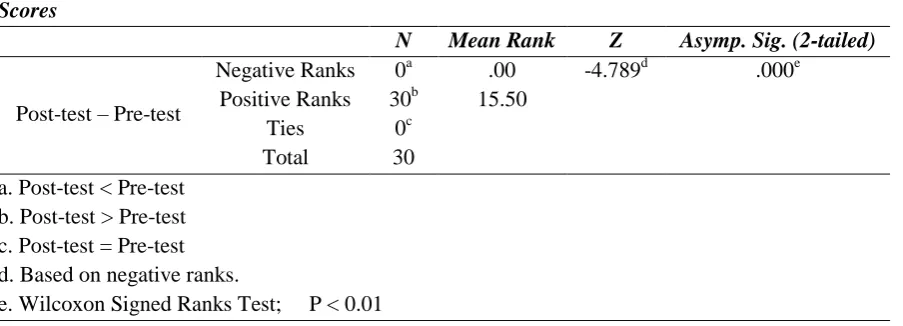
The Wilcoxon Signed Ranks Test showed a statistically significant effect for time (p = 0.00).
The results obtained from Wilcoxon Signed Ranks Test indicated that the scores of the
learners were different across the two time points, that in general there were statistically
significant differences between the delayed CF groups' pre-test and post-test scores. The
results are presented in Table 3, which show that the delayed feedback group performed
better on the post-test compared to the pre-test.
Table 3. Pre/post-test Results of Delayed CF Group
Scores
N Mean Rank Z Asymp. Sig. (2-tailed)
Post-test – Pre-test
Negative Ranks 0a .00 -4.789d .000e Positive Ranks 30b 15.50
Ties 0c
Total 30
a. Post-test < Pre-test
b. Post-test > Pre-test c. Post-test = Pre-test d. Based on negative ranks.
e. Wilcoxon Signed Ranks Test; P < 0.01
Immediate/Delayed Post-test Comparisons on the Grammaticality Judgment Test
The descriptive scores presented in Table 4 to establish the comparability between the
immediate and delayed CF groups. The results of the pre-test pointed us towards the fact that
leaners in both groups possessed almost no knowledge of the past passive structure
(M=11.20, immediate CF; M = 9.17, delayed CF out of 20).
Despite statistically significant increase in scores between groups on their post-test
scores, results obtained from the Mann-Whitney U test revealed no statistically significant
difference between the two groups, although in post-test, delayed CF group scored much
higher (M = 34.32) than immediate group (M = 26.68). Therefore, there was no statistically
significant difference between the two treatment groups in terms of their effect on
grammatical knowledge gain.
The Role of Corrective Feedback Timing in Task Engagement and Oral Performance 241
Scores
Group N Mean Rank Mann-Whitney U Z Asymp. Sig. (2-tailed)
Post-test
immediate CF 30 26.68
335.500 -1.748 .080
Delayed CF 30 34.32 Total 60
Note: P < 0.05
Engagement
Changes in Behavioral Engagement
Results obtained from the Kolmogorov-Smirnov test, revealed that the data collected from
participants' behavioral engagement were normally distributed. The results reported in Table
5 show that the Sig value of the test is more than 0.05 (p = 0.2). Therefore, there were no
meaningful differences between the distribution of the data and the normal distribution. In
other words, the data was normally distributed.
Table 5 depicts the results:
Table 5. Normality of the Behavioral Engagement
One-Sample Kolmogorov-Smirnov Test
behavioral
N 60
Normal Parametersa,b Mean 17.72
Std. Deviation 8.501
Test Statistic .085
Asymp. Sig. (2-tailed) .200c,d
a. Test distribution is Normal. b. Calculated from data.
c. Lilliefors Significance Correction.
d. This is a lower bound of the true significance.
One condition of the independent sample t-test is the notion of 'the equality of variance'
for the two groups, which is examined by the Fisher test (F). Therefore, the p value obtained
from the F test is more than 0.05 (p = 0.604). Thus, no statistically significant difference was
found between the two CF groups with regard to the equality of the variances. On the other
hand, because the p value of the t-test is less than 0.01 (0.000), there existed a statistically
significant difference between the immediate and delayed CF types.
Table 6. Comparison Analysis Results for Behavioral Engagement
Group Statistics
Group N Mean Std. Deviation Std. Error Mean
Immediate vs Delayed
Immediate CF 30 23.43 6.735 1.230
242 Applied Research on English Language, V. 9 N.2 2020
ARE
L
Independent Samples Test
Levene's Test for Equality of Variances t-test for Equality of Means
F Sig t df Sig.
(2-tailed)
Mean Difference
Std. Error Difference
Equal variances
assumed .272 .604 7.027 58 .000 11.433 1.627
Note: P < 0.01
Changes in Social and Cognitive Engagement
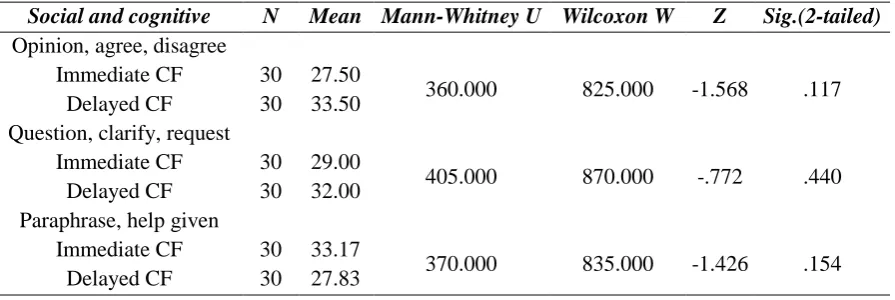
Within the two weeks of experiment, performance data was analyzed in order to measure
whether there existed changes in social and cognitive engagement. Table 7 reports the
descriptive statistics: a) Delayed CF group in the case of social and cognitive engagement
(M = 33.50) with regard to the 'opinions, agreements, disagreements' outperformed
immediate CF group (M = 27.50), b) Delayed CF (M = 32.00) group in the case of 'Question,
clarify, request' was better than immediate CF group (M = 29). Although the delayed CF
group showed higher scores than the immediate CF group, the differences did not reach
statistical significance (p = 0.117; p = 0.440).
Besides, results indicated that there existed no statistically significance difference
between the two groups (p= 0.154) in the case of 'paraphrase and help given' although
immediate CF group did better (M= 33.17) than the delayed CF group (M = 27.83).
Table 7. Comparison analysis results for social and cognitive engagement
Social and cognitive N Mean Mann-Whitney U Wilcoxon W Z Sig.(2-tailed)
Opinion, agree, disagree
Immediate CF 30 27.50
360.000 825.000 -1.568 .117 Delayed CF 30 33.50
Question, clarify, request
Immediate CF 30 29.00
405.000 870.000 -.772 .440
Delayed CF 30 32.00
Paraphrase, help given
Immediate CF 30 33.17
370.000 835.000 -1.426 .154
Delayed CF 30 27.83
Note: P < 0.05
Changes in Emotional Engagement
Results concerning participants' affections toward the immediate and delayed CF showed that
immediate group had a more positive emotional reaction toward the CF than the delayed
group. Table 8 shows the results. The mean score for the immediate CF is 86.26 and 81.80
for delayed CF group. As can be seen, the p value of 0.00 indicates that there was a
statistically significance difference between immediate and delayed CF groups in terms of
The Role of Corrective Feedback Timing in Task Engagement and Oral Performance 243
Table 8. Comparison Analysis Results for Engagement Survey
Group N Mean Std. Deviation df f sig t
Immediate vs Delayed
Immediate CF 30 86.26 4.55 58 4.92 .000 4.465 Delayed CF 30 81.80 3.04
Note: P < 0.01
Changes in Complexity Measures
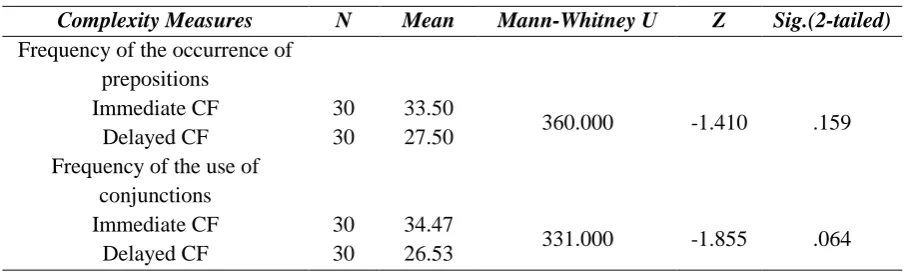
Table 9 depicts the two variables employed to measure the complexity of language use in the
participants' oral performances: amount of the use of 'prepositions' and 'conjunctions'. In the
case of prepositions, the immediate group outperformed the delayed group (M= 33.50 for
immediate; M= 27.50 for delayed group). Statistically speaking, however, there exists no
significant difference between immediate and delayed CF in terms of their use of
prepositions. Regarding the 'frequency of the use of conjunctions', the immediate group (M=
34.47) outperformed the delayed group (M= 26.53). Likewise, the p value of 0.06 indicated
that there was no statistically significance difference between the immediate and delayed
groups with regarded to the use of conjunctions.
Table 9. Complexity Measure for Immediate and Delayed Groups
Complexity Measures N Mean Mann-Whitney U Z Sig.(2-tailed)
Frequency of the occurrence of prepositions
Immediate CF 30 33.50
360.000 -1.410 .159
Delayed CF 30 27.50
Frequency of the use of conjunctions
Immediate CF 30 34.47
331.000 -1.855 .064
Delayed CF 30 26.53
Note: P < 0.5
Changes in Accuracy Measures
Mean scores of the learners' performance on the effects of immediate and delayed CF on
accuracy are presented in Table 10. As can be seen, the p values of 0.21, 0.52, 0.68 revealed
no statistically significant differences between the two groups.
Table 10. Accuracy Measures for Immediate and Delayed CF
Sig.(2-tailed) Z Mann-Whitney U Mean N Accuracy Measures
Error Free Clauses
.218 -1.232 372.500 33.08 30 Immediate CF 27.92 30 Delayed CF
Number of Self- Correction
244 Applied Research on English Language, V. 9 N.2 2020
ARE
L
31.50 30
Delayed CF
Target like use of verb tenses
.687 -.403 425.000 31.33 30 Immediate CF 29.67 30 Delayed CF
Note: P < 0.05
Changes in Fluency Measures
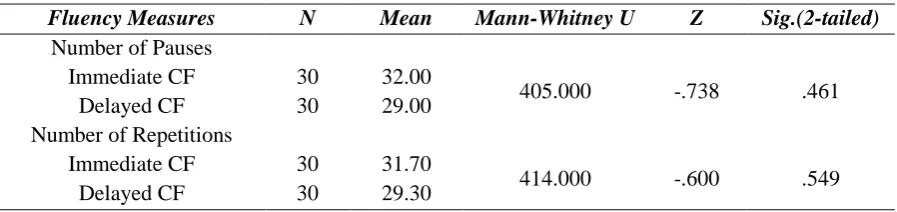
To find answer to the last research question, it was useful to trace the changes, produced by
the immediate and delayed CF on fluency which is in part in terms of 'the number of pauses'
and 'the number of repetitions'. As can be seen in Table 11, the immediate group obtained a
higher score (M = 32, 31.70). Thus, the immediate group had more pauses during task
performance than the delayed group. Although the difference did not reach statistical
significance (p = 0.46), delayed CF had a lower number of pauses (M = 29) than the
immediate group. Similarly, the p value of 0.54 with regard to 'the number of repetitions'
revealed no statistical significant difference between the immediate and delayed CF groups. It
is important to note that the participants in the immediate CF group paid no attention to the
teacher's correction and therefore did not repeat the correct form during task performance.
Table 11. Fluency Measures for Immediate and Delayed CF
Sig.(2-tailed) Z Mann-Whitney U Mean N Fluency Measures
Number of Pauses
.461 -.738 405.000 32.00 30 Immediate CF 29.00 30 Delayed CF Number of Repetitions
.549 -.600 414.000 31.70 30 Immediate CF 29.30 30 Delayed CF
Note: P < 0.05
Discussion and Conclusion
This study examined how much progress in learners' CAF, grammar gain and engagement
was made as a result of the changes in their CF time. The results of the current study revealed
a statistically significant improvement in the two CF groups but did not reveal any significant
difference between the two CF conditions with regard to their impact on social and cognitive
engagement, grammar gain, as well as on their complexity, accuracy and fluency. On the
other hand, in the case of behavioral and emotional engagement, there was a statistically
significance difference between the two CF conditions. Next we provide specific answers to
The Role of Corrective Feedback Timing in Task Engagement and Oral Performance 245
The first research question examined whether there was a difference between the
pre-test and post-test scores of the immediate and delayed CF conditions and between the two
CF groups. The outcomes obtained from the GJT test revealed that there were no statistically
significant differences between the two CF conditions, but there was a statistically significant
difference between the learners in terms of their patterns of improvement from the pre-test to
the post-test.
As it was noted in the reviewed literature, little attention has been paid to the timing of
CF, and yet there has been little attempt to distinguish the boundary between immediate and
delayed CF. Even though Long (1977) originally defined delayed correction as correction
that allows learners to finish their utterances, and immediate correction as correction that
interrupts them, contemporary CF research has subsumed these older notions under the label
of immediate CF. Contemporary CF literature often refers to delayed CF as a correction that
is given sometime after a communicative task (Hunter, 2012; Quinn, 2014).
Following these recommended conventions, a certain period of delay at an optimal
length might enable future researchers to close off avenues of hopeless possibilities and to
deal with an optimal length of delay which is neither too short nor too long. Undoubtedly, CF
that is provided immediately or provided after only a short delay may smoother learners'
desire to simply use language, unfettered by their over attention to correctness. Closely linked
to the immediate CF is the lure of immediate demands of the task or the pressure of knowing
that another task will begin shortly, which may cloud students' ability to process new
information. Thus, the believing game of distinguishing between immediate and delayed CF
may provide future researchers with a means for interpretation and understanding of whether
altering the length of delayed CF results in a difference in L2 development and performance.
Finally, and perhaps most importantly, the reason for an increase in scores across the
two CF conditions (immediate and delayed) is that the two groups received Form-Focused
Instruction (FFI) on the past passive-structure. Goo and Mackey (2013) have maintained that
the presence of additional instruction in CF research makes it difficult to clearly attribute
results to the effect of CF. They propose that this problem of separating the effects that result
from CF from those that result from additional FFI could be avoided by conducting studies
that do not include additional FFI. Besides, since the passive structure is less frequently
found in natural conversation, it deemed to be necessary to design FFI tasks which would
stimulate regular use of the past passive structure upon which CF could be provided when
246 Applied Research on English Language, V. 9 N.2 2020
ARE
L
The second research question explored whether there was a difference in the L2
learners' engagement that resulted from the immediate and the delayed CF treatment. The
results indicated that there was a statistically significant difference between the two CF
conditions in the case of behavioral and emotional engagement. On the other hand, no
statistically significant differences were found between the two CF conditions in terms of
their effect on the L2 learners' social and cognitive engagement.
Participants from the two CF conditions responded to the CF provision with both
negative and positive attitudes. Some negative emotional reactions were predictable because,
as was evident in the literature, researchers who discourage teachers from using CF
(e.g., Krashen, 1982) warn that CF may create negative evidence in learners' mind and
undermine their confidence. In contrast, the results obtained from HSSSE revealed that when
learners find learning environment exciting and enjoyable, they will pay more attention to the
task and yet try harder. Therefore, the difference between these two CF conditions may
possibly be due to difference in their corrective functions. Moreover, as Skinner, Furrer,
Marchand, and Kindermann (2008) note, learners who are more emotionally engaged show
higher levels of behavioral engagement.
In order to see whether there were fluctuations in behavioral engagement in L2 use
across the two CF conditions, performance data were measured and then transcribed. The
results revealed that the two CF conditions had a statistically significant impact on behavioral
engagement. Behavioral engagement, which in this study was marked by the 'total words
spoken', did seem to support the development of positive emotions and led to an increase in
interest and satisfaction in the immediate CF group compared to the delayed group: Learners
with lower level of classroom participation will finally fail to engage in learning tasks and
become more bored and frustrated, whereas learners who try hard and hang on in learning
tasks will tend to find them increasingly more exciting and fun.
Factors conceptualized as fundamental to cognitive and social engagement revealed no
statistically significance difference between the two CF conditions. We found that, in the two
CF conditions, student-student interactions seemed to offer more opportunity for establishing
high-level cognitive engagement than teacher-student interactions, both in class and small
group interactions. The social rules central to the communicative dictogloss task also
appeared to play a crucial role in the formation and manifestation of cognitive engagement.
The Role of Corrective Feedback Timing in Task Engagement and Oral Performance 247
in particular, revealed that learning occurs in the midst of communication. This idea is not
surprising given the pervasiveness of the communicative approach in EFL classrooms.
The other aim of the study was to examine the spoken complexity and how it can be
affected by different CF conditions. In line with previous studies (Farrokhi, Zohrabi & Chehr
Azad, 2018; Rahimi & Dastjerdi, 2012), the results did not reveal any significant effects of
CF timing on complexity. The results of the descriptive statistics revealed that the immediate
CF groups' complexity with regard to the 'frequency of the use of prepositions' and 'use of
conjunctions' was lower than that of delayed CF. However, considering the inferential
statistics, there were insignificant differences between the two CF groups in either
occurrences.
The logical explanation for these results, according to Farrokhi et al. (2018) can be
based on Schmidt's (1995) distinction between low and high levels of awareness and the
argument that while noticing is necessary for acquisition, understating results in deeper
learning.
Compared to other aims of consciousness, consciousness at the level of understanding,
a higher level of awareness, has had a relative influence on an analysis of an object of
consciousness in meaningful learning. Therefore, it can be suggested that since “explicit
correction helps learners develop awareness at both levels, noticing and understanding, it can
be a better candidate for the promotion of the second language learning” (Farrokhi et al,
2018, p. 138). Besides, the participants in this study may not still have reached an adequately
advanced linguistic level in their L2 development to begin displaying a clear attention to
complexity (Skehan, 2009).
Finally, in contrast to previous studies (e.g. Farrokhi et al, 2018; Rahimi & Dastjerdi,
2012), the analysis reported on the effects of the two CF provisions on the fluency and
accuracy revealed no statistically significant difference between the CF groups. One possible
reason for this lack of difference may be learners' pair work opportunities to bring together
their linguistic experience and co-construct L2 language knowledge. Swain and Lapkin
(1998) indicate that requests for validation of language form or language choice draw
learners' attention to a specific language form. This possibly makes learners more receptive,
confident and hence more likely to notice the feedback received in small group interactions
which, in turn, may affect their accuracy and fluency.
The findings of the present study call for more flexibility on the part of the teachers in
248 Applied Research on English Language, V. 9 N.2 2020
ARE
L
about the adverse effects of feedback. Such flexibility is academically beneficial for teachers,
especially when they need to combine instruction and CF also need to wait until after some
practice time before CF provision. However, accuracy may possibly be a similarly essential
element of the effective completion of the task. For instance, automaticity and accuracy are
necessary for those L2 students who are learning how to use rhetorical devices in public
speaking classes which may, in turn, affect their engagement.
Study Limitation
The limitation of the study indicates the need for more research which includes longer
interventions. The longer one might bring in its differences between immediate and delayed
CF treatments in a more reliable way.
References
Butler, D. L., & Winne, P. H. (1995). Feedback and self-regulated learning: A theoretical
synthesis. Review of Educational Research, 65(3), 245-281.
Cohen, A. D. (1987). Student processing of feedback on their compositions. In A.L. Wenden
and J. Robin (eds) Learner Strategies in Language Learning, 57-69. Englewood Cliffs,
NJ: Prentice-Hall.
Ellis, R., (1994). The study of second language acquisition. Oxford University.
Ellis, R. (2003). Task-based language learning and teaching. Oxford University Press.
Ellis, R. (2010). Epilogue: A framework for investigating oral and written corrective
feedback. Studies in Second Language Acquisition, 32(2), 335-349.
Ellis, R., & Barkhuizen, G. P. (2005). Analyzing learner language. Oxford: Oxford
University Press.
Farmani, R., Akbari, O., & Ghanizadeh, A. (2017). The Impact of Immediate and Delayed
Error Correction on Iranian EFL Learner's Motivation. European Journal of Foreign
Language Teaching, 2(3), 76-88.
Farrokhi, F., Zohrabi, M., & Chehr Azad, M. H. (2018). Corrective feedback and Iranian EFL
learners' spoken complexity and accuracy. Teaching English Language, 12(2), 117-143.
Ferris, D. R. (1995). Student reactions to teacher response in multiple‐draft composition
classrooms. TESOL Quarterly, 29(1), 33-53.
Goo, J., & Mackey, A. (2013). The case against the case against recasts. Studies in Second
The Role of Corrective Feedback Timing in Task Engagement and Oral Performance 249
Hattie, J., & Timperley, H. (2007). The power of feedback. Review of Educational Research,
77(1), 81-112.
Hedgcock, J., & Lefkowitz, N. (1996). Some input on input: Two analyses of student response
to expert feedback in L2 writing. The Modern Language Journal, 80(3), 287-308.
Hendrickson, J. (1978). Error correction in foreign language teaching: Recent theory,
research, and practice. The Modern Language Journal, 62(8), 387–98.
Housen, A., & Kuiken, F. (2009). Complexity, accuracy, and fluency in second language
acquisition. Applied Linguistics, 30(4), 461-473.
Housen, A., Kuiken, F., & Vedder, I. (Eds.). (2012). Dimensions of L2 performance and
proficiency: Complexity, accuracy and fluency in SLA (Vol. 32). John Benjamins
Publishing.
Hunter, J. (2012). Small talk: Developing fluency, accuracy, and complexity in speaking.
ELT Journal, 66 (1), 30-41.
Hunter, J.D., (2011). A multi-method investigation of the effectiveness and utility of delayed
corrective feedback in second language oral production. Unpublished Ph.D.
Dissertation (Module 3), University of Birmingham, UK.
Krashen, S. D. (1982). Principles and practice in second language learning. NY: Pergamon.
LaPierre, D. (1995). Language output in a cooperative learning setting: Determining its
effects on second language learning. Unpublished MA thesis, University of Toronto.
Larsen-Freeman, D. (1995). On the teaching and learning of grammar: Challenging the
myths. In F. Eckman, D. Highland, P. Lee, J. Mileham & R. Rukowski Weber (Eds.),
Second language acquisition theory and pedagogy. Mahwah, NJ: Lawrence Erlbaum.
Lee, E. J. E. (2013). Corrective feedback preferences and learner repair among advanced ESL
students. System, 41(2), 217-230.
Li, S. (2010). The effectiveness of corrective feedback in SLA: A meta-analysis. Language
Learning, 60(2), 309-365.
Li, S., Zhu, Y., & Ellis, R. (2016). The effects of the timing of corrective feedback on the
acquisition of a new linguistic structure. The Modern Language Journal, 100(1),
276-295.
Loewen, S., & Nabei, T. (2007). Measuring the effects of oral corrective feedback on L2
knowledge. Conversational interaction in second language acquisition: A collection of
250 Applied Research on English Language, V. 9 N.2 2020
ARE
L
Long, M. H. (1977). Teacher feedback on learner error: Mapping cognitions in H. D. Brown,
C. A. Yorio, & R. H. Crymes (Eds.), On TESOL '77 (pp. 278-293). Washington:
TESOL. 278-294.
Lyster, R., & Saito, K. (2010). Oral feedback in classroom SLA: A meta-analysis. Studies in
Second Language Acquisition, 32(2), 265-302.
Lyster, R., Saito, K., & Sato, M. (2013). Oral corrective feedback in second language
classrooms. Language Teaching, 46(1), 1-40.
MacIntyre, P. D., Dörnyei, Z., Clément, R., & Noels, K. A. (1998). Conceptualizing
willingness to communicate in a L2: A situational model of L2 confidence and
affiliation. The Modern Language Journal, 82(4), 545-562.
Philp, J., & Duchesne, S. (2016). Exploring engagement in tasks in the language classroom.
Annual Review of Applied Linguistics, 36, 50-72.
Quinn, P. (2014). Delayed versus immediate corrective feedback on orally produced passive
errors in English. (Unpublished doctoral dissertation). University of Toronto, Toronto.
Rahimi, A., & Dastjerdi, H. V. (2012). Impact of immediate and delayed error correction on
EFL learners’ oral production: CAF. Mediterranean Journal of Social Sciences, 3(1),
45-54.
Rocca, K. A. (2008). Participation in the college classroom: The impact of instructor
immediacy and verbal aggression. The Journal of Classroom Interaction, 22-33.
Salend, S. J. (2001). Creating inclusive classrooms: Effective and reflective practices
(4th ed.). Columbus, OH: Merrill/Prentice Hall.
Saslow, J. M., Ascher, A., Morsberger, R. E., Laporte, P., Long, W. P., & Ruzicka, D.
(2011). Top notch. Pearson Education.
Schmidt, R. W. (1995). Consciousness and foreign language learning: A tutorial in the role of
attention and awareness in language learning. In R. Schmidt (Ed.) Attention and
awareness in language foreign language learning, (pp. 1-64). Honolulu, HI: University
of Hawaii Press.
Shabani, K., & Safari, F. (2016). Immediate vs delayed correction feedback (CF) and
accuracy of oral production: The role of anxiety. Theory and Practice in Language
Studies, 6(11), 2222-2230.
Sheen, Y. (2012). The timing of corrective feedback and L2 learning. Paper presentation at
The Role of Corrective Feedback Timing in Task Engagement and Oral Performance 251
Skinner, E., Furrer, C., Marchand, G., & Kindermann, T. (2008). Engagement and
disaffection in the classroom: Part of a larger motivational dynamic? Journal of
educational psychology, 100(4), 765.
Skehan, P. (2009). Modelling second language performance: Integrating complexity,
accuracy, fluency, and lexis. Applied Linguistics, 30(4), 510-532.
Stroud, R. (2015). Learner Classroom Engagement: Definition, Measurement and Data
Usage. Paper presentation at the Asian Conference on Psychology and the Behavioral
Sciences. Kwansei Gakuin University, Japan.
Stroud, R. (2017). The impact of task performance scoring and tracking on second language
engagement. System, 69, 121-132.
Swain, M., & Lapkin, S. (1998). Interaction and second language learning: Two adolescent
French immersion students working together. The Modern Language Journal, 82(3),
320-337.
Varnosfadrani, A. D. (2006). A comparison of the effects of implicit/explicit and
immediate/delayed corrective feedback on learners’ performance in tailor-made tests.
Unpublished PhD thesis, University of Auckland.
Yazzie-Mintz, E. (2007). Voices of Students on Engagement: A Report on the 2006 High
School Survey of Student Engagement. Center for Evaluation and Education Policy,
252 Applied Research on English Language, V. 9 N.2 2020