126 |
P a g e
International Journal of Pharmaceutical
Development & Technology
e ISSN - 2248 - 910X
www.ijpdt.com
Print ISSN - 2248 - 9096EFFECT OF WATERSHED ON PROMOTION OF SELF-HELP GROUPS
AND CREATION OF ECONOMIC OPPORTUNITIES
Santhi Sri KV
1*, Brahmaji Rao P
2and Sivannarayana G
31
Asst. Professor, Dept. of Foods and Nutritional Sciences, Acharya Nagarjuna University,Guntur-522510, Andhra Pradesh, India.
2Asst. Professor, Dept. of Environmental Science, Acharya Nagarjuna University, Guntur - 522510, Andhra Pradesh, India. 3Professor, Department of Extension, Agricultural College, Bapatla, Andhra Pradesh 522101, India.
ABSTRACT
Livelihood security is the adequate and sustainable access to control over resources, both material and social, to enable households to achieve their rights without undermining the natural resource base. The livelihood security approach aims for holistic analysis and understanding of the root cause of food insecurity. Self help groups are also one among the sources to provide food security. Hence the study was conducted to see Effect of Watershed in terms of Increasing Socio- Economic Status, promotion of self help groups and creation of economic opportunities in six villages of three mandals of Prakasam district. Results revealed that promotion of self help groups were more compared to earlier where there were no watershed activities. Also, it is striking to note down that there was not even a single group in three villages namely Ganeswarapuram, East Venkatapuram and Nancharapuram, before installation of watershed. But after watershed construction there was group formations as well as economic opportunities.
Keywords: Self help groups, Three mandals of Prakasam district.
INTRODUCTION
Watersheds are hydrologic units that are considered to be efficient and appropriate for assessment of available resources and subsequent planning and implementation of various development programmes [1]. Watershed is defined as “ Natural Hydrologic entity that cover a specific area expanse of land surface from which the rainfall runoff flows to a defined drain, channel, stream or river at any particular point’’ [2]. A watershed, very often referred as synonym to catchment in the hydrological divide separation one drainage basin from other. It is also defined as topographically delineated area that is drained by a stream system and is characterizes by a common outlet through which excess over land flow collected within the watershed is drained out [3].
The development of natural resources in an area can be contained and the resources property developed only by adopting the watershed approach [4]. The basic unit of development is a watershed, which is a manageable hydrological unit [5]. In this approach, development is not confined just too agricultural lands alone, but covers the area, stating from the highest point of the area (ridge line) to the outlet of the nalah or the natural stream [6]. Dry land agriculture is pestered with various problems like soil, land and environmental degradation. Since about four decades
watershed has become the pivotal role for all soil and land developments in a holistic way reported in [7]. Soil and water are the most important natural resources within our eco system and watersheds have been identified as planning units for administrative purpose to conserve these precious resources [3,8]. The concept of management recognizes inter relationship among land use, soil and water and linkage between uplands and downstream areas according to the findings [9].
The watershed should be concentrated upon and to be turned into a beneficial asset. There shouldn’t be change only in the lands, but also in the people and their economy. The attitude of “For themselves” should change to “For us”. A Self-Help Group may be registered or unregistered. It typically comprises a group of micro entrepreneurs having homogenous social and economic backgrounds; all voluntarily coming together to save regular small sums of money, mutually agreeing to contribute to a common fund and to meet their emergency needs on the basis of mutual help [10]. They pool their resources to become financially stable, taking loans from the money collected by that group and by making everybody in that group self-employed Self-help groups are seen as instruments for a variety of goals including empowering women, developing leadership abilities among poor people,
127 |
P a g e
increasing school enrolments, and improving nutrition and the use of birth control [11]. Financial intermediation is generally seen more as an entry point to these other goals, rather than as a primary objective. This can hinder their development as sources of village capital, as well as their efforts to aggregate locally controlled pools of capital through federation, as was historically accomplished by credit unions.
The effect of natural resource management and environmental variables influencing the participation SHGs is yet to be explored. In this context, the present paper focuses on the Effect of Watershed in terms of Increasing Socio- Economic Status. Promotion of self help groups and creation of Economic Opportunities and their potential role in improving the welfare of the rural households. By doing so the present paper contributes to the existing literature on how the natural resources and environmental variables influence participation in SHGs and the impact of participation on household welfare.
MATERIALS AND METHODS
The present study was carried out to know the impact of watershed on Household production systems. Six villages from 3 Mandals in Prakasam District were selected for study. Thus-from Darsi Mandal- Ganeswarapuram and East Venkatapuram and from Mundlamur Mandal- Vempadu, Pasupugallu and from Kurichedu Mandal-Nancharapuram, Avvulamandha were selected. In all these villages watershed activities were there from 1995 to 2000 (Five years)
A total of 1869 families were surveyed from all the six villages to see impact of watershed on household production systems. A total of households 97, 374, 284, 597, 165, 352 from Ganeswarapuram East Venkatapuram, Vempadu, Pasupugallu, Nancharapuram, and Avvulamandha respectively were surveyed for data collection.
A great deal of work in Andhra Pradesh Rural Livelihood Programme (APRLP) is on strengthening the ongoing watersheds of government of A.P. Efforts are being made to meet the strategic and practical livelihood concerns of the poor, women and small marginal farmers in completed, ongoing new watersheds. APRLP believes that watersheds activities should go beyond land based initiatives in order to address the multiple livelihood needs of the rural populations. APRLP to develop a strategy on developing skilled persons in watershed villages, in the agriculture and livestock sector, Vermiculture, Horticulture and Nursery rising, floriculture, Sericulture, Hybrid seed production. Training in poultry farming/commercial backyard poultry rearing, Sheep farming/Sheep extension, dairying/ fodder production, Nutrition, Kitchen Gardens.
In order to study the impact of watershed on household protection systems, 6 villages from 3 mandals
were selected in Prakasam District of Andhra Pradesh. The 6 village’s efforts have been made to enumerate and study the impact of watershed. The households in all 6 villages were surveyed with pre-tested schedule. This study helps to know whether the implemented watershed was successful or not. The following objectives were framed to assess the data.
RESULTS AND DISCUSSION
Assessment was made on impact of watershed with regard to production, developmental as well as socio-economic activities. The study was carried out in six villages of three mandals in Prakasam district and the results are presented under the following sections. The changes occurred due to watershed activities in all the six villages were tabulated as follows.
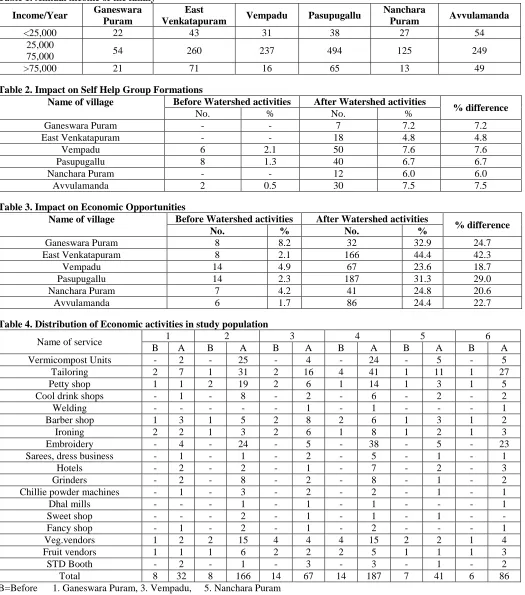
It is perusal from the table that majority of the families have annual income of Rs.2,500 to 75,000 and most of them have good material possessions like T.V., Bike, Gas Stove etc., This shows their better standard of living which was due to watershed activities.
It is obvious from the table that self-groups are more compared to earlier where we can see limited groups. SHG membership seems to be positively correlated with livestock ownership, especially goats and buffaloes. SHGs are especially responsible for the increase in dairy production. Livestock have been an integral part of farming systems and the livelihoods of rural households especially in rain fed areas throughout the world.
According to watershed management plan (Bunga), Chandigarh, it is stated that in order to improve the socio-economic condition of people, reduce the dependence and reverse the process of environmental degradation, it is essential to improve ore adopt soil and water conservation measures on watershed basis which would serve as a model of resource development in the Siwalik region [12]. Results reported that half of the families worked as labourers and the rest half were self-employed. And regarding live-stock and social forestry and Horticulture there was improvement.
Impact of watershed in all the villages (n=1869 households)
A success in any watershed programme is impossible without the active participation of the people of the region. Community involvement is essential for successful implementation as well as for the maintenance of structures created under the project. Even if implementation of a programme is by an external agency, the management of the schemes is essential for the task of the communities. For adequate participation it is important to create awareness among the people of the region, involve them in project implementation from the very beginning and utilize indigenous technical knowledge available in that region. N.G.Os can play a vital role of linking Government agencies with the people. Thus convergence of knowledge available
in various fields of biological, social and engineering sciences is must to undertake the various steps in an
128 |
P a g e
management plan and its implementation. It is striking to notice that huge number of Self help groups was formed only after implementation of watersheds. There was a
drastic change. With regard to economic opportunities, numerous opportunities were established only after implementation of watersheds.
Table 1. Annual income of the family
Income/Year Ganeswara
Puram
East
Venkatapuram Vempadu Pasupugallu
Nanchara
Puram Avvulamanda
<25,000 22 43 31 38 27 54
25,000
75,000 54 260 237 494 125 249
>75,000 21 71 16 65 13 49
Table 2. Impact on Self Help Group Formations
Name of village Before Watershed activities After Watershed activities
% difference
No. % No. %
Ganeswara Puram - - 7 7.2 7.2
East Venkatapuram - - 18 4.8 4.8
Vempadu 6 2.1 50 7.6 7.6
Pasupugallu 8 1.3 40 6.7 6.7
Nanchara Puram - - 12 6.0 6.0
Avvulamanda 2 0.5 30 7.5 7.5
Table 3. Impact on Economic Opportunities
Name of village Before Watershed activities After Watershed activities
% difference
No. % No. %
Ganeswara Puram 8 8.2 32 32.9 24.7
East Venkatapuram 8 2.1 166 44.4 42.3
Vempadu 14 4.9 67 23.6 18.7
Pasupugallu 14 2.3 187 31.3 29.0
Nanchara Puram 7 4.2 41 24.8 20.6
Avvulamanda 6 1.7 86 24.4 22.7
Table 4. Distribution of Economic activities in study population
Name of service 1 2 3 4 5 6
B A B A B A B A B A B A
Vermicompost Units - 2 - 25 - 4 - 24 - 5 - 5
Tailoring 2 7 1 31 2 16 4 41 1 11 1 27
Petty shop 1 1 2 19 2 6 1 14 1 3 1 5
Cool drink shops - 1 - 8 - 2 - 6 - 2 - 2
Welding - - - 1 - 1 - - - 1
Barber shop 1 3 1 5 2 8 2 6 1 3 1 2
Ironing 2 2 1 3 2 6 1 8 1 2 1 3
Embroidery - 4 - 24 - 5 - 38 - 5 - 23
Sarees, dress business - 1 - 1 - 2 - 5 - 1 - 1
Hotels - 2 - 2 - 1 - 7 - 2 - 3
Grinders - 2 - 8 - 2 - 8 - 1 - 2
Chillie powder machines - 1 - 3 - 2 - 2 - 1 - 1
Dhal mills - - - 1 - 1 - 1 - - - 1
Sweet shop - - - 2 - 1 - 1 - 1 - -
Fancy shop - 1 - 2 - 1 - 2 - - - 1
Veg.vendors 1 2 2 15 4 4 4 15 2 2 1 4
Fruit vendors 1 1 1 6 2 2 2 5 1 1 1 3
STD Booth - 2 - 1 - 3 - 3 - 1 - 2
Total 8 32 8 166 14 67 14 187 7 41 6 86
129 |
P a g e
Table 5. Self Help Groups (N = 1869)
Before Water Shed activities After Water Shed activities
No. % No. %
16 0.9 157 8.4
Table 6. Economic opportunities (N = 1869)
Before Water Shed activities After Water Shed activities
No. % No. %
57 3.0 579 30.9
John Butter worth et.al, (2003) [13] reported from his case study conducted in Mehabub Nagar that Gaddam Alivelamma from Koduru village in Mehabub Nagar was introduced to vermicomposting by an NGO which was working to improve the livelihoods of small and marginal farmers. It was shown very good results in gaining more income through selling of Vermicompost.
Padma (2002) [14] reported that in Nomula, Nalgonda, the livelihoods of 15 scheduled caste households have been improved due to watershed activities. Bharathi, Mehabub Nagar (2002) [15] reported that the women from Malleboinpalli, Mehabub Nagar used credit from the SHGs to purchase raw materials for Gongali (Shawl) making as well as to buy sheep and buffaloes. Unny (2003) [16] reported that in Prakasam district from Doddavarappadu village, Padivindla Gorvardhan has built his career with vermincomposting by creating a micro-corporate in thatched sheds.
According to WOTR (1999) [17] labourers in Mendhwan village could find employment eight months of the year compared with three months work prior to installation of watershed.
As a welfare state the Govt. of India and state Governments accord the highest priority to poverty alleviation in rural areas. The 25 years’ perspective plan prepared by the planning commission also indicated poverty
reduction as one of the major objectives of watershed development programme. Water and soil are two most important natural resources for our survival. Their rapid depletion obviously is of great concern for mankind. To arrest their degradation, technical knowledge, integration of various sciences, understanding of Socio-Economic aspects and peoples’ participation are of utmost importance.
Uncontrolled, unplanned, unscientific land use and human activities lead to deterioration of watersheds which in turn results in low productivity of food, fuel, forage, fibre and fruits, erosion and denudation, and poor health of people and cattle. Thus rational utilization of land and water resources for optimum production with minimum hazard to natural resources is of paramount importance. This can be made possible only by utilizing the collective wisdom of experts from various disciplines.
Thus the impact of watershed studied in all the six villages has shown positive results. This was due to active participation of the people. Hence it is concluded that such programmes must be enhanced and coverage of villages also should be increased to provide benefit to the rural communities. Government also must provide necessary encouragement and support to such programmes for effective implementation and to see light in the eyes of poor people.
REFERENCES
1. Krishna Tiwari, R, Roshan Bajracharya M, and Bishal Sitaula, K, 2008, Natural resource and Watershed management in south Asia, A comparative evaluation with special references to Nepal, The Journal of Agriculture and Environment, 9. 2. Chensheng He, Changan Shi, Changchun Yang and bryan, Agosti P. A windows-Based GIS-AGNPS Interface, Journal of
the American Water Resources Association, 37(2), 2001, 395-406.
3. Khan MA, Issac VC and Bohra DN. Hydrological characteristics of sardar samand reservoir in arid Rajasthan. Annals of Arid Zone, 29, 1990, 87-92.
4. Kushwaha SPS. Sustainable Development Planning in Pathri Rao Sub-watershed Using Geospatial Techniques, Current Science, 98, 2010, 11.
5. Pascual U. Water Agriculture and Sustainable Wellbeing, Oxford University Press, New Delhi, 2009. 6. Bali, Integrated Watershed Management Programme, Khetarli, 2010, 1-188.
7. World Water Assessment Programme. The United Nations World Water Development Report 3, Waterin a Changing World. Paris, UNESCO, and London, Earthscan, 2009.
8. Zwarteveen M, Boelens YR. Investigation interdisciplinaria sobre justicia hidrica unas aproximaciones conceptuales. Primera Conferencia de Justicia Hídrica. Cusco, 2009, 22-26.
9. L’Abee-Lund JH, Haugen T. Fangststatistikken avlaksefisk – hva viser den Fiskesymposium. Gardermoen, 2002, 14–15. 10. Sujith Kumar PS, Income Diversification in Rural Household Measurements and Determinants, the ICFAI Journal of
130 |
P a g e
11. Paridhi Mutreja. Optimization of the usage of Financial Support in terms of Annual Bonus distributed to the Joint Forest Management Committees and identifying credit linkage between financial institutions and Joint Forest Management Committees, 2011.
12. Singh G, Mittal SP, Dhruva Narayana VV and Agnihotri RC. Watershed management plan Vit Bunge, SWCRTI, Dehra Dun. 1983.
13. John Butterworth, Barbara Adolph, and Suresh Reddy B. How farmers manage soil fertility in a guide to support innovation and livelihoods, 2003.
14. Padma K. DCBC-Nalgonda.in. Initiative- An update of events and activites of the Andhra Pradesh Rural Livelihood Programme. Impact of watershed activity on livelihood, 2, 2002, 2.
15. Bharathi G. Initiative- An update of events and activites of the Andhra Pradesh Rural Livelihood Programme, Impact of watershed activity on livelihood, 2, 2002, 2.
16. Unny EP. Language, landscape and livelihoods- sketches and notes on five drought prone districts of Andhra Pradesh, 2003. 17. WOTR Watershed Organization trust. Watershed development and the land less. The watershed family. Newsletter of the