Question answer relationship strategy increases reading comprehension
among Kindergarten students
Leena Furtado
(Professor, California State University, Dominguez Hills, USA) [email protected]
Heidi Pastell
(MA, Elementary Teacher in California, USA)
(Received: 25.12.2011, Accepted: 10.03.2012) Abstract
The Question Answer Relationship (QAR) strategy equips students with tools to successfully
decode and comprehend what they read. An action research project over 18 days with
twenty-three kindergarteners adapted exposure to QAR’s “In the Book” and “In my Head” categories
with similar questions for each of two popular Aesop’s fables. The challenges and outcomes
are presented with special emphasis on teacher-preparation, teacher-reflections, and a
hands-on, day-by-day project-implementation. An oral pre-test, after reading The Tortoise and the
Hare, served as a baseline assessment for student-comprehension levels. The QAR strategy
was then explicitly taught, with opportunities to practice the comprehension skills in small and
large groups with parental assistance. Students overwhelmingly scored higher on the post-test
reading comprehension after the read-aloud of The Jay and the Peacock with some receiving
perfect scores.
Keywords: question answer relationships (QAR); action research intervention; reflective inquiry; implement theoretical constructs (ITC); reading comprehension.
Introduction
A complex and pervasive goal of education in elementary school is reading comprehension for all students (Sporer, Brunstein, Kieschke, 2009) because reading comprehension provides the foundation for a substantial amount of academic learning
comprehension (National Institute of Child Health and Human Development, 2000).
Guthrie, Wigfield, Barbosa, Perencevich, Taboada, Davis, Scafiddi & Tonks (20041) posit reading comprehension to be a complex process resting primarily on instructional research which includes explicit cognitive strategy instruction. Strategies such as using schema, making connections, visualizing, inferring with text, and the question answer relationships (QAR) strategy are often associated with the instruction of older children (Stahl, 2004); however, it is important to note that these are all very relevant strategies for younger (even Kindergarten) students too (Gregory & Cahill, 2010). This study reports an action project intervention of an adapted exposure of QAR comprehension skills development among Kindergarten students.
Review of Literature
Comprehension Learning Through the Use of Explicit Strategy
Raphael, Highfield & Au’s (2006) research notes that students lack the fundamental skill to apply the sources for finding information to answers in school settings, “despite the fact that students ask and answer questions from a very young age” (Raphael, et al.,
2006, p. 13). The scholars designed QAR as a method for a deliberate and a common way of thinking and talking about effective sources of information when answering questions. QAR strategy incorporates Anderson & Pearson’s (1984) schema
1
See also Guthrie, J.T., Wigfield, A. & Perencevich, K.C. (Eds) (2004). Motivating Reading Comprehension: Concept-oriented reading instruction. Mahwah, NJ: Erlbaum.
theory, Brown, Campione & Day’s (1981) metacognition, and Schank & Abelson’s (1977) script theory. The QAR language conveys the idea that answers can be found in text sources or in our background knowledge and experiences (“In the Book” and “In My Head”) (Raphael, et al., 2006). Research shows how important it is for students to understand the distinction between these two primary sources of information to improve reading comprehension (Taylor, 2008).
QAR draws from the advocacy of Vygotsky’s (1986) psycho-social interactions where children gain incremental cognitive and holistic development through cooperative learning, small-group centers, and social activities with the “more capable other2” (Raphael, et al., 2006, p. 37) as
opposed to competitive, large-group, teacher-dominated learning. These forms of social learning are of great importance to the child, both socially and academically. Joining thinking and doing as two seamlessly congruent halves of the learning process is at the core of allowing students to actively participate in the learning process, and strengthen their knowledge base by tapping into prior knowledge and effectively implementing scaffolding strategies (Taylor, Pearson, Peterson & Rodriguez, 2005). If teachers are going to be successful instructors of comprehension, they must be involved in reading with an awareness of how the strategies are successfully used in actual reading (Dobler, 2009).
2 The illustration refers to how a parent (the more
Comprehension Through Read-Aloud
One successful strategy used in actual reading is the “read-aloud” approach, especially useful for beginning learners with rudimentary reading skills. Trelease (2006) recommends reading to young children for the very same reasons we talk to young children. He says
“we read to young children …….to reassure, to entertain, to bond; to inform or explain, to arouse curiosity, and to inspire. But in reading aloud, you also condition the child’s brain to associate reading with pleasure; create background knowledge; build vocabulary; and provide a reading model” (Chapter
1).
Reading to a child may be deemed an easy task, but it can become a powerful, yet subtle, learning tool when placed within a structured setting (Beck & McKeown, 2001), where comprehension skills are honed in by providing children the opportunities to preview a text, to generate words, and organize thoughts to make oral responses before, during and after reading of a text (Yopp & Yopp, 2004). Dickinson and Tabors (2001) suggest that teachers and parents should involve children in both immediate and non-immediate talk. Immediate talk concentrates on answering factual details and labeling pictures. Non-immediate talk extends beyond the text. It includes word meanings, making predictions and inferences, and relating the text to personal experiences. It is important that individual children have numerous opportunities to engage in non-immediate talk before and during read-aloud. A
cross-age read-aloud program of high-school student volunteers reading to pre-K children showed tangible and noteworthy gains for the afore-mentioned advocacies3 in promoting textual comprehension and critical thinking among both student-readers and their pre-K learners (Furtado, 2010).
Leadership and Action Research Intervention
In schools, effective teacher intervention …
“has become a defining characteristic of recent efforts to professionalize teaching and reform school” (Smylie, 1996, p. 3).
Teacher leadership is often embedded in the research-based instructional improvement efforts undertaken by teachers to enhance student learning (York-Barr & Duke, 2004). It is true that teachers are extremely busy and are constantly faced with “doing more with less”. Danielson (2006) delineates teacher dispositions and required models for leadership in the profession where teachers just don’t do things differently but do them
better (italics, authors) as a professional exploration of practice. While, Fullan (1994) advocates that teacher leaders should develop and exhibit: 1) knowledge of teaching and learning pedagogy; 2) collegiality; 3) engagement in life-long learning and growth; 4) awareness of change processes within the educational context and the larger community; and, 5) a moral perspective towards the profession.
Deciding to do more; and, making a difference are personal endeavors a teacher
3
can or may strive towards. Recently, an elementary public school in southern California adopted the “The Leader in Me” program, by highlighting the seven qualities of highly effective people (Covey, 2004) to be addressed and adopted by the teachers of the leadership committee for this new program4.
Reflective Inquiry for the Action Research Intervention
Reflection or inquiry is especially of great importance for a teacher-leader and its origin can be traced back to Dewey’s (1993) philosophy of progressive education. He viewed inquiry as a process of pragmatic problem-solving and the nurturing of reflective skills as an essential ingredient to improve the practice of teaching (Emerling, 2010). For the teacher, reflection strengthens instructional pedagogy, ensures that methodology is grounded in empirical research and personal teaching philosophies, promotes creativity, builds schemata for future lessons, and supports academic, social, and emotional desired student outcomes (Henderson, 2009). Schon (1987) recommends teachers to reflect and think spontaneously during classroom interactions and also engage in recall and reflection on one’s actions and thoughts after an instructional process by self or with peers to reveal the wisdom embedded in the experience.
4 The program focuses on a teacher’s self-mastery
skills by teachers being more proactive, to prioritize, to begin with the end in mind, develop interdependence by creating success for the school, understand initiative, first understand needs, be synergized to change, and become a life-long learner.
Reflective inquiry and its importance in an action research intervention are explicitly considered, and especially well highlighted by the following researchers:
Wellington (1991) states, “reflection practice calls for personal and professional transformation intended to raise consciousness, to challenge complacency, and to engender a higher order of professional practice” (p. 5).
Canning (1991) states, that reflection can lead the teacher to explore alternatives that eventually lead to “Aha!” (p. 20) moments associated with participating in systematic reflection and action research.
Schon (1987) describes two types of reflections to help develop a reflective thought process. They are: “Reflection-in-Action”, leading to one’s spontaneous ways of thinking and acting in the midst of the action and “Reflection-on-Action,” to reflect after the process is completed.
Killion & Todnem (1991) beckon teachers as professionals to treat reflection as “a gift we give ourselves, not passive thought……. but an effort we approach with rigor, some purpose… and in a formal way…to reveal the wisdom embedded in our experience” (p. 14).
The teacher’s initial reflection “My initial reaction was to think back to my years in the BTSA5 program and recall the vast amount
5
of reflection that was required” is further
expanded in her own words.
Teacher’s Initial Thoughts
Back then, amongst all the stress and chaos of becoming a new teacher, reflection seemed to be “one more thing to do.” … As years go by …; I find myself reflecting more frequently than before.
As a fellow colleague pointed out this evening in class: “In the beginning, you are just taking materials and strategies that you can get and trying them out to see what works”.
Likewise, reflection for the student makes learning more meaningful, connects to strengths and needs, helps develop self-efficacy and esteem, solidifies content, and allows for students to find their academic niche. Time should be allotted to allow students to really think about their work, effort, achievements, and needs. Even at a young age such as Kindergarten, students are capable and excited to review special pieces of work and verbally describe how they created it, and why they chose a particular method to accomplish a task (Gregory & Cahill, 2010).
The Study
This predicative study explicates instruction of the QAR strategy over a four week (18 day intervention) period to enhance comprehension skills among Kindergarten students. The research also presents simultaneous teacher reflections that underscore the critical challenges to implement theoretical constructs (ITC) and
professional development of newly-credentialed, beginning teachers and fulfill the requirements for the California Clear Multiple and Single Subjects Credentials.
the spontaneous adjustments required during intervention to maximize student learning.
Preparing for a QAR Intervention
Empirical studies call for a more formal preparation and support of teacher leaders to collaborate, create community, foster ownership, empower self and others, and most importantly, learn to lead by researching and improving one’s instructional expertise in the classroom (Fullan, 1994; Lieberman & Miller, 2005). Dick (2007) describes action research to be an extension of a natural approach to problem-solving entailing “review plan act review…and so on” (p. 150). The
iterative cycle of action and research leads teachers to fulfill the “dual aims of action (or change) and research (or theory, or understanding)” (Dick, 2007, p. 150) “that incorporates questioning, assessing, investigating, collaborating, analyzing, and refining” (Schoen, 2007, p. 211) the
problem.
The teacher is a five-year veteran in elementary schools, and has two years in the current classroom.
The teacher is enrolled in a MA in education capstone course that teaches and nurtures in-service teachers on classroom interventions over 13 weeks (Covey, 2004; York-Barr & Duke, 2004).
The teacher attended instructional sessions for exposure to the various stages of research, data analysis and a review of Action Research Project modules completed by prior students in the program.
In this setting, 5 peer teachers chose QAR6 as their intervention project, and peer-collaboration was encouraged throughout 13 week semester (Henderson, 2009).
Mentoring by a professional educator, peer-consultations, and weekly reflection journals are tools used to “review plan act review…” (Dick, 2007, p.150)
QAR to specific classroom needs.
School Profile
The elementary school in southern California has an Academic Performance Index (API) score of 965 (scores range from 200-1000) for 2009-10; has a split-day and a full-day Kindergarten; and, uses a Response to Intervention (RTI) program to target and
6Question answer relationships now, written by the
creators of QAR, extensively outlines the QAR strategy, provides a framework for organizing instruction, and offers many classroom examples across grade levels. The book contains lesson plans and activities that teachers can utilize when implementing the strategy. Raphael, T. Highfield, K., & Au, K. (2006). Question answer relationships now, New York, NY: Scholastic.
assist struggling readers. Twenty-three students, (twelve boys and eleven girls) ages five and six participated in the study. There are eighteen Caucasian, two Japanese, one Chinese, one Iranian, and one Korean student in the class. For most of the year, students focus on letter recognition, phonemic awareness, and decoding. Reading comprehension and text analysis are imbedded in the daily Language Arts instruction, with a focus on RTI small group instruction on comprehension skills. This helps prepare kindergarten readers for the transition to first grade. Through the use of small group instruction, targeted skills, and the Headsprout7 computer program, students were exposed to a modified QAR intervention.
Adapting the Research for Kindergarteners
The purpose of the study was to see how explicit instruction of the QAR strategy over a four week (18 day intervention) period can 7
See www.headsprout.com. Headsprout Early
Reading is a research-based, online supplemental early reading program that teaches reading fundamentals. Headsprout provides instruction in Phonemic Awareness, Phonics, Fluency, Vocabulary, and Reading Comprehension, and teaches segmenting, blending, and decoding in context. Key Program Outcomes:
- Reading/decoding up to the mid-2nd-Grade level
- Fluent knowledge of over 90 phonetic elements and over 100 sight words - Potential reading vocabulary of over 5,000
words
- Progression from single word
comprehension to building meaning and inferential comprehension
enhance reading comprehension among Kindergarten students. It was crucial to adapt various QAR lessons, alter time periods, and modify specific strategies so that the content was both accessible and appropriate for young learners.
Because many students cannot read independently and write answers to questions, there are parent volunteers, who also help orally ask the questions. Students’ exact answers are then recorded on their tests, and graded. Over fifty percent of students’ parents volunteer on a weekly basis within the classroom. All students are proficient in the English language, and are able to communicate their thoughts and ideas very well.
The stories used for intervention are both Aesop’s fables. The teacher selected The Tortoise and the Hare and The Jay and the Peacock from a reading list for kindergarten children to allow comprehension beyond the literal level with admirable animal characters that children of all backgrounds can relate to (O’Sullivan, 2004). The selected stories helped focus on student characteristics such as: perseverance; completion of a task, self-image and accept your true identity. A pre- and post-test consisted of the same thirteen questions. Six of the thirteen questions are “In the Book” questions, while the remaining seven are “In My Head” questions.
Kindergarteners Learn Reading Comprehension With a QAR Strategy of Six "In the Book" and Seven "In my Head" Questions
"In the Book" Questions "In my Head" Questions
1. Where does the story take place?
7. How does the story end?
2. Who are the
characters?
8. What kind of a story is this? What is the moral or lesson?
3. Who is your favorite character and why?
9. Is this story like your own life? How?
4. Which character do you dislike and why?
10. If you were the author, how would you change the story?
5. What is the problem of the story?
11. Why do you think the author used a tortoise (jaybird) and a hare (peacocks) for the main characters?
6. How is the problem solved?
12. If you were the hare (little jaybird), what would you have done? 13. Did you like the story? Why or why not? What was the best part?
Staying within the same genre for testing, and using the same questions allows for the results of the pre- and post-tests to reflect accuracy, consistency, and the ability to measure the effectiveness of the intervention.
DAY 1: QAR- A New Adventure in Reading!!!
lay the groundwork for a whole group discussion that explained how different types of questions can help to understand the text in various ways. Students engaged in a discussion which highlighted the difference between “In the Book” questions, and “In My Head” questions. The class also briefly discussed the story’s elements (characters, setting, problem, solution, etc.). Students were told that they would be called over either by the teacher or a parent volunteer to answer a series of questions about the story.
End of DAY 1: Initial Assessment
After the discussion, the look of confusion was evident on students’ faces. There was an immediate need to delve deeper into the QAR strategy. The difference between “In the Book” and “In My Head” questions required descriptive examples of questions from the fable that was just read. As students thought about each question, they began to understand the difference between finding the answer in the story, and finding the answer in their heads. This took a long time and a plethora of examples, but slowly students began to grasp the main concept.
DAY 2: A 2nd Reading of The Tortoise and the Hare
After day one’s introduction of the QAR strategy, it became clear that explicit, step-by-step instruction and descriptions were necessary in order to maintain student focus, engagement, and excitement. Day 2 began by reviewing day 1’s experiences. Students engaged in a whole group discussion on The Tortoise and the Hare, highlighting key elements of the story, and reviewing the comprehension questions that had been
discussed on day 1. Students found it easy responding to “In the Book” questions such as: Who are the main characters? Where does the story take place? Why are the animals running in a race?
However, when it came to “In My Head” types of questions, students struggled a bit. It is not surprising at all that students initially struggle with these types of questions, After all, implementation of QAR has just started, and developmentally speaking, students will need extra time to be exposed to the skill, as well as practice it. Days 2 - 5: Realignment of QAR based on Initial Pre-Test Results
Five students were given the first pre-test, while the rest of the class worked independently on a worksheet related to the fable. Upon initial review of the five pre-tests, it appeared that students continue to do very well with the “In the Book” questions, and remain slightly unclear or confused with the “In My Head” questions. Since gathering data and analyzing students’ strengths and needs should guide instruction, the teacher used the rest of the week to highlight the “In My Head” questions. Students were given ample time to practice this skill, both in whole and small groups (ITC: Schon’s (1987) classroom interactions implemented here).
Teacher Thoughts8
The scope and sequence of activities and discussions related to QAR need to be monitored …. . Because I am witnessing looks of confusion when discussing the “In My Head” portion of the QAR strategy whole group, I decided … to supplement … with smaller group activities to focus on the confusing topics.
Days 6 - 10: Understanding QAR and Working in Groups
With the help of parent volunteers, three groups of six students each and one group of five students formed around the classroom. With the parent volunteers and the teacher acting as facilitators, both “In the Book” and “In My Head” questions were asked orally within each group. If students were unsuccessful answering their particular question, the discussion was opened up to the rest of the group, and students were able to support each other and contribute to the answer. Small group leaders emerged to assist those that might have difficulty (Here, the teacher is implementing social and peer interactions discussed in Beck & McKeown, 2001; Trelease, 2006; Vygotsky, 1986). After the literature circles finished their discussions, all students returned to the common rug to share ideas and reflect on how QAR was working for them (student reflection is something this class does on a daily basis)9. It was reassuring to hear
8
The teacher reflects on Schon’s (1987) recommendation to reflect and think spontaneously during classroom interactions. The teacher is fully implementing Dick’s (2007) iterative cycle with her “review plan act review ….” actions to supplement her initial intervention-plans. 9
These students possess two different sets of portfolios for their work. One set is for the parents to take home and admire their important work. The other set stays in the classroom for students to add to,
students reflect on their literature circles and share ideas on what they think about their own learning.
Teacher Strategizes Her Priorities10
Throughout week two, it was my priority to explicitly explain the QAR strategy, model how it works every day, allow students to engage in guided practice after each mini-lesson, enable students to coach each other in small groups, independently apply the strategy to smaller passages read aloud, as well as self-assess their work and achievements at the end of each lesson through a meaningful class discussion.
These group lessons were groundbreaking in the sense that students who previously struggled with the comprehension question (either both types, or just one), were beginning to understand the difference between the two types of questions, and slowly becoming more comfortable expressing their thoughts and opinions within their small group (Raphael, et al., 2006).
Teacher Diary11
Week two was devoted to teaching, developing, and building upon the QAR strategy …… Students worked in both large and small groups to practice answering the two types of questions, as well as deciphering which type of question was being asked …… This … thinking is quite abstract for many young learners, … we spent an extended period of time honing this skill.
and give verbal rationale as to why they picked each piece.
10
ITC: Here the teacher is implementing Yopp & Yopp (2004) where comprehension skills are honed in by providing children the opportunities to preview a text, to generate words, and organize thoughts to make oral responses before, during and after reading of a text.
11 Beck & McKeown’s (2001) placement of reading
Days 11 – 15: Students Read New Stories Selected by Their Own Leaders
These five days had students take the knowledge that they gained in their small literature circles during days 6 – 10, and apply it to different stories. Students were again placed in groups of five or six, and a group leader was chosen. The leader then had the opportunity to go to the classroom library and choose one story that he or she believed the group would enjoy (Raphael, et al., 2006). Each group chose a different story to focus on and such stories included:
Biscuit, Danny and the Dinosaur, The Giving Tree, and Dogzilla!
The teacher chose the group leaders ahead of time, based on the better performers in the pre-test, as well as students who demonstrated an understanding of the two types of QAR questions (using ideas generated in Covey, 2004; Emerling, 2010; Henderson, 2009). The small groups now only had parent volunteers asking questions while the teacher moved across groups listening and observing students’ awareness in understanding and answering with increased confidence (important attributes for transfer of skills extensively noted in Gregory & Cahill, 2010; Trelease, 2006; Yopp & Yopp, 2004). More students were able to identify the two types of questions with increasing accuracy.
Teacher Thoughts12
12
The teacher is reflecting on the seven qualities for effective persons from Covey (2004), and, is also following Henderson’s (2009) emphasis that reflection strengthens instructional pedagogy, ensures that methodology is grounded in empirical research and personal teaching philosophies, promotes creativity, builds schemata for future lessons, and
Although I am extremely pleased with my students’ progress and deeper understanding of the QAR strategy, I know that this is only the tip of the iceberg. ……. I will continue to have students practice the QAR strategy, and perhaps develop their own questions to ask each other before administering the study’s post-test.
Days 16 – 18: The Jay and the Peacock; and the Post-Test
For the final days, students continued practicing the strategy and orally created their own “In the Book” or “In My Head” questions to ask their classmates. On day 16, the second fable The Jay and the Peacock
was read aloud, and individual testing continued through day 18. While giving the post-test orally to students, and recording their answers verbatim, many exuded more confidence and exhibited a greater level of understanding the text. The post-test scores increased, as well as their breadth of knowledge pertaining to comprehension questions and strategies. Whether these young learners realize it or not, they are now equipped with a very powerful tool to take with them throughout their academic careers (Alvermann & Earle, 2003; Kirsch et al., 2002).
Teacher Thoughts13
At the end of our QAR journey, I began to realize that it is not the end of a research project, but rather, the beginning of my students’ exposure and engagement in a wide array of useful comprehension strategies.
supports desired academic, social, and emotional student-outcomes.
13 Finally, the teacher reflects and understands her
This is one small stepping stone in the path of reading. …. In the future, I hope to have students … understand how strategies work together, … that there can be multiple strategies … appropriate at different times in their reading, and realize that they need to develop … … applying strategies to
Results
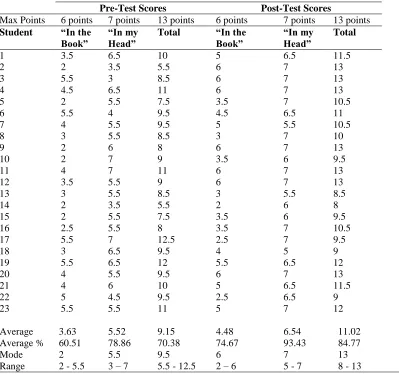
Twenty out of twenty-three students scored considerably higher on the post-test than they did on the pre-test. The three students who did not score higher had scores that remained the same on both tests. The class’s average score for the pre-test was 9.15, and climbed post-test to 11.02 (on a 13 point scale). This shows a 14.39% improvement, but more significant is that the class reaches 84.77% accuracy in scores with the intervention. Reading comprehension has benefited from the QAR strategy. What is noteworthy is that the mode score for the pre-test was 9.5, around the 9.15 average score. The mode score for the post-test was 13, a perfect score. Seven out of twenty-three students scored a perfect 13 on the post-test. This is reflected in the range moving from 5.50-12.50 to 8.00-13.00. While the lowest score in the pre-test is 5.50 (42.31% of total points), the post-test low of 8.00 is 61.54% of total points: a 19.23% improvement.
Pre and Post-Total Scores and Difference of Scores (Post-Pre)
Results (n = 23) Pre-Test
Post-Test
Difference of Scores (Post-Pre) Average (Max =
13 points)
9.15 points
11.02
points 1.87 points
Average (%) 70.38% 84.77% 14.39%
Range of Scores
5.50-12.50
8.00-13.00
Finally, individual scores for each student are shown in Table 1 (Appendix). This provides a deeper growth-description for each student’s individual progress. Some students grow through the intervention while many stay at a high achievement level as seen with seven perfect scores and an average of 11.02 in the post-test.
Verbatim Responses (Tables 2 and 3- Appendix)
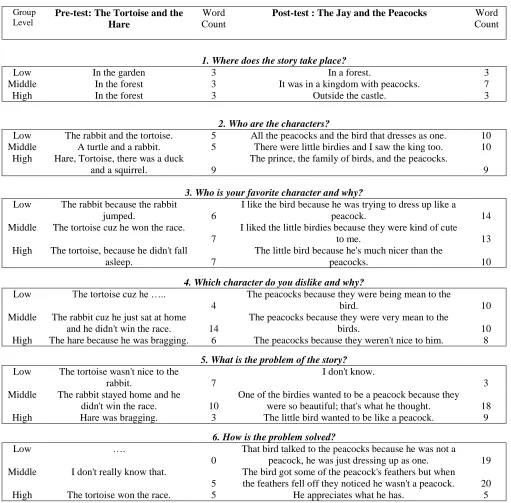
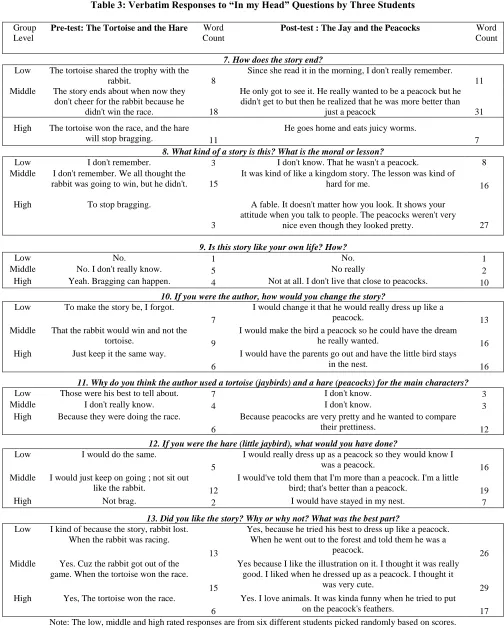
Six verbatim answers from six different students (the three in the pre-test are different from the three in the post-test) are presented after rating scores as low, middle and high; with Table 2 covering responses to “In the Book” and Table 3 showing responses to “In My Head” questions. Both pre- and post-test responses are shown beside each other to view changes in reading comprehension experienced by the young learners. The journals document an increase in word-count, and exhibit a high performance level for responding to these questions.
Teacher's Scoring of “In the Book” Verbatim Responses
Group Level
Pre-test: The Tortoise and the Hare
Total Words
Post-test: The Jay and the Peacocks
Total Words
Low 3 of 6 correct responses (50.0%)
25 3 of 6
correct responses (50.0%)
59
Middle 4 of 6 correct responses (66.7%)
44 5 of 6
correct responses (83.3%)
78
High 6 of 6 correct responses (100.0%)
33 6 of 6
correct responses (100.0%)
44
Note: The low, middle and high rated responses are from six different students picked randomly based on scores.
Pre and Post-"In the Book" and “In my Head” Scores and Difference of Scores (Post-Pre)
Results (n = 23) "In the Book" Scores "In my Head" Scores
(Max = 6 points) (Max = 7 points)
Pre-Test Post-Test Difference of Scores (Post-Pre)
Pre-Test Post-Test Difference of Scores (Post-Pre) Average 3.63 points 4.48 points 0.85 points 5.52 points 6.54 points 1.02 points
Average (%) 60.51% 74.67% 14.16% 78.86% 93.43% 14.57%
All three examples show an increase of word usage in answers. The low student in the pre-test with 25 total words has another student jumping to 59 total words in the post-test answers; even though both score at the same 50% level. Similar large increases are seen at the medium (post-test use of 78 words to a pre-test usage of 44 words, and a smaller increase for the high students. Another sign of increased confidence and eagerness is the large quantity of words used by weaker students. In both tests, the high students scored a perfect 100%; with a smaller count of words. Weaker students seem to believe lots of words will somehow arrive at the answer the teacher is scoring. Similar outcomes exist in the “In my Head” responses shown below, although this time the high student with a 100% score uses 96 words in the post-test as compared to only 38 (a 153% increase) in the pre-test with a 93% correct response level. That is definitely a change from the “In the Book” high-student response. While the middle student in both pre- (78 words used) and post-test (116 words used) follows the “In the Book” trend of using lots of words hoping to score well. Using more total words in the post-tests for both categories of questions shows an overall increase in confidence in comprehending the texts. Teacher's Scoring of “In my Head” Verbatim Responses Group Level Pre-test: The Tortoise and the Hare Total Words Post-test: The Jay and the Peacocks Total Words
Low 2.5 of 7
correct responses (35.7%)
44 5.5 of 7 correct responses (78.6%)
78
Middle 4.5 of 7 correct responses
78 5.5 of 7 correct responses
116
(64.3%) (78.6%)
High 6.5 of 7 correct responses (92.9%)
38 7 of 7
correct responses (100.0%)
96
Note: The low, middle and high rated responses are from six different students picked randomly based on scores.
Discussion
This Action Research project allowed the teacher an opportunity to explore and implement a new instructional strategy in the classroom. Success depended on knowledge of the strategy, guidance from a professional educator, social peer-collaborative sessions in research design, and, an intervention subject to reflective revisions and adaptations to meet classroom challenges faced by students experiencing a new learning tool. At the end of the four weeks, after careful planning and execution of explicit lessons, students felt at ease when completing the post-test, and they actually exhibited an air of confidence and pride. The intervention benefit showed an overall 14.39 % increase in comprehensions skills.
enthusiasm for the QAR strategy and implementing an intervention for the first time, the presence of teacher-intimidation (as perceived by 5 and 6 year olds) may have been present14. This may also have steered students towards learning to the post-test where scores increase. Still, the high total achievement levels are a benefit of the intervention project.
Final Thoughts
As a five year veteran, this teacher exhibited the incentive to grow and lead within the school, an intervention with proven strategies using internal as well as external resources. One-on-teaching and numerous practice-sessions were made possible with the presence and support from parents. This freed the teacher to observe large segments of the intervention and also mentor parents in comprehension skills. Teacher observations and reflective diaries coupled with peer interaction on research design, enrolment in a MA capstone course and mentorship with a professional educator also helped in facing and overcoming challenges any teacher may encounter when attempting action research intervention. The study’s improved reading comprehension is a positive incentive to continue interventions of QAR within the reading curriculum as early as kindergarten.
References
Anderson, R. C. & Pearson, P. D. (1984). A schema-theoretic view of basic processes in reading comprehension.
14
A guarded admission expressed in the teacher’s journal writings when attempting to record, assimilate, and self-evaluate the completed action project (in post-intervention reflections).
In P. D. Pearson (Ed.), Handbook of reading research (255-292). New York: Longman.
Alvermann, D. & Earle, J. (2003). Comprehension Instruction. In A. P. Sweet & C. Snow (Eds.), Rethinking reading comprehension (12-30). New York: Guilford.
Beck, I. L. & McKeown, M. G. (2001). Text talk: Capturing the benefits of read-aloud experiences for young children. The Reading Teacher,
55(1), 10-20.
Brown, A. L., Campione, J. C. & Day, J. D. (1981). Learning to learn: On training students to learn from texts.
Educational Researcher, 10, 14-21. Canning, C. (1991). What teachers say about
reflection? Educational Leadership, 48(6), 18-21.
Covey, S. R. (2004). The 7 Habits of Highly Effective People Powerful Lessons in Personal Change, (Revised Edition), New York, NY: Free Press.
Danielson, C. (2006). Teacher Leadership That Strengthens Professional Practice. VA: Association for Supervision and Curriculum development.
Dewey, J. (1993). How We Think. NY: Dover.
Dick, B. (2007). Action research as an enhancement of natural problem solving. International Journal of Action Research.3(1+2), 149-167. Dickinson, D. K. & Tabors, P. O. (2001)
Beginning literacy with language. Baltimore, MD: Brookes.
Ermeling, B. A. (2010). Tracing the effects of teacher inquiry on classroom practice. Teaching and Teacher Education. 26(2010), 377-388. Fullan, M. (1994). Teacher leadership: A
failure to conceptualize. In D. R. Walling (Ed.), Teachers as Leaders: Perspectives on the Professional Development of Teachers (241-253). Bloomington, IN: Phi Delta Kappa. Furtado, L. (2010). A read-aloud-cross-age
service learning partnership using multicultural stories. The Reading Matrix: An International Online Journal,8(2), 96-110.
Gregory, A. E. & Cahill, M. A. (2010). Kindergartners can do it, too! Comprehensive strategies for early readers. The Reading Teacher, 63(6) 515-520.
Guthrie, J. T., Wigfield, A., Barbosa, P., Perencevich, K. C., Taboada, A., Davis, M. H., Scafiddi, N. T. & Tonks, S. (2004). Increasing reading comprehension and engagement through Concept-Oriented Reading Instruction. Journal of Educational Psychology, 96, 403–423.
Guthrie, J. T., Wigfield, A. & Perencevich, K. C. (Eds.) (2004). Motivating Reading Comprehension: Concept-oriented reading instruction. Mahwah, NJ: Erlbaum.
Headsprout Early Reading. (2010). www.headsprout.com.
Henderson, C. (2009). Improving Schools Through Action Research: A Comprehensive Guide for Educators. NJ: Pearson Education, Inc.
Killion, J. P., & Todnem, G.R. (1991). A process for personal theory building.
Educational Leadership, 48(6), 14-16.
Kirsch, I., de Jong, J., LaFontaine, D., McQueen, J., Mendelovits, J. & Monseur, C. (2002). Reading for change: Performance and engagement across countries. Paris: Organization for Economic Co-operation and Development.
Lieberman, A. & Miller, L. (2005). Teachers as leaders. The Educational Forum 69(Winter), 151-162.
National Institute of Child Health and Human Development. (2000). Report of the National Reading Panel. Teaching children to read: an evidence-based assessment of the scientific research literature on reading and its implications for reading instruction: Reports of the subgroups (NIH Publication No. 00-4754). Washington, DC: U.S. Government Printing Office.
O’Sullivan, S. (2004) Books to live by: Using children literature for character education. The Reading Teacher, 57(7), 640-45.
Raphael, T., Highfield, K. & Au, K. (2006).
Question answer relationships now.
New York, NY: Scholastic.
Schank, R. C. & Abelson, R. P. (1977).
Scripts, plans, goals and understanding: an inquiry into human knowledge structures. Mahwah, NJ: Erlbaum.
Schoen, S. (2007). Action research: A developmental model of professional socialization. The Clearing House, 80(5), 211-216.
Smylie, M. A. (1996). New Perspectives in Leadership. The Elementary School Journal96(1) 3-7.
Sporer, N., Brunstein, J. C., & Kieschke, U. (2009). Improving students’ reading comprehension skills: Effects of strategy instruction and reciprocal teaching. Learning and Instruction, 19(3), 272-286.
Taylor, B. M., Pearson, P. D., Petersen, D. P. & Rodriguez, M. C. (2005). The CIERA school change framework: An evidence-based approach to professional development and school reading improvement. Reading Research Quarterly, 40(1), 40-69. Taylor, B. M. (2008). What does excellent
reading instruction look like in elementary classrooms? Minnesota Center for Reading Research, April, 1-9.
Trelease, J. (2006). The read aloud handbook. (Revised Fifth Edition). New York, NY: Penguin.
Vygotsky, L. S. (1986). Thought and language (A. Kozulin, Trans.). Cambridge, MA: MIT Press.
Wellington, B. (1991). The promise of reflective practice. Educational Leadership, 48(6), 4-5.
Yopp, R. H. & Yopp, H. K. (2004). Preview-predict-confirm: Thinking about language and content informational text. The Reading Teacher, 58, 79-83.
APPENDIX
Table 1: Number of Correct Responses for the QAR Intervention Pre-Test Scores Post-Test Scores
Max Points 6 points 7 points 13 points 6 points 7 points 13 points
Student “In the
Book” “In my Head”
Total “In the
Book” “In my Head”
Total
1 3.5 6.5 10 5 6.5 11.5
2 2 3.5 5.5 6 7 13
3 5.5 3 8.5 6 7 13
4 4.5 6.5 11 6 7 13
5 2 5.5 7.5 3.5 7 10.5
6 5.5 4 9.5 4.5 6.5 11
7 4 5.5 9.5 5 5.5 10.5
8 3 5.5 8.5 3 7 10
9 2 6 8 6 7 13
10 2 7 9 3.5 6 9.5
11 4 7 11 6 7 13
12 3.5 5.5 9 6 7 13
13 3 5.5 8.5 3 5.5 8.5
14 2 3.5 5.5 2 6 8
15 2 5.5 7.5 3.5 6 9.5
16 2.5 5.5 8 3.5 7 10.5
17 5.5 7 12.5 2.5 7 9.5
18 3 6.5 9.5 4 5 9
19 5.5 6.5 12 5.5 6.5 12
20 4 5.5 9.5 6 7 13
21 4 6 10 5 6.5 11.5
22 5 4.5 9.5 2.5 6.5 9
23 5.5 5.5 11 5 7 12
Average 3.63 5.52 9.15 4.48 6.54 11.02
Average % 60.51 78.86 70.38 74.67 93.43 84.77
Mode 2 5.5 9.5 6 7 13
Table 2: Verbatim Responses to “In the Book” Questions by Three Students
Group Level
Pre-test: The Tortoise and the Hare
Word Count
Post-test : The Jay and the Peacocks Word Count
1. Where does the story take place?
Low In the garden 3 In a forest. 3
Middle In the forest 3 It was in a kingdom with peacocks. 7
High In the forest 3 Outside the castle. 3
2. Who are the characters?
Low The rabbit and the tortoise. 5 All the peacocks and the bird that dresses as one. 10 Middle A turtle and a rabbit. 5 There were little birdies and I saw the king too. 10
High Hare, Tortoise, there was a duck
and a squirrel. 9
The prince, the family of birds, and the peacocks.
9
3. Who is your favorite character and why?
Low The rabbit because the rabbit
jumped. 6
I like the bird because he was trying to dress up like a
peacock. 14
Middle The tortoise cuz he won the race. 7
I liked the little birdies because they were kind of cute
to me. 13
High The tortoise, because he didn't fall
asleep. 7
The little bird because he's much nicer than the
peacocks. 10
4. Which character do you dislike and why?
Low The tortoise cuz he …..
4
The peacocks because they were being mean to the
bird. 10
Middle The rabbit cuz he just sat at home and he didn't win the race. 14
The peacocks because they were very mean to the
birds. 10
High The hare because he was bragging. 6 The peacocks because they weren't nice to him. 8
5. What is the problem of the story?
Low The tortoise wasn't nice to the
rabbit. 7
I don't know.
3 Middle The rabbit stayed home and he
didn't win the race. 10
One of the birdies wanted to be a peacock because they were so beautiful; that's what he thought. 18
High Hare was bragging. 3 The little bird wanted to be like a peacock. 9
6. How is the problem solved?
Low ….
0
That bird talked to the peacocks because he was not a
peacock, he was just dressing up as one. 19 Middle I don't really know that.
5
The bird got some of the peacock's feathers but when
the feathers fell off they noticed he wasn't a peacock. 20
High The tortoise won the race. 5 He appreciates what he has. 5
Table 3: Verbatim Responses to “In my Head” Questions by Three Students
Group Level
Pre-test: The Tortoise and the Hare Word Count
Post-test : The Jay and the Peacocks Word Count
7. How does the story end?
Low The tortoise shared the trophy with the
rabbit. 8
Since she read it in the morning, I don't really remember. 11 Middle The story ends about when now they
don't cheer for the rabbit because he
didn't win the race. 18
He only got to see it. He really wanted to be a peacock but he didn't get to but then he realized that he was more better than
just a peacock 31
High The tortoise won the race, and the hare
will stop bragging. 11
He goes home and eats juicy worms.
7
8. What kind of a story is this? What is the moral or lesson?
Low I don't remember. 3 I don't know. That he wasn't a peacock. 8
16 Middle I don't remember. We all thought the
rabbit was going to win, but he didn't. 15
It was kind of like a kingdom story. The lesson was kind of hard for me.
High To stop bragging.
3
A fable. It doesn't matter how you look. It shows your attitude when you talk to people. The peacocks weren't very
nice even though they looked pretty. 27
9. Is this story like your own life? How?
Low No. 1 No. 1
Middle No. I don't really know. 5 No really 2
High Yeah. Bragging can happen. 4 Not at all. I don't live that close to peacocks. 10
10. If you were the author, how would you change the story?
Low To make the story be, I forgot.
7
I would change it that he would really dress up like a
peacock. 13
Middle That the rabbit would win and not the
tortoise. 9
I would make the bird a peacock so he could have the dream
he really wanted. 16
High Just keep it the same way.
6
I would have the parents go out and have the little bird stays
in the nest. 16
11. Why do you think the author used a tortoise (jaybirds) and a hare (peacocks) for the main characters?
Low Those were his best to tell about. 7 I don't know. 3
Middle I don't really know. 4 I don't know. 3
High Because they were doing the race.
6
Because peacocks are very pretty and he wanted to compare
their prettiness. 12
12. If you were the hare (little jaybird), what would you have done?
Low I would do the same.
5
I would really dress up as a peacock so they would know I
was a peacock. 16
Middle I would just keep on going ; not sit out
like the rabbit. 12
I would've told them that I'm more than a peacock. I'm a little bird; that's better than a peacock. 19
High Not brag. 2 I would have stayed in my nest. 7
13. Did you like the story? Why or why not? What was the best part?
Low I kind of because the story, rabbit lost. When the rabbit was racing.
13
Yes, because he tried his best to dress up like a peacock. When he went out to the forest and told them he was a
peacock. 26
Middle Yes. Cuz the rabbit got out of the game. When the tortoise won the race.
15
Yes because I like the illustration on it. I thought it was really good. I liked when he dressed up as a peacock. I thought it
was very cute. 29
High Yes, The tortoise won the race.
6
Yes. I love animals. It was kinda funny when he tried to put
on the peacock's feathers. 17