New Integrated Approach for Solving a Supplier Selection Problem in a
Competitive Environment
Amin Shahmardan
1,
Mohammad Hendijani Zadeh
2 1Amirkabir University of TechnologyP. O. Box,1476885173, Tehran, Iran E-mail: [email protected]
2
University of Tehran
P. O. Box,1423241213, Tehran, Iran E-mail: [email protected]
http://dx.doi.org/10.5755/j01.ee.25.3.5092
The main objective of this paper is a presentation of new integrated approach for solving a supplier selection problem by the use of a defined technique, which derives from LPP (linear physical programming), and execution of F-PROMETHEE (fuzzy preference ranking method for enrichment evaluation) method as a ranking algorithm. The objective of supplier selection problem is an identification of suppliers that have the highest capability of responding desirably to firm’s needs. Suppliers are ranked from the best to worst total performance regarding to use of a common set of criteria and measures. Defined method intends to take two considerable actions: to employ typically available information and lessen the burden of choosing of weights for DM (decision maker). Owing to the paucity of information, measuring of the exact value of the attributed weights of criteria and input data seem to be impossible. Therefore, the use of fuzzy techniques is justifiable. According to brought weights, F-PROMETHEE method is implemented to rank the suppliers. In previous works, weights of criteria were achieved in relation to DM’s comments and there was less attention given to the fact that suppliers work in a competitive environment, furthermore, situations of rivals have not been considered as an important factor, precisely. In addressed approach, the information of the enterprise, which is working with DM and its rivals’ information in different criteria, is regarded as input data and weighting of these criteria and ranking of those suppliers are conducted through a suggested algorithm.
Keywords: supplier selection, linear physical programming, F-PROMETHEE, competitive environment, Fuzzy sets.
Introduction. Multi Criteria Decision Making
Techniques
Multi Criteria Decision Making problem (MCDM) is a branch of Operation Research (OR) ,which deals with procedures and techniques to assist a Decision Maker (DM) to have the best solution in his/her problem. MCDM methods have been implemented frequently in terms of solving different problems in both of certain and uncertain environments. One of the most important characteristics of solution method is brought preference information elicited from DM as well as their kind of these information asked from DM (Ignizio & Cavalier, 1994).Generally there are two sorts of techniques applied to solve decision making problems. Some of them are matched with problems with a number of limited alternatives; on the other hand, some applied methods are demonstrating continuous solution spaces. Methods such as AHP (Analytic Hierarchy Process) (Saaty, 1988) and outranking methods (Benayoun
et al., 1966; Roy, 1971) are categorized in the first group. Among the techniques with continuous solution spaces, goal programming (Lee, 1972; Ignizio, 1976) and fuzzy programming (Zimmermann, 1985) are regarded as the most prevalent methods. (Podvezko & Podviezko, 2010) suggested a model in terms of the relation of choice of the
preference function and their parameters with multi-criteria appraisement results.
Amin Shahmardan, Mohammad Hendijani Zadeh. New Integrated Approach for Solving a Supplier Selection Problem…
specify meaningful targets. DM only needs to specify desirability ranges for each design metric, not those meaningless weights, which make this approach very user- friendly. The main contribution of the proposed approach is that weights of criteria are brought according to information related to rivals (information will be changed to scores for quantifying comparisons) and DM’s opinions as well. Consequently, normalization process is carried out to extract the weights of defined criteria. In former works like AHP and so on, there was least attention given to the position of rivals and DM’s opinions were considered the only gauge for calculating the weights of criteria. This deficiency is responded properly in the proposed approach. Finally, according to the weights of defined criteria and brought scores that belong to companies, one of the outranking methods is exerted to rank our situation among our rivals in a specific situation. Preference Ranking Organization Method for Enrichment Evaluation (PROMETHEE) is mentioned as one of the most efficient and suitable ranking methods (Geldermann et al., 2000). Flexibility and simplicity of this outranking method makes it more desirable for its users (Geldermann et al., 2000). PROMETHEE technique has been used repeatedly in various fields like portfolio selection problems (Rudolf & Vetschera, 2011) and etc. F (fuzzy)-PROMETHEE is an extension of PROMETHEE under dominance of fuzzy environment. By use of F-PROMETHEE, these alternatives are ranked from the best to worst, and decision making process will be facilitated for DM. In our approach, information of an enterprise, which is working with DM and its rivals’ information in different criteria, is regarded as input data and weighting of these criteria and ranking of those suppliers are conducted through a suggested algorithm. It is clear that precise information is classified as secret profiles of companies and there is only the possibility of estimating of this information to elicit their status in defined criteria. Hence, lack of information as well as being in an uncertain environment leads us to the use of fuzzy techniques. To summarize the proposed procedure: a new integrated approach for solving a supplier selection problem was presented; LPP method was applied to calculate weights of defined criteria in mentioned problem and F-PROMETHEE technique, as an outranking method, was implemented to rank suppliers
The research objective: To present an integrated approach for solving a supplier selection problem.
The research problem: Ranking of suppliers in a competitive environment by the use of proposed approach.
The research method: Techniques are elicited from comparative analysis of literature, synthesis, and deductions. This paper embodies four notable sections: first of all, some reviews about related works and applied algorithms to solve supplier selection problems are stated. In section two some explanations about the applied methods are presented. The third section is devoted to a numerical example to become more familiar with a practical use of the stated approach. Conclusion is made in the fourth part of this article.
Literature review
allocation of products to suppliers so that the total annual purchasing cost could be minimized. (Jain et al., 2004) suggested a fuzzy based approach for supplier selection. The authors mentioned that it might be hard for an expert to define a complete rule set for assessment of the supplier performance. GA (genetic algorithm) was therefore implemented to generate a number of rules inside the rule set according to the essence and type of the priorities associated with the products and their supplier’s attributes. (Rezaei & Davoodi, 2012) used a nonlinear physical programming algorithm to solve a problem according to determined criteria. (Liu & Zhang, 2011) addressed the extension of ELECTRE, called ELECTRE-III, with entropy weights. (Vahdani et al., 2010) considered interval values as decision information in the application of ELECTRE. (Montazer et al., 2009; Sevkli, 2010) extended ELECTRE for supplier selection when triangular fuzzy values provided the decision information. (Che et al.,
2011) integrated PROMETHEE with the extended fuzzy concept and studied a case of information system (IS) outsourcing under triangular fuzzy environments. (Buyukozkan & Cifci, 2012) proposed a new integrated approach for green supplier selection by the combination of TOPSIS and ANP techniques. (Zolfani et al., 2012) proposed a hybrid MCDM model encompassing AHP and COPRAS-G methods for selecting company supplier. In the other work in supply chain management domain (Smeureanu et al., 2012) presented Intelligent agents and risk based model for supply chain management.
Methodology: Calculations related to weights of criteria
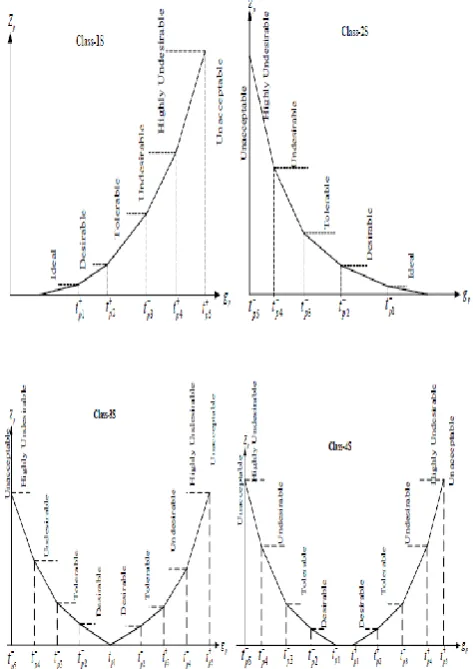
Linear Physical Programming (LPP) technique is considered as one of the multi objective optimization techniques that have been implemented numerously in various fields (Maria et al., 2003; Messac & Ismail-Yahaya, 2002; Messac, 1998, Melachrinoudis et al., 2000). LPP divides the value of objective into some continuous regions to express preference for each criterion, and obtains preference function from piecewise spline segment interpolation. Detailed information about this method can be found in the references (Messac, 1996; Messac, Gupta & Akbulut, 1996). In this method, Decision Maker (DM) states his/her preferences according to each criterion by using 4 classes. Figure 1 illustrates these classes and qualitative and quantitative meaning of them.
Let’s consider is the decision vector and is the generic linear objective function. Horizontal axis reflects the value of objective function and vertical axis demonstrates the penalty function for specific criterion. A higher quantity of means that more urgent conducts should be done to improve the objective function and function should be minimized. One of the desirable characteristics of LPP is that it allows DM to express his/her preferences regarding to each criterion with more specificity and flexibility than by simply saying minimize, maximize, greater than, less than, or equal to (Maria et al.,
2003). For instance, let’s examine the case of Class S1. Preference ranges are:
Ideal range
Desirable Range
Tolerable range Undesirable range
Highly Undesirable range Unacceptable range
The parameters through are physically meaningful constants that express DM’s preference associated with the generic design metric.
For class S2 the following preference ranges are considered:
Ideal range
Desirable Range Tolerable range
Undesirable range
Highly Undesirable range Unacceptable range
In this paper, LPP is used to determine the weights of our criteria in our numerical example. By the use of classes S1 and S2, the value of can be defined as follows. It has been supposed that has a constant quantity for each criterion in this article.
Be defined as follows. Set , then,
(1)
Then,
̃ (2)
Amin Shahmardan, Mohammad Hendijani Zadeh. New Integrated Approach for Solving a Supplier Selection Problem…
Values of and depend on how bad a situation is if one criterion lags behind that of alternatives. Whenever the situation worsens, the higher and are considered. Following stages are carried out to determine the weights of each criterion.
1. Defining of ̃ which represents the weight of
range s in criterion .
̃ ̃ (3)
2. Defining of ̃ , which demonstrates the weight of criterion. ̃ ̃ (4)
Unacceptable ranges have no weight. 3. Calculation of the normalized weights for each criterion. ∑ (5)
4.Final weight of each criterion is deducted by calculation of weighting average, which comprises both DM’s comments and rivals’ situations. (6)
Ranking of suppliers Next stage is the implementation of one of the ranking methods to elicit the situations of the suppliers. In this paper, one of the outranking methods called PROMETHHE has been executed to rank the suppliers according to their performances in defined criteria. PROMETHHE was introduced by (Brans & Vincke, 1985) and later extended by (Brans & Mareschal, 1994). It is considered as one of the outranking methods. This technique is regarded as a reaction to complete aggregation (MAUT) methods (Macharis et al., 2004) and is one of the intuitive methods of MCDM, which is so much intelligible for DM (Ballis & Mavrotas, 2007). For the use of this MADM technique, four following steps are carried out: 1. A table has to be formed that includes specific alternatives as well as certain criteria for assessment. 2. Preference function should be defined that states deviation between two alternatives on a particular criterion into a preference degree ranging 0 to 1. 3. Choosing of one of the six possible shapes of preference functions put forward by Brans et al (1986) (usual shape, U-shape function, V-shape function, level function, linear function and Gaussian function) ( ) (7)
( )
( )
j jf
a
f b
expresses the deviation score of two alternatives on a certain criterion. 4. By knowing the weights of criteria calculated in the previous part, we define the following formulas: ∑ (8)∑ ⁄ (9)
∑ ⁄ (10)
(11)
and represent positive and negative preference flow for each alternative, which measure how an alternative (a) is out ranking (formula 8) or out ranked (formula 9). (formula 10) displays the value function and alternative (a) will be more attractive, if its value function has a higher amount. In partial ranking, we face with three situations in terms of superiority of alternative (a) to alternative (b) (formula 12), being indifferent two alternatives (formula 13), being incomparable two alternatives (formula 14) (Brans, 1985). { (12) { (13)
{
(14)
On the other hand by use of , we only measure the
net and it will be our main evaluation application for decision making. Every alternative, which has a higher
net has a better position in an ultimate ranking, and we have a complete ranking.When DM states his/her experiences and considerations in linguistic terms as input data, the obscurity and fuzziness are taking place. In such circumstances, probability of making a mistake in our assessment arises incredibly. The solution is the use of F-PROMETHHE that is the combination of fuzziness and PROMETHEE.
In this paper, F-PROMETHE is implemented as it was suggested by (Goumas & Ligero 2000). The procedures of F-PROMETHEE are the same as of PROMETHEE, but fuzzy logic gets involved in this methodology as well. By using this technique, it will be easier for DM to interpret his/her qualitative attitudes and information to mathematical expressions.
is the presentation of a fuzzy number, which is shown in Figure 2.
x ) (x b
a
m
1Fig. 2. Presentation of fuzzy number x=(a,m,b)
x is a variable that belongs to the fuzzy set and its membership function
f x
( )
has the value between [0,1], inclusively.For or ,x does not belong to the set. For the membership degree is indicated by membership function that varies between 0 and 1, inclusively.
In our paper, Weights of criteria are brought by application of LPP method and preference thresholds
are crisp numbers.
According to the properties of our MCDM problem (in our case supplier selection problem), linear preference function (type 5) with indifferences and stringent preference thresholds is our best choice to be employed.
In F-PROMETHEE exhibits the differences between two fuzzy numbers of that result in a fuzzy number. Above equations are transformed to the following equations respectively;
Essential formulas for basic computations with fuzzy number are characterized in Table 1.
Eventually, in application of F-PROMETHEE, we are given some fuzzy numbers. According to the mentioned computations, value of will be calculated. Right now, this fuzzy numbers should be changed to the defuzzy forms according to following formula introduced by (Zadeh, 1965).
⁄ (17) One after that, remaining stages of F-PROMETHEE are performed and
,
and
net will be measured regarding to stated formulas formerly.Table 1
Basic fuzzy operations
Opposite
.
Numerical Example
In this section, a decision making problem is put forward in a competitive environment to discern practicality of the proposed approach more properly.
Let’s consider we have a following information about our (a company, which is working with DM) scores in comparison with our five (A, B, C, D, E) rivals in various criteria. These criteria are (1, 2, 3, 4, 5, 6). LPP paradigm is introduced according to DM’s wishes to: 1. Minimize
Cost, 2. Maximize Design and development ability, 3. Maximize Performance History, 4.Maximize the Flexibility of companies in preparation of demands, 5. Maximize On time delivery percentage, 6. Maximize Quality and goodness of products. They have been stated in a style of fuzzy numbers, and they are transformed to form of crisp numbers.
Table 2 represents our fuzzy scores as well as our rivals in specific criteria in a defined supplier selection problem.
..
Some of the criteria are quantitative that have been transformed to have an amount among [1, 10] inclusively in this numerical example. On the other hand, a number of criteria is qualitative and after being quantified, we will have a quantity among [1, 10], inclusively. There is a point that, when we are dealing with great quantities in a criterion, because of being and as denominator,
attributed weight will have a low quantity. Contrarily, if there is low amount for a specific criterion, it results in a high quantity of the weight, which is wrongly interpreted as major importance of that criterion. Hence, the scale of a criterion has great significance. Table 3 demonstrates
the normalized fuzzy scores of each company that have quantities among [1, 10] for defined criteria in our specific supply selection problem.
According to fuzzy rules, this information is transformed to crisp numbers as depicted in the Table 4.
As it was mentioned before, for obtaining of weights of criteria by LPP technique, essential ranges are described to achieve exact position of each input data in these brought intervals.
Table 2
Fuzzy scores of our rivals and our company
E D C B A Own Initial Data
(14,15.5,17) (16,17,18.5) (10,11,12) (12,14,16) (14.5,16,17.5) (13,15,18) Cost () (7,8,8) (4,4,6) (4,6,8) (4,4,5) (6,7,8) (5,6,6) Design and Development (4,5,6) (6,7,9) (7,8,9) (4,4,5) (4,5,6) (6,7,8) Performance History
(7,8,9) (3,4,5) (2,3,4) (4,5,7) (6,6,8) (5,6,7) Flexibility of company in preparation of demand (90,93,95) (85,87,90) (80,80,85) (75,77,80) (77,80,83) (80,85,90) On time delivery percentage ()
Amin Shahmardan, Mohammad Hendijani Zadeh. New Integrated Approach for Solving a Supplier Selection Problem…
Table 3
Normalized fuzzy scores of companies in defined criteria
D C B A Own Normalized Data
(5.23,6.82,8.41) (7.35,8.41,10) (1,2.06,3.12) (3.12,5.23,7.35) (5.76,7.35,8.94) (4.18,6.3,9.47) Cost (7,8,8) (4,4,6) (4,6,8) (4,4,5) (6,7,8) (5,6,6) Design and Development (4.5,5.5,6.5) (6,7,9) (7,8,9) (4,4,5) (4,5,6) (6,7,8) Performance History
(7,8,9) (3,4,5) (2,3,4) (4,5,7) (6,6,8) (5,6,7) Flexibility of company in preparation of demand
(7.75,9.1,10) (5.5,6.4,7.75) (3.25,3.25,5.5) (1,1.9,3.25) (1.9,3.25,4.6) (3.25,5.5,7.75) On time delivery percentage
(5.2,6.4,8.2) (3.4,4,5.2) (6.4,8.2,8.2) (8.2,8.2,10) (1,2.2,3.4) (5.2,5.2,6.4) Quality and goodness of products
Table 4
Crisp number of each company in defined criteria
E D C B A Own Defuzzy Numbers
6.82 8.5425 2.06 5.2325 7.35 6.5625 Cost
7.75 4.5 6 4.25 7 5.75 Design and Development
5.5 7.25 8 4.25 5 7 Performance History
8 4 3 5.25 6.5 6 Flexibility of company in
preparation of demand 8.99 6.51 3.81 2.01 3.25 5.5 On time delivery percentage
6.55 4.15 7.75 8.65 2.2 5.5 Quality and goodness of products
Table 5 illustrates these intervals and Figure 3 depicts the applied Class Function regions for the generic -th objective in terms of two defined criteria (Cost, Design and Development) as an instance in our supply selection problem in a competitive environment. Initial data had been normalized before they changed into crisp numbers as it has been shown in Table 4. For Cost as a criterion, which should be minimized, Class S1 is applied and supplier C had the best situation in this criterion.
Consequently, is considered as equal to cost of supplier C and , are equal to costs of suppliers B, E ,A, D, respectively. As it has been portrayed in Fig 3, the supplier, which is working with DM, has been situated in Tolerable zone and attributed weight to this criterion (Cost) is equal to the weight of Tolerable zone.
Figure 3. Class Function regions for the generic -th objective for two defined criteria
Table 5
Calculated ranges related to defined criteria
Ideal Desirable Tolerable Undesirable Highly Undesirable 1 (0.352,1.068,4.4) (0.3,0.84,2.82) (0.523,1.29,3.365) (0.984,2.39,6.11) (1.76,4.185,9.578) 2 (0.1375,0.275,0.628) (0.275,0.628,1.467) (0.55,1.467,4.4) (1.467,4.4,8.8) (3.52,8.8,17.6) 3 (0.122,0.275,0.628) (0.244,0.628,1.467) (0.677,1.6,3.91) (1.467,3.52,8.8) (3.52,8.8,17.6) 4 (0.122,0.275,0.628) (0.275,0.733,1.467) (0.628,1.76,4.4) (1.76,4.4,11.73) (4.4,1.73,35.2) 5 (0.11,0.242,0.568) (0.284,0.687,1.6) (0.8,2.71,5.41) (1.91,5.41,18.53) (5.41,18.53,70.4) 6 (0.11,0.268,0.536) (0.268,0.536,1.375) (0.536,1.375,3.385) (1.692,4.4,10.353) (5.176,16,70.4)
According to formula 4, weights of criteria are calculated and following fuzzy numbers are elicited that have been shown in Table 6. Then, they are altered to crisp numbers and eventually by the use of normalization, the attributed weights of criteria are
attained. Table 7 represents the defuzzy weights of each criterion. Implementation of normalization process results in normalized deffuzy weights illustrated in Table 8.
Table 6
Calculated fuzzy quantities of weights for defined criteria
6 5 4 3 2 1
Table 7 Defuzzied weights of each criterion
6 5 4 3 2 1
5,211 2,907 2,137 1,947 4,767 1,617 Defuzzy Weights
Table 8 Normalized defuzzied weights of each criterion
6 5 4 3 2 1
0,281 0,156 0,115 0,105 0,256 0,087 Normalized Defuzzy Weights
DM’s comments in terms of weights of criteria have been depicted in Table 9.
Table 9
Comments attributed to DM about each criterion
6 5 4 3 2 1 Criteria
0,236 0,121 0,057 0,207 0,136 0,243 Weights based on decision maker’s opinion
……….
Final weight of each criterion is deducted by calculation of weighting average according to formula 6.
represents the significance degree of situation of
rivals and is specified by decision maker. In this paper it has been supposed to be 0,6. Table 10 shows the final weight of each criterion.
Table 10 Final weight of each criterion
6 5 4 3 2 1 Criteria
0.263 0.142 0.0918 0.1458 0.208 0.1494 Final Weights
In this stage, F-PROMMETHEE, as a ranking method, was executed according to its related formulas. , and have been calculated according to the formulas 9, 10 and 11 respectively. Table 11 shows the brought
results and greater quantity of implies better situation of that alternative (supplier) in defined criteria. The calculations have been carried out regarding to the brought results associated with table 10.
Table 11
F-PROMETHEE flows
E D C B A Own
0,4067 0,167 0,36846 0,2424 0,1035 0,24574
0,1092 0,3538 0,1443 0,3744 0,3972 0,1569
0,2975 -0,1868 0,22416 -0,132 -0,2937 0,0888
………
Ultimate ranking has been portrayed in Figure 4.
Figure 4. Depiction of final ranking
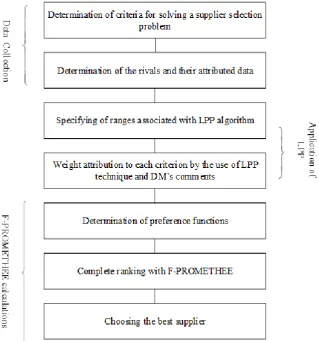
To be more familiar with the applied procedures of the mentioned approach, Figure 5 has been drawn to explain the summarized approach for solving a supplier selection problem.
Conclusion
In this paper, a new integrated approach for solving a supplier selection problem was presented; LPP method was applied to calculate weights of defined criteria in the mentioned problem and F-PROMETHEE technique, as an outranking method, was implemented to rank the suppliers regarding to the brought s (which are related to the results of F-PROMETHEE method) of suppliers. Final ranking demonstrated that a supplier E had the best situation and performance among all the suppliers, and previous supplier, which cooperated with DM, has been ranked as a third place. Hence, it will be reasonable for
DM to collaborate with a supplier E for tackling its needs. The stated approach has a great contribution in comparison with former approaches. In previous works, when a supply selection problem was put forward, determination of weights of criteria was assigned to DM. This dubious task was problematic for DM and his/her comments constitute the essence of attributed weights to defined criteria. Moreover, it could be resulted in ascribing an unrealistic degree of importance to criteria owing to negligence of other aspect in decision making process and lack of information in a competitive environment of today business. The neglected dimension, which has been accentuated in presented approach, was the role of rivals in decision making process to elicit the weights of criteria more realistically in a strict competitive environment.
Amin Shahmardan, Mohammad Hendijani Zadeh. New Integrated Approach for Solving a Supplier Selection Problem…
paying attention to the situations of rivals in defined criteria as well as DM’s comments in calculation of weights of criteria in a supply selection problem and competitive environment related to that.
In future works, the other ranking techniques such as fuzzy-TOPSIS. SWARA, and etc can be applied to elicit the position of each alternative. The proposed approach can be implemented in other cases in different fields.
References
Araz, C., & Ozkarahan, I. (2007). Supplier evaluation & management system for strategic sourcing based on a new multicriteria sorting procedure. International Journal of roduction Economics, 106, 585–606. http://dx.doi.org/10.1016/j.ijpe.2006.08.008
Benayoun, R., Roy, B., & Sussman, B., (1966). ELECTRE: Unemethode pour guider le choix en presence de points de vuemultiples, Sema (Metra International), Direction Scientifique, Note de Travail (49), Paris, France.
Ballis, A., & Mavrotas, G. (2007). Freight village design using the multicriteria method PROMETHEE. Operational Research, 7(2), 213–231. http://dx.doi.org/10.1007/BF02942388
Brans, J. P., & Mareschal, B. (1994). The PROMCALC & GAIA decision support system for multicriteria decision aid.
Decision support systems, 12(4), 297–310. http://dx.doi.org/10.1016/0167-9236(94)90048-5
Brans, J. P., & Vincke, P. (1985). Note-A Preference Ranking Organisation Method: (The PROMETHEE Method for Multiple Criteria Decision-Making). Management science, 31(6), 647–656. http://dx.doi.org/10.1287/mnsc.31.6.647 Brans, J. P., Vincke, P., & Mareschal, B. (1986). How to select and how to rank projects: The PROMETHEE method.
European journal of operational research, 24(2), 228–238. http://dx.doi.org/10.1016/0377-2217(86)90044-5
Buyukozkan, G., & Cifci, G. (2012). A novel hybrid MCDM approach based on fuzzy DEMATEL, fuzzy ANP and fuzzy TOPSIS to evaluate green suppliers. Expert Systems with Applications, 39(3), 3000–3011. http://dx.doi.org/10.1016/j.eswa.2011.08.162
Chen, C. T., Lin, C. T., & Huang, S. F. (2006). A fuzzy approach for supplier evaluation & selection in supply chain management. International Journal of Production Economics, 102, 289–301. http://dx.doi.org/10.1016/j.ijpe.2005.03.009
Chen, Y., Wang, T., & Wu, C. (2011). Strategic decisions using the fuzzy PROMETHEE for IS outsourcing. Expert Systems with Applications, 38(10), 13216–13222. http://dx.doi.org/10.1016/j.eswa.2011.04.137
Choi, T. Y., & Hartley, J. L. (1996). An exploration of supplier selection practices across the supply chain. Journal of Operations Management, 14(4), 333–343. http://dx.doi.org/10.1016/S0272-6963(96)00091-5
Geldermann, J., Spengler, T., & Rentz, O. (2000). Fuzzy outranking for environmental assessment. Case study: iron and steel making industry. Fuzzy sets and systems, 115(1), 45–65. http://dx.doi.org/10.1016/S0165-0114(99)00021-4 Ghodsypour, S. H., & O’brien, C. (2001). The total cost of logistics in supplier selection, under conditions of multiple
sourcing, multiple criteria and capacity constraint. International Journal of Production Economics, 73(1), 15–27. http://dx.doi.org/10.1016/S0925-5273(01)00093-7
Ho, W., Xu, X., & Dey, P. K. (2010). Multi-criteria decision making approaches for supplier evaluation and selection: A literature review. European Journal of Operational Research, 202(1), 16–24 http://dx.doi.org/10.1016/j .ejor.2009.05.009
Hwang, C. L., & Yoon, K. (1981). Multiple attributes decision making methods & applications. New York: Springer. http://dx.doi.org/10.1007/978-3-642-48318-9
Ignizio, J. P., (1976). Goal Programming and Extensions. Lexington Books, Lexington, MA. Ignizio, J. P., & Cavalier, T. M., (1994). Linear Programming. Prentice-Hall, Englewood Cliffs, NJ.
Jain, V., Tiwari, M. K., Chan, F. T. S., (2004). Evaluation of the supplier performance using an evolutionary fuzzy-based approach. Journal of Manufacturing Technology Management, 15 (8), 735–744. http://dx.doi.org/10.1108/174 10380410565320
Lee, S., (1972). Goal Programming for Decision Analysis.Auerbach, Philadelphia, PA
Li, G. D., Yamaguchi, D., & Nagai, M. (2007). A grey-based decision-making approach to the supplier selection problem.
Mathematical and Computer Modeling, 46, 573–581. http://dx.doi.org/10.1016/j.mcm.2006.11.021
Liu, P., & Zhang, X. (2011). Research on the supplier selection of a supply chain based on entropy weight and improved ELECTRE-III method. International Journal of Production Research, 49(3), 637–646. http://dx.doi.org/10. 1080/00207540903490171
Macharis, C., Springael, J., De Brucker, K., & Verbeke, A. (2004). PROMETHEE and AHP: The design of operational synergies in multicriteria analysis.: Strengthening PROMETHEE with ideas of AHP. European Journal of Operational Research, 153(2), 307–317. Doi: http://dx.doi.org/10.1016/S0377-2217(03)00153-X
Maria, A., Mattson. C, Ismail-Yahaya, A., & Messac, A. (2003). Linear Physical Programming for production planning optimization. Engineering Optimization, 35 (1), 19–37. http://dx.doi.org/10.1080/0305215031000078401
Melachrinoudis, E., Min, H. & Messac, A. (2000). Optimizing manufacturing plant relocation from supply chain perspectives using physical programming. In: Kenneth Laurence, (Ed.), Advances in Management Science, Multicriteria Applications, 10. JAI Press, pp. 15–39, (ISBN: 0-7623-0365-4).
Messac, A. (1996). Physical programming: Effective optimization for computational design. AIAA Journal, 34(1), 149– 158. http://dx.doi.org/10.2514/3.13035
Messac, A., (1998). Control-structure integrated design with closed-form design metrics using physical programming.
AIAA Journal, 36, 855–864. http://dx.doi.org/10.2514/2.447
Messac, A., Gupta, S., & Akbulut, B. (1996). Linear physical programming: Effective optimization for complex linear systems. Transactions on Operational Research, 8, 39–59
Messac, A., & Ismail-Yahaya, A. (2002). Multiobjective robust design using physical programming. Structural and Multidisciplinary Optimization, 23, 357–371. http://dx.doi.org/10.1007/s00158-002-0196-0
Montazer, G. A., Saremi, H. Q., & Ramezani, M. (2009). Design a new mixed expert decision aiding system using fuzzy ELECTRE III method for vendor selection. Expert Systems with Applications, 36(8), 10837–10847. http://dx.doi.org/10.1016/j.eswa.2009.01.019
Podvezko, V., & Podviezko, A. (2010). Dependence of multi‐criteria evaluation result on choice of preference functions and their parameters. Technological and Economic Development of Economy, 16(1), 143–158. Doi: 10.3846/tede.2010.09
Rezaei, J., & Davoodi, M. (2012). A joint pricing, lot-sizing, and supplier selection model. International Journal of Production Research, 50(16), 4524–4542. http://dx.doi.org/10.1080/00207543.2011.613866
Roy, B., (1971). Problems and methods with multiple objective functions. Mathematical Programming 1 (2), 239–266. http://dx.doi.org/10.1007/BF01584088
Rudolf Vetschera, R., Teixeirade Almeida, A. (2012). A PROMETHEE-based approach to portfolio selection problems.
Computers & Operations Research, 39, 1010–10202011. http://dx.doi.org/10.1016/j.cor.2011.06.019 Saaty, T., (1988). The Analytic Hierarchy Process. University of Pittsburgh, Pittsburgh, PA.
Amin Shahmardan, Mohammad Hendijani Zadeh. New Integrated Approach for Solving a Supplier Selection Problem…
Smeureanu, I., Ruxanda, G., Diosteanu, A., Delcea, C., & Cotfas, L. A. (2012). Intelligent agents and risk based model for supply chain management. Technological and Economic Development of Economy, 18(3), 452–469. Doi: 10.3846/20294913.2012.702696
Swift, C. O. (1995). Preference for single sourcing & supplier selection criteria. Journal of Business Research, 32(2), 105– 111. http://dx.doi.org/10.1016/0148-2963(94)00043-E
Vahdani, B., Jabbari, A. H. K., Roshanaei, V., & Zandieh, M. (2010). Extension of the ELECTRE method for decision-making problems with interval weights and data. International Journal of Advanced Manufacturing Technology, 50(5–8), 793–800. http://dx.doi.org/10.1007/s00170-010-2537-2
Zadeh, L. A., (1965). Fussy sets. Information and Control 8, 338–353. http://dx.doi.org/10.1016/S0019-9958(65)90241-X Zimmermann, H. J. (1985). Fuzzy Set Theory—and Its Applications. Kluwer-Nijhoff, Boston. http://dx.doi.org/10.
1007/978-94-015-7153-1
Zolfani, S. H., Chen, I. S., Rezaeiniya, N., & Tamosaitiene, J. (2012). A hybrid MCDM model encompassing AHP and COPRAS-G methods for selecting company supplier in Iran. Technological and Economic Development of Economy,
18(3), 529–543. Doi: 10.3846/20294913.2012.709472
Amin Shahmardan, Mohammad Hendijani Zadeh
Naujas integruotas požiūris sprendžiant tiekėjo pasirinkimo problemą konkurencinėje aplinkoje
Santrauka
Šio darbo tikslas – pateikti naują integruotą požiūrį, skirtą problemoms spręsti renkantis tiekėją, tam panaudojant apibrėžtą metodą ( kilusį iš LPP (angl. linear physical programming) ir F-PROMETHEE (angl. fuzzy preference ranking method for enrichment evaluation)) kaip reitingavimo algoritmą. Svarbiausias tikslas yra nustatyti tiekėjus, kurie turi daugiausia/didžiausių galimybių, greičiausiai ir tinkamai reaguoti į įmonės poreikius. Tiekėjai yra reitinguojami vertinant veiklas nuo geriausios iki blogiausios, remiantis bendru kriterijumi. Apibrėžtas metodas atlieka du svarbius veiksmus: panaudoja lengvai prieinamą informaciją, ir sumažina reikšmių pasirinkimo naštą priimant sprendimus. Dėl nedidelio informacijos kiekio, tikslių, kriterijui priskirtų reikšmių bei įvesties duomenų, vertės nustatymas neįmanomas. Todėl, neapibrėžtų metodų naudojimas yra pateisinamas. Remiantis reikšmėmis, F-PROMETHEE metodas yra įdiegtas, norint sureitinguoti tiekėjus. Ankstesniuose darbuose buvo gautos kriterijų reikšmės, susijusios su sprendimų priėmimo komentarais ir buvo mažiau dėmesio skirta tokiam faktui, jog tiekėjai dirba konkurencinėje aplinkoje. Tuo metu konkurencija nebuvo laikoma svarbiu veiksniu. Nurodytame metode, informacija apie įmonę, kuri dirba su priimančiais sprendimus ir savo konkurentų informacija, laikoma įvesties duomenimis, o šių kriterijų reikšmės ir tiekėjų reitingavimas yra atliekamas panaudojant pasiūlytą algoritmą. Taigi tyrimo tikslas: pateikti integruotą požiūrį į tiekėjo pasirinkimą. Tyrimo problema: tiekėjų reitingavimas konkurencinėje aplinkoje. Tyrimo metodas: literatūros lyginamoji analizė, sintezė. Yra daugybė darbų, kuriuose analizuojamos problemas renkantis tiekėjus. Ho, Xu, ir Dey (2010) analizavo daugiakriterinio sprendimo priėmimo (DKSP) metodus, skirtus tiekėjams pasirinkti ir kurie buvo publikuoti straipsniuose nuo 2000 iki 2008 metų. Chen, Lin, ir Huang (2006) pasiūlė neapibrėžtą daugiakriterinį sprendimų priėmimo metodą renkantis tiekėją ir naudojant TOPSIS (Hwang ir Yoon, 1981), kad būtų nustatyta visų tiekėjų reitingavimo tvarka. Li, Yamaguchi, ir Nagai (2007) pasiūlė pilka spalva pagrįstą metodą renkantis tiekėją. Araz ir Ozkarahan (2007) pristatė PROMETHEE (Brans ir Vincke, 1985; Brans, Vincke, ir Mareschal,1986) metodiką, strateginei tiekėjų įvertinimo atrankai, kurioje tiekėjai yra įvertinami pagal tiekėjo bendro projektavimo galią ir suskirstomi į kategorijas, atsižvelgiant į jų bendrą veiklą. Chen, Wang, ir Wu (2011) įtraukė PROMETHEE su išplėsta, neapibrėžta koncepcija, ir nagrinėjo informacinės sistemos išornaudos atvejį, esant trišalei neapibrėžtai aplinkai. Buyukozkan ir Cifci (2012) pasiūlė naują jungtinį metodą, skirtą žaliųjų prekių tiekėjus pasirinkti suderinus TOPSIS ir ANP metodus. Zolfani ir kt. (2012) pasiūlė hibridinį DKSP modelį, apimantį AHP ir COPRAS-G metodus, renkantis kompanijos tiekėją. Kituose, tiekimo grandinės valdymo srities darbuose, Smeureanu ir kt. (2012) pateikė protingais veiksniais ir rizika pagrįstą modelį tiekimo grandinei valdyti.
LPP metodas yra laikomas vienu iš daugiatikslio optimizavimo metodų, kuris buvo įdiegtas įvairiose srityse (Maria ir kt., 2003; Messac ir Ismail-Yahaya, 2002; Messac, 1998, Melachrinoudis ir kt., 2000). LPP paskirsto tikslo vertę į tam tikrus ištisinius regionus, kad išreikštų kiekvieno kriterijaus pasirinkimą ir sudaro pasirinkimo funkciją iš splain funkcijos, sudarytos iš gabalų, segmento interpoliacijos. Smulkesnę informaciją apie šį metodą galima rasti nuorodose (Messac, 1996; Messac, Gupta ir Akbulut, 1996). Šiame metode sprendimų priėmėja(s) (SP) suformuluoja savo pasirinkimą kiekvieno kriterijaus atžvilgiu, panaudodama 4 klases. Šiame darbe LPP yra panaudojamas norint nustatyti kriterijų reikšmes mūsų pavyzdyje. Kitame etape įdiegiamas vienas iš reitingavimo metodų, siekiant išaiškinti tiekėjų situaciją. Šiame darbe buvo panaudotas vienas iš svarbesnių metodų, pavadintas PROMETHHE, kad būtų sureitinguoti tiekėjai pagal jų veiklą, remiantis nustatytais kriterijais. Sudarytoje lentelėje pateiktos konkrečios alternatyvos, taip pat tam tikri įvertinimo kriterijai. Reiktų apibrėžti pasirinkimo funkciją , kuri nurodo nukrypimą nuo dviejų alternatyvų tam tikrame kriterijuje į pasirinkimo laipsnio intervalą nuo 0 iki 1. Pasirinkta viena iš šešių galimų pasirinkimo funkcijos formų, kurias pasiūlė Brans ir kt. (1986) (įprasta forma, U-formos funkcija, V-formos funkcija, lygio funkcija, linijinė funkcija ir Gauso funkcija). Kai SP išreiškia savo patirtį ir pasvarstymus, įvesties duomenyse atsiranda neaiškumas ir neapibrėžtumas. Esant tokioms aplinkybėms, netikėtai atsiranda tikimybė padaryti klaidą mūsų įvertinime. Sprendimas: panaudoti F-PROMETHHE metodą, kuris yra neapibrėžtumo ir PROMETHEE derinys. Šiame darbe nustatyti kriterijai yra: 1) Minimizuoti kaštus; 2) Maksimizuoti projektavimo ir plėtros galimybes; 3) Maksimizuoti veiklos istoriją; 4) Maksimizuoti kompanijų lankstumą ruošiant reikalavimus; 5) Maksimizuoti pristatymo laiku procentinę išraišką; 6) Maksimizuoti gaminių kokybę ir tinkamumą.
Mes turime šiek tiek informacijos apie mūsų (kompanijos, kuri dirba su SP) taškus, lyginant su mūsų penkiais (A, B, C, D, E) konkurentais pagal įvairius kriterijus. Galutinis reitingavimas parodė, kad tiekėjo E situacija ir veikla buvo geriausia tarp visų tiekėjų, o ankstesnis tiekėjas, kuris bendradarbiavo su SP, buvo įvertintas kaip trečias. Taigi, SP būtų tikslinga bendradarbiauti su tiekėju E,norint patenkinti savo poreikius. Šio metodo reikšmė yra didelė, jei lyginsime su ankstesniais metodais. Ankstesniuose darbuose, kai buvo iškelta tiekėjo pasirinkimo problema, kriterijų reikšmių nustatymas buvo priskirtas SP. Tokia abejotina užduotis sudarė problemą SP, ir jo/jos komentarai nulėmė priskirtas reikšmes nustatytiems kriterijams. Dar daugiau, tai galėjo baigtis nerealistišku kriterijų svarbos laipsnio paaiškinimu dėl to, kad buvo nepaisyta kitų aspektų priimant sprendimą ir informacijos trūkumo apie šiandienos verslo konkurencinę aplinką. Nekreipiamas dėmesys į dydį, kuris buvo akcentuotas pateiktame metode, t. y. konkurentų vaidmenį priimant sprendimus, siekiant kuo objektyviau išaiškinti/ nustatyti kriterijų reikšmes negailestingoje konkurencinėje aplinkoje. Sprendimas buvo priimtas remiantis informacija apie tiekėjus, taip pat ir pagal nustatytus kriterijus. Taigi galima pateikti algoritmo naudą: dėmesio kreipimas į konkurentų situaciją nustatytais kriterijais, taip pat SP komentarai, apskaičiuojant kriterijų reikšmes ir sprendžiant tiekėjo pasirinkimo problemą esant konkurencinei aplinkai.Tolesniuose darbuose gali būti taikomi kiti reitingavimo metodai, tokie kaip neapibrėžtas TOPSIS, SWARA, ir t. t., norint išaiškinti kiekvienos alternatyvos situaciją. Pasiūlytas metodas gali būti įdiegtas ir kitais atvejais bei skirtingose srityse.
Raktažodžiai: tiekėjo pasirinkimas, LPP, F-PROMETHEE, konkurencinė aplinka, neapibrėžtos sekos.