ISSN 1392-2785 ENGINEERING ECONOMICS. 2008. No 3 (58)
WORK HUMANISM
Strategic Outsourcing Plan and the Structure of Outsourcing Process
Vytautas Boguslauskas, Goda Kvedaravičienė
Kauno technologijos universitetas K. Donelaičio g. 73, LT-44029, Kaunas
Companies often treat outsourcing as de facto solution, without careful evaluation and understanding the true strategic rationals for pursuing it. Outsourcing brings in companies‘ business significant structural changes, which require a cohesive master plan, i.e. a strategic outsourcing plan.
If a company starts outsourcing initiative, steps for success are: knowledge, planning, sourcing and execution. The success is primarily dependent on explicit planning and identification of all possible opportunities. Strategic outsourcing plan must be done from the perspective that it will help to grow business instead of focusing only on cost cutting, leaving out from consideration long term business implications.
Company‘s business strategy should be aligned with outsourcing strategy and outsourcing strategy execution should stay in sync with near and long term business growth goals. The biggest mistake that companies are making when approaching an outsourcing solution is missing linkage to business strategy. Strategic Outsourcing Plan built without the context of business strategy can produce, at best, only tactical result and can take a company entirely to the wrong direction, allowing functions to be outsourced in ways that actually hurt the company.
Before entering into an outsourcing engagement and before starting the plan, company should have certain processes to compare actual performance against plans. Concrete measurements, data history help to indicate processes weaknesses and opportunities for improvement, thus giving direct input to strategic outsourcing plan.
Different duration business and outsourcing plans are defined as: long term, near term, short term and tactical. Each plan has its own business owners, activities to be performed, methods and tools to be used and documents created.
Both strategic plans: business and outsourcing, should be performed in parallel in order to achieve maximum benefit.
Keywords: outsourcing,strategic outsourcing plan, strategic business plan, corporate strategy, measurements system, planning process.
Introduction
Many business organizations often treat outsourcing as de facto solution, based on assumption, that savings will be achieved without indepth analysis of the real strategic and economic factors and values. Companies are focused on outsourcing mechanics and expectations to reduce costs immediately and significantly. The rationale for determining scope, processes and payback alternatives are typically
taken for granted. There is not enough attention paid to risks, which exist if outsourcing engagements are performed without proper strategic planning. This leads to the failure of expectations.
Surveys conducted in the market show tendencies, that most of the companies are looking at outsourcing as the tool to reduce costs. Major CAPS and A.T. Kearney Inc research revealed, that more than 80 percent of study respondents indicated cost reduction (operating cost and capital investment) and the need to focus on the core business as reasons, which led them to outsource (Knowledge W.P. Carey, 2005). However, the evidence, that companies are thinking about outsourcing strategically, was lacking. Eventhough most of the respondents were considering that their outsourcing efforts are strategic, survey performers could not say that companies' outsourcing processes are used for competitive advantage beyond cost reduction. Another study by Deloitte Consulting, "Calling a Change in the Outsourcing Market," seems to confirm what the CAPS/A.T. Kearney Inc study found. The Deloitte points out that focusing on cost savings is a formula for failure - especially since managing outsourcing relationships are difficult. (Knowledge W.P. Carey, 2005).
During past two decades, corporations had been engaging in major outsourcing initiatives to improve service by just reducing costs. After twenty years these organizations have learned important lessons and are driving strategic sourcing concept, an outsourcing approach, that focuses on long-term needs and strengthens competitive advantage. One-time arrangements can achieve specific results, but with this set-up the outsourcer does not maintain its focus on continuous improvement that generates maximum return on investment. Approaching outsourcing strategically, makes it possible to leverage expertise and technology, with greater and continuous benefit.
A well designed Strategic Outsourcing Plan (SOP) creates the context for a successful outsourcing effort. It lays out specific factors that are driving the decision and defines criteria for success.
The object of research – Strategic Outsourcing Plan.
The main objective of this research – is to disclose the relevance and importance of proper strategic outsourcing plan; it‘s alignment and interdependence with corporate strategy; classify and structurise phases of the plan‘s preparation as there is no explicit methodology in scientific literature .
Major steps to successful outsourcing
A company is considering to use outsourcing initiative as an opportunity to gain competitive advantage. What are the steps for success?
According to M.Robinson (Robinson M., 2005), to create and implement an effective sourcing strategy, specific methodology , which consists of four main steps is to be used:
1. Knowledge: understanding the trends shaping the general market place, industry and the company. 2. Planning: analysing outsourcing goals, reconciling
with company business direction and setting the strategy to establish reasons for outsourcing and what value is expected to be received; determining the best business model.
3. Sourcing: deciding on vendors and locations and negotiating the outsourcing contract that specifies the general, financial and legal framework of the environment.
4. Execution: managing the transition and knowledge transfer, communicating the right message, prioritizing relationship management to make link between vendor and company friction free, implementing nonstop service quality measurements and audits to show that customer needs are being met and steady progress in terms of quality is being made.
D.Brown writes (Brown D., 2005), that foundation tasks for successful strategic outsourcing plan and its execution are: setting strategic direction of the organization, identifying core competencies and determining outsourcing strategic objectives, developing list of suppliers, appointing implementation and governance team.
The CAPS/A.T. Kearney study identifies three phases of effective outsourcing: planning and analysis, contracting and relationship development and implementation. (Knowledge W.P. Carey., 2005).
Eventhough various writers name process steps differently and sometimes steps consist of slightly different actions, all of them agree, that the success is primarily dependent on explicit planning and identification of all possible opportunities, which can help to gain competitive advantage; control and avoid risks. Risks have emerged as a key issue in today‘s outsourcing management (Gottschalk. P., 2006).
Diligent planning can be time and energy intensive effort. Putting strategic plans in place takes a lot of time, resources and commitment. However, this exercise is worth performing because standard models of outsourcing engagements are full of hidden costs and only planning performed for and by particular company leverages best practices and delivers maximum value for the business (Vashistha A., 2006; Greaver M.F, 1999; Kolawa A. 2008).
As M.Robinson cited Phaneesh Murthy CEO of iGATE Global Solutions (Robinson M., 2005), there are three mistakes when launching outsourcing. Mistake number one mistake is not enough upfront planning and analysis to try to understand what are the right processes to outsource, and how to do it well. The risk increase if company‘s managers pick the wrong set of processes. The second mistake is not paying enough attention to the process of transition management. The third mistake is when companies outsource for wrong reasons – e.g.
because the neighbour did this and not necessarily because it benefits to the business.
Corporate strategy and outsourcing goals interdependence
Mistake number one (mentioned above) clearly tells the importance of SOP. SOP must be done from the perspective that it will help to grow business instead of focusing only on cost cutting. Company‘s outsourcing strategy should be aligned with business strategy and outsourcing strategy execution should stay in sync with near and long term business growth goals (Knowledge W.P. Carey, 2005).
CAPS/A.T. Kearney study contends that to tackle outsourcing on a strategic level, business leaders must first identify the major drivers that create a more competitive environment. The study mentions such drivers (Knowledge W.P. Carey., 2005):
• Globalization • Demographics • The new consumer
• Natural resources and the environment • Regulation and activism.
The key is knowing which ones are most significant to the business, then design business and outsourcing strategy appropriately.
Next, the study supports the idea that outsourcing can potentially restructure the entire value chain of an organization. The relative quality of the individual business units in a company largely determines the characteristics of an organization. Outsourcing has become a driver of this quality.
Outsourcing provides a competitive strategy benefit in a number of ways to an organization. It allows ease of management, reduction in cost, lesser manpower, and frees up internal resources. Outsourcing can, and frequently does, provide both long-and short-term benefits to companies that outsource, provided they have a strategic objective for outsourcing (Gupta S.D., 2004).
According to C.D. Jones study (Jones C.D, 2006), the biggest mistake that companies make when approaching an outsourcing solution is missing linkage to business strategy. Besides that, companies have insufficient data to build a solid business case, meaning assumptions are driving decisions rather than facts. These two factors alone — lack of strategy and data — can be highly destructive.
SOP built without the context of business strategy can produce, at best, only tactical results. An outsourcing plan that does not incorporate business strategies can take a company to the wrong direction entirely, allowing functions to be outsourced in ways that actually hurt the company (it business edge, 2006).
even if all previous years targets were met, the potential to grow might have been more than what the process set out, because some opportunities were missed and some tools were not exercised, what did not give damage in current year but seriously eroded future results. A good understanding of strategic planning will continuously guide company to decide when, what and how to optimally outsource, including when to exit.
There is a set of main questions to be answered, when rethinking strategic planning process, which have direct relationship to SOP. The summarised view from different sources is presented in the table below (Mc Cue A., 2006; Out Law news, 2005; Tucci L., 2005; Ward L., 2005).
Main strategic growth plan sections/questions to revise
Input to strategic business plan from outsourcing perspective
Revenue growth
- how revenue targets are decided?
- who is involved in the decision?
- is there a formal input process or is it driven by few people in senior management?
- how more effectively sales may be done with the help of outsourcing?
- is currently outsourcing exercised enough in performing sales?
- can sales process be more effective by outsourcing sales/part of it?
Operating margins and working capital
- how goals for profit margins are determined?
- how goals for working capital and liquidity ratios are determined?
- are they set by senior management or based on some data?
- can outsourcing be used to exercise cost cutting opportunities?
- can it help to avoid major capital investments? - can it help to improve financial ratios?
Process capabilities
- has business measured process capabilities necessary for supporting growth?
- has business identified core processes?
- can non core processes be outsourced to become more effective?
- can outsourcing bring in newest technology and world class capabilities?
Staff development
- is growth plan tied to staff development?
- does organization have right skills?
- can outsourcing offer access to new skills pool not available internally?
- can it offer better management?
Action
- how transition from strategy to
action happen? - can it assist in a fast growth or overflow situations? - can it improve company‘s flexibility?
Planning process
- how people are engaged in long-term planning?
- how innovations enhance products and processes in the organization?
- can it improve overall performance?
- can it enhance company‘s credibility?
Figure 1. Strategic business and strategic outsourcing plans‘ relation.
If some of the questions on left side of the table cannot be answered by organization or answers are unsure, then it must take step back and have a methodology for drilling down into its business. The benefits received after fixing the growth planning process first will far overweigh any tactical outsourcing advantage company may get in the nearest future.
Performance measurements necessity
Before entering into an outsourcing engagements and even more – before starting the plan, company should have certain processes to compare actual performance against plans. There is no possibility to evaluate if performance is good or bad if there is no certain measurements system in place. Concrete measurements, data history help to indicate processes weaknesses and opportunities for improvement; develop and update strategic business plans and give input to strategic outsourcing plan. Without this system, decisions about possible parts to be outsourced can not be accepted, therefore before any outsourcing planning, company has to implement functionality and growth measurement system (Hannan M., 1991).
Prior to SOP preparation, a comprehensive review of all business processes is a must as well (KLG, 2005; Ramanujam A., 2005; Meyer T., 2006). Evaluations should be done in order to analyse to what extent results are achieved in the process. But the evaluation should not be limited to only planned, positive effects. Evaluation should investigate all kinds of effects as illustrated in the figure below.
Expected benefits Expected problems
Unexpected benefits Unexpected
problems Planned
Effects
Unplanne
Positive Negative
Effects
Figure 2. Evaluation effects of the strategy implementation (Gottschalk P., 2005).
All planned positive effects belong to the upper-left quadrant for planned benefits. Here is the evaluation to what extent results were achieved in accordance with the strategic plan. However, there were also other benefits achieved about which company did not think when the strategic plan was developed. These benefits are also as valuable as the results company was aiming for. Hence, the results are both: planned and unplanned.
There are always negative effects as well. Some problems were known and these problems have been dealt with. However, new problems were experienced about which company did not think when strategy was developed. These problems cause an increase in negative effects from the strategy implementation.
After results evaluation, discrepancies will be identified and there should be some actions performed, which will benefit most:
• Learning from evaluation results. • Revision of implementation approach. • Revision of strategy.
• Creation of new strategy.
Preparation of strategic outsourcing plan
the entire enterprise and the marketplace. Solid understanding of company‘s growth plans – long, near, short term and tactical - will lead to serious outsourcing framework.
Different duration business and outsourcing plans are defined as:
• Long term - >= 5 years, • Near term – 3 years, • Short term - 1 year,
• Tactical – weekly or quarterly.
Each plan has it‘s own business owners, activities to be performed, methods and tools used and documents created.
Both plans: strategic business and strategic outsourcing, should be performed in parallel in order to achieve maximum benefit.
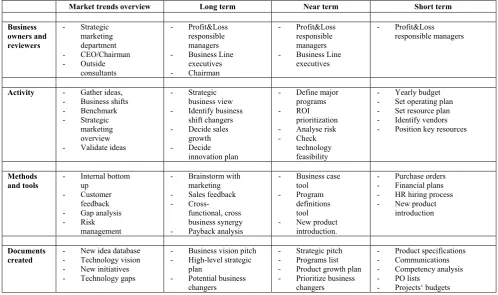
The below table shows strategic business long, near and short term plans overview. It summarises the main business owners, activities to be performed, methods and tools to be used and documents created in each stage of planning. According to M.Robinson (Robinson M., 2005) the same steps are valid for SOP as the same people in each level perform the same tasks.
Each phase of the planning process results in sourcing initiatives, which should be in line with growth objectives.
Market trends overview Long term Near term Short term
Business owners and reviewers
- Strategic marketing department
- CEO/Chairman
- Outside
consultants
- Profit&Loss responsible managers - Business Line
executives
- Chairman
- Profit&Loss responsible managers - Business Line
executives
- Profit&Loss responsible managers
Activity - Gather ideas, - Business shifts
- Benchmark
- Strategic marketing overview - Validate ideas
- Strategic business view - Identify business
shift changers - Decide sales
growth
- Decide
innovation plan
- Define major programs
- ROI
prioritization - Analyse risk
- Check
technology feasibility
- Yearly budget - Set operating plan - Set resource plan - Identify vendors - Position key resources
Methods and tools
- Internal bottom up
- Customer
feedback - Gap analysis
- Risk
management
- Brainstorm with marketing - Sales feedback
-
Cross-functional, cross business synergy - Payback analysis
- Business case tool
- Program
definitions tool
- New product
introduction.
- Purchase orders - Financial plans - HR hiring process
- New product
introduction
Documents created
- New idea database - Technology vision - New initiatives
- Technology gaps
- Business vision pitch - High-level strategic
plan
- Potential business changers
- Strategic pitch - Programs list - Product growth plan - Prioritize business
changers
- Product specifications
- Communications
- Competency analysis
- PO lists
- Projects‘ budgets
Figure 3. Long-term, near-term and short term plans overview.
Market trends overview
The first step of SOP plan preparation is business and labour market global and regional trends review and analitical research from outsourcing perspective.
This stage should be shaped by top level executives and with the help of outside consultants, if needed. Main activities to be performed are listed in Figure 4.
Business owners and
reviewers Activity
- Strategic marketing department
- CEO/Chairman
- Outside
consultants
- Global economic trends review - Company‘s global and regional
growth definitions
- Launching of globalization or regional expansion initiative
Figure 4. Market trends overview tasks related to strategic outsourcing
CAPS/A.T. Kearney study also identifies, that strategy planning phase must be driven by the board of directors,
CEO and CFO. (Knowledge W.P. Carey, 2005). Participation of senior leadership ensures that outsourcing plan is tied into the overall strategic plan of the organization, and that the intent of the strategy won't be lost to tactical, quick-hit wins.
Long term plan
The annual schedule of long term business plan finalisation should be first quarter of every year. Although company‘s vision and values do not change often, strategic plans may undergo serious revision depending upon the dynamic business environment. Then strategic long term business plan should be realigned with outsourcing initiatives and serve as framework for long term SOP development.
Thus, company‘s business long term plan is giving directions and guidelines for long term SOP.
analysis, because when going offshore, common risks (infrastructure stability, security, process maturity) become conspicuous, and uncommon risks (hr predictability, political stability) emerge (Overby S., 2006).
Business owners and reviewers
Activity
- Profit&Loss responsible managers
- Business
Line executives
- Chairman
- Identify global sourcing regions and technology drivers
- Perform country/regional geopolitical and economic risks analysis
- Conduct global/regional competitive due diligence - Set high level business sourcing
targets
Figure 5. List of long term strategic outsourcing plan activities and business owners
Near term plan
Fundamental process for creation of near term plan is identical to long term, except two points:
1. This plan focuses on actions or goals which can be completed within a period from 1 to 3 years with reasonably acceptable risk.
2. Accountability for executing and delivering the near-term plan should include second-tier leaders such as vice presidents, general managers, business line leaders in addition to top-level executives (Robinson M., 2005).
In this phase concrete decisions for near future actions have to be taken. Processes to be outsourced have to be finally defined and major vendors have to be identified.
Main activities to be performed are listed in Figure 6 (Power M.J, 2006; Robinson M., 2005)
Business owners and reviewers
Activity
- Profit&Loss responsible managers
- Business
Line executives
- Chief
Operations Officer and Chief Procurement Officer
- Decide functions/processes to be outsourced, e.g: Back office function, engineering, manufacturing, product support, call centres, business processes (HR, finance, etc.), IT, R&D, marketing
- Narrow down focus
country/countries - Identify major vendors
- Compare development/investment in own facilities vs outsourcing
Figure 6. List of near term strategic outsourcing plan activities and business owners.
Short term plan
This phase is where all actions happen. A good transition should be made from the three years plan to next year‘s specific action plan. Each project in the short term must relate to one of the larger achievements included in the three year plan. The two have to be in sync with the overall strategy.
Companies should start assessing competencies, evaluating locations, selecting major outsourcing vendors. Special attention should be paid to RFP process and
structure, which is the first step in balancing operational control with managed transformational change (Roehrig P., 2005).
Main activities to be performed are listed in Figure 7.
Business owners and reviewers
Activity
2
- Profit&Loss responsible managers
- Request for proposal prepared - Needed skills identified - Needed resources quantified
- MSA/SLA prepared
- Vendors to be considered identified - Purchase orders prepared - Transition team formed - Project plans ready - Budgets ready
Figure 7. List of short term strategic outsourcing plan activities and business owners
Tactical plan
Suggested planning timeline is like this: 1q for long term plan, 2q for developing 3 years plan, 3q should be dedicated for the short term plan.
After a long term, near term and short term plans are drafted, individual project or program managers must develop their detailed project plans during fourth quarter. Upfront knowledge of company‘s requirements and their estimated time line project by project is vital for effective outsourcing. Equipped with this knowledge company can recognise gaps as well as human resources development, hiring and training needs. Conducting a cost-benefit analysis of available skills will show whether objectives can be achieved within approved budget.
During implementation, leaders are the executive / business and functional officers of the affected units and the chief procurement officer. It is at this stage that an outsourcing strategy can fall apart due to lack of planning, lack of a far horizon view, and lack of support by senior leaders - even if senior management led the original design (Knowledge W.P. Carey, 2005). Focus on implementation and constantly check in with senior leadership is needed to make sure that overall objectives of outsourcing strategy is aligned with overall company goals.
Conclusions
- When assessing outsourcing options it may become apparent that certain company strategies are diametrically opposed to outsourcing of a specific function, or at given, outsourcing at all.
- Before any outsourcing planning, company has to implement functionality and growth measurement system. Companies should have processes for analysing if the business has been expanding according to the plans, measuring and comparing what were the variations last year and years before. - Rationale for outsourcing may be fundamentally
References
1. Brown, D. Black Book of Outsourcing: how to manage the changes, challenges and opportunities / D. Brown, S. Wilson # New Jersey: John Wiley & Sons, 2005, p. 19-88.
2. Greaver M. F. Strategic outsourcing: a structured approach to outsourcing decisions and initiatives / M. F. Greaver // New York: AMA publications, 1999, p. 17-35.
3. Gottschalk, P. E-business strategy, Sourcing and Governance / P. Gottschalk // London, Hershey: Idea Group Publishing. 2006, p. 126-140.
4. Gottschalk, P. Managing Successful IT Outsourcing Relationships / P. Gottschalk, H. Solli-Saether // London, Hershey: IRM Press, 2006, p. 127-147.
5. Gupta, S. D. Outsourcing – a strategic decision? [2008-03-14]. http://www.networkmagazineindia.com/200410/coverstory01.shtml 6. Hanan, M. Tomorrow's competition: the next generation of growth
strategies / M. Hannan // New York: New York America Management Association, 1991.
7. Jones, C. D. Sourcing strategy: knowing when to outsource[2008-0307].http://www.cio.com/archive/100106/sourcingstrategy. pdf 8. IT Business edge. Ignoring Business Strategy Makes for Weak
Outsourcing Efforts [2008-02-13]. http://www.itbusinessedge. com/ item/?ci=13443
9. KLG. Nearshore vs Offshore Sourcing. Relative risks, rewards and economic outcomes [2008-02-13]. http://www.klgonline.com /Location /KLG_NearshorevsOffshore.pdf
10. Knowledge@W. P. Carey. Outsourcing: Effective Strategies Necessary for Long-Term Success [2008-03-20]. http://knowledge. wpcarey.asu.edu/article.cfm?articleid=1023
11. Knowledge@W. P. Carey. Fools rush out: plan carefully before outsourcing customer services [2008-03-20]. http://knowledge. wpcarey.asu.edu/article.cfm?articleid=1071
12. Knowledge@W. P. Carey. How to embrace globalisation and succeed in business [2008-03-20]. http://knowledge.wpcarey.asu. edu/article.cfm?articleid=1209
13. Kolawa, A. Outsourcing: Devising a Game Plan [2008-03-14]. http://www.acmqueue.org/modules.php?name=Content&pa=showpa ge&pid=235&page=1
14. Linder, J. C. Outsourcing for radical change: a bold approach to enterprise transformation / J. C. Linder // New York: Accenture LLP, 2004, p. 26-86.
15. Mc Cue, A. Short term cost-cutting still key outsourcing driver [20070211].http://services.silicon.com/itoutsourcing/0,3800004871, 39157270,00.htm
16. Meyer, T. Nearshoring to Central and Eastern Europe. [2008-02-11]. http://www.dbresearch.com
17. Out Law news. Cost replaces expertise as outsourcing's main driver [2007-02-11]. http://www.out-law.com/page-6065
18. Power, M. J. Outsourcing Handbook: how to implement successful outsourcing process / M. J. Power, K. Desouza, C. Bonifazi // London, Philadephia: Cogan Page limited, 2006, p. 31-66.
19. Overby, S. Global outsourcing guide [2008-03-20]. http:
//www.cio.com/archive/071506/2006_global_outsourcing_guide.pdf 20. Ramanujam, A. Nearshoring to Atlantic Canada, is it the smart
alternative to offshore outsourcing to India? [2008-02-18]. http://www.nearshoring.ca/whitepaper01.htm
21. Robinson, M. Global Outsourcing. Executing on Onshore, Nearshore or Offshore Strategy / M. Robinson, R. Kalakota, S. Sharma // Alpharetta: Mivar Press, 2005, p. 52-80.
22. Roehrig, P. Using The RFP to create A Sourcing deal transformation roadmap [2008-03-07]. http://www.forrester.com /Events/ Content/ 0,5180,-1249,00.ppt#1
23. Tucci, L. Outsourcing loosing its sheen [2007-02-11]. http:// searchdatacenter.techtarget.com/originalContent/0,289142,sid80_gci 1091263,00.html
24. Vashistha, A. The offshore nation: strategies for success in global outsourcing and offshoring / A.Vashistha, A.Vashistha // New York: Tata McGraw-Hill, 2006, p. 33-49.
25. Ward, L. To outsource or not to outsourse [2007-02-11]. http:// www.technewsworld.com/story/21700.html.
Vytautas Boguslauskas, Goda Kvedaravičienė
Strateginis kompetencijų nuomos planas ir kompetencijų nuomos proceso struktūra
Santrauka
Kompetencijų nuomą kompanijos dažnai traktuoja kaip de facto sprendimą. Pakankamai dėmesio išsamiam tokio sprendimo pagrindimui ir strateginių priežasčių, dėl kurių turėtų imtis kompetencijų nuomos iniciatyvos, suvokimui neskiria.Kompanijos dėmesį skiria kompetencijų
nuomos mechanikai bei tikimybei greitai bei reikšmingai sumažinti kaštus. Apimties nustatymas, procesų parinkimas ir atsipirkimo skaičiavimas dažnai nėra pagrindžiamas. Tiesiog priimama nuostata, kad kompetencijų nuoma iš principo yra naudinga ir nereikia detaliai tokio pasirinkimo pagrįsti. Tokiu atveju nėra skiriama pakankamai dėmesio rizikai, kuri atsiranda, jei kompetencijų nuomos santykiai pradedami be tinkamo išankstinio pasirengimo ir strateginio planavimo. Tai užkerta kelią lūkesčiams patenkinti.
Rinkoje atlikti tyrimai rodo, kad dauguma kompanijų vertina kompetencijų nuomą kaip galimybę greitai sumažinti kaštus. Didelės apimties CAPS ir A.T. Kearney Inc tyrimas atskleidė, kad daugiau nei 80 procentų respondentų pagrindinėmis priežastimis, lėmusiomis apsisprendimą naudoti kompetencijų nuomą, nurodė kaštų mažinimą
(veiklos kaštų bei kapitalinių investicijų) ir norą koncentruotis ties pagrindine kompanijos veikla. Tačiau trūko įrodymų, kad kompanijos vertina kompetencijų nuomą strategiškai. Nors dauguma respondentų
buvo įsitikinę savo pasirinkimu esant strateginiu, tyrimo rengėjai negalėjo teigti, kad kompanijos naudoja kompetencijų nuomą konkurenciniam pranašumui įgyti, o ne tik kaštams mažinti.
Per paskutinius du dešimtmečius korporacijos naudojosi kompetencijų
nuoma kaip priemone paslaugoms gerinti mažinant bendruosius paslaugos teikimo kaštus. Per dvidešimt metų tos kompanijos išmoko svarbią
pamoką ir dabar stengiasi taikyti strateginės kompetencijų nuomos koncepciją, kuri skiria dėmesį ilgalaikiams kompanijos poreikiams ir stiprina jos konkurencinį pranašumą
Tinkamai sukurtas Strateginis kompetencijų nuomos planas (SKNP) sudaro sąlygas sėkmingai kompetencijų nuomai. Pasitelkiant šį planą, išsiskiria specifiniai faktoriai, į kuriuos atsižvelgiant priimamas teisingas sprendimas ir nustatomi sėkmės kriterijai.
Tyrimo objektas – Strateginis kompetencijų nuomos planas (SKNP). Pagrindinis tyrimo tikslas – atskleisti tinkamo SKNP svarbą ir pranašumus prieš pradedant planuoti kompetencijų nuomos projektus; nurodyti jo suderinimą su kompanijos verslo strategija; pateikti verslo plano ir kompetencijų nuomos plano tarpusavio priklausomybę; aptarti plano parengimo etapų metodologijos sudarymą, kurios šiuo metu trūksta mokslinėje literatūroje.
Tyrimo metodai: sisteminė, loginė ir palyginamoji analizė. Jeigu kompanija imasi įgyvendinti kompetencijų nuomos koncepciją, sėkmę lemia šie etapai: bendroji informacija, planavimas, paieška ir vykdymas. Nors skirtingi autoriai vadina šiuos proceso etapus kiek skirtingai ir kartais jie susideda iš šiek tiek skirtingų veiklų, tačiau visi sutinka, kad sėkmė tiesiogiai priklauso nuo išsamaus planavimo ir visų įmanomų galimybių, galinčių suteikti konkurencinį pranašumą, identifikavimo, taip pat nuo rizikos, kuri tapo pagrindine problema kompetencijų nuomos vadyboje, išvengimo ir jos kontrolės.
SKNP turi būti rengiamas atsižvelgiant į verslo plėtimo perspektyvą
didinti pardavimus ir konkurencinį pranašumą, o ne tik kreipti dėmesįį
kaštų mažinimą. Kompanijos verslo strategiją turi atitikti kompetencijų
nuomos strategija, o kompetencijų nuomos strategijos įgyvendinimas visą
laiką turi sutapti su ilgalaikiais, vidutinio laikotarpio ir trumpalaikiais verslo augimo planais.
Remiantis C. D. Jones studija, didžiausia kompanijų daroma klaida renkantis kompetencijų nuomą yra trūkstamas ryšys su verslo strategija. Be to kompanijoms trūksta duomenų rimtam verslo planavimui sudaryti, nes sprendimus rinktis kompetencijų nuomą lemia prielaidos, o ne rimti ir patikimi faktai. Vien tik šie du faktoriai – strategijos ir duomenų trūkumas – yra labai grėsmingi ir gali iš esmės sugriauti kompanijos verslą
netolimoje ateityje.
Prieš pradedant bet kokį kompetencijų nuomos planavimą, kompanijoje turi būti įdiegti procesai tam, kad faktiniai rezultatai būtų
kokį kompetencijų nuomos planavimą kompanija turi įdiegti funkcionalumo ir augimo matavimo sistemą.
Sudarant kompetencijų nuomos strategiją, visą laiką reikia turėti galvoje dabartinius bei ateities verslo planus. Kiekvienas su kompetencijų
nuoma susijęs sprendimas turi būti svarstomas visos kompanijos ir esančios rinkos kontekste. Rimtas ilgalaikių, vidutinio laikotarpio, trumpalaikių bei taktinių augimo planų suvokimas sudaro sąlygas tvirtiems kompetencijų nuomos pamatams.
Skirtingos trukmės verslo ir kompetencijų nuomos planai skirstomi taip:
• Ilgalaikiai - >= 5 metai,
• Vidutinio laikotarpio – 3 metai,
• Trumpalaikiai - 1 metai,
• Taktiniai – savaitiniai ar ketvirtiniai.
Kiekvienam planui paskirti atsakingi už jo rengimą verslo vadovai, nurodytos veiklos, kurias reikia atlikti, taikomi metodai, naudojamos priemonės ir reikalingi sukurti dokumentai.
Norint gauti maksimalią naudą, abu strateginiai planai - verslo ir kompetencijų nuomos - turi būti ruošiami paraleliai.
Pirmasis SKNP rengimo etapas yra verslo ir darbo rinkos tendencijų
apžvalga atsižvelgiant į kompetencijų nuomos perspektyvą. Už šį etapą
turi būti atsakingi aukščiausi kompanijos vadovai, kuriems prireikus gali padėti konsultantai iš išorės.
Antrasis etapas yra ilgalaikio plano rengimas. Pagal rekomenduojamą
metinį planų rengimo grafiką, ilgalaikis planas turi būti baigtas per pirmąjį
kiekvienų metų ketvirtį. Nors kompanijos vizija ir vertybės dažnai nesikeičia, dėl itin dinamiškos verslo aplinkos strateginiai verslo planai turi būti kasmet išsamiai peržiūrimi. Po to strateginis ilgalaikis verslo planas turi būti suderintas su ketinimais naudoti kompetencijų nuomą ir turi būti esminis ilgalaikiam SKNP kūrimui. Šiam etapui reikalinga detali analizė ir skaičiavimai, nes planuojant nuomotis kompetencijas iš nutolusių vietovių įprastinės rizikos lygis didėja (infrastruktūros stabilumas, procesų branda) ir papildomai atsiranda neįprastoji rizika (kultūriniai skirtumai, personalo veiksmų prognozavimas, politinis stabilumas).
Vidutinio laikotarpio plano rengimo etape būti priimami konkretūs sprendimai, kurie bus įgyvendinami netolimoje ateityje. Turi būti galutinai parenkami procesai, tinkami kompetencijų nuomai, bei nustatomi pagrindiniai galimi paslaugos teikėjai.
Trumpalaiko plano rengimo etape planuojami konkretūs veiksmai. Turi būti sklandžiai pereita nuo trijų metų plano prie konkretaus kitų metų
veiksmų plano. Kiekvienas trumpo laikotarpio projektas turi sietis su vienu iš didesnių pasiekimų, įtrauktu į trejų metų planą. Abu kartu jie turi sietis su bendrąja strategija.
Ypatingas dėmėsys turėtų būti skiriamas pasiūlymo sąlygų rengimo procesui ir struktūrai. Tai yra pirmas žingsnis sudarant išsinuomojamų
operacijų kontrolės ir valdytinų transformacijos sąlygotų pokyčių
pusiausvyrą.
Sukūrus ilgalaikius, vidutinio laikotarpio ir trumpalaikius planus, per ketvirtą metų ketvirtį atskirų projektų bei programų vadovai turi parengti detalius projektų, už kuriuos jie atsakingi, planus. Išankstinis kompanijos reikalavimų žinojimas ir tinkamas visų projektų pradžios ir pabaigos planavimas yra esminis dalykas norint sėkmingai įdiegti kompetencijų
nuomą. Kompanijos vadovai, turintys šias žinias, gali lengvai nustatyti trūkstamus žmogiškųjų resursųįgūdžius, nuspręsti, kiek ir kokie mokymai reikalingi turimam personalui, kiek pasamdyti naujų darbuotojų. Atliekant esamų įgūdžių kaštų-naudos analizę, taps aišku, ar tikslai gali būti pasiekti, esant turimam projekto biudžetui.
Kompetencijų nuomos diegimo metu lyderiai yra verslo ir atskirų
funkcinių dalinių, kuriuos palies kompetencijų nuoma, vadovai bei pirkimų vadovai. Būtent šitame etape visa kompetencijų nuomos strategija gali sugriūti dėl trūkstamo detalaus taktinio plano, trūkstamo aukščiausio lygio vadovų palaikymo, net jei jie ir palaikė idėją pradinėse stadijose. Susitelkimas ties diegimu ir nuolatinis suderinimas su aukščiausia vadovybe būtinas tam, kad viskas vyktų sklandžiai ir išliktų suderinta su ilgalaikiais kompanijos verslo planais.
Siūlomos planavimo datos yra šios: ilgalaikis planas turėtų būti parengtas per 1 ketvirtį, 2 ketvirtis turėtų būti skirtas vidutinio laikotarpio planams kurti, per 3 ketvirtį reikėtų parengti trumpalaikį planą, o 4 ketvirtis skirtas taktiniams planams rengti.
Išvados:
- Vertinant kompetencijų nuomos pasirinkimus, yra akivaizdu, kad kai kurios kompanijos strategijos visiškai priešingos sprendimui nuomotis tam tikrą funkciją. Gali pasitaikyti atvejų, kai atskiros strategijos iš principo prieštarauja kompetencijų nuomos koncepcijai kompanijoje.
- Prieš pradedant bet kokį su kompetencijų nuoma susijusį
planavimą, kompanijoje turi būti įdiegta funkcionalumo ir augimo matavimo sistema. Turi būti analizės procesai, kurie lygintų ar veiklos plėtimasis atitiko planus, matuotų nukrypimus ir lyginantų rezultatus su praėjusiais laikotarpiais.
- Atskirų net ir tos pačios pramonės šakos kompanijų priežasčių
rinktis kompetencijų nuomą pagrindimas gali būti iš esmės skirtingas. Kai skirtingi faktoriai yra laikomi strateginiais, kompetencijų nuomos sprendimai reguliuojami atsižvelgiant į
skirtingus prioritetus. Todėl būtina atskira kiekvienos kompanijos analizė ir neturi būti vadovaujamasi trafaretiniais modeliais.
Raktažodžiai: kompetencijų nuoma, strateginis kompetencijų nuomos planas, strateginis verslo planas, verslo strategija, matavimo sistema, planavimo procesas.