ISSN 1392-2785 Inzinerine Ekonomika-Engineering Economics(2). 2009 ECONOMICS OF ENGINEERING DECISIONS
Estimation of Trade Specialization: the Case of the Baltic States
Dalia Bernatonyte
1, Akvile Normantiene
21Kaunas University of Technology
Laisves av.55, LT-44309 Kaunas, [email protected]
2South Baltic Cross-border Cooperation Programme
Rzeznicka str. 58, 80-822 Gdansk,[email protected]
Global trade environment has changed in three major ways in recent decades. International trade has grown rapidly in value and volume, the composition of trade has altered significantly, and trade flows have been extensively liberalised. Increasing international trade is crucial to the continuance of globalization. Globalization and integration processes are having a major impact on the international trade system. Current economic integration processes (accession of Lithuania, Latvia, Estonia and other States into the EU) expanded the boundaries of the European Union thus influencing tendencies of changes of nature and pattern of trade specialization.
Trade among nations is traditionally explained as arising from the specialization of nations in particular industries as conditioned by the nation’s relative factor endowments. Traditional theories such as comparative advantages or factor endowments state that countries with different resources or factor endowments will trade with each other. But empirical evidences show that countries with similar endowments do more trade these days. Based on new theories, monopolistic competition and increasing returns lead to intra-industry trade among countries, whereas the old comparative advantage is still applied for the countries separated by high economic distance. Trade specialization theories distinguish between inter-industry and intra-industry specialization. Inter-industry specialization refers to the simultaneous exchange of different goods. Countries specialize by exploiting their comparative advantages arising from differences in technology, innovativeness and differences in factor endowments. Many studies suggest that more developed countries and more specialized trade structure lead to higher intra-industry trade. To understand why economists have to turn their attention to these aspects, differences between inter-industry trade and intra-inter-industry trade specialization are analysed in this article.
Seeking to define the nature and pattern of trade specialization in the Baltic States, the basic theories of trade specialization and methods of measurement of inter-industry and intra-inter-industry trade specialization are analyzed in this article. For analyzing the structure and determinants of country’s foreign trade and identification the basis on which competitive advantages are built various measures of trade specialization are determined. Using relative trade advantage index and standard international trade classification, the nature and pattern of inter-industry trade specialization was established in the
Baltic States. Using Grubel-Lloyd index and standard international trade classification the nature of intra-industry specialization in trade between the Baltic States and the EU was estimated. On the basis of researches it was determined that intra-industry trade share between the Baltic States and the EU over examined period has been growing rapidly.
Keywords: trade specialization, inter-industry trade specialization, intra-industry trade specialization, relative trade advantage index, Grubel-Lloyd index, export, import.
Introduction
International trade today is a dynamically developing part of global economics and the following factors influence its constant growth: increase of international division of work; globalization and internationalization of production; liberalization of international trade by WTO regulation; transnational competition enabling creation of new branches of economics, renew main capital, etc. (Bernatonyte, Normantiene, 2007). The change of traditional direct trade form to self-service form of trade has increased the product assortment in many groups of products (Butkeviciene, Stravinskiene et al., 2008). According to the level of the list of articles of goods international trade consists of two flows: inter-industry trade and intra-industry trade. Intra-industry trade (i.e. trade of differentiated products of a single branch between countries) rather than inter-industry trade is an important and constantly growing modern international sector. Under current conditions it constitutes approximately one fourth of global trade, more that 60 % of European trade and 20 % of Japan trade (Bernatonyte, Normantiene, 2007). Increasing part of intra-industry trade in the volume of global trade is of importance to the changes of economy of separate countries. The scale of such trade increased the volumes of production, export and import in various sectors of economy change of such countries. This leads to changing nature of international trade and its structure of goods.
will trade with each other (Husted, Melvin, 2004). But empirical evidences show that the countries with similar endowments do more trade these days. Based on new theories, monopolistic competition and increasing returns lead to intra-industry trade among countries, whereas the old comparative advantage is still applied for the countries separated by high economic distance (Bernatonyte, Normantiene, 2007). Effect of economies of scale helps to explain the trade in similar goods the comparative part of which in the total volume of trade is big enough and still has the tendency of growth (Volgina, 2006). Many studies suggest that traditional sources of competitive advantage (e.g. natural resources, access to financial resources, economies of scale, etc.) no longer suffice, growing relevance has recently been attributed by researches to human resources and their management (Kazlauskaite, Buciuniene, 2008).
Trade specialization theories distinguish between inter-industry and intra-industry specialization. Inter-industry specialization refers to the simultaneous exchange of different goods. Countries specialize by exploiting their comparative advantages arising from differences in technology (Ricardo, 1817) and innovativeness (Posner, 1961) and differences in factor endowments (Hecksher, Ohlin, 1933). Vanek (1959) extended the Hecksher-Ohlin framework to include natural resources (Algieri, 2007).
Most of researches show that the more developed a country is the more specialized is the structure of international trade and, therefore, a larger part of trade within a branch dominates in the total scope of international trade (Kalbasi, 2003; McAleese, 2004; Tiits, Juriado, 2006 etc.).
The problem. In orderto understand why economists have turned their attention on the analysis of trade specialization, it is necessary to examine differences between inter-industry trade and intra-industry trade specialization. Trade based on inter-industry trade and intra-industry trade specialization are distinguished using various indices. This is particularly important for the Baltic States due to the lack of researches in this field.
The following are the dominating approaches of measurement of inter-industry trade and intra-industry trade: The Balassa index, Grubel-Lloyd index, The Aquino index, Donges and Riedel index, Hine and Greenaway method, Sapir method, The Bergstrand method etc (Balassa, 1966; Grubel, Lloyd, 1975; Aquino, 1978; Donges, Riedel, 1977; Hine, Greenaway, 1991; Sapir, 1996; Bergstrand, 1990). All these approaches used have both advantages and disadvantages however, the problem they face while assessing the index of intra-industry trade is that of provision of data. Usually the standard international trade classification (SITC) is used, yet there exist doubts regarding subjection of certain goods to the same branch or other branches (Volgina, 2006).
When the problems of measurement of trade specialization are analyzed, the economic literature focuses on a great extent on purposefulness of the usage of such trading forms. The opinions of scientists are different on this point (Jasinskas, Simanaviciene, 2008). The opinion prevails that horizontal intra-industry trade in differentiated products varying in style, external features enables the countries with similar endowment of production factors to gain benefit from economy of scale specializing in manufacturing
certain products (Lancaster, 1980; Dixit, Stiglitz, 1977). Such an approach is mainly used for the analysis of nature of intra-industry trade between developed countries. In the opinion of other authors vertical intra-industry trade in differentiated products, varying in style, external features enables gaining benefits from such trading with the countries having different endowment of production factors, different working power abilities, etc (Falvey, Kierzkowski, 1987; Falm, Helpman, 1987). Therefore, this approach of intra-industry trade is used when analyzing the nature of trade specialization between the countries of different economic development.
During 1990s, the Baltic States liberalised and reformed their economies. Differences in liberalization processes, administrative reforms and political frameworks revealed themselves as differences in trade structure and comparative advantage. Since 1990 they have chosen the EU markets as their foreign trade policy orientation. Since 1993 the Baltic States trade with the EU progressed with remarkable speed, both imports and export values (Runevic, 2008). Today the Baltic States are competing exporters of similar sectors of commodities (Snieska,
2008). While demand in Eastern markets is shrinking, export conditions to EU countries are getting more attractive. This encourages Baltic States exports to the EU (Snieska, 2008). The Baltic States are considered as attractive recent entrants of the EU demonstrating high growth and representing new unsaturated market (Tvaronaviciene, Grybaite et al., 2008).
Several studies have assessed the evolution of the trade patterns in the transition economies. The attention was given especially to the so-called accession countries, i.e. transition countries currently seeking EU accession (Aturupane et al., 1997; Fidrmuc et al., 1999; Kaitila, 1999). It is possible to state that the enter of the extra small economy to the economically integrated area of EU can lead by market structure transitions to the consolidation of economic prosperity of such small country (Kraft, 2008). Current economic integration processes (accession of Lithuania, Latvia, Estonia and other States into the EU) expanded the boundaries of the European Union thus influencing tendencies of changes of nature and pattern of trade specialization. However, researches related to such changes are scares. It is particularly important to the specialization of the Baltic States in trade with the EU. Therefore, a serious problem arises – what criteria should be used when assessing the nature of trade specialization under the changed conditions.
The object of this research: trade specialization of the Baltic States.
The aim of research: to analyze the nature and pattern of trade specialization in the Baltic States.
The tasks of research - toanalyze the basic theories of trade specialization; to determine the methods of measurement of inter-industry and intra-industry trade specialization; to perform the comparative analysis of Lithuanian, Latvian and Estonian inter-industry and intra-industry trade with the EU; to establish the nature and pattern of trade specialization in trade between the Baltic States and the EU.
specialization, inter-industry and intra-industry trade; the systematic statistical data analysis of the EU and Lithuanian, Latvian and Estonian international trade.
Theoretical review of trade specialization
Trade specialization evolves over time bringing with it patterns of economic development that vary from country to country and from region to region within countries. The nature and pattern of trade specialization has been the subject of much study.
Neoclassical trade theory explains patterns of regional specialization on the basis of comparative advantages resulting from differences in productivity, such as David Ricardo’s theory, or endowments, such as Hecksher-Ohlin model, between countries and regions. According to these theories, increased specialization along lines of comparative advantages provides gains to trade. David Ricardo’s theory on relative comparative advantage provided the fact that different countries have comparative advantage in different production branches, and individual regions or countries should specialize in production and export of goods which can be produced comparatively cheaper than in other countries. Thus, the goods that can be produced by other countries more effectively shall be imported. Ricardo provided the main principle of this theory: goods are more mobile between different regions than resources (work, capital, land). This assumption describes the theory of intra-industry trade. The theory of comparative advantage deals with all the reasons of international trade that are generated by the differences between the countries. Ricardo’s contribution is not related to his note that all countries are different, but, rather, to the fact that these differences help all countries gain an international advantage even if they have higher wages (developed countries) or lower productivity (developing countries) if compared to neighbouring countries. Ricardo’s idea of trade model was to show that each country can gain an advantage due to certain differences among countries. Anyway, whether a country has higher wages or another – lower productivity, competitive wage rates that prevail in a country ensure that every country will specialize in the good having a comparative advantage. However, D. Ricardo’s trade model is unable to explain the influence of trade on distribution of income within a country or what can be described by a comparative advantage (Bernatonyte, Normantiene, 2007).
Thus, trade theorists turn their attention to the Hecksher-Ohlin trade model. In Hecksher-Ohlin model factor endowments are labour and capital; therefore, a abundant country will tend to specialize capital-intensive goods and will export these goods in exchange for labour-intensive commodities. Labour-abundant countries instead of it will specialize and export products that make intensive use of labour and will import capital-intensive goods (Lindert, Pugel, 1996). Yet the empiric researches of Hecksher-Ohlin model failed. The reason was that the researched models failed to provide the fact that international trade has great influence on distribution of income. The main reason why international trade fails to provide the influence on distribution of income is that most international trade is intra-industry trade. When international
trade takes places there is no massive redistribution of production factors from labour–intensive industries to capital–intensive industries. On the contrary, the production factors are redistributed within industries and this does not have the same impact as inter-industry trade (Bernatonyte, Normantiene, 2007). Both of these theories imply that the gains from trade accrue as the result of specialization in production of goods that are traded at improving terms of trade. However, actual trading patterns observed in industrialized countries do not show this predicted specialization (Kregel, 2000).
Neoclassical trade theory will provide a general answer stating that if capital-abundant societies specialize in capital-intensive production for exports and labour-abundant societies specialize in labour-intensive production for exports, trade among them will be an important stimulator of economic growth, because trade enlarges consumption, increases world output, and provides universal access to scarce resources and help countries to achieve development through specialization (Rojas, 1998).The neoclassical trade theory envisages that, as factors of production and consumers are scattered across regions, the structure of industrial production will be dispersed geographically. Each region will specialize in the production in which it has a comparative advantage, and in this way inter-industry specialization is stimulated. Inter-industry trade refers to the simultaneous exchange of goods belonging to different sectors (Algieri, 2008).Thus, the neoclassical theories analyzed the trade between countries with different provision of production factors. However, majority of global trade is conducted between the developed countries having similar economic structure and endowment of production factors.
During the 1980s, new trade theory models were developed to explain high levels of intra-industry trade and the large proportion of world trade between very similar countries (Amiti, 1998). New trade theory models challenged the traditional theories and provided a simple explanation for the observed intra-industry trade patterns. They emphasized the gains of trade associated with intra-industry trade in horizontally differentiated products based on imperfect competition, consumer preferences and other features of industrial organization. Theory of intra-industry was developed by a number of authors who found in recent developments in monopolistic competition theory the modelling techniques needed.
this will translate in inter-industry specialization between the core regions. Besides, scale economies will lead to intra-industry trade across companies, which will concentrate in the production of a unique differentiated product (Brülhart, 1998).
Kevin Lancaster and Paul Krugman show that intra-industry trade expansion is a result of product differentiation in markets with monopolistic competition and increasing returns to scale (Lancaster, 1980, Krugman 1980). In the opinion of Paul Krugman, the basic idea of intra-industry trade theory is the distinction between two kinds of trade: inter-industry trade based on comparative advantage, and intra-industry trade based on economies of scale. The industrial structure of a country’s production will be determined by its factor endowments. Within each industry, however, there is assumed to be a wide range of potential products, each produced under conditions of increasing returns. Because of these scale economies, each country will produce only limited subset of products in each industry, with the pattern of intraindustrial specialization – which country produces what-essentially arbitrary. In the opinion of these authors, trade in differentiated products is most likely to take place between the countries with similar factor endowments and with a high level of per inhabitant income.
Elhanan Helpman and Paul Krugman synthesize traditional and new international trade theories in a framework that incorporate together differences in factor endowments, decreasing costs and horizontal product differentiation, in order to explain both intra-industry and inter-industry trade (Helpman, Krugman, 1981). A key issue associated with this synthesis between the traditional view (incomplete specialization of nations) and the new perspective (complete specialization of firms) is the potential (social) cost of displacing resources between alternative users: gains are not net gains, since factors being industry-specific in the short run must be displaced. Invested capital and qualifications become obsolete because of incomplete portability of factors and assets across industries. In this case, moving from one industry to another as a result of inter-industry adjustment is costly. In the case of intra-industry trade, adjustment costs are supposed to be much smaller than for inter-industry trade that has distribution effects for factor rewards (Fontagné, Freudenberg, 1997). However, the synthetic view of international trade missed an important issue that products are not only differentiated horizontally but also vertically. Accordingly, determinants and results of intra-industry trade in horizontally differentiated products are different from those in vertical differentiation. Horizontal intra-industry trade increases when produced goods are similar in quality and thus the trade is conducted between similar countries (Lancaster, 1980; Krugman 1981; Bergstrand 1990).
Vertical intra-industry trade is explained as simultaneous export and import of products, which are different in quality (Falvey, Kierzkowski, 1987, Falm, Helpman, 1987); fixed costs in R&D (Gabszewicz et al., 1981) or qualification of the labour force (Gabszewicz, Turini, 1997). They indicated that the share of vertical intra-industry trade increases in an environment where many big firms settle and produce numerous varieties.
Although, geographical advantage plays the role in the new trade theory, it is however considered as exogenous, as if it was determined by physical rather than economic characteristics (Algieri, 2008). The new economic geography models indicate that geographical advantage is endogenous and regional specialization is the result of the spatial pattern of agglomeration of economic activities (Krugman, 1991). Firms are located in an economic centre, which can be considered as being such only because other firms are located there. Regions that for historical reason have a head start as centres of production will attract even more producers, becoming the economic “core” while other areas become the “periphery”.
In order to understand the nature and pattern of trade specialization, it is necessary to analyze the problem of its measurement.
Methods of assessment of trade specialization
Researchers have employed a number of measures of trade specialization. They are used for studying the structure and determinants of country’s foreign trade and to identify the basis on which to build competitive advantages. Various methods are used for measuring inter-industry trade specialization: The Balassa index, Donges and Riedel index, Hine and Greenaway method, Sapir method etc (Balassa, 1965; Donges, Riedel, 1977; Hine, Greenaway, 1991; Sapir, 1996).
The indicator of the revealed comparative advantage provides a more concise picture of trade specialization. The concept of revealed comparative advantage was introduced by Liesner (1958), but refined and popularized by Bela Balassa and known as the ‘Balassa index’ (Balassa, 1965). It is widely used empirically to identify a country’s weak and strong export sectors. Michael Porter uses it to identify strong sectoral clusters (Porter, 1990). Balassa (1965) explored the possibility of relying on various theoretical explanations of international trade to determine the patterns of comparative advantage. The revealed comparative advantage (RCA) index is defined by Balassa (B) (1965) as follows:
B = (X ij / X it) / (X nj / X nt), (1)
Where: X – export; i – a country; j – a commodity; t – a set of commodities; n – a set of countries.
This index based on observed trade patterns. It measures a country’s exports of a commodity relative to its total exports and to the corresponding export performance of a set of countries. If B>1, then a comparative advantage is revealed. The standard deviation of this index across products can be used as measure of the comparative importance of inter-industry specialization and intra-industry trade. In fact, the greater the extent of inter-industry specialization, the greater is value of standard deviation.
An alternative specification of revealed comparative advantage, called by the relative trade advantage (RTA) was offered by Vollrach in 1991. It is calculated as the difference between relative export advantage (RXA), which equates to the Balassa (B) index, and relative import advantage (RMA):
Where: RXA = B; │Xi− Mi│
RMA = (M ij / M it) / (M nj / M nt); GLi = 1 – ———— (4)
(Xi + Mi)
M – import.
Where: Xi is the export in a certain line of goods and
Mi – import in the same commodity group.
The positive value of RTA indicates comparative trade advantages, while negative value indicates comparative trade disadvantages. If RTA>0, then a comparative advantage is revealed, i.e. a sector in which the country is relatively more competitive in terms of trade. RTA measures a country’s exports and imports of a commodity relative to its total exports and imports. Imre Fertő classified RTA index in three categories: RTA<0 refers to all those product groups with a comparative trade disadvantage. RTA = 0 refers to all those product groups in a break even point without trade advantage or trade disadvantage. RTA>0 refers to all those product groups with comparative trade advantage (Fertő, 2008). To measure the inter-industry trade specialization in trade between the Baltic States and the EU, this study uses relative trade advantage index (RTA).
The value of GLi index can vary between 0 and 1,
whereas the former denotes zero intra-industry trade and the latter corresponds to the situation where all trade is intra-industry. One should also note that trade imbalance between trading partners leads to downward deviation of the value of the GLi index, i.e. the theoretical maximum
value 1, which corresponds to hundred-percent intra-industry remains unachievable. A series of low GLi index
of one region or country reflect a centripetal process of industrial agglomeration and high specialization, while a series of high GLi index values reflect a centrifugal process
of industrial dispersion.
Regarding the fact that Grubel-Lloyd index is widespread and used for the analysis of intra-industry trade specialization in separate countries, it will be used in this study to analyze the nature and pattern of trade specialization in the Baltic States.
Several alternative measures have been developed in the literature to assess the degree of intra-industry trade: Grubel-Lloyd index, The Aquino index, The Bergstrand method etc (Grubel, Lloyd, 1975; Aquino, 1978; Bergstrand, 1990). The index most often used to assess the importance of intra-industry trade was introduced by Grubel and Lloyd in 1975 examining the trade of the countries of the Organization for Economic Cooperation and Development (OECD. Herbert Grubel and Peter Lloyd suggested the following formula to measure the importance of intra-industry trade:
Comparative analysis of trade between the Baltic States and the EU
Development of the Baltic States economy depends on foreign trade to a great extent. Development of foreign trade encourages structural changes of economy, helps to make close economic contracts to businessmen of other countries and to adjust to market conditions better. Lithuanian, Latvian and Estonian integration into the EU opened huge possibilities for their foreign trade. Regional integration oriented transformations in the Baltic region (Melnikas, 2008). Formation of the unified social, economic and technological space in the Baltic region could be comprehend as a successful case of the regional integration oriented transformations in the European Union (Melnikas, 2008). Differences in manufacturing bases, administrative reforms and political frameworks of the Baltic States have led to different developments in trade structure and comparative advantage.
GLi = [(Xi + Mi) – | Xi – Mi |] / (Xi + Mi) · 100 %, (3)
Where: GLi – index of intra-industry trade for industry i;
Xi – value of export in industry i;
Mi – value of import in industry i;
Xi + Mi – total value of trade;
| Xi – Mi | – trade balance industry i.
The value of GLi ranges from 0 to 100. Thus, the
closer the GLi value is to 100, the more important is
intra-industry trade and vice versa, the closer the value GLi is to
0, the more important is inter-industry trade. If Xi or Mi
equal to 0, there is no intra-industry trade, and this index equals 0 because the country is only exporting or importing the products of a given branch. When GLi =100, two-sided
trade is conducted: the country exports as much as it imports. In other words, the closer the value of GLi is to
100 the larger the volume of intra-industry trade is (Grubel & Lloyd, 1975). In order to establish an average level of intra-industry trade, Grubel and Lloyd proposed the weighted index to arrive at an overall measure of intra-industry trade. They noticed that GLi is characterized by
the tendency of reduction when the trade in goods is not balanced. Limitation of using this index is related to the reason that the value thereof is highly dependent on whether the branch of group of goods is defined. The wider the definition the larger the possibility that the countries trade in certain amount of differentiated goods within the limits of the groups of goods (branches) and, therefore, the value of this index is larger.
The analysis of trade specialization of the Baltic States is based on unadjusted relative trade advantage index and Grubel–Lloyd index for measurement inter-industry and intra-industry specialization. Using relative trade advantage index (RTA) and standard international trade classification (SITC) the nature and pattern of trade specialization between the Baltic States and the EU are calculated (Table 1, Table 2, Table 3).
Empirical results indicate a large variation in the RTA indices (Table 1, Table 2 and Table 3). The RTA for Lithuania presented in Table 1 indicates that the country has achieved revealed comparative advantage in trade with the EU in: food, drink and tobacco, raw materials, other manufactured goods. Data of Table 1 show that Lithuania has the highest comparative advantage in trade with the EU in mineral fuels, lubricants and related materials (among Baltic States in 2001-2007). Such situation shows that Lithuania has comparative advantages in the trade with low-added value commodities.
Table 1
Relative trade advantage indices of Lithuanian trade with the EU according to SITC in 2001-2007 Year
SITC
2001 2002 2003 2004 2005 2006 2007
Food, drink and tobacco (SITC 0+1) 0.62 0.59 0.71 0.83 0.63 1.03 1.50
Raw materials (SITC 2+4) 2.37 2.19 2.10 1.87 1.87 1.21 1.03
Mineral fuels, lubricants and related materials (SITC 3) 7.43 5.69 5.42 6.18 6.18 3.79 1.93
Chemicals and related products (SITC 5) -1.04 -0.88 -0.87 -0.85 -0.85 -0.86 -0.68
Machinery and transport equipment (SITC 7) -0.37 -0.39 -0.38 -0.44 -0.46 -0.53 -0.64
Other manufactured goods (6+8) 0.25 0.26 0.20 0.12 0.19 0.15 0.22
Source: Author’s calculation, Eurostat Comext database, January, 2009.
Table 2
Relative trade advantage indices of Latvian trade with the EU according to SITC in 2001-2007 Year
SITC
2001 2002 2003 2004 2005 2006 2007
Food, drink and tobacco (SITC 0+1) -0.45 -0.19 -0.26 -0.10 0.26 0.40 0.68
Raw materials (SITC 2+4) 13.75 12.14 12.41 9.87 8.42 6.96 3.34
Mineral fuels, lubricants and related materials (SITC 3) -0.19 -0.01 -0.07 0.76 1.41 0.50 0.25
Chemicals and related products (SITC 5) -1.17 -1.10 -1.05 -0.94 -0.92 -0.82 -0.68
Machinery and transport equipment (SITC 7) -0.66 -0.69 -0.68 -0.62 -0.65 -0.72 -0.75
Other manufactured goods (6+8) 0.58 0.61 0.55 0.51 0.37 0.35 0.37
Source: Author’s calculation, Eurostat Comext database, January, 2009.
The RTA for Latvia presented in Table 2 indicates that the country has achieved comparative advantage in trade with the EU. Latvia’s competitive position in trade with the EU measured by RTA index improved as well in 2005-2007 compared to the period 2001-2004. There were few branches where Latvia had a positive comparative advantage: raw materials (the highest RTA among Baltic States), and manufactured goods. Since 2005, Latvia has been observing positive RTA in trade with the EU in mineral fuels, lubricants and related materials as well as food, drink and tobacco (Table 2). Such situation was determined by many reasons, mainly, abolition of customs
taxes for food products and alcoholic drinks from the EU states. This reduced the prices of these products in 2005, increased consumption and import thereof. On the other hand, during the examined period from 2001 to 2007 export of the said goods increased. The RTA presented in Table 3 indicates that Estonia has achieved revealed comparative advantage in trade with the EU in: raw materials, other manufactured goods, mineral fuels, lubricants and related materials. There was one branch where Estonia saw a drop in the RTA index in 2007 compared to 2001: machinery and transport equipment (Table 3).
Table 3
Relative trade advantage indices of Estonian trade with the EU according to SITC in 2001-2007
Year SITC
2001 2002 2003 2004 2005 2006 2007
Food, drink and tobacco (SITC 0+1) -0.08 -0.02 -0.15 -0.06 -0.16 -0.05 0.01
Raw materials (SITC 2+4) 5.26 5.20 4.97 3.99 3.52 2.97 2.28
Mineral fuels, lubricants and related materials (SITC 3) 0.21 0.40 0.49 0.85 1.31 2.53 1.84
Chemicals and related products (SITC 5) -0.83 -0.81 -0.76 -0.77 -0.80 -0.81 -0.75
Machinery and transport equipment (SITC 7) -0.39 -0.50 -0.57 -0.43 -0.49 -0.57 -0.55
Other manufactured goods (6+8) 0.30 0.45 0.52 0.31 0.25 0.21 0.30
Source: Author’s calculation, Eurostat Comext database, January, 2009.
Observing similarity to Latvia and Lithuania, there were few branches where Estonia had a negative value of RTA: chemicals and related products, machinery and transport equipment (Table 3).
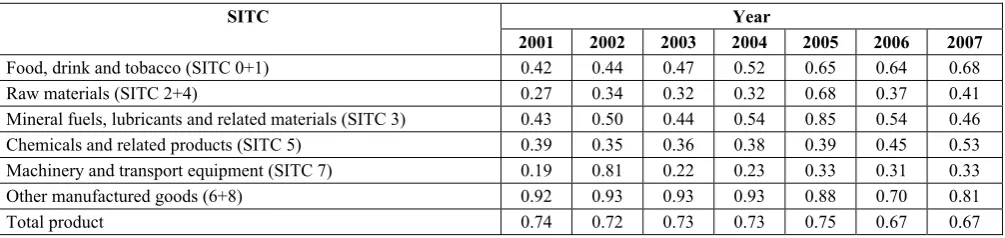
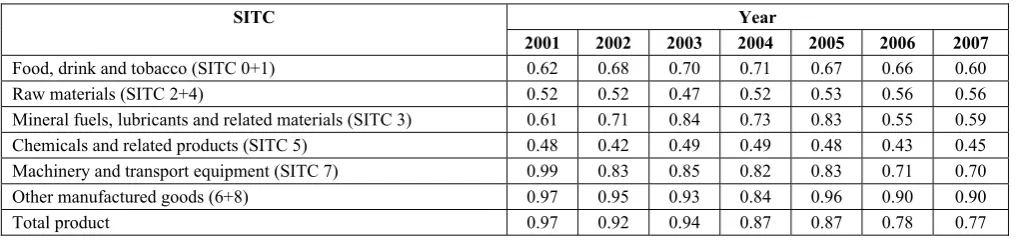
Using the Grubel-Lloyd index and SITC, the index of intra-industry trade between the Baltic States and the EU during the 2001-2007 is calculated (Table 4, Table 5 and Table 6). As we can see from the Table 4, Table 5 and Table 6, intra-industry trade of all examined countries with EU is predominant if compared to inter-industry trade (Grubel-Lloyd index during the examined period of time
varies from 0.67 to 0.97). This is related to the fact that all examined countries are of similar economic development, capital-labour ratio, qualification level.
index is close to 1 (Table 4). This is related to the fact that the EU is the main Lithuanian trading partner: share of export of goods to the EU in the total export during 2001– 2007 was the largest. This was also characteristic to the import from EU. Such a tendency remained through 2004,
when Lithuania became a member of the EU. In 2007 export of Lithuanian goods to the EU comprised 64.8 % and import from the EU – 68.3% (Foreign trade in 2007, 2008).
Table 4
Intra-industry trade between Lithuania and the EU according to SITC in 2001-2007 Year SITC
2001 2002 2003 2004 2005 2006 2007
Food, drink and tobacco (SITC 0+1) 0.94 0.97 0.97 0.99 0.94 0.97 0.99
Raw materials (SITC 2+4) 0.82 0.78 0.70 0.80 0.79 0.81 0.73
Mineral fuels, lubricants and related materials (SITC 3) 0.05 0.04 0.09 0.07 0.08 0.14 0.20
Chemicals and related products (SITC 5) 0.59 0.59 0.69 0.64 0.64 0.64 0.77
Machinery and transport equipment (SITC 7) 0.49 0.53 0.63 0.50 0.49 0.47 0.41
Other manufactured goods (6+8) 0.98 0.99 0.99 0.93 0.92 0.81 0.85
Total product 0.97 0.92 0.89 0.89 0.91 0.85 0.80
Source: Author’s calculation, Eurostat Comext database, January, 2009.
When analyzing intra-industry trade between Lithuania, Latvia, Estonia and the EU according to SITC, we see that huge differences in separate groups prevail (Table 4, Table 5 and Table 6). Data of Table 4 show that trading in food products, drinks, tobacco, other manufactured goods, raw materials, chemicals and related products dominate between Lithuania and the EU because trading indices of these branches are the largest. This shows the nature of specialization of international trade. Data of Table 4 show that Lithuanian trading with the EU in food products, drinks, tobacco, chemicals and related products during 2007 not only increased, if compared to 2001, but also were the largest among the Baltic States. Such situation was determined by many reasons, mainly, abolition of customs taxes for food products and alcoholic drinks from
the EU States. This reduced the prices of these products, increased consumption and import thereof. On the other hand, during the examined period of time from 2001 to 2007 export of the said goods increased (Foreign trade 2007, 2008).
Thus, the changes of GLi index of this branch show not only the increased level of specialization of this branch but also the ability of manufacturers to compete under more open trading conditions when Lithuania became the member of the EU. After Lithuania became a member of the EU, the consumption of manufactured goods (especially long-term ones) increased. However, having the trading regime with EU and other countries changed Lithuania exports most of manufactured goods, thus, index of trade in these goods are close to 1(Table 4).
Table 5
Intra-industry trade between Latvia and the EU according to SITC in 2001-2007 Year SITC
2001 2002 2003 2004 2005 2006 2007
Food, drink and tobacco (SITC 0+1) 0.42 0.44 0.47 0.52 0.65 0.64 0.68
Raw materials (SITC 2+4) 0.27 0.34 0.32 0.32 0.68 0.37 0.41
Mineral fuels, lubricants and related materials (SITC 3) 0.43 0.50 0.44 0.54 0.85 0.54 0.46
Chemicals and related products (SITC 5) 0.39 0.35 0.36 0.38 0.39 0.45 0.53
Machinery and transport equipment (SITC 7) 0.19 0.81 0.22 0.23 0.33 0.31 0.33
Other manufactured goods (6+8) 0.92 0.93 0.93 0.93 0.88 0.70 0.81
Total product 0.74 0.72 0.73 0.73 0.75 0.67 0.67
Source: Author’s calculation, Eurostat Comext database, January, 2009. The analysis of intra-industry trade between Latvia and the EU shows that trading in food, drink, tobacco, raw materials, chemical and related products during 2007 not only increased, if compared to 2001, but also were the largest (Table 5). This is related to the fact that examined countries are of similar economic development, capital labour ratio, qualification level.
Data in table 6 show that trading in machines and means of transport, mineral fuels, lubricants, related materials and other manufactured goods dominate between Estonia and the EU because trading indices of these branches are the largest. This shows the nature of trade specialization of Estonia.
countries as importing goods to any other EU country. In order to make sure implementation of solid foreign trade policy Lithuania applies custom tariffs, quantitative limitations, tariff quotas and other means of foreign trade regulation to the third countries
,
which EU applies. The Baltic States have applied other means of EU foreign traderegulation: antidumping, protective, compensatory, reciprocal means, quantitative limitations, non-tariff limitations (veterinary and other standards), and means, introduced as sanctions according to the decisions of the United Nations.
Table 6
Intra-industry trade between Estonia and the EU according to SITC in 2001-2007 Year SITC
2001 2002 2003 2004 2005 2006 2007
Food, drink and tobacco (SITC 0+1) 0.62 0.68 0.70 0.71 0.67 0.66 0.60
Raw materials (SITC 2+4) 0.52 0.52 0.47 0.52 0.53 0.56 0.56
Mineral fuels, lubricants and related materials (SITC 3) 0.61 0.71 0.84 0.73 0.83 0.55 0.59
Chemicals and related products (SITC 5) 0.48 0.42 0.49 0.49 0.48 0.43 0.45
Machinery and transport equipment (SITC 7) 0.99 0.83 0.85 0.82 0.83 0.71 0.70
Other manufactured goods (6+8) 0.97 0.95 0.93 0.84 0.96 0.90 0.90
Total product 0.97 0.92 0.94 0.87 0.87 0.78 0.77
Source: Author’s calculation, Eurostat Comext database, January, 2009.
Thus, the changes of GLi index show not only the increased level of specialization of goods but also the ability of manufacturers to compete under more open trading conditions when the Baltic States became the members of the EU. The changes in trade regime impacted trade character (Ginevicius, Tvaronavicieneet al., 2008). EU trade policy and the implementation of its principles had influence on new members of EU export and import marketable structure. It should be noted that since the Baltic States have become the members of the EU, common custom tariff of the EU is valid in Lithuania, Latvia and Estonia. This means that the same customs are applied for goods which are imported to the territory of the Baltic States from the third countries as importing goods to any other EU country. In order to make sure implementation of solid foreign trade policy Lithuania applies custom tariffs, quantitative limitations, tariff quotas and other means of foreign trade regulation to the third countries
,
which EU applies. The Baltic States have applied other means of EU foreign trade regulation: antidumping, protective, compensatory, reciprocal means, quantitative limitations, non-tariff limitations (veterinary and other standards), and means, introduced as sanctions according to the decisions of the United Nations.Thus, the analysis of intra-industry trade reveals that after the Baltic States have become the members of the EU, structural changes of their economics takes place. Lithuania’s trade with the EU under a free trade regime influences the increase in the volumes of import and export. This is also characteristic of the examined members of EU: Latvia and Estonia. Due to that the share of intra-industry trade importance thereof has increased. Intra-industry trade provides more additional benefits from international trade than comparable advantage because trade within a branch enables the countries to gain benefit from larger markets. A country can simultaneously decrease the amount of produced goods and to increase the range of goods useful to the consumers. Thus, the nature of international trade is changing as well as its structure of goods due to increasing specialization within a branch and the variety of produced goods increases.
Conclusions
1. It was found that trade specialization evolves over time, bringing with it patterns of economic development that vary from country to country and from region to region within countries. Therefore the nature and pattern of trade specialization has been the subject of much study. 2. The research indicates that trade specialization theories
distinguish between inter-industry and intra-industry specialization. The analysis of the basic theories of trade specialization shows that there are three main strands of literature concerning trade specialization: neoclassical trade theory, new trade theory and new geography theory. It was determined that the neoclassical theories analyzed the trade between countries with different provision of production factors. However, majority of global trade is conducted between the developed countries having similar economic structure and endowment of production factors.
3. The analysis shows that new trade theory models challenged the traditional theories and provided a simple explanation for the observed intra-industry trade patterns. They emphasized the gains to trade associated with intra-industry trade in horizontally differentiated products based on imperfect competition, consumer preferences and other features of industrial organization. Theory of intra-industry was developed by a number of authors who found in recent developments in monopolistic competition theory the modelling techniques needed. The new economic geography models indicate instead that geographical advantage is endogenous and regional specialization is the result of the spatial pattern of agglomeration of economic activities. Firms locate in the economic centre, which can be considered as such only because other firms are located there. Regions that for historical reason have a head start as centres of production will attract even more producers, becoming the economic “core” while other areas become the “periphery”.
specialization were examined and on these grounds the best of them were selected.
5. The research indicates that relative trade advantages index is the best of measuring inter-industry specialization in the trade between the Baltic States and the EU. This index helps to estimate a sector in which the country is relatively more competitive in terms of trade.
6. On the basis of the study of many methods of estimation of intra-industry trade specialization it was determined that the most appropriate method for measuring the importance of this form of trade is Grubel-Lloyd index. This index as an indicator of the degree of industrial specification helps to study ability of the Baltic States to compete in a more open trade setting.
7. It is shown that Lithuanian, Latvian and Estonian integration into the EU opened huge possibilities for their foreign trade. Differences in manufacturing bases, administrative reforms and political frameworks of the Baltic States have led to different developments in trade structure and comparative advantage. It was determined that the Baltic States are competing exporters of similar sectors of commodities. While the demand in Eastern markets is shrinking, export conditions to EU countries are getting more attractive. This encourages the Baltic States exports to the EU.
8. On the basis of standard international trade classification (SITC) and relative trade advantages (RTA) index the nature and pattern of inter-industry trade specialization in the Baltic States was determined. It is found that the biggest flows from Lithuania to the EU are in such groups: food, drink and tobacco; raw materials; mineral fuels, lubricants and related materials. It was determined that there were few branches where Latvia had a positive comparative advantage: raw materials (the highest RTA among Baltic States), other manufactured goods. Such situation was determined by many reasons, mainly, abolition of customs taxes for food products and alcoholic drinks from the EU states. This reduced the prices of these products in 2005, increased consumption and import thereof. On the other hand, during the examined period from 2001 to 2007 export of the said goods in Lithuania and Latvia increased.
9. The researches show that Estonia has achieved comparative advantage in the trade with the EU in raw materials, other manufactured goods, mineral fuels, lubricants and related materials. Similarly to Latvia and Lithuania, there were few branches where Estonia had a negative value of RTA: chemicals and related products, machinery and transport equipment.
10. On the basis of Grubel-Lloyd index and SITC concentration of intra-industry trade flows between the Baltic States and the EU is determined. The analysis shows that the growth tendency of intra-industry trade between Lithuania, Latvia, Estonia and the EU is characteristic. This is related to the fact that foreign trade between the Baltic States and the EU in 2001-2007 highly increased, and all examined countries are of similar economic development, capital-labour ratio and qualification level.
11. On the basis of SITC it was determined that huge differences in separate groups of goods prevail in intra-industry trade between the Baltic States and the EU. It is
found that trading in food, drink, tobacco, raw materials, machines and means of transport, chemical products, and other manufactured goods dominate between the Baltic States and the EU. This shows the nature of specialization in the trade of examined countries.
12. Thus, the analysis shows that intra-industry trade provides more additional benefits from international trade than comparative advantage because intra-industry trade enables the countries to gain benefit from larger markets. A country can simultaneously decrease the amount of produced goods and to increase the range of goods useful to the consumers. Thus, the nature of international trade is changing as well as its structure of goods due to increasing specialization within a branch and the variety of produced goods.
References
1. Algieri, B. Trade Specialization dynamics in Russia // http://www.accessmylibrary.com/com2/summary_028 6-31283843_ ITM.
2. Amiti, M. (1997). Specialization Patterns in Europe. Discussion Paper, 363, 66-77.
3. Amiti, M. (1998). New Trade Theories and Industrial Location in the EU: A Survey of Evidence. Oxford Review of Economic Policy, 14(2), 45-53.
4. Aquino, A. (1978). Intra-industry trade and inter-industry specialization as concurrent sources of international trade in manufactures. Weltwirtschaftliches Archiv, 114 (2), 275-295.
5. Aturupane, C., Djankov, & S., Hoekman, B. (1997). Determinants of Intra-industry Trade between East and West Europe. CEPR Discussion Paper, 1721, 235-265. 6. Balassa, B. (1965). Trade Liberalization and Revealed
Comparative Advantage. The Manchester School of Economics and Social Sciences, 33, 35-55.
7. Balassa, B. (1966). Tariff reductions and trade in manufactures among the industrial countries. American Economic Review, 56, 23-42.
8. Barrios, M. Recent Trends in Intra-industry trade // http://www.aaep. org.ar/anales/works/works1996/Bario sMarcelo.pdf.
9. Bergstrand, J. (1990). The Hecksher-Ohlin-Samuelson model, the Linder hypothesis and the determinants of bilateral industry trade. Economic Journal, 100, 55-75. 10. Bernatonyte, D., & Normantiene, A. (2007). Estimation of Importance of Intra-industry Trade. Inzinerine Ekonomika-Engineering Economics(3), 25-34.
11. Brülhart, M. (1998). Trading Places: Industrial Specialization in The European Union. Journal of Common Market Studies, 36(3), 22-35.
12. Butkeviciene, V., Stravinskiene, J., & Rutelione, A. (2008). Impact of consumer package communication on consumer decision making process. Inzinerine Ekonomika-Engineering Economics(1), 57-65.
13. Dixit, A., & Stiglitz, J. (1977). Monopolistic competition and optimum product diversity. American Economic Review, 67, 297 -308.
14. Donges, J., & Riedel, J. (1977). The Expansion of Manufactured Exports in developing Countries: Empirical Assessment of Supply and Demand Issues.
15. Eurostat Comext database// http://fd.comext.eurostat. cec.eu.int /xtweb/
16. Falm, H., & Helpman, E. (1987). Vertical product differentiation and North-South Trade. American Economic Review, 77(5), 810 -822.
17. Falvey, R.E., & Kierzkowski, H. (1987). Product quality, intra-industry trade and imperfect competition// R. E. Falvey, H. Kierzkowski.Oxford: Clarendom Press. 18. Fertő, I. Comparative advantage and trade competitiveness
in Hungarian agriculture // http: //www.gtk.szie.hu /upload_files/20070822114239_pape fi.doc.
19. Fontagne, L., & Freudenberg M. (1997). Intra-industry trade: Methodological issues reconsidered. CEPII, 97(1), 15-23.
20. Foreign trade in 2007. (2008). Vilnius: statistics department of the government of the Republic of Lithuania.
21. Gabszewicz, J., Shaked, J., & Sutton, J. (1981). International Trade in Differentiation Products.
International Economic Review, 22 (3), 527-534. 22. Gabszewicz, J., & Turrini, A. (1997). Worker’s Skills,
Product Quality and Industry Equilibrium. CORE Discussion Paper, 9755, 155-175.
23. Ginevicius, R., Tvaronaviciene, M., Korsakiene, R., & Kalainskaite, K. (2007). Lithuania - Belarus economic relations: How the EU accession impacted bilateral trade. Journal of Business Economics and Management, 8(2), 137-144.
24. Greenaway, D., & Hine, R. (1991). Intra-industry Specialization, Trade Expansion and Adjustment of European Economic Space. Journal of Common Market Studies, 29 (6), 75-96.
25. Grubel, H. G., & Lloyd, P.J. (1975). Intra-industry trade: the theory and measurement of international trade in differentiated products //H. G. Grubel, P.J. Lloyd. London: Macmillan.
26. Helpman, E. (1981). International trade in the presence of product differentiation, economies of scale and monopolistic competition. Journal of International Economics, 11, 305- 340.
27. Husted, S., & Melvin, M. (2004). International Economics. 6 Th Ed //S. Husted, M. Melvin. New York: Addison-Wesley.
28. Jasinskas, E., & Simanaviciene, Z. (2008). Government’s support for farmers’ knowledge dissemination and its improvement. Inzinerine Ekonomika-Engineering Economics(3), 67-72.
29. Kaitila, V. (1999). Trade and Revealed Comparative Advantage: Hungary, the Czech Republic and the European Union. BOFIT Discussion Papers, 3, 55-76. 30. Kalbasi H. Modelling and patterns of intra-industry
trade // http:www.ecomod.net/conferences/ecomod 2003/ ecomod2003_papers/Kalbasi.pdf
31. Kazlauskaite, R., & Buciuniene, I. (2008). The Role of Human Resources and Their Management in the Establishment of Sustainable Competitive Advantage.
Inzinerine Ekonomika-Engineering Economics(5), 78-84. 32. Kraft, J. (2008). The Influence of the Oligopolistic
Finge on Economies of New EU Countries on the
Example of the Czech Republic. Inzinerine Ekonomika-Engineering Economics(5), 48-53.
33. Kregel, J. Technology, Trade and Development // http://www.twns ide.org.sg/title/kregel.htm.
34. Krugman, P. (1980). Scale economies, product differentiation and the pattern of trade. American Economic Review, 70, 950- 959.
35. Krugman, P. (1981). Intraindustry Specialization and the Gains from Trade. Journal of Political Economy, 89 (5), 959-974.
36. Liesner, H. (1985). The European Common Market and British Industry. Economic Journal, 68, 302-316. 37. Lancaster, K. (1980). Intra-industry trade under perfect
monopolistic competition. Journal of International Economics, 10, 151-175.
38. Lindert, P. H., & Pugel, T.A. (1996). International economics. 10 th ed. USA: IRWIN.
39. McAleese D. (2004). Economics for business. 3 th ed.UK: Prentice Hall.
40. Melnikas, B. (2008). Integral spaces in the European Union: Possible trends of the social. Economic and technological integration in the Baltic region. Journal of business Economics and management, 9(1), 65-77. 41. Melnikas, B. (2008). Integration Processes in the Baltic
Region: the New Form of Regional Transformations in the European Union. Inzinerine Ekonomika-Engineering Economics(5), 54-64.
42. Porter, M. (1990). The Competitive Advantage of Nations. London: MacMillan.
43. Rojas, R. The Poverty of International Trade Theory // http: www.rrojasdatabank.info/capital5htm.
44. Runevic, M. The Impact of Foreign Direct Investments on Export Competitiveness of Companies and Sectors: the Case of Baltic States //http://www.eizg.hr//Admin Lite/FCKeditor/UserFiles/F:\GROWTHANDDEVELOP MENT.htm.
45. Sapir, A. (1996). The Effects of Europe’s Internal Market Programme on Production and Trade. Weltwirtschaftliches Archiv, 132, 55-74.
46. Snieska, V. (2008). Research into International Competitiveness in 2000-2008. Inzinerine Ekonomika-Engineering Economics(4 ), 29-41.
47. Tiits, M., Juriado, J. Intra-industry trade in the Baltic Sea region / M. Tiits,J.Juriado//http://www.ibs.ee/ component/option.com/docman/task.doc.view/gid.14/te mid39/html
48. Tvaronaviciene, M., Grybaite, V., & Korsakiene, R. (2008). Foreign Capital Destinations: Baltic States Versus India. Journal of Business Economics and Management, 9(3), 227-234.
49. Volgina N.A. (2006). Meždunarodnaja ekonomika. Moskva: Eksmo.
Dalia Bernatonytė, Akvilė Normantienė
Prekybos specializacijos vertinimas Baltijos valstybių atveju
Santrauka
Globalizacijos ir integracijos procesai turėjo didelės įtakos tarptautinės prekybos vystymuisi. Tarptautinė prekyba šiuo metu yra dinamiškai besivystanti pasaulinės ekonomikos dalis, kurios pastoviam augimui turėjo įtakos šie veiksniai: tarptautinio darbo pasidalijimo gilėjimas, gamybos globalizacija ir internacionalizacija; tarptautinės prekybos liberalizacija dėl PPO reguliavimo ir pan.
Ekonominėje literatūroje prekyba tarp šalių aiškinama šalių
specializacija atskirose šakose dėl šalių santykinio apsirūpinimo gamybos veiksniais. Neoklasikinės teorijos: D. Rikardo lyginamojo pranašumo teorija ir Hechsherio-Ohlino gamybos veiksnių santykio teorija tarptautinę prekybą tarp šalių aiškino išteklių ir gamybos veiksnių
apsirūpinimo, jų naudojimo proporcijų skirtumais. Šios teorijos nagrinėjo tik tarpšakinę prekybą, pagrįstą lyginamuoju pranašumu (Husted, Melvin, 2004). Tačiau empiriniai tyrimai rodo, kad šiuo metu tarpusavyje prekiauja ir šalys, panašiai apsirūpinusios gamybos veiksniais. Remiantis alternatyviomis teorijomis monopolinė konkurencija ir gamybos masto sąlygojama ekonomija skatina prekybą šakos viduje tarp panašių šalių
(joms būdingos vienodos galimybės, vienodi vartotojų skoniai ir prio-ritetai, nes sukuria papildomus gamybos specializacijos stimulus. Gamybos masto efektas padeda paaiškinti prekybą panašiomis prekėmis, kurių bendro prekybos dydžio lyginamoji dalis gana didelė (Volgina, 2006).
Prekybos specializacijos teorijos nagrinėja skirtumus tarp tarpšakinės prekybos ir prekybos šakos viduje specializacijos. Jos nurodo, kad šalys specializuojasi dėl lyginamojo pranašumo, kurį įgyja dėl technologijų, apsirūpinimo gamybos veiksniais skirtumų. Daugelis atliktų
tyrimų rodo, kad kuo labiau išsivysčiusios šalys, tuo labiau specializuota tarptautinės prekybos struktūra ir todėl didesnė bendro tarptautinės prekybos dydžio dalis prekybos šakos viduje (McAleese, 2004, Tiits, Juriado, 2006 ir kt.). Norint suprasti, kodėl ekonomistai sutelkė dėmesįį
prekybos specializacijos analizę, šiame straipsnyje nagrinėjami skirtumai tarp tarpšakinės prekybos ir prekybos šakos viduje specializacijos. Analizuojant šiuos skirtumus yra nagrinėjami įvairūs rodikliai. Tai ypač
aktualu Baltijos valstybėms, nes tyrimai šia tema nėra atlikti.
Vykstantys ekonominės integracijos procesai (Lietuvos, Latvijos, Estijos ir kitų valstybių įstojimas į ES) pastaraisiais metais išplėtė
Europos Sąjungos ribas. Tai turėjo įtakos prekybos specializacijos pobūdžio ir struktūros kitimo tendencijoms. Tačiau pasigendama tyrimų, susijusių su šiais pokyčiais. Ypač tai aktualu Baltijos valstybių prekybos su ES specializacijos pobūdžiui. Todėl iškyla pagrindinė problema: pagal kokius kriterijus vertinti prekybos specializacijos pobūdį pakitusiomis sąlygomis?
Tyrimo objektas – prekybos specializacija Baltijos valstybėse.
Tyrimo tikslas – išanalizuoti prekybos specializacijos pobūdį ir struktūrą Baltijos valstybėse.
Tyrimo uždaviniai: išnagrinėti pagrindines prekybos specializacijos teorijas; aptarti tarpšakinės prekybos ir prekybos šakos viduje specializacijos įvertinimo metodus; atlikti Lietuvos, Latvijos ir Estijos tarpšakinės prekybos ir prekybos šakos viduje su ES lyginamąją analizę; nustatyti prekybos specializacijos pobūdį ir struktūrą tarp Baltijos valstybių ir ES.
Tyrimo metodai. Straipsnis parengtas taikant mokslinės literatūros, nagrinėjančios prekybos specializacijos, tarpšakinės prekybos ir prekybos šakos viduje problemas, analizę ir sintezę, sisteminę Europos Sąjungos ir Lietuvos, Latvijos ir Estijos tarptautinės prekybos statistinių duomenų analizę.
Analizė rodo, kad neoklasikinės teorijos specializacijos pobūdį
aiškina lyginamuoju pranašumu, įgytu dėl darbo našumo skirtumų. Pagal D. Rikardo lyginamojo pranašumo teoriją, skirtingos šalys turi lyginamąjį
pranašumą skirtingose gamybos šakose ir atskiri regionai ar šalys turi specializuotis tokių produktų gamyboje ir eksporte, kuriuos gali pagaminti sąlygiškai mažesniais kaštais negu kitos šalys. Tokiu atveju importuojamos prekės, kurias gali pagaminti daug efektyviau kitos šalys. Hechsherio-Ohlino prekybos modelis pagrįstas prekybos nauda dėl apsirūpinimo gamybos veiksniais.
Remiantis šiuo modeliu, šalis eksportuoja prekes, kurių gamybai suvartojama daugiau santykinai gausių toje šalyje išteklių, ir importuoja tas prekes, kurių gamybai suvartojama santykinai nepakankamų toje šalyje išteklių. Remiantis neoklasikinėmis teorijomis, jei šalis, turinti gausius kapitalo išteklius specializuojasi kapitalui imlios prekės gamyboje ir ją eksportuoja, o šalis, turinti gausius darbo išteklius, specializuojasi darbui imlios prekės gamyboje ir ją eksportuoja, prekyba tarp tokių šalių
yra svarbus ekonominio augimo stimulas. Tokiu atveju prekyba padidina vartojimą, didėja pasaulinė gamybos apimtis, apsirūpinimas reikalingais ištekliais ir tai padeda šalims vykdant specializaciją užtikrinti jų tolimesnį
vystymąsi (Rojas, 1998).
Neoklasikinės teorijos analizuoja šalių, skirtingai apsirūpinančių
gamybos veiksniais, prekybą. Tačiau didžioji dalis pasaulinės prekybos vykdoma tarp išsivysčiusių šalių, kurių panaši ekonomikos struktūra ir jos panašiai apsirūpinusios gamybos veiksniais. Todėl straipsnyje nagrinėjami naujų prekybos teorijų modeliai, padedantys paaiškinti šią
situaciją ir įvertinti prekybos šakos viduje reikšmę. Analizė rodo, kad monopolinės konkurencijos modeliuose įvairovė, kuriai teikiama pirmenybė, paklausos požiūriu derinama su gamybos masto ekonomijos požiūriu ir yra svarbi prekybos didėjimui šakos viduje. Vartotojai teikia pirmenybę įvairovei, tačiau tik maža jų dalis yra vietinės produkcijos vartotojai. Taip yra dėl to, kad vyraujant ekonomijai dėl gamybos masto gamyba koncentruojama, apribojant ją iki optimalaus kiekio prekių rūšių, kurios gali būti pagamintos kiekvienoje šalyje.
Nors šiame straipsnyje aptariami įvairūs prekybos specializacijos pobūdžio ir struktūros įvertinimo metodai (Bela Balasso indeksas, Sapir metodas, Grubelio-Loido indeksas ir kt.), tačiau tarpšakinės prekybos specializacijos tarp Baltijos valstybių ir ES analizei pasirinktas santykinis prekybos pranašumo indeksas, pasiūlytas Vollrath (1991), nes jis padeda nustatyti atskirų šaliųįvairių prekių lyginamąjį pranašumą ES rinkose.
Atlikus mokslinėje literatūroje pateiktų prekybos šakos viduje specializacijos įvertinimo metodų analizę, straipsnyje naudojamas Grubelio-Loido prekybos šakos viduje indeksas.
Šis indeksas pasirinktas dėl dviejų priežasčių: pirma, jis plačiai naudojamas tokio pobūdžio analizei, antra, šis indeksas yra rodiklis, kuris parodo šakos specializacijos lygį ir todėl padeda įvertinti Baltijos valstybių
sugebėjimą konkuruoti užsienio rinkose atviros rinkos sąlygomis.
Naudojant santykinį prekybos pranašumo indeksą ir SITC, atlikta tarpšakinės prekybos specializacijos pobūdžio tarp Baltijos valstybių ir ES 2001-2007 m. analizė. Nustatyta, kad Baltijos valstybės turi santykinį
pranašumą prekiaudamos su ES maisto produktais, gėrimu, tabaku, žaliavomis, mineraliniu kuru ir kitomis pramoninėmis prekėmis. Tyrimai rodo, kad Baltijos valstybės neturi lyginamojo pranašumo prekyboje su ES mašinomis, transporto priemonėmis ir cheminiais produktais, nes santykinis prekybos pranašumo indeksas yra neigiamas.
Pasitelkus Grubelio-Loido indeksą, straipsnyje atlikta prekybos šakos viduje specializacijos tarp Baltijos valstybių ir ES 2001–2007 m. analizė. Nustatyta, kad Baltijos valstybių prekybai šakos viduje su ES būdinga didėjimo tendencija ir ši prekybos forma vyraujanti, palyginti su tarpšakine prekyba (prekybos šakos viduje indeksas nagrinėjamu laikotarpiu svyruoja nuo 0,67 iki 0, 97). Prekybos šakos viduje indekso dydžiui turėjo įtakos vartotojų skonių, poreikių skirtumai atskirose šalyse, ekonomija dėl gamybos masto, gaunama vykdant prekybą diferencijuotais produktais.
Analizuojant Lietuvos, Latvijos, Estijos ir ES prekybos pokyčius pagal atskiras šakas, nustatyta, kad prekybos maisto produktais, gėrimais, tabaku, žaliavomis, mineraliniu kuru ir kitomis pramoninėmis prekėmis indeksai 2007 m. palyginti su 2001 m., padidėjo. Tokią situaciją sąlygojo daugelis priežasčių, visų pirma, muitų maisto produktams ir alkoho-liniams gėrimams iš ES šalių panaikinimas, sumažinęs šių produktų
kainas, padidinęs jų vartojimą ir importą. Antra vertus, nagrinėjamu laikotarpiu padidėjo ir šių prekių eksportas.
Straipsnyje atlikta prekybos šakos viduje analizė rodo, kad Baltijos valstybėms tapus ES narėmis vystėsi jų ekonomika, o prekiaujant su daugeliu šalių laisvosios prekybos režimu didėjo eksporto ir importo mastai. Todėl padidėjo prekybos šakos viduje dalis, jos reikšmingumas. Taigi atlikti tyrimai rodo, kad keičiasi tarptautinės prekybos pobūdis ir jos prekinė struktūra, nes gilėja specializacija šakos viduje, plėsdama gaminamų prekiųįvairovę.
Raktažodžiai: prekybos specializacija, tarpšakinė prekyba, prekyba šakos viduje, santykinis prekybos pranašumo indeksas, Grubelio-Loido indeksas, eksportas, importas.