Electronic Journal of Plant Breeding, 9 (2) : 511-517 (June 2018) ISSN 0975-928X
511 DOI: 10.5958/0975-928X.2018.00062.5
Research Article
Analysis of simple sequence repeat (SSR) polymorphism between N22 and
Uma rice varieties for marker assisted selection
Swapnil Gorakh Waghmare1,3, P. Sindhumole1*, M. R. Shylaja1, Deepu Mathew1 , Rose Mary Francies1, P. S. Abida2, and S. Sajini2
1College of Horticulture, Kerala Agricultural University, Vellanikkara, Thrissur, Kerala, India, PIN - 680 656 2
Regional Agricultural Research Station, KAU, Pattambi, Palakkad, Kerala, India, PIN - 679 306
3Faculty of Fisheries and Protection of Waters, South Bohemian Research Centre of Aquaculture and Biodiversity of Hydrocenoses, Research Institute of Fish Culture and Hydrobiology, University of South Bohemia in Ceske Budejovice, Vodňany, Czech Republic
*E-Mail : [email protected]
(Received:07 Oct 2017; Revised:10 May 2018; Accepted:10 May 2018)
Abstract
SSR polymorphism in two rice varieties viz., N22 (donor parent for heat and drought tolerance) and Uma (high yielding variety susceptible to heat and drought) was investigated to identify ready to use SSR markers which can be employed in selection in the marker assisted breeding programmes involving these varieties. For this, 197 simple sequence repeat (SSR) primers which were distributed on all the twelve chromosomes of rice were utilised. The results revealed distinct polymorphism among the tolerant and susceptible parents for 41 RM primers. Based on this study, the large range of similarity and dissimilarity values for N22 and Uma provides greater confidence for the assessment of simple sequence repeat (SSR) polymorphism. Diversity analysis can be done by using these polymorphic SSR markers. These polymorphic markers can also be used for the linkage analysis of various traits. Besides, these identified polymorphic SSR markers can be utilised for QTL mapping by screening the progenies of the cross Uma × N22.
Key words
Simple sequence repeats (SSR), parental polymorphism, N22, Uma, Marker assisted selection Introduction
Rice (Oryza sativa L.) occupies 23 per cent of the total area under cereal production in the world. Rice is also the staple food for more than half of the world’s population USDA(2016). Rice is a member of the Gramineae family and its genome (Oryza sativa; AA genome) is composed of 12 chromosomes (2n = 24) and has a total length of 430 Mb Kurata et al.( 2002), which is one-tenth the size of the human genome, and is a model system for cereal genome analysis.
Uma is the popular high yielding variety of Kerala, but it is extremely susceptible to high temperature stress, particularly during the reproductive and grain filling stages. Now, in the major rice growing tracts of Kerala viz., at Palakkad, Kole and Kuttanad, the temperature tends to rise up to 39ºC or more especially during the second/third crop. Hence heat stress induced spikelet sterility has become a severe problem in Uma variety. Hence it is the need of the hour to incorporate drought and heat tolerance into this high yielding variety during the current scenario of climate change.
N22 (Nagina 22) is the most heat tolerant variety of rice found so far and used as a heat tolerance donor in various breeding programme. N22 also shows
drought tolerance. During the evaluation of physiological and proteomic approaches to study high temperature stress tolerance at anthesis in rice, some of the heat shock proteins in N22 were considerably upregulated and it may be the reason behind the heat tolerance of N22 Jagadish et al., (2010).
Electronic Journal of Plant Breeding, 9 (2) : 511-517 (June 2018) ISSN 0975-928X
512 DOI: 10.5958/0975-928X.2018.00062.5
range from facilitating the appropriate choice of parents for hybridization, mapping/tagging of gene blocks associated with economically important traits, DNA finger printing etc. Gupta and Varshney,(2000).
An ideal genetic marker would provide the specificity and the rapidity of PCR with more information per locus examined. Jeffreys et al. (1985) suggested that PCR primers from the conserved flanking regions of Variable Number Tandem Repeat (VNTR) loci be developed, thereby allowing PCR amplification of the entire VNTR locus. Resulting PCR products would vary in size according to the repeated DNA units in the VNTR alleles present. This approach was extended to a different type of VNTR locus at which the repetitive DNA units are only 2 to 5 base pairs in length rather than repeat units in the range of 11 to 60 base pairs in length. These researchers suggested that high level of polymorphism existed because of variation in the number of such short repeat units. This type of reiterated sequence has been termed as Simple Sequence Repeats (SSR) or microsatellites Jacob et al.(1991), which include a variety of di-, tri-, tetra- and penta-nucleotide tandem repeats that can provide high levels of polymorphism at multiple loci.
Frisch et al. (1999) suggested that molecular markers can be used in backcross breeding for two purposes: (1) To trace the presence of a target allele for which the term ‘foreground selection’ was suggested by Hospital and Charcosset (1997); and (2) to identify individuals with a low proportion of undesirable genome from the donor parent, which is called ‘background selection’, as first proposed by Tanskley et al. (1989) and later reviewed by Viescher et al. (1996). The main advantage of using DNA markers is to accelerate the fixation of recipient alleles in non-target regions and to identify the genotypes containing crossovers close to target genes Tanskley et al.(1989).
Materials and Methods
Two rice varieties viz., Uma (popular high yielding variety) and N22 (heat and drought tolerant variety) collected from RARS, Pattambi, Kerala constituted the experimental material. Genomic DNA of the two rice varieties was extracted by CTAB method Murray and Thompson, (1980). Young leaves were selected as the ideal part for extraction of the genomic DNA. 0.1 g of leaves were extracted with DNA extraction buffer (4% CTAB, 100 mM Tris HCl, 20 mM EDTA, 1.4 M NaCl, 2 % PVP and 0.2 % β-mercaptoethanol) preheated at 60 ˚C. The quality and quantity of extracted DNA was judged by agarose gel electrophoresis. DNA quantification and purity was checked by measuring the O.D.
values at 260 and 280 nm using a NanoDrop ND100 spectrophotometer. For studying the parental polymorphism between Uma and N22, a total of 197 SSR markers were used. The information regarding chromosomal location and sequences of primers were obtained from
www.gramene.org.
The polymerase chain reaction was carried out in Eppendorf thermal cycler using 197 SSR markers. The PCR reaction mix includes the following: DNA 50 ng/μl; 10 X Taq assay buffer; 10 mM dNTPs; 25 mM MgCl2, 10 μM each of forward and reverse primers. The PCR programme included a) initial denaturation at 95°C for 3 min, b) denaturation at 94°C for 50 s, c) primer annealing ~57 °C for 30 s, d) extension 72 °C for 1 min, e) final extension 72° C for 10 min, and f) hold at 4°C for . Steps from b) to d) were repeated for 35 times for amplification of DNA. After completion of amplification, PCR products were stored at -20°C and the amplified products were analysed by electrophoresis using 2% agarose gels. Ethidium bromide was added while pouring the gel so that the DNA fluorescence could be observed when gel was exposed to UV light. The DNA fragments were then visualised under Gel Doc and the banding pattern was observed and recorded using gel documentation unit (GELSTAN 4X Advanced-Mediccare).
Results and Discussion
The ratio of UV absorbance at OD260/OD280 ranged between 1.87-1.97, and hence DNA samples were rated as good and standard. The quantity of DNA in the isolated samples ranged from 1534.90 to 2144.82 ng/µl.
Parental polymorphism at the molecular level was determined by genotyping them with SSR markers. The genomic DNA of the two parents N22 (P1) and Uma (P2) were initially screened using 197 Rice Microsatellites (RM) markers. These 197 Rice Microsatellite markers are distributed throughout the entire genomic area over the twelve chromosomes of rice.
Electronic Journal of Plant Breeding, 9 (2) : 511-517 (June 2018) ISSN 0975-928X
513 DOI: 10.5958/0975-928X.2018.00062.5
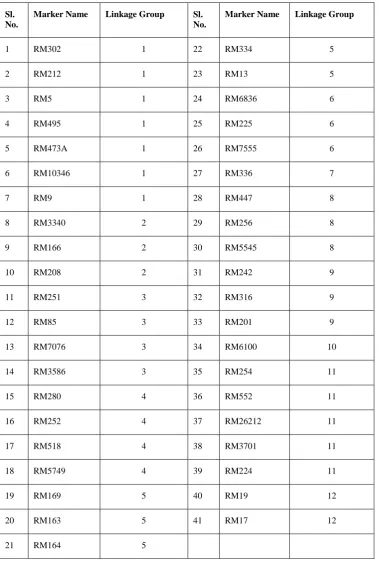
markers on LG-8, three markers on LG-9, single marker on LG -10, five markers on LG-11, and two markers on LG-12 (Table 1).
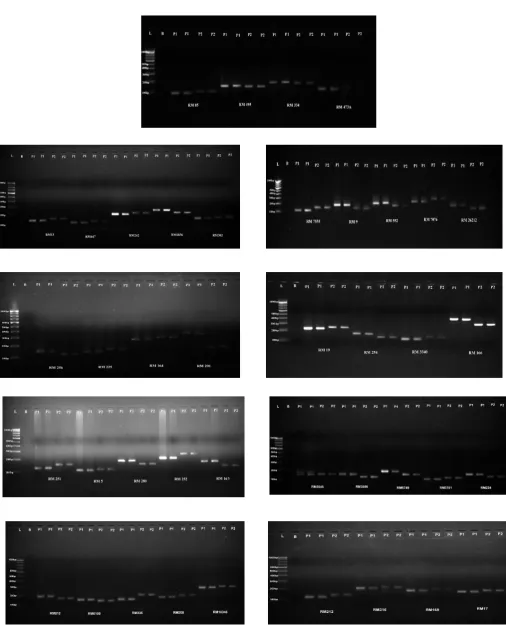
Parental polymorphism per cent between any two parents depended on the number of relevant primers selected for screening. The parental survey revealed 20.82 per cent polymorphism between the two parents (N22 and Uma) used in the present study. Similar to the findings of the present study, Zhang et al. (2009) had identified 30 per cent polymorphism by using 200 SSR markers in heat tolerant 996 and heat susceptible 4628 rice cultivars. Buu et al. (2014) used 501 SSR markers for the polymorphism between two parents, OM5930 (heat sensitive variety) and N22 (heat tolerant variety), among which 264 were polymorphic. Vikram et al. (2011) also detected the polymorphism of N22 with IR64, Swarna and MTU1010 varieties to the extent of 42.50%, 43.50% and 40.10%, respectively.
Kanagaraj et al. (2010) screened 1206 SSR markers between IR20/Nootripathu and identified 134 polymorphic SSR markers between these two parents showing 11.12 per cent polymorphism. Salunkhe et al. (2011) identified 96 SSR markers to be polymorphic among 343 SSR markers between two parents IR20 and Nootripathu indicating 27.99 per cent parental polymorphism. Wei et al. (2013) screened 2304 SSR markers and identified 322 polymorphic SSR markers between two breeding lines, HT54 (heat stress tolerant) and HT13 (heat stress susceptible with 13.98 per cent polymorphism. Vikram et al. (2011) used 880 SSR markers and they identified 71 SSR markers between two rice varieties, Basmati334 and Swarna with 8.07 per cent polymorphism. Yadav et al. (2015) studied the parental polymorphism between BPT-5204 and ARC-10531 rice varieties with 500 SSR markers and found 70 polymorphic markers between them.
The 41 rice microsatellite (SSR) markers identified as polymorphic between the two parents (N22 and Uma) will be useful as a pointer to the existence of different alleles at each of the 41 marker loci. As the two parents differ from each other with respect to various traits (e.g., kernel colour, plant height, maturity duration etc.) other than their reaction to drought and heat stress, the identified polymorphic markers may or may not be linked to any of these traits.
Out of these 41 polymorphic markers, fourteen were recognised by earlier researchers as associated with QTL for heat tolerance in rice. RM 473A was a polymorphic marker between parents for heat tolerance located on LG 1 at 107.7 cM as
identified by Liao et al. (2011). Buu et al. (2013) reported RM251 as a polymorphic marker between parents for heat tolerance whereas Poli et al. (2013) reported RM225 as a polymorphic marker between parents for heat tolerance. As per the reports of Bharathkumar et al. (2014), RM6100 was polymorphic for heat tolerance. Buu et al. (2014) had identified RM7076, RM3586, 26212 and RM5749 as polymorphic markers for heat tolerance. Wei et al. (2013) identified RM242 as associated with heat tolerance. Zhao et al. (2006) reported RM3340, RM447, RM5545, RM3701 and RM336 as being polymorphic markers for heat tolerance. Various researchers like Zhang et al. (2009), Lang et al. (2015) and Buu et al. (2014) reported RM3586 as a polymorphic marker for heat tolerance.
QTL analysis of various related traits can be performed by utilising these ready to use polymorphic markers along with mapping population developed from the cross Uma x N22. As N22 is a drought and heat tolerant donor parent and Uma is a high yielding popular variety of Kerala, heat or drought tolerance trait scan be incorporated into the susceptible Uma variety, by marker assisted breeding. The 41 polymorphic markers can be used for background and foreground selection of Uma and N22 during marker assisted breeding programmes. Moreover, these identified polymorphic markers can be used for diversity analysis and linkage analysis for various traits in rice.
Acknowledgement
Authors are thankful to CPBMB, COH, Kerala Agricultural University and Regional Agricultural Research Station, Pattambi, for providing facilities to conduct this research work and gratefully acknowledges DBT for providing the fund to carry out this research programme.
References
Beckmann, J. S and Soller, M. 1983. Restriction fragment length polymorphisms and genetic improvement of agricultural species.
Euphytica. 35: 11-124.
Electronic Journal of Plant Breeding, 9 (2) : 511-517 (June 2018) ISSN 0975-928X
514 DOI: 10.5958/0975-928X.2018.00062.5
Buu, B. C., Anh, T. Q., Anh, B. P. N., Nguyen, N. N., Minh, L. T., Cuong, N. T., Bang, H. V., Hai, T. V., Quynh, L. V., Hieu, N. V., Tam, B. P., Ha, P. T. T., Nha, C. T., and Lang, N. T. 2013. Rice breeding for heat tolerance at initial stage. Omonrice19: 1-10.
Buu, B. C., Ha, P. T. T., Tam, B. P., Nhien, T. T., Hieu, N. V., Phuoc, N. T., Minh, L. T., Giang, L. H., and Lang, N. T. 2014. Quantitative trait loci associated with heat tolerance in rice (Oryza sativa L.). Plant Breed. Biotech. 2: 14-24.
Frisch, M. M., Bohn, M., and Melchinger, A. E. 1999. Comparison of selection strategies for marker-assisted backcrossing of a gene. Crop Sci. 39: 1295-1301.
Gupta, P. K. and Varshney, R. K. 2000. The development and use of microsatellite markers for genetic analysis and plant breeding with emphasis on bread Wheat.
Euphytica113: 163-185.
Hospital, F., and Charcosset, A. 1997. Marker-assisted introgression of quantitative trait loci.
Genetics 147: 1469-1485.
Jacob, H. J., Lindpainter, K., Lincoln, S. E., Kusumi, K., Bunker, R. K., Mao, Y., Ganten, D., Dzau, V. J., and Lander, E. S. 1991. Genetic mapping of a gene causing hypertension in the stroke prone spontaneously hypertensive rat. Cell
167: 213-224
Jagadish, S. V. K., Muthurajan, R., Oane, R., Wheeler, T. R., Heuer, S., Bennet, J., and Craufurd, P. Q. 2010. Physiological and proteomic approaches to address heat tolerance during anthesis in rice (Oryza sativa L.). J. Exp. Bot.
61(1): 143-156.
Jeffreys, A. J., Wilson, V and Thein, S. L. 1985. Hypervariable minisatellite region in human DNA. Nature 314: 67-73.
Jones, N., Ougham, H and Thomas, H. 1997. Markers and mapping - We are all geneticists now.
New Phytologist. 137: 165-177.
Kanagaraj, P., Prince, K. S. J., Sheeba, J. A., Biji, K. R., Paul, S. B., Senthil, A., and Babu, R. C. 2010. Microsatellite markers linked to drought resistance in rice (Oryza sativa L.).
Curr. Sci. 98: 836-839.
Kurata, N., Nonomura K.I., and Ima, Y.I.H. 2002. Rice Genome Organization: the Centromere and Genome Interactions. Ann. Bot. 90: 427-435
Lang, N.T., Ha, P. T. T., Tru, P. C., Toan, T.B., Buu, B. C., and Cho, Y. C. 2015. Breeding for heat tolerance rice based on marker-assisted backcrossing in Vietnam. Plant Breed. Biotech. 3: 274-281.
Mohan, M., Nair, S., Bhagwat, A., Krishna, T. G., Yano, M., Bhatia, C. R and Sasaki, T. 1997. Genome mapping, molecular markers and marker-assisted selection in crop plants. Mol. Breed.3: 87-103.
Murray, M. G., and Thompson, W. F. 1980. Rapid isolation of high molecular weight plant DNA. Nucleic acids res.8(19): 4321-4326. Poli, Y., Basava, R. K., Panigrahy, M., Vinukonda, V. P.,
Dokula, N. R., Voleti, S. R., Desiraju, S., and Neelamraju, S. 2013. Characterization of a Nagina22 rice mutant for heat tolerance and mapping of yield traits. Rice6(36): 1-9. Salunkhe, A., Poornima, R., Prince, K. S. J., Kanagaraj,
P., Sheeba, J. A., Amudha, K., Suji, K. K., Senthil, A., and Babu, R. C. 2011. Fine mapping QTL for drought resistance traits in rice (Oryza sativa L.) using bulk segregant analysis. Mol. Biotechnol.49: 90-95. Tanskley, S. D., Young, N. D., Paterson, A. H. and
Bonierbale, M. W. 1989. RFLP mapping in plant breeding: New tools for an old science. Biotechnology 7: 257-264.
USDA [United States Department of Agriculture]. 2016. Economic Research Service. [On line]. Available:
https://www.ers.usda.gov/topics/crops/rice/ [26 Feb 2017].
Viescher, P. M., Haley, C. S., and Thompson, R. 1996. Marker assisted introgression in backcross breeding programs. Genetics 144: 1923-1932.
Vikram, P., Swamy, B. P. M., Dixit, S., Ahmed U. H., Cruz, M. T. S., Singh, A. K., and Kumar, A. 2011. qDTY1.1 a major QTL for rice grain yield under reproductive-stage drought stress with a consistent effect in multiple elite genetic backgrounds. BMC Genet. 12: 89. Wei, H., Liu, J., Wang, Y., Huang, N., Zhang, X., Wang,
Electronic Journal of Plant Breeding, 9 (2) : 511-517 (June 2018) ISSN 0975-928X
515 DOI: 10.5958/0975-928X.2018.00062.5
Yadav, S., Anuradha, G., Kumar, R. R., Vemireddy, L. R., Sudhakar, R., and Donempudi, K. 2015. Identification of QTLs and possible candidate genes conferring sheath blight resistance in rice (Oryza sativa L.). Springer Plus 4: 175.
Zhang, G., Chen, L., Xiao, G., Xiao, Y., Chen, X., and Zhang, S. 2009. Bulked segregant analysis to detect QTL related to heat tolerance in rice
using SSR markers. Agric. Sci. China 8(4): 482–487.
Electronic Journal of Plant Breeding, 9 (2) : 511-517 (June 2018) ISSN 0975-928X
516 DOI: 10.5958/0975-928X.2018.00062.5
Table 1. SSR Rice Microsatellite markers showing polymorphism between Uma and N22
Sl. No.
Marker Name Linkage Group Sl.
No.
Marker Name Linkage Group
1 RM302 1 22 RM334 5
2 RM212 1 23 RM13 5
3 RM5 1 24 RM6836 6
4 RM495 1 25 RM225 6
5 RM473A 1 26 RM7555 6
6 RM10346 1 27 RM336 7
7 RM9 1 28 RM447 8
8 RM3340 2 29 RM256 8
9 RM166 2 30 RM5545 8
10 RM208 2 31 RM242 9
11 RM251 3 32 RM316 9
12 RM85 3 33 RM201 9
13 RM7076 3 34 RM6100 10
14 RM3586 3 35 RM254 11
15 RM280 4 36 RM552 11
16 RM252 4 37 RM26212 11
17 RM518 4 38 RM3701 11
18 RM5749 4 39 RM224 11
19 RM169 5 40 RM19 12
20 RM163 5 41 RM17 12
Electronic Journal of Plant Breeding, 9 (2) : 511-517 (June 2018) ISSN 0975-928X
517 DOI: 10.5958/0975-928X.2018.00062.5
Fig. 1. SSR amplification pattern of N22 and Uma with 41 polymorphic markers