LAUTECH JOURNAT OFE vctNEERINe AND TECHNOLOGY 3(1) 200s: 76 - 81
OPTIMAL ALLOCATION OF PIPE DIAMETERS IN PIPE NETWORKS
USING MODIFIED ASSIGI{MENT PROBLEM APPROACH
o.O. Ogunleyel, M.A. Waheed2,
G.A. Odewole2
rDepartment
of Chemical Engineering, Ladoke Akintota University of Technology, P.M.B. 4000, Ogbomoso-Nigeria.
t
-Department
of Mechanical Engineering, Ladoke Akintola University of Technology,
P.M.B. 40000 Ogbomoso-Nigeria
ABSTN4CT
llater supply to qieas of need via pipe neth,ork has been a problem since the pipes layout involved may be complex and thereby making the daermination of pipe diameters for cost minimization tlfficult, In this paper, attempt was made on the deterntination of optimal dianteters of pipe that minimizes pipe network cost, The work involves the use of a linear programming optimization techniqae fotmulated in a modified assignment problem approach. This wus applied to a problem previously worked upon with some other techniques to asceftain the strenglh of this present approach implemented on MATLAB 6.5 version cornputing environment.
The minimum cost anit of 41900forthe eight-pipe, one reservoir andtwo loop distribution system obtainedwas the same utith that of the "best ruil" ln the previous reported works. Also, 12 functions evaluation in 53 seconds on Pentium 233 MHx processor computer produeed this optimal condition as against the 1372 evaluations ifl 7 minutes on Pentium 100MHz processor computer for the previous "best run". These indicate the elfieiency and the effectiveness ofthe studied approach.
Keywords: Pipe Networks, Head loss, Nodal head, Efficiency, Optimal Pipe Diameter.
INTRODUCTION
Transportation of liquids via networks of pipe has become an integral part of both upstreanr and downstream petroleum sectors; management of which can either boost or reduce the sectors earnings. Apart from this, municipal water distribution systems represent a major portion of the investment in urban infrastructure and a critical component of public works. This nornrally have the goal of designirrg water distribution systems to deliver potable rvater over spatially extensive areas in required quantities and under satisfactory pressures. In addition to these goals, cost-effectiveness and reliability in system design are also important.
The designs of this type of water distribution systems are inherently complex because they are large-scale and spatially extensive. It also composed of multiple pipe loops to maintain satisfactory levels of redundancy for system reliability and it rs govemed by nonlinear hydraulic equations. Their designs mostly include complex hydraulic devices such as valves and pumps and are impacted by
pumping and energy requirements. Other
characteristics of this system includes, the complication by numerous layout, pipe sizing, and pumping alternatives, the influence of tradeoff between capital investment, operations and maintenance costs during the design process (Nicklow,2000).
The optimal design of rnunicipal water distribution systems is a challenging optimization
O-O. Ogunleye, M-A. Waheed,G.A. OdewolelLAUTECH Joumal ot Engineering and Technology 3(1) 2OO5:76 * 81
previously solved with non linear approaches obtained from literature is used to test the efficacv of the proposed approach.
Previous Design and Optimization of Pipe Networks
Optimization of pipe networks has gained much attention in the past few decades. Numerous algorithrns are being tested on distribution systems by researchers to get the most reliable solutions, usirrg the least computational time possible. Linear programming (LP), nonlinear programming (NLP), mixed-integer linear programmirrg (MILP), mixed-integer nonlinear programming (MINLP), as well as fvzzy logic (FL), stochastic dyramic programming (SDP) and thegenetic algorithm (GA) are themost promising rnethods.
Creasey (1988) reviewed the appfopl'iate mathetnatical techniques to solvc the problem of operational optimisation fbr water distribution netrvorks. insisting particularly on the pump-scheduling problem. I-le also stated that integer-ba-sed programming seen,ts to be the only \r'av to achieve savings for a wide rangc of nctwork sizcs and complexities because of their ability. to handle high non linearit.v- r'esulting within short time. l:.ramples of applicatiorr ol'dynanric progranrnring on small-scale systems can be lixnd in Rao and Brcc ( 1977), W o o d a n d R a y e s ( 1 9 8 1 ) , G o l d b e r g a n d K u o ( 1 9 8 7 ) , and Coulbcck (1988).Also. this handlcs non lincarity but becornes impractical for large size networks due
to extraordinarily rvide search space and
consequently the enornrous cr>mputational tirne. With the availability of linear programming (1..P) algorithms thal wcre mole robust and efficient, several paper.s on the sub.iect rvere published, ,lowitt and Cermanopoulos ( 1992) procluccd the most significant applications in lhe lield o1'I-P techniques applied to the pump-scheduling pr'oblem. One of the latest approaohes consists o1'taking into account the non-linear relationships. which ale parl of any pump-scheduling trrroblern. Kessler and Shamir (1989) used the linear programming gradient (LPG) method as an extension of the method proposed by Alperovits and Shamir (1977), Also a two-phase decomposition method was used extending that of Alperovits and Shamir (1977) to non-linear modelling. Though splrt pipe solutions obtained in the above cases are cheaper, some of the results obtained were not practical and some others were not feasible. In addition, some of these methods impose a restrictron on the tyre of the hydraulic component of the network which does not give room for global optimality.
The appearance of impt'oved non-linear
programrning (Nl,P) al-eorithms. ct-rnvinced
resealchers to rather apply NLP techniques to sohre the opcrational optimisation problcrm. Chase and Ormsbee 1989), l,ansey and Zhong (1990) and Brion and Mays (199 l) linked nctwork-simulation modcls r.vith non-l i near opti miz-ation algorith ms to deternr ine
optimal opcrations. One commonly used approai;h in operational optimization ploblerns has been the utilization of a MINLP algorithm {Pahor and Kravanja, 1995; Grossnran,1996; IJruno et al.. 19981 Zamora and Crossman. 1998).'I'hough most of these approaches are r,vell suited for non linear conditions but becomes problcm when storage space and conrputalional tinre ale considered.
Also, genetic algorithms have been applied in the problem of pipe network optimization ( Savic and Walters ,1997). He applied both simple genetic algorithm (SGA) and improved GA, with various enhancements based on the nature of the problem, and reported promising solutions for problems from literature. This approach is charaterised by uncertainty about the termination of the search and the absence of guarantee for the global optimum.
Problem Formulation
Pipe network, especially in water distribution, is system containing pipes, reservoirs, pumps, valves of different types, which are connected to each other to provide water to consumers at drfferent nodes. Generally, the hydraulic requirements on any rretwork of pipes impose two constraints: the continuity constraint; for n nodes in the network, this constraint can be written as:
F o , = o
where Qi represents the node i (sign included).
( l )
discharges into or out of the
The second hydraulic constraint is the energy constraint according to which the total head loss around any loopmust addup to zeroor is equal to the energy delivered by a pump if there is any:
s-r ,
Lhr
= U
(2)
where lrl is the head loss due to friction in a pipe. This embeds the fact that the head loss in any pipe, which is a function of its diameter, length and hydraulic properties, must be equal to the difference in the nodal heads. This constraint makes the problem highly non-linear owing to the nature of the equation that relates frictional head loss and florv. The equation can generally be written as
.
aot,
It, = ---=-
' D '
(3)where a is coefficient depending on length, roughness. etc, b is discharge exponent and c is exponent of pipe diameter (D) which is very close to 5 in most head loss equations.
; ' ' -
O.O. Ogunleye, M,A. Waheed, G.A. Odewole/LAUTECH Journa, of Engiieeilng and Technology 3(1) 20A5: 76 * 81head requirement at the demand nodes is tal<en as a constraint for the choice of pipe diameters.
Formulating the above constraints in suclr a manner suited for assignment problem techniques calls for sets of linear eqr"rations. For a problem to fit the definition of an assignment problem, such kinds of applications need to be formulated in ways tlrat satisfy the following assumptions:
r The number of assignees and the number of tasks are the same
r Each assignee is to be assigned to exactly one task.
. Each task is to be performed by exactly one assignee.
r There is a cost cij associated with assignee i performing task j.
r The objective is to determine how all n assignment should be made in order to minimize the total cost (Hillier and Lieberman,1995).
The mathematical model for assignment problem uses the following decision variables:
ft if assignee iperforms task j
x i , = 1 ' ' ( 4 )
l o i f n o t
But for pipe network problems where the number of c ommercially available p ipes diameters i are not usually the same with the number of pipes j needed in a network resulting in an n x m matrices of assignment variables, it means that the number of assignees and the number of tasks are not the sarne. This problem can be solved to make it suitable for assignment problem approach by repeating the ith pipe diameter (assignment) in m-times for jth task to make-up but still carrying its assigned parameters. The jth task is also repeated in n-tirnes on ith assignment level for possible multiple choice of an assignee to tasks of that ith assignment. This gives room for multiple choice of a particular pipe diameter in the network. The resulting matrix here is a nm x nm type that is suited for this solution approach.
Objective function
The objective function to be minimized by the optimization approach is the cost of the network which is calculated based on the cost per unit length associated with the diameter and the length of the pipe. But in a sjfuation where the nunrber of assignee is more than the task or vise versa, dummy variables should be infroduced to make up for the deficiency so that a square matrix can be obtained (i,e. n : m). It should also be noted that unit cost higher than the highest on the original cost distribution should be
assigned to the dummy variables in order to eljminate them from emerging as the optimal variables. With all these ,the objective function can now be written as:
_q _4_
Minimize C, = L ),c(D,)x,,L, (5)
i = l i = l
Where n is the number of commercially available pipe diameters, m is the number of pipes in the network and c(Di) is the cost per unit length of the jth pipe with diameter D1 and length L;.
Constraints
The above objective function is subject to the two lrydraulic constraints in equations 1 and 2 which are also linearised by the introduction of assignment variables. also included is the minimum nodal head constraint. To ensure its adherence to the assignment problern format when solving the resulting linear programming problem, the following constraints are also introduced:
g
F o r i= l t o n , t h e n L x , i = I ( 6 )
j = l
F o r j : l t o m , t h e n
$T-L $T-L r , ,
= n
( 8 )
i = t J = l
" , r 2 0
( f o r a l l i a n d j ) ( 9 ) (x;i binary, for all i and j) Once the above equations are properly formed and the required parameter solved for in any algebraic solver. the problem can then be solved using any linearprogramming package suchas MATLAB 6.5 version computing environment to obtain the required result.
Selected Case
A.O. Ogunleye, M.A. Waheed, A.A, OdewolelLAUTECH Joumal of EnginepJilng and Technology 3{1) 2005: 76 - 81
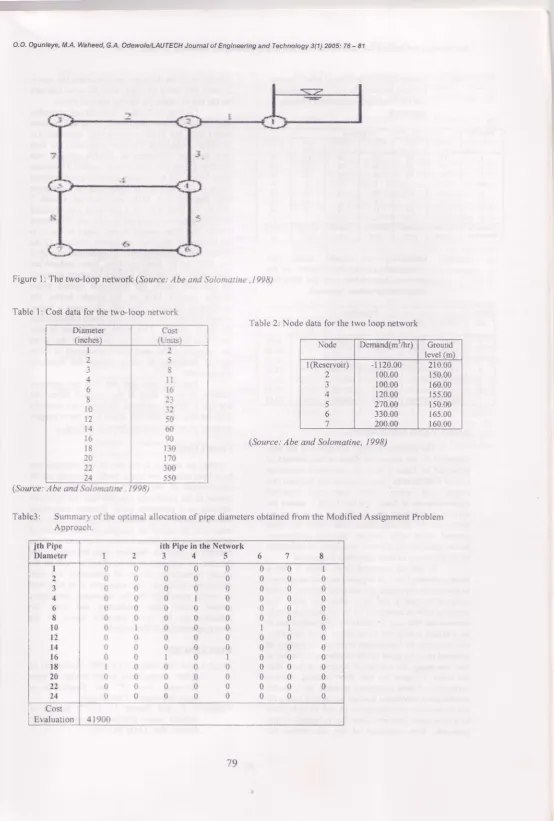
Figure l: The two-loop network (Spurce: Abe and Solomatine ,1998)
Table l: Cost data for the two-loop network
Table 2: Node data for the two loop network
(Source: Abe and Solomatine, 1998)
(Source: Abe and Solonatirc .1998)
Table3: Summary of the optimal allocation of pipe diameters obtained from the Modified Assignment Problem Approach.
Diameter I Cct nches
I
z
54 6 8 l 0 l 2 l 4 t 6 l 8
zo
22 24
2 5 8 l l l 6 23 32 50 60 90 r 3 0 t 7 0 300 550
Node Demand(m'/hr) Ground level (m)
l(Reservoir)
2
J4 5 6 7
-1 r20.00 100.00 100.00 120.00 270.00 330.00 200.00
210.00 150.00 160.00 I55.00 150.00 165.00 160.00
jth Pipe Diameter
ith Pipe in the Network
8 1
6
5 4 3 2 I
I
.,
3
4 6 8 t 0 1 2 l 4 l 6 l 8 20t ,
24
0 0 0 0 0 0 0 1 0 0 0 0 0 0 0 0 0 0 0 0 0 0 0 0 0 0 0 1 0 0 0 0 0 0 0 0 0 0 0 0 0 0 0 0 0 0 0 0 0 1 0 0 0 1 1 0 0 0 0 0 0 0 0 0 0 0 0 0 0 0 0 0 0 0 1 0 1 0 0 0 r 0 0 0 0 0 0 0 0 0 0 0 0 0 0 0 0 0 0 0 0 0 0 0 0 0 0 0 0 0 0 0 Cost
O.O. Ogunleye, M.A. Waheed, G.A Odewole/LAUTECH Joumal of Engineering and Technology 3(1) 2005: 76 - 81
Table 4: Comparison of the optimal pipe diameter (inches) between the previous approaches and the Modjfied Assignment Problenr Approach.
Table 5: Comparing the Nodal heads (m) corresponding to optimal diameter for the previous Approaches with the Modified Assignment Problem Approach
RESULT AND DISCUSSION
The resulting optimal allocation of the pipe diameters to the respective pipes in the network is presented in Table 3 with the associated minimum cost of 41900(units). Also a comparison between this output and some other previously reported approaches are in Table 4 while Table 5 shows the optimal nodal head associated with each of these diameters. All the algorithrns have nearly the same optimal value with varying function evaluations before optimality is attained, this being an indication ofthe efficiency ofeach algorithm in question,
It can be observed from Table 3 that a binary variable 0 or 1 is assigned to each assignment as previously explained. An assignee i carries I when assigned to task j and zero when not used, The resulting table is actually a 14 by l4 matrix but only summarized this way for dexterity. The output has to be a sq uare m atrix for the p roblem to b e suited for this approach. In Assignment problem, the number of assignee must be equal to the number of tasks but in this case study, the number of assignee is more than the tasks. To cater for this short coming, dummy variables had been introduced to make up. Also the modification introduced through equation 6 caters for the explanation why diameters 10 and l6 inches had to appear more than one time that is typical of this approach. This relaxation of the rule makes the
summation of the decision variables along the row to be more than unity for some, unity for some and zero for the rest to obtain the desired optimal values.
Looking atTable 4, thebest run algorithm reported by Abe and Solomatine (1998) had the same output with the linear programming approach (i.e. Modified Assignment Problem Approach) but with very different efficiency as MAPA solution was obtained for the two loop network within 53 seconds using MATLAB 6.5 version computing environment which is very efficient in computing on a computer with Pentium 233 MHz processor as against 7 minutes for Best Run on a computer with Pentium
100MHz processor reported by Abe and Solomatine (1998). This wide margin in time might be traced to the number of functions evaluation which is 12 for MAPA due to more number of parameters specified and 1372 for the best run. Also, linear systems are characterized by straight forward direction of search for optimum unlike the non-linear system where various options have to be sought before the optimum is obtained. This will also mean a higher storage r equirement f or t he n on-linear s ystems t han the linear system. This same explanation is also applicable to the observations on Table 5 that gives the optimum nodal head that corresponds to these optimal diameters so as to satisfy tlre hydraulic requirements.
However, one can see that the optimum solution given by each of the previous algorithms and that of MAPA represent different pipe networks u'ith v arving cost and t his might g ive the m anagers varieties ofoptions in their decision rnaking,
C O N C L U S I O N S
\\'ithin the context of the size of the problems that have been solved, one could readily conclude on the effectiveness of the MAPA as it produces result srmilar to the previously reported best run but more efficient as it possesses lower function evaluations that culminated in appreciable time saving. Also, this result will be suited for analysts in their choice of s u i t a b l e a l g o r i t h m w h e n i t c o m e s t o t h e s i z e o f t h e network in question. Mention must be made of the fact that the accuracy of an MAPA lies much on the proper formulation. choice of constraints and right parameter e stimation. This a pproach of M APA will be useful especially for the upcoming developing nations where their academics and even the industries do not have adequate access to the emerging software in this regard.
REFERENCf,S
Abe,A.J. and Solomatine,D.P.(1998) Application of global optimization to the design of pipe networks. Proc. 3"' Intl. Conference of lrydro idorm atics, Cop e n hage n.
Alperovits E, and Shamir \J. (1977) Design of optimal u'ater distribution systems. I?'afer
Re.sour. Res. 13 (6) 885-900.
Pipe No Aleorithm
cRs2 ACCOL L K J 4 Best Run MAPA I 2 3 5 7 8 I 6 l 0 t 6 l 6 1 0 1 0 IE t 4 I 1 4 I 1 4 t2 zt l 8 2 0 3 l 6 4 t 8 l 6 1 8 l 6 l 4 L t 4 I t 4 l 0 8 l 0 l 6 l o l 0 t 0 l 8 l 0 l 6 4 l 6 l 0 l 0 I Cost(units) Evaluations 4ZIUUU 10009 424000 338 I
447000 l E l 0
439000 720
4 l 9000 1372 419000 t 2 I ) 3 5 6 7
53.21 | s1.20
O.O' Ogunleye, M.A. Weheed, G.A. Odevtole/LAUTECH Journal of Engineerlng and Technotogy 3(1) 2(N5: 76 - 81
Brion L.M. and Mays L.W. (1991) Methodology for optimal operation of pumping stations in water distribuiion systems,. ACSE J. Hydraul.Eng. I l7 (1 l) l-19.
Bruno J.C., Fernandez F.. Castells F. and Grossman l.E. (1998)4 ligorous MINLP model for' the optimal synthesis and opelation ofutility plants. T'rans IChemE 76 (Part A) 246-258. Chase D.V. and Ormsbee L.E. (1989) Optimal pump
operation of rvater distribution system with multiple storage tanks. Proc. 1990 ASCE Conf. on llater Resour. Planning and )uIanage. ASCE. New Yort 733-736. Coulbeck B (1988) A rcview of methodologies lbr
modelling and conlrol of watel supply. In: B Coulbeck and Cll Orr (eds.) Contputer Application in Water Supply. l'olume 2:
Syslems Optimizalion and Control.
Research Studies Press Ltd. 80-109. Creasey J.D. (1988) Pump Scheduling in Warer
Supply: More Than a Mathematical Problem. In: B Coulbeck and Ctl On (eds.) Compuler Aplication in ll'ater Supply. Volume 2: Slstents Optimi:ation and Conlrol- Research Studies Press Ltd. 279-289.
Goldberg D.F:. and Kuo C.ll- (1987) Genetic algorithms in pipcline optimization. J. Compting in Ch'il t-ng. I (2) 128- I 4 | . (irossman l.E. (1996f Mired-intcger optimisation
tcchniques for algorithmic process
synttresis. Adrorces in Chem. Eng. 23 171-t 9 5 .
Hil lier,F. S and Licbcrman G.J.( 1 995). Introducti on to Opctatron Research. McGraw Hill Intl Edirtiqr (6' Edition),N .Y .329
Jowitt P.W.-and Gennanopoulos C. (1992) Optimal
ll/nter Resour. Planning and Manage. ll8 (4) 406-422.
Kessler, A. and Shamir,U.(1989) Analysis of the linear programming gradient method for optimal design of water supply networks. Water Res. Research, 25(7), 1469- I 480. Lansey K.E. and Zhong Q. (1990) A methodology
frlr optimal control of purnp stations. Proc. 1990 ASCE Conf. on Water Resoar.. Planning and hlanage, ASCE, New-York. Nick low, J.W.(2000) Discrete-Time Optimal Control
for Water Resources Engineering and Management. IVater International" Yol.25 No l,pp89-95
Pahor R. and Itu'avanja Z. (1995) Simultaneous
solution and MINLP synthesis of
DAE/process problems: PFR netrvorks in overall processes. Computers & Chem. Eng. 19 (Suppl.) l 8l-1 88.
Rao H.S. and Bree (Jr.) DW (1977) Extended period simulation of water systems -Pan A, ASCE J. Hydraul. Div. 103 (2) 9?-10S,
Savic, D.A. and Walters,G.A (1997) Cenetic algorithms for least-cost design of water distribution n etworks. llater R es. Planning and Management, 123(2), 67 -77 .
Wood D.J. and Rayes A.c, (1981) Reliability of algorithms for pipe network analysis. I.SCE J. Hydraul. Div.107 (10) 1145-ll6l. T.amctra J.M, and Crossman I.E. (1998) A global