University of South Carolina
Scholar Commons
Theses and Dissertations
6-30-2016
Visibility-Based Pursuit-Evasion In The Plane
Nicholas Michael Stiffler
University of South Carolina
Follow this and additional works at:https://scholarcommons.sc.edu/etd Part of theComputer Engineering Commons
This Open Access Dissertation is brought to you by Scholar Commons. It has been accepted for inclusion in Theses and Dissertations by an authorized administrator of Scholar Commons. For more information, please [email protected].
Recommended Citation
Stiffler, N. M.(2016).Visibility-Based Pursuit-Evasion In The Plane.(Doctoral dissertation). Retrieved from
Visibility-Based Pursuit-Evasion in the Plane
by
Nicholas Michael Stiffler
Bachelor of Science
University of South Carolina, 2009 Master of Science
University of South Carolina, 2012
Submitted in Partial Fulfillment of the Requirements
for the Degree of Doctor of Philosophy in
Computer Science and Engineering
College of Engineering and Computing
University of South Carolina
2016
Accepted by:
Jason M. O’Kane, Major Professor
Marco Valtorta, Committee Member
Michael N. Huhns, Committee Member
Manton M. Matthews, Committee Member
Linyuan Lu, External Committee Member
c
Copyright by Nicholas Michael Stiffler, 2016
Dedication
“The true test of a man’s character is what he does when no one is watching.”
– John Wooden
For my siblings
Tyler, Lydia, Kyle, Jordan, and Blue
Acknowledgments
This thesis is the culmination of several years of scholarship and would not have been
possible without the generous contributions of many different people. My mentor,
Jason O’Kane, had the most profound impact on my development as a research
scientist and provided valuable advice along the way.
I also offer sincere thanks to my peers in theSouthCarolinaAutonomousRobotics
Research (SCARR) group: Mohammad Behbooei, Laura Boccanfuso, Shervin
Ghasem-loo, Jeremy Lewis, Fatemeh Zahra Saberifar, and Yang Song. The research group
fostered a fertile environment in which I was able to do my best work. My committee
members Michael Huhns, Linyuan Lu, Manton Matthews, and Marco Valtorta offered
helpful guidance throughout by applying their unique expertise and perspective to
my work. Ioannis Rekleitis, while not a serving member of my committee, also
de-serves recognition for his willingness to provide an external perspective on my work.
Many other faculty and professors, including Ryan Austin, Randy Baldwin, Jenay
Beer, Duncan Buell, Stephen Fenner, Srihari Nelakuditi, Barb Ulrich, and Gabriel
Terejanu, have had immense influence on my growth and development as a computer
scientist and as a person. Thank you for the the various contributions you each have
made to my life.
More personally, I am thankful for the love and support that I have received from
my family and friends during my time in graduate school. Thank you to David and
Chelsea Hilmer, Matthew Crocket, Spencer Childress, Michael and Katie Reynolds,
and Conway “Deuce” Harris, whose friendship during this arduous journey was pivotal
Finally, it would be impossible to describe the amount of loving support and
en-couragemnt I’v recieved from my fiance, Lacie. Thank you for tolerating me
through-out this journey.
Financial support for this work was provided by the NSF under award IIS-0953503
Abstract
As technological advances further increase the amount of memory and computing
power available to mobile robots, we are seeing an unprecedented explosion in the
utilization of deployable robots for various tasks. The speed at which robots begin to
enter various domains is largely dependent on the availability of robust and efficient
algorithms that are capable of solving the complex planning problems inherent to
the given domain. One such domain which is experiencing unprecedented growth in
recent years requires a robot to detect and/or track a mobile agent or group of agents.
In these scenarios, there are typically two players with diametrically opposed
goals. For matters of security, we have a guard and an intruder. The guard’s goal is
to ensure that if an intruder enters the premises they are caught in a timely manner.
Analogously, the intruder wishes to evade detection for as long as possible. Search
and rescue operations are often framed as a two-player game between rescuers and
survivors. Though the survivors are unlikely to behave antagonistically, an agnostic
model is useful for the rescuers to guarantee that the survivors are found, regardless
of their movements. Both of these tasks, are at their core, pursuit-evasion problems.
There are many variants of the pursuit-evasion problem, the common theme
amongst them is that one group of agents, the “pursuers”, attempts to track
mem-bers of another group, the “evaders”. Geometric formulations of the pursuit-evasion
problem require a pursuer(s) to systematically search an environment to locate one
or more evaders ensuring that all evaders will be captured by the pursuer(s) in a
finite time. Thevisibility-based pursuit-evasion problem is a geometric variant of the
re-gion of the environment that the pursuer(s) can actively perceive. If an evader lies
within this visibility region then it is captured (detected).
This thesis contains four novel contributions that solve various visibility-based
pursuit-evasion problems. The first contribution is an algorithm that computes the
optimal (minimal path length) pursuer trajectory for a single pursuer. The
sec-ond contribution is an algorithm that generates a joint motion strategy for multiple
pursuers. Motivated by the result of the second contribution, the third result is a
sampling-based algorithm for the multiple pursuer scenario. The fourth contribution
is a complete algorithm that computes a trajectory for a pursuer that has a very
Table of Contents
Dedication . . . iii
Acknowledgments . . . iv
Abstract . . . vi
List of Tables . . . x
List of Figures . . . xi
Chapter 1 Introduction . . . 1
1.1 Motion Planning . . . 3
1.2 Thesis Organization . . . 12
Chapter 2 Problem Statement . . . 16
2.1 Representing the environment, evaders, and pursuers . . . 16
2.2 Shadows . . . 18
2.3 Reformulating the Objective . . . 23
Chapter 3 Related Work . . . 25
3.1 Target Tracking . . . 25
3.2 Pursuit-Evasion . . . 27
Chapter 4 GL3M Algorithm . . . . 31
4.1 Overview . . . 31
4.2 Critical Information Changes . . . 32
4.3 The Pursuit-Evasion Graph . . . 34
5.1 Formalizing the Objective . . . 37
5.2 Optimal Tours of Segments . . . 38
5.3 Algorithm Description . . . 44
5.4 Results . . . 57
5.5 Concluding Remarks . . . 60
Chapter 6 A Complete Algorithm for Multiple Pursuers . . . . 65
6.1 Critical Boundaries . . . 66
6.2 Algorithm . . . 75
Chapter 7 A Sampling Based Algorithm for Multiple Pursuers 79 7.1 Sample-Generated Pursuit-Evasion Graph . . . 80
7.2 Algorithm . . . 86
7.3 Simulation Results . . . 91
Chapter 8 Pursuit Evasion for a Single Pursuer with Fixed Beams . . . 97
8.1 Problem Formulation: Fixed Beams . . . 100
8.2 Description of Algorithm . . . 101
8.3 Simulation Results . . . 113
8.4 Conclusion . . . 113
Chapter 9 Discussion and Conclusion . . . 115
9.1 Contributions, Limitations, and Open Questions . . . 116
9.2 Future Directions . . . 119
Bibliography . . . 120
Appendix A Cylindrical algebraic decomposition . . . 129
List of Tables
Table 5.1 Table that corresponds to a pursuer making repeated crossings over an Appear/Disappear event boundary. Scenarios 1 and 2 consider when a disappear event occurs first whereas Scenario 3
describes what occurs when an appear event occurs first. . . 52
Table 5.2 Table that corresponds to a pursuer making repeated crossings over a Split/Merge event boundary. Scenarios 4-7 detail the various PEG-nodes that are visited when the merge event occurs first. 53 Table 5.3 Table that corresponds to a pursuer making repeated crossings over a Split/Merge event boundary. Scenarios 8 and 9 consider when a merge event occurs first. . . 53
Table 5.4 The simulation results for the GL3M algorithm, GL3M with post-processing ToS path smoothing, and our optimal algorithm. . 60
Table 6.1 The ten possible shadow vertex merges can be grouped into four general cases. . . 68
Table 7.1 Simulation Results for the brick environment. . . 94
Table 7.2 Simulation Results for the H environment. . . 95
List of Figures
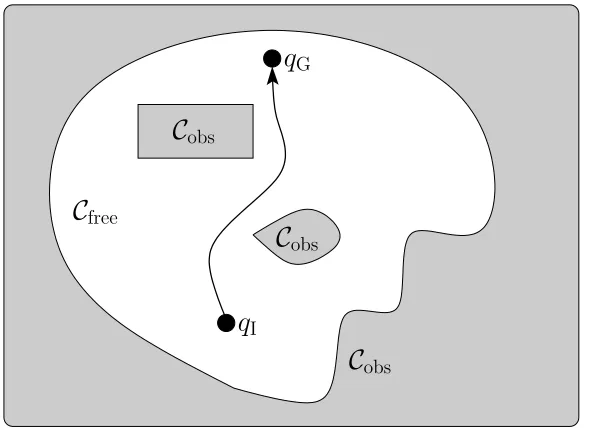
Figure 1.1 The basic motion planning problem visualized using the concept of configuration space. The task is to find a collision free path
inCfree from qI toqG. . . 8
Figure 1.2 Organization of this thesis with arrows indicating dependencies.
Novel results are denoted by the shaded blocks. . . 12
Figure 2.1 An environment with two pursuers (red circles) and three
shad-ows (filled path-connected regions). . . 18
Figure 2.2 An appear event increases the number of shadows by one, and the new shadow is labelled clear (green region). A disappear
event decreases the number of shadows, its label is discarded. . . 22
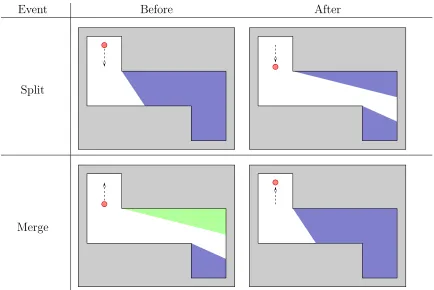
Figure 2.3 When a shadow splits into multiple shadows, they inherit the same label as the original shadow. When a merge event occurs the new shadow is clear if and only if all of the original shadows
are also clear. . . 23
Figure 2.4 A push event occurs when a shadow gets pushed between
neigh-boring pairs of environment reflex vertices. . . 24
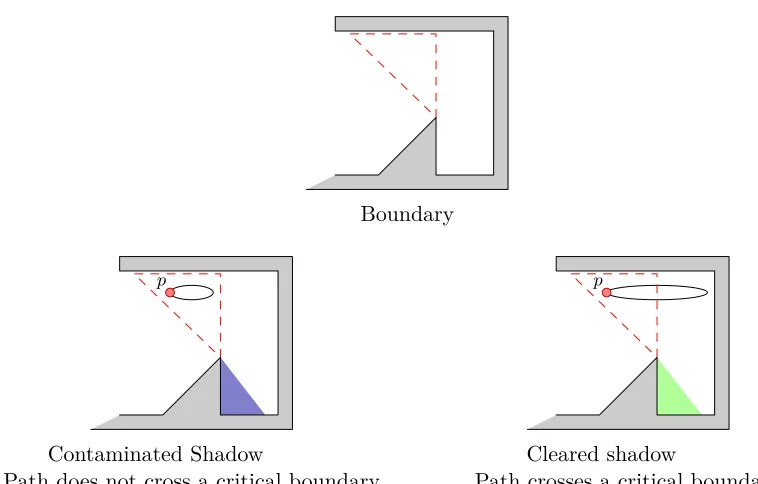
Figure 4.1 An illustration of the concept of conservative regions. . . 32
Figure 4.2 Ray shooting is performed for three general cases to form the
conservative regions. . . 33
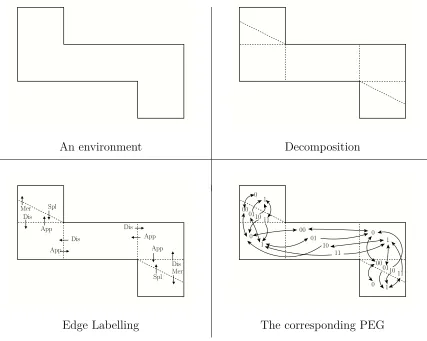
Figure 4.3 An example of the Pursuit Evasion Graph for a given environment. 34
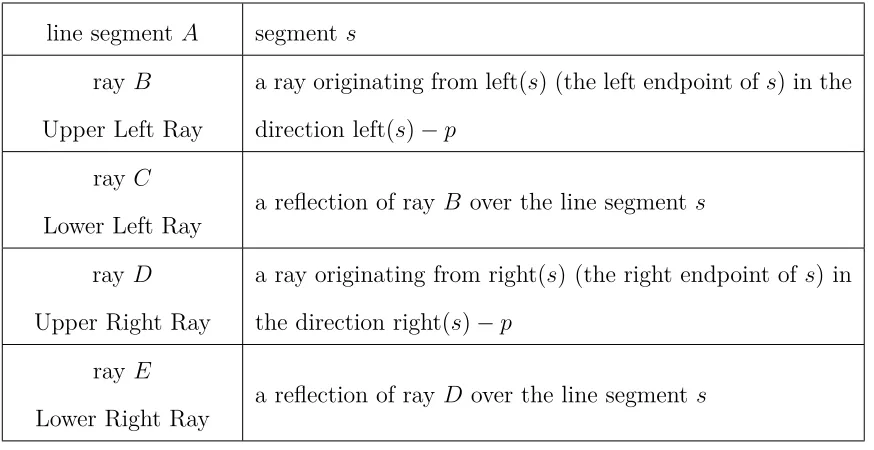
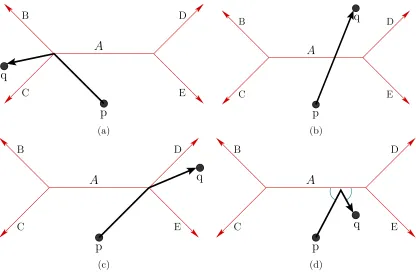
Figure 5.1 A single Shortest Path Map. These four rays and one segment subdivide the plane into regions with combinatorially equivalent
Figure 5.2 The SPM for the first segments divides the plane according to the combinatorial structure of the shortest path from p tos to
a query point q. . . 42
Figure 5.3 Computing the Shortest Path Map for segment si depends on
the Shortest Path Map for segmentsi−1. . . 44
Figure 5.4 The scenario that occurs when theUnavailingPruning strat-egy is used. Initially the pursuer must travel to the closest critical boundary edge. Then for sequences of even length the pursuer will be in the blue conservative region. For sequences
of odd length, the pursuer will be in the green conservative region. 50
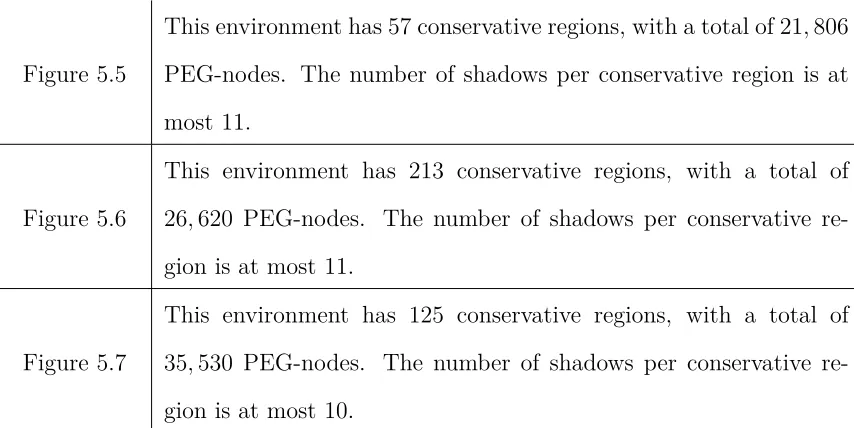
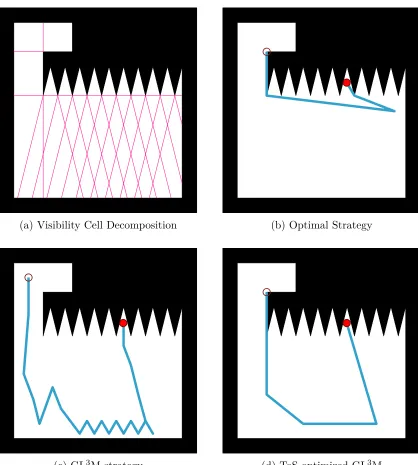
Figure 5.5 An environment (5.5a) where the optimal pursuer strategy (5.5b) returned by our algorithm looks vastly different from both the original GL3M strategy (5.5c) and the GL3M strategy optimized
using a ToS (5.5d). . . 62
Figure 5.6 An environment (5.6a) where the optimal pursuer strategy (5.6b) returned by our algorithm looks fairly similar to both the orig-inal GL3M strategy (5.6c) and the GL3M strategy optimized
using a ToS (5.6d). . . 63
Figure 5.7 An environment (5.7a) where the optimal pursuer strategy (5.7b) returned by our algorithm looks vastly different from both the original GL3M strategy (5.7c) and the GL3M strategy optimized
using a ToS (5.7d). . . 64
Figure 6.1 A configuration of three robots searching an environment. The
shaded regions represent areas hidden to the pursuers. . . 66
Figure 6.2 An environment with two pursuers illustrating the different
types of shadow vertices. . . 67
Figure 6.3 Type I and Type III vertices merge into a Type III vertex. . . 68
Figure 6.4 A Type II vertex merges with a Type III vertex, eliminating
the shadow. . . 69
Figure 6.5 A Type II vertex merges with a Type IV vertex, creating a
Type III vertex. . . 70
Figure 6.6 A Type III vertex merges with a Type III vertex creating a
Figure 6.7 A Type III vertex merges with a Type IV vertex, creating a
Type III vertex. . . 71
Figure 6.8 A Type IV vertex merging with a Type IV vertex with 2-robots. . 72
Figure 6.9 A Type IV vertex merging with a Type IV vertex requires
mul-tiple robots and creates a single Type IV vertex. . . 73
Figure 6.10 Merge events that never occur: (a) I-I (b) I-II (c) I-IV (d) II-II. . 74
Figure 6.11 An example of a critical boundary(bitangent) polynomial pass-ing through obstacles. Because the pursuer motion shown crosses this boundary, it moves to a new CAD cell, even though no
shadow event occurs. . . 76
Figure 7.1 A pursuer strategy generated by our algorithm. Filled circles represent the pursuers’ initial positions and open circles
repre-sent their goal positions. . . 80
Figure 7.2 A snapshot of the SG-PEG. Dashed red lines indicate a unique
joint pursuer configuration. . . 82
Figure 7.3 An illustration of the update step. Initially there are two con-taminated shadows (purple). During the Update a new label appears. At the conclusion of the Update method, there are two shadows: a cleared shadow (green) and a contaminated
shadow (purple). . . 83
Figure 7.4 By considering only straight line motions that do not intersect
the environment we ensure the generation of collision free strategies. 88
Figure 7.5 Multiple intermediary vertices are preferred to a single long
connection. . . 88
Figure 7.6 A collection of dense samples is problematic since cycles can occupy a large amount of computing resources. To combat this
we can require all cycles to be a minimum length. . . 89
Figure 8.1 A pursuit plan (left) computed by our algorithm. The pursuer uses four orthogonal beams (right) to capture the evader, re-gardless of the evader’s path or velocity. The pursuer starts on the bottom boundary of the top-center corridor, and travels
first to the left and then to the right. . . 98
Figure 8.2 A robot with four fixed beam sensors. In this example gap g12
is shaded green. . . 102
Figure 8.3 An illustration to detect when a Left event occurs. An
illus-tration to detect when a Right event occurs. . . 103
Figure 8.4 An illustration that demonstrates when an event does not occur at a reflex vertex. An illustration that demonstrates when an
event does not occur at a convex vertex. . . 103
Figure 8.5 Decomposition of a simple environment into conservative
re-gions by ray extensions. . . 105
Figure 8.6 Refinement of the decomposition from Figure 8.5 by vertical ray extensions upward and downward from each vertex. The
resulting cells are convex. . . 106
Figure 8.7 An illustration of theLeft Extend/Retract events. . . 107
Figure 8.8 An illustration of theRight Extend/Retract events. . . 107
Figure 8.9 A scenario where gap edges can appear/disappear and shrink/grow. When travelling from the interior to the boundary edgeg01and g40disappear,g12andg34shrink toge2 and g3e, andg23remains
the same. Conversely, when travelling from the boundary edge
to the interior gap edges appear, grow, and remain the same. . . . 109
Figure 8.10 An illustration of thesplit andmergeevents that occur when
transitioning between an edge of the region graph and an
envi-ronment vertex. . . 110
Figure 8.11 The final generated plan for the example shown in Figures 8.5
and 8.6. . . 112
Figure 8.12 A plan generated by our algorithm for the above environment. . . 112
Figure A.1 An environment described by four polynomials and it’s
Figure A.2 The CAD of the gingerbread face and the adjacency graph
Chapter 1
Introduction
One of the ultimate goals in Robotics is the creation of an autonomous system that
is capable of converting high-level task specifications from humans into low-level
descriptions detailing how to accomplish the task. Planning algorithms are
instru-mental in creating autonomous systems. A planning algorithmautonomously decides
the sequence of actions necessary to perform a task given an initial configuration, a
collection of goal configurations, and a collection of sensors. This may appear to be
a relatively straightforward process, but challenges such as effectively modelling the
planning problem and designing and implementing efficient algorithms complicate the
process.
The motion planning problem is a refinement of the planning problem. At the
highest level, the motion planning problem asks the following question; “How can a
robot decide what motions to perform in order to achieve its goal while operating
in the physical world?” In the context of Robotics, the motion planning problem
appears in such problems as: navigation, coverage, localization, manipulation, and
pursuit-evasion.
In this thesis we focus on the pursuit-evasion problem. Although there are many
variants of the pursuit-evasion problem, the common theme amongst them is that
one group of agents, the pursuers, attempts to systematically locate the members
of another group, the evaders. Pursuit-evasion problems are of particular interest
because surveillance, evasion/detection, and search and rescue (SAR) are, at their
mentioned problems can be interpreted as pursuit-evasion problems.
• In a surveillance problem such as the Art Gallery Problem1 [64], the guards can
be represented as mobile robots equipped with a camera and tracking software.
• An evasion/detection problem where one agent wants to remain hidden/undetected
from another adversarial agent can also be adapted to incorporate a robot. A
robot similar to the one used in the hypothetical surveillance scenario can act
as the adversary in this instance.
• Another scenario that benefits from deployable robots are search and rescue
operations during a disaster. Rather than exacerbate the situation by placing
the rescuers in harm’s way, an alternative strategy exists where a team of
au-tonomous search and rescue robots conduct the rescue operation. By framing
the scenario in the context of a pursuit-evasion game where the evaders are
the survivors and the pursuers are the robots, we can utilize the algorithms
developed to solve pursuit-evasion problems to aid in rescue operations.
This is but a small sample of potential scenarios that illustrate the presence of
pursuit-evasion problems in the real world. It is imperative that we find effective ways in
which to tackle these problems.
The remainder of this introductory chapter is organized into two parts. The first is
a brief overview of motion planning (Section 1.1), and the second contains a preview
of the primary results and overall structure of the thesis (Section 1.2).
1
1.1
Motion Planning
This section is not designed to be a comprehensive guide to motion planning. Indeed,
entire books [17, 46, 47] have been written on the subject. Instead, this section aims
to provide enough details so that the reader is left with a clear understanding of what
entails a motion planning problem, and the general tools/mechanisms used to tackle
these kinds of problems.
1.1.1
Basic Ingredients of Planning
This section contains several basic ingredients that appear in motion planning.
Al-though this thesis focuses on the pursuit-evasion problem, the following apply to
nearly all motion planning problems regardless of topic.
States
A crucial idea that is the foundation of any motion planning problem is the concept
of a state.
Definition 1. Astateis the collection of all aspects of the robot and the environment
that can have an impact on the future.
The state is a complete description of the robot’s physical situation in the
environ-ment. A single state represents just one possible representation of the robot. The set
of all possibles states is called the robot’s state space. The notation x ∈ X is often
used to denote a specific state in the robot’s state space.
Actions and Transitions
Robots interact with and move through the environment by changing their state,
Definition 2. An action, also known as inputs or controls in control theory, is any
physical interaction that causes a change to the robot’s state.
An action in this case is a robot initiated physical interaction. The set of all possible
actions that the robot can take is called the robot’s action space. A robot action is
typically denoted asu∈U, whereu is a single action belonging to the robot’s action
space, U.
Equipped with a formal way to represent a robot’s situation in the environment
and a set of possible ways in which the robot can act upon the environment we can
formally discuss how a robot goes about changing its state through the use of astate
transition function.
Definition 3. A state transition function is a function whose input is a state xk and
an action uk and outputs a state xk+1 for any timek ≥0.
In its simplest form, the state transition function is a mathematical representation
detailing how a robot updates its state during execution by “transitioning” from one
state to another until a goal state is reached. Mathematically, the state transition
function appears as
f :X×U →X
xk+1 =f(xk, uk).
(1.1)
Observations
A central idea in Robotics is the ability for a robot to infer knowledge about itself
and/or its surroundings through the use of sensors. The key idea is that any
infor-mation that we want to utilize to influence the control of the robot must come from
sensors. In a perfect scenario, a sensor provides complete information. This involves
avoiding ambiguity by yielding complete information, utilizing noiseless sensors, and
using simple enough sensors that they are easy to model. Often times sensors provide
For this thesis, we will focus on how to represent a robot’s available sensory data
in the context of the models discussed in this section.
Definition 4. Anobservation is all of the current available sensor information that
the robot has access to.
At its core, the observation provides the robot with a “hint” about what the current
state is. An observation is typically denoted asy∈Y, wherey is a single observation from the observation space. Since the observation is dependent on the robot’s current
state, the observation function appears as
h:X →Y
y=h(x).
(1.2)
Note that the robot need not necessarily know the state used to generate a particular
observation.
Representing the Passage of Time
There are a number of ways to represent the passage of time, the following three
representations are the most prevalent: continuous time, discrete time with a fixed
length, and discrete stage with variable length. The choice of model is often dependent
on the application. We focus on the continuous time and discrete stage models in
this thesis.
In the continuous time model, time is represented by a real number t. The robot
can potentially change its action at any instant in time, thus the robot’s actions
can be expressed as a function u(t) of time. The state transition function in the
continuous time domain takes the derivative of the state with respect to time and
appears as dx
dt = f(x, u) or alternatively ˙x = f(x, u). The new state can then be computed via integration x(t) =
t
R
0f
x(s), u(s)ds.
In the discrete stage time model, time progresses in a series of discrete stages, that
time is represented by a stage counterkrather than a physical time. This higher level model allows for more abstract actions in the sense that you can perform an action
u for any desired duration. The transition function for the discrete stage model is
essentially the same one introduced in Equation 1.1, that isxk+1 =f(xk, uk).
Representing Uncertainty
In this context uncertainty refers to the situation where the robot is unsure of its
current state. Uncertainty in a system can be attributed to several factors;
uncer-tain actions, unceruncer-tain sensing, and initial unceruncer-tainty. We model this ambiguity by
introducing an adversary called “nature” which interferes with the robot by adding
noise to the system. In this way we can adapt the models used up to this point by
introducing nature actions and observations to account for any uncertainty that may
exist in our system. Nature actions are denoted as θ ∈ Θ, where Θ is the nature action space. The introduction of nature actions requires the following modification
to our state transition function in Equation 1.1:
f :X×U ×Θ→X
xk+1 =f(xk, uk, θk).
(1.3)
Two reasonable models for interpreting the value of θ that nature chooses are
nonde-terministic and probabilistic models. The nondenonde-terministic model can be viewed as
the worst-case scenario model where we don’t know anything about howθ is chosen,
whereas the probabilistic model assumes that nature chooses θ according to some probability distribution.
We can also assume that nature interferes with our robot’s observations as well.
Nature observations are denoted as ψ ∈Ψ, where Ψ is the nature observation space.
func-tion in Equafunc-tion 1.2 to:
h:X×Ψ→Y
y=h(x, ψ)
(1.4)
Our time models can be adapted to account for the effects of nature. The action
errors cause the continuous time state transition function to become ˙x = f(x, u, θ) and the discrete stage state transition function to becomexk+1 =f(xk, uk, θk). Simi-larly, sensing errors require a modification to the observation functions. The
contin-uous time observation function becomes y(t) = hx(t), ψ(t) and the discrete stage
observation function becomes yk =h(xk, ψk).
Configuration Spaces
This section provides a high level introduction toconfiguration spaces. The key idea is
that we want to represent the robot as a single point in the appropriate space, and by
extension seek a mapping that transforms obstacles into an appropriate representation
in this space. This space is called the robot’s configuration space, also commonly
referred to as the C-space. A configuration is a single point in the configuration
space.
Definition 5. A configuration is a complete specification of the position of every
point in the system.
By considering a problem in the robot’s C-space, we can transform the problem
of planning the motion of a spatial object into the problem of planning the motion
of a point. At its core, the C-space is just a special kind of state space.
Now we attempt to provide some intuition concerning the transformation of a
general path planning problem into a problem in the robot’s C-space. Informally,
we want to shrink the robot down to a point and expand the obstacles by the same
q
Gq
IC
freeC
obsC
obsC
obsFigure 1.1: The basic motion planning problem visualized using the concept of con-figuration space. The task is to find a collision free path in Cfree fromqI to qG.
of the expanded obstacle region in the C-space, then the corresponding spatial robot
will stay out of the real workspace obstacles.
The C-space is just a collection of possible configurations that our robot could
occupy. However, similar to the physical domain there are areas of the C-space called
obstacle configurations that we want to restrict the robot from entering. An obstacle
configuration is a configuration in which the robot is in collision with an object in the
environment. The set of obstacle configurations is denoted by Cobst. Everything else
in the C-space is considered a free configuration and is denoted by Cfree = C − Cobst.
Informally Cfree are areas corresponding to “safe” configurations for the robot.
Using the C-space formalization, the basic motion planning problem takes as
input a starting configuration qI, a goal configuration/region qG ∈ Cgoal ⊆ Cfree and
outputs a collision free path throughCfree from the starting configuration to the goal
configuration/region. An illustrative example of this concept appears in Figure 1.1.
For a more mathematically rigorous definition of the configuration space we refer
Information Spaces
This section provides the reader with a high level understanding ofinformation spaces.
The key idea, is that in the presence of state uncertainty where the robot’s true state
is hidden, we want to create some representation based on the information available
to the robot. Fundamentally, information spaces can be viewed as a special kind of
state space.
What information is available to the robot? In some scenarios, initial conditions
may be specified in such a way that the initial state may be known, but in general a
robot has access only to the history of past actions and the sensor observations it has
received. The space of past histories is called the robot’s history information space
and is denoted byIhist and defined as
Ihist = ∞
[
i=0
(U ×Y)i. (1.5)
After k stages, the robot’s history information state is the following sequence of action-observation pairs
ηk+1= (u1, y1, . . . , uk, yk)∈ Ihist. (1.6)
The history I-space provides a way of storing and maintaining the action-observation
histories, but does not provide any insight into how the robot might make use of this
information. It typically is not feasible to deal with history I-states explicitly because
the length of a history I-state grows linearly with the number of stages. Instead, we
consider information mappings (I-maps) of the form
κ:Ihist → I (1.7)
that consolidate the history I-states into a new target space I called a derived
in-formation space. Informally, κ can be viewed as the mechanism that the robot uses
to interpret its sensor information. Naturally the usefulness of a derived I-space is
For the purpose of reasoning about planning problems, we consider a special class
of I-maps called sufficient I-maps. Given an I-map κ : Ihist → I, κ is a sufficient I-map if there exists an information transition function
fI :I ×U×Y → I (1.8)
such that
fI
κ(ηk), uk, yk
=κ(ηk, uk, yk) (1.9)
for any ηk ∈ Ihist, uk ∈U, yk∈ Y. The intuition is that the I-states derived byκ are sufficient to determine future derived I-states. This is very similar to the idea of a
sufficient statistic [13, 90] in Statistics. In this sense the current derived I-state is as
powerful as having the complete action-observation history when computing future
derived I-states. So we are able to reason about the problem in the derived I-space
rather than the history I-space.
It remains to show what a solution to a planning problem looks like in an
infor-mation space. First, consider how the goal region in an inforinfor-mation space differs from
that of a typical state space. A goal region in a state space is the set of terminating
configurations that the robot could be in when it satisfies its task, whereas a goal
region in an information space must account for all of the potential action-observation
pairs that could cause the robot to enter into a configuration that accomplishes the
task. So naturally we can represent the goal region, IG as a subset of the history
I-space.
The last piece of information that we need is a mechanism that guides our search
through the I-space to the goal region. In essence we want a mapping
π :I →U (1.10)
that, given an I-state, selects the next action the robot will take. Such a mapping is
called a policy over a derived I-space, and if repeated applications of π produces an
1.1.2
Properties of Planners
This section introduces several different properties of planners focusing on the quality
of the solution they provide. In particular we focus onoptimality and varying degrees
ofcompleteness. We use the following definition to define what it means for a planner
to beoptimal.
Definition 6. A planner isoptimal if it finds motions that optimize some parameter
such as length, execution time, or energy consumption.
This definition places the onus on the author to clearly specify the parameter(s) being
optimized. This often aids the reader by providing some insight about the problem
and/or the robot model. The following example demonstrates this idea.
Example: A planner that generates a minimal cost (Euclidean
distance) path.
False
Assump-tion:
The minimal cost path will also be the path that
minimizes the robot’s execution time to follow the
aforementioned path.
Scenario:
This case often arises when the path requires the
robot to spend a large amount of time rotating as
opposed to translating.
We use the following definition to define what it means for a planner to be
com-plete.
Definition 7. A planner is complete if it will always find a solution to the motion
planning problem when one exists, or indicate failure in finite time if no solution
1. Introduction
2. Problem
Statement 3. Related Work
4. GL3 M
5. Single Pursuer Optimal
6. Multi-Pursuers Complete
7. Multi-Pursuer Sampling Based
8. Single Pursuer Fixed Beams
9. Conclusion
Figure 1.2: Organization of this thesis with arrows indicating dependencies. Novel results are denoted by the shaded blocks.
While complete algorithms are desirable, they become intractable as the degree
of the configuration space gets larger [11]. Therefore we often seek weaker forms of
completeness such as resolution completeness or probabilistic completeness.
Definition 8. A planner is resolution completeif a solution exists at a given level of
discretization. A planner is probabilistically complete if the probability of finding a
solution tends to 1 as time goes to infinity.
1.2
Thesis Organization
We conclude this introductory chapter with a preview of the remainder of this thesis.
A formal problem statement appears in Chapter 2. A literature review appears in
Motwani (GL3M) algorithm that influenced the four novel contributions that appear
in Chapters 5, 6, 7, and 8. Concluding remarks and some potential avenues for future
work appear in Chapter 9. The structure and dependencies between chapters are
shown in Figure 1.2. This thesis presents four novel results for various visibility-based
pursuit-evasion problems: an optimal search strategy for a single pursuer, a complete
algorithm for multiple pursuers, a randomized algorithm for multiple pursuers, and
a complete algorithm for a single pursuer with limited sensing capabilities.
1.2.1
Single Pursuer - Shortest Path
The first result (Chapter 5) considers an instance of the visibility-based
pursuit-evasion problem that utilizes a single pursuer to search the environment for potential
evaders. The main contribution is a complete algorithm whose goal is to compute a
minimal-cost pursuer trajectory that ensures that the evaders are captured in a finite
time, or reports that no finite time pursuer trajectory exists. This result improves
upon the known algorithm of Guibas, Latombe, LaValle, Lin, and Motwani, which
is complete but makes no claims as to the quality of the solution. The central idea
is that by carefully decomposing the two-dimensional polygonal environment into
combinatorially equivalent convex regions, we can exploit the structure of the problem
by considering a simpler subproblem that is equivalent to computing the minimal-cost
pursuer trajectory.
1.2.2
Multiple Pursuers - Complete Solution
The second result (Chapter 6) considers an instance of the visibility-based
pursuit-evasion problem that utilizes multiple pursuers to search an environment. We present
a centralized algorithm that searches the pursuers’ joint configuration space for a joint
strategy for the pursuers that will satisfy the capture conditions of the pursuit-evasion
of the pursuers’ joint configuration space by using polynomials that capture where
critical changes can occur to the region of the environment hidden from the pursuers.
After computing the adjacency graph for the CAD, we construct a Pursuit-Evasion
Graph(PEG) induced by the adjacency graph. A search through the PEG can produce
one of the following outcomes; the search can reach a vertex where the pursuers’
motions up to this point ensures that the evader has been captured, or the search
terminates without finding a solution and produces a statement recognizing that no
solution exists.
1.2.3
Multiple Pursuers - Probabilistically Complete
Sampling-Based Solution
Motivated by the complexity of the previous result, our third result (Chapter 7)
intro-duces a probabilistically-complete sampling-based algorithm for solving a
visibility-based pursuit-evasion problem that utilizes multiple pursuers. This technique
con-structs a Sample-Generated Pursuit-Evasion Graph (SG-PEG) that utilizes an
ab-stract sample generator to search the pursuers’ joint configuration space for a search
strategy that captures the evaders, or reports that no such strategy exists under the
current constraints.
1.2.4
Single Pursuer - Fixed Beams
The final result (Chapter 8) considers an instance of the visibility-based
pursuit-evasion problem where a single pursuer is equipped with a finite collection of
single-direction sensors, with the goal of locating an adversarial evader within the
line-of-sight of one of those sensors. The novel contribution is a complete and efficient
algorithm for solving this fixed-beam pursuit-evasion problem. The intuition of the
regions, within which the evader cannot “sneak” between any pair of adjacent sensors.
This decomposition induces a graph we call the Fixed-Beam Pursuit-Evasion Graph
(FB-PEG), such that any correct solution strategy can be expressed as a path through
Chapter 2
Problem Statement
This chapter formalizes the visibility-based pursuit-evasion problem considered in
this thesis. We begin by describing the model used to represent the environment,
evaders, and pursuers (Section 2.1) and then give a formal definition for the area of
the environment not visible to the pursuers, called shadows (Section 2.2).
2.1
Representing the environment, evaders, and
pursuers
The environment is a polygonal free-space, defined as a closed and bounded set
W ⊆ R2, with a polygonal boundary ∂W. The boundary of the environment is
composed ofm vertices.
The evader is modeled as a point that can translate within the environment. Let
e(t)∈W denote the position of the evader at time t≥0. The path eis a continuous
function e : [0,∞) → W, in which the evader is capable of moving arbitrarily fast
(i.e. a finite, unbounded speed) within W. The evader trajectory e is unknown to
the pursuers. Without loss of generality we can assume that there is a single evader.
If the pursuers can guarantee the capture of a single evader, then the same strategy
can locate multiple evaders, or confirm that no evaders exist.
from a given collection of starting positions, the pursuers’ motions can be described
by a continuous function p : [0,∞) → Wn, so that p(t) ∈ Wn denotes the joint configuration of the pursuers at time t ≥ 0. The function p is called a joint motion
strategy for the pursuers. We use the notation pi(t) ∈ W to refer to the position of pursuer i at time t. Likewise, xi(t) and yi(t) denote the horizontal and vertical coordinates of pi(t). Without loss of generality, we assume that the pursuers move with maximum speed 1.
Each pursuer carries a sensor that can detect the evader. The sensor is
omnidi-rectional and has unlimited range, but cannot see through obstacles. For any point
q ∈ W, let V(q) denote the visibility region at point q, which consists of the set of
all points inW that are visible from pointq. That is, V(q) contains every point that
can be connected toq by a line segment inW. Note that V(q) is a closed set.
When considering the maximal path-connected component of V(q), the edges of
its boundary are either along∂W or belong to an occlusion ray.
Definition 9. Anocclusion ray,−→qr, is a ray starting at a pursuer position q tangent
to a visible environment reflex vertex r.
Informally, an occlusion ray originating at point q is a ray that acts as a boundary
separating a visible and non-visible portion of W.
The time of capture for an evader following trajectory e and a group of pursuers
executing the joint motion strategy p is denoted as:
tc(p, e) = min
(
t≥0 | e(t)∈[
i
Vpi(t) )
(2.1)
The pursuers’ goal is to capture the evader regardless of the evader’s trajectory.
Definition 10. A pursuer joint motion strategypis a solution strategyif there exists
a finite time of capture, denoted tc(e) and defined as
p1
p2
Figure 2.1: An environment with two pursuers (red circles) and three shadows (filled path-connected regions).
The time tc(e) is the least upper bound for the time of capture over all valid evader trajectories when the pursuers follow the joint motion strategy p.
2.2
Shadows
The key difficulty in locating the evader is that the pursuers cannot, in general, see
the entire environment at once. This section contains some definitions for describing
and reasoning about the portion of the environment that is not visible to the pursuers
at any particular time.
Definition 11. The portion of the environment not visible to the pursuers at time t
is called the shadow region S(t), and defined as
S(t) =W − [
i=1,...,n
Vpi(t).
Note that the shadow region may contain zero or more nonempty path-connected
components, as seen in Figure 2.1.
Definition 12. A shadow is a maximal path-connected component of the shadow
Notice that S(t) is the union of the shadows at time t. The important idea is that the evader, if it has not been captured, is always contained in exactly one shadow, in
which it can move freely.
As the pursuers move, the shadows can change in any of five ways, called shadow
events.
• Appear: A new shadow can appear, when a previously visible part of the
envi-ronment becomes hidden.
• Disappear: An existing shadow can disappear, when one or more pursuers move
to locations from which that region is visible.
• Split: A shadow can split into multiple shadows, when the pursuers move in
such a way that a given shadow is no longer path-connected.
• Merge: Multiple existing shadows can merge into a single shadow, when
previ-ously disconnected shadows become path-connected.
• Push: An existing shadow can be pushed between pairs of neighboring
environ-ment reflex vertices, when the pursuer’s motion changes the cardinality of the
set of visible environment reflex vertices.
These events were originally enumerated in the context of the single-pursuer version
of this problem [27] and examined more generally by Yu and LaValle [96].
2.2.1
Shadow Labels
For our pursuit-evasion problem, the crucial piece of information about each shadow
is whether or not the evader might be hiding within it.
Definition 13. A shadow s is called cleared at time t if, based on the pursuers’
motions up to time t, it is not possible for the evader to be within s without having
Definition 14. A shadow is called contaminated if it is not clear. That is, a
con-taminated shadow is one in which the evader may be hiding.
We can assign a binary label to each shadow corresponding to the cleared/contaminated
status of the shadow. A label of 0 means that the shadow is cleared and similarly
a label of 1 means that the shadow is contaminated. Notice that, since the evader
can move arbitrarily quickly, the pursuers cannot draw any more detailed
conclu-sion about each shadow than its clear/contaminated status; if any part of a shadow
might contain the evader, then the entire shadow is contaminated. Using this
worst-case reasoning, we can completely represent the I-state given the pursuers’ current
configuration and the current shadow labels.
Comparison Operators: Equal (=) and Not Equal (6=)
This section describes two comparison operators for shadow labels that test for
equal-ity. Consider two shadow labelsS = (s1s2. . . sk) and S
′ =
s′ 1s
′ 2. . . s
′
k
.
Definition 15. Two shadow labels S and S′ are
equal to(=) one another if the
following holds:
∀i 1≤i≤k : si =s
′
i.
The intuition behind the (=) relation is that if a shadow appears as cleared in S
then it must also be cleared in S′. Similarly, if a shadow is contaminated in
S then
it must also be contaminated inS′.
Definition 16. Two shadow labels S and S′ are
not equal to one another if the
following holds:
∃i 1≤i≤k : si 6=s
′
The intuition behind the (6=) relation is that there must exist at least one shadow
whose label is dissimilar between S and S′
. The not equal relation is the logical
negation of the equal to relation.
Binary Relation: Dominates (≫)
This sections describes a dominance binary relation over shadow labels. Consider two
shadow labelsS = (s1s2. . . sk) andS ′
= s′
1s ′ 2. . . s
′
k
.
Definition 17. A shadow labelSdominates a shadow labelS′ if the following holds:
∀i 1≤i≤k : si ≤s
′
i.
Informally, S dominates S′ if for every shadow that is cleared in
S′, the correspond-ing shadow in S is also cleared. The intuition is that S provides at least as much
information as S′
, and can potentially contain more information in the case where
si = 0 and s
′
i = 1.
Definition 18. A shadow label S strictly dominates (≫) a shadow label S′
if
S ≫S′
and S 6=S′
. (2.3)
2.2.2
Label Update Rules
Each time a shadow event occurs, the labels can be updated based on worst case
reasoning. Below we describe the update rules for a shadow’s label according to the
visibility event that has occurred. Each rule describes how a label preceding the
visibility event is updated immediately following a given visibility event.
• Appear: New shadows are formed from regions that had just been visible, so
Event Before After
Appear
Disappear
Figure 2.2: An appear event increases the number of shadows by one, and the new shadow is labelled clear (green region). A disappear event decreases the number of shadows, its label is discarded.
• Disappear: When a shadow disappears, its label is discarded.
• Split: When a shadow splits, the new shadows inherit the same label as the
original.
• Merge: When shadows merge, the new shadow is assigned the worst label of
any of the original shadows’ labels. That is, a shadow formed by a merge event
is labeled clear if and only if all of the original shadows were also clear.
• Push: When a shadow is pushed, it maintains its current label.
Figures 2.2, 2.3, and 2.4 illustrate the shadow label update rules where cleared
shad-ows are represented as the filled path-connected green regions and contaminated
Event Before After
Split
Merge
Figure 2.3: When a shadow splits into multiple shadows, they inherit the same label as the original shadow. When a merge event occurs the new shadow is clear if and only if all of the original shadows are also clear.
2.3
Reformulating the Objective
We can incorporate this idea of reasoning about evaders via shadows to reformulate
the pursuer’s goal in terms of shadows rather than evader positions. Recall the
definition ofsolution strategyfrom Definition 10 where the pursuers’ goal was stated as
computing a finite time of capture for each evader over all possible evader trajectories.
Using the definitions of cleared and contaminated from above to describe a shadow’s
current status, we know that in the event that all of the shadows in the shadow region
are cleared, then we can be certain the evader has been seen at some point. The result
of this reasoning is that we can connect the shadow labels to our goal of finding a
solution strategy.
Event Before After
Push
Figure 2.4: A push event occurs when a shadow gets pushed between neighboring pairs of environment reflex vertices.
reaches a pursuer configuration in finite time in which all of the shadows are cleared.
Chapter 3
Related Work
Pursuit-evasion problems are often classified under the vast umbrella of target
track-ing, security, and monitoring and surveillance problems. For brevity, this thesis will
use the term target tracking to refer to this collection of similar problems. Target
tracking problems typically require the system to ascertain some information about
a target (environmental feature and/or a mobile agent). Target tracking problems
span multiple disciplines and can be found in game theory [70,78], computational
ge-ometry [12,15,16,53], wireless networks [14,25,28], and mobile robotics [4,33]. In this
chapter we provide a brief overview of the target tracking problem (Section 3.1)
fol-lowed by a more focused literature review of Pursuit-Evasion problems (Section 3.2).
3.1
Target Tracking
As mentioned above, target tracking is a problem that spans multiple disciplines.
This thesis focuses on those works most closely related to mobile robotics. In the
most general case the objective for these problems is to maintain visibility between
the target and the tracker. Algorithms are known for planning the tracker’s motions
using dynamic programming [48], sampling-based methods [57], Partially Observable
Markov Decision Process (POMDP) [30], and reactive approaches [55]. The target
tracking task can be further complicated by additional constraints such as avoiding
detection [4], maintaining the target’s privacy [60], and bounded observer speed [54].
The first problem is wireless sensor network assisted target tracking (Section 3.1.1)
and the second problem is monitoring and surveillance (Section 3.1.2). This is a small
sample of the various tasks and approaches encompassed within target tracking.
3.1.1
Wireless Sensor Network Target Tracking
As mentioned above, wireless sensor networks (WSNs), have been one approach used
to track a moving target(s). This target could be a human [14, 80], a moving vehicle
[26, 28, 97], or other moving target [3, 40, 79]. WSNs have been used in conjunction
with mobile robots [33, 62] to tackle the target tracking problem. Typically, the
mobile robots are used during sensor deployment with the goal of achieving good
sensor coverage [5,6]. However, their has been work done that focuses on the tracking
application after the deployment has occurred [63].
3.1.2
Monitoring and Surveillance
Monitoring and surveillance are two terms that are often used interchangeably. The
key distinction is that monitoring is a passive task that does not result in any direct
action on the agent’s part. The monitoring task typically charges the agent with
using its sensory information to detect a change in its environment. Surveillance
tasks are often seen as the active version of the monitoring problem where an agent
is tasked with actively searching its environment in an effort to detect some change
in the environment.
Persistent monitoring and surveillance tasks are variations on the traditional
moni-toring and surveillance tasks that require a tracker or team of trackers to perform their
monitoring/surveillance task in perpetuity. The “perpetuity” aspect is what makes
these problems well-suited to be carried out by a robot or robot team.
Visibility-based monitoring problems commonly occur in many applications such as security and
The increased availability of mobile robots capable of performing these tasks has led
to increased interest [45, 51, 82] in recent years.
3.2
Pursuit-Evasion
This section examines existing literature in the field of pursuit-evasion. Although
this thesis presents results for a visibility-based pursuit-evasion problem, we discuss
the evolution of the pursuit-evasion problem from differential games (Section 3.2.1)
to a graph-based formulation (Section 3.2.2) and finally to a geometric formulation
(Section 3.2.3).
3.2.1
Differential Games
The pursuit-evasion problem was originally posed in the context of differential games
[29,31] and has produced a variety of different problems with small variations. In the
lion and man game, a lion tries to capture a man who is trying to escape [37, 58, 59,
77, 93]. In game theory, the homicidal chauffeur is a pursuit evasion problem which
pits a slowly moving but highly maneuverable runner against the driver of a vehicle,
which is faster but less maneuverable, who is attempting to run him over [31, 74].
Bounds for this problem that require the pursuer to physically capture the evader
suggests the number of pursuers required to satisfy this capture condition exceeds
that needed for the visibility-based pursuit-evasion problem [41].
3.2.2
Graph-Based Formulation
Pursuit-evasion on a graph can be traced back to the independent work done by
Parsons and Petrov. The motivation behind the Parsons’ problem was the desire for
a graphical model to represent the problem of finding an explorer who is lost in a
known as the edge-searching problem, is to determine a sequence of moves for the
pursuers that can detect all intruders in a graph using the least number of robots. A
move consists of either placing or removing a robot on a vertex, or sliding it along
an edge. A vertex is considered guarded as long as it has at least one robot on it,
and any intruder located therein or attempting to pass through will be detected. A
sliding move detects any intruder on an edge.
The Parsons’ problem and some of its results were later independently rediscovered
by Petrov [68] using slightly different motivating problems. Petrov’s formulation
considered the cossacks and the robber game [69] and the princess and the monster
problem [31]. Golovach showed that both problems considered an equivalent discrete
game on graphs [23].
There are variations of graph-based pursuit-evasion that consider both edge
guard-ing and node guardguard-ing. One such formulation that differs from edge-searchguard-ing (where
searchers move across edges and guard vertices) that has a direct application to
Robotics is the Graph-Clear problem [44]. Graph-Clear is a pursuit-evasion problem
on graphs that models the detection of intruders in an environment by robot teams
with limited sensing capabilities.
This is but a small sample of the existing literature surrounding the graph-based
pursuit-evasion problem. We have placed an emphasis on the inception of the problem
and briefly touched on some recent results. For a more comprehensive review of
recent results in graph-based pursuit-evasion we direct the reader to the following
surveys [1, 9, 10, 21, 89].
3.2.3
Geometric Formulation
The visibility-based pursuit-evasion problem and the surveillance/tracking problem
are various types of pursuit-evasion problems that use a geometric formulation.
Yamashita [88] as an extension of the watchman route problem1 [16] and is a geometric
formulation of the traditional graph-based pursuit-evasion problem. Research on the
visibility-based pursuit-evasion has produced numerous results for both the single
pursuer and multiple pursuer variants of the problem.
Single Pursuer Visibility-Based Pursuit-Evasion
There are many interesting results for the single pursuer visibility-based
pursuit-evasion problem. A complete solution [27], a randomized solution [32], and an optimal
shortest path solution have been found.
The capture condition for the general visibility-based pursuit-evasion problem
is defined as having an evader lie within the pursuer’s capture region. There has
been substantial research focused how the visibility-based pursuit-evasion problem
changes when a robot has different capture regions. Thek-searcher is a pursuer with k visibility beams [50, 88], the∞-searcher is a pursuer with omni-directional field of view [27,66], and theφ-searcher is a pursuer whose field-of-view [22] is limited to an
angleφ∈(0,2π]. Note that all of these approaches consider evaders with unbounded speed.
Others have studied scenarios where there are additional constraints, such as the
case of curved environments [49], an unknown environment [75], a maximum bounded
speed for the pursuer [92], or constraints on the pursuer similar to those of a typical
bug2 algorithm [73].
1
The objective of the watchman route problem is to compute the shortest path that a guard should take to patrol an entire area populated with obstacles, given only a map of the area.
2
Multiple Pursuer Visibility-Based Pursuit-Evasion
As a result of the problem complexity, there is a wide range of literature with differing
techniques attempting to solve the multi-robot visibility-based pursuit-evasion
prob-lem. Some recent results involve using some of the pursuers as stationary sentinels
while other pursuers continue with the search [43]. Another approach involves
main-taining complete coverage of the frontier [20]. There are other variants of the
Chapter 4
GL
3
M Algorithm
The prior work of Guibas, Latombe, LaValle, Lin, and Motwani is integral in
un-derstanding some of the techniques that contribute to the results in this thesis. As
such, it is necessary to summarize the work of Guibas, Latombe, LaValle, Lin, and
Motwani [27] that presents a complete solution to the visibility-based pursuit-evasion
problem that utilizes a single pursuer.
4.1
Overview
The authors’ main contribution is a way to change the continuous problem of finding
a pursuer trajectory into a simpler discrete problem. Initially, the problem requires
a pursuer trajectory that solves the single pursuer visibility-based pursuit-evasion
problem. But by considering the areas of the environment that induce changes to
the shadow region we can ask the following equivalent question. What areas of the
environment does the pursuer have to visit to guarantee that the evader is captured?
Once a valid sequence has been found, returning a trajectory is trivial.
In the remainder of this chapter we investigate how certain pursuer motions can
force a critical information change within the shadow region (Section 4.2), and
de-scribe a graph structure and algorithm for solving the single pursuer visibility-based
Boundary
p
Contaminated Shadow
Path does not cross a critical boundary
p
Cleared shadow
Path crosses a critical boundary
Figure 4.1: An illustration of the concept of conservative regions.
4.2
Critical Information Changes
During the execution of a strategy, the pursuer must identify the contaminated
shad-ows in the shadow region. This piece of information is dependent upon the initial
position of the pursuer and the pursuer’s history of past positions, up to the current
time. As the pursuer moves, this information changes continuously; however, to
de-velop a complete algorithm, the authors need only be interested in tracking times in
which the pursuer’s information changes combinatorially. That is, we are only
con-cerned with pursuer movements that generate shadow events, as seen in Figure 4.1.
Definition 20. A region R ⊆ Wn is a conservative region if any path that remains
within R generates no shadow events.
By definition a conservative region has the following information-conservative
prop-erty: while the pursuer remains within a conservative region the pursuer’s shadow
labels will not change.
The original paper describes a visibility cell decomposition of the environment that
(a) (b) (c)
Figure 4.2: Ray shooting is performed for three general cases to form the conservative regions.
of the environment into conservative regions works by extending rays from inflection
points in the environment, and extending rays outwards from pairs of mutually visible
environment vertices. The inflection and bitangent ray extensions represent where
the pursuer’s shadow labels change.
There are five events that can occur at a critical event boundary that cause a
change in the pursuer’s shadow labels as it traverses between conservative regions.
These events (appear, disappear, split, merge, and push) were mentioned earlier in
Section 2.2.
The procedure used in creating the ray extensions provides the following
informa-tion about what type of event takes place along the boundary of the extension:
(a) Ray extensions caused by an inflection at a single endpoint of an environment
edge cause appear and disappear events.
(b) Ray extensions caused by a pair of mutually visible environment vertices (where
the vertices are not part of the same environment edge) cause split and merge
events.
(c) Ray extensions caused by inflections at both endpoints of an environment edge
cause push events.
An environment Decomposition Dis Dis Mer Spl Mer App Dis App App App Dis Spl 00 0 1 1 10 11 1 0 1 0 00 011011 00 011011 01 0
Edge Labelling The corresponding PEG
Figure 4.3: An example of the Pursuit Evasion Graph for a given environment.
4.3
The Pursuit-Evasion Graph
With this information, the complete Pursuit-Evasion Graph (PEG) can be
con-structed as shown in Figure 4.3. The PEG is a directed graph composed of nodes
that contain a shadow labeling and a reference to a conservative region, where a node
exists for each possible shadow label combination for every conservative region. Its
edges are the set of critical events that occur from crossing an event boundary from
one conservative region to another. The algorithm starts at the PEG-node that
con-tainsp(0) with a shadow label of 1· · ·1. Using this node as the root of a graph search, the algorithm uses breadth-first search to find a path to a node with a shadow label
Chapter 5
An Optimal Strategy for a Single Pursuer
The specific problem we consider in this chapter is a variation on the visibility-based
pursuit-evasion problem in which a single pursuer moving through a simply-connected
polygonal environment seeks to locate an unknown number of evaders, each of which
may move arbitrarily fast. The pursuer has an omni-directional field-of-view that
extends to the environment boundary.
The goal is to compute a pursuer strategy such that all evaders in the environment
lie within the pursuer’s field-of-view at some finite time as the pursuer carries out
its search strategy, or to identify when no such strategy exists. Guibas, Latombe,
LaValle, Lin, and Motwani presented a complete algorithm for this problem [27], the
details of which appear in Chapter 4. However, the authors consider only feasibility
and do not attempt to compute optimal strategies. We build upon this work by
developing an algorithm that solves the visibility-based pursuit-evasion problem by
returning a solution strategy that is optimal in the sense that it minimizes the distance
travelled by the pursuer.
We use the same decomposition and Pursuit-Evasion Graph (PEG) discussed in
Section 4.2 and Section 4.3, but our algorithm must simultaneously consider multiple
paths to each node. Each of these paths can be viewed as a tour that travels through
an ordered sequence of cell boundaries. We introduce a pruning operation to
elimi-nate suboptimal paths, and a forward search algorithm whose termination condition
guarantees that an optimal solution will be found.