Implementation of Closed-Loop Stepper Motor
Driver Based on Lead Angle Estimation
Kien Minh Le and Khoa Dang Truong
Le Quy Don Technical University, Hanoi, VietnamEmail: {kiendktd1, khoahn67}@gmail.com
Abstract—In this work, a position controller for hybrid stepper motors has been successfully designed. The proposed method is based on a lead angle estimator to generate a desired excitation phase of the currents in two phases of a stepper motor. This results in producing the highest motor torque. The step-out problem, which is a common phenomenon of stepper motors when operating in open-loop position control mode with varied load torque, especially at high speed, is overcome. Therefore, the stepper motor can operate in a wide operating speed range. The proposed method is effective in implementation using a Digital Signal Processing (DSP)-based stepper motor drive platform. The position tracking performance of the proposed method was validated by means of experimental comparison with the open-loop position control technique.
Index Terms—closed-loop control, open-loop control, phase
advance control, hybrid stepper motors
I. INTRODUCTION
Hybrid stepper motors are one of the most commonly used solutions in situations requiring high positioning accuracy such as automotive, textile, domestic appliances, CNC systems, and robotics [1], [2]. Their definite advantages are high efficiency, high power density, high torque-to-inertia ratio, absence of rotor windings, and absence of external rotor excitation.
Originally, stepper motors were designed to be used in open-loop mode only because of their inherent stepping ability that results in accurate positioning without requiring any feedback position information. Open-loop control algorithms for stepper motors have been extensively studied in the literature [2]-[6]. However, in open-loop operation mode, step-out problem commonly occurs in stepper motors when the load varies, especially when operated at high speeds.
In order to prevent stepper motors from encountering the step-out problem, closed-loop position control algorithms were applied [1], [7]-[12]. In a closed-loop stepper motor driver, control algorithms, such as PID (Proportional Integral Derivative) position control [1], [7], optimal control [8], global learning control [9], and lead angle control [1], [7], [10]-[12] could be implemented. Even though the PID position control method is easy to apply for a stepper motor driver, however, the produced motor torque is not optimal because the torque angle of
Manuscript received June 16, 2018; revised September 7, 2018.
the motor is not considered in this method. The optimal and global learning control approaches [8], [9] could achieve high speed motion but they require a complex computation. In the lead angle control methods [10]-[12], the value of the lead angle is calculated based on the produced motor torque, the motor speed, and the compensation for back Electromagnetic Force (EMF). Therefore, by using these techniques, the stepper motor can operate at high speed with the high torque. However, these approaches require a high computation load because of complex calculations.
In this paper, we propose a method to estimate the lead angle of the stepper motor for implementing a closed-loop position control for a hybrid stepper motor drive. We experimentally validated that the proposed method can generate the highest motor torque as well as uniform position tracking performance in not only high-speed operation but also varied load torques.
This paper is organized as follows: The mathematical model of the hybrid stepper motor and the conventional micro-stepping technique is briefly introduced in Section II. The design of the position controller is clearly described in Section III. Section IV shows the experimental results to verify the proposed approach. Finally, Section V summarizes the conclusions.
II. MATHEMATICAL MODEL OF HYBRID STEPPER MOTOR AND MICRO-STEPPING TECHNIQUE In this research, a two-phase bipolar hybrid stepper motor is considered and the micro-stepping technique is applied to evaluate the position control performance. A simple state-space of the studied hybrid stepper motor is given by [1]:
1
= ( sin( )), 1
= ( cos( )), 1
= (( sin( ) cos( )) ),
= ,
a
a a t
b
b b t
t a t b l
di
v Ri K
dt L
di
v Ri K
dt L
d
K i K i D T
dt J
d
dt
(1)
rotor electrical angular speed [rad s/ ], is the rotor electrical angular position [rad]. Dis the viscous friction coefficient [N m s rad / ]. J is the rotor inertia
2
[N m s /rad].Ktis the torque constant [N m A / ].
T
lis the load torque [N m ]. R and L are the resistance [ ] and inductance [H] of the phase winding, respectively. Nr is the number of rotor teeth.
Generally, the direct-quadrature (DQ) transformation, described in (2), is used to change the frame of reference from the fixed coordinate to the rotating coordinate. This transform is useful both from a signal processing point of view and from a control design point of view.
cos( ) sin( ) =
sin( ) cos( )
T
(2) The resulting DQ coordinate state-space representation is as follows:1
= ( ), 1
= ( ),
1
= (( ),
= ,
d
d d q
q
q q d t
t q l
di
v Ri Li
dt L
di
v Ri Li K
dt L
d
K i D T
dt J
d
dt
(3)
where
( , )
i i
d q and( ,
v v
d q)
are the phase currents and the voltages on the DQ coordinate.Full-, half- and micro-stepping techniques are normally applied to operate stepper motors and the impact of these control algorithms are analyzed in detail in [13]. Among them, the micro-stepping technique, which inputs two
shifted 90o sinusoidal signals to a hybrid stepper motor for position tracking, is known as the best method to obtain a high position resolution [13]-[15].
In order to rotate a rotor to the reference position
ref, the reference micro-stepping inputs(
v
a ref,,
v
b ref,)
, in phase A and phase B, are given as follows:,
,
cos(
),
sin(
),
a ref ref
b ref ref
v
V
v
V
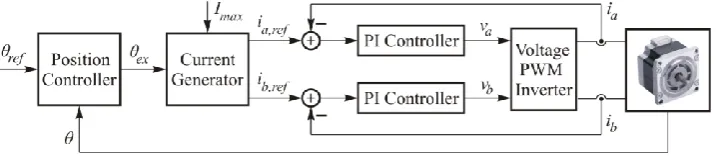
(4)where V is the supplied voltage to the stepper motor. Fig. 1 shows a block diagram of the current control system of a two-phase stepper motor. For position control, dual control loops are commonly implemented in which the inner loop is for current control, and the outer loop is for position control, as shown in Fig. 2. The stepper motor driver always requires the current control loop having a wider bandwidth rather than the position control loop. Generally, the bandwidth of the current control loop is selected to be equal to or 10 times greater than that of the position control loop. In order to guarantee the current tracking performance, a proportional-integral (PI) algorithm (5) is widely applied for the current controller of each phase since it is simple and easily adjusted.
, ,
, ,
=
(
)
(
) ,
=
(
)
(
) ,
a p a ref a i a ref a
b p b ref b i b ref b
v
K i
i
K
i
i dt
v
K i
i
K
i
i dt
(5)where
K
p andK
i are the proportional gain and integral gain of the current controller, respectively. Their values are determined from the desired current tracking performance requirement.Figure 1. Block diagram of current control loops.
Figure 2. Block diagram of the proposed steppe motor control system.
III. DESIGN OF POSITION CONTROLLER
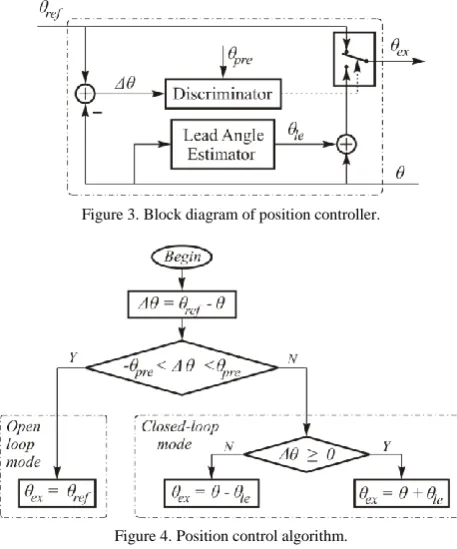
For stepper motor drivers, an appropriate excitation angle is required to generate the highest produced torque for a stepper motor by using a lead angle control technique [12]. Illustrated in Fig. 3 is a block diagram showing a position controller of the stepping motor driver
based on a lead angle technique. The discriminator is employed to generate a switching signal for either open-loop mode or closed-open-loop mode, depending on the position error
, a difference between the referenceequal to, the predetermined value
pre. Moreover, the lead angle
le computation is designed based on the motor parameters (R L V
, , ,
andK
t), the motor speed
and the phase currentsi
a b, . The detail of the position control algorithm is shown in Fig. 4. When the positionerror
is less than the predetermined value
pre, the position controller is operated in the open-loop control mode, and the excitation angle
ex is set to the reference position
ref. Otherwise, when the position error
is greater than, or equal to, the predetermined value
pre, the position controller is operated in the closed-loop mode based on a lead angle control technique that generates the highest produced torque. In this mode, theexcitation angle
ex is a sum of the lead angle
le and the feedback position
.
By using the proposed position control approach, two significant advantages are obtained in comparison with using only the open-loop control method. Firstly, the vibration phenomenon, when the motor is stopped, is overcome. Secondly, the step-out problem, when the motor is rotating, is prevented, especially at high speed and with a varied load torque.Figure 3. Block diagram of position controller.
Figure 4. Position control algorithm.
In this study, the calculation of the lead angle, which is presented in [12], was implemented in order to perform the closed-loop stepping motor driver. At steady state, assuming that sL0 (s is Laplace operator), the electrical equations in (3) can be approximated as follows:
=
,
=
.
d d q
q q d t
v
Ri
Li
v
Ri
Li
K
(6)When the motor is operated in closed-loop mode, the excitation mirco-stepping inputs, in phase A and phase B,
are derived from (4) by replacing
ex for
ref.,
,
=
cos(
),
=
sin(
),
a ex ex
b ex ex
v
V
v
V
(7) And combining with (2), we obtain=
cos(
),
=
sin(
),
d le
q le
v
V
v
V
(8)where
le=
ex
is defined as a lead angle (or load angle).From (6) and (8) the current
i
q is obtained as2 2 2
(
le)
(
le)
tq
VRsin
V Lcos
RK
i
R
L
(9)Moreover, the produced motor torque
T
m is proportional toi
q(
T
m=
K i
t q)
in (3). Thus, from (9), an equation (10) expressing a lead angle
le is obtained.1 1
1 1
tan (
)
sin (
)
tan (
)
sin (
),
,
m t
le
t
q t
atan asin
ZT
R K
L
R
K V
ZV
Zi
R K
L
R
V
ZV
(10)
where atan
tan (
1L
)
R
and
1
sin (
).
asin
m t
t
ZT
R K
K V
ZV
2 2=
(
)
Z
R
L
is the total impedance of the winding of the motor. In (10), theparameters,
L
,R
,K
t,andV
, are given values. The calculation of the led angle is complex by using (10) and it is therefore not effective in implementation. An approximation technique is applied to estimate the lead angle in this study. As can be seen in (10), the lead angleconsists of two terms atanand asin.In which, the term atan
is rapidly increased to 90o
when the stepper motor
speed is increased. So this term is assumed to be a
constant value of 90o. Now, the approximation is applied for only the second term asin. Because the produced motor torque is proportional to the current
i
q, which is the amplitudeI
maxof the reference phase currents, ,
(
i
a ref,i
b ref),i
q is assumed to be a maximal value of 2 A to generate the highest motor torque. As can be seen inFig. 5, which shows the angle asin in relation with the operating mechanical motor speed
m
/
N
r, the angle asin can be expressed asif
( )
84
90
84
m
asin o
m
f
(11)When the mechanical motor speed
m is in the range of [0 84 rad/s], by using System Identification Toolbox ofMATLAB, the function asin
f
(
m)
is approximated, in the discrete-time domain, with the sampling time0.25
a
T
ms, as follows:asin
k
mk
asink
(12)By using the proposed method, the highest motor torque is produced over the whole operating motor speed range. Therefore, the stepping motor can be effectively controlled, not only to a high speed region but also with varied load torque, without step-out. That will be demonstrated in Section IV.
Figure 5. The angle
asin f(
m).IV. EXPERIMENTAL RESULTS
A. Implementation
Fig. 1 shows the entire stepper motor control system, and Fig. 6 shows the corresponding experimental setup of the hybrid stepper motor control system. The EzM-56L two-phase hybrid stepper motor, manufactured by Fastech Co., was used in the experiments: The rated voltage (V) is 40 Vdc, the rated phase current (I) is 2 A, the phase resistance (R) is 2.3 , the phase inductance (L) is 7.35 mH, the torque constant (
K
t) is 0.083 N∙m/A, the rotor inertia (J) is 0.269∙104N∙m∙s /rad, the damping 2 coefficient (D) is 0.0013 N∙m∙s/rad, the number of rotorteeth (
N
r) is 50, and the load torque (T
l) is 0.029 N∙m. The motor is fed by two H-bridges (one for each phase) using a 40-Vdc bus. The experimental tests were performed by applying an 40-kHz switching frequency for the power MOSFET used for the H-bridges. A digital control board, based on the DSP TMS320F2811 (Texas Instruments), was employed to implement the proposedcontrol algorithm with a sampling interval (
T
s) of 25 s. The resolution of micro-stepping technique driving the motor is 10000 pulses per revolution. The rotor position measurement was provided by a 2500-lines-per revolution. Quadrature signals were used to obtain 4x resolution. This results in 10000 pulses per revolution ofthe resolution of the encoder. The phase currents were measured using shunt resistances of the PWM motor driver.
Figure 6. Experimental setup of the hybrid stepper motor.
B. Experimental Results
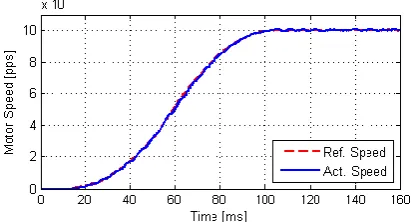
First, an experiment was performed with the stepper motor operating normally to demonstrate the lead angle value in relation with the actual motor speed. Fig. 7 shows the motor speeds and Fig. 8 shows the motor position error and the lead angle, which corresponds the motor speed shown in Fig. 7. Fig. 7 demonstrates that the actual motor speed tracks the reference motor speed well. The motor position error and the lead angle, shown in Fig. 8, increase proportionally following the increase of the motor speed, shown in Fig. 7. When the motor speed reaches about 100000 pps, the motor position error is approximately 210 pulses and the lead angle value is
about 160 .o The maximum lead angle value 180o is obtained when the motor speed is above 140000 pps.
Figure 7. The motor speeds when the motor operates normally.
Figure 8. The motor position and Lead angle.
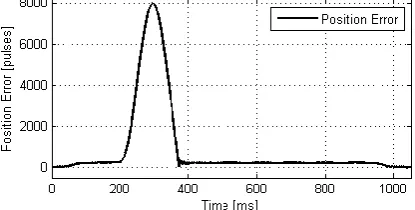
Next, the closed-loop position control performance
was tested with the predetermined angle value
pre in Fig.if
4 set to a value of 90o (one step). Fig. 9 shows the reference and actual motor speeds and Fig. 10 shows the corresponding motor position error when a loss of the motor speed synchronization occurs. It can be clearly seen in Fig. 9 that at the time about 200 ms, an external torque is applied to hold the rotor in about 50 ms. Then, at the time about 250 ms, the external torque is removed and the rotor is therefore released to continue rotating. After this time point, the rotor speed increases rapidly and reaches a maximal of 122000 pps at the time of about 380 ms, and then settles down to the reference speed 100000 pps at the time 400 ms. During the loss of motor speed synchronization (200 to 400 ms), the motor position error increases rapidly up to 8000 pulses (around one round) and then reduces to a small value at the end of the loss of motor speed synchronization as shown in Fig. 10. This indicates that the loss of motor speed synchronization is overcome and the actual motor speed continues tracking the reference motor speed well. This demonstrates that the motor speed is recovered effectively by using the proposed position control approach. The motor can operate at high speed and with varied load torque without step-out.
Figure 9. The motor speeds when loosing step problem occurs.
Figure 10. The motor position error.
V. CONCLUSION
This paper proposed a closed-loop stepper motor driver based on the lead angle estimation method. The lead angel value was adjusted by considering the motor speed to obtain the highest produced motor torque. Therefore, the driver could avoid the step-out problem when the motor is operating at high speed and with the varied load torque, which keeps the motor operating accurately and smoothly. The effectiveness of the proposed control algorithm is demonstrated by the experimental results,
which indicated that the motor speed was recovered effectively in the short time of motor position error. In the future, damping methods may be feasible to be considered to upgrade the stepper motor driver.
REFERENCES
[1] K. M. Le, H. V. Hung, and J. W. Jeon, “An advanced closed-loop control to improve the performance of hybrid stepper motors,”
IEEE Transactions on Power Electronics, vol. 32, no. 9, pp. 7244-7255, Sep. 2017.
[2] Y. Lee, D. Shin, W. Kim, and C. C. Chung, “Proximate in-phase current estimator to reduce torque ripple in permanent-magnet stepping motor,” IEEE Transactions on Industrial Electronics, vol. 63, no. 3, pp. 1707-1716, Mar. 2016.
[3] S. Derammelaere, F. Verbelen, and K. Stockman, “Open loop control of a stepping motor with step loss detection and stall detection using back-EMF based load angle estimation,” in Proc. IEEE/ASME International Conf. on Advanced Intelligent Mechatronics, Jul. 2014, pp. 788-793.
[4] P. Sousa, S. Valtchev, M. V. Neves, and A. L. Rodrigues, “A new open-loop control method for stepping motor driving,” in Proc. International Conf. on Power Engineering, Energy and Electrical Drives, Mar. 2009, pp. 605-610.
[5] N. Q. Le and J. W. Jeon, “An open-loop stepper motor driver based on FPGA,” in Proc. International Conf. on Control, Automation and Systems, Oct. 2007, pp. 1322-1326.
[6] S. Manea, “Stepper motor control with dsPIC DSCs,” Tech. Rep. AN1307, Microchip Technology Inc., Chandler, AZ, 2009. [7] J. B. Grimbleby, “A simple algorithm for closed-loop control of
stepping motors,” IEE Proc. on Electronic Power Application, vol. 142, no. 1, pp. 5-13, 1995.
[8] P. Crnosija, B. Kuzmanovic, and S. Ajdukovic, “Microcomputer implementation of optimal algorithms for closed-loop control of hybrid stepper motor drives,” IEEE Transactions on Industrial Electronics, vol. 47, no. 6, pp. 1319-1325, Dec. 2000.
[9] S. Bifaretti, V. Iacovone, A. Rocchi, P. Tomei, and C. M. Verrelli, “Global learning position controls for permanent-magnet step motors,” IEEE Transactions on Industrial Electronics, vol. 58, no. 10, pp. 4654-4663, Oct. 2011.
[10] S. Derammelaere, C. Debruyne, F. D. Belie, K. Stockman, and L. Vandevelde, “Load angle estimation for two-phase hybrid stepping motors,” IET Electric Power Applications, vol. 8, no. 7, pp. 257-266, Mar. 2014.
[11] A. Hoda and K. Abe, “Control apparatus for position control motor,” U.S. Patent No. 6 121 744, Sep. 19, 2000.
[12] A. Takemori, Y. Kuwano, Y. Takahashi, and H. Taka, “Stepping motor driver,” U.S. Patent No. 6 850 026, Feb. 1, 2005.
[13] S. Derammelaere, et al., “The efficience of hybrid stepping motors: Analyzing the impact of control algorithms,” IEEE Industrial Application Magazine, vol. 20, no. 4, pp. 50-60, Jul./Aug. 2014. [14] W. Kim, D. Shin, and C. C. Chung, “Microstepping using a
disturbance observer and a variable structure controller for permanent-magnet stepper motors,” IEEE Transactions on Industrial Electronics, vol. 60, no. 7, pp. 2689-2699, Jul. 2013. [15] G. Baluta, “Microstepping mode for stepper motor control,” in
Proc. International Symposium on Signals, Circuits and Systems, Jul. 2007.
Kien Minh Le received the B.S. degree in
electrical engineering from Hanoi University of Science and Technology, Hanoi, Vietnam, in 2006; the M.S. degree in automation from Le Quy Don Technical University, Hanoi, Vietnam, in 2011; and the Ph.D. degree in electronics and electrical engineering from Sungkyunkwan University, Suwon, South Korea, in 2017.
Khoa Dang Truong received the B.S. and M.S. degrees in electrical engineering from Le Quy Don Technical University, Hanoi, Vietnam, in 1989 and 1999, respectively, and the Ph.D. degree in electronics and electrical engineering from Bauman Moscow State Technical University, Moscow, Russia, in 2004.