www.ijsernet.org Page 58
WEB-BASED LEARNING ENVIRONMENTS AS AN ENHANCING
AGENT TO SUPPORT UNIVERSITY-LEVEL STUDENTS
SELF-REGULATED LEARNING (SRL) STRATEGIES
Ali Ayed Alshahrani, Saud Ayed Alshahrani
College of Arts1, College of Educaton2, University of Bisha1’2, Bisha, Saudi Arabia,
ABSTRACT
This study investigates the influence of using a Web-Based Learning Environment as an enhancing agent to support university-level students self- regulated learning (SRL) strategies as they work through their learning process. The aim was to help them adopt a consistent approach to their learning practice (self-regulation), to foster a realistic appraisal of their metacognitive strategies strengths and weaknesses (self-judgment), and to examine the relationship between self-initiated processes and students’ overall performance. The study adopted Zimmerman and Tsikalas [1] computer-based learning environments self-regulation three-phase model as a basis for Self-Regulated Learning in e- portfolio courses. Using a non-equivalent pre-/post- test quasi-experimental research design, 127 male students from King Khalid university departments of Mathematics (51 students) and English Language (76 students) were recruited during the first semester of 2012 academic year. A mixed methodology was used consisting of an online questionnaire, artifacts, online tracking data, and interviews in order to collect relevant data. These findings suggest that e-portfolio software, by facilitating both working on tasks, and the provision of regular peer and teacher feedback on tasks, has the potential to encourage a significant improvement in students SRL and metacognitive strategies as well as their performance.
1. Introduction
There is a revolution in the number of Internet users, providers, and applications, which have continuously grown to make the Internet the main conduit for information. This altered traditional computer-assisted language learning from language learning software and CD-ROMs to web-based applications [2] [3].
www.ijsernet.org Page 59
demand for 21st century Integrative CAL software that promotes the learners’ authorship, facilitates interactions with peers, teachers, and external audiences outside the classroom to promote and enhance adaption of self-regulated learning strategies. That is, the new LMSs should be designed based on the view of learners’ centrality in the learning paradigm that entails adopting social networking interaction applications that encourage the active involvement of the learner in an array of learning activities and technological interaction patterns [6]. Researchers have examined the new web-based applications such as wikis, blogs, RSS, and electronic portfolios, which may satisfy the emerging integrative Computer Aided Learning (CAL) view of the learning process where the learners are at the epicenter [7]. Web-based application software is sought that empowers students to actively define their learning needs and develop their proficiency at their own pace through the stages of the learning process. In other words, researchers are looking for new tools that encourage learner to adapt and develop self-regulated learning strategies and equip them with the technology to include various multimedia components so as to allow learners to collect and organize artifacts in many formats, with multiple presentations of the same evidence of learning achievement which learners can reflect [8].
2. Purpose of the Study and Research Questions
This study investigates the influence of using a web-based learning environment (TaskStream e- portfolio) as an enhancing agent to support university- level students self-regulated learning (SRL) strategies as they work through their learning process. This study aims to help students to:
1. Adopt a consistent approach to their learning practice (self-regulation),
2. Foster a realistic appraisal of their metacognitive strategies strengths and weaknesses (self-judgment), and
3. Examine the relationship between self- Regulated Learning strategies and students’ performance.
In order to investigate this purpose, the research sought to answer the following research questions:
1) Does using a WBLE platform encourage students to consistently apply SRL strategies?
2) Does using a WBLE platform lead to a change in students overall performance?
3. Study Design
www.ijsernet.org Page 60 during the first semester of 2011-2012 academic year. The participants were registered in an English writing and 102 mathematic courses. The courses met three hours per week for 14 weeks. Students were randomly assigned into a control group (65 students) and 62 in the experimental group.
The choice of the methodology design was centered on the purpose of the investigation. Therefore, this study adopted an embedded mixed methods design to collect multiple data using different strategies, approaches, and methods, in such a way that enabled the researchers to conduct an experiment (quantitative), and within that experiment, collect qualitative data that provided information as to how the participants experienced the intervention [9]. A mixed methodology was used consisting of an online questionnaire, artifacts, online tracking data, and Interviews. The resulting mixture or combination of data findings provided more detail as a means of achieving an elaborate and comprehensive understanding of the complex phenomenon by illustrating, clarifying, or elaborating certain aspects ( [10] [11].
4. Data Collection Methods
Due to the various methods used in this study, data were collected during different periods of the semester. During the first week, participants completed an online pre-test questionnaire. They then submitted their first artifacts at the beginning of the six week. Six participants agreed to be interviewed and data were collected during the seventh week. During the thirteenth week, participants submitted their second artifacts to be evaluated as their post-test sample, and the second set of interview data were collected from the six participants during the fourteenth week. During the last week of the study, participants were asked to complete an online post- test questionnaire. Quantitative data from the questionnaire and online tracking data were analyzed using the Mann-Whitney U test for non-parametric data, and t-test for parametric data.
5. Findings
A statistical analysis of the pre-intervention test using the Mann-Whitney U statistic shows no significant differences in the consistency with which learners in the conventional and e-portfolio groups claimed to apply SRL strategies. The post- implementation test findings (seeTable 1) indicate a significant difference in the participants’ consistency in applying the SRL strategies between the conventional (mdn = 18.2) and eportfolio (mdn = 26) groups (U = 152, Z = 1.946, P = 0.029).
Table 1. Mann-Whitney U Test for the e-portfolio group SRL strategies
Z-value Asymp. Sig.
Define Goals
-1.946 .052
Plan Tasks
www.ijsernet.org Page 61
Performing Phase
-0.587 .557 Monitoring phase
-2.117 .034* Seeking Feedback
-2.012 .044*
Making Change
-.945 .345
* Significant at the 5% level (p <0.05)
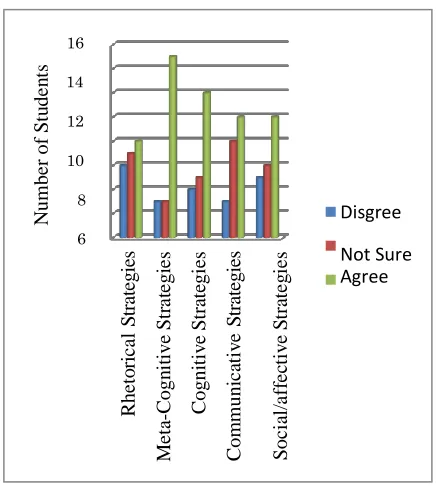
The results indicated that learners in the e- portfolio group used meta-cognitive strategies while performing their tasks, followed by cognitive and then communicative strategies. Social/affective strategies and then rhetorical strategies were the least frequently used (see Figure 1).
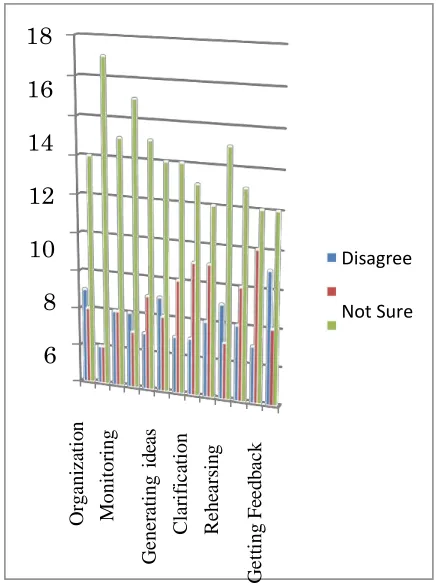
www.ijsernet.org Page 62 A further analysis of the meta-cognitive strategies indicated that Planning strategies are the most used, evaluation and monitoring follow respectively. Figure 2 also indicated that Cognitive strategies of revision, elaboration and Rhetorical strategy of organization are among the highly used strategies with the organization strategy.
Figure 2. E-portfolio students’ use of specific SRL strategies
Data generated from students’ use of TaskStream reveal an increase in the number of interaction between students in the form of postings of questions and the replies during the intervention period as represented in Figure 3.
www.ijsernet.org Page 63 Figure 3.Students’ questions and replies weekly statistics
The findings in Table 4.15 show that the correlation between performance and the SRL is very strong (r = .823, p = .0001 and n = 43).
Table 2. Correlation Analyses of the Post - Intervention Test Data
Spearman's rho
Writing
performance SRL
Writing performance (post-test)
Correlation
Coefficient 1.000
Sig. (2-tailed)
.
SRL Correlation
Coefficient .823(*) 1.000
Sig. (2-tailed)
.000 .
*Correlation is significant at the P<0.01 level (2 tailed).
6 Discussion
Week 14
Week 13
Week 12
Week 11
Week 10
Week 9
Week 8
Week 7
Week 6
Week 5
Week 4
Week 3
Week 2
Week 1 0 2
2 6
11 14 9
28
13
15 20
18 36
9 16 18 21
11 27
8 14 23
3 6 8
17
15
0 10
Replies 20
Question s
30 40
www.ijsernet.org Page 64 The results concerning the students’ self- consistency in the learning process before the intervention and the first interview session indicated no significant differences between the two groups. Students’ lack of sufficient knowledge SRL strategies, explain how intermittently they take sufficient time to plan their learning goals, and infrequently used strategies to monitor and evaluate their performance.
The analysis of the post-implementation data revealed significant increases among students in the eportfolio group in levels of self-consistency in applying the SRL strategies. In the forethought phase of self-consistency, enhancements were observed in the planning strategies (0.013) and to some extent to in their defining the learning task goals (0.052). This change can be attributed to feedback from teachers and peers encouraging them to use various planning strategies while working together online in their collaborative groups.
No noteworthy differences between the participants in both groups were noted in the performing phase. Despite this, the data analysis shows an improvement in performance among the eportfolio group participants. This improvement could be due to the increased use of e-portfolio features to access the resources section. Feedback from the teacher and peers assisted students in noticing weaknesses in their performance in terms of the clarity of meaning.
Enhancements were also observed in seeking help and feedback, self-monitoring, evaluation, and making changes (revision). TaskStream’s collaborative working features enabled immediate and synchronous interaction between the students and their external reviewers for receiving feedback. TaskStream’s comments and asynchronous features provided extra conduits for getting feedback from other students outside the student’s small peer reviewing group. Taskstream also allowed the students to send links of their work to others who had no access to the platform to review their work, and add further comments in the spaces provided. These features encouraged learners to ask for feedback, as revealed by the increase in the use of these features by participants.
The findings presented in Table 2 show a strong positive relationship between performance and the SRL strategies (0.823). These findings give an overall view of the impact of the TaskStream e-portfolio as a personal developmental learning tool, which enhances knowledge and understanding, and increases students’ self-awareness.
7.Conclusion
e-www.ijsernet.org Page 65 portfolio courses. Using a non-equivalent pre-/post-test quasi-experimental research design, 127 male students from King Khalid university departments of Mathematics (51 students) and English Language (76 students) were recruited during the first semester of 2012 academic year. A mixed methodology was used consisting of an online questionnaire, artifacts, online tracking data, and interviews in order to collect relevant data. These findings suggest that e-portfolio software, by facilitating both working on tasks, and the provision of regular peer and teacher feedback on tasks, has the potential to encourage a significant improvement in students SRL and metacognitive strategies as well as their performance.
Implications for practice
Based on these results, the implications of this research concern three issues: learners, instructors, and institutions.
8.1 Learners
• Learners can use e-portfolios to organize their learning by identifying their actual academic knowledge and the skills they have already learned and the new skills they aspire to learn.
• E-portfolios provide a means for students to control their learning by setting their own learning goals and the time line within which these goals are achieved at their own pace.
• E-portfolios provide a means for students to present and develop their identity in a social context to engage with a wider environment through interaction with their teachers, peers, and external reviewers and evaluators who provide feedback on their learning.
• E-portfolios provide more scaffolding for learners and broaden their understanding of audiences.
• E-portfolios record learners’ academic development, and their strengths and weaknesses about academic knowledge and skills development. This promotes their monitoring and evaluation of their progress and their metacognitive skills.
• E-portfolios allow learners to share, interrelate, collaborate and scaffold each other while learning, which enable them in constructing meaning from information, and giving better understanding, and then subsequently transforming it into knowledge.
8.2 Instructors
www.ijsernet.org Page 66 • This information permits instructors to gain better understanding of the students’ motivational constructs. This would help in using explicit instruction and a careful selection of e-portfolio assignments, to enhance deeper learning and increase teaching effectiveness.
• Instructors should update the curricula and assessment methods used to include the students’ use of e-portfolio in graded tasks.
• E-portfolios enable instructors to view, track, and evaluate learners’ progress from a single web-based portfolio.
8. 3 Institutions
• In the development of practice with e- portfolios, faculty and administrators must have agreed upon goals, intentions, and implementation strategies to enrich learning opportunities.
• E-portfolios should focus on a limited set of aims and skills that are appropriate for each level of the language programme since the use of e-portfolios will probably increase the length of time required to cover the curriculum.
9. Limitations of the study
The limitations of this study include the fact that the number of the participating students was modest. A larger sample would be more representative of the student populations with more heterogeneous English Language learning experiences. The small number of participants makes it difficult to generalize the findings of this study to the overall context. These results provide exciting preliminary evidence related to those original research questions that it is hoped would encourage researchers in the field to pursue further research into e-portfolio practices in the learning contexts.
10. Future Research Directions
Future research could be directed towards using e-portfolios as learning tools in language learning classes to:
• Explore in depth how new types of social learning and self-regulation learning based portfolios affect how students learn in comparison to available commercial and open source e-portfolios.
• Carry out longitudinal research to evaluate changes in perceptions and performance in a larger population of Learners in Baccalaureate degree programme who are unfamiliar with e-portfolio tools. This would provide additional important insights into e-portfolio practices in the learning contexts.
www.ijsernet.org Page 67 • Investigate the System Initiate Coaching feature. This e-portfolio software monitors the learners’ learning patterns and lengths of pauses, then automatically provides hints when learners may not even realise that they need help.
• Explore how e-portfolio tools affect perceptions of the students’ and instructors about their roles in the learning process and the teaching-learning relationship.
• Investigate the user-friendliness of web- based portfolios and address the time constraints.
11. Reference
[1] B. j. Zimmerman and K. E. Tsikalas, "Can computer-based learning
environments(CBLEs) be used as self- regulatory tools to enhance learning?," Educational Psychologist, no. 40, pp. 267-271., 2005.
[2] M. Chang, "Enhancing web-based language learning through self-monitoring," Journal of
Computer Assisted Learning, vol. 23, no. 3, pp. 187-196, 2007.
[3] J. R. Hil, L. Song and R. E. West, "Social Learning Theory and Web-Based Learning Environments: A Review of Research and Discussion of Implications," American Journal of Distance Education, vol. 23, no. 2, pp. 88- 103, 2009.
[4] N. Garrett, B. Thoms, N. Alrushiedat and T. Ryan, "Social ePortfolios as the new course management system," On the Horizon, vol. 17, no. 3, pp. 197-207, 2009.
[5] J. Brine and M. Franken, "Students’ perceptions of a selected aspect of a computermediated academic writing program: An activity theory analysis," Australian Journal of Educational Technology, vol. 21, no. 1, pp. 21-38, 2006.
[6] B. Bannan-Ritland, "Computer-mediated communication, elearning, and interactivity: a review of the research," The Quarterly Review of Distance Education, vol. 3, no. 2, p. 161– 179, 2002.
[7] A. Jafari and C. Kaufman, Handbook of research on eportfolios, London: Idea Group, 2006.
[8] L. Stefan, R. Mason and c. Pegler, The educational potential of e-portfolios: Supporting personal development and reflective learning, Oxen: Routledge, 2007.
[9] J. W. Creswell, Educational research: Planning, conducting, and evaluating quantitative and qualitative research, 3rd ed., Upper Saddle River, NJ: Pearson/Merrill Prentice Hall, 2008.
www.ijsernet.org Page 68 [11] M. Sandelowski, "Tables or tableaux? The challenges of writing and reading mixed methods studies," in Handbook of mixed methods in social & behavioral research, Thousand Oaks, California: Sage, 2003, pp. 321-350.
[12] B. J. Zimmerman and R. Risemberg , "Self - regulatory dimensions of academic learning and motivation, in "Handbook of academic learning Construction of knowledge , San Diego, CA,