Development Application of Academic Information System (AIS)
to Manage Users
’
Activities (Case Study: University XYZ)
SulisSandiwarno
Faculty of Computer Science,UniversitasMercuBuana, Indonesia Jl. Meruya Selatan 1 No. 1, Kembangan, 11650, Indonesia
---
************************
---Abstract:
Entering the information age, where information and technology grow and develop affects human life. Academic Information System is the result of the use of information technology that has been applied in a university. At present there are still many universities that still do not use the student data processing system, this causes the university to experience difficulties in processing student data in the form of grades. Based on the problems that exist, it would be better if the system was made in a computerized manner such as an academic information system. The computerized system is made in order to support the teaching process at the university, and to facilitate the entire academic community in managing the data needed. The objectives of this study are divided into three parts: modeling system, testing system and implementation system. The result of the research that has been done is to make this system an alternative in processing all student data at the university.
Keywords:academic information system, information technology, users’ activities
---
************************
---I. INTRODUCTION
The development of information technology supports all roles in everyday life, where the use of good information technology will make good results too(Indrayani, 2013). Technology is a process that increases added value, the process uses or produces a product, the product produced is not separate from other existing products, and therefore becomes an integral part of a system(Zaid & Lau, 2014). Management of the academic field becomes a very complex problem if it is only handled manually. For that computer is one of the information systems that are part of a technological development that can support performance efficiency. The University is an institution that has applied information technology to support the exchange of information in daily life. The use of information technology is an example in the processing of student data. Currently in the
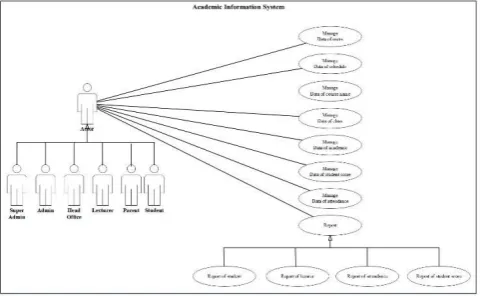
processing of student data still requires development. This causes difficult, slow and less efficient in controlling or searching for student data, seeing that the academic administration system at the university should be made by utilizing information technology media, so that it can facilitate the academic community who wants to know the data more efficiently. The use of information technology is called the Academic Information System (SIA). In the SIA supports several activities that can be done by the academic community, such as the management of lecturer data, student data, value data, student attendance, lecture schedule. But if only SIA is not enough, because a good education system is made by involving other actors outside the academic community such as parents. Parents of students can monitor activities carried out by their children who are studying at the university. So, it is expected that with this SIA, parents can also see the results of learning done by their children.
IJCT 2. RELATEDWORK
Information is data that has been classified or processed or interpreted to be used in the decision-making process. Information processing systems will process data into information or process data from useless forms to be useful for those who receive it. Value of information related to decisions. If there is no choice or decision, then information is not needed. An Information System is an output created by utilizing computer technology to provide more value to a company to increase profits(Abishov, Asan, Kanat, & Erkisheva, 2014;
Köylüoğlu, Duman, & Bedük, 2015). If a company
wants to advance, then the use of information systems must be optimal. Because the information system is the main key in winning a competitive competition today (Chvatalova & Koch, 2015, Raka-Gilang, 2016, Fajar et al, 2012). The use of this information technology is based, this web-based goal is because there is no time and place limit(Pinho, Franco, & Mendes, 2018, Andi, 2016).Academic Information System is a resource for everything in the form of information that has to do with academic problems at school. Academic Information System is a system designed for the needs of managing Academic data with the application of computer technology both 'hardware' and 'software'. This AIS provides several academic services such as: registering new students and old students, inputting student data and inputting lecturer and student data into the database, attending student absences and assessing student learning outcomes.
3. ANALYSISANDDESIGN
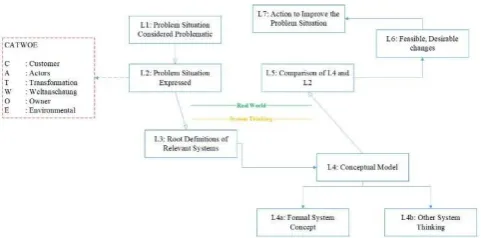
This study uses the DSAD (Development Soft Analysis Design) method where this method combines two methods, namely SSM (Soft System Methodology) and SDLC (System Development Life Cycle).
Fig 1. Conceptual Model of DSAD
SSM is a method used to compare a situation, current situation and future circumstances. From the current state (real world) there are several stages such as L1, L2, L5, L6 and L7. Whereas in the future situation (system thinking) there are several stages such as L3, L4, L4a and L4b.
1. Problem Situation Considered Problematic
In this section will be explained about the problems that occur, there are reasons why anAIS must be built. This reason is because in the university wants to make a system for managing academic data. By building this information system model, it will be easier for university to see the data record of students.
Fig 2. Problem Situation
2. Root Definitions
Explain an activity consisting of several parts called CATWOE (Customer, Actors, Transformation, Welthacuung, Owner and Environmental). This section will be connected to each other, which is to see the relationship between L1 and L2. Before entering into stage L4, L3 will see whether the problem has been explained in detail or not in L1 and L2, if it is then it will go into stage L4. If the problem is not finished, it will return to L1 and L2 until the problem is explained in detail.
IJCT After L3 is explained in detail, the next step is to enter into L4, that is in this section a model that will be adapted to the existing problem will be made. The development of this model consists of two parts, namely: Formal System Concept (a) and Other System Thinking (b). In the Formal System Thinking it is explained that the system model that will be made has been adapted to the needs of the user, and the Thinking Other System is explained that the system model that will be made can be added with other features so that it will make it easier for users to use the system.
Fig 3. Use case diagram of academic information system
4. Action to Improve the Problem Situation
At this stage, the final part in determining the system will be built or not, because if the L1-L4 process of the user agrees, the steps in L5-L7 can be done. The L5-L7 stage is to build a system that can facilitate users in using the system. The system that is built must be in accordance with the needs of the users.
4. TESTINGANDIMPLEMENTATION
The implementation and testing phase of the system is carried out after the analysis and design phase is completed. In this section we will explain the implementation of a system application that uses several functions that the author makes consists of the implementation environment, coding, and interfaces of the system application.
Fig 4. Login users
The login view provides information that, every actor has access to log in if they are registered in the system. If the username and password are entered correctly, the actor will enter the system, if the username and password are wrong then the actor will return to enter the username and
password again.
Fig 5. Home of super admin
Fig 6. Schedule of super admin
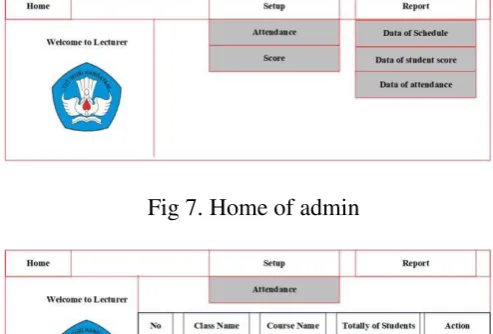
IJCT Fig 7. Home of admin
Fig 8. Lecturer input attendance
Fig 9. Lecturer input score
Fig 10. Parent check schedule
5.CONCLUSION
Based on the descriptions that have been explained, there can be a conclusion that can be used to overcome the problem. The solution used is computerizing the system using the website. By using computer media and using the website in providing unlimited information.
a. The design of academic information systems
is made with the aim that the academic community at the university can access easily and efficiently. The presentation of school information which includes grades, absences and student data, is presented in the form of databases that can be updated by administrators ranging from input values, input student absences, to subjects
b. With this website the school can minimize
the use of paper because the data collection in the administrator is done in a computerized system.
References:
Abishov, N., Asan, D., Kanat, A., & Erkisheva, Z. (2014). Development of an Automated Information System University Management. Procedia - Social and Behavioral Sciences. https://doi.org/10.1016/j.sbspro.2014.07.434
Andi Nugroho. (2016). Aplikasi Web Informasi Dan RegistrasiPeserta Seminar, Workshop, Talkshow Pada Acara Seminar NasionalPengamplikasianTelematika (Sinaptika) Tahun 2016. Seminar NasionalSistemInformasi Indonesia, 1-8.
Chvatalova, Z., & Koch, M. (2015). Optimizing of Information Systems in Companies: Support of Sustainable Performance. Procedia - Social and Behavioral Sciences. https://doi.org/10.1016/j.sbspro.2015.11.488
Fajar Masya1, Elvina2, Fitri Maria Simanjuntak3. (2012). SistemPelayananPengaduan Masyarakat pada DivisiHUMAS POLRI Berbasis Web. Seminar NasionalAplikasiTeknologiInformasi, 1-6.
Indrayani, E. (2013). Management of Academic Information System (AIS) at Higher Education in the City of Bandung. Procedia - Social and Behavioral Sciences. https://doi.org/10.1016/j.sbspro.2013.10.381
Köylüoğlu, A. S., Duman, L., & Bedük, A. (2015). Information Systems in Globalization Process and Their Reflections in Education. Procedia - Social and Behavioral Sciences. https://doi.org/10.1016/j.sbspro.2015.04.610
IJCT
International Journal of Information Management. https://doi.org/10.1016/j.ijinfomgt.2018.04.002
Raka Yusuf1, GilangWidi Darmawan2. (2016).
AplikasiBerbasis Web
DenganMenggunakanPustakaJavascriptFabricjsUntukPe mbuatanKomik Strip Punakawan. Seminar NasionalTeknologiInformasi dan Multimedia, STMIK AMIKOM Yogyakarta, 1-6.