Research on Topology Control Algorithm for
Large-scale Wireless Sensor Networks
Min Jin
Electronics and Computer Science College, Zhejiang Wanli University , Ningbo ,China.
ABSTRACT
Aimed at the application characteristics of the large-scale WSN, a new 3 layers topology architecture is proposed in this paper. As well as, we propose an algorithm to discovery and label the bottleneck-nodes of the top-layer is brought up. The simulation experiment indicated that the algorithm for eliminate bottleneck-node can balance the overall communication load, control the key-level communication energy consumption, and improve the monitoring network robustness.
Keywords: large-scale WSN, topology control, bottleneck node.
I. INTRODUCTION
In recent years, with the development of WSN (Wireless Sensor Network) , the application of the large-scale WSN began to appear, such as the large regional environmental monitoring, river valley ecosystem supervising and controlling, remote atmospheric monitoring, etc.. Comparing With small-scale WSN, which has only several ten sensor nodes and overlay radius at several ten meters to ascend 100 meters , large-scale WSN has several important characteristics, such as a wide degree of node to distribute, broad covering, many sinks being in conjunction with a work, complications of the data communication and higher request to balance the overall energy load, etc.
Topology architecture for WSN is in close relation to energy consumption of communication. Under the large-scale WSN environment, because of nodal point type complications, wide distribute, long distance and wide influence, topology architecture for the network has the characteristics of unsteady and inconstancy. The algorithm for the existing topology architecture needs to carry on an adaptability improvement.[1] In chapter 2, need for topology architecture for large-scale WSN is discussed. In Chapter 3, a kind of 3 layers topology control architecture for large-scale WSN is presented, and strategy for data communication is analyzed, and a set of algorithms to bottleneck-nodes for the top layer of topology control for large-scale WSN is presented.
At present, the topology controls of WSN may divide into two broad headings, namely: Energy control of plane node and level topology architecture. In the energy control aspect, a series of algorithm has been proposed, such as COMPOW and so on based on energy distribution, LINT/LILT and LMN/LMA and so on based on node density algorithm, CBTC, LMST, RNG, DRNG and DLSS and so on based on approach the chart the approximate algorithm. In the level topology control aspect, a series of algorithm has been proposed, such as LEACH and HEED and so on based on self organizing clustering algorithm, the improvement GAF hypothesized geography grid clustering algorithm as well as Top Disc clustering algorithm and so on.[2]
For a large regional coverage and many sink collaboration WSN, Energy control of plane node and level topology architecture can‘t directly use. Concrete causes presented below:
1. In accordance with their respective sensor node clustering region on the geographical distribution and traffic, a lot of sink nodes need load balance;
2. Different clustering cluster-head due to shoulder more communication relay task is also a need to better balance their traffic load of energy consumption;
3. Different levels of data communication, such as sensor node-cluster-head, cluster-head-sink, sink-base station, need to introduce a different topology control strategies.
4. From the main network lifetime this design elements into account, the base station-sink communications layer topology control is the key to global, you need to have a relatively complete topology control algorithm support, research bottlenecks node properties, design algorithms and strategies to identify and eliminate bottlenecks nodes to enhance the reliability of communication.
II. LARGE-SCALE WSN'S THREE-TIER TOPOLOGY AND TOP-TIER TOPOLOGY CONTROL A. Three-tier topology
According to the basic characteristics of communication object, the transport type and the data flow in the different communications layer of large-scale WSN, the entire monitoring network is divided into three-tier (as shown in Fig.2), namely: the top network (base stations and the sink), the second-level subdomains network (sink and region cluster-head) and the bottom cluster (cluster-head and sensor nodes).
Sk: Sink, CH: Cluster-Head, S:Sensor Fig.2 Three-tier topology of WSN
First level is top communication network level, which covers entire monitor region: This level is formed by the base stations and many sink nodes, the data communication occurs in monitor base station and many sink nodes, the transmission data comes from various sensing subfield and is gathered and processed by sink node. This is the entire monitor network key communication level, and the reliable request is higher. Second level is subfield monitoring network based on single sink: This level is formed by the sink node and the cluster-head nodes in cover division subfield. Sensing nodes in each division subfield further divides to monitor cluster (Cluster) by dynamic method. This level's data communication occurs between the sink node and each cluster-head, the data current capacity is ordinary. Third level is sensing node network, which covers single cluster of: This level corresponds a single cluster in a monitor subfield, formed by cluster-head node and sensing nodes in cluster. Similar with LEACH algorithm, each divided cluster uses the time rotation method to realize the cluster generation, a cluster-head election, the data communication and the cluster maintenance duty. This data communication occurs between a cluster-head node and other sensors.
protocol of route communication level by level. First, bottom network is one sensing node cluster, and is constituted by the single cluster-head node and member of the cluster . The sensing nodes can use classical protocol LEACH to send data to the cluster -head, namely according to the TDMA time slot, every member node transmits monitor data to the cluster-head node by the single-hop communication mode. Next, regarding second level network, because the entire monitor covers the region after the subfield division, the data communication question of the second level network(i.e. each subfield)has been localized into the tradition communication question, 'single sink + many clusters '. In the environment of large region covered by the large-scale WSN, geographic span of every 'single sink + many clusters ' in the subregioncan be quite large, so you can use improved cluster protocol proposed in Chapter 3, which is centralized dynamic Adaptive Routing Protocol based on the cluster-head minimum spanning tree, to solve the problems of data communication between sink and all cluster-head nodes. Finally, for top level network consisting of monitoring stations and the multiple sinks , because the base stations and sink nodes have greater storage capacity and more adequate electricity support than the generic sensor node, the layer routing protocol can use dynamic self-healing LTP protocol of WSN to enhance network robustness and extend lifetime.
B. Top Level Topology Control Algorithm Based no Debottlenecks Sink Node
In three-tier structure shown in Figure-5, the top network is a core layer of global communications. The reasons are listed below, first of all sink node is at the core of the monitoring network node and it hosts convergence and communication task of network core data, second, being different from demise of a small amount of sensor nodes will not lead to the the global impact, if any sink nodes at the top of the network is demise, it will result in the demise of the corresponding subfield monitoring network, and finally result in an overall impact on the entire monitoring network failure.
C. Bottleneck node of WSN
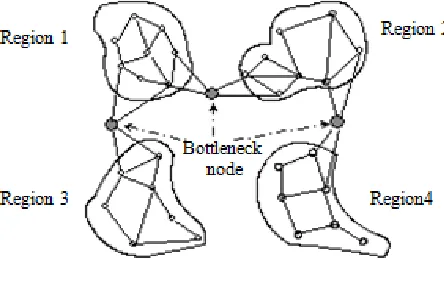
Typically, the bottleneck node of WSN may be defined as: In a random deployment of WSN, those minimum node due to its decline, the whole network was divided into two or more non-contiguous zones, and because of the convergence nodes of data collection and the node of monitoring target are not in the same region, causing the entire network lifetime end. How do I find the 'bottleneck node' is equivalent to how to find MCS in graph theory. If the base station or any one node in network can get topology information of the entire network, it can find the 'bottleneck node'[3] by Karger and Stein MINCUT algorithm. But in a real network, due to lack of network resources, to get the entire network topology infor-mation is very difficult, expensive or even impossible task [4].
Fig. 3 Bottleneck node
Through the observation we found that almost all the 'bottleneck node' have a common characteristic, that is their neighbor nodes can be divided into multiple disjoint node-set, when a node in one node-set needs to communicate with a node in other node-set, the 'bottleneck node' will be the only relay. Therefore, according to the characteristics to look for this kind of nodes, which have the similar characteristics with 'bottleneck node’, and refer to it as 'quasi-bottlenecks node.
D. Bottleneck Sink Node Determination Algorithm BNN-D
According to the characteristics, that the potential bottlenecks sink node's neighbor nodes can be divided into multiple disjoint node-set, the algorithm BNN-D() is designed to judge bottlenecks nodes, which is used to determine whether a node is the bottleneck node.
1. Put all neighboring nodes of judging node Si in collection SETB; 2. Select a node from SETB to put it in the collection SETA;
3. Check the remaining node in SETB node by node to see whether it is a neighbor node of a node in SETA. (1) If it is, put it in SETA; (2) Otherwise, select next node, go to step 3;
4. Repeat step 3 until each node in SETB is checked;
5. If SETB is empty, the Si is the bottleneck node; otherwise it is not.
E. Identification Algorithm of Bottleneck Sink Node BNN-L
Algorithm BNN-D solves a judgment problem wither a node is a bottleneck node, based on which you can use breadth-first search (BFS) to label the connecting region and bottlenecks node. Theory is as follow:
1. A randomly node Si is selected from all sensor node collection VN, calling function BNN-D (Si) to determine wither the node is a bottleneck node:
2. If it is, put it into the bottleneck node collection, and continue to select a different node, and go to step 1; 3. Otherwise if Si is not a bottleneck node, use the breadth-first search strategy;
4. Search the connected region which Si is at.(1) Put Si in node collection Vconpk in connected region Conpk, and put all neighbor nodes of the Si in query QUE; (2) The node in QUE calls function BNN-D () in turn to determine whether it is a bottleneck node: Regarding the bottleneck node, put it in the bottleneck node set, go to step (2); Regarding the non-bottleneck node, put it in Vconpk, and put this node's neighbor node in QUE; Repeat step (2), until QUE is empty; (3) Judge whether there haven’t been visited nodes in VN , if there have nodes, go to step 1, until VN is empty.
III. EXPERIMENTAL SIMULATION AND ANALYSIS A. Experimental Simulation
In view of the fact that simulation environment of the large-scale WSN based on three-tier topology is difficult to be established, the difficulty of experiment is too big. In this article, the experiment simulation uses OPNET, which base on topology control algorithm HEED. In the WSN network 160 nodes are initialized, according to this scene, simulate divides cluster of topology control algorithm HEED, which has not use the algorithm to eliminate the bottleneck node .and divides cluster of topology control algorithm HEED_B, which has use the algorithm to eliminate the bottleneck node.
Table.1Simulation data of Node average RADIUS
Number of node 20 40 60 80 100 120 140 160
HEED 156 140 119 96 86 80 72 64
HEED_B 155 124 98 76 60 53 40 32
Table.2Simulation data of Node average degree
Number of node 40 60 80 100 120 140 160
HEED 3 6 8 10 12 13 14
HEED_B 3 5 6 7 9 10 12
Table.3 Simulation data of Node average energy remaining
Round 100 300 500 700 900 1100 1300 1500 1700
HEED(%) 100 96 92 85 72 55 35 12 0
HEED_B(%) 100 98 94 88 79 67 52 34 12
B. Mean to Eliminate Disadvantage of the Bottlenecks Node
1) Complete the data aggregation before bottleneck node' do. Since the main energy consumption of 'quasi-bottleneck node' is used to data forwarding, the natural mean is reducing quantity of data forwarding of the nodes. To achieve this, the data aggregation is a feasible choice. In the wireless sensor network, the data aggregation already obtained wide and deep research, the theoretical analysis and the experiment had proven that it is one kind of effective technology, which may reduce in the data flow of the network and extension network life .
2) A node move near to the 'quasi-bottleneck node' as the support node.'quasi-bottleneck node' must forward a large number of packets, because there are no other nodes can share its load in its surroundings. Therefore, another very natural idea is that a node is moved to its nearby to share a portion of it. In deploying some removable WSN node can solve this problem, Robomote is such a node. There are Wang et, who discussed how to move a node in wireless sensor network. When a 'quasi-bottleneck node' need a node to share the load of its own, it can broadcast HELP information in a whole network to seek the help of removable node.
CONCLUSION
The main innovation of this article works is as follow: The one is that one kind of three-tier network topology control structure was given to multi-sink coordination of large-scale WSN, strategy of each level data communication has been analyzed; The other is topology control and the optimized method of the top layer network has been studied, the disadvantage of the bottleneck node was discussed, the discovery and marking algorithm of related bottleneck sink node was proposed, the mean of how to eliminate the disadvantage of the bottleneck node was preliminary analyzed.
bottleneck sink node in the top layer network topology control was quite high. how to deal with these problems perfectly is the problem we encounter.
REFERENCES
[1] WR Heinzelman, AChandrakasan, H Balakrishnan. Energy-efficient communication protocol for wireless microsensor networks, Proc. 33rd Annual Hawaii International Conference on System Sciences, Hawaii, USA, 2000: 4-7.
[2] M Lee, VWS Wong. LPT for data aggregation in wireless sensor networks[C], in Proceedings of IEEE global telecommunications conference 2005, 2005,12(5): 6.
[3] David R. Karger, Clifford Stein. A new approach to the minimum cut problem[J], Journal of the ACM, 1996,4(43):601-640.