Traumatic Bone Cyst of the Jaws: A Report of Two Cases and Review
Traumatic Bone Cyst of the Jaws: A Report of
Two Cases and Review
1Pradeesh Sathyan, 2T Isaac Joseph, 3George Jacob
ABSTRACT
Traumatic bone cyst (TBC) is an uncommon disorder of the jaw bones, as well as other skeletal bones, particularly the long bones. Traumatic bone cyst is an asymptomatic, slow gro wing lesion com-monly diagnosed incidentally during routine radio graphic exami - nation of the jaw bones. Of the jaw bones, mandible is affected much more than the maxilla. The etiology is unclear and trauma cannot be definitely determined to be the cause. Surgical explo-ration of the cavity is curative in most cases and do not require any other treatment. We present two well documented, radio-graphically and histopathologically confirmed cases of TBC involving the jaw bones. Based on the literature available, the etiopathogenesis, treatment, asso ciations and possible compli-cations of this disorder have been discussed.
Keywords: Traumatic bone cyst, Idiopathic bone cyst, Man-dible, Maxilla.
How to cite this article: Sathyan P, Joseph TI, Jacob G. Traumatic Bone Cyst of the Jaws: A Report of Two Cases and Review. Oral Maxillofac Pathol J 2015;6(1):589-593.
Source of support: Nil Conflict of interest: None
InTRoduCTIon
Traumatic bone cyst is a benign pseudo cystic cavity in
bone that is either empty or contains fluid. In 1929, Lucas and Blum for the first time described traumatic bone cyst
(TBC) as a separate disease entity.1 TBC may be identified by a great variety of names in the literature and different causative factors or a combination of such factors have
been proposed for its pathogenesis.2,3 Most of the idio
pathic bone cysts (IBC) are diagnosed incidentally in
orthopantomogram (OPG) and most of the individuals
affected are in teens or early 20s.3 The body of the man dible (75%) is usually affected with a repeated predilec tion in the premolar and molar regions.4
case rePOrt 10.5005/jp-journals-10037-1044
1Reader, 2Professor and Head, 3Postgraduate
1-3Department of Oral Pathology and Microbiology, Sree Mookambika Institute of Dental Sciences, Kulasekharam
Tamil Nadu, India
Corresponding Author: Pradeesh Sathyan, Reader Department of Oral Pathology and Microbiology, Sree Mookambika Institute of Dental Sciences, VPM Hospital Complex, Padanilam Kulasekharam, Kanyakumari, Tamil Nadu, India, Phone: 04651-278250, e-mail: pradeeshsathyan@
gmail.com
Pain is the presenting symptom in 10 to 30% of the patients.3-5 Other, more unusual symptoms include
tooth sensitivity, paresthesia, fistulas, delayed eruption of permanent teeth, displacement of the inferior dental canal and pathologic fracture of the mandible.6-10 The
WHO classification of Head and Neck Tumours, 2005
describes TBC as a nonneoplastic osseous lesion because it shows no epithelial lining, which differentiates this lesion from the true cysts of age.11 Radiographically, it
manifests as a well defined, unilocular, radiolucent area
which occasionally presents a typical festooned pattern around the apices of the adjacent teeth.12,13
The definite diagnosis of traumatic cyst is invariably achieved at surgery when an empty bone cavity without epithelial lining is observed. Sometimes, the cavity con
tains a straw-colored fluid or bright blood.3,4,14,15 Surgery
is the management of choice, particularly as it also leads to confirmation of the diagnosis. Simple curettage of the bone walls is performed and it typically heals in 6 to 12 months. Clinical and radiological follow-up after surgery is thus indicated.16 The present case reports describe the clinical and radiographic characteristics as well as the
surgical and histopathological findings of TBC.
CASe RePoRTS Case 1
A 25-year-old male patient reported to the department of oral medicine and radiology with a chief complaint of pain in the right and left sides of lower jaw since
3 months, the pain was reported to be intermittent in nature. Medical history revealed an alleged history of domestic violence to the lower jaw 10 years back. Clinical
examination revealed no evidence of lymphadenopathy,
swelling or facial asymmetry. Intraoral examination did not show any soft tissue abnormality or bony expansion.
Periodontium was noted to be healthy with no evidence
of gingivitis, periodontal pockets or tooth mobility. There were no carious lesions or tooth displacement. There was no derangement of occlusion.
Vitality tests were done in relation to right mandibular
premolars and molars, which were positive for vital teeth. Routine periapical radiograph revealed a well-defined
radiolucency with scalloping in between the roots of
lucent area of size 3 × 2.5 cm extending from the distal
aspect of the root of 44 to the distal aspect of the root of 46 and inferiorly extending till the mandibular canal
without crossing it. Computerized tomography scan
revealed unilateral involvement of right posterior man
dible. Aspiration from the lesion was negative for any fluid. Based on these findings, the clinical and radiographic
differential diagnoses of TBC, odontogenic keratocyst, odontogenic myxoma, central giant cell granuloma were considered (Figs 1A and B).
On surgical exploration, the lesion was found to be a
bone cavity which was completely devoid of any type of
fluid or visible soft tissue lining. Curettage of the cavity was performed. The removed pieces of bone with mini mal amount of soft tissue were sent for histo pathological examination which revealed dense connective tissue stroma with extravasated RBC’s along with necrotic
changes and dense chronic inflammatory infiltrate. There was no evidence of any cystic epithelium (Figs 2A and B).
the surgical intervention showed signs of local bone
repair (Fig. 3).
Case 2
A 50-year-old female patient reported to the department
of oral medicine and radiology with a chief complaint
of pain in the right and left lower jaw that began 1 week back. Dental history revealed a history of extraction 5 years back and root canal treatment 2 years back. Medical history was not contributory.
On intraoral examination, 36, 46, 48, 18, 15 and 16 were found to be missing. On inspection of alveolar mucosa a swelling of size 2 × 2 cm was seen on the right lingual aspect in relation to 47 and 48. On palpation, the swelling was found to be tender, soft and fluctuant with
bilateral expansion of buccal and lingual cortical plates
(Figs 4A and B). Vitality tests were positive for 44, 45, 47, 33, 34, 35, 37 and 38. On aspiration, blood tinged straw
colored fluid was obtained from the lesion. Clinical
Figs 1A and B:(A) Orthopantomograph showing radiolucent area extending from the distal aspect of the root of 44 to the distal aspect of the root of 46 and (B) computerized tomography scan showing unilateral involvement of right posterior mandible
Figs 2A and B:(A) Photomicrograph showing dense connective tissue stroma with extravasated RBC’s along with necrotic changes and dense chronic inflammatory infiltrate. There was no evidence of any cystic epithelium. 40×, magnification and (B) photomicrograph showing dense connective tissue stroma with extravasated RBC’s along with necrotic changes and dense chronic inflammatory infiltrate. There was no evidence of any cystic epithelium (100×, magnification)
A B
Traumatic Bone Cyst of the Jaws: A Report of Two Cases and Review
differential diagnosis included cystic ameloblastoma, cent-ral giant cell granuloma, odontogenic myxoma, odonto-genic keratocyst.
Panoramic radiography revealed three separate radiolucent lesions with scalloping borders that were
in between the roots of 44 to 47 region, 33 to 38 region and 11 to 13 region respectively (Fig. 5). Computerized
tomography scan revealed bilateral involvement of pos terior aspect of mandible and anterior aspect of maxilla showing bicortical expansion in relation to right and left
posterior mandible. Radiographic differential diagnosis of ameloblastoma, central giant cell granuloma, odonto
genic myxoma, odontogenic keratocyst were put forth. On surgical exploration under general anesthesia, a bony cavity was identified. It was devoid of tissue, fluid or epithelial lining.
Histopathological examination revealed densely
inflammed connective tissue stroma with extravasated RBCs. Necrotic changes and chronic inflammatory cells were also seen in the connective tissue. There was no evidence of any type of cystic epithelium (Figs 6A and B).
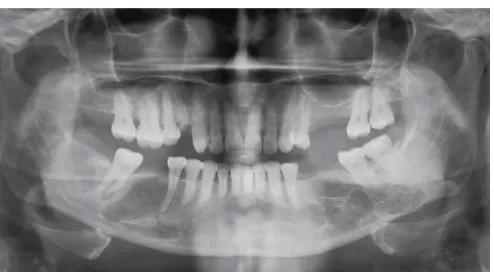
Panoramic followup radiographs of previously affec
ted regions at the intervals of 6 months and 1 year after
surgical intervention showed evidence that process of
bone repair had occurred locally (Fig. 7).
dISCuSSIon
TBC has been identified by a great variety of names in the literature, such as hemorrhagic bone cyst, simple bone cyst, solitary bone cyst, extravasation cyst, IBC, primary bone cyst.2
Trauma is the most frequently discussed etiologic fac
tor in the formation of TBC. Of the pathogenic hypothesis
of TBCs evaluated by Howe (1965)3, the most widely
accep-ted mechanism involves microtrauma an event sufficient
to precipitate intramedullary hemorrhage with osteoclastic Fig. 3:Orthopantomograph showing process of bone repair
Figs 4A and B: (A) Clinical intraoral photograph showing alveolar mucosa with a swelling was seen on the right lingual aspect in relation to 47 and 48 and (B) clinical intraoral photograph showing normal alveolar mucosa
Fig. 5:Orthopantomograph showing three separate radiolucent lesions with scalloping borders that were in between the roots of 44 to 47 region, 33 to 38 region and 11 to 13 region respectively
B A
Figs 6A and B:(A) Photomicrograph showing dense connective tissue stroma with extravasated RBC’s along with necrotic changes and dense chronic inflammatory infiltrate. There was no evidence of any cystic epithelium (40×, magnification) and (B) photomicrograph showing dense connective tissue stroma with extravasated RBC’s along with necrotic changes and dense chronic inflammatory infiltrate. There was no evidence of any cystic epithelium (100×, magnification)
activity and elimination of trabeculae within cancellous
bone compartment, yet a failure of the hematoma to undergo organization and tissue replacement. Degeneration of the hematoma results in cavitation, proposed by Olech et al.17 Other theories that have been put forward to explain the pathogenesis of the condition include:18
• Infection of bone marrow
• Loss of blood supply to hemangioma or lymphoma • Cystic degeneration of existing bone tumor
• Changes and reduction in the osteogenic activity • Faulty calcium metabolism as a result of systemic
disease (parathyroid diseases)
• Ischemic necrosis of the fatty bone marrow • Low grade chronic infection
• Imbalance between the osteoclastic and osteoblastic
activity due to trauma
• Developmental defect
• Failure of mesenchymal tissue to form bone and cartilage, and instead becomes immature as multiple bursa-like synovial cavities.
Idiopathic bone cavities are most frequently asympto-matic. Expansion of the mandible rarely occurs. A few
authors have reported the occurrence of multiple TBC
and their associa tion with fibrous/bony lesions, such as florid cemento-osseous dysplasia especially in older patients. Wakasa et al (2002) have suggested that the florid
cementosseous dysplasia may precede TBC when these
two condi tions are as sociated, which suggests that
disor-dered production of trabeculae in the former may obs truct lymphatic drainage and induce TBC formation.19-21 Panoramic radiographs and CT scans are essential for the diagnosis and evaluation of lesions and in many cases
are the primary indicators of the pathology. Radiographic
features of the lesion have generally been described as unilocular with scalloping between the roots of associ
ated teeth.3,4 Although, generally described as being
empty, there have been reports that TBCs may rarely contain straw colored fluids, blood, connective tissue or blood clot. One school of thought postulates that the
reason aspiration of idiopathic bone cavities return blood
in some cases is not because the cavity is filled with blood,
Typically, histopathological findings in TBC are non-specific and reveal fibrous connective tissue and normal bone with no evidence of any epithelial lining. The lesion may show areas of vascularity, fibrin, erythrocytes and occasional giant cells adjacent to bone surface.
Central giant cell lesions, odontogenic keratocyst, ameloblastoma, lateral periodontal cyst, and other des-tructive bone cysts and tumors should be taken into consideration in differential diagnosis.
The most commonly recommended treatment for TBC is surgical exploration of the lesion followed by curet
tage of the bony walls. This surgical exploration serves as both diagnostic maneuver and definitive therapy by producing bleeding in the cavity. This bleeding helps to form a clot which is eventually replaced by bone.22
Lite-rature mentions about the filling of cavity with blood, bovine lyophilized bone, autologous blood with bone
from patient or synthetic bone materials or single bone
grafting without blood as possible treatment options, if the surgical exploration done is ineffective. Although, these materials have been sparingly used, its efficacy and efficiency are yet to be fully studied.23
Careful curettage of the lesion favors progressive bone
regeneration, offering a good prognosis and an almost negligible relapse rate. Osseous regeneration can be verified after some months by radiographic evaluation.
ConCluSIon
Generally all maxillofacial lesions present with a stan
dard set of clinical or radiographical presentations. Proper recording of case history, knowledge of symptoms
and correct radiographic interpretation will be helpful
for proper diagnosis and management. Being open to
all probabilities and possibilities would be an added
advantage. Traumatic bone cyst should be a differential diagnosis in any case with an asymptomatic occult, cystic space especially with a history of trauma. Although devoid of complications, if left untreated, it may result in
pathological fracture as a result of the hollowing out of
the affected bone.
ACknowledGmenT
We thank Dr Mathew Jose, Professor and Head and all
staff members of the department of Oral Surgery, SMIDS-Kulasekharam for their surgical expertise in the manage
ment of the cases as well as Dr Karthiga Kannan and the
staff members of the department of Oral Medicine and
Radiology, SMIDS-Kulasekharam for their help in the
radiological evaluation of the cases.
Traumatic Bone Cyst of the Jaws: A Report of Two Cases and Review
RefeRenCeS
1. Lucas CD, Blum T. Do all cysts in the jaws originate from the dental system? J Am Dent Assoc 1929;16:647-661.
2. Cowan CG. Traumatic bone cysts of the jaws and their presen-tation. Int J Oral Surg 1980;9(4):287-291.
3. Howe GL. ‘Haemorrhagic cysts’ of the mandible. Br J Oral Surg 1965;3(1):55-76.
4. Hansen L, Sapone J, Sproat R. Traumatic bone cysts of jaws— Report of sixty-six cases. Oral Surg Oral Med Oral Pathol 1974; 37(6):899-910.
5. Huebner G, Turlington E. So-called traumatic (hemorrhagic) bone cysts of the jaws. Oral Surg 1971;31(3):354-365.
6. Forssell K, Forssell H, Happonen RP, Neva M. Simple bone cyst. Review of the literature and analysis of 23 cases. Int J Oral Maxillofac Surg 1988;17(1):21-24.
7. Beasley JD. Traumatic cyst of the jaws: report of 30 cases. J Am Dent Assoc 1976;92(1):145-152.
8. Goodstein DB, Himmelfarb R. Paresthesia and the traumatic bone cyst. Oral Surg 1976;42(4):442-446.
9. Curran J, Kennett S, Young A. Traumatic (haemorrhagic) bone cyst of the mandible: report of an unusual case. J Can Dent Assoc 1973;39(12):853-855.
10. Hughes C. Hemorrhagic bone cyst and pathologic fracture of the mandible: a case report. J Oral Surg 1969;27(5):345-346. 11. Kramer IR, Pindborg JJ, Shear M. The WHO histological typ
ing of odontogenic tumours. A commentary on the 2nd ed. Cancer 1992;70(12):2988-2994.
12. Copete MA, Kawamata A, Langlais RP. Solitary bone cyst of the jaws: radiographic review of 44 cases. Oral Surg Oral Med Oral Pathol Oral Radiol Endod 1998;85(2):221-225.
13. Peñarrocha-Diago M, Sanchis-Bielsa JM, Bonet-Marco J, Minguez-Sanz JM. Surgical treatment and follow-up of soli
tary bone cyst of the mandible: a report of seven cases. Br J Oral Maxillofac Surg 2001;39(3):221-223.
14. MacDonald-Jankowski D. Traumatic bone cysts in the jaws of a Hong Kong Chinese population. Clinical Radiology 1995;50(11):787-791.
15. Kaugars G, Cale A. Traumatic bone cyst. Oral Surg Oral Med Oral Pathol 1987;63(3):318-323.
16. Freedman GL, Beigleman MB. The traumatic bone cyst: a new dimension. Oral Surg Oral Med Oral Pathol 1985;59(6): 616-618.
17. Shear M, Speight P. Solitary Bone Cyst. Cysts of oral and maxillofacial regions. 4th ed. Oxford: Blackwell-Munksgaard Publishers; 2007. p. 156-161.
18. Ahmed KA, Al-Ashgar F. Maxillary solitary cyst: review of literature and case report. Saudi Dent J 1991;3(3):109-113. 19. Horner K, Forman GH. Atypical simple bone cysts of the jaws.
II: a possible association with benign fibro-osseous (cemental) lesions of the jaws. Clin Radiol 1988;39(1):59-63.
20. Mahomed F, Altini M, Meer S, Coleman H. Cemento-osseous dysplasia with simple bone cysts. J Oral Maxillofac Surg 2005; 63(10):1549-1554.
21. Wakasa T, Kawai N, Aiga H, Kishi K. Management of florid cementoosseous dysplasia of the mandible producing solitary bone cyst: report of a case. J Oral Maxillofac Surg 2002;60(7): 832-835.
22. Arsinoi AX, Konstantinos IC, Konstantinos T, Vasilios AP, Stavros IP. Traumatic bone cyst of the mandible of possible iatrogenic origin: a case report and brief review of literature. Head and Face Medicine 2006;2(1):1-5.