New Developments 1n Screening for
Inborn Errors of Metabolism*
PETER
MAMUNES
Department of Pediatrics,
Medical College of Virginia,
Richmond, 23219
Because the mental retardation caused by some in-born errors of metabolism is to a large degree pre-ventable by appropriate and early therapy, considera-tion is now being given to the possibility of mass screening for these disorders in the neonatal period. Experience with the prototype, the phenylketonuria (PKU) program, dictates that mass screening for in-born errors of metabolism is here to stay and will most certainly expand in the future-like it or not. Since I have recently gained some insight into the field as Metabolic Consultant to the State Health Depart-ment, I wish to review the PKU program in Virginia-the many pitfalls in Virginia-the diagnosis and treatment of this disorder, and the feasibility of mass or selective screen-ing for other inborn errors.
Mass Screening
In 1966, Virginia passed a law making it mandatory to test all newborns for the presence of PKU; indeed, today most states have such a law. The State Health Department responded to the legislature's charge to implement the program by: 1) establishing accurate Guthrie testing in three State laboratories, 2) estab-lishing a quantitative serum phenylalanine (PA) and tyrosine procedure at its central laboratory in Rich-mond, and 3) providing nutritional and medical follow-up for diagnosed cases. Three full years of experi-ence with the program have demonstrated its worth not only financially, but also in the prevention of mental retardation.
From the bookkeeping viewpoint, at $0.42 per test, 97% of the 76,000 births in the State of Virginia last year were screened for about $31,000. At an incidence of one in 13,000 it thus costs approximately $6,000 to uncover one case; it costs another $2,000 to provide therapy. In contrast, the cost to the State for the lifetime institutional care of the invariably severely retarded and untreated PKU patient is, very conserva-tively, $125,000. One state's estimate put it at twice
*
Presented at the Virginia Pediatric Society Meeting,Williamsburg, Virginia on February 27, 1970.
that figure. A recent review of the rolls of the State's institutions discloses 45 such PKU patients. At present we are actively treating 30 children at home, most of them diagnosed since the inception of the testing program. These compelling statistics should make believers of any nonbelievers regarding the financial soundness of the program.
But we must soberly admit what this program hath wrought, especially in the way of need for a more precise diagnosis and long term follow-up of positively screened patients. In the classical phenylketonuric, with markedly deficient PA hydroxylase activity (Fig 1), the serum level will reach greater than 20 mg % by the second week and usually 30-40 mg % by the third week. 0-hydroxyphenylacetic acid usually ap-pears in the urine when the serum phenylalanine level reaches 7 mg % , but phenyl pyruvic acid is not excreted in the urine until the serum phenylalanine reaches 13 to 15 mg % . Because this latter substance is what makes the ferric chloride test positive, it can be seen that urine tested under age 2-3 weeks might be negative despite a high blood level. It is for this reason that urinary screening gave way to blood screening via the Guthrie test. Of those who have a permanent elevation of serum PA (ie, greater than 3-4 mg % ) , approximately % will follow this course where dietotherapy is necessary to allay mental re-tardation (Berman et al, 1969).
operative study underway to determine if the 3-7 mg % range might be relaxed to 10-12 mg % without deleterious effect, as there is no knowledge of what level correlates with injury to the developing central nervous system. These ranges of intake are only rough guidelines, and frequent monitoring of serum PA levels by Guthrie testing is required to de -termine the more exact individual requirements. To make matters more difficult, these requirements often change with varying protein needs induced by infection, changes in the rate of growth, activity, etc.
Variability of Phenylalanine and Protein Needs
Of the 15 cases of phenylketonuria currently being followed in the MCV Metabolic Endocrine
Clinic, I have selected two which demonstrate these extremely variable phenylalanine and protein needs.
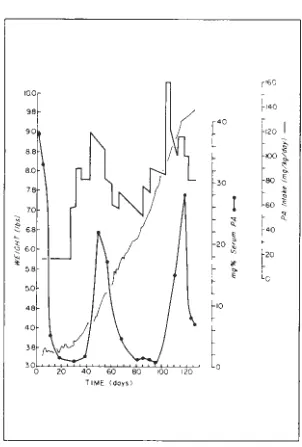
The first case (Fig 2) is that of a premature baby with
a birth weight of 4 lb at 32 weeks gestation. The child was referred to MCV at age 3 weeks weighing 3 lb 4 oz, and having a serum PA level of 38 mg % with a normal serum tyrosine and without detectable phenylpyruvic acid in the urine. Extreme lethargy, persistent vomiting, and abdominal disten-sion were present on admisdisten-sion and were not
ascrib-able to other causes (ie, sepsis, organic bowel disease, etc), and might have been due to the high serum PA level. For this reason an extremely restricted PA in-take of 16 mg/kg per day was instituted and conse-quent to the fall in the phenylalanine level, clinical
symptoms disappeared and weight gain ensued.
How-ever, with a rapid weight gain the PA needs markedly increased and even intakes of 80-90 mg/kg per day did not suffice to maintain the serum PA level above 2 mg % . For this reason it was thought that this case might merely be one of transient hyperphenylala -ninemia and a full phenylalanine intake of 120 mg/
kg per day was offered in the form of regular milk. This resulted in a rise of serum phenylalanine to 22
mg % . Therefore, an intake of 80-90 mg/kg was again used with a consequent fall in the serum PA again to Jess than 2 mg % . Regular milk supply-ing 160 mg/kg PA per day raised the level to 15 mg %, and despite a drop in intake to 100-120 mg/kg per day, it continued to rise to 28 mg % . This time a decrease in intake to 80-90 mg/kg brought the infant to the correct range. By this time the rate of growth had also slowed somewhat. Since discharge this child's serum PA level has been maintained between 3-7 mg % on an even more reduced intake of
50 mgjkg per day. This infant, then, with the catch-up
growth typical of the premature, initially required
con-siderably more than the expected amount of dietary
PA (90-100 mg/kg per day).
The second case is that of a 9 year old girl with an
I.Q. of 85 who had findings in early infancy of classical PKU (Fig 3). She was maintained in fairly
Q-cHiC,H-COOH '*1enylolonine hydro~ylose
NH1 (PKU)
PHENYLALANINE phenylol_oninell
tronsominose
TYROSINE
tyrosine
I
transaminase
0-CH:tCOOH
H O O' ·CH:·~·COOH- 0
c5:
::;,_:o:U1VIC
AC,O f _~
·cH,COOH OHPARA-OH-PHENYLPYRUVIC ACIO paro-hy.dro~y
t
TRANSIENT NEONATALphenylpyruv1c acid TYROSINEMIA
ox 1dose TYROSINOSIS
'
"
Q
PHENYLLACTIC ACID PHENYLACETIC ACID
_ ~ ·CHiCOOH ·CH
Q · c1·vcoOH OH
HOMOGENTISTIC ACID
ORTHQ·QH·PHENYLACETIC ACID
Fig 1-The classical phenylketonuric with markedly de-ficient PA hydroxylase activity.
"°
100
..
,o"
'
I
9.0
'
'°
t00 !.
t
30 80 ! i 60
•
~ ~
20
!
,o20
~
r
TIME (day1)
Fig 2-The course of case one.
.
.
·
-
-
--
·
---
--
-
-
-
---
-
--
---
---
t
_
-_
'! ... j \\/\/\Jon. 1%7
Joo 1966
Fig 3-The course of case two. Jan. 1%9
Joo
.,,
,
,
good control through the first five to six years at the
usual intake of 20-30 mg/kg of PA per day.
There-after, because almost all brain growth has occurred by this age and because by intelligence testing and gross observations there is no deterioration in func-tion when the diet is discontinued, the phenylketonuric child is usually gradually introduced to a normal PA
intake. However, one very recent careful study
sug-gests a measurable decrease of motor skills and learning processes may occur with a discontinuation
of the diet at this age (Anderson et al, 1968).
Be-cause of this study, beBe-cause the mother and child were
most comfortable with the diet, and because the
mother was fearful of any possible deterioration, PA
restriction was continued. However, for the past three
years, despite a low dietary PA intake of 16 mg/kg per
day, the serum PA has been no lower than 12 mg
% . An increase in dietary intake of PA ( as natural
food protein) to 24 mg/kg per day in December, 1969,
merely caused an increase in the serum PA to 22 mg
% . When the protein intake was increased in March,
1970, from a suboptimal level of 0.7 gm/kg per day
to 1.3 gm/kg per day (by providing additional
Lofenalac) , a lowering of the serum PA to 7 mg %
was effected, despite a small increase in total PA intake. This child therefore had high serum PA for several years because tissue protein breakdown was occurring in the face of inadequate protein
intake. The changing dietary needs demonstrated by
these two cases emphasize the need for constant monitoring with medical and nutritional supervision on an individual basis.
Other Causes of Hyperphenylalaninemia
Other than classical PKU there are at least five to
six additional causes of hyperphenylalaninemia.
Ap-proximately 2/1000 normal newborns have a posi
-tive Guthrie test in the screening program, but the vast majority are due to transient neonatal
tyrosine-mia. This entity is believed to be due to a delay in the
maturation in the liver of the enzyme parahydroxy-phenylpyruvic acid oxidase, and large amounts of parahydroxyphenylpyruvic acid are usually found in the urine. Secondarily, serum PA rises and gives the
positive Guthrie test, but serum tyrosine is
character-istically much higher than phenylalanine. The values
usually return to normal without therapy in one to
two months, but occasionally not for six to eight
months. No clinically apparent motor or intellectual deficits result from this transient defect and no
treat-ment is indicated. However, until the tyrosine levels
return to normal it is impossible to be certain that the
enzyme defect is not of a permanent nature, then called tyrosinosis ( or tyrosinemia). This disorder
fre-quently causes severe liver and kidney damage and
early death. Because it is ameliorated by a low
tyro-sine diet it becomes imperative that neonatally
ele-vated tyrosine levels picked up by pos1t1ve Guthrie tests be followed serially until they become normal. Another cause of hyperphenylalaninemia of a
tran-sient nature is a delay in the maturation of the
en-zyme PA hydroxylase where the infant initially has classical findings of PKU but later in infancy tolerates a normal phenylalanine intake without hyperphenyla-laninemia. Because of this possibility the dietary re-striction of all infants with what initially appears to be classical PKU should be relaxed periodically to demonstrate persistence of the defect, as was done in my first example.
Of the approximate 1/:i of infants with permanent
hyperphenylalaninemia who do not have the classical
course of PKU, we encounter two generally described
types. One is called atypical PKU, where levels of
greater than 20 mg % are not associated with mental
retardation despite there being no treatment. These children are usually uncovered as an older sibling of
a newly diagnosed case from the screening program.
The other term, simply hyperphenylalaninemia, is ap-plied when the serum PA level never rises above 20
mg % without dietary restrictions and is usually not
associated with mental retardation. The PA tolerance
tests unfortunately do not distinguish these groups
from the classical PKU patient, but there is some
evi-dence to suggest that the absence in the urine of the
breakdown products of PA, namely phenyl pyruvic acid
and orthohydroxyphenylpyruvic acid, favors a
diagno-sis of one of these milder forms of the disease. Indeed,
some qualified investigators recommend not treating
an infant unless there are PA metabolites in the urine,
no matter how high the level of serum PA. It is
there-fore clear that we may be unnecessarily treating, with
inherent dangers, as many as 1/:i of patients thought to
have classical PKU. There is obviously a need for
bet-ter means of diagnosing these subgroups.
Finally, there is the rare infant who lacks the en-zyme phenylalanine transaminase but who only has hyperphenylalaninemia when on a higher than normal
PA intake. In this instance, of course, no phenyl
pyru-vic acid or orthohydroxyphenylpyrupyru-vic acid appears in the urine. Space does not permit a more detailed discussion of these variants, but I have mentioned them to emphasize that whereas just five years ago hyper-phenylalaninemia was thought to be a simple disease
state, mass screening has disclosed a wide spectrum
of clinical and biochemical presentations with vari-able prognoses and treatment.
Indications for Screening
With some of the machinery already established,
the next logical question deals with what other inborn
errors should be screened. To answer this it would be
best at this point to review the ten principles of early detection outlined by a World Health Organization
P. MAMUNES
will be seen that by these criteria the PKU program is a
valid one:
1 ) "The condition should be an important prob-lem." Although not terribly common, PKU is important as it is a treatable cause of men-tal retardation.
2) "There should be an accepted treatment for patients with recognized disease." There is for PKU. For other aminoacidopathies it is not so well worked out-for galactosemia, to be mentioned shortly, there is an accepted
treat-ment.
3) "Facilities for diagnosis and treatment should
be available." These do exist but are most marginally funded, so that the more detailed work-ups required with increasing awareness of the heterogeneity of the disease are not pos-sible. This will be a drawback to establishing other mass or selective screening programs. 4) "There should be a recognizable latent or early
symptomatic state." In the instance of PKU
this is hyperphenylalaninemia, but at best this is likely an early symptomatic stage. Even dietary therapy instituted at less than 2 months of age results in only a mean I.Q. of 85 ± 12 vs. the unaffected sibling comparison of I.Q. of
TABLE Urinary Screening Tests for Metabolic Defects
Disease FeCl,
I. Phenylketonuria Green
2. Maple Syrup Navy Blue 3. Tyrosinosis Trans. Green
4. Histidinemia Green
5. Hyperglycinemia 6. Fructose Into!.
7. Galactosemia
8. Cystinuria
9. Homocystinuria 10. Hurler's
11. Morquio-Ullrich's
12. Fanconi's ±
13. Alkaptonuria Brown
14. Lowe's
15. Hyperlysinemia
DNPH
C-N C-TAB ±
dinitrophenylhydrazine cyanide nitroprusside
cetyl trimethylammonium bromide
sometimes positive
DNPH
+++
+++
+++
++
+++
±(?)
±
+
+
109 ± 11. Whether the treatment is started too late or is inadequate is not known.
5) "There should be a suitable test or examina-tion." The Guthrie test fits this bill well. 6) "The test should be acceptable to the
popula-tion." The Guthrie test again fits this bill well. 7) "The natural history of the condition, including the development from latent to declared dis-ease should be adequately understood." Clas-sical PKU qualifies to a good degree, although what level of PA or its metabolites is actually injurious is not yet known-nor is it known why some patients with significant elevations of
serum PA do not develop retardation, as in
atypical phenylketonuria.
8) "There should be an agreed policy on whom to
treat as patients." We are in the same trouble here with PKU because, as mentioned earlier, some physicians would delay treatment until metabolic products in the urine appear. Some use the level of 15 and others 20 mg % before
starting treatment.
9) "The cost of case finding should be economically balanced in relation to possible expenditure on medical care as a whole." As pointed out, PKU scores high here.
C-N Benedict's C-TAB
±
++
++
++
++
++
±
10) "Case finding should be a continuing process
and not a once and for all project." This is
certainly true for PKU.
On the basis of these criteria, what other inborn errors would qualify for mass screening? Most
amino-acidopathies probably do not qualify at this time
mainly because of their rarity and of the expensive chromatographic techniques required, making case-finding too costly. Reduction in cost of detection might be achieved by the application of the bac-terial "inhibition assay" technique as used in the Gu-thrie test. In this procedure the excessive leucine of maple syrup urine disease prevents the inhibition of
B. subtilis by 2-methyl leucine, and excessive histidine
of histidinemia prevents inhibition of B. subtilis by
azaserine. With more refined resins and increased
automation, quantification by ion-exchange chroma-tography might be a useful tool for mass screening of
aminoacidopathies, but this development is several
years away. In the meantime pilot studies in
special-ized centers are proceeding, using one or two di-mensional paper or thin layer chromatography, or high voltage electrophoresis as screening tools. In this way more knowledge of these rare diseases and their treatment can be obtained and we can then better satisfy criteria 2, 7, and 8, listed above. One
such recent study (Clow, Saiver and Davies, 1969) of
the plasma of over 36,000 neonates revealed 316 with hyperaminoacidemia, but all except six were only
transient. Five of the six permanent elevations were
hyperphenylalaninemias and one was a case of
hyper-methionemia.
Considerations are somewhat different concerning the disorder of carbohydrate metabolism,
galactose-mia. In this disorder a buildup in the blood and tissues
of galactose and galactose-1-phosphate causes mental retardation, cataracts, liver and kidney disease, and
usually early death. Whereas previous estimates have put the incidence at 1: 50,000, recent mass screening surveys put it at between 1: 20,000 to 1: 30,000 (Hansen, 1969). Various screening tests are presently being evaluated-measuring either blood galactose levels via a bacterial inhibition assay technique or the
actual levels of the deficient enzyme,
galactose-1-phosphate uridyl transferase, from spotted filter paper or with 50 microliters of heparinized blood. As for
phenylketonuria and maybe for most inborn errors, it has already been established that there are several
variants of galactosemia-four at present. It is not totally clear which types re·quire therapy, but because this disease satisfies most of the established prin-ciples, with good treatment available (lactose
elimina-tion) it would appear that as soon as it is determined which test is most suitable, it will be the next meta-bolic disorder to be mass screened. Indeed one state has already made testing for galactosemia mandatory
and several other states are seriously considering it.
There are a host of other inborn metabolic disor-ders for which diagnostic tests are available, but their consideration for inclusion in mass screening are not as pressing as the aforementioned diseases, either because of their rarity (Wilson's disease), the lack of adequate therapy, or the lack of a test acceptable to the population ( cystic fibrosis) .
Selective Screening
Though to this point we have been talking about mass screening, I would like to discuss one type of
selective screening-that is, the screening of a selected group. Mental retardates, specifically, are more likely to have metabolic disorders than the general popula-tion. At first blush it would seem to be a waste of time, effort, and money to seek a diagnosis once mental re-tardation has already ensued, because in almost all instances therapy cannot reverse this damage. On the other hand, several other considerations point out the validity of testing mental retardates for metabolic dis-orders.
1) Establishing the cause of retardation enables better prognosticating and genetic counsel-ling.
2) If therapy is started early with only mild re-tardation present, further deterioration might be prevented or slowed.
3) Identifying the inborn error allows a better determination of its incidence and therefore
its possible worthiness for inclusion in mass screening programs.
4) Identifying the inborn error may give more insight into the various modes of clinical and/or biochemical presentation and there-fore allow earlier recognition of future cases
and determination of appropriate therapy.
There are almost as many screening tests as there are inborn errors of metabolism, but by selecting a few tests that will identify several different disorders,
a workable screening panel can be established. The table depicts such a panel of tests established initially by R. B. Young (Department of Pediatrics, Medical College of Virginia) and continued presently by myself
as a service to physicians in the State. In the present
practice, fresh acidified urine of any patient with sus-pected mental retardation, or with a clinical complex to suggest an inborn error, is mailed to the Pediatric Metabolism Laboratory at the Medical College of Vir-ginia. These tests are performed once weekly and the results mailed promptly to the referring physician. With more experience with these programs, it is
P. MAMUNES
Summary
I have briefly outlined the PKU program in the State of Virginia and tried to demonstrate how this screening experience has disclosed the heterogeneity of the disease plus the need for an individualized ap-proach to dietary control. I have applied the principles of mass screening to examine the feasibility of testing for other inborn errors and, on this basis, feel that galactosemia will soon next join with PKU. Mass screening for other aminoacidopathies will await more refined testing techniques and a definition of their incidence and mode of therapy. In the meantime, accumulated experience thus far mandates the
estab-lishment of specialized lab facilities and
multidisci-plinary teams; these will be necessary to effect opti-mal evaluation and treatment of patients found to be positive by these screening techniques.
References
Anderson VE, Siegel FS, Tellegen A, et al: Manual dex-terity in phenylketonuric children. Percept Motor Skills 26: 827, 1968
Berman JL, Cunningham GC, Day RW, et al: Causes for high phenylayanine with normal tyrosine. Amer J Dis Child 117: 54, 1969
Berry HK, Wright S: Conference on treatment of phenyl-ketonuria. J Pediat 70: 142, 1967
Clow C, Scriver CR, Davies E: Results of mass screening for hyperaminoacidemias in the newborn infant. Amer 1
Dis Child 117: 48, 1969
Davens E, et al: Statement on treatment of phenylketo
-nuria. Pediatrics 35: 501, 1965
Hansen RG: Hereditary galactosemia. JAMA 208: 2077,