Available Online at www.ijpret.com
369
INTERNATIONAL JOURNAL OF PURE AND
APPLIED RESEARCH IN ENGINEERING AND
TECHNOLOGY
A PATH FOR HORIZING YOUR INNOVATIVE WORK
KNOWLEDGE MANAGEMENT: NEED FOR CORPORATES
GAJENDRA Y PATIL, ANIKET K SHAHADE
1. Research Scholar, Shri Sant Gajanan Maharaj College of Engineering, Shegaon.
2. M.E Scholar, Shri Sant Gajanan Maharaj College of Engineering, Shegaon.
Accepted Date: 27/02/2014 ; Published Date: 01/05/2014
\
Abstract: Knowledge management is not a single discipline. Rather it is an integration of numerous endeavors and field of industry. Knowledge management is about using the brain power of an organization in a systematic and organized manner in order to achieve efficiencies, ensure competitive advantage and spur innovation. This paper gives a brief introduction about Knowledge Management, its need, definition, component, assets and challenges.
Keywords: Knowledge Managemet (KM), KM Assets, Information Overload, Information Congestion.
.
Corresponding Author: MR. GAJENDRA Y PATIL
Access Online On:
www.ijpret.com
How to Cite This Article:
Available Online at www.ijpret.com
370
INTRODUCTION
Knowledge Management (KM) is the process of gathering, managing and sharing employees’ knowledge capital throughout the organization. Fundamentally, knowledge management is about applying the collective knowledge of the entire workforce to achieve specific organizational goals. The aim of knowledge management is not necessarily to manage all knowledge, just the knowledge that is most important to the organization. It is about ensuring that people have the knowledge they need, where they need it, when they need it – the right knowledge, in the right place, at the right time[1].
Knowledge sharing throughout the organization enhances the business processes in organization, try to introduce some new more efficient and effective business processes and removes old redundant processes. It is a discipline that promotes a collaborative and integrated approach to the creation, capture, organizational access and use of an enterprises asset. KM has now become a mainstream priority for companies of all sizes. Capturing a company's most valuable Knowledge (asset) and distributing it effectively across the enterprise is a business critical issue for many help desk, customer support and IT departments[2].
The systematic process of finding, selecting, organizing, distilling and presenting information, improves an employee’s comprehension in a specific area of interest.KM, as emphasized by Abdul Kalam (2004), helps an organization to gain insight and understanding from its own experience[4].
KM is not only about Knowledge Technology. KM must be an enabler to achieve strategic business objectives. The organizational debris from failed attempts to impose new technical infrastructures that are either inappropriate to their work environments, or where people are not willing to share knowledge is ample evidence. Hence the need of Knowledge Management initiative arises to become solution for such problems, which brings together people, process and technology and helps corporate to achieve its goals and vision.
Available Online at www.ijpret.com
371
Reasons for Emergence and Growth of Knowledge Management
Information Overload: information needed. Information resides in many different sources, some easily accessible, others volatile and highly personal. As Microsoft founder Bill Gates Information overwhelms corporations, schools, classrooms, and our minds. Finding what we need to complete a task, especially more complex ones, can be time consuming and frustrating if we do not have access to a well-organized, readily available infrastructure that contains the type of noted in his presentation at COMDEX Fall 1999: “Corporate information today is so hard to find. It’s kept in folders, or anecdotally understood by people in the company” (cited in VNU Business Media, 2001). Gates added, “Knowledge workers need to share things, and need access to the right information at the right time. This is so hard today.” What is true? Which solution is better? Or what are the solutions? What we have gained are volumes of unfiltered and unprocessed information and what we struggle to find are the time and the ability to respond quickly to ever increasing demands and expectations from our employers and clients, whether they are students or faculty or staff[5].
Information Congestion: In our computer networks communication channels are bottleneck. We some time say that the internet access is slow during peak hours at work because too many of us are searching the Web at the same time. Sometimes the speed with which we can tap into available internal data warehouses or transactional operational systems is less than desirable because too many of us are accessing vast amounts of data, thus putting a significant strain on our systems. If we had the mechanisms to target very specifically the data or information we are looking for, the overall speed of our networks would be consistently at its best capacity[5].
Information, Skill Segmentation and Specialization: The era, when a single person mastered many different domains, is long gone. While there are always exceptions to confirm the rule. Most of the people now master only one domain of expertise and sometimes only part of a specific domain. It is often the case that the completion of various projects requires access to and corroboration of information from multiple domains. Having access to the right information, at the right time, without necessarily being an expert in all domains involved, would greatly improve individual and organizational efficiency and effectiveness[5].
Available Online at www.ijpret.com
372
recognizing that capturing and sharing these experiences and skills save them money, prevent or reduce interruptions in activities, and enhance their overall ability to cope with changes in personnel[5].
Competition: This has always been a main component for improvement and innovation in the business environment. With the propagation of nontraditional higher education providers and modalities of instructional delivery, colleges and universities are increasingly finding themselves competing for students much more than they were accustomed to a decade ago. Being able to anticipate changes in our environments and demands for new programs or courses, and to respond quickly, are becoming prerequisites for how higher education must operate in order to survive, thrive, and adapt to change.
Need for Corporates
Knowledge management is based on the idea that an organization’s most valuable resource is the knowledge of its people. This is not a new idea – organizations have been managing “human resources” for years. What is new is the focus on knowledge. This focus is being driven by the accelerated rate of change in today’s organizations and in society as a whole. Knowledge management recognizes that today nearly all jobs involve
“knowledge work” and so all staff are “knowledge workers” to some degree or another – meaning that their job depends more on their knowledge than their manual skills. This means that creating, sharing and using knowledge are among the most important activities of nearly every person in every organization[5].
Knowledge management solutions are now the most important strategic technologies for large companies, according to a new report and survey of European executives by the Economist Intelligence Unit (EIU.com, 2003), sponsored by Tata Consultancy Services. In the survey, 67% of companies cite knowledge management/business intelligence solutions as important to achieving their strategic goals over the next three years[3].
Available Online at www.ijpret.com
373
Components of KM
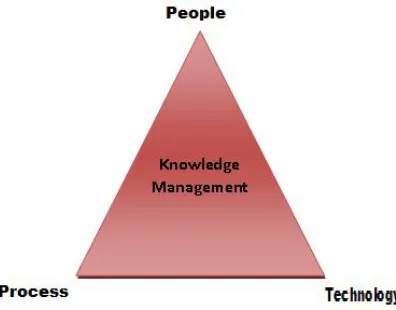
The components of Knowledge Management are broadly classified into three categorized People, Process and Technology as shown in the following diagram[5];
Figure 1. Knowledge Management Components.
All three components are critical to build a learning organization and get business result from Knowledge Management, a majority of organization worldwide implementing KM have found it relatively easier to put technology and processes in place, whereas the people component has posed greater challenges.
The biggest challenge in KM is to ensure participation by people and employee in the knowledge sharing, collaboration and re-use to achieve business results.
Principles of KM
Davenport and Prusak (1998) states 8 principles of knowledge management. They summarize what is known and are worth repeating here[3].
1. Knowledge originates and resides in people’s heads
2. Knowledge sharing requires trust.
3. Technology enables new knowledge behaviors
4. Knowledge sharing must be encouraged and rewarded
5. Management support and resources are essential
6. Knowledge initiatives should begin with a pilot program
7. Quantitative and qualitative measurements are needed to evaluate the initiative
Available Online at www.ijpret.com
374
KM Assests
Typically, there are six knowledge assets in an organisation, namely[2]:
1)Relationship between Stakeholders: includes licensing agreements; partnering agreements, contracts and distribution agreements.
2) Human resources: skills, competence, commitment, motivation and loyalty of employees.
3) Physical infrastructure: office layout and information and communication technology such as databases, e-mail and intranets.
4) Culture: organizational values, employee networking and management philosophy.
5) Practices and routines: formal or informal process manuals with rules and procedures and tacit rules, often refers to “the way things are done around here”.
6) Intellectual Property: patents, copyrights, trademarks, brands, registered design and trade secrets.
CONCLUSION
This paper has tried to cover different aspects of Knowledge Management. It has been observed that KM for corporate is mainly for getting competitive advantages over the rival companies. In this paper we mentioned the reasons for emergence and growth of management, need of Knowledge Management for corporate also the principles and different assets of Knowledge Management.
`REFERENCES
1. G. Abdul Kalam, A.P.J. 2004. Digital Library and its multi dimensions. President of India’s
speech at the “Inauguration of International Conference on Digital Libraries (ICDL) – 2004, New
Delhi : Feb 24, 2004. Available
at:http://www.presidentofindia.nic.in/scripts/sllatest1.jsp?id=282.
2. Marr, Bernard. 2003. Consider the culture when benchmarking KM Processes. KM Review
Vol. 6, no.5: 6-7.
3. Davenport T. and L. Prusak (1998) Working Knowledge: How Organizations Manage What
they Know Boston, MA: Harvard Business School Press.
4. ABC of Knowledge Management; Freely extracted from the NHS National Library for Health
at http://www.library.nhs.uk/knowledgemanagement/ by Géraud Servin.