Available Online at www.ijpret.com 97
INTERNATIONAL JOURNAL OF PURE AND
APPLIED RESEARCH IN ENGINEERING AND
TECHNOLOGY
A PATH FOR HORIZING YOUR INNOVATIVE WORK
DATA SECURITY OF PRIVATE CLOUD USING ENCRYPTION SCHEME WITH RSA
ASST. PROF. RAJESH T. NAKHATE, MR. AAKASH D. WANI, MISS. PAYAL N. TOMPEY,MISS. NEHA S. CHAMATKAR, MISS. VAISHALI G. GOHANE Dept. of Information Technology, DMIETR, Wardha-442001
Accepted Date: 15/03/2016; Published Date: 01/05/2016
\
Abstract: A phrase used to describe a variety of computing concepts is Cloud computing that involve a huge number of computers systems connected through a real-time communication network such as the internet. Cloud Computing is a standard paradigm which has become today’s hottest research area because of its capability to reduce the costs associated with computing. Due to the fast development of the Cloud Computing technologies, the rapid increase of cloud services are became very incredible. Securing data is a challenging issue in today’s date. Most of the data travel over the internet and it becomes difficult to make data secure. The prevalent problem associated with Cloud Computing is the Cloud security and the proper Implementation of Cloud over the Network. In this Research Paper we are using RSA Algorithm for improving the Security.
Keywords: Cloud Computing, RSA Algorithm and Internet.
Corresponding Author: MR. AAKASH D. WANI
Access Online On:
www.ijpret.com
How to Cite This Article:
Available Online at www.ijpret.com 98 INTRODUCTION
Cloud computing is the extensive dreamed idea of computing as a service, where data vendors can remotely store their data in the cloud to enjoy on-demand high-quality applications and services from a shared pool of configurable computing resources. Cloud is a new business model enfolded around new technologies such as server virtualization that take advantage of economies of scale and multi-tenancy to reduce the cost of using information technology resources. It also carries new and challenging security threats to the outsourced data. Since cloud service providers (CSP) are separate administrative entities, data outsourcing actually resigns the owner’s ultimate control over the providence of their data. The term cloud computing probably comes from (at least partially) the use of a cloud image to represent the Internet or some huge networked environment. Cloud computing really is accessing resources and services needed to perform functions with dynamically changing needs. An application or service developer requests access from the cloud rather than a specific end point or named resource. What goes on in the cloud manages multiple infrastructures across multiple organizations and consists of one or more frameworks overlapped on top of the infrastructures tying them together. Cloud computing platforms are rising very rapidly. Organizations can provide hardware for clouds internally, or a third party can provide it externally. A cloud might be restricted to a single organization or group, available to the general public over the Internet, or shared by multiple groups or organizations [1].
SECURITY ISSUES OF DATA IN CLOUD
Available Online at www.ijpret.com 99 data and applications are protected while the customer must ensure that the provider has taken the proper security processes to protect their information.
PROPOSED WORK
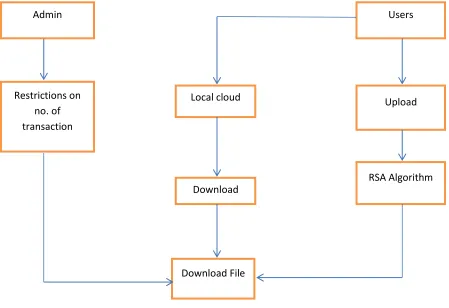
Available Online at www.ijpret.com 100 Figure 1:- Basic design of proposed work
Admin: In an organization, admin create roles for users & also specify the number of transactions per user as per their role.
User: A user can upload/download file. When uploading file RSA scheme are used to encrypt data when downloading the files inversely RSA are used to decrypt data.
Local Cloud: Local Cloud is used to store data in the encrypted form.
Below we will explain RSA Algorithm.
RSA
RSA is widely used Public-Key algorithm. RSA stands for Ron Rivest, Adi Shamir and Len Adleman, who first publicly described it in 1977. In our proposed work, we are using RSA algorithm to encrypt the data to provide security so that only the concerned user can access it[5]. Here we explain RSA algorithm. RSA algorithm involves three steps:
Admin Users
Restrictions on no. of transaction
Upload
RSA Algorithm Local cloud
Download
Available Online at www.ijpret.com 101 1. Key Generation
2. Encryption
3. Decryption
An RSA algorithm is the genetic algorithms in the security system in the cryptography [6]. In
RSA algorithms first we choose the two integer values.
Let P and Q are the integer values. Then we find the value
of N.
N = P × Q … (1.1)
∅(N) = (P − 1) × (Q − 1) … (1.2)
Then we choose the value of e, which is not
factor of ∅(N)
And also we find the value of d, which is
related the expectation value (e).
ed = 1 mod ∅(N) … (1.3)
Or d = ½ mod ∅(N) … (1.4)
Or d = 𝑒−1 mod ∅(N) … (1.5)
By Euclidian theorem the value of d depends
upon |∅(N)|.
The value of d has the modulus values 1, 2…n.
d = 1 + |∅(N)| … (1.6)
RSA algorithms are also used in the
encryption and decryption.
Available Online at www.ijpret.com 102 Decryption key = (d, N).
If the message M so the value of M <N.
Encrypt = E = 𝑀𝑒 mod N ... (1.7)
Decrypt => M = 𝐸𝑑mod N … (1.8)
In equations (1.1), (1.2) and (1.6) are using
for the key generation but the equation (1.7), (1.8) are using encryption and decryption.
IMPLEMENTATION AND RESULT
1. The described work is implemented in
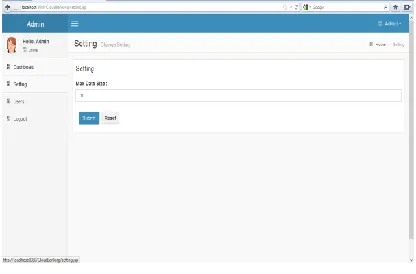
Advanced Java. Firstly we show the snapshot where admin restricts all the users to assign the size for one user. Figure 2. Represents assigning data size.
Figure 2. Assigning Data Size
Available Online at www.ijpret.com 103 Figure 3. Represents list of users
3. Figure 4. Represents the uploading page where Employee upload the file and the processing can take place. When Employee upload a file Firstly RSA Algorithm applied on the file which encrypt the file and make not visible to the admin.
Figure 4. Represents the uploading procedure
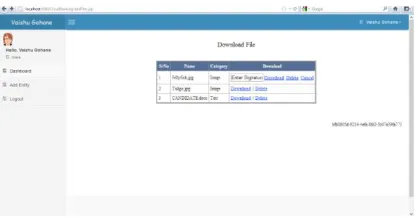
4. Figure 5. Represents the downloading procedure where Employee wants to download the file. But during downloading a file RSA Algorithm decryption is required.
Available Online at www.ijpret.com 104 5. Figure 6. Represents the downloading a page within No Permission to download the file. Because an Employee have restricted only two files have downloaded. Because Employee is restricted by an admin. After accessing two files when Employee wants to download a third file a message is generated that Contact to admin.
Figure 6. Represents the downloading files with in Restriction
6. RSA helps to encrypted the data which converts an image into an Encrypted form of data. Below Fig.7. Represents the encryption by using RSA Algorithm.
a. Image before encryption
b. image after encryption
Available Online at www.ijpret.com 105 CONCLUSION AND FUTURE SCOPE
Cloud Computing is still a new and evolving paradigm where computing is viewed as on demand service. Once the organization takes the decision to move to the cloud, it drops control over the data. Security of the Cloud relies on reliable computing and cryptography. Thus, in our proposed work, only the authorized user can access the data. Even if some unauthorized user gets the data accidentally or intentionally if he captures the data also, he can’t decrypt it and accessed it due to encryption techniques. With the kind of A RSA Algorithm it would be more secure to get hacked. It also provides a better storage and security over Cloud design.
In future our proposed work is very help full to increase the security on cloud in cloud computing As the Security need increases access and helps for safeguarding of data.
ACKNOWLEDGMENT
Author would like to give his sincere gratitude to guide Mr. Rajesh T. Nakhate who encouraged and guided us throughout this paper.
REFERENCES
1. Uma Somani, “Implementing Digital Signature with RSA Encryption Algorithm to Enhance the Data Security of Cloud in Cloud Computing," 2010 1st International Conference on Parallel, Distributed and Grid Computing (PDGC - 2010). Volume 64, pp.211-216.
2. Leena Khanna “Cloud Computing: Security Issues And Description Of Encryption Based Algorithms To Overcome Them” International Journal of Advanced Research in Computer Science and Software Engineering, Volume 3 March - 2013, pp. 279-283.
3. Wei-Tek Tsai “Role-Based Access-Control Using Reference Ontology in Clouds”978-0-7695-4349-9/11 $26.00 © 2011 IEEE DOI 10.1109/ISADS.2011.21
4. Ajit Singh, “Securing Data by Using Cryptography with Steganography ”“International Journal of Advanced Research in Computer Science and Software Engineering“ Volume 3, Issue 5, May 2013 ,pp.404-402.
5. Rashmi Nigoti “A Survey of Cryptographic Algorithms for Cloud Computing” IJETCAS 13-123; March-May 2013, pp.141-146.
Available Online at www.ijpret.com 106 7. Esh Narayan” To Enhance the data security of cloud in cloud computing using RSA Algorthim”, Bookman International Journal of Software Engineering, Vol. 1 No. 1 Sep. 2012, ISSN No. 2319-4278.
8. Farzad Sabahi, “Cloud Computing Security Threats and Responses," IEEE Trans. on Cloud Computing., vol. 11, no. 6, pp. 670 { 684, 2002.}
9. Mohammed Achemlal, Sa¨ıd Gharout and Chrystel Gaber “Trusted Platform Module as an Enabler for Security in Cloud Computing” Vol 978-1-4577-0737-7/11/$26.00 ©2011 IEEE.
10. Jianfeng Yang, Zhibin Chen “Cloud Computing Research and Security Issues” Vol 978-1-4244-5392-4/10/$26.00 ©2010 IEEE.
11. Victor Echeverr´ıa, Lorie M. Liebrock, and Dongwan Shin “Permission Management System: