Quick Guide to
Education Indicators
UNESCO
The constitution of the United Nations Educational, Scientific and Cultural Organization (UNESCO) was adopted by 20 countries at the London Conference in November 1945 and entered into effect on 4 November 1946. The Organization currently has 195 Member States and 10 Associate Members.
The main objective of UNESCO is to contribute to peace and security in the world by promoting collaboration among nations through education, science, culture and communication in order to foster universal respect for justice, the rule of law, and the human rights and fundamental freedoms that are affirmed for the peoples of the world, without distinction of race, sex, language or religion, by the Charter of the United Nations.
To fulfil its mandate, UNESCO performs five principal functions: 1) prospective studies on education, science, culture and communication for tomorrow’s world; 2) the advancement, transfer and sharing of knowledge through research, training and teaching activities; 3) standard-setting actions for the preparation and adoption of internal instruments and statutory recommendations; 4) expertise through technical cooperation to Member States for their development policies and projects; and 5) the exchange of specialized information.
UNESCO Institute for Statistics
The UNESCO Institute for Statistics (UIS) is the statistical office of UNESCO and is the UN depository for global statistics in the fields of education, science, technology and innovation, culture and communication.
The UIS was established in 1999. It was created to improve UNESCO’s statistical programme and to develop and deliver the timely, accurate and policy-relevant statistics needed in today’s increasingly complex and rapidly changing social, political and economic environments.
Published in 2018 by: UNESCO Institute for Statistics P.O. Box 6128, Succursale Centre-Ville Montreal, Quebec H3C 3J7
Canada
Tel: +1 514-343-6880
Email: [email protected] http://www.uis.unesco.org
Ref: UIS/2018/ED/TD/4
© UNESCO-UIS 2018
This publication is available in Open Access under the Attribution-ShareAlike 3.0 IGO (CC-BY-SA 3.0 IGO) license (http:// creativecommons.org/licenses/by-sa/3.0/igo/). By using the content of this publication, the users accept to be bound by the terms of use of the UNESCO Open Access Repository (http://www.unesco.org/open-access/terms-use-ccbysa-en).
The designations employed and the presentation of material throughout this publication do not imply the expression of any opinion whatsoever on the part of UNESCO concerning the legal status of any country, territory, city or area or of its authorities or concerning the delimitation of its frontiers or boundaries.
What is this guide?
This guide serves as a quick reference on how to monitor progress towards Sustainable Development Goal 4 (SDG 4) on quality education. It provides basic explanations of SDG 4 targets, their indicators, how they are created and where to find the information needed for these indicators.
Table of contents
1. What is SDG 4? . . . .7
2. What tools exist to measure progress towards SDG 4? . . . .11
3. What is the UIS’ role in SDG 4 monitoring? . . . .17
4. How are SDG 4 indicators developed and calculated? . . . . 20
4.1 Free, equitable and quality primary and secondary education . . . .22
4.2 Quality early childhood development, care and pre-primary education . . . .25
4.3 Quality TVET and tertiary education . . . .28
4.4 Technical and vocational skills . . . .30
4.5 Equal access to all levels of education and training for the vulnerable . . . .32
4.6 Youth and adult literacy and numeracy . . . .34
4.7 Knowledge and skills needed to promote sustainable development . . . .36
4.a School environment . . . .38
4.b Scholarships . . . .39
4.c Qualified teachers . . . .40
Annex. Targets and indicators of Sustainable Development Goal 4 on education . . . .41
Acronyms
AES Adult Education SurveyCLA Catalogue of Learning Assessments
CONFEMEN Conférence des ministres de l’Éducation des États et gouvernements de la Francophonie DAC Development Assistance Committee
DHS Demographic and Health Survey
ECLAC UN Economic Commission for Latin America and the Caribbean ECDI Early Childhood Development Index
EFA Education for All
EMIS Education Management Information System ESD Education for sustainable development GAML Global Alliance to Monitor Learning GCED Global citizenship education GEMR Global Education Monitoring Report GPE Global Partnership for Education GPI Gender parity index
HLPF UN High-Level Political Forum on Sustainable Development IAEG-SDGs Inter-Agency and Expert Group on SDG Indicators IAG-EII Inter-Agency Group on Education Inequality Indicators ICT Information and communication technology
IEA International Association for the Evaluation of Educational Achievement IIEP UNESCO International Institute for Educational Planning
IPUMS Integrated Public Use Microdata Series
ISCED International Standard Classification of Education ITU International Telecommunications Union
LaNA Literacy and Numeracy Assessment
LAMP Literacy Assessment and Monitoring Programme
LLECE Latin American Laboratory for Assessment of the Quality of Education MDG Millennium Development Goal
MELQO Measuring Early Learning Quality and Outcomes MICS Multiple Indicator Cluster Survey
MPL Minimum proficiency level NEA National Education Account
NEQMAP Network on Education Quality Monitoring in the Asia-Pacific NGO Non-governmental organization
ODA Official development assistance
OECD Organisation for Economic Co-operation and Development OOSCI UIS/UNICEF Global Initiative on Out-of-School Children
PASEC Programme d’Analyse des Systèmes Éducatifs de la CONFEMEN (CONFEMEN Programme for the Analysis of Education Systems)
PILNA Pacific Islands Literacy and Numeracy Assessment PIRLS Progress in International Reading Literacy Study PISA Programme for International Student Assessment PRIDI Programa Regional de Indicadores de Desarrollo Infantil
SACMEQ Southern and Eastern Africa Consortium for Monitoring Educational Quality SDG Sustainable Development Goal
SEAMEO Southeast Asian Ministers of Education Organization SEA-PLM Southeast Asia Primary Learning Metrics
SLS Short Literacy Survey
STEP Skills Towards Employment and Porductivity SWTS School-to-Work Transition Survey
TCG Technical Cooperation Group on the Indicators for SDG 4-Education 2030
TERCE Tercer Estudio Regional Comparativo y Explicativo (Third Regional Comparative and Explanatory Study) TIMSS Trends in International Mathematics and Science Study
TVET Technical and vocational education and training UIS UNESCO Institute for Statistics
UNESCO United Nations Educational, Scientific and Cultural Organization UNICEF United Nations Children’s Fund
1. What is SDG 4?
H
eads of State, government leaders, UN high-level representatives and civil society met in 2015 at the 70th Session of the United Nations General Assembly and adopted the 2030 Agenda for Sustainable Development. This ambitious agenda, “of the people, by the people, and for the people,” was designed with the active involvement of UNESCO. Education plays a central theme throughout the 2030 Agenda, which includes a stand-alone education goal and education-related targets within 7 other of the 17 Sustainable Development Goals (SDGs).SDG 4 aims to “ensure inclusive and equitable quality education and promote lifelong learning opportunities for all” by 2030. The goal consists of ten targets to guide countries along a transformative path to a sustainable education agenda.
What is a target? A target is a specific, measurable objective which will contribute to achieving one or more
of the goals. SDG 4 has ten targets encompassing many different aspects of education. Among them, there are seven targets which are expected outcomes and three targets which are means of achieving these outcomes.
How can the progress of SDG 4 be measured?SDG 4 has a broader focus than its predecessors, Millennium
Development Goal (MDG) 2, “Achieve universal primary education” and MDG 3, “Promote gender equality and empower women”. From a statistical point of view, the MDG framework was built on a set of concrete, measurable indicators and helped to improve national capacity for monitoring in many developing countries. SDG 4 targets, on the other hand, are more complex and contain several concepts that were never measured before at the global level, creating new challenges for developing the indicators which can monitor progress towards SDG 4.
© Ami V
itale / The W
What is an indicator? Indicators are markers of change or continuity which enable us to measure the path of development, for example. Within the SDGs, they describe the way in which a given unit (pupil, school, country or region) is progressing in relation to a specific target. SDG 4 indicators are multifaceted and many require new methodologies, definitions and calculation methods, as well as considerable changes to national systems reporting data both nationally and internationally.
What is the difference between a target and an indicator? If you have a personal target, say, to finish a
marathon this year, a possible indicator to monitor your progress is the distance that you can run every day during your preparation. Achieving longer distances indicates that you are closer to your target.
However, educational targets are much more complex than running 42 km and often more exhausting. A better analogy could be found in the process of learning how to play a new musical instrument. You might set a personal target of learning how to play the guitar this year. But how skilful will you need to be to say that you know how to play it? You may set a more specific target such as playing a particular song or learning how to play a given number of chords. Moreover, choosing one or more indicators to monitor your progress can be as complex as the target setting: Number of hours dedicated to learning? Number of chords or parts of the song that you know how to play? Your teacher’s feedback? The options are many, and the same is true for SDG 4 indicators.
How are the SDG 4 indicators developed? Following several rounds of global consultations and meetings
with UN Member States, international and regional organizations, academia, businesses, non-governmental organizations (NGOs) and civil society, a list of 11 global indicators to monitor SDG 4 was formally adopted by the UN General Assembly in 2017. With consensus reached on the list of global education indicators, a tier classification tool was developed to identify the state of methodological development of each indicator and its data availability on a global scale. Tier 1 and Tier 2 indicators have internationally-established methodologies and standards, but Tier 2 indicators are not available for a sufficient number of countries. Tier 3 indicators require the development of methodologies and standards, and this work has been prioritised by the Inter-Agency and Expert Group on SDG Indicators (IAEG-SDGs), a globally representative group of 28 national statistical experts established by the UN Statistical Commission in 2015 to develop and implement a global indicator framework for the monitoring of the SDGs. All indicators are considered equally important for monitoring SDG 4, independent of their tier classification.
UIS Information Paper No. 45 (2017c) describes current procedures undertaken by the UNESCO Institute for Statistics (UIS) to develop education indicators from administrative and survey data.
Are all countries and regions going to use the same indicators?SDG 4 monitoring is based on universal
principles and emphasises a participatory framework in which all stakeholders (including civil society, business, parliament, academia and government) can recognise their shared responsibility in achieving the SDGs. Figure 1 shows the multi-tiered, multi-purpose framework, which is composed of four monitoring levels—global, thematic, regional and national.
across countries and years provides insight into measuring performance, driving policy reform and allocating resources equitably to improve learning among all population groups. The IAEG-SDGs, composed of Member States and including regional and international agencies as observers, is responsible for the global indicator framework development, as well as for its refinement and occasional revision. The IAEG-SDGs has identified the UNESCO Institute for Statistics (UIS) as the custodian agency for 9 of the 11 global indicators for SDG 4 and a partner organization for the other two global indicators.
Thematic monitoring adds a level of monitoring of cross-nationally comparable indicators within a specific sector (e.g. education, environment, energy, health) or cross-cutting themes (e.g. gender). Thematic indicators serve as a framework to track progress on a cross-nationally comparable basis, with a more in-depth view of sectoral priorities than available in the global monitoring framework. This level provides the opportunity to identify sector-specific challenges and bottlenecks and mobilise the action required to address them. The thematic monitoring of SDG 4 follows the guidelines established by the Education 2030 Framework for Action, which was adopted by 184 UNESCO Member States in 2015. The thematic indicators for SDG 4 are developed by the Technical Cooperation Group on the Indicators for SDG 4-Education 2030 (TCG), which consists of representatives of Member States, international agencies and civil society organizations. The UIS hosts the Secretariat and co-chairs the TCG with the UNESCO Division for Education 2030 Support.
At the regional level of monitoring, a set of indicators will be developed to consider priorities and issues of common interest that are shared by countries in a particular region, as outlined in regional planning documents or frameworks. Different regions and sub-regions have reached agreements on certain goals and targets even before the approval of the SDGs. A crucial step to promote efficiency and to avoid the duplication of efforts is to map the global and regional strategies. The UIS and the Global Education Monitoring Report have produced a global overview of regional education monitoring, reporting and benchmarking mechanisms:
East Asia and the Pacific: Association of Southeast Asian Nations (ASEAN) —Work Plan on Education
2016-2020; Pacific Islands Forum (PIF)—Pacific Education Development Framework; Southeast Asian Ministers of Education Organization (SEAMEO)—Education Agenda 2035; SPC Pacific Community— Education Quality Assessment Programme.
Europe and Northern America: European Union (EU)—Education and Training 2020 (ET 2020).
Latin America and the Caribbean: Caribbean Community (CARICOM)—Human Resource Development
2030 Strategy; Central American Educational and Cultural Coordination (CECC)—Central American Education Policy (PEC); Organization of American States (OAS)—Inter-American Education Agenda; Organization of Eastern Caribbean States (OECS)—OECS Education Sector Strategy; Organization of Ibero-American States (OEI)—Metas 2021.
Northern Africa and Western Asia: African Union (AU)—Continental Education Strategy for Africa
2016-2025;Arab League Educational Cultural and Scientific Organization (ALECSO).
South and West Asia:South Asian Association for Regional Cooperation (SAARC)—SAARC Development
Sub-Saharan Africa: African Union (AU)—Continental Education Strategy for Africa 2016-2025; Southern African Development Community (SADC)—Process of update of Protocol on Education and Training / Regional Implementation Plan 2007-2015.
Cross-regional organizations: Commonwealth—Commonwealth Education Policy Framework; Islamic
Educational, Scientific and Cultural Organization (ISESCO)—Strategy for the Development of Education in the Islamic World; Organisation internationale de la Francophonie (OIF); Organisation for Economic Co-operation and Development (OECD).
National level monitoring of SDG 4 is linked to the needs of national and sub-national governments in developing education sector plans and informing policies. Data that provide high-level granularity and adapt to the specificities of the national context—such as in sub-national geographical units, specific disadvantaged groups or by wealth—offer a greater capacity to inform policy by examining relevant disparities in education outcomes. Monitoring SDG 4 at this level benefits from the active participation of a diverse group of stakeholders representing their respective constituencies and education-related concerns. The UIS also works closely with national governments and statistical agencies to support national strategies for data collection and to enable international reporting on all SDG 4 targets within the Education 2030 Framework for Action.
The global and thematic education indicators were designed to facilitate cross-national monitoring of progress towards the targets. Countries will be encouraged to report on both global and thematic indicators. Each country will determine whether it is able to collect all the data needed for each of the recommended indicators and to report them as requested. Countries may choose from the list of thematic indicators that are most relevant for their policy needs. International organizations will continue to collect data from countries for cross-national com-parisons and to report on trends.
Source: UNESCO Institute for Statistics, 2016.
Figure 1. Four levels of monitoring education targets
Global
Regional
National
Thematic
Secretariat: UIS Technical Body: TCG
UN Regional Commissions
Secretariat: UNDESA Technical Body: IAEG-SDGs
2. What tools exist to measure
progress towards SDG 4?
T
here are several regional and international organizations which generate information on how to measure countries’ progress towards SDG 4 targets. The coordination of the SDG data and indicator development at the international level is the responsibility of SDG custodian agencies.Custodian agencies are UN bodies (and in some cases other international organizations) responsible for
compiling and verifying country data and metadata and for submitting the data, along with regional and global aggregates, to the United Nations Statistics Division (UNSD). The agencies ensure that the data are internationally-comparable and develop international standards and methodologies to help countries in monitoring. Country-level data may be published in their databases and used for thematic reporting.
The institutional network
The UIS has been mandated as the official source of cross-nationally-comparable data to monitor progress towards SDG 4 on education and key targets related to science and culture. As defined in the Education 2030 Framework for Action, the UIS works with partner organizations and experts on the development of new indicators, statistical approaches and
© Bart V
erweij / W
monitoring tools to assess progress towards SDG 4 (UNESCO, 2016), in coordination with the Education 2030 Steering Committee.
This mandate reflects the trust of the international community in UIS data and its proven track record in methodological work and standard-setting with national statistical offices, line ministries and technical partners in every region.
Some key initiatives coordinated by the UIS include:
The Technical Cooperation Group on the Indicators for SDG 4–Education
2030 ( TCG ) serves as a platform to discuss and develop the indicators used for
monitoring SDG 4 targets in an open, inclusive and transparent manner. The TCG is composed of 38 regionally-representative statistical experts from Member States, international organizations, civil society and the Co-Chair of the Education 2030 Steering Committee.
The Global Alliance to Monitor Learning ( GAML ) is designed to improve learning
outcomes by supporting national strategies for learning assessments and developing internationally-comparable indicators and methodological tools to measure progress towards key targets of SDG 4. Through a highly-collaborative approach, GAML brings together a broad range of stakeholders, including experts and decisionmakers involved in national and cross-national learning assessment initiatives, as well as donors and civil society.
The Inter-Agency Group on Education Inequality Indicators ( IAG-EII ) is set up to promote and
coordinate the use of household survey data for education monitoring at the national, regional and global levels. The IAG-EII is led by the UIS, UNICEF and the World Bank, and includes as members other organizations involved in the production and use of household survey data: the Global Education Monitoring Report, Global Partnership for Education (GPE), ICF, the OECD, RTI International and USAID.
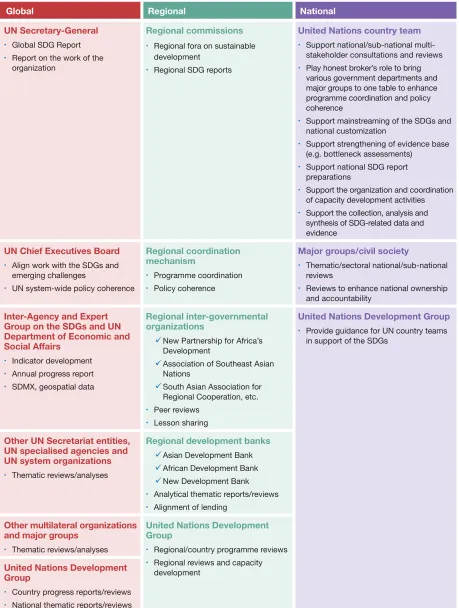
The UN system has developed a wide support network for SDG monitoring at the global, regional and national levels. The specific roles of organizations in each level are detailed in Table 1.
Data sources
Countries are the starting point for all national and international monitoring. The players involved in data collection
and dissemination include the national statistical office, line ministries and other relevant national institutions.
Table 1. Supportive role of the UN system, international organizations and major groups
Global Regional National
UN Secretary-General • Global SDG Report • Report on the work of the
organization
Regional commissions
• Regional fora on sustainable development
• Regional SDG reports
United Nations country team • Support national/sub-national
multi-stakeholder consultations and reviews • Play honest broker’s role to bring
various government departments and major groups to one table to enhance programme coordination and policy coherence
• Support mainstreaming of the SDGs and national customization
• Support strengthening of evidence base (e.g. bottleneck assessments)
• Support national SDG report preparations
• Support the organization and coordination of capacity development activities • Support the collection, analysis and
synthesis of SDG-related data and evidence
UN Chief Executives Board • Align work with the SDGs and
emerging challenges
• UN system-wide policy coherence
Regional coordination mechanism
• Programme coordination • Policy coherence
Major groups/civil society
• Thematic/sectoral national/sub-national reviews
• Reviews to enhance national ownership and accountability
Inter-Agency and Expert Group on the SDGs and UN Department of Economic and Social Affairs
• Indicator development • Annual progress report • SDMX, geospatial data
Regional inter-governmental organizations
ü New Partnership for Africa’s Development
ü Association of Southeast Asian Nations
ü South Asian Association for Regional Cooperation, etc. • Peer reviews
• Lesson sharing
United Nations Development Group • Provide guidance for UN country teams
in support of the SDGs
Other UN Secretariat entities, UN specialised agencies and UN system organizations • Thematic reviews/analyses
Regional development banks ü Asian Development Bank
ü African Development Bank
ü New Development Bank • Analytical thematic reports/reviews • Alignment of lending
Other multilateral organizations and major groups
• Thematic reviews/analyses
United Nations Development Group
• Regional/country programme reviews • Regional reviews and capacity
development United Nations Development
Group
• Country progress reports/reviews • National thematic reports/reviews
Administrative data. Every year, the UIS conducts surveys on formal education programmes and educational attainment and every two years a survey on literacy. These surveys consist of a set of questionnaires on education programmes, students, financial and human resources, literacy and educational attainment, which are reported according to international standards to assure cross-country comparability. The main data sources are administrative records from school surveys or aggregate data from labour force or household surveys. The questionnaires are sent to national statistical offices and ministries of education in each country. The results from these questionnaires are the source of many SDG 4 indicators.
Data on education finance and expenditure are essential to effectively address critical education policy questions. Data on public and international education expenditure are derived from administrative records compiled typically by the Ministry of Finance, Ministry of Education or national statistical offices. In 2016, the UNESCO International Institute for Educational Planning (IIEP) and the UIS jointly developed a methodology on National Education Accounts (NEAs), a comprehensive, systematic and comparable framework for collecting, processing and analysing data on education expenditure (IIEP, UIS and Pôle de Dakar, 2016). Data on private household expenditure are derived from household budget surveys usually administered by national statistical offices.
Household surveys.The UIS compiles and disseminates household survey data to produce indicators to
examine specific characteristics of populations, which are generally only available through these sources. Datasets from household surveys are gathered from international programmes, such as the Demographic and Health Survey (DHS) and the Multiple Indicator Cluster Survey (MICS), as well as from survey repositories of organizations such as the UN Economic Commission for Latin America and the Caribbean (ECLAC), the Integrated Public Use Microdata Series (IPUMS) and the World Bank. These data are used to calculate various education indicators, such as school attendance and completion rates.
Learning assessments. The UIS identified nine cross-national learning assessments which meet the criteria
to measure SDG 4 Indicator 4.1.1, the proportion of children and young people achieving minimum proficiency in reading and mathematics: LaNA (Literacy and Numeracy Assessment), PASEC (Programme d’Analyse des Systèmes Éducatifs de la CONFEMEN), PILNA (Pacific Islands Literacy and Numeracy Assessment), PIRLS (Progress in International Reading Literacy Study), PISA (Programme for International Student Assessment), SACMEQ (Southern and Eastern Africa Consortium for Monitoring Educational Quality), SEA-PLM (Southeast Asia Primary Learning Metrics), TERCE (Tercer Estudio Regional Comparativo y Explicativo) and TIMSS (Trends in International Mathematics and Science Study). Using these data sources, the UIS has calculated key indicators related to learning outcomes for SDG 4.
Main regional platforms
Many regions have international structures to monitor education development in countries. They serve as an important source of internationally-comparable data with high regional relevance. Some regional initiatives include:
Africa
PASEC has been administered in 13 countries in Francophone West Africa. PASEC is designed to assess student
abilities in mathematics and reading in French. Started in 1993, the programme is managed by CONFEMEN (Conférence des Ministres de l’Éducation des États et gouvernements de la Francophonie). The assessment is administered in different years in different countries. PASEC is typically administered to students in 2nd and 5th grades at the beginning and end of the same school year, and is designed to measure students’ progress over the course of that year. Assessment results are intended for use primarily as a diagnostic tool.
SACMEQ is a consortium of Ministries of Education located in the Southern Africa sub-region. SACMEQ aims at
assessing and monitoring the quality of education and learning achievements in member countries. The broad areas of assessment are: pupils’ characteristics and their learning environments, teacher characteristics, head teacher characteristics and their views on school infrastructure and management. SACMEQ assessments were carried out starting in 1995, 2000 and 2006. A fourth round of assessments was scheduled for implementation starting in 2012.
Uwezo, meaning ‘capability’ in Kiswahili, is a five-year initiative that aims to improve competencies in literacy and numeracy among children aged 6 to 16 years in Kenya, Tanzania and Uganda. Since 2009, Uwezo has implemented large-scale, nationally-representative household surveys to assess the actual basic literacy and numeracy competencies of school-aged children. Each year, Uwezo produces three national reports and one regional report that present the main findings.
Arab States
Unlike other UNESCO regions, the Arab States do not use a regionally-harmonised approach for measuring student achievement. Furthermore, many countries rely solely on end-of-cycle examinations. However, more countries are participating in international large-scale assessments, such as TIMSS and PIRLS managed by IEA, in addition to PISA managed by the OECD.
Asia and the Pacific
SEA-PLM is a regional assessment which seeks to set a common approach to assessing learning outcomes
of Grade 5 students in reading, writing, mathematics and global citizenship. The Southeast Asian Ministers of Education Organization (SEAMEO) Secretariat and UNICEF East Asia and Pacific Regional Office (EAPRO) jointly serve as the Secretariat to SEA-PLM.
countries in 2012 to set the regional baseline and country rankings for literacy and numeracy achievement of pupils who have completed four and six years of primary education.
The Network on Education Quality Monitoring in the Asia-Pacific (NEQMAP), established in March 2013 in Bangkok, is a platform to exchange knowledge, experiences and expertise on the monitoring of educational quality in countries and jurisdictions of the Asia-Pacific region. The network focuses on student learning assessments as key tools for monitoring educational quality, while acknowledging the importance of the role of curriculum and pedagogy in successful learning. UNESCO’s Asia and Pacific Regional Bureau for Education (UNESCO Bangkok) serves as the NEQMAP Secretariat.
Europe and North America
Eurostat is the statistical office of the European Union situated in Luxembourg. Its mission is to provide
high-quality statistics on European countries. Eurostat’s education and training statistics provide information on the participation of individuals in education and training activities, education financing, teaching staff and educational outcomes. Despite not having specific regional learning assessments, most countries in Europe and North America participate in large-scale international assessments organized by the IEA and OECD.
Latin America and the Caribbean
The Latin American Laboratory for Assessment of the Quality of Education (LLECE), which is seated in the UNESCO Regional Bureau for Education in Latin America and the Caribbean, is a network of national units measuring educational assessment in the region. LLECE has conducted comparative and explanatory regional educational assessment studies since 1997.
3. What is the UIS’ role in SDG 4
monitoring?
The UIS is the official statistical agency of UNESCO. In this capacity, the international development community has given the UIS the mandate to develop the methodologies, standards and indicators needed to achieve SDG 4–Education 2030 and key targets in science and culture, in close consultation with partners. UIS efforts sustain activities across several areas of SDG 4 monitoring (see Figure 2).
Interim reporting
Monitoring the 43 global and thematic indicators on education follows a similar reporting strategy as for all SDG targets. However, for some indicators data are currently not available. While the UIS works on capacity building and indicator development, alternative data sources are used in the interim to maximise the availability of data. The objective is to report progress before the methodological development of the main data sources is finalised. The interim reporting strategies will be applied until sustainable long-term reporting strategies have been put in place for each of the indicators.
Collaboration
As the official source of cross-nationally-comparable data on education, the UIS bears a major responsibility for the success of SDG 4 monitoring. This responsibility is shared with partner organizations. While the UIS has been given the mandate to produce the data needed to monitor progress and channel policies and resources to those in greatest need, no single organization can produce all the data for all indicators. For some of the global indicators, for instance, different organizations were designated as the custodian agency (see Table 2).
© Dominic Chavez / W
Figure 2. UIS’ role in SDG 4 monitoring
CAPACITY BUILDING
The statistical capacity of most countries is being put to the test by the breadth, depth and ambition of the global education goal. The emphasis on equity and quality of education in the 2030 Agenda for Sustainable Development and the more comprehensive nature of the SDGs relative to the MDGs require more data than before and from a wider range of sources: administrative data, financial data, and data from censuses, household surveys, and national, regional and international learning assessments. Based on its longstanding track record working directly with countries, the UIS has developed a series of tools and strategies to help national statistical offices and line ministries overcome the measurement challenges. The UIS Data Digest 2017 describes these strategies, focusing on data quality as the foundation for an effective SDG 4 monitoring framework (UIS, 2017b).
STANDARD SETTING
At the global and international levels, it is essential to make sure that “apple statistics” are not mixed with “orange statistics”. In this sense, the UIS develops and implements standards for international comparability of data. At the same time, the Institute works to improve the quality of the data produced to monitor education around the world. Two examples are the International Standard Classification of Education (ISCED) and GAML’s work to define comparable learning metrics or scales for the relevant SDG 4 targets.
INDICATOR DEVELOPMENT
Indicator development is a core part of UIS work and is one of the main drivers for introducing new data collections or modifying existing ones. Once the need for an indicator is identified and its development agreed, the next steps are to develop the methodology to calculate the indicator, identify the data sources, administer a survey to Member States or identify alternate sources of data, and finally analyse the indicators (UIS, 2017c). For SDG 4 monitoring, the TCG and the GAML are the main fora for the work on indicator development, based on active participation of Member States, partner organizations and leading experts.
DATA COLLECTION
The UIS compiles education-related data and metadata from various sources at the national, regional and international levels. Although most data are collected through annual UIS surveys sent to Member States, the Institute also produces indicators based on household surveys and international learning assessments.
DISSEMINATION AND ANALYSIS
Table 2. SDG 4 global indicators and custodian agencies
Indicator Custodian agency
4.1.1 Proportion of children and young people (a) in Grade 2 or 3; (b) at the end of primary education; and (c) at the end of lower secondary education achieving at least a minimum proficiency level in (i) reading and (ii) mathematics, by sex
UNESCO-UIS
4.2.1 Proportion of children under 5 years of age who are developmentally on track in health, learning and psychosocial well-being, by sex UNICEF
4.2.2 Participation rate in organized learning (one year before the official primary entry age), by sex UNESCO-UIS
4.3.1 Participation rate of youth and adults in formal and non-formal education and training in the previous 12 months, by sex UNESCO-UIS
4.4.1 Proportion of youth and adults with information and communications technology (ICT) skills, by type of skill UNESCO-UIS, ITU
4.5.1 Parity indices (female/male, rural/urban, bottom/top wealth quintile and others such as disability status, indigenous peoples and conflict-affected, as data become available) for all education indicators on this list that can be disaggregated
UNESCO-UIS
4.6.1 Proportion of population in a given age group achieving at least a fixed level of proficiency in functional (a) literacy and (b) numeracy skills, by sex UNESCO-UIS
4.7.1
Extent to which (i) global citizenship education and (ii) education for sustainable development, including gender equality and human rights, are mainstreamed at all levels in: (a) national education policies, (b) curricula, (c) teacher education and (d) student assessment
UNESCO-UIS
4.a.1
Proportion of schools with access to: (a) electricity; (b) the Internet for pedagogical purposes; (c) computers for pedagogical purposes; (d) adapted infrastructure and materials for students with disabilities; (e) basic drinking water; (f) single-sex basic sanitation facilities; and (g) basic handwashing facilities (as per the WASH indicator definitions)
UNESCO-UIS
4.b.1 Volume of official development assistance flows for scholarships by sector and type of study OECD
4.c.1
Proportion of teachers in: (a) pre-primary education; (b) primary education; (c) lower secondary education; and (d) upper secondary education who have received at least the minimum organized teacher training (e.g. pedagogical training) pre-service or in-service required for teaching at the relevant level in a given country, by sex
UNESCO-UIS
4. How are SDG 4 indicators
developed and calculated?
To define the global and thematic indicators, each target was analysed with two purposes in mind: to identify the key concepts that need to be measured to monitor progress towards its achievement and whether existing policies would be sufficient to ensure that the target could be met or whether further action, including remedial action, might be needed to get back on track. The underlying key concepts that guided the development of the indicators were as follows:
Learning, skills and knowledge
Five of the ten education targets focus on learning outcomes of children, youth and adults. This is a shift from previous global targets, such as the MDGs, which focused solely on ensuring access to, participation in and completion of formal primary education and on gender equality in primary, secondary and tertiary education. The Education 2030 targets underscore the extent to which enrolment and participation are the best means to attain good results and learning outcomes at every age and stage, such as school readiness for pre-school children, academic competencies of children in primary and secondary education, functional literacy and numeracy skills among youth and adults, and skills for work.
© Salahaldeen Nadir / W
Equity
Across each target, the overarching focus on equity aims to ensure that no one is left behind, especially the poorest and most vulnerable groups. In the years that remain until 2030, the international community must transform this decisive engagement into reality for all children, youth and adults, no matter where they live or the conditions they face. Equity indicators encompass individual characteristics, such as sex, location, ethnicity, language, disability status and engagement in child labour, and household characteristics, such as parents’ education level, wealth or other measures of socioeconomic status.
Participation and completion
Indicators on participation and completion have the highest rates of data availability among countries. This is most likely linked to the availability of such data in routine data collection systems, such as Education Management Information Systems (EMIS). In fact, during the past 15 years, most countries have made great strides to establish mechanisms to track progress, particularly on the former MDGs and specifically the Education for All (EFA) goals, by measuring access to, participation in and completion of formal primary education and gender equality in primary, secondary and tertiary education. Within the SDG 4 agenda, countries are expected to continue collecting these data while improving their quality to track progress over time.
Policy and provision
To fully monitor some SDG 4 targets, it is necessary to cover not only outcomes and outputs but also the inputs of educational systems. On the whole, inputs are the aspects of the education system that the government has relatively direct control over (such as total spending, legislation, structure), while outputs are the direct results of those inputs and outcomes are the ultimate objectives that the system as a whole is supposed to fulfil, such as learning outcomes. Therefore, some indicators aim at comparing countries in relation to the structure and resources provided for students and teachers, as well as the normative framework guiding national education policies.
And next…
Free, equitable and quality
primary and secondary education
TAR
GE
T 4.1
By 2030, ensure that all girls and boys complete free, equitable andquality primary and secondary education leading to relevant and effective learning outcomes.
Indicator 4.1.1
Proportion of children and young people (a) in Grade 2 or 3; (b) at the end of primary education; and (c) at the end of lower secondary education achieving at least a minimum proficiency level in (i) reading and (ii) mathematics, by sex
CONCEPT
Target 4.1 covers the quality of primary and lower secondary education. The key concepts to measure include the quality of education and learning in two subject areas at the beginning and the end of primary education and at the end of lower secondary education.
Minimum proficiency level (MPL) is the benchmark of basic knowledge in a domain (mathematics, reading, etc.) measured through learning assessments.
DEFINITION
Percentage of children and young people in Grade 2 or 3 of primary education, at the end of primary education and at the end of lower secondary education achieving at least a minimum proficiency level in (i) reading and (ii) mathematics. The minimum proficiency level will be measured relative to new common reading and mathematics scales currently in development.
The current indicator shows data published by each of the agencies and organizations specialised in cross-national learning assessments. Data are comparable only for countries which participated in the same assessment. Methods to compare the results from different cross-national learning assessments are in development.
4.1
© Matluba Mukhamedova / W
orld Bank
TA
R
G
E
T
CALCULATION METHOD
The indicator is calculated as the percentage of children and young people at the relevant stage of education achieving or exceeding a pre-defined proficiency level in a given subject.
INTERPRETATION
The three measurement points will have their own established minimum standard. There is only one threshold that divides students into (a) below or (b) at or above minimum proficiency levels. Below minimum is the percentage of students who do not achieve a minimum proficiency level as established by countries according to globally-defined minimum competencies. At or above minimum is the percentage of students who have achieved at least the minimum proficiency level as defined in the assessment.
UIS Information Paper No. 48 (2017d) discusses the possibilities and limitations of developing a global assessment strategy for Indicator 4.1.1, taking into account both the technical and political dimensions of cross-national assessments.
DATA SOURCES
Various cross-national learning assessments including: PASEC, PIRLS, PISA, SACMEQ, TERCE and TIMSS.
The document “Metadata for the global and thematic indicators for the follow-up and review of SDG 4 and Education 2030” is the main UIS reference for information on each SDG 4 indicator. The metadata document, updated every year, provides a detailed description of the indicators, as well as their calculation methods, data sources and limitations (UIS, 2017a).
METHODOLOGICAL CHALLENGES
There are three key challenges in the production of learning outcomes indicators on a cross-nationally-comparable basis. First, national, regional and global data on basic competencies in literacy and numeracy are frequently collected but cannot be used in an integrated manner to create a global picture of learning. For instance, the proficiency of Brazilian students can be compared to the Paraguayan students as both countries have participated in the same regional assessment. However, their proficiency cannot be compared to South African students because the regional assessment in which South Africa participates does not use the same framework, which is based on different concepts and methods of how to assess learning.
Second, if national and regional data are to be used for global monitoring of learning, shared technical standards must be developed to ensure that the data are of similar quality.
Third, solutions must take into account multiple viewpoints: identifying relevant areas of learning that can and should be measured globally; conceptualising how national and regional data can help inform global measurement; and finally, striking an appropriate balance between global competencies and the role of local influences and goals on education.
4.1
TA
R
G
E
T
The goal of the UIS is to develop global content frameworks for reference to ensure that all children are taught what they need, to improve the quality of data and to report under common metrics. This work will support governments to measure effectively and monitor student learning outcomes in mathematics and reading against SDG Indicator 4.1.1 over time and to utilise the data for making informed policy decisions. A further goal is to support the use of existing national and cross-national assessments to facilitate the measurement and reporting of learning outcomes, rather than requiring a single assessment to be used by all countries for SDG reporting purposes.
In addition to the challenges mentioned above, it is important to note a significant limitation of the data available. Assessments are typically administered within school systems, referred to as school-based learning assessments. The current indicators cover only children in school. Therefore, children who are out of school are not included in this indicator. Assessing competencies of children and young people who are out of school would require household-based surveys.
The UIS has developed a framework to guide the design and implementation of learning assessments to support the production of measures of learning outcomes according to the highest-quality technical standards. Principles of Good Practice in Learning Assessment is a good reference for data quality on learning outcomes (UIS and ACER, 2017).
4.1
TA
R
G
E
T
Quality early childhood
development, care and
pre-primary education
By 2030, ensure that all girls and boys have access to quality early childhood development, care and pre-primary education so that they are ready for primary education.
Indicator 4.2.1
Proportion of children under 5 years of age who are developmentally on track in health, learning and psychosocial well-being, by sex
CONCEPT
Key concepts to measure include quality of care and education, access to programmes and child development and learning at the start of school. Measuring early childhood development is complicated but possible with sufficient technical consultation and operational support to countries to generate reliable data.
DEFINITION
Currently there is no globally-accepted definition of ‘developmentally on track’, and consequently, there are no further definitions for the indicator so far. Relevant information for this indicator can be found in MICS’ Early Childhood Development Index (ECDI) that presently defines ‘on track’ as the percentage of children aged 36 to 59 months who are developmentally on track in at least three of the following four domains:
m literacy-numeracy—at least two of the following are true: can identify/name at least 10 letters of the
alphabet, can read at least 4 simple words, and can recognise and name all numbers from 1 to 10;
4.2
TARGET 4.2
© T
amar Kobakhidze / W
orld Bank
TA
R
G
E
T
m physical—one or both of the following are true: can pick up small objects easily and is generally well
enough to play;
m socio-emotional—at least two of the following are true: gets along well with other children, does not
kick, bite or hit other children, and is not easily distracted; and
m learning —one or both of the following are true: can follow simple instructions on how to do
something correctly and, when given something to do, is able to do it independently.
CALCULATION METHOD
In MICS ECDI, the indicator is calculated as the percentage of children aged 36 to 59 months demonstrating age-appropriate levels of development in the areas being measured. A commonly-accepted definition of ‘on track’ has not yet been developed using national and regionally-developed standards for children’s learning and development.
INTERPRETATION
A high value indicates a large number of young children are well prepared for starting primary school in the areas of health, learning and psychosocial well-being.
DATA SOURCES
Measures to capture children’s early childhood experiences have been used in multiple countries in representative samples, such as: MICS ECDI, UNICEF West and Central African Regional Office (WCARO) Prototype in West Africa, Programa Regional de Indicadores de Desarrollo Infantil (PRIDI) in Latin America, the East Asia and Pacific Child Development Scales, the Early Development Index and the Early Human Capacity Index. Newly-developed scales with two to three representative samples include the Measuring Early Learning Quality and Outcomes Scale (MELQO) and the International Development and Early Learning Assessment (IDELA).
UNICEF assists countries in collecting and analysing data in order to fill data gaps for monitoring the situation of children and women through its international household-survey initiative, the MICS. For the fourth round of MICS (MICS 4), data collection was expanded to include an ECDI that aims to measure the developmental status of children within four domains: literacy-numeracy, physical, social-emotional development and learning.
METHODOLOGICAL CHALLENGES
Further methodological development work will be needed to ensure that the proposed measure reflects a commonly-agreed upon definition of ‘on track’ that is aligned with national standards, is relevant to children in all parts of the world and accurately reflects ‘developmentally on track’ in all countries. This requires establishing normative developmental patterns, which has not yet taken place in most countries. In addition, more countries will need to include questions about early childhood in their national household surveys or to participate in one of the international projects generating data for this indicator.
4.2
TA
R
G
E
T
Indicator 4.2.2
Participation rate in organized learning (one year before the official primary entry age), by sex CONCEPT
This indicator measures children’s exposure to organized learning activities in the year prior to the start of primary school. An organized learning programme is one which consists of a coherent set or sequence of educational activities designed with the intention of achieving pre-determined learning outcomes or the accomplishment of a specific set of educational tasks. Early childhood and primary education programmes are examples of organized learning programmes. The official primary entry age is the age at which children are obliged to start primary education according to national legislation or policies. DEFINITION
The participation rate in organized learning (one year before the official primary entry age) is defined as the percentage of children of the given age who participate in one or more organized learning programmes, including programmes which offer a combination of education and care. Participation in early childhood and in primary education are both included. The age will vary by country depending on the official age for entry to primary education.
CALCULATION METHOD
The number of children in the relevant age group who participate in an organized learning programme is expressed as a percentage of the total population of the same age.
INTERPRETATION
A high value of the indicator shows a high degree of participation in organized learning immediately before the official entrance age to primary education.
DATA SOURCES
The UIS produces time series based on enrolment data reported by Ministries of Education or national statistical offices and population estimates produced by the UN Population Division. Enrolment data are collected through the annual UIS Survey of Formal Education. Data are reported according to the levels of education defined in ISCED to ensure international comparability of resulting indicators. The indicator can also be calculated from household surveys and population censuses that collect data on attendance in early childhood and primary education by single year of age.
METHODOLOGICAL CHALLENGES
Participation in learning programmes in the early years is not full time for many children, meaning that exposure to learning environments outside of the home will vary in intensity. The indicator measures the percentage of children who are exposed to organized learning but not the intensity of the programme, which limits the ability to draw conclusions on the extent to which this target is being achieved. More work is needed to ensure that the definition of learning programmes is consistent across various surveys and defined in a manner that is easily understood by survey respondents, ideally with complementary information collected on the amount of time children spend in learning programmes.
4.2
TA
R
G
E
T
Quality TVET and tertiary
education
TARGET 4.3
By 2030, ensure equal access for all women and men to affordable and quality technical, vocational and tertiary education, including university.Indicator 4.3.1
Participation rate of youth and adults in formal and non-formal education and training in the previous 12 months, by sex
CONCEPT
The global target covers several different concepts. Although affordability and quality are not directly measured by the global indicator, the main concept of “equal access” is assessed through the comparison of participation rates by sex.
DEFINITION
Percentage of youth and adults in a given age range (e.g. 15-24 years, 25-64 years, etc.) participating in formal or non-formal education or training in a given time period (e.g. last 12 months). Ideally, the indicator should be disaggregated by types of programme such as technical and vocational education and training (TVET), tertiary education, adult education and other relevant types, and cover both formal and non-formal programmes. Thanks to ISCED 2011, the methodology related to indicators of participation in formal education and training is sound and well-established throughout most countries. However, methods to measure participation in non-formal education and training vary substantially worldwide.
CALCULATION METHOD
The number of people in selected age groups participating in formal or non-formal education or training is expressed as a percentage of the population of the same age.
4.3
© Gerhar
d Jör
én / W
orld Bank
TA
R
G
E
T
INTERPRETATION
A high value indicates a large share of the population in the relevant age group is participating in formal and non-formal education and training.
DATA SOURCES
There are already methodologies implemented at national and international levels collecting data on Indicator 4.3.1. At the international level, surveys like the European Adult Education Survey (AES), the OECD Programme for the International Assessment of Adult Competencies (PIAAC) and the ILO School-to-Work Transition Survey (SWTS) generate periodical and comparable information. At the national level, National Household Surveys and Labour Force Surveys usually collect data on participation in formal and also non-formal education programmes, although data collection on participation in the latter type is much less common.
METHODOLOGICAL CHALLENGES
Formal and non-formal education and training can be offered in a variety of settings including schools and universities, workplace environments and other places, and can have a variety of durations. Administrative data often only capture provision in formal settings, such as schools and universities. Finally, participation rates do not capture the intensity or quality of the provision nor the outcomes of the education and training on offer.
4.3
TA
R
G
E
T
Technical and
vocational skills
TARGET 4.4
By 2030, substantially increase the number of youth and adults who have relevant skills, including technical and vocational skills, for employment, decent jobs and entrepreneurship.Indicator 4.4.1
Proportion of youth/adults with information and communications technology (ICT) skills, by type of skill
CONCEPT
ICT skills determine the effective use of information and communication technology. The lack of such skills continues to be one of the key barriers keeping people, and in particular women, from fully benefitting from the potential of ICTs. The global indicator is based on the percentage of individuals with ICT skills by type of skill. It measures ICT skills based on the number of people who report to have undertaken certain computer-related activities in a given time period (usually during the last 12 months in the case of Eurostat or 3 months in the case of the International Telecommunications Union (ITU)).
DEFINITION
Percentage of youth (aged 15 to 24 years) and adults (aged 15 years and older) who have undertaken certain computer-related activities in a given period (e.g. last three months). Computer-related activities to measure ICT skills include:
m Copying or moving a file or folder m Finding, downloading, installing and
configuring software
m Using copy and paste tools to duplicate or
move information within a document
m Creating electronic presentations with
presentation software (including text, images, sound, video or charts)
4.4
© Lakshman Nadaraja / World Bank
TA
R
G
E
T
m Sending e-mails with attached files (e.g.
document, picture, video)
m Transferring files between a computer and
other devices
m Using basic arithmetic formulae in a
spreadsheet
m Writing a computer program using a
specialised programming language
m Connecting and installing new devices (e.g.
modem, camera, printer)
A computer refers to a desktop computer, a laptop (portable) computer or a tablet (or similar handheld computer). It does not include equipment with some embedded computing abilities, such as smart television sets or cellular phones.
CALCULATION METHOD
The indicator is calculated as the percentage of people in a given population who have responded ‘yes’ for each of the ICT skills measured.
INTERPRETATION
This indicator makes the link between ICT usage and impact, and helps measure and track the level of proficiency of users. A high value indicates that a large share of the reference population has the ICT skill being measured.
DATA SOURCES
The methodology was developed by Eurostat and adopted by the ITU. Eurostat collects these data annually for 32 European countries, while the ITU is responsible for setting up the standards and collecting this information from remaining countries.
METHODOLOGICAL CHALLENGES
One of the main challenges with this indicator is its narrow coverage of “relevant skills” proposed by the target. In addition, the indicator is based on self-reported information. Those surveyed provide information on the types of activities they have undertaken but not their proficiency level. It is impossible to verify the accuracy of these self-assessments, and more importantly, there can be large differences in reporting between groups of different cultural and personal backgrounds. For example, women tend to underreport their abilities in using computers and the Internet, while men tend to overstate their abilities. It is also very likely that someone from one country approaches the question differently from somebody from another country. In terms of population coverage, the target for youth and adults stresses the fact that young people specifically should be included in the measurement. Context is relevant and may be vastly different from one country to the next. Children in high-income countries may develop skills years ahead of those in low-income countries.
4.4
TA
R
G
E
T
Equal access to all levels of
education and training for
the vulnerable
By 2030, eliminate gender disparities in education and ensure equal access to all levels of education and vocational training for the vulnerable, including persons with disabilities, indigenous peoples and children in vulnerable situations.
Indicator 4.5.1
Parity indices (female/male, rural/urban, bottom/top wealth quintiles and others, such as disability status, indigenous peoples and conflict-affected, as data become available) for all education indicators on this list that can be disaggregated
CONCEPT
Equity is one of the most prominent features of the new international agenda. This term broadly refers to different concepts related to fairness and compensatory actions that recognise disadvantage. The parity index is the key indicator that will be used for global monitoring across all disaggregated indicators. As a result, equity-related indicators account for the largest share of the data needed to monitor SDG 4 as a whole.
DEFINITION
Parity indices require data for specific groups of interest. They represent the ratio of the indicator value for one group to the value for another group. Typically, the group more likely to be disadvantaged is in the numerator. A parity index of exactly 1 means that the indicator values of the two groups are identical, while by convention, values between 0.97 and 1.03 are interpreted to reflect parity between the two groups.
4.5
TARGET 4.5
© Jawad Jalali / W
orld Bank
TA
R
G
E
T
CALCULATION METHOD
The indicator value of the likely more disadvantaged group is divided by the indicator value of the other sub-population of interest.
INTERPRETATION
The further from 1 the parity index lies, the greater the disparity between the two groups of interest.
Table 4.5.1. Indicator 4.1.1b in Country A, by sex
Female Male Number of students in last year of primary education at or above the minimum
proficiency level 25 15
Total number of students in last year of primary education 50 50
Indicator 4.1.1b 50% 30%
The gender parity index (GPI) represents the ratio of the indicator value for girls to the value for boys. Therefore, the GPI for Country A’s Indicator 4.1.1b results from the division of the female value (50%) by the male value (30%), which is equal to 1.67. A value between 0.97 and 1.03 would reflect gender parity, while values below 0.97 show an advantage for boys and values above 1.03 reflect an advantage for girls.
DATA SOURCES
The sources for parity indices are the very indicators calculated for each of the other targets. However, not all data used by the global and thematic indicators allow the types of disaggregation required for the calculation of the parity indices.
METHODOLOGICAL CHALLENGES
Efforts to produce data and indicators to monitor equity in education should not come at the expense of data quality, nor should they be disregarded because of vulnerable situations or scarce resources. To date, Member States have yet to fully integrate equity as part of their regular national monitoring of education, although the new impetus given by the SDGs triggers the need to develop a shared and agreed-upon strategy. This approach will require building consensus on the definition of equity, common metrics and standards, and coordination mechanisms to reduce transaction costs.
Inter-Agency Group on Education Inequality Indicators (IAG-EII)
In response to the call for a greater focus on equity in the SDGs, the UIS, UNICEF and the World Bank have created the Inter-Agency Group on Education Inequality Indicators (IAG-EII). It aims to promote and coordinate the use of household survey data for monitoring at the national, regional and global levels. Better coordination will help ensure standardised reporting to complement information available through administrative data, typically collected by school systems.
The IAG draws partly on the experience of the UIS/UNICEF Global Initiative on Out-of-School Children (OOSCI), which aimed to strengthen the evidence base for national education policymaking by combining data from multiple sources and identifying the characteristics of children and adolescents excluded from education.
4.5
TA
R
G
E
T
Youth and adult literacy
and numeracy
TARGET 4.6
By 2030, ensure that all youth and a substantial proportion of adults, bothmen and women, achieve literacy and numeracy.
Indicator 4.6.1
Proportion of a population in a given age group achieving at least a fixed level of proficiency in functional (a) literacy and (b) numeracy skills, by sex
CONCEPT
Key concepts to measure include proficiency in literacy and numeracy. For operational reasons, literacy has been very often restricted to the ability to read and write a simple statement, including some basic arithmetic skills (numeracy). However, this definition is simplistic and does not encompass adequately the complexity of these concepts. UNESCO has more recently suggested an improved definition of literacy as an “ability to identify, understand, interpret, create, communicate and compute, using printed and written materials associated with varying contexts. Literacy involves a continuum of learning in enabling individuals to achieve their goals, to develop their knowledge and potential, and to participate fully in their community and wider society”.
DEFINITION
Percentage of youth (aged 15 to 24 years) and of adults (aged 15 years and older) who have achieved or exceeded a given level of proficiency in (a) literacy and (b) numeracy. The minimum proficiency level will be measured relative to new common literacy and numeracy scales currently in development.
The fixed level of proficiency is the benchmark of basic knowledge in a domain (literacy or numeracy) measured through learning assessments. Currently, there are no common standards validated by the
4.6
© Dana Smillie / W
orld Bank