Available Online At www.ijpret.com
INTERNATIONAL JOURNAL OF PURE AND
APPLIED RESEARCH IN ENGINEERING AND
TECHNOLOGY
A PATH FOR HORIZING YOUR INNOVATIVE WORK
THREE-DIMENSIONAL PASSWORD SYSTEM IMPLEMENTATION TECHNIQUE
RONAK B. SINGH, ZEESHAN I. KHAN 1. B.E, Department of CSE, IBSS College of Engineering, Amravati.
2. Asst. Prof., Department of CSE, IBSS College of Engineering, Amravati.
Accepted Date:
27/02/2013 Publish Date:
01/04/2013
Keywords
3 D Password
System
Implementation
Corresponding Author Mr. Ronak B. Singh
Abstract
The 3-D password is a multifactor authentication scheme that
can combine most existing authentication schemes such as
textual passwords, graphical passwords, and various types of
biometrics into a 3-D virtual environment. The user navigates
and interacts with various objects in 3-D virtual environment.
The sequence of actions and interactions toward the objects
inside the 3-D environment constructs the user’s 3-D
password. The method of implementing 3-D Password system
after building 3-D virtual environment should be more secured
Available Online At www.ijpret.com I. INTRODUCTION
The Dramatic increase of computer usage
has given rise to many security concerns.
One major security concern is
authentication, which is the process of
validating who you are to whom you
claimed to be. The 3-D password is a
multifactor authentication scheme. It can
combine all existing authentication schemes
into a single 3-D virtual environment. This
3-D virtual environment contains several
objects or items with which the user can
interact. The type of interaction varies from
one item to another. The 3-D password is
constructed by observing the actions and
interactions of the user and by observing
the sequences of such actions. It is the
user’s choice to select which type of
authentication techniques will be part of
their 3-D password. This is achieved
through interacting only with the objects
that acquire information that the user is
comfortable in providing and ignoring the
objects that request information that the
user prefers not to provide [1].
Now, in a 3-D virtual environment space of
size G × G × G, the objects are distributed
with unique (x, y, z) coordinates and saved
with reference to those co-ordinates as a
user’s 3-D Password including the
references of other authentication scheme
if used [1]. But it is possible that attacker by
using various methods of security attack
can succeed in recovering those
co-ordinates and thus a chance of recovering
3-D password increases as each co-ordinate
represent some action in 3-D virtual
environment. Hence, to avoid these we can
represent each action of 3-D virtual
environment as a unique code instead of (x,
y, z) co-ordinates. And then, we can encrypt
these unique codes and save as a user’s 3-D
password. So, if also attacker succeeds in
recovering the password he will get the
password in form of these unique codes
which will fail him to find related action in
3-D virtual environment. A system carries
records of all action and its corresponding
unique code to verify user’s 3-D password.
Thus, it increases the security level of 3-D
Available Online At www.ijpret.com II. 3-D PASSWORD SCHEME
The multifactor authentication scheme that
combines the benefits of various
authentication schemes should satisfy the
following requirements.
1) The new scheme should not be either
recall based or recognition based only.
Instead, the scheme should be a
combination of recall, recognition,
biometrics, and token-based authentication
schemes.
2) Users ought to have the freedom to
select whether the 3-D password will be
solely recall, biometrics, recognition, or
token-based, or a combination of two
schemes or more. This freedom of selection
is necessary because users are different and
they have different requirements. Some
users do not like to carry cards. Some users
do not like to provide biometrical data, and
some users have poor memories.
Therefore, to ensure high user acceptability,
the user’s freedom of selection is
important.
3) The new scheme should provide secrets
that are easy to remember and very difficult
for intruders to guess.
4) The new scheme should provide secrets
that are not easy to write down on paper.
Moreover, the scheme secrets should be
difficult to share with others.
5) The new scheme should provide secrets
that can be easily revoked or changed.
A. 3-D Password Overview
The 3-D password is a multifactor
authentication scheme. The 3-D password
presents a 3-D virtual environment
containing various virtual objects. The user
navigates through this environment and
interacts with the objects. The 3-D
password is simply the combination and the
sequence of user interactions that occur in
the 3-D virtual environment. The 3-D
password can combine recognition, recall,
token, and biometrics-based systems into
one authentication scheme. This can be
done by designing a 3-D virtual
environment that contains objects that
request information to be recalled,
Available Online At www.ijpret.com
presented, and biometrical data to be
verified.
Virtual objects can be any object that we
encounter in real life. Any obvious actions
and interactions toward the real-life objects
can be done in the virtual 3-D environment
toward the virtual objects. Moreover, any
user input (such as speaking in a specific
location) in the virtual 3-D environment can
be considered as a part of the 3-D
password. We can have the following
objects:
1. A computer with which the user can
type;
2. A fingerprint reader that requires the
user’s fingerprint;
3. A biometrical recognition device;
4. A paper or a white board that a user can
write, sign, or draw on;
5. An automated teller machine (ATM)
that requests a token;
6. A light that can be switched on/off;
7. A television or radio where channels can
be selected;
8. A staple that can be punched;
9. A car that can be driven;
10.A book that can be moved from one
place to another;
11.Any graphical password scheme;
12.Any real-life object;
13.Any upcoming authentication scheme.
To perform the legitimate 3-D password,
the user must follow the same scenario
performed by the legitimate user. This
means interacting with the same objects
that reside at the exact locations and
perform the exact actions in the proper
sequence [1].
B. 3-D Virtual Environment Design
Guidelines
Designing a well-studied 3-D virtual
environment affects the usability,
effectiveness, and acceptability of a 3-D
password system. Therefore, the first step
in building a 3-D password system is to
design a 3-D environment that reflects the
administration needs and the security
requirements.
The design of 3-D virtual environments
Available Online At www.ijpret.com
1) Real-life similarity: The prospective 3-D
virtual environment should reflect what
people are used to seeing in real life.
Objects used in virtual environments should
be relatively similar in size to real objects
(sized to scale).Possible actions and
interactions toward virtual objects should
reflect real-life situations. Object responses
should be realistic. The target should have a
3-D virtual environment that users can
interact with, by using common sense.
2)Object uniqueness and distinction: Every
virtual objector item in the 3-D virtual
environment is different from many other
virtual object. The uniqueness comes from
the fact that every virtual object has its own
attributes such as position. Thus, the
prospective interaction with object 1 is not
equal to the interaction with object 2.
However, having similar objects such as 20
computers in one place might confuse the
user. Therefore, the design of the 3-D
virtual environment should consider that
every object should be distinguishable from
other objects. In designing a 3-D virtual
environment, it should be easy for users to
navigate through and to distinguish
between objects. The distinguishing factor
increases the user’s recognition of objects.
Therefore, it improves the system usability.
3) Three-dimensional virtual environment
size:A 3-D virtual environment can depict a
city or even the world. On the other hand, it
can depict a space as focused as a single
room or office. The size of a 3-D
environment should be carefully studied. A
large 3-D virtual environment will increase
the time required by the user to perform a
3-D password. Moreover, a large 3-D virtual
environment can contain a large number of
virtual objects. Therefore, the probable 3-D
password space broadens. However, a small
3-D virtual environment usually contains
only a few objects, and thus, performing a
3-D password will take less time.
4) Number of objects (items) and their
types: Part of designing a 3-D virtual
environment is determining the types of
objects and how many objects should be
placed in the environment. The types of
objects reflect what kind of responses the
object will have. For simplicity, we can
consider requesting a textual password or a
finger print as an object response type.
Available Online At www.ijpret.com
and the number of objects affects the
probable password space of a 3-D
password.
5) System importance: The 3-D virtual
environment should consider what systems
will be protected by a 3-D password. The
number of objects and the types of objects
that have been used in the 3-D virtual
environment should reflect the importance
of the protected system [1].
III. SECURITY ANALYSIS
To analyze and study how secure a system
is, we have to consider how hard it is for the
attacker to break such a system. A possible
measurement is based on the information
content of a password space, which is
defined in as “the entropy of the probability
distribution over that space given by the
relative frequencies of the passwords that
users actually choose.” We have seen that
textual password space may be relatively
large; however, an attacker might only need
a small subset of the full password space as
Klein observed to successfully break such an
authentication system. As a result, it is
important to have a scheme that has a very
large possible password space as one factor
for increasing the work required by the
attacker to break the authentication
system. Another factor is to find a scheme
that has no previous or existing knowledge
of the most probable user password
selection, which can also resist the attack
on such an authentication scheme.
Attacks and Countermeasures
To realize and understand how far an
authentication scheme is secure, we have
to consider all possible attack methods. We
have to study whether the authentication
scheme proposed is immune against such
attacks or not. Moreover, if the proposed
authentication scheme is not immune, we
then have to find the counter measures
that prevent such attacks. In this section,
we try to cover most possible attacks and
whether the attack is valid or not.
Moreover, we try to propose
countermeasures for such attacks.
Brute Force Attack: The attacker has to try
all possible 3-D passwords. This kind of
attack is very difficult for the following
Available Online At www.ijpret.com
1) Time required to login: The total time
needed for a legitimate user to login may
vary from 20 seconds to 2 min or more,
depending on the number of interactions
and actions, the size of the 3-D virtual
environment, and the type of actions and
interactions done by the user as a3-D
password. Therefore, a brute force attack
on a 3-Dpassword is very difficult and time
consuming.
2) Cost of attacks: In a 3-D virtual
environment that contains biometric
recognition objects and token-based
objects, the attacker has to forge all
possible biometric information and forge all
the required tokens. The cost of forging
such information is very high; therefore,
cracking the3-D password is more
challenging. Moreover, the high number of
possible 3-D password spaces leaves the
attacker with almost no chance of breaking
the 3-D password [1].
Well-Studied Attack: The attacker tries to
find the highest probable distribution of 3-D
passwords. However, to launch such an
attack, the attacker has to acquire
knowledge of the most probable 3-D
password distributions. Acquiring such
knowledge is very difficult because the
attacker has to study all the existing
authentication schemes that are used in the
3-D environment. Moreover, acquiring such
knowledge may require forging all existing
biometrical data and may require forging
token-based data. In addition, it requires a
study of the user’s selection of objects, or a
combination of objects, that the user will
use as a 3-D password. Moreover, a
well-studied attack is very hard to accomplish
since the attacker has to perform a
customized attack for every different 3-D
virtual environment design. Every system
can be protected by a 3-D password that is
based on a unique 3-D virtual environment.
This environment as a number of objects
and types of object responses that differ
from any other 3-D virtual environment.
Therefore, a carefully customized study is
required to initialize an effective attack [1].
Shoulder Surfing Attack:An attacker uses a
camera to record the user’s 3-D password
or tries to watch the legitimate user while
the 3-D password is being performed. This
attack is the most successful type of attack
Available Online At www.ijpret.com
graphical passwords. However, the user’s
3-D password may contain biometrical data or
textual passwords that cannot be seen from
behind. The attacker may be required to
take additional measures to break the
legitimate user’s 3-D password. Therefore,
we assume that the 3-D password should be
performed in a secure place where a
shoulder surfing attack cannot be
performed.
Timing Attack: In this attack, the attacker
observes how long it takes the legitimate
user to perform a correct sign-in using
the3-D password. This observation gives the
attacker an indication of the legitimate
user’s 3-D password length. However, this
kind of attack alone cannot be very
successful since it gives the attacker mere
hints. Therefore, it would probably be
launched as part of a well-studied or brute
force attack. Timing attacks can be very
effective if the 3-D virtual environment is
poorly designed [1].
IV. 3-D PASSWORD SYSTEM
IMPLEMENTATION
All the possible actions that can occur in 3-D
virtual environment are represented by
unique codes which are saved separately in
the system. Now, assume that we need to
set a D password for a particular user in
3-D virtual environment of Hard Rock café
which consists of several authentication
schemes.
We would set a 3-D password in a sequence
which is represented by some
corresponding code by system for some
particular action as described below:
Authentication Scheme Unique Code
1. Use Pass faces graphical
password. (One human
face selected)
DERON#
2. Select desired carom
shot.
(One carom shot is
selected)
DEZEE#
Available Online At www.ijpret.com
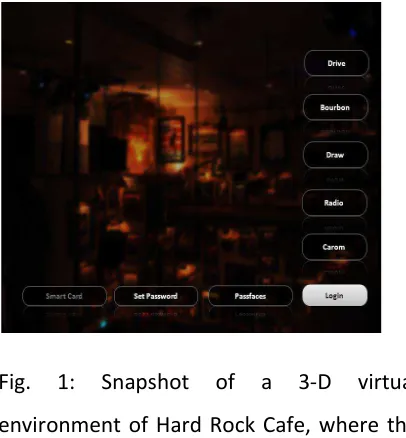
Fig. 1: Snapshot of a 3-D virtual
environment of Hard Rock Cafe, where the
user can use a Passfaces graphical
password, set a textual password, set radio
frequency, select desired carom shot as a
part of the user’s 3-D password.
1. Passfaces graphical password:
Consider use choose passfaces as his/her
first authentication scheme as a part of
his/her 3-D password. The user will be
asked to choose one image of human faces
from a face database as their future
password. In the authentication stage, the
user sees a grid of nine faces or more faces,
consisting of one face previously chosen by
the user and eight decoy faces. The user
recognizes and clicks anywhere on the
known face. The user is authenticated if
he/she correctly identifies the face. The
technique is based on the assumption that
people can recall human faces easier than
other pictures [2].
So when user selects the face, its
corresponding code, say, DERON# is saved
as part of user’s 3-D password.
2. Select desired carom shot: In this
event user has to select one carom shot
according to his/her liking out of fix seven
carom shots. So when user save particular
shot its corresponding code, say, DEZEE# is
saved as a second action of user’s 3-D
Password.
Fig. 2: User saves a desired a carom shot as
a second action of 3-D password in 3-D
Available Online At www.ijpret.com
3. Set textual password:User sets a textual
password as a third activity of 3-D
password and it is encrypted and saved.
Now, we had set a 3-D password using
three authentication schemes which is
represented by unique code as,
DERON#^DEZEE#^^BONBOUR11#
Now, user will always form this unique code
inside the system in order to access his/her
account. So if attacker recovers this code
even, he will not be able to identify user’s
3-D password. This unique code can again
be encrypted by various methods to
increase security level and then decrypted
as required for login process.
Also, user can be put in time limit to
complete all action and interaction in 3-D
virtual environment according to the time
of his/her 3-D password avoiding attacker
to try some probabilities. If the user fails to
give correct 3-D password three times,
there can be system to block his/her
account.
V. CONCLUSION AND FUTURE WORK
There are many authentication schemes in
the current state. Some of them are based
on user’s physical and behavioral
properties, and some other authentication
schemes are based on user’s knowledge
such as textual and graphical passwords.
Moreover, there are some other important
authentication schemes that are based on
what you have, such as smart cards. Among
the various authentication schemes, textual
password and token-based schemes, or the
combination of both, are commonly
applied. However, as mentioned before,
both authentication schemes are vulnerable
to certain attacks. Moreover, there are
many authentication schemes that are
currently under study and they may require
additional time and effort to be applicable
for commercial use.
The 3-D password is a multifactor
authentication scheme that combines these
various authentication schemes into a
single 3-D virtual environment. The virtual
environment can contain any existing
authentication scheme or even any
upcoming authentication schemes by
adding it as a response to actions
Available Online At www.ijpret.com
resulted password space becomes very
large compared to any existing
authentication schemes.
The design of the 3-D virtual environment,
the selections of objects inside the
environment, and the object’s type reflect
the resulted password space. It is the task
of the system administrator to design the
environment and to select the appropriate
object that reflects the protected system
requirements. Additionally, designing a
simple and easy to use 3-D virtual
environment is a factor that leads to a
higher user acceptability of a 3-D password
system.
The choice of what authentication schemes
will be part of the user’s 3-D password
reflects the user’s preferences and
requirements. A user who prefers to
remember and recall a password might
choose textual and graphical passwords as
part of their 3-D password. On the other
hand, users who have more difficulty with
memory or recall might prefer to choose
smart cards or biometrics as part of their
3-D password. Moreover, users who prefer to
keep any kind of biometrical data private
might not interact with objects that require
biometric information. Therefore, it is the
user’s choice and decision to construct the
desired and preferred 3-D password.
The 3-D password is still in its early stages.
Designing various kinds of 3-D virtual
environments, deciding on password
spaces, and interpreting user feedback and
experiences from such environments will
result in enhancing and improving the user
experience of the 3-D password. Moreover,
gathering attackers from different
backgrounds to break the system is one of
the future works that will lead to system
improvement and prove the complexity of
breaking a 3-D password. Moreover, it will
demonstrate how the attackers will acquire
the knowledge of the most probable 3-D
passwords to launch their attacks.
Shoulder surfing attacks are still possible
and effective against 3-D passwords.
Therefore, a proper solution is a field of
research.
VI. REFERENCES
1. IEEE Transactions on Instrumentations
Available Online At www.ijpret.com
Password for more Secure Authentication”
by Fawaz Alsulaiman and Abdulmotaleb El
Saddik.
2. IEEE International Conference Virtual
Environment, Human Computer-Interfaces
and Measurement Systems, “A Novel 3D
Graphical Password Schema” by Fawaz
Alsulaiman and Abdulmotaleb El Saddik.
3. “Graphical Passwords: A Survey” by
Xiaoyuan Suo, Ying Zhu and G. Scott. Owen,
Department of Computer Science, Georgia