T
T
h
h
e
e
r
r
a
a
n
n
o
o
s
s
t
t
i
i
c
c
s
s
2013; 3(10):731-740. doi: 10.7150/thno.5162Review
Proton Therapy Verification with PET Imaging
Xuping Zhu, Georges El Fakhri
Center for Advanced Medical Imaging Sciences, NMMI Division, Radiology Department, Massachusetts General Hospital, Harvard Medical School, Boston.
Corresponding author: Georges El Fakhri, White 427, 55 Fruit Street, Boston, MA 02114. Email: [email protected] Phone: (617) 726-9640 Fax:(617) 726-6165.
© Ivyspring International Publisher. This is an open-access article distributed under the terms of the Creative Commons License (http://creativecommons.org/ licenses/by-nc-nd/3.0/). Reproduction is permitted for personal, noncommercial use, provided that the article is in whole, unmodified, and properly cited.
Received: 2012.09.04; Accepted: 2013.08.28; Published: 2013.09.19
Abstract
Proton therapy is very sensitive to uncertainties introduced during treatment planning and dose delivery. PET imaging of proton induced positron emitter distributions is the only practical ap-proach for in vivo, in situ verification of proton therapy. This article reviews the current status of proton therapy verification with PET imaging. The different data detecting systems (in-beam, in-room and off-line PET), calculation methods for the prediction of proton induced PET activity distributions, and approaches for data evaluation are discussed.
Key words: proton therapy, proton range verification, PET imaging.
Introduction
Proton therapy is one of the most precise mo-dalities of external radiation therapy. Unlike a photon beam which has a high entrance dose and decreases gradually while passing through the body, a proton beam can penetrate through tissues and deposit most of its energy near the end of its track, known as the Bragg peak (Figure 1). In clinics, a spread-out Bragg peak (SOBP) field can be generated by using protons of multiple energies. Compared to the conventional photon therapy, proton therapy has a much lower entrance dose and no dose beyond the target volume. Because of this unique depth-dose characteristic, proton therapy is able to deliver highly conformal radiation fields to target volumes. Therefore, it is preferred for tumors with irregular shapes and/or around critical structure. Also, because of its much lower integral dose (approximately 60% lower than in photon therapy [1]), proton therapy is preferred for the treatments of pediatric patients, when the proba-bility of secondary tumor caused by radiation dose to the normal tissue is a concern. For these reasons, the number of proton therapy centers is growing rapidly worldwide despite the high capital cost. Several
companies are currently developing compact proton treatment equipment, which is expected to greatly reduce the cost of proton therapy.
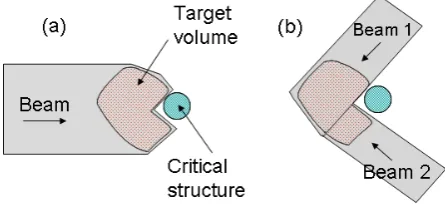
However, proton therapy is also more sensitive to uncertainties in treatment planning and delivery compared to photon therapy. Proton range inaccuracy is particularly of concern [2, 3]. Due to the steep gra-dient of dose fall-off at the Bragg peak region, uncer-tainties in proton therapy planning have more severe consequences than in photon therapy. A range error could mean a portion of a tumor not receiving any radiation dose at all (under-shooting), or the normal tissue lying distal to the beam receiving a full dose (over-shooting). Range uncertainties could potentially prevent the full utilization of the physics advantage of proton therapy. For example, in the case of a tumor in close proximity to a critical structure, shown in Figure 2, the optimal arrangement of one single beam stop-ping in the tumor right in front of the critical structure (a) would have to be substituted with a more con-servative arrangement of two patched beams (b) to protect the critical structure from possible radiation damage.
Fig 1. The comparison of dose-depth profiles for photon and proton therapies.
Uncertainties in proton therapy arise from sev-eral sources. In the treatment planning process, range uncertainties can be caused by stochastic errors (CT noise), CT artifacts, CT resolution (partial volume effects), and most importantly, the Hounsfield unit (HU) conversion method [2, 3]. Currently most com-mercial planning systems are based on analytical pencil-beam dose calculation algorithms, which pro-ject the range based on the water-equivalent depth in the patient using empirical HU conversion schemes to translate CT scans into relative stopping powers. Such conversion formalism cannot be directly validated in vivo, causing intrinsic range uncertainties in treat-ment planning calculations. In addition, since CT scans provide only electron density distribution, the analytical algorithm cannot correctly model some other physics effects, such as multiple Coulomb scat-tering and non-elastic nuclear reactions, especially at interfaces of alternating low- and high- density tis-sues. Therefore, further range degradation is expected in case of complex geometries and density variations. During treatment, further uncertainties are intro-duced due to setup and positioning errors, organ mo-tions, and change of anatomical structures, such as the shrinkage of tumors or change of weights.
Fig 2. (a) The optimal beam arrangement of one proton beam stopped in a target volume right in front of a critical structure. (b) The conservative beam arrangement of two patched beams to avoid possible damage to the critical structure.
Verification of proton therapy is very important to ensure treatment planning and delivery systems are functioning properly. Furthermore, understand-ing the uncertainties in proton therapy is important for the determination of the safety margins in treat-ment planning. Since proton beams stop completely in the body, direct in vivo treatment monitoring is difficult. Point dose measurement with implanted dosimeter has been proposed for range monitoring, but the approach is invasive and involves splitting an SOBP field into two opposite ‘sloped’ subfields [4]. Three methods are being investigated for in vivo, non-invasive imaging of dosimetry for proton thera-py. MRI has been used to measure the physiological changes in proton irradiated tissues, such as the fatty replacement of vertebra bone marrow, however this cannot be done in-situ because the physiological changes take several weeks to develop [5]. The prompt gamma imaging approach uses prompt gamma emission produced by inelastic interactions of incident protons and target nuclei to verify the proton dose delivery and range [6-8]. The prompt gamma rays have a high production rate and can be detected within a few nanoseconds after the nuclear reactions. However, most of the emissions correlated to proton range are in the energy range of 4~10 MeV, and there are no practical detectors available for prompt gamma detection. Currently the only practical approach is the PET imaging of proton induced position emitters [9-15]. In this review the current status of investiga-tions on PET verification of proton therapy and the quantitative methods used are discussed.
Rationale for Proton therapy verification with PET
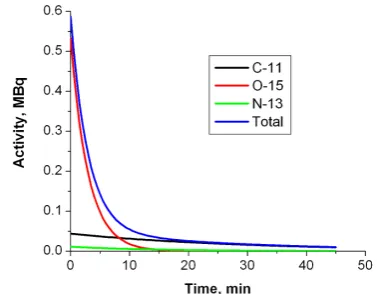
synchrotron-based proton facility only) or immedi-ately after irradiation. However, because of the short half live of 15O, 11C becomes the dominant nuclide after a few minutes. Figure 3 shows the relative con-tributions of the three nuclide species at different time points when only radioactive decay presents. Because the PET signal originates from contributions of mixed radionuclide species with different decay rates, PET verification of proton therapy is very sensitive to the time course of data acquisition.
Table 1. Major nuclear reaction channels for proton induced positron emitter productions.
Radionuclide Half live (min) Nuclear reaction channels /
Threshold energies (MeV)
15O 2.037 16O(p,pn)15O/16.79
11C 20.385 12C(p,pn)11C/20.61,
14N(p,2p2n)11C/3.22, 16O(p,3p3n)11C/59.64
13N 9.965 16O(p,2p2n)13N/5.66,
14N(p,pn)13N/11.44
30P 2.498 31P(p,pn)30P/19.7
38K 7.636 40Ca(p,2p2n)38K/21.2
Dose deposition and positron emitter production in proton therapy are two different processes in har-don therapy. A heavy charged particle loses energy primarily through the ionization and excitation of atoms. When passing through the tissue, the moving charged particle deposits dose by imparting energy to atomic electrons through electromagnetic forces. Pos-itron emitter production, on the other hand, involves nuclear reactions, and the yield depends on several factors including the proton fluence, the cross sections of specific reaction channels (which are ener-gy-dependent) and the density of target nuclei. While for a mono-energetic ion beam (for example, a 12C beam) an activity peak close to the Bragg peak can be found due to projectile fragmentation reactions, for proton therapy (in which only target fragmentation reactions are possible) the PET activity distribution is completely different from the dose distribution, with
almost no activities produced within ~1 cm before the Bragg peak due to the energy thresholds of nuclear reactions [20]. Therefore PET activity and dose dis-tributions cannot be compared directly. For treatment verification the PET measurements have to be com-pared with predicted activity distributions or other reference images.
PET data acquisition
There are three operational modalities for PET verification of proton therapy, based on the PET sys-tem used for data acquisition, as illustrated in Figure 4. In-beam PET uses build-in PET detectors attached to the proton treatment system so that PET data can be acquired during (for synchrotron-based proton facilities only) and immediately after treatment. Off-line PET uses an established PET scanner close to the treatment site, often with a CT component. Parodi et al compared the in-beam and off-line modalities for both synchrotron and cyclotron based proton and ion beam therapy facilities [19]. In-room PET uses a stand-alone PET scanner positioned within the treat-ment room for PET acquisition. The advantages and limitations of the three modalities are discussed here in terms of acquisition time course, data quality and cost effectiveness.
Fig 3. Relative contributions of major radionuclide species as a function of time due to radioactive decay. The simulated production rates in a clinical case during the treatment were from Parodi et al[19].
In-beam PET
Dedicated PET detectors integrated into the beam delivery systems were considered by many to be the method of choice for the PET verification of proton therapy. Currently in-beam PET detectors for hardon therapy (including carbon beam and proton therapy) are installed or under development in sev-eral facilities around the world, such as the Gesell-schaft für Schwerioneneforschung (GSI), Darmstadt, Germany [21, 22]; the Heavy Ion Medical Accelerator (HIMA) in Chiba, Japan [23]; the CATANA Proton-therapy Center in Catana, Italy [24], and the National Cancer Center (NCC), Kashiwa, Japan [13-15]. The most important advantage of in-beam detectors is the time course of PET acquisitions. For cyclotron based facilities, where the beam is delivered continuously during the treatment, PET acquisition can be started immediately following the treatment, minimizing the delay between treatment and PET acquisition. For synchrotron based facilities, where pulsed beam is delivered, PET data can even be collected during the pauses of beam delivery and continued after the treatment as needed. Because of the timely PET data acquisition, the PET activity level in the tissue is at the highest level for both long half live (11C, 13N, etc) and short half live (15O, 10C, etc) components, and the ef-fect of biological washout of PET activities is mini-mized. Patient repositioning errors and anatomical morphologic changes can also be avoided or mini-mized as PET data is acquired with the patient still at the treatment position. For treatment sessions with multiple fields, a short PET scan can be taken after the delivery of each field.
However, integration of a dedicated PET system integrated into the beam delivery system is expensive and technically demanding [19]. One of the major technical challenges is the geometric constrains in a treatment environment. In order to ensure an opening for the beam portal and flexible patient positioning, usually a conventional full-ring detector configura-tion is not feasible. The time-of-flight technique could be used to partially reverse the effects caused by non-complete angles of PET data collection [25], but also involves higher cost and implementation com-plexity. Another challenge is the synchronization of the PET data acquisition with the beam control sys-tem, especially for synchrotron-based facilities col-lecting PET data between beam spills. PET acquisition is not possible during beam extraction because of the high prompt gamma and neutron backgrounds.
The currently employed in-beam PET systems mostly use dual-head configurations. At GSI, the de-tectors are mounted above and below the patient couch [22]. At HIMA, the detectors are mounted on a
rotating gantry port [13]. The limited angle configu-ration with in-complete angular data collection re-sulted in lower sensitivity, limited field of views and artifacts in reconstructed images. In an effort to allow data collection from all angular directions, another configuration, OpenPET, is currently under devel-opment at National Institute of Radiological Science, Chiba, Japan [26-30]. The first generation of OpenPET (Dual-ring) system design consists two axially sepa-rated detector rings with the beam passing through the gap between the two rings [28]. Although full-ring detectors are used in this configuration, only oblique lines of response are collected and reconstructed, leading to degradations of sensitivity and image quality. The system configuration proposed for the second generation of OpenPET (Single-ring) has a cylinder shape cut at a slant angle, with the shape of each cut end to be an ellipse [30]. The detector ring can be rotated to form an accessible open space for the beam portal. Even though the data collection is still not complete, part of direct lines of responses can be collected. The sensitivity was found to be 1.2 times higher than the dual-ring Open PET, and the simula-tion results indicated that uniform resolusimula-tion can be achieved with depth-of-interaction detectors.
Off-line PET
Off-line PET uses a commercial scanner outside of the treatment room for PET imaging after the treatment. Usually this is an established scanner in a nearby location that normally also serves other ap-plications. The pioneer work was done at the Francis H. Burr Proton Therapy Center at the Massachusetts General Hospital (MGH)[9, 10, 12, 31, 32], Boston, followed by other clinical studies at HIMA[33] and Proton Therapy Institute at the University of Flori-da[34]. A new large-scale clinical trial, the MIRANDA study, is currently being conducted at University Hospital of Heidelberg, Germany [35]. The study plans to recruit 240 subjects of different tumor types for off-line PET verification of both proton and carbon beam therapies.
between the treatment and imaging facilities. The delay in the MGH studies ranged from ~15 to 30 minutes, during which time the short-lived radionu-clide species, most importantly 15O, had decayed. Therefore, off-line PET can measure only long half-life contributions, mostly from 11C. The performance is further degraded by the biological washout of the proton induced PET activity, which reduces the ac-tivity level in the target region (especially for tissues with high perfusion rates) and also changes the rela-tive activity distributions. Other factors affecting the performance of off-line PET include the repositioning errors and patient anatomical changes during trans-portation and repositioning. These can be partially compensated if an accompany CT scan is taken with the PET scan[12].
In-room PET
In-room PET uses a stand-alone PET scanner positioned within the treatment room for PET imag-ing. The first in-room PET studies were also carried out at the Francis H. Burr Proton Therapy Center, MGH [36]. A compact, mobile brain PET scanner, NeuroPET from PhotoDiagnostic Systems, Inc, was used for the PET acquisitions. The scanner was posi-tioned next to the beam nozzle, and the treatment couch was rotated and transported to the scan posi-tion after the treatment. No patient re-posiposi-tioning was necessary. The average delay between treatment and PET acquisition was 2.5 minutes
In-room PET is a compromise between in-beam and off-line PET. The cost of a stand-alone PET scan-ner is significantly lower compared to the installation of a PET system integrated into the beam delivery system. With no geometric constrains associated with the beam delivery and patient positioning, a full-ring detector can be used for complete data collection and improved image quality. Although there is still a de-lay between treatment and PET scan, the gap is much shorter than in off-line PET, allowing the collection of abundant 15O signals. Complications caused by bio-logical washout, repositioning errors, anatomical changes, etc., are also greatly reduced or eliminated. In particular, in-room PET is an economical option for most hospital-based proton centers that use a cyclo-tron for proton beam generation, because the beam is delivered continuously and no PET data collection is possible during the treatment. If a mobile united is invested, the PET scanner can also be shared with other applications if desired. However, since the PET scan needs to be acquired in the treatment room and the time required (including the moving of patient bed and the PET acquisition) is likely to be longer than with in-beam PET, the in-room PET has a rela-tively higher impact to the patient throughput in the
treatment room.
The largest obstacle encountered in the first ex-perience of in-room PET was the co-registration be-tween PET images and the treatment planning CT scan. Because the planned dose (and therefore the predicted activity distributions to be discussed next) was on the CT grid, PET images must be registered with the treatment planning CT images for proper comparison. However, since only the proton irradi-ated region was activirradi-ated, the co-registration was difficult without transmission images at the PET scan position. In the reported MGH studies the PET and CT were registered with concentric CT and PET fidu-cial markers. The co-registration errors range from 2 to 5 millimeters, adding uncertainties not only to the comparison between PET measurements and predic-tions, but also to the PET attenuation corrections be-cause the attenuation map was generated from the treatment planning CT co-registered to the PET grid. A mobile PET/CT scanner will be available to MGH in the near future, which can be expected to signifi-cantly improve the performance of in-room PET.
Prediction of PET activity distributions
Reconstructed PET images must be compared with a reference for the treatment verification. Be-cause proton dose and PET activity distributions are not directly related, treatment verification cannot be carried out by comparing these two distributions di-rectly. Up to data two types of reference images have been used. In the clinical research conducted at HIMA, PET scan taken at an earlier treatment session was used as the reference images in fractionated therapy to confirm the activated volumes in later ses-sions [13]. In most other studies, PET measurements were compared with predicted PET activity distribu-tions calculated with Monte Carlo simuladistribu-tions or an-alytical methods. The proposed approaches for the prediction of proton induced activity distributions are discussed.
Monte Carlo simulations
con-sideration timing parameters such as the irradiation time, delay between treatment and scan, and scan duration. The corrected distributions of different ra-dionuclide species are then summed up and blurred with a 3-D Gaussian convolution kernel to model the spatial resolution of the PET scanner. Figure 5 shows an example of Monte Carlo predicted and measured PET distributions in a nasal cavity melanoma clinical case. The spatial distribution of measured PET activity agreed well with the Monte Carlo prediction in this case.
Fig 5. A clinical example of Monte Carlo predicted and measured PET distributions in a nasal cavity melanoma clinical case. The 20-minute PET scan was taken on an in-room, stand-alone PET scanner after a 2-Gy fractionated proton dose delivery, with a 1.9 minute delay between the end of irradiation and the start of PET scan. (a) Treatment planning dose distribution; (2) Monte Carlo simulated dose distribution; (3), Monte Carlo simulated PET activity distribution; (d), PET measurement. The spatial distribution of measured PET activity agreed well with the Monte Carlo prediction in this case [41].
Uncertainties associated with Monte Carlo sim-ulations arise from two major sources. The prediction relies on the proton fluence and energy distribution in each voxel, the nuclear reaction cross sections and the tissue density and elemental composition at the voxel level. One of the factors limiting the accuracy of PET activity prediction is the reliability of the cross section data for the relevant reaction channels. A variety of experimental values for cross sections of different reaction channels have been published, along with theoretical values. However, significant discrepancies have been found between data sets from different sources. Studies by Espana et al [42] indicated that range differences of up to 4.4 mm can be found by using different cross section data sets in certain cases. Another source of uncertainty is CT conversion
algo-rithm, the same factor that also contributes signifi-cantly to range uncertainty in treatment planning at the first place. In the simulations treatment planning CT scans are converted to tissue type and density maps, from which elemental composition and target nuclide density are determined for each voxel. In ad-dition to CT conversion, the accuracy of PET activity prediction is also affected by CT stochastic errors, artifacts, resolutions, etc. Espana et al [43] estimated that an intrinsic 1 mm uncertainty for PET range veri-fication is due to CT conversion alone.
Analytical calculations
Despite the uncertainties associated with Monte Carlo simulations, it is still considered the most ac-curate approach for the prediction of proton induced PET activity distribution. However, considerable time and computing power are required for full-blown Monte Carlo simulations for each radiation field. Therefore, alternative analytical approaches have been explored for a simpler and more direct way to calculate PET activity distributions. Parodi et al [44] first proposed a filtering approach based on Gaussi-an-power law convolutions to reconstruct the local 11C distribution profile near the distal edge. The model described the one-dimensional 11C activity distribution as a convolution product of the planned dose with a small number of reaction-dependent filter
functions. The filter function is based on a special function defined as the convolution of a Gaussian with a powerlaw function. Good agreement was found between the results of the filtering approach and Monte Carlo simulations for simulation data in the distal fall-off. Attanasi et al [45] further extended the model for 3D activity distribution estimation, and included filter functions for other radionuclide species (15O et al) as well, so that the model can also be used for in-beam and in-room PET verifications. It was reported that in general the predicted activity distri-butions using the filtering approach were in good agreement (< 1 mm) with Monte Carlo simulation results, but the agreement was limited only to the distal region.
Another analytical method was proposed by Miyatake et al using an activity pencil beam (APB) algorithm [46]. The pencil beam algorithm is a stand-ard algorithm of dose calculation in proton therapy. In APB, contributions of different positron emitters originated from the same target nuclide, such as 11C, 13N and 15O from 16O via reaction channels 16O (p, 3p3n) 11C, 16O (p, 2p2n) 13N and 16O (p, pn)15O respec-tively, are collectively represented as a ‘virtual’ posi-tron emitter nuclide. The depth activity distribution of each virtual nuclide is measured experimentally. An
~
activity pencil beam kernel is determined using depth and lateral (which is an effect of multiple Coulomb scattering) activity distributions measured for each of the three major ‘virtual’ nuclei, 12C, 16O and 40Ca. This kernel, combined with tissue composition information extracted from treatment planning CT images, is used for activity distribution calculation using a pencil beam algorithm similar to the one used in dose cal-culations in treatment planning. The algorithm being developed is expected to predict PET activity distri-butions with satisfying accuracy in a few minutes so that it can be incorporated into the clinical routine of treatment monitoring with an in-beam PET system. However, because the measured PET activity distri-bution contains mixed contridistri-butions from radionu-clide with different half-lives, the PET measurements depend greatly on the time course of irradiation and data acquisition. These would require virtual nuclei activity distributions to be measured for different combinations of irradiation and delay times.
Biological washout
Regardless of the approach to be used for the prediction of the original PET activity production distribution, the effect of biological washout must be corrected as it can potentially change the activity dis-tribution significantly. Biological washout of proton induced activity starts as soon as the irradiation be-gins. Although the off-line PET is the most severely affected, biological washout also cannot be ignored in the in-beam and in-room PET measurements. Unfor-tunately, up to date there is no dedicated model for the correction of biological washout in proton in-duced PET activity. The currently used washout model is based on animal study results using im-planted radioactive or stable carbon beams [9, 19]. In this model, the original PET activity level in each voxel, estimated from Monte Carlo simulations or analytical calculations, is decomposed into three components undergoing fast, medium and slow bio-logical decays. The tissue type in each voxel is also determined based on the Hounsfield Units in the treatment planning CT scan. Thresholds of Houns-field units are set to identify five tissue types: hard bone, soft bone, fat, muscle and brain. Tissue-specific fractions and biological half-lives are assigned to each of the three components in each voxel. The final ac-tivity distribution is thus calculated based on the nu-clide radioactive decay rate, assigned biological washout parameters and the time course of irradia-tion and PET acquisiirradia-tion.
There are many problems with this pre-defined biological washout model. First of all, the currently used model was adopted from carbon-beam study results [47, 48]. Its applicability to proton beam
ther-apy is questionable because projectile fragmentation is the dominant contribution in carbon ion therapy, while only target fragmentation is possible in proton therapy [20]. Secondly, it does not account for varied washout rates of different radionuclide species, i.e. the same washout parameters are assigned for 11C and 15O for the same tissue type. Thirdly, the current model does not account for local variations, while in fact biological clearance rate is greatly affected by physiological environment such as local vasculature development and perfusion rate. In addition, many soft tissue types have very similar CT numbers but very different biological washout characters, while in the current model they are assigned the same washout parameters. On top of all the uncertainties, it is very difficult to obtain accurate biological washout pa-rameters.
To overcome the limits with the current washout model, a kinetic modeling approach was proposed at MGH [49] and is currently under development. The method is based on the observation that 15O is the dominant contribution to PET measurements imme-diately after proton irradiation. Instead of using pre-defined biological clearance parameters, the model describes the production and elimination of the 15O distribution with a differential equation with two parameters, the production rate during the irradiation and the elimination rate (which is the sum of radioac-tive and biological clearance rates). The time-activity history obtained from dynamically reconstructed PET image data is then fitted with the model equation to estimate both the production and elimination rates simultaneously. A 15O production map can be pro-duced by fitting the dynamic PET data voxel by voxel, and compared to the original 15O distribution pro-duction prediction directly. The kinetic approach does not rely on any arbitrary washout parameters, esti-mates both the activity production and washout rates of 15O, and the variations in biological washout rates are automatically taken into consideration. However, since 15O dominance is required, the method, if suc-cessful, would only be applicable to in-beam and in-room PET modalities.
Use of PET images for proton therapy
verification
was also analyzed for treatments of following days and compared with the reference. If a difference was detected, the causes would be investigated. If the changes were conformed to be due to tumor shrink-age or changes in body shapes, a new CT scan would be acquired and a new treatment plan would be used to replace the old plan. In this study, re-planning was performed for 3 clinical cases out of the 48 subjects.
While comparing proton irradiated volume at different treatment fractions is useful for the moni-toring of the consistency of the treatments at different days, it does not provide information whether the actual delivered dose distributions deviate from the treatment plans. In order to detect possible errors in treatment planning, the measured PET images need to be compared with the predicted distributions in a proper way. Because the location of the highest en-ergy deposition in proton therapy is largely deter-mined by the proton range, current clinical research is focused on range verification. Two approaches have been used in the off-line studies at MGH. For the point-wise approach, range verification was per-formed by comparing the distal fall-off positions at 20% to 50% of the last local maximum in the depth-activity profiles between PET measurements and Monte Carlo predictions [9, 10]. For the shift ap-proach, the range difference between two depth pro-files was determined by shifting the normalized fall-off regions against each other to minimize the sum of absolute differences in the activity values [12, 31]. The analysis can be performed either on individ-ual profiles or in the whole fall-off region. In the MGH off-line PET study of 23 subjects, the feasibility of range verification was found to be restricted to a lim-ited amount of positions and tumor sites. The ad-dressed factors contributing to the uncertainties in range verification include the reproducibility of off-line PET, biological washout effect (especially in soft tissue regions), Monte Carlo simulation accuracy, motions, beam arrangements, organ movements and co-registration accuracy. As a result, proton beam range can only be verified within an accuracy of 1~2 mm when the beam ends in low-perfused bony structures of head and neck patients. It was identified that intracranial and cervical spine patients, especially patients with arteriovenous malformations or metal implants, can greatly benefit from the approach [9, 12, 32].
Comparing distal fall-off depth is a simple yet very useful figure of merit for range verification. However, since the distal fall-off depth determination is closely associated with the shape of the activity profiles, both the point-wise and shift approaches depend greatly on the accuracy of the activity distri-bution predictions and measurements. Monte Carlo
simulations are generally considered the most accu-rate approach for the prediction of proton induced activity distribution, but as discussed previously, there are many factors contributing to the uncertain-ties in simulations, especially for regions with highly heterogeneous tissue types having large variations in elemental compositions and biological washout rates. The accuracy of PET measurements is also a concern, especially for off-line PET. Differences of up to 30% were observed for repeated measurements on the same patient with the same treatment plan scanned one week apart, possibly due to statistical errors, variations in the elemental composition and changes in the biological washout rates at different days [12]. In cases of complicated distribution patterns in the distal region, the selection of the last local maximum is difficult and often subjective, which subsequently affects the distal fall-off position determination. A more robust method for range verification is very desirable.
In addition to range verification, direct dose verification with PET imaging is also actively pur-sued, which involves reconstructing radiation dose distributions from measured PET images. The method proposed by Fourkal et al [50] uses an analytical model to calculate positron-emitter species matrices (PESM) based on proton energy fluence distributions. Once the PESM is known, the radiation dose distribu-tion in a patient is obtained from the deconvoludistribu-tion of the 3D PET activity distribution measurements with the PESM. The approach proposed by Remmele et al [51] is based on the filtering approach proposed by Parodi et al [44] and further extended by Attanasi et al [45], in which the expected PET images of activity distributions are calculated by the convolution of the planned dose with specific filter functions. As a re-verse process, the estimated dose distribution during the treatment is calculated using deconvolution methods based on the PET images and appropriate filter functions. Since this deconvolution is an ill-posed inverse problem, regularization techniques are used to guarantee a stable solution. Both methods demonstrated feasibility with simulation and/or phantom data, but applying the dose reconstruction techniques on measured patient PET images remains a major challenge because of the degradation of image qualities by noise, artifacts and limited knowledge on biological washout effects.
Conclusions
cost-effective option for most hospital-based proton centers, except for treatment facilities with an off-line scanner available very close by. The performance of proton treatment verification with PET is affected not only by the PET data detecting systems used, but also by the methods used for data processing and inter-pretation. Additional work is desirable for more reli-able criteria for range and/or delivered dose verifica-tion and for the development of an accurate biological washout model. Recently a second generation of dose delivery techniques, spot beam scanning, is slowly becoming commercially available to the proton ther-apy community. This poses new challenge to the treatment verification with PET, and new approaches need to be developed accordingly.
Competing Interests
The authors have declared that no competing interest exists.
References
1. DeLaney TF. Proton therapy in the clinic. Front Radiat Ther Oncol. 2011; 43: 465-85. doi:000322511 [pii] 10.1159/000322511.
2. Paganetti H. Range uncertainties in proton therapy and the role of Monte Carlo simulations. Phys Med Biol. 2012; 57: R99-117. doi:10.1088/0031-9155/57/11/R99.
3. Yang M, Zhu XR, Park PC, Titt U, Mohan R, Virshup G, et al. Compre-hensive analysis of proton range uncertainties related to patient stop-ping-power-ratio estimation using the stoichiometric calibration. Phys Med Biol. 2012; 57: 4095-115. doi:10.1088/0031-9155/57/13/4095. 4. Lu HM. A point dose method for in vivo range verification in proton
therapy. Phys Med Biol. 2008; 53: N415-22. doi:S0031-9155(08)89105-1 [pii] 10.1088/0031-9155/53/23/N01.
5. Gensheimer MF, Yock TI, Liebsch NJ, Sharp GC, Paganetti H, Madan N, et al. In vivo proton beam range verification using spine MRI changes. Int J Radiat Oncol Biol Phys. 2010; 78: 268-75. doi:S0360-3016(09)03634-7 [pii] 10.1016/j.ijrobp.2009.11.060.
6. Smeets J, Roellinghoff F, Prieels D, Stichelbaut F, Benilov A, Busca P, et al. Prompt gamma imaging with a slit camera for real-time range control in proton therapy. Phys Med Biol. 2012; 57: 3371-405. doi:10.1088/0031-9155/57/11/3371.
7. Min CH, Lee HR, Kim CH, Lee SB. Development of array-type prompt gamma measurement system for in vivo range verification in proton therapy. Med Phys. 2012; 39: 2100-7. doi:10.1118/1.3694098.
8. Moteabbed M, Espana S, Paganetti H. Monte Carlo patient study on the comparison of prompt gamma and PET imaging for range verification in proton therapy. Phys Med Biol. 2011; 56: 1063-82.
9. Parodi K, Paganetti H, Shih HA, Michaud S, Loeffler JS, DeLaney TF, et al. Patient study of in vivo verification of beam delivery and range, using positron emission tomography and computed tomography imaging after proton therapy. Int J Radiat Oncol Biol Phys. 2007; 68: 920-34. doi:S0360-3016(07)00377-X [pii] 10.1016/j.ijrobp.2007.01.063.
10. Parodi K, Paganetti H, Cascio E, Flanz JB, Bonab AA, Alpert NM, et al. PET/CT imaging for treatment verification after proton therapy: a study with plastic phantoms and metallic implants. Med Phys. 2007; 34: 419-35. 11. Parodi K, Enghardt W. Potential application of PET in quality assurance
of proton therapy. Phys Med Biol. 2000; 45: N151-6.
12. Knopf A, Parodi K, Bortfeld T, Shih HA, Paganetti H. Systematic analysis of biological and physical limitations of proton beam range verification with offline PET/CT scans. Phys Med Biol. 2009; 54: 4477-95. doi:S0031-9155(09)12608-8 [pii] 10.1088/0031-9155/54/14/008. 13. Nishio T, Miyatake A, Ogino T, Nakagawa K, Saijo N, Esumi H. The
development and clinical use of a beam ON-LINE PET system mounted on a rotating gantry port in proton therapy. Int J Radiat Oncol Biol Phys. 2010; 76: 277-86. doi:S0360-3016(09)00921-3 [pii] 10.1016/j.ijrobp.2009.05.065.
14. Nishio T, Ogino T, Nomura K, Uchida H. Dose-volume delivery guided proton therapy using beam on-line PET system. Med Phys. 2006; 33: 4190-7.
15. Miyatake A, Nishio T, Ogino T, Saijo N, Esumi H, Uesaka M. Measure-ment and verification of positron emitter nuclei generated at each treatment site by target nuclear fragment reactions in proton therapy. Med Phys. 2010; 37: 4445-55.
16. Maccabee HD, Madhvanath U, Raju MR. Tissue activation studies with alpha-particle beams. Phys Med Biol. 1969; 14: 213-24.
17. Beebe WJ, Vaska P, Dilmanian F, Peggs S, Schlyer D. Simulation of proton therapy treatment verification via PET imaging of induced posi-tron-emitters. IEEE Nuclear Science Symposium and Medical Imaging Conference (NSS/MIC) Conference Records. Portland, Oregon 2003. 18. [Internet] EXFOR. Experimental Nuclear Reaction Data File: Energy
Sciences and Technology Dept; BNL; 2010. http://wwwnndcbnlgov/nndc/exfor/.
19. Parodi K, Bortfeld T, Haberer T. Comparison between in-beam and offline positron emission tomography imaging of proton and carbon ion therapeutic irradiation at synchrotron- and cyclotron-based facilities. . Int J Radiat Oncol Biol Phys. 2008; 71: 945 -56.
20. Enghardt W, Parodi K, Crespo P, Fiedler F, Pawelke J, Ponisch F. Dose quantification from in-beam positron emission tomography. Radiother Oncol. 2004; 73 Suppl 2: S96-8.
21. Pawelke J, Enghardt W, Haberer T, Hasch BG, Hinz R, Kramer M, et al. In-beam PET imaging of the control of heavy-ion tumour therapy. IEEE Trans Nucl Sci. 1997; 44: 1492 - 8. doi:10.1109/23.632694.
22. Enghardt W, Crespo P, Fiedler F, Hinz R, Parodi K, J P, et al. Charged hadron tumour therapy monitoring by means of PET. Nucl Instrum Methods A. 2004; 525: 284-8.
23. Iseki Y, Mizuno H, Futami Y, Tomitani T, Kanai T, Kanazawa M, et al. Positron camera for range verification of heavy-ion radiotherapy. Nucl Instrum Methods A. 2003; 515: 840-9. doi:doi:10.1016/j.nima.2003.07.005. 24. Vecchio S, Attanasi F, Belcari N, Camarda M, Cirrone P, Cuttone G, et al. A PET prototype for in-beam monitoring of proton therapy. IEEE Nu-clear Science Symposium. Honolulu, HI. 2007;:24-362.
25. Crespo P, Shakirin G, Fiedler F, Enghardt W, Wagner A. Direct time-of-flight for quantitative, real-time in-beam PET: a concept and feasibility study. Phys Med Biol. 2007; 52: 6795-811. doi:S0031-9155(07)48959-X [pii] 10.1088/0031-9155/52/23/002. 26. Yamaya T, Inaniwa T, Yoshida E, Nishikido F, Shibuya K, Inadama N, et
al. Simulation studies of a new 'OpenPET' geometry based on a quad unit of detector rings. Phys Med Biol. 2009; 54: 1223-33. doi:S0031-9155(09)87469-1 [pii] 10.1088/0031-9155/54/5/008.
27. Yamaya T, Inaniwa T, Mori S, Furukawa T, Minohara S, Yoshida E, et al. Imaging simulations of an "OpenPET" geometry with shifting detector rings. Radiol Phys Technol. 2009; 2: 62-9. doi:10.1007/s12194-008-0046-x. 28. Yamaya T, Yoshida E, Inaniwa T, Sato S, Nakajima Y, Wakizaka H, et al. Development of a small prototype for a proof-of-concept of OpenPET imaging. Phys Med Biol. 2011; 56: 1123-37. doi:S0031-9155(11)68904-X [pii] 10.1088/0031-9155/56/4/015.
29. Yoshida E, Kinouchi S, Tashima H, Nishikido F, Inadama N, Murayama H, et al. System design of a small OpenPET prototype with 4-layer DOI detectors. Radiol Phys Technol. 2012; 5: 92-7. doi:10.1007/s12194-011-0142-1.
30. Tashima H, Yamaya T, Yoshida E, Kinouchi S, Watanabe M, Tanaka E. A single-ring OpenPET enabling PET imaging during radiotherapy. Phys Med Biol. 2012; 57: 4705-18. doi:10.1088/0031-9155/57/14/4705. 31. Knopf A, Parodi K, Paganetti H, Cascio E, Bonab A, Bortfeld T.
Quanti-tative assessment of the physical potential of proton beam range verifi-cation with PET/CT. Phys Med Biol. 2008; 53: 4137-51. doi:S0031-9155(08)73119-1 [pii] 10.1088/0031-9155/53/15/009. 32. Knopf AC, Parodi K, Paganetti H, Bortfeld T, Daartz J, Engelsman M, et
al. Accuracy of Proton Beam Range Verification Using Post-Treatment Positron Emission Tomography/Computed Tomography as Function of Treatment Site. Int J Radiat Oncol Biol Phys. 2011; doi:S0360-3016(10)00251-8 [pii] 10.1016/j.ijrobp.2010.02.017.
33. Nishio T, Miyatake A, Inoue K, Gomi-Miyagishi T, Kohno R, Kameoka S, et al. Experimental verification of proton beam monitoring in a human body by use of activity image of positron-emitting nuclei generated by nuclear fragmentation reaction. Radiol Phys Technol. 2008; 1: 44-54. 34. Hsi W, Indelicato DJ, Vargas C, Duvvuri S, Li Z, Palta J. In vivo
verifica-tion of proton beam path by using post-treatment PET/CT imaging. Med Phys. 2009; 36: 4136-46.
35. Combs SE, Bauer J, Unholtz D, Kurz C, Welzel T, Habermehl D, et al. Monitoring of patients treated with particle therapy using posi-tron-emission-tomography (PET): the MIRANDA study. BMC Cancer. 2012; 12: 133. doi:1471-2407-12-133 [pii] 10.1186/1471-2407-12-133. 36. Zhu X, Espana S, Daartz J, Liebsch N, Ouyang J, Paganetti H, et al.
37. Parodi K, Ferrari A, Sommerer F, Paganetti H. Clinical CT-based calcu-lations of dose and positron emitter distributions in proton therapy us-ing the FLUKA Monte Carlo code. Phys Med Biol. 2007; 52: 3369-87. doi:S0031-9155(07)38453-4 [pii] 10.1088/0031-9155/52/12/004. 38. Pshenichnov I, Mishustin I, Greiner W. Distributions of
posi-tron-emitting nuclei in proton and carbon-ion therapy studied with GEANT4. Phys Med Biol. 2006; 51: 6099-112. doi:S0031-9155(06)29938-X [pii] 10.1088/0031-9155/51/23/011.
39. Tuckwell W, Bezak E. Calculation of the positron distribution from 15O nuclei formed in nuclear reactions in human tissue during proton ther-apy. Phys Med Biol. 2007; 52: 2483-98. doi:S0031-9155(07)25841-5 [pii] 10.1088/0031-9155/52/9/010.
40. Seravalli E, Robert C, Bauer J, Stichelbaut F, Kurz C, Smeets J, et al. Monte Carlo calculations of positron emitter yields in proton radiother-apy. Phys Med Biol. 2012; 57: 1659-73. doi:10.1088/0031-9155/57/6/1659.
41. Min CH, Zhu X, Winey BA, Grogg K, Testa M, El Fakhri G, et al. Clinical application of in-room positron emission tomography for in vivo treat-ment monitoring in proton radiation therapy. Int J Radiat Oncol Biol Phys. 2013; 86: 183-9. doi:S0360-3016(12)03906-5 [pii] 10.1016/j.ijrobp.2012.12.010.
42. Espana S, Zhu X, Daartz J, El Fakhri G, Bortfeld T, Paganetti H. The reliability of proton-nuclear interaction cross-section data to predict proton-induced PET images in proton therapy. Phys Med Biol. 2011; 56: 2687-98. doi:S0031-9155(11)81703-3 [pii] 10.1088/0031-9155/56/9/003. 43. Espana S, Paganetti H. The impact of uncertainties in the CT conversion
algorithm when predicting proton beam ranges in patients from dose and PET-activity distributions. Phys Med Biol. 2010; 55: 7557-71. 44. Parodi K, Bortfeld T. A filtering approach based on Gaussian-powerlaw
convolutions for local PET verification of proton radiotherapy. . Phys Med Biol. 2006; 51: 1991-2009.
45. Attanasi F, Knopf A, Parodi K, Paganetti H, Bortfeld T, Rosso V, et al. Extension and validation of an analytical model for in vivo PET verifica-tion of proton therapy--a phantom and clinical study. Phys Med Biol. 2011; 56: 5079-98. doi:S0031-9155(11)72186-8 [pii]. 10.1088/0031-9155/56/16/001.
46. Miyatake A, Nishio T, Ogino T. Development of activity pencil beam algorithm using measured distribution data of positron emitter nuclei generated by proton irradiation of targets containing (12)C, (16)O, and (40)Ca nuclei in preparation of clinical application. Med Phys. 2011; 38: 5818-29. doi:10.1118/1.3641829.
47. Mizuno H, Tomitani T, Kanazawa M, Kitagawa A, Pawelke J, Iseki Y, et al. Washout measurement of radioisotope implanted by radioactive beams in the rabbit. Phys Med Biol. 2003; 48: 2269-81.
48. Tomitani T, Pawelke J, Kanazawa M, Yoshikawa K, Yoshida K, Sato M, et al. Washout studies of 11C in rabbit thigh muscle implanted by sec-ondary beams of HIMAC. Phys Med Biol. 2003; 48: 875-89.
49. Zhu X, Alpert NM, Min CH, Normandin M, Paganetti H, Bortfeld T, et al. Verification of proton therapy with PET: A kinetic modeling ap-proach. J Nucl Med. 2012; 53:264.
50. Fourkal E, Fan J, Veltchev I. Absolute dose reconstruction in proton therapy using PET imaging modality: feasibility study. Phys Med Biol. 2009; 54: N217-28. doi:S0031-9155(09)01942-3 [pii]. 10.1088/0031-9155/54/11/N02.