
Performance of various Clustering Algorithm Used
in Wireless Sensor Network
Ananya Saxena#1, Dr. Deepshikha Agarwal#2
#
Department of Computer Science & Engineering ASET, Amity University Lucknow
Lucknow, India
Abstract—Wireless Sensor Network has come a long
way with its energy efficiency as a prime factor of consideration due to the increasing deployment of wireless network. In this review paper, we showcase the features of Stable Election Protocol by describing about the clustering done in order to increase the energy efficiency of the sensory nodes. In the Classical Clustering Protocols we are not able to make efficient use of energy of the nodes. Therefore the heterogeneity which Stable Election Protocol provides helps in increasing the stability period of the sensory nodes as well as increase in the life of the network. This paper also describe the performance of other protocols such as LEACH, DEEC,ESEP and EESEP and the role of these protocols in increasing energy efficiency is justified.
Keywords—wireless sensor network, sensory node,
clustering protocols, energy efficiency.
I. INTRODUCTION
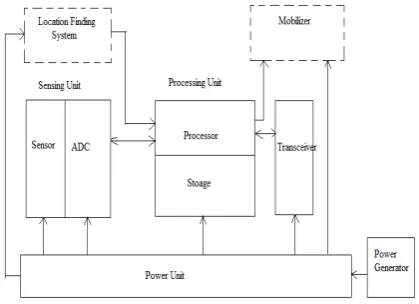
Wireless sensor network is the collection of wireless nodes placed in a random order with energy as a constraint (being less) where the nodes can be both, mobile as well as stationary. Wireless sensor network consists of sensor nodes with multiple functions i.e. sensing the data, processing the data and transmitting the data. For the aforementioned functions we have separate devices present in the sensor node. There is a sensing device, processing device, transmitting device which sense, process and transmit the data respectively. It is necessary for sensor node to have a power device that conducts the whole functioning of sensory nodes. These sensor nodes contain different amount of remaining energies which makes the network heterogeneous. Thus the network can be divided into two level heterogeneous network, three level heterogeneous network and multilevel heterogeneous network. This concept of heterogeneity helps in using the energy of different sensory nodes in an optimized way. There are different protocols that helps in determining the energy efficiency of the network. In order to avoid network congestion we introduce the process of selection of cluster heads. Till now the protocols such as LEACH, SEP, DEEC haveplayed their individual roles to determine howefficient the given network is. In the upcoming sections we will describe these protocols and further we will also showcase the ESEP and EESEP.
II. WIRELESS SENSOR NETWORK A. Concept:
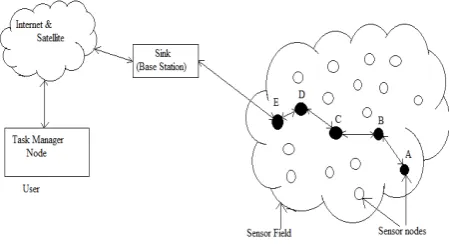
The development of wireless sensor network in various applications like Defense, Health, Environment monitoring [1] and Industry etc. always attract many researchers in this field. In the figure 1 it is illustrated that how we set up the wireless sensor network. Wireless Sensor Network is a type of Ad Hoc network which consist of various sensor nodes [2] as shown in fig. 1. These networks generally assumed to be energy restrained because the size of the sensor node is very small. Even though the sensor network has similarities with Ad Hoc network, the protocol which are being used in the Ad Hoc network cannot be necessarily used in Wireless Sensor Network. There are listed some reasons due to which we cannot use Ad Hoc network protocols in WSN:
The Ad Hoc network contains lesser number of nodes than the sensor network.
Another reason is power supply means the wireless sensor network have restricted power supply as compared to Ad Hoc network.
Fig. 1 Basic Wireless Sensor Network
B. Sensor Node:
Fig. 2 Basic Components of Sensor node
III. LITERATURE REVIEW A. LEACH: Low Energy Adaptive Clustering Protocol
W. Heinzelman et.al. studied Energy Efficient Routing Protocols for Wireless Sensor Networks. In wireless sensor network this is very first protocol used in wireless sensor network. This protocol consists of two phases. In the first phase we just create clusters based upon the signal strength of the sensor node and dynamically elect the cluster head CH according to the prior optimal probability. This cluster head collects data from all other nodes to send that data to base station. This phase is also called as setup phase. In the second phase, which is also called study state phase, the cluster head send collected information to the base station. The duration of this phase is longer than the previous phase and this is done to minimize the overhead. In this protocol we consider that all the sensor nodes contain same amount of energy means we consider a homogeneous network [3].
B. SEP: Stable Election Protocol
I. Akyildiz et.al. proposed a Stable Election Protocol for Clustered Heterogeneous Wireless Sensor Network. Author described that in the wireless sensor networks when the first node of the network dies then network becomes very unstable, especially when the node heterogeneity is present in the network. Here the node heterogeneity means that there are present nodes which contain different energies. LEACH protocol did not able to efficiently use the energy of the nodes present in heterogeneous network. So to solve this problem we use Stable Election Protocol. It is heterogeneous aware protocol used to prolong the time interval before the death of the first node, means it increase the stability period of the network which is useful for the applications in which feedback from the sensor network must be reliable. This protocol uses two level hierarchies of nodes. In this we have two types of nodes normal nodes and the advanced nodes. The nodes which contain higher energies considered as advanced nodes and the node contain energy lesser than advanced nodes are called normal nodes.
In this protocol the election probabilities of cluster head depends on the remaining energy of the node means the nodes which contain more remaining energy then the other node becomes cluster head [4].
C. DEEC: Distributed Energy Efficient Clusturing
Ritu Kadyan et al. in 2014 have presented Distributed Energy Efficient Clustering in Heterogeneous Wireless Sensor Network. This paper describe that this protocol is also used to efficiently use the energy efficiency of the nodes present in wireless sensor networks. The difference between distributed energy efficient protocol and stable election protocol is that the selection of cluster head is done by using initial and residual energy of the nodes. DEEC protocol also estimate the ideal value of network life time to compute the reference energy that each node should expend during each round.
For DEEC it is not necessary to have any global knowledge of energy at every election round. Unlike SEP and LACH, DEEC also performs well in the heterogeneous environment [5].
In this section, the LEACH, SEP and DEEC is presented in the heterogeneous wireless sensor network. In this first initialize the network by taking 20% of the advanced nodes (m=0.2) and 300% of the normal nodes (α=3), we take sink at the center of the network and the maximum distance from the sink to any node is approximately 70m. In this we take certain control parameters like stability period, network lifetime, throughput which we required for comparing the performance of the LEACH, SEP and DEEC. The simulation results presented in MATLAB.
TABLE 1: Control Parameters for LEACH, SEP, DEEC
Parameters Value
Network Field(Size) 100m×100m
Optimal Probability(Popt) 0.1
Initial Energy of normal nodes(E0) 0.5j E elec (Transmitter/Receiver Electronics) 50nJ/bit
E DA(Data Aggregation) 5nJ/bit/signal
e fs(Transmit amplifier if d maxtoBS<=do)
10pJ/bit/m2
e fs(Transmit amplifier if d maxtoBS>=do)
0.0013pJ/bit/m4
Message Size 4000 bit
Threshold Distance(do) 70m
Fig. 3 (a) when m=0.1 and α=2 [4]
Fig. 3 (b) When m=0.2 and α= 3 [4]
Now we have juxtaposed throughput of SEP with that of LEACH in the presence of heterogeneous nodes when m=0.2 and α=3. Figure 4 depicts that in the stable region the throughput of SEP is considerably larger than that of LEACH. In fig. 4(a), fig. 4(b) we can see that when the data is send from cluster head to sink and from nodes to their cluster head respectively then SEP performs well than LEACH.
Fig. 4 (a) Cluster Head to sink [4]
Fig. 4 (b) Nodes to their cluster head [4]
Furthermore, in fig. 4(c) the throughput of the total network also good when we used SEP.
Fig. 4(c) Total for the whole network [4]
In this section, we present the distributed energy efficient clustering in the heterogeneous wireless sensor network. In the given fig. 5 we are staging the performance of DEEC on the basis lifetime, number of alive nodes and data packet send to base station parameters. In this we are taking 4000 number of rounds.
Fig. 5 (b) Alive nodes During 4000 rounds and 100 nodes [5]
Fig. 5 (c) Packet send to BS node during 4000 rounds and 100 nodes [5]
Fig. 5 (d) Count of cluster head per round during 4000 rounds and 100 nodes [5]
In three level of heterogeneity of nodes DEEC performs well. Simulation results shows that the number of alive nodes varies as network evolves and first node dies around 1800 rounds. In compare to other protocol the unstable region starts later in DEEC.
D. ESEP: Extended Stable Election Protocol
Mannepalli Shreehari et.al. in 2015 proposedExtended Stable Election protocol for Increasing Lifetime of WSN.As name suggests this protocol is the modification of Stable Election Protocol. In this the author analyzed three level of hierarchy so that we can enhance the lifetime of the network. This protocol includes three types of nodes normal, moderate, advanced nodes. On the basis of battery power and residual energy of the node elects its cluster head. ESEP also enhance the stability period of the network. When we compare ESEP with the SEP protocol by using certain parameters like energy consumption, dead node then we found the 8-9% improvement in energy consumption and 10-11% improvement in dead nodes has been achieved by using ESEP protocol. The packet delivery fraction and average end to end delay almost same in SEP and ESEP but number of nodes increases in network it varied [6].
TABLE 2: Simulation Parameters
Simulation Parameter Value Routing Protocol SEP, ESEP Simulation Area 1000×1000sq.m Number of nodes 50,60,70,80,90,100 Traffic type/CBR rate CBR/ 0.05MBPS Simulation time 100 sec
Energy 20J
Antenna Omni Directional
Propagation Mode Propagation/Two Ray Ground
In this we simulate the performance of SEP and ESEP by using NS 2 simulator. In this author takes varying number of nodes for simulation. In fig. 6 (a) we found that by varying number of nodes the power consumption of SEP is more than ESEP. In the fig. 6 (b) we can see that by inceasing the number of nodes the number of dead nodes is more in SEP than ESEP.
Fig. 6 (b) Dead Nodes vs. Number of Nodes [6]
Furthermore, in fig. 6 (c) the packet delivery in both the protocols is almost same.
Fig. 6 (c) Packet Delivery Fraction vs. Number of Nodes [6]
In the fig. 6 (d), in some points the end to end delay is equal in both the protocols but when number of nodes reaches to 100 the delay in more in SEP than ESEP.
Fig. 6 (d) Average End to End Delay vs. Number of Nodes [6]
E. EESEP: Energy Efficient Stable Election Protocol
C. Divya et.al. given that in the SEP algorithm the election probabilities of cluster head depends on the remaining energy of the node, this weighted election probability can be turn down to the Optimal Threshold value. But in EESEP algorithm we use Initial Energy (E˳) to calculate the Optimal Threshold value. It can be reduced more amount of Optimal Threshold value. The cluster head selection is also reduced by the Optimal Threshold value. This will cause more number of network nodes to remain alive. When cluster head nodes collects data from other nodes and aggregate the data and then send that data to base station (sink) then at this time the alive nodes use their own energy. In this process use of the energy consumed in its minimum amountalong with EESEP algorithm provides more energy efficient network and also increase the lifetime of the network, in the presence of heterogeneous nodes [7].
Table 3: Simulation Parameters for SEP & EESEP
Parameters Value
Network Field(Size) 200m×200m sqr
Number of nodes 300
Optimal Probability(Popt) 0.1
Initial Energy of normal nodes(E0) 0.5j E elec (Transmitter/Receiver Electronics) 50×10
-8pJ/bit/m4
EDA(Data Aggregation) 5nJ/bit/message
efs(Transmit amplifier if dmaxtoBS<=do) 10pJ/bit/m2
efs(Transmit amplifier if dmaxtoBS>=do) 0.0013pJ/bit/m4
Message Size 4000 bit
Weighted Election Probability of
Nodes(P) 0.05
In this we take number of rounds 10000 and the base station is located at the center of the network. In the fig. 7 we can see that in given number of rounds, the number of alive nodes is 12% in SEP and the number of alive nodes is 54% in EESEP means results shows that the 42% more alive nodes are present in the EESEP than SEP.
IV. CONCLUSION AND FUTURE SCOPE
From the above discussed work we conclude that various energy efficient protocols infer different results in a heterogeneous wireless sensor network. The main focus was on clustering protocols that are used to enhance the energy as well as the lifetime of a network. Thus wireless senor network has come a long way in providing a stable environment for transmission of data along different set of nodes. We can use a set of different nodes ranging from hundred to any further numeric value to get zeroed to the functioning of nodes on large scale and can work on enhancing the energy efficiency of the network. Thus it will ultimately increase the lifetime of the network.
REFERENCES
[1] D. Culler, D. Estrin, M. Srivastava, “Overview of Sensor
Networks,” IEEE Computer Society, August 2004.
[2] Prasant Mohapatra, Srikanth Krishnamurthy, “Ad-hoc networks
technologies and protocols,” Springer Science plus Business Media, 2005
[3] W. Heinzelman, A. Chandrakasan, and H. Balakrishnan, “Energy
efficient routing protocols for wireless microsensor networks,” In
Proceedings of 33rd Hawaii International Conference on System
Science (HICSS), HI, USA, 2000, Vol. 8, pp. 110
[4] Georgios Smaragdakis, Ibrahim Matta, Azer Bestavros, “SEP:A
Stable Election Protocol for clustered heterogeneous wireless sensor network,” Bostan University, Technical Report BUCS-TR-2004-002
[5] Ritu Kadyan, Kamal Saluja, “Distributed Energy Efficient
Clustering (DEEC) in Heterogeneous Wireless Sensor Networks,” International Journal of Engineering and Innovative Technology (IJEIT), Volume 4, Issue 1, July 2015
[6] Mannepalli Sreehari, L Jagadeesh Naik, Ch. Sudershan Raju,
“Extended stable election protocol for increasing life time of WSN,” International Journal of Engineering Research and Applications, ISSN: 2248-9622, January 2015
[7] C. Divya, N. Krishnan, T. Gandhi Mathy, “Energy Efficient Stable
Election Protocol for Clustured Heterogeneous Wireless Sensor Networks,” IOSR Journal of Computer Engineering, e-ISSN:2278-0661, p-ISSN:2278-8727, Volume12, August 2013
[8] V. Mhatre and C. Rosenberg, “Homogeneous vs.. hetrogeneous
clustered sensor network: A comparitive study,” In Proceedings of 2004 IEEE International Conference on Communication (ICC2004), June 2004
[9] I. Akyildiz, W. Su, Y. Sankarasubramaniam, and E. Cayirci, ”A
![Fig. 3 (a) when m=0.1 and α=2 [4]](https://thumb-us.123doks.com/thumbv2/123dok_us/7869663.1305388/3.595.69.279.89.445/fig-m-a.webp)
![Fig. 6 (a) Energy Consumptionvs. Number of nodes [6]](https://thumb-us.123doks.com/thumbv2/123dok_us/7869663.1305388/4.595.308.540.551.724/fig-energy-consumptionvs-number-nodes.webp)
![Fig. 6 (b) Dead Nodes vs. Number of Nodes [6]](https://thumb-us.123doks.com/thumbv2/123dok_us/7869663.1305388/5.595.63.282.76.247/fig-b-dead-nodes-vs-number-of-nodes.webp)
