COMPARATIVE ALLELOPATHIC POTENTIAL OF NATIVE AND INVASIVE WEEDS IN RICE ECOSYSTEM
Tasawer Abbas1,*, Asif Tanveer1, Abdul Khaliq1 and Muhammad Ehsan Safdar2
ABSTRACT
Invasive weeds pose serious threat to aquatic ecosystems such as wet land paddy rice. An investigation was made to compare the allelopathic effects of aqueous extracts and residues of two invasive weeds viz., Alternanthera philoxeroides and A. sessilis with those of three native weeds viz., Conyza stricta, Polygonum barbatum and Echinochloa crus-galli of rice (Oryza sativa L.) in Pakistan. All weeds under study showed phytotoxic effects on germination and seedling growth of rice through their aqueous extracts as well as residues to variable degree compared with control treatment. However, significantly lower germination percentages (10 and 35%), germination/emergence index (0.5 and 0.4), shoot lengths (2 and 7 cm), root lengths (1.5 and 1.9 cm), seedling biomass (5 and 6 mg), seedling vigor indices (25 and 100) and higher mean germination/emergence times (6.8 and 8 days) were observed in case of 5% aqueous extract of A. sessilis and 4% residue of A. philoxeroides, respectively. Overall, phyto-inhibitory effects of water extracts were more severe than residues. The highest suppressive action of A. philoxeroides and A. sessilis seem not only due to their higher total phenolic contents (116 and 106 mg L-1) but complex interaction of potent phenolic compounds namely 4-hydroxy-3-methoxybenzoic acid, chlorogenic acid, ferulic acid, gallic acid, m-coumaric acid, p-coumaric acid and vanillic acid as shown by their HPLC analysis. It can be concluded that these two invasive weed species are bigger threat to local wet land rice ecosystems and may result in greater yield losses of rice crop in the country.
Key words: Allelopathy, Alternanthera spp., Conyza stricta, Echinochloa crus-galli, Polygonum barbatum, Oryza sativa.
Citation: Abbas, T., A. Tanveer, A. Khaliq and M.E. Safdar. 2016. Comparative allelopathic potential of native and invasive weeds in rice ecosystem. Pak. J. Weed Sci. Res. 22(4): 269-283.
1Dept. of Agronomy, University of Agriculture, Faisalabad, Pakistan 2Dept. of Agronomy, University College of Agriculture, University of Sargodha, Pakistan
INTRODUCTION
Invasive weeds are becoming dominant over native weed species all over the world due to changing climate scenario (Sandel and Dangremond, 2011). Although successful invasion of alien plants is mostly attributed to their better physiological and phenological growth responses to increasing temperatures and CO2 concentrations compared with local flora (Song et al., 2009; Willis et al., 2010). However, allelopathic interference also plays major role in successful invasion of weeds (Pandey, 1994). Moreover, aquatic and semi-aquatic plants are proved more successful invaders (Daehler, 1998). Weeds possess several naturally occurring allelochemicals in the form of secondary metabolites which may be released from their different parts to their surroundings that may negatively influence seed germination, seedling growth and other developmental processes of neighboring plants (Sajjad et al., 2007; Iqbal et al., 2010).
The allelopathic potential of A. philoxeroides and A. sessilis against various crops including wheat, eggplant and rape has been widely studied (Liu et al., 2007; Zhang et al., 2009; Dhole et al., 2011). However, understanding about their phytotoxic ability against rice is also necessary to find probable reason of their invasive success. Therefore, studies were planned to compare allelopathic potential/ability of these aquatic invasive weeds in rice ecosystem with three indigenous weeds, C. stricta, P. barbatum and E. crus-galli in rice ecosystem.
MATERIALS AND METHODS
Effects of water extracts and residues of five weed species, viz. Alternanthera philoxeroides (Mart.) Griseb. (alligator weed), Aternanthera sessilis L. (sessile joy weed), Conyza stricta L. (erect horseweed), Polygonum barbatum L. (joint weed) and Echinochloa crus-galli L. (barnyard grass) were studied at their different concentrations on the germination and early seedling growth of rice in Weed Science Laboratory, University of Agriculture Faisalabad, Pakistan during 2013.
Collection of weeds
Plants of selected weeds viz. Alternanthera philoxeroides, A. sessilis, Conyza stricta, Polygonum barbatum and Echinochloa crus-galli were uprooted randomly at maturity from Agronomic research area, University of Agriculture, Faisalabad, Pakistan during 2012. These weeds were gently washed in distilled water for removing dust and soil particles and then were dried in shade for a week at 25 °C. After drying, whole plants of each species were chopped into small pieces.
Preparation of aqueous extracts and residues of weeds
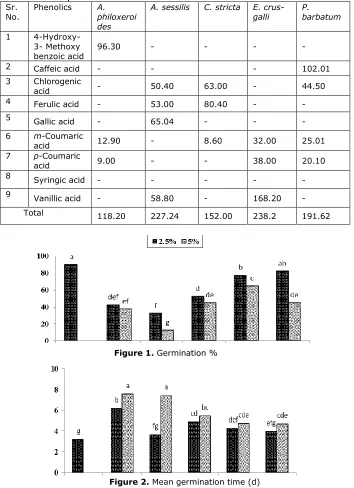
Determination of total phenolic contents and types of phenolics Total water-soluble phenolics in water extracts of these weeds were estimated as per the method of Swain and Hillis (1959) using Folin-ciocalteu reagent. Their amounts were determined spectrophotometrically at 700 nm against the standard of ferulic acid in Table 1. For identification and quantification of suspected phytotoxins of A. philoxeroides, A. sessilis, C. stricta, P. barbatum and E. crus-galli, their aqueous extracts were chemically analyzed on Shimadzu HPLC system (Model SCL-10A, Tokyo, Japan). The peaks were detected by UV detector. Standards of suspected phytotoxins (Aldrich, St Louis, USA) were run similarly for their identification and quantification. The identified phenolics are listed along with their concentrations in the Table 2. Concentration of each isolated chemicals was determined by the following equation,
Aqueous extracts and residues bioassay studies
To study the effect of whole plants aqueous extract of various weeds on germination and seedling growth of rice, ten rice seeds were placed separately in each petri dish lined with doubled layered filter paper. At start of experiment 7 ml of each extract at 2.5% and 5% concentration was applied in every petri dish, separately. Minimum and maximum temperatures were 24+2 °C and 28+2 °C, respectively. The extracts/distilled water were added to Petri dishes as and when needed. To study allelopathic effects of aquatic weeds residues on germination and seedling growth of rice, plastic pots of 11 cm diameter and 5 cm depth were filled with the 350 g soil 2% and 4% residue: soil mixtures, separately. Pots filled with residues free soil were kept as control. Ten seeds of wheat were placed in each pot. Then distilled water was applied to avoid the drying out of seedlings throughout the growth period. Minimum and maximum temperatures during the course of experiment were 24+2 °C and 28+2 °C, respectively. After 15 days, the seedlings were removed from petri plats and pots, washed with water and length of roots and shoots was measured. Roots and shoots were oven dried at 70 °C until a constant weight was obtained.
Mean germination/ emergence time (MGT/MET) was calculated as per equation of Ellis and Roberts (1981):
Where, n is the number of seeds or emerged seedlings on day D, and D is the total number of days counted from the beginning of
germination.
The germination/ emergence index (GI/EI) was calculated as per Association of Official Seed Analysis (1990) by using the following formula:
Seedling vigor index was calculated following the equationgiven by Abdul-baki (1980):
Statistical analysis
Data was analyzed statistically by using the Fisher’s Analysis of Variance and least significant difference at 5% probability was used to compare the treatment’s means (Steel et al., 1997).
RESULTS AND DISCUSSION
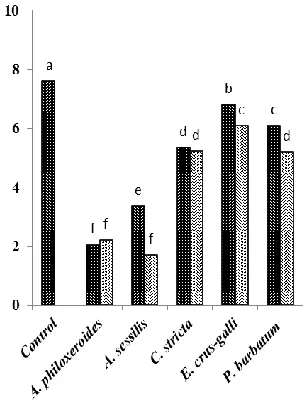
The results revealed that aqueous extracts of all weeds under study suppressed the germination percentage (GP), mean germination time (MGT) and germination index (GI) of rice as compared to distilled water treated control (Fig. 1-3). However, aqueous extract of A. sessilis at 5% concentration caused maximum inhibition by showing significantly lower GP (10%) and GI (0.5) and higher MGT (6.8 days). These results are in line with those of Manandhar et al. (2007) and Xuan et al. (2006) who observed that aqueous extracts of dominant weeds of rice field inhibit the germination of rice. Gu et al. (2008) reported that E. crus-galli reduced the germination and seedling growth of rice by releasing allelochemicals e.g. p-hydroxymandelic acid, inhibitory effect was more severe as concentration of water extract increased. The increase in MGT may result from the slowdown of physiological processes of the plants due to the impairment of seeds respiration caused by allelochemicals (Weir et al., 2004). Reduction in GP may due to decreased activity of enzymes involves in translocation of stored seed assimilates during germination of seeds (Hilda et al., 2002).
(SL), root length (RL), seedling biomass (SB) and seedling vigor index (SVI) compared with control. However, SL was promoted to some extent by 2.5% aqueous extract of E. crus-galli (Figure 4). The significantly lower SL (2 cm), RL (1.5 cm), SB (5 mg) and SVI (25) of rice seedlings were produced by 5% aqueous extract of A. sessilis which were followed by those noted in case of 5% aqueous extract of A. philoxeroides (Figures 4-7). These results are supported by the findings of Zuo et al. (2012) who reported that Alternanthera sp. exhibited greater allelopathic potential due to its antioxidants compounds. Punjani (2005) and Mubeen et al. (2011) reported that aqueous extracts of different parts and whole plant of different weeds reduced the root and shoot length and total dry weight of rice seedling. Findings are further supported by Manandhar et al. (2007) who reported that dominant weeds of rice field reduced the germination and inhibit the root and shoot elongation of rice seedlings.
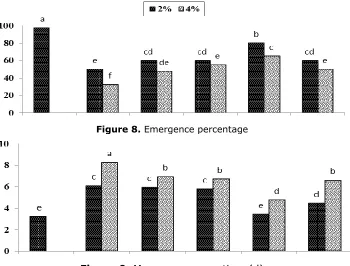
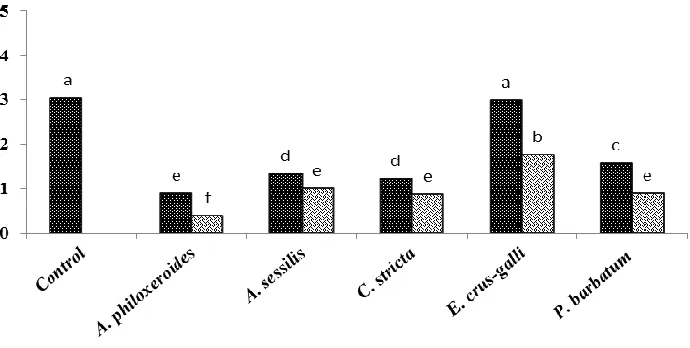
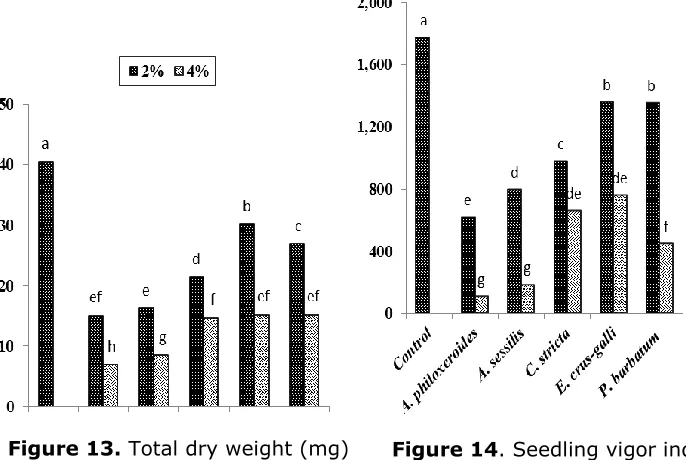
Regarding effect of residues of weeds under study on germination of rice, suppressive action was also noted in case of all weeds compared with control (Figures 8-10). However, significantly lower GP (35%) and emergence index (EI) (0.4) whereas significantly higher mean emergence time (MET) (8 days) were observed in pots filled with A. philoxeroides residues at 4% concentration. difference between residues of all tested weeds in influencing emergence percentage, MET and EI of rice seeds (Figure 11-14). All weeds residues at 2 and 4% significantly increase rice MET, while a reduction in emergence percentage and EI was observed in rice seedlings as compared to control soil. Effect of A. philoxeroides and A. sessilis was stronger than other weeds residues. The overall germination inhibition was more pronounced in case of 4% residues as compared to 2% residues. Our results are in agreement with those of Katoch et al. (2012) who also found that residues of weeds in the soil had inhibitory effect on the emergence traits of rice.
field crop on account of their allelopathic potential (Dhole et al., 2011; Abbas et al., 2014). Several studies have documented that when weeds grow in the field; their decaying residues affect the germinations and seedling growth of associated crops (Shaukat et al., 2003; Batish et al., 2005).
Comparison of allelopathic properties of aqueous extracts and residues of weed species studied depicted that phytotoxic inhibitory effects on germination and seedling growth of rice were more pronounced in case of their aqueous extracts than residues. Soil incorporated residues caused lesser inhibition than aqueous extract in petri dishes because soil possesses the capability to adsorb/detoxify bioactive compounds (Inderjit and Weiner, 2001). In our studies, more suppressive action of A. sessilis and A. philoxeroides aqueous extracts and soil residues seem to be due to their higher total phenolic contents (116 and 106 mg L-1) and complex allelopathic interaction of 4-hydroxy-3- methoxy benzoic acid, chlorogenic acid, ferulic acid, gallic acid, m-coumaric acid, p-coumaric acid and vanillic acid as detected by HPLC analysis (Tables 1 and 2). It is expected that the presence of these phenolics in the weeds played a role in inhibition of seed germination and growth of rice. Chon et al. (2005) reported that phenolic compounds are major allelochemicals which cause inhibition in germination and early seedling growth of plants.
CONCLUSION
Present studies lead us to onclude that two invasive weeds A. sessilis and A. philoxeroides have more inhibitory effects on rice compared with conventional weed including C. stricta, P. barbatum and E. crus-galli. Their higher phytotoxic interference will be a threat to rice crop in Pakistan and may play havoc with rice yields in conventional wet land rice ecosystem.
Table-1. Total phenolics content quantified in weeds
S. No. Weeds Total phenolics (mg L-1)
1 A. philoxeroides 106
2 A. sessilis 116
3 C. stricta 159
4 E. crus-galli 429
Table-2. Types and quantities of phenolic compounds (mg L-1) identified in aqueous extracts of weeds.
Sr.
No. Phenolics A. philoxeroi des
A. sessilis C. stricta E.
crus-galli P. barbatum
1 4-Hydroxy-3- Methoxy
benzoic acid 96.30 - - - -
2 Caffeic acid - - - 102.01
3 Chlorogenic
acid - 50.40 63.00 - 44.50
4 Ferulic acid - 53.00 80.40 - -
5 Gallic acid - 65.04 - - -
6 m-Coumaric
acid 12.90 - 8.60 32.00 25.01
7 p-Coumaric
acid 9.00 - - 38.00 20.10
8 Syringic acid - - - - -
9 Vanillic acid - 58.80 - 168.20 -
Total 118.20 227.24 152.00 238.2 191.62
Figure 1. Germination %
Allelopathic effects of whole plant aqueous extract of aquatic weeds on (Fig. 1) germination percentage, (Fig. 2) mean germination time, (Fig. 3) Germination Index of
rice.
Figure 3. Germination index
Allelopathic effects of whole plant aqueous extract of aquatic weeds on (Fig. 4) shoot length and (Fig. 5) root length (Fig. 6) total dry weight
and (Fig. 7) seedling vigor index of rice. of rice
Figure 8. Emergence percentage
Figure 9. Mean emergence time (d)
Figure 10. Emergence index
Allelopathic effects of whole plant residues of aquatic weeds on (Fig. 8) emergence percentage, (Fig. 9) mean emergence time and (Fig. 10)
emergence index of rice
Allelopathic effects of whole plant residues of aquatic weeds on (Fig. 11) shoot length, (Fig. 12) root length, (Fig. 13) total dry weight and
(Fig. 14) seedling vigor index of rice
REFERENCES CITED
Abbas, T., A. Tanveer, A. Khaliq, M.E. Safdar and M.A.Nadeem. 2014. Allelopathic effects of aquatic weeds on germination and seedling growth of wheat. Herbologia 14 (2): 11-25.
Abdul-Baki, A.A. 1980. Biochemical aspects of seed vigour. Hort. Sci. 15:765-771.
Association of Official Seed Analysis. 1990. Rules for testing seeds. J. Seed Tech. 12: 1-112.
Batish, D.R., S. Kaur, H.P. Singh and R.S. Kohli. 2009. Nature of interference potential of leaf debris of Ageratum conyzoides. Plant Growth Regul. 57(2): 137-144.
Batish, D.R., H.P.Singh, J.K. Pandher and R.K. Kohli. 2005. Allelopathic interference of Parthenium hysterophorus residues in soil. Allelopathy J. 15 (2): 321- 322.
Chon, S.U., H.G. Jang, D.K. Kim, Y.M. Kim, H.O. Boo and Y.J. Kim. 2005. Allelopathic potential in lettuce (Lactuca sativa L.) plants. Sci. Hort. 106: 309-317.
Clements, D., T.M. Dugdale and T.D. Hunt. 2011. Growth of aquatic alligator weed (Alternanthera philoxeroides) over 5 years in south-east Australia. Aq. Inv. 6(1): 77-82.
Dhole, J.A., S. Bodke and N. Dhole. 2011. Allelopathic effect of aqueous extract of five selected weed species on seed mycoflora, seed germination and seedling growth of Sorghum vulgare Pers. (Jawar). RJPBCS. 2 (3): 142-148.
Daehler, C.C. 1998. The taxonomic distribution of invasive angiosperm plants: Ecological insights and comparison to agricultural weeds. Biological Conservation. 84: 167-180.
Dongre, P.N. and A.K. Singh. 2007. Inhibitory effects of weeds on growth of wheat seedlings. Allelopathy J. 20 (2): 387-394. Ellis, R.A. and E.H. Roberts.1981. The quantification of ageing and
survival in orthodox seeds. Seed Sci. Tech. 9: 373-409.
Everitt, J.H., R.L. Lonard and C.R. Little. 2007. Weeds in South Texas and Northern Mexico. Lubbock: Texas Tech University Press. Hilda, G.G., Z.G. Francisco, R.K. Maiti, M.L. Sergio, L. Del Rio Dora Elia
and M.L. Salomon.2002. Effect of extracts of Cynodon dactylon L. and Sorghum halepense L. on cultivated plants. Crop Res. (Hisar) 23(2): 382-388.
Grubben, G.J.H. and O.A. Denton. 2004. Plant Resources of Tropical Africa 2. Vegetables. PROTA Foundation, Wageningen; Backhuys, Leiden; CTA, Wageningen.
Gu, Y., H.B. Li and C.H. Kong. 2008. Allelopathic potential of barnyard grass on rice and soil microbes in paddy. Allelopathy J. 21(2): 389-396.
Inderjit and J. Weiner. 2001. Plant allelopathic interference or soil chemical ecology? Persp. Plant Ecol. Evol. System. 4: 3-12. Iqbal, J., F.Karim and S. Hussain. 2010. Response of the wheat crop
(Triticum aestivum L.) and its weeds to allelopathic crop water extracts in combination with reduced herbicides rates. Pak. J. Agric. Sci. 47(3): 309-316.
Katoch, R., A. Singh and N. Thakur. 2012. Effect of weed residues on the physiology of common cereal crops. IJERA. 2: 301-304. Liu, A.R., Y.B. Zhang, X.M. Zhang, X.L. He and Q. Wu. 2007. Effects of
aqueous extract from alligator weed on seed germination and seedling development of Lolium perenne and Festuca arundinacea.Acta Pratacult.Sin.16: 96–101.
Manandhar, S., B.B. Shrestha and H.D. Lekhak. 2007. Weeds of paddy field at kirtipur, Katmandu. Sci. World. 5(5): 100-106.
Masoodi, A. andF.A Khan, 2012. Invasion of alligator weed (Alternanthera philoxeroides) in Wular Lake, Kashmir, India. Aq. Inv. 7(1): 143–146.
Pandey, D.K. 1994. Inhibition of salvinia (Salvinia molesta Mitchell) by parthenium (Parthenium hysterophorus L.) II. Relative effect of flower, leaf, stem, and root residue on salvinia and paddy. J. Chem. Ecol. 20(12): 3123-3131.
Punjani, B.L. 2005. Allelopathic effects of Prosopis chilensis (Molina) Stuntz. on germination and seedling growth of rice. Allelopathy J. 16(2): 295-299.
Saeed, S.A., M.Hussain and A.M. Bajwa. 1987. Cereal weeds and their management in Punjab. Progr.Farming. 7(1): 26-29.
Sajjad, H., S.Sadar, S. Khalid, A. Jamal, A. Qayyum and Z. Ahmad. 2007. Allelopathic potential of Senna (Cassiaan gustifolia Vahl.) on germination and seedling characters of some major cereal crops and their associated grassy weeds. Pak. J. Bot. 39(4): 1145-1153.
Sandel, B. and E.M. Dangremond. 2011. Climate change and the invasion of California by grasses. Global Change Biol. 18(1): 277–289.
Shaukat, S.S., Z. Tajuddin and I.A.Siddiqui. 2003. Allelopathic potential of Launaea procumbens (Roxb.) Rammaya and Rajgopal: A Tropical Weed. Pak. J. Biol. Sci. 6(3), 225-230. Song, L., L.Song, J.Wu, C.Li, F.Li, S.Peng and B.Chen. 2009. Different
responses of invasive and native species to elevated CO2 concentration. Acta Oecologica. 35(1): 128-135.
Steel, R.G.D., J.H. Torrie and D. Dicky. 1997. Principles and Procedures of Statistics. Multiple comparisons. 3rd Ed., MC Graw Hill Book Co, NY USA, pp. 178-198.
Swain, T. and W.E. Hillis. 1959. The phenolic constituents of Prunus domestica L. I. The quantitative analysis of constituents. J. Sci. Food Agric. 10(1)): 63-68.
Tanveer, A., A.Khaliq, and M.H.Siddiqui. 2013. A review on genus Alternanthera weeds implications. Pak. J. Weed Sci. Res. 19(1): 53-58.
Weir, T.L., S.W.Park and J.M. Vivanco. 2004. Biochemical and physiological mechanisms mediated by allelochemicals. Curr. Opin. Plant Biol. 7: 472-479.
Willis, C.G., B.R. Ruhfel, R.B. Primack, A.J. Miller-Rushing, J.B. Losos and C.C. Davis. 2010. Favorable climate change response explains non-native species' success in Thoreau's woods. PLOS ONE. 5(1): 1-4.
Zhang, Z., L. Xu, Y.T. Ma and J. Li, 2009. Allelopathic effects of tissue extract from alligator weed on seed and seedling of ryegrass. Acta Bot. Boreali-Occidentalia Sin. 29: 148–153.