of interstellar hegemony and the Zoo Hypothesis
Duncan H. Forgan
1August 31, 2016
1Scottish Universities Physics Alliance (SUPA),
School of Physics and Astronomy, University of St Andrews
Word Count: 3,405
Direct Correspondence to:
D.H. Forgan
Email:[email protected]
Abstract
The Zoo solution to Fermi’s Paradox proposes that extraterrestrial intelligences (ETIs) have agreed to not contact the Earth. The strength of this solution depends on the ability for ETIs to come to agreement, and establish/police treaties as part of a so-called “Galactic Club”. These activities are principally limited by the causal connectivity of a civilisation to its neighbours at its inception, i.e. whether it comes to prominence being aware of other ETIs and any treaties or agreements in place.
If even one civilisation is not causally connected to the other members of a treaty, then they are free to operate beyond it and contact the Earth if wished, which makes the Zoo solution “soft”. We should therefore consider how likely this scenario is, as this will give us a sense of the Zoo solution’s softness, or general validity.
We implement a simple toy model of ETIs arising in a Galactic Habitable Zone, and calculate the properties of the groups of culturally connected civilisations established therein. We show that for most choices of civilisation parameters, the number of culturally connected groups is greater than 1, meaning that the Galaxy is composed of multiple Galactic Cliques rather than a single Galactic Club. We find in our models for a single Galactic Club to establish interstellar hegemony, the number of civilisations must be relatively large, the mean civilisation lifetime must be several millions of years, and the inter-arrival time between civilisations must be a few million years or less.
1
Introduction
Fermi’s Paradox remains insoluble to humankind. The lack of observational data for extraterrestrial
intel-ligences (ETIs), known commonly as Fact A (Hart, 1975), must be reconciled with our understanding of
our own civilisation, which we might assume is not rare or unique thanks to the Copernican Principle of
Mediocrity. Brin (1983) and Cirkovic (2009) review the Paradox in detail.
One particular solution to the Paradox is referred to as the Zoo hypothesis (Ball, 1973). In this scenario,
humanity is deliberately kept out of the Galactic conversation for one or more reasons, ranging from our
own primitive nature and a desire to protect Earth as a nature reserve, or perhaps a recognition that
contact-ing less developed civilisations has a deleterious effect on their development. The related Interdict Solution
also proscribes ETIs from making contact or revealing themselves to us for both our sake and theirs (Fogg,
1987).
However, this solution (and many others like it) demand a uniformity of motive amongst ETIs. An
interdict placed on Earth can be utterly broken by a single message or spacecraft. Social norms, especially
those cultivated between civilisations that evolved independently of each other, require policing.
The development and policing of social norms requires, at the very least, causal contact between
civil-isations, and the existence of a “Galactic Club” to agree on these norms, as well as jurisprudence to deal
with their violation (cf Freitas 1977). Hair (2011) argued that in a simple model of civilisation arrival, if the
distribution of individual arrival times is Gaussian, then the time between the appearance of the first and
second civilisations in the Milky Way,IAT1, follows an inverse exponential distribution (Snyder & Miller,
1991). This inter-arrival time can therefore be very large, meaning the first civilisation to arise is able to
influence the others greatly, and thereby facilitate the setup of social norms and uniformity of motive across
the entire Galaxy.
Forgan (2011) argued against this model, noting that space-time separation is the critical variable for
cultural connectivity, and hence the spatial distribution of civilisations is likely to break this hegemony.
Note that this definition of cultural connection demands that a civilisation begins receiving transmissions
from other civilisations before it becomes technologically advanced enough to detect them, and hence
cannot develop its own customs regarding other civilisations without being influenced by previously
estab-lished norms.
However, the extent of Forgan (2011)’s work was to suggest that for a plausible set of civilisation
properties, the number of culturally-connected civilisation groups (CCGs) in the Milky WayNgroup >1.
The next logical step is to investigate the behaviour ofNgroupas a function of the properties of ETIs, and
identify regimes where a single Galactic Club might be established, and where multiple, smaller Galactic
Cliques are established.
In this work, we investigate a toy model for the emergence of intelligent civilisations in the Milky Way.
By measuring the space-time separations of civilisation pairs, we establish groups of civilisations that are
culturally connected. By doing this we can investigate the conditions required for the establishment of
uniformity of motive amongst a Galactic population of intelligent species.
In section 2 we describe the simulation techniques we adopt to model the causal and cultural
connec-tions between civilisaconnec-tions; section 3 describes the resulting groups established, and the likelihood that the
2
Method
We carry out Monte Carlo Realisation simulations of civilisation emergence (and extinction), using a
sim-ple toy model. We place civilisations in a Galactic Habitable Zone similar to that of Lineweaver et al.
(2004) and Gowanlock et al. (2011). The field of Galactic Habitability is struggling to achieve consensus
on the true GHZ, and it is clear that it will depend sensitively on the stellar kinematics as well as the
hier-archical merging history of the Milky Way (Forgan et al., 2015; Vukoti´c et al., 2016). We will return to the
assumptions made regarding spatial distribution in the Discussion.
Our GHZ extends from 6kpc to 10kpc, with an exponentially decreasing surface density of stars with
radius:
Σ∗(r)∝e−R/Rs. (1)
The scale lengthRs= 3kpc. For simplicity, we do not model the vertical stratification of the Galactic disc,
and assume that stars are evenly distributed in the z axis between -1 and 1 kpc.
Civilisations are assigned an arrival time, which is sampled from a Gaussian distribution with mean and
variance(µarrive,σarrive2 ). This parametrisation reflects the observation that the factors which govern the
emergence of a civilisation satisfy the conditions for the application of the Central Limit Theorem, which
has been demonstrated by more detailed MCR modelling (Forgan, 2009; Forgan & Rice, 2010). Rather
than attempt to constrain the parameters, we instead explore a larger parameter space, presumably larger
than the space bounded by factors such as the star formation history and age-metallicity relation of the
Milky Way (Rocha-Pinto et al., 2000b,a), and the details of what makes a planet habitable, what keeps it
habitable (Raup & Sepkoski, 1982; Rushby et al., 2013; O’Malley-James et al., 2013), what governs the
emergence of life and intelligent life (Carter, 2008), and the essentially unknown sociological factors that
govern a civilisation’s development and lifetime.
To calculate civilisation connectivity, we calculate the space-time separation 4-vector
dxν = (c∆t,∆x,∆y,∆z) (2)
wherecis the speed of light,∆tis the difference in arrival time between the two civilisations, and∆x,∆y
and∆zare the spatial separations in Cartesian co-ordinates. We adopt the following convention:
|dxν|
2
=c2∆t2−(∆x2+ ∆y2+ ∆z2) (3)
And hence for two civilisations to be causally connected,|dxν|
2
must be positive (or equivalently,|dxν|
must be real). Note that this 4-vector represents the strictest constraints on two civilisations being connected
and aware. In effect, it demands that a signal transmitted from civilisationireaches civilisationi+1’s home
planet before civilisationi+ 1emerges. We could construct similar 4-vectors for other possibilities, such
as crewed or uncrewed spacecraft being sent fromitoi+ 1. This would require modification of equation
(3), replacingcwith a variable representing the spacecraft velocity, which special relativity demands must
be less thanc. We can therefore be confident that if the space-time separation as given by equation (3) is
We assign each civilisation a lifetime, which is also sampled from a Gaussian defined by its mean and
variance(µlif e, σlif e2 ). We therefore demand that a communication window between both civilisations is
open, i.e. that both civilisations must be able to communicate before one or the other goes extinct.
We calculate connected groups using the following algorithm:
1. Firstly, the set of all civilisations is sorted by arrival time. The first civilisation to arrive establishes
the first group, and it is identified as that group’s “leader”.
2. We then test all other civilisations against the leader, in ascending arrival time order, for causal
connections using equation (3).
3. If the space-time separation between the leader and a civilisation is positive, the civilisation joins the
leader’s group.
4. If a civilisation is not connected to the leader, it begins its own group and is established as a leader.
5. Once all civilisations are tested, we move to the next civilisation that is not connected, and repeat the
algorithm until all civilisations belong to a group.
This produces a single realisation of the culturally connected groups in the GHZ. We carry out 30
realisations for any given set of parameters(Nciv, µarrive, σarrive, µlif e, σlif e), and use this data to
com-pute mean and standard deviations on the resulting statistics, which include the number of groupsNgroup
and their maximum extentSgroup, which is defined as the maximum distance between any two pairs of
civilisations in the group.
3
Results & Discussion
3.1
Dependence on Total Number of Civilisations
We first begin by fixing all parameters, and carry out a series of realisations for multiple values ofNciv.
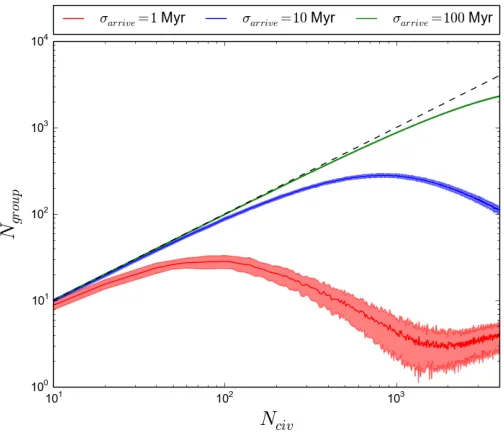
Figure 1 shows how the mean number of causally-connected groups (CCGs) varies with increasingNciv
for a fixed(µlif e, σlif e) = (0.1,10−3)Myr andµarrive = 5000Myr. Each curve represents a different
value ofσarrive = (1,10,100)Myr.
We can immediately see that the lowest group counts occur when σarrive is at its minimum value.
This is at direct odds with the result of Hair (2011), which prefers a relatively large value ofσarrive for
hegemony establishment based on the consequently large inter-arrival time between the first and second
civilisations. However, we find that for the largest values ofσarrive, the number of groupsNgroup is at
its maximum (i.e. it is equal to the number of civilisationsNciv) until it reachesNciv>300. In all three
cases, the mean spatial extent of each civilisation asymptotes to similar values at largeNciv(Figure 2).
While theσarrive = 100Myr sizes are slightly lower than the other two cases, it remains within a single
standard deviation.
In the case whereσarrive is set to its lowest value, the minimum number of groups tends to around 3,
and asymptotes to this value forNciv>1000(where it also approaches the maximum group extent of 20
kpc, corresponding to the diameter of the Galactic Habitable Zone edge). Given that the1σuncertainty on
Figure 1: The mean number of groups identified in the MCR runs as a function of civilisation number, for
three values ofσarrive= 1,10,100Myr. The black dashed line indicates the maximum number of groups
[image:6.612.169.422.453.668.2]Ngroup=Nciv. We fix(µlif e, σlif e) = (0.1,10−3)Myr andµarrive = 5000Myr.
Figure 2: The mean spatial extent of groups identified in the MCR runs as a function of civilisation number,
for three values of σarrive = 1,10,100 Myr. As in Figure 1, (µlif e, σlif e) = (0.1,10−3) Myr and
can therefore predict that for this Galactic Habitable Zone configuration, civilisation populations emerging
within a relatively narrow time interval have the best odds for establishing the Galactic Club (given a typical
civilisation lifetime of 0.1 Myr).
Such co-ordination of arrival time seems a priori unlikely - indeed, it most likely demands that a global
regulation mechanism exists to “synchronise the biological clocks” of planets separated by enormous
dis-tances (Vukotic & Cirkovic, 2007; Annis, 1999). Proposed regulation mechanisms, such as gamma ray
bursts, would still fail to synchronise the entire GHZ, as their ability to sterilise planets extends no more
than a few kpc, and their efficacy even at these distances remains a source of debate (Martin et al., 2010;
Thomas, 2009, and references within).
3.2
Dependence on Civilisation Lifetime Parameters
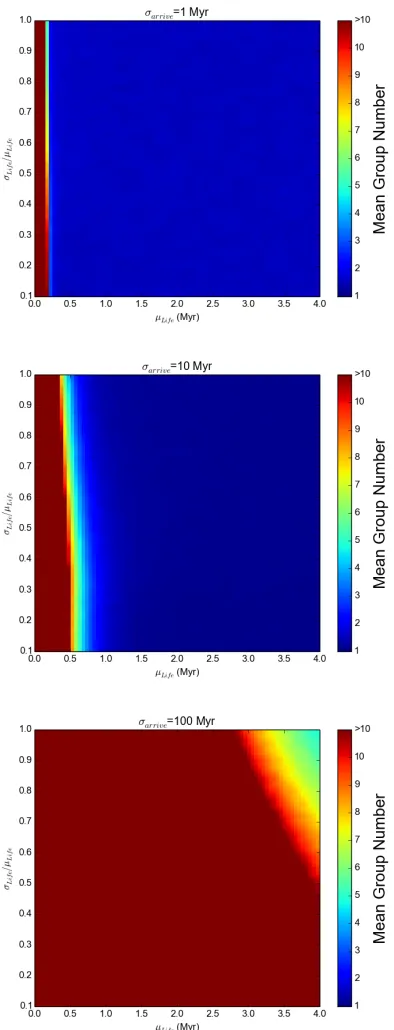
As we have established thatNgroup can become small forNciv > 500, we now fix Nciv = 500and
explore the effects of the civilisation lifetime parameters(µlif e, σlif e). Figure 3 shows how the mean
group number depends on these parameters (with each plot showing a different value ofσarrive). Again,
we can see that hegemony establishment (Ngroup = 1) is easier ifσarriveis lower. The group number is
only weakly dependent onσlif e(except for very highσarrive).
In all cases, the mean civilisation lifetimeµlif e must exceed around 250,000 years for hegemony to
be established. Note that this lifetime is measured from when a civilisation is sufficiently technologically
advanced to begin communication. The earliest fossil records of homo sapiens date to approximately
190,000 years ago (McDougall et al., 2005). If human civilisation is indeed subject to the Principle of
Mediocrity, then we should expect our total lifetime (from the emergence of anatomically modern humans
to now, and from now until the end of our civilisation) to be close to the mean. The results of this toy model
suggests that for hegemony establishment to proceed and form a Galactic Club, our species has likely only
persisted for approximately half its lifespan.
Note that if we wished a single civilisation to be exceptionally long-lived near the beginning of the
simulation (a low mean lifetime with a high standard deviation), then this would still result in a reasonably
large number of groups. This underlines that space-time separation is the principal factor, and that the
Galaxy is sufficiently large that cliques can be established at large spatial separations even from ancient
long-lived civilisations.
4
Discussion
We should be clear that this work makes no predictions on the number of intelligent civilisations in the
Milky Way. It cannot even predict if extraterrestrial intelligences exist at all. It is merely a controlled
numerical experiment that tests the ability of civilisations to influence each other if they exist, depending
on the details of when and where civilisations might emerge.
We have progressed beyond the original assertion of Forgan (2011), that typically the number of
cul-turally connected groups is greater than 1. Our Galactic Habitable Zone model of civilisation emergence
predicts thatinitially, there will be significant opportunity for cultural variance across space and time, and
Figure 3: The mean number of groups as a function ofµlif eandσlif e. The mean arrival timeµarrive is
To reach this conclusion, we have assumed an annular GHZ for civilisation emergence. We have
as-sumed the rather wide annular range of 6-10 kpc based on Gowanlock et al. (2011), which remains the most
high-resolution study of galactic habitability, if somewhat constrained by demanding azimuthal symmetry
(Forgan et al., 2015). This is actually a restricted GHZ - Gowanlock found that habitable planetary systems
were possible from as little as 2.5 kpc from the Galactic Centre. Populating this region with civilisations
will result in much smaller spatial separations due to the high surface density of stars, which may reduce
the number of cliques. However, the maximum spatial separation is a function of the outer radius of the
GHZ:
dxmax= 2Router. (4)
IfNciv remains small, the outer edge will be poorly populated, reducing the maximum separation below
this value (we can infer this by studying the mean group size curves in Figure 2 forNciv < 100). This
would increase the probability of a single Club forming, but only in this limit. IfNcivis sufficiently large,
populating the interior with more civilisations cannot allow a Galactic Club to form, as a small fraction
will reside at the distant fringes of 10 kpc, and the number of culturally connected groups will in general
be greater than 1. This is true as long asRouteris relatively large. Given that we exist atR≈8kpc, we
can be reasonably confident that this is the case.
We also assumed that stellar motions are negligible in this analysis, which is clearly not the case even
in a relatively restricted GHZ (Vukoti´c et al., 2016). While the speed of lightin vacuoremains constant
in all reference frames, the distance between stars can be reduced by proper motions, resulting in reduced
light travel times and greater probability of civilisation connectivity (with the converse being true for stars
receding from each other). Once cliques have been established, the spatial extent of the clique will evolve
according to local stellar dynamics. It is likely that initially separate cliques will be able to diffuse into
each other. Given that cliques are somewhat intermixed even at inception (which we can see from the large
group extents established in Figure 2), it is unclear what further effects this may cause.
While cultural variation is initially large, this does not preclude the later emergence of uniform motive
once individual cliques become causally connected to each other, i.e. a uniformity established through
political means. The galactopolitical machinations of a set of civilisation cliques (and the internecine
activities of an individual clique) far exceed the capabilities of this simple toy model. All that we can
predict is that if civilisation cliques do come into contact, it is likely they will hold significantly different
perspectives on the Universe, and the rights and responsibilities of sentient beings and the institutions they
construct.
It is also possible for cliques to evolve internally, in isolation from their peers. Cultural norms change
with time, and the growth of a clique as new civilisations become culturally connected may enhance the rate
of cultural evolution, as new ideas and perspectives begin to percolate through the clique’s membership.
A clique that initially holds treaties regarding contact in high regard may discard them through changes
in their internal make-up, especially if they are subject to strong environmental pressures that impact their
way of life.
Despite these factors that are beyond the realms of simple MCR analyses such as this work, we are still
able to draw important conclusions on the Zoo Hypothesis. The initial state of the Zoo hypothesis (that
diverse. Subsequent cultural evolution can act to soften the Zoo Hypothesis, just as much as it may act to
harden it. For example, a dominant clique may attempt to impose an authoritarian monoculture, or cliques
may “agree to disagree” for political expediency.
We have no way of predicting how extraterrestrial cultures will interact. However, we do know that
from the multitude of possible outcomes of political negotations, the Zoo hypothesis demands that only a
small subset of these outcomes are possible. If the Zoo hypothesis is correct, and it demands a uniformity
of motive established via a Galactic monoculture, we should conclude that it is most likely imposed
-perhaps against the wishes or interests of the Galactic community - through interactions between a number
of cliques, either through political or military means.
5
Conclusion
In this work, we have investigated the implicit assumptions made to invoke the Zoo hypothesis as a solution
to Fermi’s Paradox. We achieved this by explored the culturally-connected civilisation groups present in a
toy model of the intelligent civilisation population of the Milky Way. We find that for there to be only a
single group (a “Galactic Club”), the mean civilisation lifetime must be extremely long, and the arrival time
between civilisations must in fact be relatively short (constrained by a small standard deviation in arrival
time,σarrive). This is perhaps an unlikely scenario, as it would require a large number of civilisations to
emerge across the Galaxy in a very short time frame. This is also in opposition to previous work which has
suggestedσarriveneeds to be large for a single first civilisation to dominate the Milky Way.
This toy model underlines that the Zoo solution to the Fermi Paradox remains “soft”, i.e. it demands a
uniformity of motive amongst ETIs that only exists when certain conditions are met. Our previous work in
this area has suggested that these conditions are unlikely to be met in our Galaxy (Forgan, 2011), but did
not explore the population of causally-connected groups that would result.
We therefore conclude the following:
• If civilisations typically last less than 1 Myr, then it appears likely thatNgroup >>1, resulting in a
set of “Galactic Cliques” rather than a single Galactic Club.
• A single long-lived, ancient civilisation still fails to knit the entire Galactic community of
civilisa-tions into a single Club.
• Ifallcivilisations can last much longer than 1 Myr, then a single Galactic Club can be established,
but only if all civilisations arrive quite close together in time.
Typically, the Galaxy is composed of “Galactic Cliques”. Once established, these cliques may come
into causal contact with others, bringing their own established norms to discussions in a scaled-up
ver-sion of contact between individual civilisations. One clique attempting to place an interdict on contacting
“primitive” civilisations is likely to encounter significant problems if another clique disagrees.
This analysis remains insufficient to completely remove the Zoo solution from the list of possible
solutions to Fermi’s Paradox, but it illustrates the underlying assumptions required to propose it. It may
well still be the case that the Earth resides in a region of space occupied by a conservative clique bent on
increases (e.g. Wright et al. 2015; Stevens et al. 2015), we should presumably be able to break the deadlock
imposed in this scenario. In an extreme case, a neighbouring clique is free to violate non-contact treaties
with impunity - if we are a late arrival to a populous Galactic community, then many established cliques
may be aware of our presence, and they may not pay attention to local signage forbidding them to reveal
themselves.
Acknowledgments
The author gratefully acknowledges support from the ECOGAL project, grant agreement 291227, funded
by the European Research Council under ERC-2011-ADG, and the STFC grant ST/J001422/1.
References
Annis J., 1999, J. Br. Interplanet. Soc., 52, 19
Ball J., 1973, Icarus, 19, 347
Brin G. D., 1983, QJRAS, 24, 283
Carter B., 2008, International Journal of Astrobiology, 7, 177
Cirkovic M. M., 2009, Serbian Astronomical Journal, 178, 1
Fogg M., 1987, Icarus, 69, 370
Forgan D., Dayal P., Cockell C., Libeskind N., 2015, International Journal of Astrobiology, pp in press,
arXiv:1511.01786
Forgan D. H., 2009, International Journal of Astrobiology, 8, 121
Forgan D. H., 2011, International Journal of Astrobiology, 10, 341
Forgan D. H., Rice K., 2010, International Journal of Astrobiology, 9, 73
Freitas R. A., 1977, Mercury, 6
Gowanlock M. G., Patton D. R., McConnell S. M., 2011, Astrobiology, 11, 855
Hair T. W., 2011, International Journal of Astrobiology, 10, 131
Hart M. H., 1975, QJRAS, 16, 128
Lineweaver C. H., Fenner Y., Gibson B. K., 2004, Science, 303, 59
McDougall I., Brown F. H., Fleagle J. G., 2005, Nature, 433, 733
Martin O., Cardenas R., Guimarais M., Pe˜nate L., Horvath J., Galante D., 2010, Astrophysics and Space
O’Malley-James J. T., Greaves J. S., Raven J. A., Cockell C. S., 2013, International Journal of Astrobiology,
12, 99
Raup D. M., Sepkoski J. J., 1982, Science, 215, 1501
Rocha-Pinto H. J., Maciel W. J., Scalo J., Flynn C., 2000a, A&A, 358, 850
Rocha-Pinto H. J., Maciel W. J., Scalo J., Flynn C., 2000b, A&A, 358, 869
Rushby A. J., Claire M. W., Osborn H., Watson A. J., 2013, Astrobiology, 13, 833
Snyder D. L., Miller M. I., 1991, Random point processes in time and space. Springer-Verlag
Stevens A., Forgan D., O’Malley-James J., 2015, International Journal of Astrobiology, pp in press, arXiv
eprint 1507.08530
Thomas B., 2009, International Journal of Astrobiology, 8, 183
Vukotic B., Cirkovic M. M., 2007, Serbian Astronomical Journal, 175, 45
Vukoti´c B., Steinhauser D., Martinez-Aviles G., ´Cirkovi´c M. M., Micic M., Schindler S., 2016, MNRAS,
459, 3512
Wright J. T., Cartier K. M. S., Zhao M., Jontof-Hutter D., Ford E. B., 2015, The Astrophysical Journal,