www.sciencepolicyjournal.org JSPG, Healthy Food Policy Issue, Sept. 2014
Stakeholder arguments in access to healthy
food state-level legislation in newspapers and
bill hearings, 2010-2012.
Lindsey Haynes-Maslow
1
, Danielle Schramm
2
, Barbara
Mark
3
, Alice Ammerman
4
, and Pam Silberman
5
Union of Concerned Scientists, Food& Environment Program 1825 K Street NW, Suite 800, Washington, DC 20006
Corresponding Author: [email protected]
1Food & Environment Program, Union of Concerned Scientists. 2ICF International, Atlanta, GA. 3School of
Nursing, University of North Carolina at Chapel Hill. 4Department of Nutrition, University of North Carolina
at Chapel Hill. 5Department of Health Policy & Management, University of North Carolina at Chapel Hill.
Executive summary: The purpose of this study is to understand the arguments used to support and oppose access to U.S. state-level healthy food legislation between 2010 and 2012. This analysis includes 137 bills introduced in 34 states, of which 18 of which were enacted into law. Bill types were categorized as either “expanding” access to healthy food or “restricting” access to unhealthy food, and further categorized into eight topics. Expanding legislation included policies focused on farmers’ markets food assistance program expansion, grocery store development, healthy food financing, local produce promotion, and formation of task forces to study access to healthy food. Restricting legislation included policies designed to limit access to unhealthy food, such as sugar sweetened beverage (SSB) taxes and prohibiting food assistance recipients to purchase SSBs and snacks with their benefits.
Bills that expanded access to healthy food were found to be more likely to pass than those that restricted access to unhealthy food. These results are attributed to the fact that acts of expanding legislation fostered more support and were less controversial. Overall, healthy food bills that passed had 10 times more supporters than opponents. Among the stakeholder arguments used to support expanding legislation, fairness and economic security were the two most frequently cited. Bill justifications were often based on the premise that lack of healthy food access disproportionally affects low-income populations or that investing in the local economy would increase property values and tax revenue.
www.sciencepolicyjournal.org JSPG, Healthy Food Policy Issue, Sept. 2014 Policymakers seeking to improve access to healthy foods should counteract the food
industry’s messages of opposition with value-laden messages focusing on the economic benefits of healthy food legislation, the need to protect public health, and the right of every individual to access health foods. To best assess the effectiveness of these messages, they should be tested in focus groups or community forums to see which are most effective in changing public opinion about the food industry from a supportive stance to one of opposition and mistrust.
I.Introduction
Obesity is currently the leading preventable cause of illness and a major contributor to morbidity and mortality in the United States.1
Consuming healthy foods can help maintain weight and prevent weight gain and reduce the risk of chronic diseases.2 Public health advocates
have referred to obesity as the “new tobacco” due to its high rates of morbidity and mortality, its impact on healthcare costs, and the fact that obesity and smoking are both influenced by similar psychological, social, and environmental factors.3 While there are also important
differences between the influences on obesity and on tobacco use, an understanding of the arguments used by and against the tobacco industry may help lay the groundwork for framing arguments in regards to healthy food access legislation.
Framing theory is built upon the idea that individuals, groups, and societies view issues from various perspectives. Each individual has preconceived beliefs and values that likely have been a part of their culture for long periods of time. When framing messages, speaking to an individual’s core values and beliefs is critical to successfully highlighting and promoting specific issues.4 The overall goal of framing is to influence
opinions, decisions, and behaviors by appealing to core values through the use of arguments or facts that an individual is willing to accept.
Similarly, the way that issues are framed can also influence policy formation.5 In the policymaking
process, political battles are rarely won using logical and rational arguments. They are often won based on which side can best frame an argument that resonates with public opinion and political will.6
The use of framing can be seen in the example of tobacco control, which is one of the most cited and successful public health movements of this century. The public health
community framed the anti-smoking campaign by appealing to the core values of health, the rights of non-smokers, protection from public health harms, the David versus Goliath analogy regarding the tobacco industry, and being transparent and forthright about the harms of smoking. Policy makers and public health advocates successfully used these frames to help reduce smoking rates through the implementation of tobacco taxes, marketing restrictions, and smoke-free institutional policies.7 In 1990, only 700 local ordinances
across the U.S. banned smoking in public places. In 1998, the U.S. Master Settlement Agreement’s release of internal documents from tobacco companies jumpstarted social disapproval of the tobacco industry, as this event revealed that the industry had manipulated nicotine levels, withheld data about smoking harms, and purposefully marketed smoking to youth.8 By
2005, over 25 state ordinances restricted smoking in public places. Partly as a result of the public health community’s efforts from 1965 to 2011, smoking rates in the United States decreased from 42% to 19%.9 The tobacco
industry responded by defending their products and framing arguments to counteract the anti-smoking campaign from the public health community. These arguments focused on promoting individual choice and personal responsibility (i.e., liberty), the fear of big government, economic security (e.g., promoting the economy by employing individuals and purchasing tobacco from farmers), and lack of truthfulness (e.g., deceit and manipulation of scientific evidence).10, 11, 12, 13
www.sciencepolicyjournal.org JSPG, Healthy Food Policy Issue, Sept. 2014 health. Examples of such frames include:
portraying the food industry as a “killer” in that unhealthy foods can lead to increased morbidity and mortality, portraying the food industry as an impediment to personal choice because consumers do not have the information they need to make informed choices about food, portraying the food industry as manipulative and deceitful in their marketing strategies that target youth and minorities as consumers of their products, and portraying the public health community as protecting the public against the food industry. In contrast, the food industry has focused on promoting individual choice and personal responsibility, fear of big government, economic security (e.g., taxes hurt business and consumers), and lack of truthfulness from the scientific community (e.g., insufficient evidence to claim certain foods cause obesity).
It is important to keep in mind that while the issues of obesity and tobacco use are similar, there are dissimilarities. Although the scientific and medical communities can accurately conclude that no health benefits exist for humans consuming tobacco, the same claim cannot be made for food. Acquiring appropriate nutrition is a necessity for the human body. Physicians can recommend that their patients stop smoking, but they cannot recommend that they stop eating. Therefore, although there may be similarities between access to healthy food and anti-tobacco frames, there may also be unique frames employed in the food debate.
To date, most content analyses of obesity legislation have focused on bills regarding childhood obesity. While the methodology for research on adult obesity is similar, documentation of childhood obesity legislation focuses specifically on school-based nutrition,14,15
physical education,16,17 and food marketing to
children.18,19 Examples of expanding healthy food
legislation for adults include financing initiatives to increase the sale of fresh produce in underserved communities, allowing farmers’ markets to accept electronic benefit transfer (EBT) for Supplemental Nutrition Assistance Program (SNAP) recipients, establishing food access task forces, and taxing sugar-sweetened beverages (SSBs). To date, there has been little analysis of state-level policy efforts to address
access to healthy foods, and no studies have conducted a content analysis of the framing of the legislation. More specifically, minimal research has been conducted on how the bill arguments for and against such legislation have been framed. The purpose of this policy analysis is (1) to determine which states have introduced access to healthy food legislation and to describe their content and history, and (2) to understand the frames that stakeholders have used to support and oppose state-level access to healthy food legislation. Stakeholder arguments used to support or oppose each bill are described through content analysis methodology. It is hypothesized that the frames used to support and oppose bills will mirror those used in the tobacco fight from the 1950s to the 2000s. Findings from this study could be helpful to policymakers and community-based organizations seeking to improve access to healthy foods in that they may effectively utilize the framework already established by the opposition to the tobacco industry.
II. Methods A. Data Sources
Legislative Database – Multiple online sources were used to obtain information regarding bills that address healthy food legislation including the Yale Rudd Center for Food Policy and Obesity’s Legislation Database (Legislative Database), state legislatures’ websites, and InfoTrac Custom Newsstand. The Legislative Database was used to identify which states introduced legislation between January 1, 2010 and December 31, 2012. The Legislation Database began tracking food policy legislation filed by federal and state governments in 2012. It includes 22 obesity issue areas, including access to healthy foods, food assistance programs, and SSB taxes. From these three categories, bills were further categorized into eight sub-categories: 1) grocery store/supermarket development, 2) local produce promotion, 3) farmers’ markets, 4) SSB taxation, 5) food assistance program (SNAP/WIC) expansion, 6) food assistance program (SNAP/WIC) restriction, 7) healthy food financing, and 8) food task forces.
www.sciencepolicyjournal.org JSPG, Healthy Food Policy Issue, Sept. 2014 websites were used to access bill text, committee
hearing transcripts, testimonies, letters of support, and minutes. These sources contain information on bill language and history including status updates, whether a bill has passed or failed, bills enacted into law, and dates for law adoption. While all 50 states have bill text available online, only 18 have legislative hearing data (transcripts, testimonies, letters of support, and minutes). The level of data available on the legislative websites varies by bill depending on how far individual bills traveled in the legislative process. Bills that were referred to specific committees and read multiple times in chamber were more likely to have data available online.
InfoTrac Custom Newsstand – After all available data were downloaded from state legislature websites, InfoTrac Custom Newsstand was used to search for newspaper articles and press releases related to each bill. This is an online search engine database that keeps up-to-date information from over 1,100 major U.S. regional, national and local newspapers.
B. Search strategy and sample selection of legislative bills and articles
A total of 214 bills and resolutions that were introduced from January 1, 2010 to December 31, 2012 were identified. Bills were excluded if they focused on school food (n = 19), food marketing to children (n = 1), eligibility requirements for food assistance programs (n = 4), city ordinances (n = 7), bills introduced before 2010 (n = 7), a general tax exemption (e.g., exempting certain foods from sales taxes; n = 25), preemption (e.g., authorizing or restricting municipalities from imposing their own food and beverage taxes; n = 5), voting requirements in legislation (n = 2), or if they were a duplicate bill (n = 6). After these exclusions, a total of 132 bills and 5 resolutions from 34 states were selected for this study.
State legislature websites were employed to find hearing data (transcripts, testimonies, letters of support, and minutes) specific to each of the selected bills and resolutions. This search strategy yielded 113 documents: 67 testimonies, 23 bill analyses, 13 sponsor memos, 6 letters of support, 2 witness lists, and 2 veto messages.
After all hearing data were collected, InfoTrac Custom Newsstand was used to find newspaper articles and press releases specific to each bill written between 2010 and 2012. Based on a preliminary search of 30 bills, articles were most likely to be published close to a committee hearing date. However, due to the relatively low number of articles published about bills, articles were searched from the date a bill was introduced until it passed or failed to pass.
Headlines and lead paragraphs of newspaper articles were searched using three different combinations: state name and bill number, state name and bill title, and state name and bill topic (using one of the eight bill categories noted above). For states introducing SSB taxes, three combinations were used: state name and SSB tax, state name and sweetened beverage tax, and state name and soda tax. This search strategy yielded 206 articles, of which 100 were selected. Articles were excluded if they were duplicates or if the article was not predominantly about the bill, in terms of its substantive content.
C. Bill content analysis
Bill coding was divided into three stages: general bill information (quantitative), stakeholder analysis (qualitative), and bill arguments (qualitative).
General bill information – A database was created to include the following information regarding each bill: state of origin, number, title, year of introduction, chamber of origin, sponsor, legislative history, amount of time “active,” topic, purpose (i.e. to expand or restrict access), strength of language, funding, oversight of activities, and whether the bill was enacted into law. These categories were selected using past research on childhood obesity legislation and additional categories thought to be of interest to policymakers.14, 17, 18, 19
www.sciencepolicyjournal.org JSPG, Healthy Food Policy Issue, Sept. 2014 were coded as opponents if they opposed the bill
or voted against it. Conversely, they were coded as proponents if they supported the bill or voted for it. For each state, stakeholder positions were counted for each bill they opposed or supported.
Bill Arguments – Press releases, newspaper articles, transcripts, testimonies, letters of support, and meeting minutes were analyzed using a general inductive approach to identify how arguments were framed. This is considered an appropriate approach to analysis as it allowed for the capturing of arguments that might have been overlooked if using an established codebook. The customized codebook for this study was developed through an iterative process. Fifteen codes were independently applied to 213 documents. Once all documents were coded, code frequencies were determined and summary reports for each code were compiled.
III. Results
A. Quantitative results
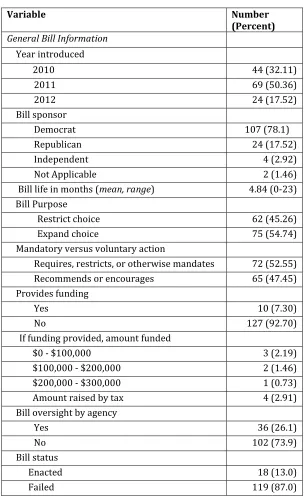
Bill Information – Between 2010 and 2012, 34 states introduced 137 bills focusing on access to healthy food, 18 of which were enacted into law (see Table 1). Five states introduced approximately half of all bills (see Table 2): New York (24), Mississippi (12), California (11), Hawaii (11), and Tennessee (11). A majority of the bills recommended or encouraged action (72%) and were introduced by a Democrat (78.1%). Only 10 bills (7.3%) allocated funding to the bill’s activities, and none of the bills included an evaluation component.
Legislative History – A total of 137 bills were introduced in one of the two legislative bodies and referred to a committee (see Figure 1). Of these 137 bills, 49 were heard by a committee. Of the 49 bills heard by a committee, 29 were sent to the floor for consideration. From the 29 bills considered on the floor, 27 were referred to another legislative body, with 21 ultimately being heard in committee. From the 21 heard in committee, 6 passed without amendments and 15 with amendments. For the 15 bills passed with amendments, all were reconciled between both bodies. Among the 21 bills sent to governors, 3
were vetoed and 18 were approved to become law.
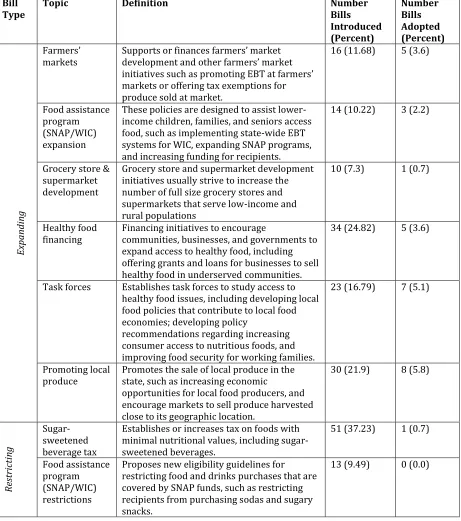
Bill Types – Bill types were categorized as either expanding access to healthy food or restricting access to unhealthy food. Bills were then further categorized into the aforementioned eight categories (see Table 3). Expanding legislation included policies relating to six categories: farmers’ markets; food assistance program expansion; grocery store/super market development; healthy food financing, promoting local produce, and task forces. Restricting legislation included two categories, namely SSB taxes and food assistance program restrictions. Bills could be coded as belonging to more than one bill category.
SSB taxes had the highest number of bills with 51 (37.2%). A total of 34 bills (24.8%) financed healthy food initiatives, 30 promoted local produce (22%), 23 created task forces (16.8%), 16 were in regards to farmers’ markets initiatives (11.7%), 14 called for food assistance program expansions (10.2%), 13 called for food assistance program restrictions (9.5%), and 10 promoted grocery store development (7.3%). A total of 75 bills were categorized as expanding whereas 62 bills were restricting. Of the 18 bills that were passed into law, 17 were expanding legislation.
B. Qualitative results
www.sciencepolicyjournal.org JSPG, Healthy Food Policy Issue, Sept. 2014 categorized as either proponents or opponents,
and then assigned a category type and sub-category.
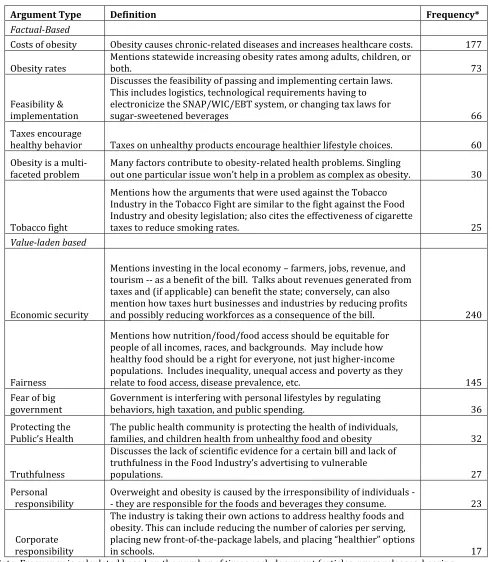
Arguments – A total of 13 arguments were identified that were used to support or oppose access to healthy food legislation, six of which focused on factual arguments and seven on value-laden arguments that appealed to an individual’s core values and beliefs (see Table 4). The six factual arguments identified were (listed from most frequently cited to least): costs of obesity, continuously-increasing obesity rates, bill feasibility and implementation, taxes encouraging healthy behavior, obesity as a multi-faceted health problem, and referencing the fight against the tobacco industry. The seven core-value arguments identified were (listed from most frequently cited to least): economic security, fairness, fear of big government, protecting the public’s health, truthfulness, personal responsibility, and corporate responsibility. The following section includes the type of bills, stakeholders, and arguments used to support or oppose each type of legislation: expanding (enacted and failed) and restricting (enacted and failed).
C. Expanding legislation analysis 1. Enacted legislation
Of the 18 bills that were passed into law, 17 were expanding legislation. They fit into the following categories: promoting local produce (n=8), task forces (n=7), healthy food financing (n=5), farmers’ market (n=5), food assistance program expansion (n=3), and grocery store development (n=1). Promoting local produce and task forces accounted for nearly 80% of passed expanding legislation. Among the expanding legislation that passed, 90.6% of stakeholders were identified as bill proponents. Approximately 70% of bill proponents were profit organizations and businesses. Among non-profit organizations, approximately 65% had missions focusing on food and nutrition or health. Among businesses supporting legislation, 65% were either finance- or agriculture-based.
Among stakeholders opposing legislation, those representing businesses (primarily farmers’ markets) were least likely to support
bills that required EBTs. Most people representing farmers’ markets opposed these bills because they did not want to have to purchase EBT terminals and pay additional processing fees associated with EBT cards. Among the factual arguments used to oppose these bills, many businesses discussed feasibility and implementation issues (10.1%) associated with requiring EBT at farmers’ markets, including individual vendors operating their own point-of-sale system, or having a third-party operate the EBT system at markets.
Among the stakeholder arguments used to support expanding legislation, fairness and economic security were the two most frequently cited supporting value-laden frames. When using the fairness frame, many bill justifications included information on how lack of healthy food access disproportionally affects low-income populations, and that access should be equitable for people regardless of socio-economic status. Bill proponents often cited health disparities in lower-income populations regarding childhood and adult obesity rates, diabetes, and other obesity-related chronic diseases. Many bills cited statistics that showed the importance of ensuring that impoverished populations have access to fresh fruits and vegetables. In a California bill analysis, legislators stated that the bill’s purpose was to acknowledge “…that access to healthy food items is a basic human right and lack of healthy, affordable food options can result in higher levels of obesity and other diet-related disease.”20
www.sciencepolicyjournal.org JSPG, Healthy Food Policy Issue, Sept. 2014 Additionally, some supporters argued that more
healthy food venues would bolster property values and tax revenue for the community. Justifications for promoting local produce and farmers’ markets included the importance of protecting productive farmlands for future generations, investing in the local economy, and promoting tourism.
2. Failed legislation
Of the 119 bills that failed to pass, 56 were expanding legislation that fell into the following categories: healthy food financing (n = 29), promoting local produce (n = 22), task forces (n = 16), farmers’ markets (n = 11), food assistance program expansion (n = 11), and grocery store development (n = 9). Healthy food financing and promoting local produce categories accounted for nearly 90% of the failed expanding legislation. Among the expanding legislation that failed, bill proponents accounted for 94% of the stakeholders. The majority of bill proponents (71.3%) were non-profit organizations and governments. For non-profit organizations, nearly 80% of all organizations’ missions focused on either health (44.0%), food and nutrition (20.0%), or policy (16.0%). Bill opponents of failed expanding legislation were agriculturally-driven, non-profit organizations and the government.
For failed expanding legislation, fairness and economic security were the two most frequently cited value-laden frames, accounting for nearly 50% of all frames. Bill sponsors and proponents often cited the factual arguments such as costs of obesity (including obesity-related chronic conditions like heart disease, diabetes, and stroke that contribute to the rising health care costs) as a justification for legislation expanding access to healthy food (12.6%). The frames that were used to oppose legislation were personal responsibility, feasibility and implementation, and fear of big government. Several opponents criticized the government for offering food assistance programs, stating that individuals have become too reliant on them. Many bill opponents questioned the feasibility of passing and implementing certain laws. For bills encouraging farmers’ markets to accept EBT, several
policymakers discussed the technical difficulties and costs associated with such a large transition.
D. Restricting legislation analysis 1. Enacted legislation
Only one restricting bill was enacted into law: Colorado’s House Bill 1191, the elimination of soda sales tax exemptions. Prior to the passage of this bill, soda was exempt from sales and use tax; after implementation Colorado imposed a 2.9% sales tax on soda. Approximately 75% of stakeholders were identified as bill proponents. At least half of the bill proponents were non-profit organizations and the government. Among non-profit organizations, two-thirds were health-related and one-third policy-health-related. The only opponents were Republican legislators, who deemed the bill unconstitutional.
The main frame used to support the bill was that of economic security in that promoting the bill would generate much needed revenue in the state’s economic downturn. As Governor Ritter commented, Colorado’s citizens must, “…work together as stubborn stewards of taxpayer dollars to adjust, adapt and succeed.”22 However,
opponents of the bill also made economic security counterarguments. They argued that implementing a soda tax would only threaten the state’s economy by hurting business and consumers. As Colorado State Senator Josh Penry questioned, “Do we want a one-party Democratic monopoly that views tax increases as the solution for every challenge that confronts us, or do we want balanced leadership who will cut spending across the board instead of kicking businesses and families when times are tough enough?”23 Several
opponents also questioned the feasibility of implementing the new tax and which drinks would be defined as “soda” in the tax code.
2. Failed legislation
www.sciencepolicyjournal.org JSPG, Healthy Food Policy Issue, Sept. 2014 – both proponents and opponents – compared to
any other legislation type category. Approximately 63% of all stakeholders were proponents, including non-profit organizations and governments. The majority of the non-profit organizations were health-related (86.8%). Among bill opponents, businesses accounted for 26.1% of all stakeholders. SSB taxes were opposed by both small businesses and large corporations, which ranged from bottlers to distributors to store managers. Among these businesses, over 90% were from either the retail or food industry.
For restricting legislation, the costs of obesity and taxes encouraging healthier behavior were the most popular factual arguments. SSB taxes were seen a way to incentivize healthier behaviors by influencing consumer behavior and decreasing SSB consumption. Bill proponents often cited the effectiveness of tobacco taxes in reducing smoking rates in an attempt to demonstrate the merit of SSB taxes in encouraging healthy behavior (i.e., discouraging consumption). During testimony for the proposed Kansas SSB tax, a non-profit organization discussed how SSB taxes could be effective in targeting adolescents, as they are more price sensitive than adults, “As in increases on cigarettes there was a decline especially with the young smoker so there might be the same value in relation to soda pop.” 24
In terms of value-laden frames, economic security was the most frequently cited. Proponents argued that taxes could support revenue directed at initiatives aimed to reduce obesity. In addition to generating state revenue, many politicians and advocates trying to promote bills stated that it was is in the best interest for children – states should protect them from unhealthy food and obesity in order to promote healthful lives as they age, fitting with the public health frame. As Assemblyman Bill Monning from California said in response to a sugary drink tax, "The long term health of California's children is at risk and we must work together to avoid a future influx of chronically-ill adults into our already overstressed healthcare system." 25 In
regards to another California soda tax bill, Senate Majority Leader Dean Florez commented, “When Michelle Obama introduced her children's health
initiative last week she explained that our children didn't do this to themselves. They didn't create an environment where high sugar sodas are the cheapest, easiest drink to find. We did that to them. So we have a responsibility to fix it. And this bill is the right way to start.” 26 Senator Florez also said
in this press conference, "I don't want obesity to be the legacy that we leave to our children.” 26
Several bill proponents discussed the lack of truthfulness in the argument of the opposing side. Many SSB tax proponents discussed the soda and food industry’s marketing tactics to target children and minorities, as well as the issue of donations from these companies to schools and other non-profit organizations. As one press release criticized, “They defend themselves by increasing their giveaways to community programs, buying full-page ads that celebrate their hypocritical call for moderate consumption and spending $500 million a year to market to our kids. No other food category in the nation so aggressively markets to children, and yet the soda giants continue to tell us they are champions for health.” 27
www.sciencepolicyjournal.org JSPG, Healthy Food Policy Issue, Sept. 2014 Many opponents also mentioned that
implementing SSB taxes during an economic recession would not be helpful for consumers who are just trying to get by and pay their bills. In bill hearings and testimonies, many citizens were worried about how SSB taxes would affect their personal finances through higher prices and job loss. Some opponents appealed to the fairness core value as they felt that SSB taxes would disproportionately affect lower- to middle-income consumers. As Teresa Casazza, President of the California Taxpayers Association commented, “Families cannot afford another tax at a time when they are already struggling to make ends meet, especially one that is regressive and discriminatory.” 29
Fear of big government was a frame that was used specifically in bills regulating food choice- SSB taxes and food restrictions for SNAP recipients. Many bill opponents said they were against bills regulating food choices due to their paternalistic nature (i.e., the bill would limit personal choice, freedom, or liberty). One Hawaii mother opposing SSB taxes said in her testimony, “I teach my children at home, where they should be taught, how to eat the right way… I think that the government's role is not within our lifestyle, to begin taxing us on our lifestyle, or to be interpreting our lifestyle and telling us how to live.” 30 Similarly, in Kansas, representatives of
Treat American Food Services argued in their testimony against a SSB tax, “Residents of Kansas don't like it when our government officials use taxation to tell them what to eat and drink, even if we might agree there is a problem. Obesity should be managed by the decisions a person makes relating to overall diet and exercise, not by government or taxes.” 31
In response to SSB tax proposals and the allegations about the link between SSBs and obesity, many soda corporations responded through the corporate responsibility frame and touted that the soda industry was voluntarily taking their own actions to address the obesity epidemic. On numerous occasions, corporations said they were doing their part to address obesity by voluntarily reducing the amount of calories in soft drinks and offering lower-calorie alternatives. They also mentioned supporting new calorie labeling initiatives, including the
National School Beverage Guidelines in which the soda industry removed high-calorie soft drinks from schools and replaced them with lower-calorie beverage choices. As the American Beverage Association said, “We are producing fewer total beverage calories for the marketplace through the innovation of more zero- and low-calorie beverages. From 1998-2008, industry cut the total beverage calories it brought to market by 21 percent.” 32
Multiple corporations mentioned that the beverage industry was teaming up with First Lady Michelle Obama’s “Let’s Move” anti-obesity campaign. As Coca Cola commented, “Coca Cola is supporting Michelle Obama’s ‘Let’s Move’ campaign and front of the package labeling, We're for transparency, as the first beverage company to commit that nearly all our packages will have calories displayed on the front label.” 32
Additionally, they also discussed their own exercise initiatives, including the “Think, Drink, Move” campaign. Another initiative by the beverage industry is the “Clear on Calories” campaign, which put nutrition labels on the front of the drink, so that consumers can see it before they make their purchases.
Claims regarding a lack of scientific evidence were employed by the food industry to support their arguments that SSBs were not linked to obesity and that taxes would not decrease consumption. The American Beverage Association, which represents soft-drink makers, bottlers, and distributors, repeatedly challenged the argument that consumption of sugary drinks leads to obesity in bill hearings and press releases. When discussing obesity, the food and beverage industry often referenced peer-reviewed studies that showed that low physical activity level, not SSBs, was the main contributor to rising obesity rates. Additionally, the food industry cited the inverse relationship between the history of soft drink consumption and obesity rates: “Sales of regular soft drinks have declined year-over-year by 12 percent from 2000 to 2009, according to Beverage Digest. Adult and childhood obesity rates continue to rise across the country during that same period, according to the Centers for Disease Control and Prevention.” 32 Further,
www.sciencepolicyjournal.org JSPG, Healthy Food Policy Issue, Sept. 2014 Personal responsibility was most likely to be
referenced in opposition to SSB tax bills than any other bill type. One California SSB tax bill failed because committee members felt that SSB consumption was the individual’s responsibility, not the government’s: “Committee members said the issue of product consumption was one of parental and individual responsibility.” 33 A father
and emergency room physician commented, “We are certainly seeing serious increases in obesity in society for many reasons. But the father in me does tend to think that we need to be more personally responsible as citizens." 34 The soda
industry argued that “…decisions about consumption of sugary drinks are a matter of individual responsibility and parental authority.”32
Opponents of restricting legislation focused on two factual arguments: feasibility of implementation and obesity as a multi-faceted issue. For SSB tax bills, many opponents questioned how the products would be taxed (e.g., by size, grams of sugar, or by unit), and they noted that tax codes would need to be revised. Additionally, opponents argued that one of the consequences of implementing SSB taxes would be the replacement of products with other similar products, or substitute goods such as fruit juices, energy drinks, or sports drinks. Substituting goods could reduce the effectiveness of using tax laws to decrease SSB consumption. For bills restricting SNAP-eligible foods, most opponents discussed issues of state versus federal jurisdiction and that states have no authority to change federal laws. Currently, SNAP food regulations are dictated by Federal statutes and states seeking to change this must receive permission from the federal government before passing laws that are inconsistent with federal statutes. In order to enforce new restrictions on SNAP purchases, the California Grocers Association wrote in an opposition letter to the California legislator: "It is nearly impossible to identify, evaluate and track the nutritional profile of every beverage, or beverage product, for purchase in the ever-changing marketplace.” 35
While proponents of SSB taxes argued that obesity rates were the result of increases in SSB consumption, the food industry argued that obesity was a multi-faceted problem. As David Thorp, President of the American Beverage
Association said in his press release, “If we really want to have a significant effect on the state's obesity rates, we need to look at comprehensive solutions that will have a meaningful and lasting impact on our citizens, not simplistic approaches targeting one portion of the items in our grocery cart for restrictions or taxation. A beverage tax unfairly lays the blame for obesity on the consumption of one particular product.” 32
IV. Discussion
This study is the first to systematically identify state-level policy efforts to address access to healthy food. The majority of these bills that are introduced have a relatively short life and do not go far into the legislative process. Additionally, certain bill types and topics are more likely to pass than others. Bills that expand access to healthy food (n = 17) rather than restrict access (n = 1) have a better chance of being enacted, most likely because they are less controversial and have more supporters. Bills that restrict personal choice and raise taxes are controversial and more likely to face political opposition and are usually unpopular. Additionally, bills that are supported by multiple sectors are easier to pass than bills that are highly opposed. In this study, bills that passed had 10 times more proponents than opponents. Bills that promoted local produce (n = 8), created task forces (n = 7), supported farmers’ market initiatives (n = 5), and promoted healthy food financing (n = 5) were more likely to pass than food assistance program expansions (n = 3), grocery store development (n = 1), and SSB taxes (n = 1). It may be that bills requiring few resources (with respect to time and money) are easier to pass than resource-intensive bills. A study focusing on predictors of childhood obesity legislation enactment found that bills not requiring funding, such as Safe Routes to School or nutrition and physical education curriculum changes, were easier to pass than revenue-restricting bills.18
www.sciencepolicyjournal.org JSPG, Healthy Food Policy Issue, Sept. 2014 failed legislation, where supporters focused more
evenly on factual and value-laden arguments. This leads to the conclusion that bills which resonate with an individual’s core values are more likely to pass than bills whose arguments focus on facts or statistics such as obesity rates and healthcare costs. Among the value-laden arguments, economic security and fairness were the most popular frames used by proponents and opponents. For enacted legislation, approximately 80% of the supporting arguments used were economic security and fairness. Conversely, among the failed restricting legislation (the largest bill category among all bill types), economic security was the predominant frame used by stakeholders to oppose either SSB taxes or food assistance program restrictions. One interesting aspect of the economic security and fairness frame was that among failed expanding legislation, even when 50% of the arguments of the other factual and value-laden frames were used to support the bills, the bills still did not pass. This could be attributed to the type of stakeholder and that some stakeholders, such as businesses, have more sway than others.
For enacted legislation, non-profit organizations, businesses, and government were the largest proponents. Among the businesses supporting enacted legislation, approximately 80% were financially, agriculturally, or retail-affiliated – all of which are large, well-established industries. Opposing businesses consisted mostly of farmers’ markets (91.7%), which are smaller, and possibly less established, organizations. However, when larger businesses opposed legislation, such as SSB taxes and food assistance restrictions, bills were less likely to pass. Among restricting legislation that failed to pass, opposing businesses consisted of approximately 50% from the retail industry, 40% food industry, and 10% finance industry. One potential explanation could be that businesses, especially those in large, well-established industries have more resources and networks to publicly oppose legislation than smaller businesses, governments, and non-profit organizations. In general, businesses are more likely to appeal to an individual’s core values than government or non-profit organizations by employing messages of economic security, fear of
big government, personal responsibility, truthfulness, and corporate responsibility.
SSB taxes and restricting certain SNAP-eligible food items were vehemently contested by businesses such as the beverage and retail industry, since it has the potential to decrease their sales. A study examining patterns of childhood obesity prevention legislation in the United States also cited similar findings.14
Between 2003 and 2005, researchers found that bills that were more revenue restricting, such as vending machine restrictions in schools, were less likely to be enacted into law than task forces, walking and biking paths, and physical education classes.14 Another study focusing on predictors of
childhood obesity legislation enactment found that menu labeling and SSB taxes were highly opposed and had little success in the legislature.18
Just as with the tobacco fight, the food industry used, and is currently using, core values such as the fear of big government, economic security, truthfulness, and personal responsibility to successfully oppose food legislation bills. However, one unique frame used in the food debate that does not mirror the tobacco frames is fairness. While fairness was one of the public health community’s most prevalent value-laden arguments, a study examining attitudes about childhood obesity policy found that messages focusing on racial/ethnic and socio-economic disparities as a reason for government action were viewed as weak justifications.35 However,
the study did find that obesity-related health care costs were a justifiable reason for government action among moderates and liberals.
Two factors that were crucial in passing anti-tobacco legislation were strong scientific evidence displaying the health consequences of tobacco use and growing social disapproval of tobacco companies ignited by the discovery of internal documents that revealed manipulation of nicotine, hidden data about smoking harms, and targeted advertising to youths.8 This negative
www.sciencepolicyjournal.org JSPG, Healthy Food Policy Issue, Sept. 2014 complaints against the Kellogg Company for
making false and misleading claims on children’s cereal boxes. Kellogg claimed that their cereals would improve children’s attentiveness by almost 20% and helped boost immunity. The Federal Trade Commission ended up requiring Kellogg to remove the health claims from their cereal boxes. Additionally, new food studies are now showing the negative health consequences and addictive properties of sugar.36
Since appealing to an individual’s core values is more effective than using factual-based arguments, policymakers should take advantage of emerging scientific evidence showing the addictive properties of sugar. They should also utilize litigation revealing the food industry intentionally tailoring their advertisements to youth and minorities as leverage, thus negating the industry’s frames to promote individual choice and personal responsibility. Capitalizing on these frames may reduce public support for the food industry and certain unhealthy products.
A. Limitations
At least five limitations exist in this study. First, identifying bills for this study was based on the Yale Rudd Center for Food Policy and Obesity’s Legislation Database. Although the database does contain a comprehensive list of bills based on various bill topics, some bills may have been missed or incorrectly categorized under a bill topic. Therefore, this study might not include all access to healthy food bills introduced between 2010 and 2012.
Second, this study did not take into account preemption laws, which is an issue that has arisen in several states. Preemption laws can prohibit local governments from passing restricting legislation, such as taxing SSBs or regulating the drink size or location of where SSBs or snacks are sold. It is possible that different stakeholder groups and/or different messages may have been used in preemption legislation than in other healthy food state legislation.
Third, the newspaper articles and press release data used for the content analysis depend solely on the articles found via InfoTrac Custom Newsstand. Although this database catalogs a vast number of articles, it does not cover all
newspapers across the United States. Therefore, during the search for articles, some pertaining to certain bills may have been omitted without the authors being aware.
Fourth, legislative data from committee meetings, bill hearings, and testimonies depends on information available from state legislative websites. Not all states upload this information to their websites, so this analysis is only based on information from states that provide publicly available online access to meetings, hearings, and testimonies. Therefore, it should be noted that this content analysis does not contain an exhaustive list of all documents relating to meeting minutes and hearings.
Lastly, this study does not examine legislation that was introduced before 2010 and after 2012. Therefore, research findings can only be based on this study period, though they can be translated to current legislative battles regarding healthy food legislation. Regardless, future research should examine time periods both prior to and after the study period to obtain a more complete picture of access to healthy food legislation.
B. Policy Implications and Conclusion
www.sciencepolicyjournal.org JSPG, Healthy Food Policy Issue, Sept. 2014 Federal Drug Administration currently has no
dietary guidelines for sugar intake, the food industry could argue that a SSB tax is unjust, as they cannot be expected to change the nutritional content of food items when there is not a guideline to follow. However, policymakers could argue that the government grants public health “police powers” to take actions that benefit society as a whole.38
During the fight against the tobacco industry, early tobacco-control legislation failed because the industry marketed their public messages effectively by framing arguments to suggest that smoking was about individual choice and personal responsibility. However, after publicizing the tobacco industry’s deceitful cover-up of health-related information in regards to smoking, public support decreased and policymakers seized the opportunity to successfully enact tobacco-control legislation. Access to healthy food legislation is still in the early stages, where the food industry is using similar value-laden arguments about individual choice and personal responsibility. Only now is the public health community beginning to identify the food industry’s marketing tactics, as well as the science of sugar as an addictive substance.
The way a public health issue is framed affects public opinion, individual behavior, and policy formation.5 This study shows that
appealing to core values is a more successful tactic than using factual-based arguments. However, it must also be noted that the type of stakeholder involved can have a significant impact on a bill’s success or failure. Just as with the first half of the tobacco fight, tobacco companies effectively influenced policymakers and the public – which is likely to be the case with food-related businesses.. While businesses did not play a significant role in establishing most of the current food legislation, when they did get involved they heavily influenced the policy formation process, ultimately forcing it to a halt.
Equally important, businesses relied successfully on value-laden messages appealing to an individual’s personal liberties and personal responsibility. Therefore, policymakers and advocates seeking to promote healthy food legislation should counteract the food industry’s messages with other value-laden messages such as economic security, protecting the public’s health, and an individual’s right to access healthy food. These types of messages should be tested at the local level through focus groups and community forums to see which resonate most with people’s core values. While passing legislation is one way to address access to healthy food, the public health community should remember the fight against tobacco and recognize that the first true step to establishing effective policy is to change public opinion.
References
1. Centers for Disease Control and Prevention (CDC). The Power of Prevention: Chronic disease…the public health challenge of the 21st century.
Washington DC: 2009.
2. Levi J, Segal LM, Laurent RS, et al. F as in fat: Obesity 2012 report. 2012. Trust for America's Health.
3. Mercer SL, Green LW, Rosenthal AC, et al. Possible lessons from the tobacco experience for obesity control. Am J Clin Nutr. 2003; 77(S1073-S1082). See comment below on #18
4. Chong D and Druckman JN. Framing theory. Annu Rev Polit Sci. 2007; 10:103-126.
5. Lima JC and Siegel M. The tobacco settlement: An analysis of newspaper coverage of a national policy debate, 1997-98. Tobacco Control. 1999; 8: 247-253.
6. Chapman S and Lupton D. The fight for pubic health: Principles and practice of media advocacy. London: BMJ Publishing Group; 1994.
www.sciencepolicyjournal.org JSPG, Healthy Food Policy Issue, Sept. 2014 8. Mello MM, Studdert DM, and Brennan TA. Obesity
- The new frontier of public health law. N Engl J Med. 2006; 354(24): 2601-2610.
9. Centers for Disease Control and Prevention (CDC). Cigarette smoking among adults - United States, 1995. MMWR Morb Mortal Wkly Rep. 1997; 46: 1217-1220.
10. Givel MS and Glantz SA. Tobacco lobby political influence on US state legislatures in the 1990s. Tobacco Control. 2001; 10: 124-134.
11. Haltom W and McCann M. Distorting the law: Politics, media, and the litigation crisis. Chicago, IL: The University of Chicago Press; 2004.
12. Chopra M and Darton-Hill I. Tobacco and obesity epidemics: Not so different after all? BMJ. 2004; 328: 1558-1560.
13. Menashe CL and Siegel M. The power of a frame: An analysis of newspaper coverage of tobacco issues - United States, 1985-1996. J Health Communication. 1998; 3: 307-325.
14. Boehmer TK, Brownson RC, Haire-Joshu D, and Dreisinger ML. Patterns of childhood obesity prevention legislation in the U.S. Prev Chronic Dis. 2007; 4(3): 1-11.
15. Boehmer TK, Luke DA, Haire-Joshu DL, Bates HS, and Brownson RC. Preventing childhood obesity through state policy. Predictors of bill enactment. Am J Prev Med. 2008; 34(4): 333-340.
16. Brescoll VL, Kersh R, and Brownell KD. Assessing the feasibility and impact of federal childhood obesity policies. Annals American Academy of Political and Social Science. 2008; 615(1): 178-194. 17. Eyler AA, Brownson RC, Aytur SA, et al. Examination of trends and evidence-based elements in state physical education legislation: A content analysis. J School Health. 2010; 80(7): 326-332.
18. Cawley J and Liu F. Correlates of state legislative action to prevent childhood obesity. Obesity. 2008; 16: 162-167.
19. Eyler AA, Nguyen L, Kong J, Yan Y, and Brownson R. Patterns and predictors of enactment of state childhood obesity legislation in the united states: 2006-2009. Am J Public Health. 2012; 102(12): 2294-2301.
20. State of California, Assembly Committee on Agriculture. AB 2720: Bill Analysis, Page 2. April 14, 2010.
21. Graber T. "Norcross bill to help supermarkets locate in urban areas advances." Politicker NJ.
http://www.politickernj.com/51708/norcross-bill-help-supermarkets-locate-urban-areas-advances. October 14, 2011.
22. Davis G. "Some sweet, others sour on ‘Twinkie Tax.’" Denver Daily News.
http://statebillnews.com/2010/02/some-sweet-
others-sour-on-%E2%80%98twinkie-tax%E2%80%99/. February 2, 2010.
23. Hoover T. "Ritter signs bills to end tax breaks, balance budgets." The Denver Post.
http://www.denverpost.com/search/ci_14466328. February 25, 2010.
24. Jones S. Testimony in support of SB 567. Statewide Independent Living Council of Kansas. March 17, 2010.
25. Hoppin J. "Beverage tax legislation fizzles flat in committee." Times-Herald Online.
http://www.timesheraldonline.com/ci_17929312. April 26, 2011.
26. Goldstein H. "Press Release: Senator Florez introduces soda tax to fund childhood obesity programs." Public Health Advocacy.
www.publichealthadvocacy.org. February 18, 2010.
27. Goldstein H. "Big soda should pick up the tab for role in childhood obesity crisis." Mercury News.
http://www.mercurynews.com/search/ci_1468124
9?IADID=Search-www.mercurynews.com-www.mercurynews.com&nclick_check=1. March 17, 2010.
28. Kinzel B. "Sumlin will oppose soda tax in 2012."
www.sciencepolicyjournal.org JSPG, Healthy Food Policy Issue, Sept. 2014
http://www.vpr.net/news_detail/91659/shumlin-will-oppose-soda-tax-in-2012/. August 15, 2011. 29. Daily Press. "Legislators eye tax on sugary drinks: Opponents say bill would raise soda prices by 30 percent." Daily Press. May 17, 2010.
30. DePledge D. "Soda-tax fizzles on arrival."
Honolulu Star Advertiser.
http://www.staradvertiser.com/news/20110210_S
oda-tax_proposal_fizzes_on_arrival.html?id=115706539. February 10, 2011.
31. Meurer M. Testimony: In opposition to SB 567. Treat American Food Services. March 17, 2010.
32. Thorpe D. Testimony: In opposition to SB 3019. American Beverage Association. February 13, 2012.
33. Sanders J. "Soda tax legislation shelved by Assembly committee." The Sacramento Bee.
http://blogs.sacbee.com/capitolalertlatest/2011/04 /25/. April 25, 2011.
34. Hinyub C. "New bill would ban purchase of sodas with food stamps." Independent Voter Network.
http://ivn.us/2011/05/11/new-bill-would-ban-purchase-sodas-food-stamps/. May 11, 2011.
35. Gollust SE, Niederdeppe J, and Barry CL. Framing the consequences of childhood obesity to increase public support for obesity prevention policy. Am J Public Health. 2013; 103(11): 96-102.
36. Lenoir M, Serre F, Cantin L, and Ahmed SH. Intense sweetness surpasses cocaine reward. PLoS ONE. 2007; 2(8): e698.
37. Bittman M. "Introducing the National Soda Tax."
The New York Times.
http://www.nytimes.com/2014/07/30/opinion/ma rk-bittman-introducing-the-national-soda-tax.html. July 29, 2014.
38. Galva JE, Atchison C, and Levey S. Public health strategy and the police powers of the state. Public Health Rep. 2005; 120(Supp 1): 20-27.
www.sciencepolicyjournal.org JSPG., Vol. X, Issue Y, Month Year Appendix I – Figures and tables
Table 1: General Bill Information, 2010-2012
Variable Number
(Percent) General Bill Information
Year introduced
2010 44 (32.11)
2011 69 (50.36)
2012 24 (17.52)
Bill sponsor
Democrat 107 (78.1)
Republican 24 (17.52)
Independent 4 (2.92)
Not Applicable 2 (1.46) Bill life in months (mean, range) 4.84 (0-23) Bill Purpose
Restrict choice 62 (45.26) Expand choice 75 (54.74) Mandatory versus voluntary action
Requires, restricts, or otherwise mandates 72 (52.55) Recommends or encourages 65 (47.45) Provides funding
Yes 10 (7.30)
No 127 (92.70)
If funding provided, amount funded
$0 - $100,000 3 (2.19) $100,000 - $200,000 2 (1.46) $200,000 - $300,000 1 (0.73) Amount raised by tax 4 (2.91) Bill oversight by agency
Yes 36 (26.1)
No 102 (73.9)
Bill status
Enacted 18 (13.0)
Failed 119 (87.0)
www.sciencepolicyjournal.org JSPG., Vol. X, Issue Y, Month Year Table 2: States introducing legislation, 2010-2012, N= 137
State Number Bills Introduced Number Bills Adopted Total
Arizona 2 0 2
California 8 3 11
Colorado 1 2 3
Connecticut 2 1 3
Florida 2 0 2
Hawaii 11 0 11
Illinois 6 0 6
Indiana 1 0 1
Kansas 1 0 1
Kentucky 0 1 1
Louisiana 0 1 1
Maine 1 0 1
Maryland 2 0 2
Massachusetts 0 1 1
Michigan 1 1 2
Mississippi 10 2 12
Missouri 2 0 2
Montana 0 1 1
Nebraska 5 0 5
New Jersey 0 1 1
New Mexico 2 0 2
New York 23 1 24
North Carolina 3 1 4
Ohio 1 0 1
Oklahoma 3 1 4
Oregon 2 0 2
Pennsylvania 1 0 1
Rhode Island 6 0 6
Tennessee 10 0 10
Texas 6 0 6
Vermont 5 0 5
Virginia 0 1 1
Washington 1 0 1
West Virginia 1 0 1
www.sciencepolicyjournal.org JSPG., Vol. X, Issue Y, Month Year Table 3: Topics of Bill Introduced, 2010-2012
Bill
Type Topic Definition Number Bills
Introduced (Percent)
Number Bills Adopted (Percent)
Ex
pa
nd
in
g
Farmers’
markets Supports or finances farmers’ market development and other farmers’ market initiatives such as promoting EBT at farmers’ markets or offering tax exemptions for produce sold at market.
16 (11.68) 5 (3.6)
Food assistance program (SNAP/WIC) expansion
These policies are designed to assist lower-income children, families, and seniors access food, such as implementing state-wide EBT systems for WIC, expanding SNAP programs, and increasing funding for recipients.
14 (10.22) 3 (2.2)
Grocery store & supermarket development
Grocery store and supermarket development initiatives usually strive to increase the number of full size grocery stores and supermarkets that serve low-income and rural populations
10 (7.3) 1 (0.7)
Healthy food
financing Financing initiatives to encourage communities, businesses, and governments to expand access to healthy food, including offering grants and loans for businesses to sell healthy food in underserved communities.
34 (24.82) 5 (3.6)
Task forces Establishes task forces to study access to healthy food issues, including developing local food policies that contribute to local food economies; developing policy
recommendations regarding increasing consumer access to nutritious foods, and improving food security for working families.
23 (16.79) 7 (5.1)
Promoting local
produce Promotes the sale of local produce in the state, such as increasing economic opportunities for local food producers, and encourage markets to sell produce harvested close to its geographic location.
30 (21.9) 8 (5.8)
Res
tri
ct
in
g
Sugar-sweetened beverage tax
Establishes or increases tax on foods with minimal nutritional values, including sugar-sweetened beverages.
51 (37.23) 1 (0.7)
Food assistance program (SNAP/WIC) restrictions
Proposes new eligibility guidelines for restricting food and drinks purchases that are covered by SNAP funds, such as restricting recipients from purchasing sodas and sugary snacks.
www.sciencepolicyjournal.org JSPG., Vol. X, Issue Y, Month Year Table 4: Codebook and Code Frequency for Factual and Value-Laden Arguments
Argument Type Definition Frequency*
Factual-Based
Costs of obesity Obesity causes chronic-related diseases and increases healthcare costs. 177
Obesity rates Mentions statewide increasing obesity rates among adults, children, or both. 73
Feasibility & implementation
Discusses the feasibility of passing and implementing certain laws. This includes logistics, technological requirements having to electronicize the SNAP/WIC/EBT system, or changing tax laws for
sugar-sweetened beverages 66
Taxes encourage
healthy behavior Taxes on unhealthy products encourage healthier lifestyle choices. 60 Obesity is a
multi-faceted problem Many factors contribute to obesity-related health problems. Singling out one particular issue won’t help in a problem as complex as obesity. 30
Tobacco fight
Mentions how the arguments that were used against the Tobacco Industry in the Tobacco Fight are similar to the fight against the Food Industry and obesity legislation; also cites the effectiveness of cigarette
taxes to reduce smoking rates. 25
Value-laden based
Economic security
Mentions investing in the local economy – farmers, jobs, revenue, and tourism -- as a benefit of the bill. Talks about revenues generated from taxes and (if applicable) can benefit the state; conversely, can also mention how taxes hurt businesses and industries by reducing profits
and possibly reducing workforces as a consequence of the bill. 240
Fairness
Mentions how nutrition/food/food access should be equitable for people of all incomes, races, and backgrounds. May include how healthy food should be a right for everyone, not just higher-income populations. Includes inequality, unequal access and poverty as they
relate to food access, disease prevalence, etc. 145 Fear of big
government Government is interfering with personal lifestyles by regulating behaviors, high taxation, and public spending. 36 Protecting the
Public’s Health The public health community is protecting the health of individuals, families, and children health from unhealthy food and obesity 32
Truthfulness
Discusses the lack of scientific evidence for a certain bill and lack of truthfulness in the Food Industry’s advertising to vulnerable
populations. 27
Personal
responsibility Overweight and obesity is caused by the irresponsibility of individuals -- they are responsible for the foods and beverages they consume. 23
Corporate responsibility
The industry is taking their own actions to address healthy foods and obesity. This can include reducing the number of calories per serving, placing new front-of-the-package labels, and placing “healthier” options
in schools. 17
www.sciencepolicyjournal.org JSPG., Vol. X, Issue Y, Month Year
www.sciencepolicyjournal.org JSPG., Vol. X, Issue Y, Month Year Figure 2: Factual and Value-Laden Arguments by Legislation Type
Caption:Enacted legislation is more likely to have supporting value-laden arguments, whereas failed legislation is more likely to focus on both supporting factual and value-laden arguments.
0 10 20 30 40 50 60 70 80 90 100
Su
p
p
o
rt
in
g
O
p
p
o
si
n
g
Su
p
p
p
o
rt
in
g
Op
p
o
si
n
g
Su
p
p
p
o
rt
in
g
O
p
p
o
si
n
g
Su
p
p
p
o
rt
in
g
O
p
p
o
si
n
g
Enacted Expanding Legislation
Enacted Restricting Legislation
Failed Expanding Legislation
Failed Restricting Legislation
Value-Laden Arguments