A N I M A L I S S U E S
philosophical and ethical issues related to human/animal interactions
VOLUME 2 NO. 1
1998 SYDNEY AUSTRALIA
A N I M A L I S S U E S
The aim of this journal is to investigate philosophical and ethical
issues related to human/animal interactions. Papers are invited
on any topics within this general area.
Founding Editor: Dr. D. Russell, Department of General Philosophy, University of Sydney, N.S.W. 2006, Australia
e-mail: [email protected]
Co-Editors: L. Birke, Institute for Women's Studies, Lancaster
University, UK.
B. Forsman, Department of Medical Ethics, University of Lund, Sweden.
(email: [email protected])
P. Hallen, Institute of Science and Technology Policy, Murdoch University, Western Australia.
F. Mathews, School of Philosophy, La Trobe University, Victoria, Australia.
V. Plumwood, Research Scholar, Research Institute for the Humanities and Social Sciences,
University of Sydney.
Word length should be 4,000 - 10,000 words and papers should preferably be sent on a Mac disc or by e-mail to the editor, or if this is not possible, a hard copy should be sent
to the editor. Style guide available on request.
Subsriptions (1999 rates):
Australia and New Zealand: A$12 per issue (postage included) Back copies: A$5.00
Other countries: A$20 per issue (postage included) Back copies: A$8.00
Please make cheques out to ‘The University of Sydney’ and send to: Ms. S. O'Connor, Administrative Assistant,
A N I MA L I S S U E S
Vol. 2, No. 1
1998
CONTENTS
Annie O'Rourke
Caring-About Virtual Pets:
An Ethical Interpretation of Tamagotchi 1
Glenn Albrecht
Thinking like an ecosystem:
the ethics of the relocation, rehabilitation and release of wildlife 21
Simone Poirer-Bures
He's the one 47
Denis Mahony
Towards a better press for animals 52
Review Essay: Good Natured, by Frans de Waal,
reviewed by Felicity Sutcliffe 73
Book Review: Minds of Their Own, by Lesley Rogers
reviewed by Lynda Birke 83
Caring-About Virtual Pets:
An Ethical Interpretation of Tamagotchi
Annie O’Rourke
"Tamagotchi is more than a toy, it is a learning device. It teaches people to be responsible - to care fo r something - like a pet." Mary W oodward, spokesperson for Bandai Corp., U.S.Division1
"The real referent o f the gismo is nature in its entirety reinvented in accordance with the technological reality principle - a total simulacrum o f an automated nature."
Jean Baudrillard1 2
A
prevailing sense of anxiety and ambiguity clouds my thinking when I think of the reality of virtual pets. What I feel towards them has been instrumental in the writing of this article, it has been a sticking point that has forced me to confront whether or not they really matter, and whether I care. Virtual pets are things I would rather did not enter my world, and yet they are here and have affected me and many others.3 This one small toy has opened up a space for a whole new generation of toys that are so called 'responsive' entertainment.The launch of the virtual pet Tamagotchi was phenomenally successful, seemingly striking a combination of elements which sparked a feeling of its novelty. This novelty operated beyond the usual trajectory of wonder at the close proximity of its simulation of real life. Given that this toy (in its material manifestation) is relatively simple and seemingly benign, the key to interest in Tamagotchi resides elsewhere.
Tamagotchi is an electronic figure that represents a 'pet' on a small (lx l inch) screen. The screen is housed in an egg sized plastic mould that has about four control buttons which the
1 Mary Woodward quoted by Rebecca Eisenberg 'Bandai's Golden Egg', National Netly News, March 21, 1997.
2 Jean Baudrillard, The System of Objects , Translated by James Benedict, (Verso, New York, 1996), p.116.
player uses to interact with the 'live' pet on the screen. The pet (the Tamagotchi) will periodically call (by beeping) its owner to feed it, play with it, give it medicine and occasionally punish it. The game involved is one of keeping the pet alive for as long as possible by finding the right combinations of inputs that ensure its general well-being. If it all goes wrong (as it did in my case) the 'pet' will die, but you can get a new one by re-setting the program very easily. Although you have to be responsive to its needs, ultimately you have power over the life and death of this 'virtual' other, with no 'real' responsibility attached.
However, if we step back from the media and academic hyperbole surrounding 'the virtual' for a moment, we can start to see the various trajectories which make possible the arrival of such games as Tamagotchi. They have not arrived out of nowhere (or out of 'Planet Tamagotchi- somewhere in cyberspace' as Bandai Corp. have marketed). Computer games are rife, and ’animals' are more popular than ever.4 Put in the context of current lifestyles for the targeted group of consumers (of digitised, broken up time, high mobility, and a sense of individual ineffectiveness) Tamagotchi starts to make sense. Rather than just taking this sense as therefore being naturally meaningful, I seek to interrupt the trajectory and look more carefully at what and who is being affected by such inventions, and perhaps more interestingly, by their marketing. This article is thus an attempt to 'respond' to the phenomenon of virtual pets (especially the variety which launched the concept and the fad: Tamagotchi) beyond the confines of the game itself. Doing so is more than a one or two button push.
My approach has been hermeneutic,5 for the way in which virtual pets work (and are made meaningful) is through a complex process of interpretation, signification and imagination.
4 It is not that we are increasingly in contact with animals, rather, it seems that the opposite is true - the further away we are from them in an everyday sense, the more they are represented and consumed.
5 This hermeneutic approach has been informed by readings of Hans George Gadamer, Martin Heidegger and Paul Ricoeur. Specifically, I am interested in their unravelling of the process of interpretation into what Gadamer describes as a 'fusion of horizons' (a meeting of the contextual understanding of the
Hermeneutics is involved in unpicking the processes of interpretation, it looks at the sites of mediation (for example, at texts) because the possibility of a pure experience of 'reality' is questioned.6 In order to uncover what is at stake with the 'virtual' mediated experience, we have to also look at what it is simulating more carefully, that is, at the concept of 'reality' that supports it.
The game Tamagotchi can be thought of as a 'text' which has a particular world that has been programmed into its computer.7 The world of Tamagotchi is encountered by the interpreter (the player) who brings an 'historically operative consciousness'8 (a world) which shapes her or his interpretation and experience. In the interpretative encounter, a ’fusion of horizons’9 between these two worlds occurs, and a meaningful relation arrives. This is the ’effect' of Tamagotchi, the moment when its world moves out in front of the text itself into the field of life and action. It is through interpretation and imagination that the Tamagotchi housed in the plastic egg becomes meaningful as 'pet'.
The trajectory of this article follows the idea of 'worlding' and encounters between subjects and objects quite closely. In the break up of this text, I am mimicking a heuristic devised by Sandra
6 Paul Ricoeur in describing hermeneutics claims that it involves a 'general mistrust concerning the claim of any philosophy to reestablish the primacy of intuition, immediacy, as though we could have before us in our minds the pure presence of "what is" He then goes on to say that 'the word hermeneutics will be the task of the explication of all the symbolic systems which relate us indirectly to reality, whatever this reality may be. And this will be, I suppose, one of the stakes, that is, one of the ontological premises.' Charles E Reagan, ’Interviews, 1982’ in Paul Ricoeur: His Life and Work, (University of Chicago Press, Chicago, 1996), p.l.
7 The notion of ’world’ is central to a hermeneutic understanding of the process of reading and imagination. Richard Kearney describes hermeneutics as being 'not just confined to the objective structural analysis of the texts, nor to the subjective existential analysis of the authors of the texts. Its primary concern is with the worlds which these texts and authors open up.' Richard Kearney ’Paul Ricoeur and the Hermeneutic Imagination’ in T.Peter Kemp & David Rasmussen, eds.,
The Narrative Path: the Later works of Paul Ricoeur, (MIT Press, Cambridge, Massachusetts, 1991), p. 6.
8 ’Historically Operative Consciousness’ (or ’prejudice) is the Gadamerian way of expressing what Heidegger terms a subject's 'forestructure', that is, the culture, history and language through which a subject learns to make the 'world'
meaningful. Because of this 'making' the world can never be thought of as entirely outside the subject. For Gadamer's description of prejudice see Truth and Method, p.237.
Schneiders in her feminist hermeneutic reading of the Bible.10 11 Here the complex interpretive moment is broken up into three worlds: the world of the text, the world behind the text and the world before (or in front of) the text. Section One (the world of the text) reads Tamagotchi as a text that has a structure and narrative that mimics the temporality we usually associate with 'life'. Here my research was taken from my own experience of the game as well as interviews with other people who have come into contact with Tamagotchi, most of these were primary school aged children. Section two will look at the world behind the text: that is, asking what it was that gave rise to the text and the relationship of these factors to the text itself. In the case of Tamagotchi I will focus specifically on the 'caring' relation it commodifies and makes virtual by drawing on its relations to children, pets, and computer games. Section Three looks at the world before the text, that is, the world that has shifted and changed as a consequence of the encounter between the interpreter and the text. As the marketed image of Tamagotchi claims, it is in fact a Teaming device'. But what exactly is being taught and leamt needs to be examined more closely and radically questioned by someone who 'cares’.
Section 1. The World of the Text:
The Consumption of Tamagotchi
"If you keep your Tamagotchi full and happy it will grow into a cute, happy, cyber creature. If you neglect it, it will grow into an unattractive alien." (Bandai Instruction Booklet)
"You don't just play with your Tamagotchi when you feel like it -it will let you know when -it wants you. It will beep and cry for you, and its sounds will get louder and louder until you give it attention. If you ignore it, Tamagotchi will misbehave, or die."11
In order to understand Tamagotchi the players have to enter into its world and be open to its meaning and structure. As readers of this text, we also have to be open to it so that we can ultimately uncover its ethical effects. Because I am interested in the ways in which Tamagotchi are interpreted and experienced, my research in this area has focused on my own experiences of the game,
10 Sandra M. Schneiders, The Revelatory Text: Interpreting the New Testament as Sacred Scripture (Harper, San Francisco, 1991).
interviews with children who either use them or know of them, and web based research (chat rooms, personal and company websites).
Although this game is eminently repeatable (you can simply press reset if your current 'pet' dies) it is not an experience I would personally wish to repeat. My ability to respond to its beeps (in all manner of contexts) lasted only a short time. After a while, I basically programmed it to 'sleep' (to minimise its beeps), and it died soon after. I pressed 'reset' and got a brand new pet, the last one was soon forgotten. This pet lasted slightly longer (I had learnt a few tricks), but ultimately it suffered a similar fate to the first. Is this a reflection on my poor ability to mother and nurture? Should I be feeling guilty? The context of my use of the game had almost completely pre-figured my experience of it - I was researching an article, I was already cynical, I did not 'believe'. But more than this, my ontological experience of the object made it very easy for me not to care, it is small and plastic, it is very easy to make it 'go away'. Nevertheless, I still did not feel entirely comfortable in admitting that I had let it die so easily, and the children I spoke to were appalled at my lack of remorse.
To believe in this object's 'life', one necessarily has to construct a kind of narrative around its existence. This narrative involves not only the game itself, but also your role in relation to it (ie as a mother or carer). Adults whose children were not allowed to take them to school were made into 'babysitters', and people who deliberately killed theirs were named on a number of websites as
abusers' and 'torturers'. Virtual Pets mean very little in themselves (as figures on a screeen), it is their narrativisation (primarily in the head of the user) which makes them become a 'pet' and forces a particular kind of behaviour.
Paul Ricoeur describes narrative as a grasping together of events to make a temporal whole.12 This 'grasping together' is an active, interpretative function of the imagination, and thus has to do directly with the 'worlding' of the interpreter. However, a certain openness towards the 'story' of the text must be given by the interpreter, and this means a willingness to follow the temporal and spatial dimension given by the text. There are certain rules, structures, and usually a strong temporal dimension which are
designed by the maker of the text (in this case the designers of Tamagotchi) with the user's experience and ability to interpret the text in mind.
Tamagotchi simulates an organic being by presenting something which is seemingly operating under its own temporality (it beeps at you when it wants you). It mimics the narrative most often ascribed to organic beings in the West, that of an inexorable movement from birth through to death. This trajectory is the familiar narrative structure of 'beginning, middle and end' as explicated by Aristotle.13 The designers of virtual pets have imitated this structure and made it into the game itself.
In the case of Tamagotchi, the 'game' is to keep the pet alive as long as possible. The responses which you can give to the 'cries' of the Tamagotchi are limited by the computer's program and number of button options (there are usually four buttons with sub-programs, so there are approximately 16 things you can 'do' to your Tamagotchi). Figuring out the rules of the program and your particular role is the challenge of the game.
Tamagotchi was first discovered in Japan. Tamagotchi hatch from tiny eggs after travelling millions of lightyears through cyberspace. With proper care and feeding (accomplished by pushing buttons on the eggs) Tamagotchi quickly grow into adorable virtual reality pets in a wide variety of shapes and personalities.14
Bandai have constructed the myth that Tamagotchi were created independently of their physical design and manufacture. The 'world' from which Tamagotchi come from is imagined as completely immaterial, just as the pets themselves are also immaterial. Because you can 'reset' Tamagotchi and get a new one, the egg shaped casing is like a cage or nest in which you temporarily nurture the alien pet-creature. The origins and ontological experience of the this egg (as plastic and silicon) are completely erased by the mythology created by its marketing15 and by their wide interpretation as being 'virtual'.
13 J. Hillis Miller 'Narrative' in F, Lentricchia & T.McLaughlin, eds., Critical Terms for Literary Theory (University of Chicago Press, Chicago, 1990), p. 66. 14 Bandai, Tamagotchi Home Page 1997
Once the egg has been hatched and the Tamagotchi is bom onto the screen it is now up to the user to Took after' it. One of the many websites offering helpful 'mothering' hints for Tamagotchi states:
Tamagotchi require lots of tender loving care, in the form of frequent feedings and attention. Hang on there, the baby stage doesn't last very long. They mature very quickly, one human day equals one Tamagotchi year.
The internal clock of the Tamagotchi mimics the different lifespans of 'real' pets as interpreted by humans. As a child, it was a source of continual delight to figure out the 'human age' of various pets in order to determine their relation to me (if they were older or younger, a child, teenager or old man).
Tamagotchi are programmed to change their weight, get older and eventually die.There is a 'handy' statistics measure (of happiness, hunger, health and weight levels) for the user to determine the relative doses of affection, punishment, food, play, sleep and medicine to give to the pet (through pushing various combinations of buttons). Can our relationships with pets be so easily characterised and simply programmed? Consider the following description of the human/pet relationship:
Like children, the animal must be cared for: fed and watered, kept from eating dangerous foods and objects, bathed, groomed, protected against the elements, clothed when necessary, brought to the doctors and spoken for at the doctors. Like children they are petted, stroked, and played with at the will of the owner, their range of motion being limited and sex life controlled.16
What this quote reveals is the connection between behaviour towards children (parenting and nurturing) and animals in the form of pets (which I will analyse in more detail in section two). If we use this same quote to think through the role that Tamagotchi has simulated we could just as easily substitute 'the animal' for 'the Tamagotchi', the clever marketing and design of the machine by the manufacturers have almost taken such a description of the role of pet keeping practices and mimicked it with an electronic lifeworld interface. Tamagotchi reveals that what it is simulating
is already somewhat programmed and constructed by our narratives. As will be further examined in section two, the relations of nurturance towards pets and children are naturalised by making them virtual, they are taken as the 'real' referent to which the virtual refers.
The creation of Tamagotchi does not just stop at the screen's image of the hatched egg, and the marketing of Tamagotchi does not stop at its point of purchase. The reasons for purchasing the Tamagotchi are often due to social pressure and a responsiveness to advertising. One eight year old girl told me that after she saw the ad on TV for Tamagotchi, she: 'had to have one because I love animals'. The connection between the sign of the animal and the game of the virtual pet had been successful and the purchase made. Another described the fad hitting their school with the following narrative 'It all started when Sophia's Dad went to Japan and brought her back a Tamagotchi. She took it to school, then everyone had to have one'. Those who I interviewed who did not personally own a Tamagotchi or virtual pet knew almost as much about them, they had entered the everyday folklore of the primary school.
Because it is small, it can be carried on the person everywhere. You are thus always responsible for it and have no real excuse for it becoming sick or dying. Addictive and obsessional behaviour towards Tamagotchi is encouraged by the very game itself which forces the user to re-enter its world intermittently throughout the day with its constant reminders for attention. A salesperson in a Sydney toy shop described them as 'initially quite addictive, but you eventually get sick of them and stop caring.' Many other interviewees and comments on web pages followed a similar path of desire, purchase, initial excitement, addiction and emotional attachment, then annoyance and finally detachment. Similarly, ’real' pets only stay cute and appealing to humans for a short period of time. Once the initial novelty of the 'other' as young and manipulable wears off (they grow up and are sometimes then abandoned), the everyday chore of 'looking after' ceases to be so romantic.
'lives'.17 This, he deemed, was not responsive enough, the illusion or organicism was unmasked as a set program with minimal variables. One child at the primary school was excited by the promise that 'if you treat it well, it will live forever'. Unfortunately the confines of a two digit time system means that they have to in fact 'die' at 99 years (that is 99 days in human time), rather like the problem of the millennium bug. It is thought that most die within two weeks of their 'creation'.
You cannot simply turn it off. In order to end the game you have to 'kill' the Tamagotchi by neglect, or by bringing out of balance the various inputs at your disposal (feeding, punishing, medicine, bathing, pooh cleaning, making it sleep etc). The movement towards death that Tamagotchi imitate is a carefully constructed narrative both on and off the small screen. The image of death was changed by the manufacturer Bandai when it was released into the U.S. market. U.S. trial users were somewhat disturbed by the Japanese version of death which had an image of a cross and a gravestone. It was changed to an image of an angel, and the mythology of 'Tamagotchi land' and cyberheaven was elaborated upon in the booklet and websites. There is a 'Tamagotchi Graveyard' on the web where you can post your dead Tamagotchi's details (name, age, favourite habits) with a message to send to it in cyberheaven.18 The 'ritual exploration of life and death' (which according to Turkle is the function of playing with computer games19 as expressed through games such as Tamagotchi carries some fairly hefty emotional baggage. One user stated passionately: 'Those who say we feel no pain at resetting the game have obviously not raised a Tamagotchi on their own.'
And yet when the user is finally bored of the game, its material ’death’ is not even noticed. All the emotional energy and interest is in the imaginary pet as represented by the small figure on the screen.
17 Glen McCrae, Don't Bother Buying a tamagotchi, Website, August 1997. 18 Most entries were concerned with expressing their love for the pet 'God bless Linda, I bet she's having fun up on planet Tamagotchi/, another repeated T’m Sorry' two hundred times, and someone else said 'To Devon my worst
Tamagotchi, you will never be missed cause I hated you because you always beeped in the night even when I was trying to sleep, hope you go to hell and rot you little disgusting Tamagotchi.'
One vehemently anti-Tamagotchi website (and there are a few) is called 'Smash Tamagotchi'. Its writers urged people to send their Tamagotchi to them with the promise that they will be smashed. Interestingly, the same writers later reflected that although they had had many 'hits' (visits to the web page) no one had actually sent them to be smashed. What this illustrates is that people do not actually think of Tamagotchi as material, the Tamagotchi creature is ephemeral and un-smashable. A neo-luddite response to Tamagotchi is clearly not an entirely appropriate reaction to the power of the virtual.
The narrative structure encountered in the world of the text is limited to the users immaterial experience of the Tamagotchi. The material life-span (or life cycle) of the object is concealed by this narrative. But this life-span, although concealed, is still present in an ontological sense. Although we may not be fully conscious of it, it designs our experiences, our ability to care and be responsive to the virtual creature.
None of the children I interviewed mentioned what had happened to the Tamagotchi object once they were sick of the game, it is almost as if it is not even 'seen'.20 Once the program had been figured out, the challenge of everyday care was eventually just too everyday. The initial shine of the virtual (in its proximity to the real) is dulled by its repetitious nature, much the same way as children (and adults) tire of pets once they are no longer young, cute and novel. Responses to the pet by the user (who after all exists in both the world of the text and outside of it) can be controlled, managed, and made to disappear. The imaginary which prompted the interest in the object has been consumed and the 'care' that Tamagotchi professes to teach is similarly abandoned.
There is a disjuncture between the world of the text in its imaginative realm and the world of the text in its ontological or material domain. The material waste produced by such fads is not
taken seriously; the waste of time (which also has material effects) can span anywhere from two days (in my case), to a couple of years. Although a Tamagotchi death is experienced as immaterial, its material reality (which has been concealed) forecloses our response to its worlding. It is the ontological/material experience of Tamagotchi which finally teaches us not to care about Tamagotchi's well being.
Section Two: The World Behind the Text
"What is said stands against the background of the vast unsaid to which it is related."- Hans George Gadamer21
In order to understand the phenomenon of Tamagotchi we need to re-contextualise it into the life-world from which it arrived. Rather than getting carried away with its novelty (an approach which itself has an ethical effect22) I want to make apparent some of the different elements which make it meaningful. To do this in its entirety is an impossible task (for it will arrive to different people in a multitude of ways) but there are some dominant themes and discourses which can be deciphered as the nodal points from which Tamagotchi was configured. The elements I have identified are specifically related to the broader questions that I have brought to the text: that is care, ethics and a concern about virtual 'otherness'.
In order to uncover the unsaid or background that makes Tamagotchi meaningful, we have to look at the 'reality' that Tamagotchi is making virtual. This dynamic itself is not innocent however, it effects the elements that are being represented. It is my proposal that by making a 'virtual' version of a 'real' image or object, the reality status of that object becomes naturalised and fixed. The virtual, (which is defined as the 'almost' rather than the artificial - which is the 'fake'23) as a technologised entity,
21 Gadamer, Truth and Method, p.456.
22 Gadamer writes 'What changes forces itself far more attention than what stays the same. That is the general law of our intellectual life. Hence the perspectives that come from the experience of historical change are always in danger of distortion because they forget the hidden constants.' (my emphasis) Gadamer, Truth and Method, p. xiii.
makes possible a repeatable experience of the 'nature' it is replicating. To revisit the quote at the opening of this article by Baudrillard, the real referent outside of the virtual (ie nature) is actually re-invented as a simulacrum of an automated nature.
Tamagotchi contains a relatively simple computer program that is easily learnt. It arrives in a space whose occupiers are by and large computer literate, televisualised, urbanised and used to a certain quality of graphics and interactivity. The appeal of Tamagotchi cannot then be put down to a simple fascination with the highly technological. Its graphics and virtuality are similar to that found on a digital wrist watch or even on a calculator and come nowhere near being an 'almost' animal. The novelty and interest in Tamagotchi thus clearly resides elsewhere than the interface itself. In this section I will argue that it is the elements, discourses, boundaries and objects to which it refers which make it popular. These elements in themselves are not especially new or novel, indeed they are rather familiar, close and almost naive.
Heidegger argues that what is closest to us is precisely what is most hidden,24 so in the case of Tamagotchi, what has been capitalised on by the manufacturers is the very proximity of caring-for relations which are deemed necessary in our current culture and which are not usually associated with a computer interface. So it is the bringing together of a number of different realms (the animal /machine/ human, care and nurturance) into the one symbolic object which makes it so new and exciting.
The configurations from which Tamagotchi takes its meaning can be generally located within the domestic sphere: children, play, toys, pets and nurturance or mothering. Tamagotchi were supposedly created by a Japanese mother whose child could not have a real p et,25 and it was initially marketed to young Japanese girls. However, its popularity grew far beyond this group, transgressing the usual gender and age barriers for toys of its genre.
adding new layers to it.' Wolfgang Schirmacher, ’Homo Generator: Media and Postmodern Technology’ in G. Bender & T.Druckey, eds., Cultures on the Brink: Ideologies of Technology (Bay Press, Seattle, 1994), p. 67.
24 Paul Ricoeur uses Heidegger's thesis to explain why the distinction between what appears and what is hidden is not too sharp (this is in the context of explaining his use of both phenomenology and hermeneutics). Charles E. Reagan, ’Interview with Paul Ricoeur June 19, 1982’ in Paul Ricoeur: His Life and Work
It is worth staying with the marketed image of Tamagotchi for a while, for it is here that the connections to the 'real' world are most explicitly being forged. We have to be careful however, for marketing itself works in a similar way to the virtual. It creates and fixes the very market it is seeking to sell its product to. Like the virtual, it does not simply represent (and then satisfy) a consumer's previously unfulfilled desires. These images actively shape and mediate how the object or text is received and experienced.26
The marketing discourses of Bandai (the manufacturers and distributors of Tamagotchi) specifically work to solidify the idea that children can learn to act responsibly through being in contact with pets. Revisiting the opening quote of this article by a Bandai representative (It is more than a toy, it is a learning device...it teaches people to become responsible, to care for something, like a pet/) we can see how the phrase 'like a pet' grounds the claim that has just been made. It is assumed that by looking after an 'other' being, children learn an ethical and moral lesson of care. I do not doubt that a sense of morality or ethics is learnt from the contact between pet and child, but does it then follow that what is learnt is 'right' and 'natural'? What is being learnt is a culturally specific set of rules and moral codes of permissible behaviour.
Hegel situates the importance of the domestic setting as the site wherein ethics are formed in the subject.27 This realm has been overtly coded feminine and private and been demonstrated as such by feminist theory. In Western culture it has been somewhat locked out of the realm of public discourse and knowledge. Likewise reason has been privileged over passion and emotion,28
26 The media often later picks up on these marketed groups, using them to describe the current social milieu. For example Linda Lee writes of Western adolescents 'why not just call them the Tamagotchi Generation? They like things
technological and cute (like the 1995 movie Babe), they are open to the global marketplace and they insist on their right to irony. And unlike the electronic pets called Tamagaotchis, the Tamagotcheratis will never die as long as marketing people are willing to push their buttons/ Linda Lee 'Grunge gets the boot in bright new world of idoldom', The New York Times, March 13,1998, p.24. 27 Hegel's position is discussed in Selya Benhabib, ’The generalised and the concrete other’ in E. Frazer, J. Hornsby & L. Lovibond, eds., Ethics: A Feminist Reader (Blackwell, London,1992) p. 248.
28 Alison Jagger, ’Love and Knowledge: Emotion in Feminist Epistemology’,
and the relation has been 'naturalised'. So we can start to see why Tamagotchi were initially marketed to young girls, because girls traditionally learn mothering behaviour through playing with dolls and mimicking their own mothers' nurturance and responsiveness to others. The fact that Tamagotchi have become popular beyond this limited category is perhaps testimony to the actual fluidity of these roles, that they are not grounded in a feminine bodily 'reality' of the capacity for childbirth, but are rather taught and learned behaviours.
Tamagotchi explicitly plays on and constructs its close proximity to the domestic. By making virtual a relation of nurturance and imitation (ie children pretending to be adults, especially mothers) what is simulating gets broken down into a manageable program of feeding, affection, health and punishment. The fact that it can be virtualised so easily is shocking partly because it is too close to what already occurs. As well as this the nostalgic idealisation of the domestic and nurturance is revealed to involve practices usually found in the public domain: that is time management and programming. The romanticised 'natural' realm of the private and domestic is shown to be easily replicated and made into a computer program.
Tronto describes the 'nurturance' most often acted by mothers as an ethical system based on the relation of ’caring-for’ another (which is in contrast to a masculinist public ’caring-about’ relation).29 In section three I will take up this idea of the
'caring-challenged this status of the ’natural’ in relation to women and childrearing, identifying the discursive power relations that hold it in place as a dominant ideology. See for example E. Martin, The Woman in the Body: A Cultural Analysis of Reproduction , (Open University Press, London, 1987); Elizabeth Grosz, Volatile Bodies: Towards a Corporeal Feminism (Allen & Unwin, Sydney, 1994); and P. Treichler ’Feminism, Medicine and the Meaning of Childbirth’ in M.Jacobus et.al. eds., Body Politics: Women and the Discourses of Science
(Routledge, London, 1990).
29 Joan Tronto, ’Women and Caring: what can feminists learn about morality from caring’ in A.M. Jagger &
S.R. Bordo, eds., Gender, Body, Knowledge: Feminist Constructions of Being and Knowing, (Rutgers University Press, New Jersey, 1989), p.173. The strand of moral theory known as the ’feminist ethic of care’ stresses the exclusion of women from traditional Western moral theory as well as women's sense of morality as being less about abstract situations than caring for others around them. It hints towards an inter-subjectivity that displaces the traditional Western
patriarchal ethical systems which emphasise the individual moral subject capable of making objective decisions from universal principles. See for example Carol Gilligan, In a Different Voice: Psychological Theory and Women's
for/about' in Tamagotchi to show that it teaches a 'caring-about' while simulating a 'caring-for' model of ethics.
The recognition of an 'other' as being outside of oneself reiterates an ethical model that is provided by Levinas, that of the recognition of finitude through the face of the other.30 It is particularly interesting to think through this notion of ethics in terms of the animal as 'other'. Recognition that the animal's world is outside of our complete comprehension and understanding does force the human subject to acknowledge their own finitude to some degree. What is questionable is whether this can occur in either the pet or virtual pet relation. Here the interpretations and encounters with the 'other' are already so prescribed and pre-figured that any 'otherness' is easily concealed. By responding to an 'other' that has been programmed by another human to call for you (ie the Tamagotchi), are we thus able to recognise our finitude and thus ethical situatedness? I would like to leave this larger question open.
The other-ness of the pet is often concealed by the common human treatment of the pet as a child. For example language that is spoken to both infants and pets has been referred to as 'motherese'31). Thus the interpretation of the animal is not one that is totally open to the world of the other, rather it is a form of anthropomorphism that projects the subjects' identity onto the object. It has been argued that the ’cute response’ to many animals and pets is a kind of misplaced response to our own babies that illicit an innate desire to nurture and protect.32 This 'innate' desire is naturalised and made a necessary part of the grand narrative of human evolution. What is at stake in this discourse is the ultimate meaning and future of the 'human', any feelings
30 Levinas writes 'We name this calling into question of my spontaneity by the presence of the Other, ethics.' Immanuel Levinas, Totality and Infinity
(Duquesne University Press, Pittsburgh, 1969), p. 43.
31 James Serpell writes 'People even talk to pets and children in similar ways. Psychologists have found that, in terms of structure, the manner in which people talk to their dogs strikingly resembles the specific kind of language, known as "motherese", which is adopted by mothers when talking to their infants.' James Serpel, In the Company of Animals: A Study of Human Animal Relationships,
(Cambridge University Press, New York, 1996), page 78.
towards others outside of this boundary are denigrated as misplaced and sentimental.
As children, we play with toys and dolls by making them 'alive'. Similarly we construct a world of human reference for animals (a form of anthropomorphism) in order to interpret their behaviour. The boundaries implied by the term 'anthropomorphism' (between human and the animal) are not necessarily realisable to the child, rather these boundaries are learned later. Midgely writes that children slip more easily between the world of humans and animals, the boundaries between them having not yet been fully learned.33 I would extend this observation to the division between the real and the artificial and virtual. As adults, we may ’know’ the rules in a formal sense, but our everyday relation to things suggests that the childhood animism I have identified may never be fully grown out of. Such animism could even be called a form of virtualisation or narrativisation, a world is constructed that is related to (but not quite) the one that is partly concealed. Our worlding and techniques of interpretation precede our very experiences of the object so that our encounter with it is meaningful.
If we add to this picture the boundary between the human and machine we can witness the high degree of anthropomorphism (behaviours such as talking to one's computer, responding to the television etc) that circulate beyond the domain of games. The toys that adults play with (cars, boats, computers, mobile phones) are just more complicated and expensive. Tamagotchi as 'virtual pets' reveal that the boundary between the animal and machine is only meaningful to the human. They play on these dynamics and uncertainties over boundaries, turning the 'animal' into the 'machine', an image already prefigured by Descartes' influential image of the automaton. What Tamagotchi reveal to us is the way in which we already virtualise most of our relations with
others'. By virtualising an already unsure distinction, Tamagotchi confuse our ability to make a clear moral judgement; the grounds on which such judgements are usually made have been shifted.
Section 3: The World Before the Text:
What can we learn from Tamagotchi?
As is suggested by the phrase 'the fusion of horizons', the complex processes of encountering and interpreting a text involves an activity of transformation. Something occurs in this encounter between the text and the reader (or the game and the player as in the case of Tamagotchi) which changes both of them. Ricoeur describes this as the world or story encountered in the text being appropriated, becoming part of the subject's own story or world. Because any encounter is situated within a complex field of relations, objects, meanings and their interconnections, it will have a number of different consequences perhaps not even immediately apparent. Ricoeur stated in an interview :
Interpretation is not limited to the boundary of the text. As soon as we raise the problem of appropriation or application, then we go out of the world of the texts and to the field of life and action. And then we are confronted by ethical questions and political questions.34
There has been much concern over the possible effects the 'virtual' may have on the ’real’. Such concern expresses an anxiety over the possible replacement of the real by the virtual. For instance, Kruger asks: 'will real action lose its immediacy when it is but a replication of a simulated activity?'35 Though I too share in some anxiety over virtuality, what I have attempted to show is that the 'real' or 'immediate' is not only effected by the virtual, but is actually constructed by it. It is difficult to identify which one comes first for the virtual is anticipated in advance of our contact with it, then it actively constructs the world from which we supposedly come. This movement can be recognised as what is known as the hermeneutic circle.
Tamagotchi complicates the picture, because it is directly working on and fictionalising the world of praxis (ie by making a 'pet' that we have to respond to). However, we have to look beyond the confines of the game itself into the fields of its many consequences in order to see what political and ethical changes it is effecting. The term 'consequence' suggests a linearity (a cause and effect model) which conceals the more complex movements
34 Paul Ricoeur quoted in Reagan 'Interview 1982', p.10.
of 'worlding' that I have laboured to articulate in my analysis of Tamagotchi. Once we put Tamagotchi back into the everyday contexts of its use (ie in the overtly saturated universe of media, the virtual, images, objects, toys and the plethora of useless gadgets) we can start to see how the linearity suggested by 'consequence' starts to become confused. Baudrillard writes: 'the anticipation of reality by images, the precession of images and media in relation to events, such that the connection between cause and effect becomes scrambled and it becomes impossible to tell which is the effect of the other.'36 Tamagotchi, as virtual pets, reveal to us the scrambling and complexity of the relation between reality and the virtual, turning nurture into a naturalised virtuality.
Following on from the contexts described above, perhaps one of the reasons Tamagotchi has become so popular is that it feeds directly on our sense of increasing inability to be able to determine and fully comprehend our effects. As subjects (who gain our very 'subjectivity' through the reflection of ourselves in others and through the interpretation of texts 37), we seem to have developed the desire to make something respond to us and to which we have immediate and eventually dire effects.
By broadening the ethical model of consequence out from its close proximity to subjectivity to a more complex system of relationality, we are able to start to make connections outside of our immediate anthropocentric worlds. Revealing the material life-cycle of the Tamagotchi (as was demonstrated in Section Two) is one way of working against the complete hegemony of the narratives of 'life' as constructed in the image of 'virtual life'. No matter how immaterial, imaginative and ethereal virtual worlds such as Tamagotchi appear to be, they are still contained within the finitudinal boundary of human interpretative ability. A 'real' dog would not immediately interpret a Tamagotchi 'egg' as a rival. However, the dog may notice that this object is taking up human attention and changing behaviour. By using this example I am forced into an anthropomorphism which projects a certain
36 Jean Baudrillard, The Evil Demon of Images, translated by Paul Patton & Paul Foss (Power Publications, Sydney, 1987), p. 19.
57 Paul Ricoeur writes: 'what is interpreted in a text is the proposing of a world that I might inhabit and into which I might project my ownmost powers' and later: 'The shortest route from the self to itself is through the images of others.' Paul Ricoeur quoted in Kearney, 'Paul Ricoeur and the Hermeneutic Imagination',
image of the 'other' in order to illustrate yet another human-meaning.
By making pets 'virtual', is it possible that 'real' animals may be relieved from the burdens of human subjectivism? The abuse animals are subjected to through our attention (or lack of it) could be a way of lessening negative human impacts on the animal domain. But this consideration opens up a larger, more problematic question. If animals are no longer to serve as our pets, where will they go and how will they survive? Is there room in our vision of the future (a world projected which effects our current world) for animals beyond our use of them as 'standing reserve'? The increasingly enframed and designed worlds in which we live have less and less time and space for others to exist in their own autonomy. The enframing of our modern technologised lives Heidegger argues is capable only of revealing to us our own image.
Although animals are made to be our foils (especially pets), encountering them at least forces humans to recognise our own finitude and capacity to be open to the world of genuinely alterior 'other'. To paraphrase Gadamer, in any genuine questioning (which this article has sought to be) there is a wall of negativity which is faced, and this is the knowledge of 'not knowing'.38 39 I would argue that Tamagotchi's 'otherness' gets concealed by their momentum and interpretation as sign. The caring-for relation which they seemingly encourage is actually packaged into a more generalised caring-about that does not have to confront the knowledge of 'not knowing'.
Because in an ecological/relational framework everything has effect, it is a moot point that something is indeed being effected by Tamagotchi's presence and use. Thus my concern over the ethical models being taught and learnt by an encounter with Tamagotchi is one of caring-for what is being effected by their use. What is taught is a generalised type of care that pays little heed to the complexity of responses needed for changing situations. What Tamagotchi (as consumer item) does is market and package ’ethics’. I have argued that such a form of 'ethics' is actually
38 Martin Heidegger, 'A Question Concerning Technology' in The Question Concerning Technology and Other Essays (Harper Torchbooks, New York, 1977) pp. 26-27. This modem technological enframing (or Gestell) is only capable of revealing the world as 'standing reserve' to the human.
unethical because the consequence is that ethics can then be disposed of once the fad is over. In the mean-time our idea of what 'care', 'response' and ultimately 'ethics' are have been transformed, and it is a world which we all now inherit.
Biography
Annie O'Rourke graduated from Sydney University with Honours from the Women's Studies Department in 1997 for which she was awarded the University Medal. Her honours thesis (entitled 'What does Cloning create?') was a hermeneutic and ethical interpretetaion o f cloning in both its animal and
Thinking like an ecosystem:
the ethics of the relocation, rehabilitation
and release of wildlife
Glenn Albrecht
H
uman intervention in the form of the rehabilitation, relocation and release of wildlife seems, on the face of it, to be a good thing. It is an outlet for human compassion for species other than our own and is generally aimed at restoration of an environmental imbalance that humans themselves have caused. Similarly, research in the scientific community whose goal to captive breed and then release rare and endangered species back into 'the wild' seems virtuous in that it is meeting an important conservation need. However, it shall be argued in this article that such actions are self-contradictory in that they permit the continuation of the very conditions that led to their being undertaken in the first instance. While limited ethical justification can be made for rehabilitation, relocation and release of wildlife, it is not strong when faced with the claims of what might be called 'ecological justice' where the highest good equals the protection of the maximum amount of interconnected biodiversity in a given environment. The achievement of this higher good requires that our ethical attention and limited scientific and financial resources move away from supporting individual animals and species and be urgently redirected to the preservation and management of whole ecosystems.The Need to Rehabilitate
/disturbance and the ecosystem in question moves furthers towards some kind of monoculture or monotony, like a field of wheat or a car park. Under such circumstances, catastrophe is possible since the system is susceptible to epidemics of change.
The issue of human intervention in the natural order of things in the form of the rehabilitation, relocation and release of wildlife covers the full spectrum of intervention. The rehabilitation of sick or injured animals and their successful release back into their own habitat appears to maintain the complexity and diversity of ecosystems. The relocation of species that have exceeded the carrying capacity of their home range also seems to be praiseworthy in that it reduces suffering and death of animals doomed to catastrophic overpopulation in environments that limit their growth. The same could be said for captive breeding programs that have as their goal, the release of rare and endangered species into 'the wild': it is better to have these programs than to see yet more of our native animals added to the 'extinct' list.
The issue of rehabilitation and translocation intervention arises in a specific context in Australia. The assemblage of flora and fauna that was present in 1788 has been severely altered by colonisation of people from all over the world. The old Churchillian wartime phrase has been twisted to capture the essence of 210 years of colonisation: 'never in the history o f human kind have so few done so much damage in so little time.1
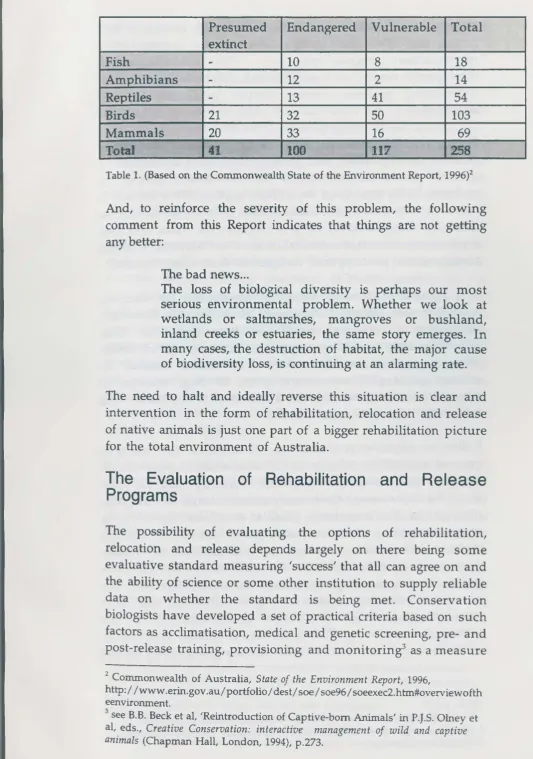
This is not the context to provide a detailed catalogue of the loss of species and the contraction of ecosystems, however, it is important to be reminded just how severe the damage to Australia's biodiversity has been. Australia is now infamous worldwide for the scale of environmental change, species extinction (especially mammals) and species now rare and endangered. 1
Presumed extinct
Endangered Vulnerable Total
Fish - 10 8 18
Amphibians - 12 2 14
Reptiles - 13 41 54
Birds 21 32 50 103
Mammals 20 33 16 69
Total 41 100 117 258
Table 1. (Based on the Commonwealth State of the Environment Report, 1996)2
And, to reinforce the severity of this problem, the following comment from this Report indicates that things are not getting any better:
The bad news...
The loss of biological diversity is perhaps our most serious environmental problem. Whether we look at wetlands or saltmarshes, mangroves or bushland, inland creeks or estuaries, the same story emerges. In many cases, the destruction of habitat, the major cause of biodiversity loss, is continuing at an alarming rate.
The need to halt and ideally reverse this situation is clear and intervention in the form of rehabilitation, relocation and release of native animals is just one part of a bigger rehabilitation picture for the total environment of Australia.
The Evaluation of Rehabilitation and Release
Programs
The possibility of evaluating the options of rehabilitation, relocation and release depends largely on there being some evaluative standard measuring 'success' that all can agree on and the ability of science or some other institution to supply reliable data on whether the standard is being met. Conservation biologists have developed a set of practical criteria based on such factors as acclimatisation, medical and genetic screening, pre- and post-release training, provisioning and monitoring3 as a measure 2
2 Commonwealth of Australia, State of the Environment Report, 1996,
http://www.erin.gov.aU/portfolio/dest/soe/soe96/soeexec2.htm#overviewofth eenvironment.
of the success or failure of reintroduction projects for captive bred populations. The Beck team's measure for success of a reintroduction program was that 'The wild population subsequently reached at least 500 individuals, which are free of provisioning or other human support (and)...will be self- sustaining.'3 4
These criteria do not, however, address cultural and ethical questions about whether such projects ought to be undertaken in the first place. Cultural values are notoriously difficult to evaluate. In the domain of the cultural significance of animals it is evident that considerable disagreement prevails between those who value animals solely for their instrumental value (circuses, fox hunters) and those who value then for aesthetic (wildlife photographers) and 'spiritual' (indigenous Australians) reasons.
It is possible to develop evaluative frameworks for assessing relocation and release programs by undertaking a systematic examination of the models and theories of environmental value offered by contemporary environmental philosophers. However, such an exercise is likely to be of interest mainly to environmental philosophers and given the huge diversity of views on offer in environmental ethics, it is, in any case, a task beyond the capacity of a short article.5
I offer two related ways of avoiding this dilemma. The first is to propose a simplified schema for the evaluation of intervention based on some fairly uncontroversial knowledge that we have about the importance of biodiversity and its reliance on ecosystem preservation. The second is to generate an ethical framework by close examination of the outcomes of such actions on both the humans and animals involved in rehabilitation and release programs. If it can be shown that the commitments and actions of carers, researchers and policy makers are inconsistent with the interests of individual animals and species involved, then such commitments and actions are also self-contradictory for the person /group involved. This is the case if animals continue to suffer because of our interventions and if ongoing loss of habitat
4 Ibid., p.273.
compromises the likely success of release and relocation programs.
Ecosystems and Values
Biologists worldwide agree that the major contemporary factor driving species to extinction is anthropogenic habitat destruction.6 It takes no breath-taking logic to conclude from this that if we desire to see this trend stopped, then habitat protection in the form of ecosystem protection is needed. Value is then placed on total biodiversity and protection of ecosystems and habitat that contain it becomes the goal of human endeavor.
Such a perspective on total biodiversity has been offered by ecologists such as Aldo Leopold.7 Leopold, in a now famous example, argued that the mountains of North America live "in fear' of their deer, just as deer live in fear of wolves. Remove the wolf and deer proliferate with subsequent overbrowsing of the vegetation of the mountain. Loss of vegetation, in turn, causes erosion and loss of the substance of the mountain. To think ecologically, we need to 'think like a mountain' and appreciate the full balance between predator, prey and habitat. This shift in thinking requires movement from attempting to value nature by assessing individual units, to valuing based on cumulative diversity and complexity.8
In Australia, similar balances are critical for a diverse and rich environment. It could be said that arid Australia lives in fear of overgrazing from kangaroos, just as kangaroos live in fear of predation from Dingoes or 10,000 years ago, Thylacines. In other words, animals at the top of the food chain play a vital role in preventing gross exploitation of finite resources from those lower down in a food chain. The same could be said for parasites whose role is to trim the population of excess by attacking those who are in some way weak; their role is no less important than other more charismatic species. In complex adaptive systems, it is not
6 See Andrew P. Dobson, Conservation and Biodiversity (Scientific American Library, New York, 1996) for a very useful summary of the contemporary issues.
See Aldo Leopold, A Sand County Almanac (Oxford University Press, Oxford, 1966); in particular, the essay, 'Thinking Like a Mountain'.
possible to isolate elements that are clearly more important than others.
Given the complexity of ecosystems it is not desirable or practical to assess the value of species or human actions in ways that are isolated from the system as a whole. Such a perspective is consistent with what we currently know about individuals, species and their relationship to their habitat. Animals exist by virtue of their dependence on a functioning ecosystem within which they survive and their survival is partly constitutive of that ecosystem at the same time. Species and habitat co-ev olv e
and do so over millions of years. It is then impossible to disaggregate such interdependence and put values on so-called parts of what is an organically unified whole. It makes good ecological sense to value the whole, as it is the whole that ultimately supports life, including our own.
A movement from atomistic to holistic values is difficult to contemplate since most value in contemporary society is assessed in terms of individual items or units for human consumption. Current ways of valuing animals are also solidly 'atomistic' and apply as much to killing them for food as wanting them for display and amusement in circuses and zoos.9 The new view, by contrast, will require a re-evaluation of all forms of intervention in natural systems and will enable a critical appraisal of the different types of rehabilitation and release undertaken by individuals and organisations. From the ethical perspective of ecological justice, the interconnected whole is the one that needs more attention focussed on it and such a focus might mean that efforts to intervene at the level of individual animals or even individual species might be considered to be noble but misguided. Rather, resources that are scarce and valuable (including the resource of the community of research scientists and the rehabilitation community) should be redirected to the main problem confronting wildlife in Australia, fragmentation and complete loss of habitat.
The Rehabilitation, Relocation and Release of
Individual Animals
At one level of analysis, an ethic of compassion, care and concern, which is at the core of human involvement with animals in need of rehabilitation and or relocation, is an expression of the very best of human virtues. Individuals who selflessly devote time and their own limited finances to animals in need are indeed followers of St Francis of Assisi. Such selflessness is even more apparent when native wildlife-carers risk their own health in the support some species. Those that care for Fruit Bats, for example, run the risk of the potentially fatal lyssavirus and morbillivirus if bitten by their patients. So at the level of an individual human, we would want to support animal carers as humane and virtuous individuals. From the perspective of the animals that benefit from such care, the opportunity to 'have a life' where one was previously unlikely must be seen as something positive. Where such animals can be returned to their previous habitat, then it seems that complexity and diversity are maintained.
However, it is almost invariably the case that the primary cause for the need for an animal to be rehabilitated is a major perturbation to the habitat of that creature by humans. The case of Koalas in Eastern Australia is instructive. Koala habitat is contracting because of a large number of human development pressures. Urbanisation, logging and woodchipping, road construction, increasing numbers of cars and domestic dogs are but some of the factors that cause injury to Koalas. Koala carers and vets, in conjunction with such institutions as the Royal Society for the Prevention of Cruelty to Animals (RSPCA), the Australian Koala Foundation and the Native Animals Trust Fund, do their best to rehabilitate injured and sick Koalas and return them to the wild.
close to dogs) in the future. The ethics of this situation become less clear. A well-intentioned and virtuous act inadvertently causes continued suffering on the part of native animals. In addition, the human resources put into the rehabilitation of individual animals are considerable with time and large amounts of money at stake. The veterinary expenses alone create pressure for more funding to cover costs. The tough questions must be asked in this situation, 'have scarce human and economic resources been used optimally?' Have the medium to long term animal welfare aspects of the situation been carefully assessed?
A possible solution to this dilemma is to place rehabilitated animals back into 'safe' areas but increasingly for animals such as Koalas, such safe places are likely to be fragments of urban bushland that have a very finite capacity to hold a viable population. Supplementary feeding is necessary to hold a number of animals that exceeds the carrying capacity of the remnant patch. Overcrowding may in turn lead to social and health problems within the captive population as normal spaces between and within the generations and sexes become constricted. Such areas also create an access problem because 'safe' means free from predators and this means investment into dog-proof fences. The Koala 'environment' becomes indistinguishable from a zoo where captive animals are held. Temptations are then strong to use the captive population as an ecotourism-education venture that has as its justification: the generation of funds to cover the costs of the rehabilitation of injured Koalas. What started as the ethical impulse of 'care' ends up enmeshed in the grey area of ecocapitalism and the imperatives of profit making. It was these same motives that led to Koala habitat destruction by other types of entrepreneurial activity in the first place.
lead to an even greater need for more of the same action in the future. Intervention somewhere 'upstream' of the problem is urgently needed to break out of this contradiction.
Native animals live in fear of cars and dogs, but they also live in fear of those who rehabilitate and release them back into dangerous urban jungles.
Rehabilitation, Relocation and Release of Whole
Species
The issues discussed above become even more pressing when the scope of reintroduction moves from individual animals to populations of whole species. In Australia, species based reintroductions and relocations have met with limited success, something that mirrors the international experience. In a study of 145 reintroductions of captive-bred populations worldwide, Beck et al concluded that under their criteria for success (see above), only 11% of reintroduction projects could be considered successful. Lack of reliable data hampered further and more detailed analysis and their study concluded:
In two years of intense searching we were able to acquire reasonably complete information on less than 50% of projects known to have reintroduced captive- bom animals. Written information documenting reintroduction procedures and post-release outcomes for over 13 million individual animals fills less than one file draw.10 *
In Australia, case studies such as those on the Brush-tailed Phascogale11 and the Marla12 indicate that reintroduction is a very complicated affair with failure to implement appropriate fire management and heavy predation from mainly introduced ground predators the reasons for limited success. Other research,
10 Beck et al, 'Reintroduction of Captive-bom Animals', p.281.
See T.R. Soderquist & M. Serena, 'An experimental reintroduction programme for brush-tailed phascogales (phascogale tapoatafa): the interface between captivity and the wild'in Olney, Creative Conservation.
The Marla project has 'played a major role in alerting Australian
conservationists to the importance of fire management and feral predators in the recovery of critical weight range desert mammals. It has also been responsible for preventing the last mainland representation of the species from becoming
extinct.'
based on recent translocation experiments with both hand reared and wild possums in Victoria13 indicate that such animals are highly stressed by translocation and have a very high and rapid mortality rate. Such high mortality is thought to be connected to the aggression of resident possums and the inability of 'naive' animals to safely navigate in an 'alien' forest environment.
Behavioural conditioning for predator identification and avoidance and the intensive acquisition of new environment skills might be ways of reducing the high rate of suffering and mortality in relocated animals. However, in addition to other costs, intensive training for predator avoidance and learning wild habitat 'life skills' makes the economics of such programs questionable. The need for intensive conditioning makes the very idea of re-introducing 'wild' animals into 'natural' habitat somewhat farcical.
In order to increase survival rates for relocations, active predator removal may also be required. However, this conventionally involves practices such as trapping, shooting and poisoning that have ethical implications of their own. It is now commonplace for the ethically motivated attempt to introduce or relocate animals to clash with the equally ethically motivated move to prevent cruelty and suffering to animals.
The case study of the Phascogales in Victoria indicate that without data on the ecology and behaviour of the species, the success of captive breeding and reintroduction programs is very limited. Soderquist and Serena indicated that '[u]nfortunately, the amount of time, effort and resources required to generate detailed ecological information about rare species of fauna is usually considerable'.14 It is self-evident that such information needs to be primarily generated 'in the field' by researchers who are prepared to get out of laboratories and study animals in their home habitat.15
13As reported by Peter R. Brown, in his paper, 'Current Scientific Research on the Rehabilitation and Translocation of Australian Wildlife' at the 1998 RSPCA Australia Scientific Seminar.
14 Soderquist & Serena, 'An experimental reintroduction programme for brush-tailed phascogales', pp.437-8.
Overall, despite the best efforts and good will of those involved, the track record of relocation and re-introduction programs has been very poor. If anything, animals in these programs seem to experience higher degrees of suffering 'in the wild' than what they would experience if they were culled or placed in 'safe' environments such as zoos. At the very least, those concerned with animal welfare must seriously question the rationality of throwing energy and resources at a problem that is not being helped by their actions. As habitat continues to contract, the likelihood of failure in rehabilitation and relocation will continue to increase.
A Case Study: The Koala in Eastern Australia
One species with a long history of intervention and relocation is the Koala in eastern Australia. Historical evidence suggests that the species was rare or absent from the open forests and woodlands of the west and coastal areas of Victoria in the first half of the nineteenth century. From this time onwards, the Koala has been involved in a roller coaster ride in terms of its population and the health of the species. It seems that the degree of direct human intervention is the most crucial determinant of Koala numbers in any one point in time.
In pre-European times, the Aboriginal people would have kept Koala numbers in check since they ate Koala flesh and may have used their pelts for furs.16 The Aboriginal relationship with the Dingo may have also helped keep Koala numbers in check since Dingos are known Koala predators. The burning of forest to keep it open and free from wildfire may also have restricted Koala habitat and hence potential expansion of the population.
The extermination and relocation of the Aboriginal people by European diseases, frontier war and colonisation removed a major predator and consumer of the Koala and allowed a new ecological succession to emerge. Furthermore, as colonists poisoned Dingoes and changed fire regimes, the Koala was given even greater habitat to invade. As observed by Parris in the lower Gouldburn River district:
16 Photographs exist of Victorian Aborigines (cl877) dressed in full-length possum-skin coats sewn by bone needles. See T. Flannery, The Future Eaters