Adv. Radio Sci., 8, 307–312, 2010 www.adv-radio-sci.net/8/307/2010/ doi:10.5194/ars-8-307-2010
© Author(s) 2010. CC Attribution 3.0 License.
Advances in
Radio Science
Convex programming for detection in structured communication
problems
T. Morsy1, J. G¨otze1, and H. Nassar2
1Information Processing Lab., TU Dortmund, 44221 Dortmund, Germany
2Faculty of Computers and Informatics, Suez Canal University, 41522 Ismailia, Egypt
Abstract. The generalized Minimum Mean Squared Error (GMMSE) detector has a bit error rate performance, which is similar to the MMSE detector. The advantage of the GMMSE detector is that it does not require the knowledge of the noise power. However, the computational complex-ity of the GMMSE detector is significantly higher than the computational complexity of the MMSE detector. In this paper, the complexity of the GMMSE detector is reduced by taking into account the structure of the system matrix (Toeplitz). Furthermore, by using circular approximation of the structured system matrix an approximate GMMSE de-tector is presented, whose computational complexity is only slightly higher than MMSE, i.e. only an iterative gradient de-scent algorithm based on the inversion of diagonal matrices is additionally required.
1 Introduction
The maximum likelihood (ML) detection problem can be written as a quadratic optimization problem with integer con-straints (Verdu, 1998). Unfortunately this problem is in gen-eral non-deterministic polynomial hard (NP-hard) (Verdu, 1989). This observation resulted in the development of many receivers that have reasonable complexity (Tan and Rasmussen, 2001; Chang and Han, 2008), e.g. the well-known least squares (LS) and minimum mean squared er-ror (MMSE) detectors (Lupas and Verdu, 1989; Madhow and Honig, 1994) as the most simple cases.
Recently convex programming has been successfully em-ployed to sub-optimally solve such detection problems. Us-ing this kind of relaxation converts the discrete optimization problem into a continuous one which can be solved
itera-Correspondence to: T. Morsy ([email protected])
tively (Boyd and Vandenberghe, 2004). Generalized mini-mum mean squared error detector is one important detector that uses convex programming to solve the detection prob-lem using unconstrained gradient descent algorithm (Yener, Yates and Ulukus, 2002). The advantages of this detector are that it has a BER performance which is similar to the MMSE detector, and does not require the knowledge of the noise power. Because of these advantages it can be used in scenarios where the noise power is changing rapidly or the noise power is unknown. Associated with these advantages of GMMSE detector there is the disadvantage, that it has a significantly higher computational complexity compared to MMSE detector.
In order to decrease this computational complexity the structure of the system matrix is used in this paper. First the Toeplitz structure of the channel convolution matrix is taken into consideration. In this case, computing the solution of the GMMSE detector requires the EVD of Toeplitz ma-trix but reduces the effort for the iterative gradient descent algorithm significantly. Nevertheless, computing the EVD of the Toeplitz matrix (using, e.g., Lanczos algorithm) is still computationally demanding. Therefore, we approximate the banded Toeplitz matrix by a circular matrix (Vollmer et al., 2001). In this case the MMSE/GMMSE solution is obtained by computing the EVD of the circular matrix us-ing FFT/IFFT, such that the required EVD implies no addi-tional effort. Therefore, the addiaddi-tional effort of approximate GMMSE is only determined by the iteration steps of the gra-dient descent algorithm based on the diagonal matrix con-taining the eigenvalues.
This paper is organized as follows: in Sect. 2 a system model for the detection problem and the convex relaxations of the problem are introduced. LS and MMSE detectors are described from the convex programming point of view in Sect. 3. GMMSE detector is described in Sect. 4. In Sect. 5 we introduce our new detector which is derived from the GMMSE detector taking into account the structure of the
308 T. Morsy et al.: Convex programming for detection in structured communication problems
error rate (BER) of the different detectors in section 6 and
the computational complexity is discussed in section 7.
Con-clusions are drawn in section 8.
2 System Model and its Relaxations
Consider the system model in matrix form as
r
=
Hx
+
n
.
(1)
The vector
r
∈
R
m
is the received signal vector, the matrix
H
∈
R
m
×
n
is the channel matrix, and the vector
n
∈
R
m
is additive white Gaussian noise with noise power
σ
2
. The
transmitted symbols
x
∈
R
n
are drawn from Binary Phase
Shift Keying (BPSK) constellation, i.e.
x
∈ {−
1,
+1
}
n
.
Under the white Gaussian noise assumption the ML
detec-tor of
x
is given by
ˆ
x
= arg
min
x
∈{−
1
,
+1
}
nk
r
−
Hx
k
2
2
.
(2)
The ML problem in (2) can be equivalently written as
ˆ
x
= arg
min
x
∈{−
1
,
+1
}
nx
T
H
T
Hx
−
2
r
T
Hx
.
(3)
Substituting the value of the matched filter output
y
=
H
T
r
(4)
into (3), we get
ˆ
x
= arg
min
x
∈{−
1
,
+1
}
nx
T
H
T
Hx
−
2
y
T
x
.
(5)
This problem is NP hard and solving (5) by exhaustive search
has a complexity which grows with
2
n
[Verdu (1989)]. This
makes computationally less complex solutions of (5)
inter-esting.
We use the benefits of convex programming as an
impor-tant mathematical tool to solve problem (5) by relaxing the
constraint set in (5). Our constraint set
x
∈ {−
1,
+1
}
n
which
contains only the corners of the unit hypercube is not a
con-vex set. Therefore we relax this constraint set using three
relaxations which yield a convex set.
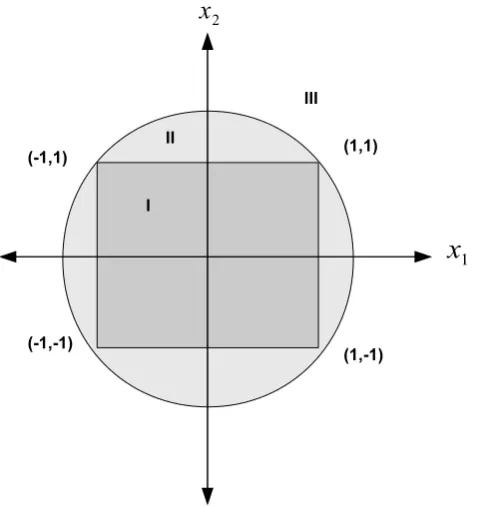
Figure1 shows the relaxed constraint sets for
n
= 2
taking
into account that the original problem contains only the
cor-ners of the unit hypercube. Three relaxations are considered:
relaxation of the constraint set to the whole unit hypercube
(region I), relaxation of the constraint set to the sphere which
covers the unit hypercube (region I+II), and the relaxation to
the whole space (region I+II+III). The solution in each case
can be mapped to the feasible set of the original problem by
taking the sign of each component of the relaxed solution
Fig. 1.
Convex relaxations
3 Least Squares and MMSE detectors
We first discuss the LS and MMSE solution from the convex
programming point of view. Relaxing the constraint set to be
the whole space, i.e. (region I+II+III), problem (5) will take
the form
ˆ
x
= arg min
x
∈
R
nx
T
H
T
Hx
−
2
y
T
x
.
(6)
The following theorem that was stated in [Boyd and
Van-denberghe (2004)] describes LS and MMSE solutions from
the convex programming point of view.
Theorem 1
Suppose that the objective function
f
in an
un-constrained convex optimization problem is differentiable, so
the well known necessary and sufficient optimality condition
is
∇
f
= 0.
(7)
Applying condition (7) to problem (6), which has an
objec-tive function
f
(
x
) =
x
T
H
T
Hx
−
2
y
T
x
,
(8)
the necessary and sufficient optimality condition gives the
solution
x
∗
=
¡
H
T
H
¢
−
1
y
,
(9)
which is the well known least squares solution.
When the noise power
σ
2
is known, using the same
re-laxation (region I+II+III) we get the minimum mean square
error solution
x
∗
=
¡
H
T
H
+
σ
2
I
¢
−
1
y
.
(10)
Fig. 1. Convex relaxations.
channel matrix. Simulation results are used to compare bit error rate (BER) of the different detectors in Sect. 6 and the computational complexity is discussed in Sect. 7. Conclu-sions are drawn in Sect. 8.
2 System model and its relaxations
Consider the system model in matrix form as
r=Hx+n. (1)
The vector r∈ Rmis the received signal vector, the matrix H∈Rm×nis the channel matrix, and the vector n∈Rmis ad-ditive white Gaussian noise with noise powerσ2. The trans-mitted symbols x∈Rn are drawn from Binary Phase Shift Keying (BPSK) constellation, i.e. x∈ {−1,+1}n.
Under the white Gaussian noise assumption the ML detec-tor of x is given by
ˆ
x=arg min
x∈{−1,+1}nkr−Hxk
2
2. (2)
The ML problem in Eq. (2) can be equivalently written as
ˆ
x=arg min x∈{−1,+1}nx
THTHx−2rTHx. (3) Substituting the value of the matched filter output
y=HTr (4)
into Eq. (3), we get
ˆ
x=arg min x∈{−1,+1}nx
THTHx−2yTx. (5)
This problem is NP hard and solving Eq. (5) by exhaus-tive search has a complexity which grows with 2n (Verdu, 1989). This makes computationally less complex solutions of Eq. (5) interesting.
We use the benefits of convex programming as an im-portant mathematical tool to solve problem Eq. (5) by re-laxing the constraint set in Eq. (5). Our constraint set x∈ {−1,+1}nwhich contains only the corners of the unit hyper-cube is not a convex set. Therefore we relax this constraint set using three relaxations which yield a convex set.
Figure 1 shows the relaxed constraint sets forn=2 taking into account that the original problem contains only the cor-ners of the unit hypercube. Three relaxations are considered: relaxation of the constraint set to the whole unit hypercube (region I), relaxation of the constraint set to the sphere which covers the unit hypercube (region I+II), and the relaxation to the whole space (region I+II+III). The solution in each case can be mapped to the feasible set of the original problem by taking the sign of each component of the relaxed solution vector.
3 Least squares and MMSE detectors
We first discuss the LS and MMSE solution from the convex programming point of view. Relaxing the constraint set to be the whole space, i.e. (region I+II+III), problem Eq. (5) will take the form
ˆ
x=arg min x∈Rnx
THTHx−2yTx. (6)
The following theorem that was stated in (Boyd and Van-denberghe, 2004) describes LS and MMSE solutions from the convex programming point of view.
Theorem 1 Suppose that the objective functionf in an un-constrained convex optimization problem is differentiable, so the well known necessary and sufficient optimality condition is
∇f=0. (7)
Applying condition Eq. (7) to problem Eq. (6), which has an objective function
f (x)=xTHTHx−2yTx, (8) the necessary and sufficient optimality condition gives the solution
x∗=
HTH
−1
y, (9)
which is the well known least squares solution.
When the noise powerσ2 is known, using the same re-laxation (region I+II+III) we get the minimum mean square error solution
x∗=HTH+σ2I
−1
y. (10)
T. Morsy et al.: Convex programming for detection in structured communication problems 309 4 Generalized MMSE detector
If we relax the constraint set in problem Eq. (5) to be the sphere which contains the unit hypercube, i.e. (region I+II), then our detection problem takes the form
ˆ
x=arg min xTx≤nx
THTHx−2yTx. (11)
Since problem Eq. (11) has a convex objective function over a convex constraint set, it is a convex optimization prob-lem and it has a unique minimum (Boyd and Vandenberghe, 2004). The convex duality theorem guarantees that no dual-ity gap exists and one can solve for the dual problem instead (Nash and Sofer, 1996). Problem Eq. (11) has a single con-straint such that there is only one dual variable and a simple iterative algorithm can be employed to solve this dual prob-lem.
We can express the Lagrange dual function as
L(x,λ)=xTHTHx−2yTx+λxTx−n, (12) which is minimized over x and maximized overλ≥0. Solv-ing for x in terms ofλand substituting back, we obtain max
λ≥0
−yTHTH+λI
−1
y−λn. (13)
This problem has the advantage, that it is a one dimensional optimization problem. Now we can solve this dual prob-lem Eq. (13) instead of the primal probprob-lem Eq. (11) because there is no duality gap between these two problems. Prob-lem Eq. (13) can be solved by different iterative algorithms (Hansen, 1979). A simple unconstrained gradient descent al-gorithm given by
¯
λ(t+1)= ¯λ(t )+µ
yTHTH+ ¯λ(t )I
−2 y−n
, (14) converges toλ¯ for a reasonable choice ofµ. The solution of Eq. (13) is given by
λ∗=max(0,λ).¯ (15) Then, the unique minimizer of Eq. (11) is
x∗=HTH+λ∗I
−1
y. (16)
This solution looks familiar because of its similarity to the MMSE detector. Whenλ∗=σ2, the GMMSE detector re-duces to the MMSE detector. Therefore this detector which depends on the value of optimum dual solutionλ∗is named Generalized MMSE detector. The advantage of the GMMSE detector is, that it improves the BER performance (Compared to LS detector as the MMSE detector) and does not require the knowledge of the noise powerσ2. However GMMSE detector has the disadvantage that it requires a significantly higher computational complexity than MMSE detector.
5 Structured problem
In this Sect. we consider the reduction of the computational complexity of the GMMSE detector by taking the structures of the underlying detection problems into account. In the first case the Toeplitz structure of the channel convolution matrix H is used. In this case we will express the matrix HTH in problem Eq. (11) by its eigenvalue decomposition HTH=V3VT where V is the matrix whose columns are the eigenvectors of HTH and 3is a diagonal matrix that con-tains the corresponding eigenvalues as its diagonal elements. Problem Eq. (11) can be rewritten as
ˆ
x=arg min xTx≤n
xTV3VTx−2yTx. (17)
The dual problem for the problem Eq. (17) in this case takes the form
max λ≥0
−yTV3VT+λI
−1
y−λn. (18)
The unconstrained gradient descent algorithm takes the form
¯
λ(t+1)= ¯λ(t )+µyTV 3+ ¯λ(t )I−2
VTy−n (19) and the GMMSE solution will be
x∗=V 3+λ∗I−1
VTy. (20)
Besides computing VTy only diagonal matrices must be converted in Eq. (19) and Eq. (20), which simplifies the computations significantly. We can also make use of the Toeplitz structure of HTH when computing the EVD by using the Lanczos algorithm (Golub and Loan, 1996). Al-though this approach reduces the computational complexity of the GMMSE detector significantly, it is still much more complex than MMSE because of the required EVD (the iterations of Eq. (19) on the diagonal matrices are only of O(n)). In the following we will discuss the circular structure case, which is obtained by an approximation of the Toeplitz case. A banded Toeplitz structure gives a circular structure by addingL−1 columns to the Toeplitz matrix, whereLis the length of the channel impulse response. This is shown in the following example forL=2:
H=
h1 0
h2h1 0 h2
→
h1 0 h2
h2h1 0 0 h2h1
= ˜H.
If channel matrix H in problem Eq. (11) is approximated by circular matrixH we obtain˜
ˆ
x=arg min xTx≤nx
TH˜THx˜ −2yTx. (21)
−4 −2 0 2 4 6 8 10 12 14 10−2
10−1 100
BER
SNR LSt
LSc MMSEt MMSEc GMMSEt GMMSEc
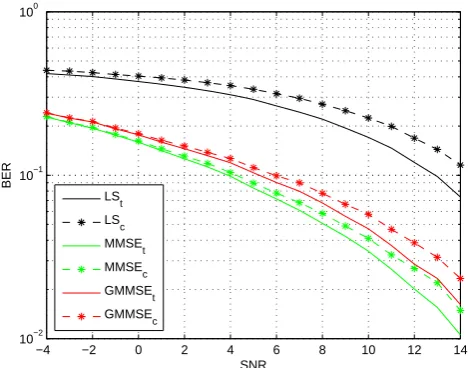
Fig. 2. Performance analysis for Structured LS, MMSE, and GMMSE detectors,n=50 and channel lengthL=7 (t: Toeplitz case;c: circular case).
We can express the matrixH˜TH by its eigenvalue decompo-˜ sitionH˜TH˜ =FT3F, where F is the discrete Fourier trans-form matrix (computed by FFT) and3=diagF· ˜H(:,1) in that case problem Eq. (11) can be written as
ˆ
x=arg min xTx≤nx
TFT3Fx−2yTx. (22)
The dual problem for problem Eq. (22) is max
λ≥0
−yTFT3F+λI
−1
y−λn (23)
and the gradient descent algorithm in the circular case takes the form
¯
λ(t+1)= ¯λ(t )+µyTFT 3+ ¯λ(t )I−2
Fy−n. (24) After getting the optimal valueλ∗, the GMMSE solution in the circular case is
x∗=FT 3+λ∗I−1Fy. (25) Again, besides computing Fy (IFFT) only diagonal matri-ces must be inverted in Eqs. (24) and (25). Most impor-tant, no EVD computation is required in the circular case, since the EVD of a circular matrix is easily obtained using FFT/IFFT. Therefore, in this case the additional effort (com-pared to MMSE) is given by the iteration of Eq. (24), i.e. in-versions of diagonal matrices and scalar products.
6 Simulation results
The BER performance of the different detectors is discussed. In the simulation we compare the BER performance for LS,
−4 −2 0 2 4 6 8 10 12 10−4
10−3 10−2 10−1 100
BER
SNR LSt
LSc MMSE
t MMSEc GMMSEt GMMSEc
Fig. 3. Performance analysis for Structured LS, MMSE, and GMMSE detectors, n=1000 and channel length L=15 (t: Toeplitz case;c: circular case).
MMSE, and GMMSE detectors, taking into account that we have two different structures, Toeplitz and circular approxi-mation. We applied this simulation for two different simu-lation scenarios. The equalization problem in the first sce-nario has a channel impulse response of lengthL=7 and a transmitted bit vector of lengthn=50. The second scenario describes the equalization problem with channel impulse re-sponse of lengthL=15 and a transmitted bit vector of length n=1000. Figures (2) and (3) show that GMMSE detector has almost the same performance as MMSE detector but it has the advantage that it does not require the knowledge of σ2. Furthermore, we see that the circular approximation only slightly degrades the performance of the detectors.
7 Complexity analysis
The computational complexity of the GMMSE detector is composed of two parts:
(Part 1). The complexity of the solution of the system of equations
(Eqs. 16, 20 or 25) which is the same as for LS and MMSE (Eqs. 9 or 10).
(Part 2). The complexity of the iterations required for the gradient
descent algorithm (Eqs. 14, 19 or 24).
T. Morsy et al.: Convex programming for detection in structured communication problems 311
−4 −2 0 2 4 6 8 10 12 1
2 3 4 5 6 7
SNRs
Mean of iterations
Toeplitz Circular
Fig. 4. Iterations for gradient descent algorithm in Toeplitz and
circular structure cases forn=50 and channel lengthL=7.
−4 −2 0 2 4 6 8 10 12 1
1.2 1.4 1.6 1.8 2 2.2 2.4 2.6 2.8 3
SNRs
Mean of iterations
Toeplitz Circular
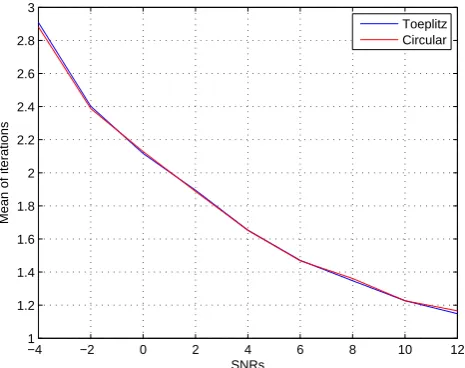
Fig. 5. Iterations for gradient descent algorithm in Toeplitz and
circular structure cases forn=1000 and channel lengthL=15.
approximation results in a significantly reduced computa-tional complexity.
In part 2 gradient descent algorithm adds some complex-ity. However, for the structured cases (Eqs. 19 or 24) the iterations of the gradient descent algorithm are only applied to diagonal matrices (3) such that the complexity is only of O(n)per iteration. Figures (4) and (5) show the mean num-ber of required iterations for the Toeplitz case and the circular case in our two scenarios respectively. Obviously, the num-ber of iterations in each scenario for both cases is almost the same. We assume the worst case complexity for part 2 by taking 6 iterations for all cases . Since the required number
No structure Toeplitz Circular 0
0.5 1 1.5 2 2.5 3 3.5 4 4.5x 10
4
Fig. 6. Computational complexity forn=50 and channel length
L=7.
No Structure Toeplitz Circular 0
0.5 1 1.5 2 2.5 3 3.5x 10
8
Fig. 7. Computational complexity forn=1000 and channel length
L=15.
of iterations is quite small and the computational complexity is only ofO(n)per iteration, the complexity of the gradient descent algorithm is almost negligible compared to part 1.
The overall complexity (part 1 and part 2) for our two cases is shown in Fig. (6) and (7).
8 Conclusions
In this paper, it was shown that the circular approximation of the Toeplitz channel matrix is not only effective to signifi-cantly reduce the computational complexity of GMMSE de-tector using the gradient descent algorithm, but it also keeps
the performance gain compared to LS detector (is almost the same as MMSE) without any requirement to know the noise power value(σ2).
In future work we will apply the presented technique to various practical problems and evaluate the performance de-pending on the channel length (L) and the dimension of the transmitted bit vector (n). We will also apply it to some com-mon communication schemes like CDMA and OFDM.
References
Boyd, S. and Vandenberghe, L.: Convex Optimization. Cambridge Univ. Press, 2004.
Chang, X.-W. and Han, Q.: Solving box-constrained integer least squares problem, IEEE Transactions on wireless communica-tions, 7[1], 277–287, 2008.
Golub, G. and Loan, C.: Matrix Computations. Johns Hopkins Univ. Press, 3rd edition 1996.
Hansen, P.: Methods of nonlinear 0–1 programming, In Annals of Discrete Mathematics 5: Discrete Optimization II, edited by: Hammer, P. L., Johnson, E. L., and Korte, B. H., Amsterdam, The Netherlands: North Holland, 1979.
Lupas, R. and Verdu, S.: Linear multiuser detectors for synchronous code-division multiple-access channels, IEEE Trans. Inform. Theory, 35, 123–136, 1989.
Madhow, U. and Honig, M. L.: MMSE interference suppression for direct-sequence spread-spectrum CDMA, IEEE Trans. Com-mun., 42, 3178–3188, 1994.
Nash, S. and Sofer, A.: Linear and Nonlinear Programming. New York: McGraw-Hill, 1996.
Tan, P. H. and Rasmussen, L. K.: The application of semidefinite programming for detection in CDMA, IEEE journal on selected areas in communications, 19[8], 1442–1449, 2001.
Verdu, S.: Computational complexity of multiuser detection, Algo-rithmica, 4[4], 303–312, 1989.
Verdu, S.: Multiuser Detection, Cambridge, UK: Cambridge Univ. Press, 1998.
Vollmer, M., Haardt, M., and G¨otze, J.: Comparative study of joint-detection techniques for TD-CDMA based mobile radio systems, IEEE journal on selected areas in communications, 19[8], 1461– 1475, 2001.