252
An Experimental Study on Partial Replacement for Coarse
Aggregate by E-waste in Concrete.
P
1
P
Saranya K P
2
P
V.MuthuswamyP
3
P
R.Sathiyaraj P
4
P
A.Sudharsan
P
1
PAssistant Professor Department of Civil Engineering
P
2, 3,4
P
Department Of Civil Engineering, SNS College of Engineering
Abstract
:Electronic waste is an emerging issue posing serious pollution problems to the human and the environment. The disposal of which is becoming a challenging problem. For solving the disposal of large amount of E-waste material, reuse of E-waste in concrete industry is considered as the most feasible application. Due to increase in cost of normal coarse aggregate it has forced the civil engineers to find out suitable alternatives to it. E-waste is used as one such alternative for coarse aggregate. Owing to scarcity of coarse aggregate for the preparation of concrete, partial addition of E-waste with coarse aggregate was attempted. The work was conducted on M25 grade mix. The addition of coarse aggregate with E-waste in the range of 0%, 32%, 34%, 36%, and 38%. Finally the mechanical properties and durability of the concrete mix specimens obtained from the addition of these materials is compared with control concrete mix. The test results showed that a significant improvement in compressive strength was achieved in the E-waste concrete compared to conventional concrete and can be used effectively in concrete. The reuse of E-waste results in E-waste reduction and resources conservation.
Index Terms— E-waste, Compressive strength, Split tensile strength.
INTRODUCTION
:In the present scenario, no construction activity can be imagined without using concrete. Concrete is the most widely used building material in construction industry. The main reason behind its popularity is its high strength and durability. Today, the world is advancing too fast and our environment is changing
progressively. Attention is being focused on the environment and safeguarding of natural resources and recycling of wastes materials. One of the new waste materials used in the concrete industry is E-waste. For solving the disposal of large amount of waste material, reuse of E-waste in concrete industry is considered as the most feasible application. E-waste is one of the fastest growing waste streams in the world. In developed countries, previously it was about 1% of total solid waste generation and currently it grows to 2% by 210. In developing countries, it ranges 0.01% to 1% of the total municipal solid waste generation. E-waste is an emerging issue posing serious pollution problems to the human and the environment options need to be considered especially on recycling concepts. E- Waste describes loosely discarded surplus, obsolete, broken, electrical or electronic devices. Rapid technology change, low initial cost has resulted in a fast growing surplus of electronic waste around the globe. Several tonnes of E-waste need to be disposed per year. E-E-waste contains numerous types of substances and chemicals creating serious human health and environment problems if not handled properly. Owing to the scarcity of coarse aggregate for the preparation of concrete, partial replacement of E-waste with coarse was attempted. The work was conducted on M25 grade mix. In this work, the percentage of various replacement levels of coarse aggregate with E-waste in the range of 0%, 32%, 34%, 36%, and 38%. Finally the mechanical properties and durability of the concrete mix specimens obtained from the addition of these materials will be compared with that obtained by using control concrete mix.
EXPERIMENTAL SETUP
:253
obtained by sieve analysis and specific gravity. Sieve analysis is carried out from various fine aggregate (FA) and coarse aggregate (CA) samples and the samples which suits the requirement is selected. Specific gravity tests are carried out for fine and coarse aggregate. The various materials used were tested as per Indian standard specification.
MATERIALS:
Raw materials required for the concreting operations of present work are cement, fine aggregate, coarse aggregate, e-waste and water.
Cement:
Cement is used as binding material in the concrete where the strength and durability re significant important. The ordinary Portland cement of 53 grades conforming to IS: 12269-1987 is used to manufacture the concrete. Also some tests were conducted such as consistency test, setting time test, specific gravity test.
Property IS Code (IS
8112:1989)
Specific gravity 3.12
Consistency 33
Initial setting time Not Less than 30 Minutes
Final setting time Not greater than 600 Minutes
Aggregate:
The size of aggregates used is 20mm and the grain size of sand is used. The aggregate tests are performed and results are as follows.
(1)Fine aggregate
:
It consists of small angular or grounded grains of silica (SiO2) and is formed by decomposition of sand stone under the effect weathering agencies. The size which is less than 4.75mm is called as fine aggregate. River sand is used as fine aggregate. Before using that, it can
be properly cleaned by sieving and washing to eliminate the impurities.
(2)Coarse aggregate:
Coarse aggregate may be in the form of irregular broken stones or naturally occurring rounded gravel. Materials which are large to be retained on 4.75mm sieve size called as coarse aggregate. It acts as a main filler, and forms the main bulk of concrete. Of which the materials adhere in the form of film. Aggregates balance the shrinkage and volume changes of concrete are used.
Physical properties of fine aggregate and coarse aggregate:
Property Fine Coarse
aggregate aggregate
Fineness modulus 3.5 8.48 Specific gravity 2.74 2.74 Bulk density(kg/mP
3
P
) 1820 1800 Water absorption (%) 1.20 1.83
Water:
Water plays an important role in mixing, laying, and compaction, setting and hardening of concrete. Water influences the strength development and durability of concrete. Ordinary drinking water can be used for preparing concrete. Guidance of examine the suitability of the available water for construction can be obtained from the following specified data in IS 456-2000.The pH value of water should be generally not be less than 6.
E-waste:
254 S Concrete Concrete Design Mix
No Type Proportions W/C
ratio C FA CA EW
1 E0 0.45 1 1.6
2.5
----2 E1 0.45 11.6
1.7 0.8 3 E2 0.45 1 1.6 1.65 0.85 4 E3 0.45 1 1.6 1.6 0.9 5 E4 0.45 1 1.6 1.55 0.95Fig 1 E-waste
DESIGN MIX:
The concrete is designed for M25 grade by using the procedure as per Indian standard (IS10262:2009). This proportion is used to prepare the samples. The mix proportions are shown in table.
Design mix proportions
W C FA CA
By
weight 197 438 709 1108 in kg/mP
3
By
volume 0.45 0.14 0.39 0.61 (mP
3
P
)
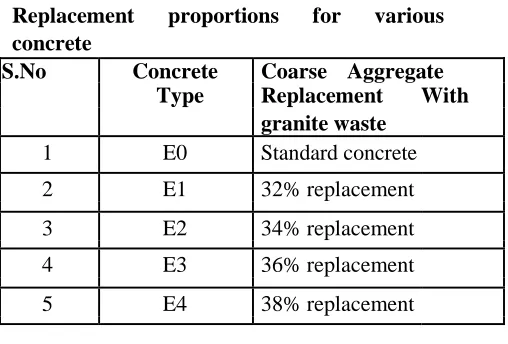
Replacement proportions for various concrete
S.No Concrete Coarse Aggregate
Type Replacement With
granite waste
1 E0 Standard concrete
2 E1 32% replacement
3 E2 34% replacement
4 E3 36% replacement
5 E4 38% replacement
EXPERIMENTAL SETUP:
Experiment methodology:
The evaluation and replacement of e-waste for coarse aggregate are done by using concrete testing. The ingredients of concrete is added and the test is conducted. In this experiment we replace the e-waste for coarse aggregate partially in the percentage of 0%, 32%, 34%, 36%, 38%. The replaced concrete is compared with the normal concrete. For this cube samples of size 150mm*150mm*150mm are casted for each percentage of replaced concrete and normal concrete. The cubes are prepared in the proportions of 1:1.6:2.5 as per our mix design and the water cement ratio of 0.45. After 24 hours the cubes are remoulded and they are cured in the curing tank for 7,14 and 28 days. Totally three set of cubes are prepared for each proportion of replacement. First set is taken for compressive test after 7 days curing and second set is for 14 days curing and also third set for 28 days curing.
MECHANICAL PROPERTIES:
Compressive strength test:
255
Compressive Strength Value For 7 Days
Curing
Table: 1
Compressive Strength Values for 14 Days
Curing
Mix Proportion Compressive Strength in N/mmP
2
0%
21.3032%
18.3434%
22.1036%
16.6638%
14.22Table:2
Compressive Strength Values for 28 Days
Curing
Mix Proportion Compressive Strength in N/mmP
2
0%
25.1032%
16.8034%
25.2336%
20.238%
17.33Tables: 3
0 5 10 15 20
0% 32% 34% 36% 38%
7 days cube strength
0 5 10 15 20 25
0% 32% 34% 36% 38%
14 days strength
Mix Proportion Compressive Strength in N/mmP
2
0% 16.29
32%
12.00
34%
17.66
36%
14.22
256
MECHANICAL PROPERTIES:
Split tensile strength test:
The split tensile strength of cylinders are tested by using the compressive testing machine. The average test result values are tabulated and comparative studies were made on the both normal and partially replaced concrete cubes of 0%, 32%, 34%, 36%, 38% for only 28days curing.
Split Tensile Strength Values for 28 Days
Mix
Proportion
Split
Tensile
Strength in
N/mm
P2
0%
5.58
32%
3.7
34%
4.88
36%
4.0
38%
3.22
Table 4
CONCLUSION:
In this project, the Compressive strength and split tensile strength have been studied for various replacements of coarse aggregate (32%, 32%, 36 %, 38% ) by E-waste.
• We have the optimum percentage of replacement is 34%. Its strength more than the conventional concrete.
• E-waste concrete provide high Non permeability and safe compared to normal concrete construction.
• Based on the results, E-waste is recommended in concrete for an economical construction.
REFERENCE:
1) PanneerSelvam.N, Gopala Krishna GVT, “Recycle of E-Waste in Concrete” Volume 5 Issue 4, International Journal of Science and Research April 2016 .
2) S.P.Kanniyappan, C.Lavanya , “Experimental Study on Effective Utilization of E-Waste in Concrete” Vol. 4, Issue 11, International Journal of Innovative Research in Science, Engineering and Technology November 2015.
3) Balasubramanian B, Gopalakrishna GVT And Saraswathy V ,”Investigation on Partial Replacement of Coarse Aggregate using E-Waste in Concrete” ISSN 0974-5904, Volume 09, No. 03 , International Journal Of Earth Sciences and Engineering June, 2016.
0 5 10 15 20 25 30
0% 32% 34% 36% 38%
28 days strength
0 1 2 3 4 5 6
0% 32% 34% 36% 38%
257
replacement of coarse aggregate by E waste in concrete” International Journal of Technical Research and Applications e-ISSN: 2320-8163, Volume 3, Issue4 (July-August 2015), PP. 266-270