R E S E A R C H
Open Access
Complementarity in single photon
interference – the role of the mode function
and vacuum fields
R. Menzel
*, D. Puhlmann and A. Heuer
Abstract
Background: In earlier experiments the role of the vacuum fields could be demonstrated as the source of complementarity with respect to the temporal properties (Heuer et al., Phys. Rev. Lett. 114:053601, 2015). Methods: Single photon first order interferences of spatially separated regions from the cone structure of spontaneous parametric down conversion allow for analyzing the role of the mode function in quantum optics regarding the complementarity principle.
Results: Here the spatial coherence properties of these vacuum fields are demonstrated as the physical reason for complementarity in these single photon quantum optical experiments. These results are directly connected to the mode picture in classical optics.
Conclusion: The properties of the involved vacuum fields selected via the measurement process are the physical background of the complementarity principle in quantum optics.
Keywords: Quantum optics, Complementarity, Mode function, Vacuum fields
Background
Complementarity is one of the most important princi-ples of quantum physics [1]. It is directly connected to the measurement problem [2]. In quantum optics light is detected as clicks of the single photons, which corre-spond to the transfer of an energy packet ofhvphotonto the
detector, with the spatial, temporal, spectral and polariza-tion filter restricpolariza-tions of the detector setup. The measured intensity of bright light results from the statistical super-position of these “clicks”. The possible super-positions of these “clicks” are given by the interference pattern of the mea-sured light fields. For a single photon this interference is given by the overlay of the electric field components in the right order of the field operators belonging to this photon at the detector
Ephoton(−) Ephoton(+)
[2]. The possibly coherent light fields produce interference fringes result-ing in certain visibilityV. In some cases the sources of the photons can be distinguished resulting in “which-path”
*Correspondence: [email protected]
University of Potsdam, Institute of Physics and Astronomy, Karl-Liebknecht Straße 24-25, D-14476 Potsdam, Germany
distinguishability D. The complementarity principle in quantum optics answers the question: How coherent are the more or less distinguishable shares of the electric field (or how distinguishable are the paths of the more or less coherent light modes)? The upper limit for the combined measurement of both isD2+V2≤1 [3–5]. The visibility is based on the coherence of the involved light modes in the different photon paths and is calculated from the max-imum and minmax-imum single photon count rates S of the interference fringes byV =(Smax−Smin)/(Smax+Smin).
It can be concluded that coherence in single photon mea-surements decreases if paths become distinguishable [6]. Thus the question about the physical details behind this quantum law of complementarity may be asked.
In a previous set of experiments we investigated the physical background of complementarity in the tempo-ral domain and showed the role of involved vacuum fields [18]. Using spontaneous parametric down conver-sion (SPDC) in induced coherence experiments first-order interference visibilities of more than 95% were observed if the single photon was emitted potentially from two dif-ferent SPDC-crystals, indistinguishable. And, as expected,
vacuum fields could be distinguished. In this case the two waves of the single photon emitted synchronously by the two crystals even in the same TEM00-mode are not
coherent in contrast to the classical expectation. In sum-mary, the random phase relations between distinguishable vacuum fields were identified as physical reason for the complementarity principle in the temporal dimension in this case [18]. Based on these results the relation of coher-ence and distinguishability for single photons in the spatial dimension is investigated, here.
Quite some work was done to investigate the coherence properties of the emitted light from SPDC. For exam-ple the coherence area of the emission was investigated with the result that the source is incoherent across the pump spot indicating a thermal emitter [7]. This fulfills expectation because SPDC is a spontaneous process. A similar but more detailed result was worked out experi-mentally and theoretically [8, 9]. In [9] it was shown that especially in radial direction coherence effects from phase matching and other details provide a more complex than thermal behavior of this SPDC light. In all these investiga-tions the correlation between the coherence of the signal and idler photons was analyzed. These correlation and entanglement properties were also investigated in detail in [10–12]. The spatial emission can be nicely described using the Schmidt mode decomposition as investigated in [13–16]. But only very few investigations deal with the coherence of the single photons which is the aim of this work (see e.g. [7, 8]).
Therefore we investigated the transversal coherence of single signal photons generated via spontaneous
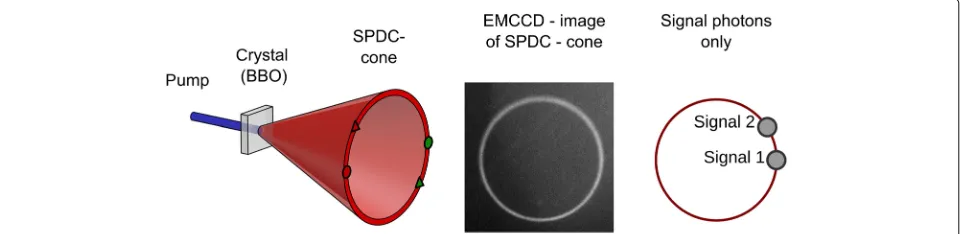
interferometer we measure the relative coherence of two tilted and on top of each other realigned Gaussian modes of a single signal photon selected out of the light cone of SPDC which are emitted from the same volume of the crystal (see Figs. 1 and 2).
As demonstrated in the “Theoretical” section the single photons in the selected TEM00-detector modes are
gen-erated by three-wave-mixing of the coherent pump beam and a this way selected vacuum field. Therefore the coher-ence properties of these photons are directly dependent on the coherence properties of the involved vacuum fields. As result the properties of the vacuum fields can be iden-tified as the physical background of the complementarity principle in the spatial dimension, in this case. The details will be discussed in the conclusion.
Methods
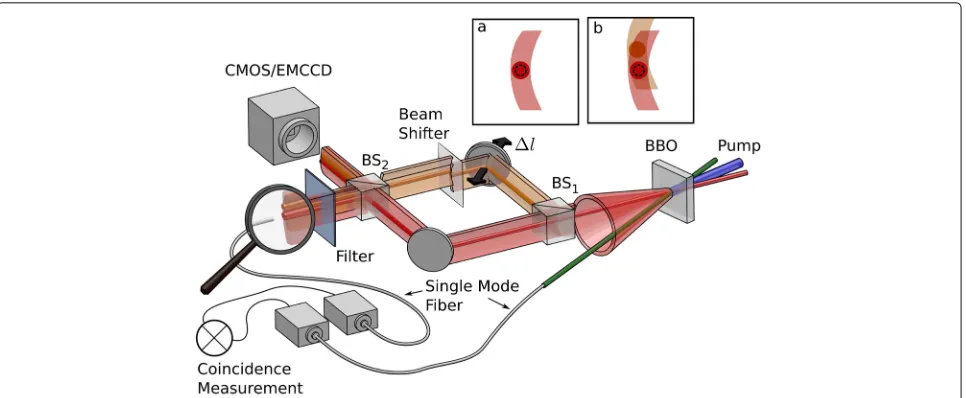
The experimental setup is shown in Fig. 2. The 2mm long BBO crystal as nonlinear material was pumped by a diode-laser (Blue mode, Toptica) with the emission peak wavelength of 405 nm and a cw power of 30 mW. From the emitted light cone the signal-photons were selected on one side of the cone and fed into the Mach-Zehnder-interferometer at the first beam splitter BS1. In one arm
of the interferometer a beam shifter was used to tilt and shift one of the interfering TEM00-modes (signal 2 in
Fig. 1) radially and tangentially relative to the reference TEM00-mode (signal 1 in Fig. 1) in the other
interferome-ter arm. Both modes were perfectly overlaid in the second beam splitter BS2to match the TEM00-mode of the
detec-tor. With this TEM00-mode detector the single photon
Fig. 2Experimental setup: For parametric down conversion a 2 mm long BBO crystal was used. The crystal was cut for collinear type I phase matching around 405 nm. The path delay between the two arms of the Mach-Zehnder-interferometer for observing the fringes and determining the visibility was realized by a motorized high resolution translation stage (l). The beam selection from different positions of the light cone structure as schemed in inset b was realized by a beam tilt and shift arrangement which also allowed for the perfect overlay of the selected two modes at the second beam splitter BS2. The detectors are single mode fiber coupled avalanche photo diodes SPCM-AQRH-13 from Perkin Elmer with lenses in front for determining the TEM00modes of the idler- and the two signal-fields
interference of the two beams is measured. This detector is constructed with a transversal single-mode fiber and an aspherical lens in front of it. It is a selector for all photons belonging to the TEM00-mode of the fiber, only. The beam
waist of this mode was aligned to match the TEM00-mode
of the pump spot in the BBO crystal by size (165μm in diameter) and position. Both have a Gaussian beam pro-file. With a delayl realized with a linear translation stage (Newport) allowing longitudinal delays of 25 mm with an accuracy of 10 nm the interference fringes between signal 1 and signal 2 were measured and the visibility calculated. The resulting interference pattern was photographed with the EMCCD camera (see Fig. 2) on the other side of the beam splitter cube BS2. At this position also the
tangential and radial distance between signal 1 and 2 was measured using a not shown HeNe-laser and a CMOS camera instead of the EMCCD.
A spectral filter was applied in front of the single mode fiber with a spectral band width of 2.5 nm (FWHM) at a peak wavelength of 808 nm. For decreasing the sig-nal to noise ratio of the visibility measurement the sigsig-nal photon interference of first-order could also be measured in coincidence with the temporally correlated idler pho-tons on the other side of the cone resulting in visibilities of almost one. But all visibility measurements given here were performed as single photon measurements without any corrections and not in coincidence.
While the position of the idler photon detection was kept fixed at the opposite position of signal beam 1, a coincidence measurement between signal and idler pho-tons allowed the determination of the distinguishability
D=(Rpath1−Rpath2)/(Rpath1+Rpath2).Rpath1andRpath2
are the coincidence rates of the idler photons with photons of signal 1 and signal 2, respectively.
Results and discussion
Perfect alignment of the Mach-Zehnder interferometer results in an unstructured bright pattern from the overlaid same share of the cone indicating perfect local coher-ence (see photo in Fig. 3 (left)). Aligning both beams in a very small angle in almost horizontal direction results in fringes from the first-order interference of the single signal photons with high contrast as can be seen in the middle trace of Fig. 3. Tilting the two interferometer arms tangentially (as in Fig. 3, right) or radially with respect to each other results in a decrease of the fringe visibility. The fringe distances and directions result from the differ-ent angles in the alignmdiffer-ents with no effect to the fringe visibility.
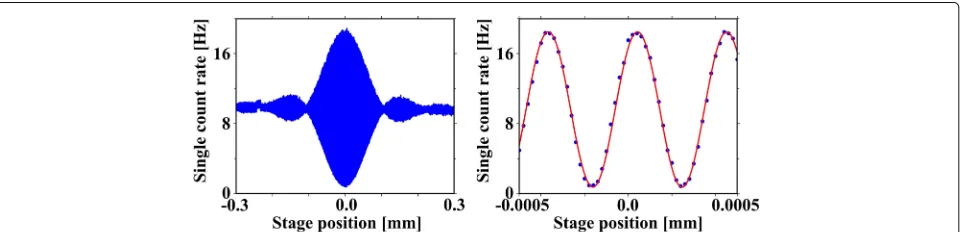
of the measured signal photons to 83μm (half width at half maximum of the interference signal), which is in good agreement with the bandwidthλof 2.5 nm (FWHM) of the applied spectral interference filter (lc=λ2/(π·λ)).
In the graph of Fig. 4 (right) the result of a high reso-lution measurement for the same alignment is given. The maximum observed visibility of the not corrected single photon measurements is 90% in both cases. This visibil-ity measurement is used as a reference for the following sets of experiments where one of the Mach-Zehnder inter-ferometer arms is tilted transversally in tangential and in radial direction. The visibility for each data point was measured in the same way as in Fig. 4. The decrease of the visibility is evaluated as a function of the tilts. The results of these measurements are depicted in Fig. 5.
In Fig. 5 (left) the result of the visibility evaluation is given as a function of a tangential tilt of one beam (sig-nal 2 in Figs. 5 and 1) with respect to the fixed one (sig(sig-nal 1). No tilt results in maximum visibility of about 90% as given in Fig. 5. But visibility drops rapidly if the mode of signal 2 is tilted more than half the divergence angle of the selected Gaussian beam. It has to be pronounced that both interfering beams are well within the light cone structure and thus they both have almost undiminished intensity. This can be seen in Fig. 3, right, which is a measurement with less than 40% visibility. The tilt of the beam in radial direction results in a similar value as can be seen in Fig. 5 (right). For comparison with the theoretical calculations the 1/√e-half-widths of the fitted visibility measurements of Fig. 5 are (2.2±0.3) mm in tangential and (2.7±0.3) mm
in radial direction and the associated maximum visibilities are 0.90 and 0.93.
For the measurement of figure 5 left the distinguishabil-ity D of the two paths of the single signal photons in the two TEM00-modes of signal 1 and signal 2 was measured
in coincidence with the idler photon as reference (see Figs. 1 and 2). The result is given in Fig. 6. As expected the distinguishability is minimal in case of overlapping modes and increases as the visibility decreases. It will approach 1 if the modes are completely separated. In between the
D2+V2expression has experimental values of about 0.8– 0.9. The limitation below 0.9 can be understood as the result of the maximum visibility of 0.9. The two experi-ments of Fig. 5 (left) and Fig. 6 demonstrate the comple-mentarity principle for the single signal photons, directly. It has to be pronounced that in all these measurement no background corrections have been applied.
Theoretical description
The theoretical analysis of the experimental data can be based on a simplified model as applied in [18, 19] using an effective Hamiltonian with couplingsaPa†Sa†I anda
† PaSaI,
whereaP,aS, andaI
a†P,a†S, anda†I
are photon annihila-tion (creaannihila-tion) operators for the pump, signal, and idler fields. This describes the annihilation (creation) of the pump photon and the simultaneous creation (annihila-tion) of signal and idler photons in the SPDC 3-wave mixing process with the vacuum field contributionsaS01
andaS02.
Fig. 5Visibility as a function of the relative tilted and thus in the reference plane shifted interfering TEM00-modes of the single signal photons in tangential and radial direction. Thesolidline is the result of the best fit of the experimental data using a Gaussian distribution in agreement with the theoretical model
We assume perfect phase matching and restrict this analysis to spectral single field modes of frequency ωS
andωI, respectively, which is experimentally realized by
the narrow spectral filter. The pump is treated as an un-depleted, classical field. From the Heisenberg equations of motion for the field operators we write the photon anni-hilation part of the total electric field operator for the two relevant signal field modes selected by the detector as
ES(+1,2)(r,t) = aS01,2+Ca†I01,2
US01,2(r)e−i(k1,2r+ωSt)(1)
ignoring an irrelevant multiplicative constant. C is a con-stant that incorporates the crystal properties and the clas-sical pump amplitude. The strong spatial TEM00-mode
filtering by the detector in this experiment extracts small spatial shares from the emitted fields, only. Therefore in addition to the usual description as in [18, 19] spa-tial mode functions for the two measured TEM00 signal
field modes propagating in the directionsk1,2through the interferometer are included asUS1,2as e.g. described in
[20]. These directions are chosen by the position of the detector behind the two interferometer arms (see Fig. 2)
Fig. 6Distinguishability of the single signal photons in the two tilted and thus in the reference plane shifted TEM00-modes in tangential direction and measured in coincidence with the reference idler photon. The solid line is a fit of the experimental data using the result of Fig. 6 (left) as reference
and thus the momentum conservation and phase match-ing angular restrictions of the down conversion process are considered. The mode functions US1,2 for the two
TEM00-detector-modes are given by
US01,2(x,y,z) =
1 1−i zλ
w2 0π
e
−i
⎡ ⎢ ⎢ ⎣ x2+y2
w20
1−i zλ w20π
⎤ ⎥ ⎥ ⎦
. (2) At the second beam splitter BS2the two fields are
super-imposed as shown in Fig. 2. In the upper arm a phase shift
φand the beam shifter for the TEM00-mode of signal 2 are
implemented. Thus behind the second beam splitter BS2
the electric field is given by
ES(+)(r,t) = ES(+1)(r,t)+E(S+2)(r+r,t)e−iφ (3) wherertakes care of the tilted and thus in the reference plane shifted TEM00-mode (signal 2 in Fig. 1).
Assuming low conversion efficiency, we retain only the lowest-order terms which is single bi-photon generation. The signal photon counting rate in the selected mode of the detector as given in Eq. 2 is proportional to
Rdetector = ∞
−∞
∞
−∞
E(S−)E(S+)dxdy (4) As result the interference visibility V at the reference plane can be calculated by the normalized cross correla-tion of the two here in y-direccorrela-tion shifted transversal field distributions of the two modes of signal 1 and signal 2 (see Fig. 1).
V(y)= 2
∞
−∞e−
y2 w2e−
(y+y)2 w2 dy
∞
−∞e−2
y2
w2dy+∞
−∞e−2
(y+y)2 w2 dy
(5)
=e− y2
2w2 (6)
The optical length from the crystal to the reference plane was 661 mm and thus the coherence radius of the observed mode was 2.06 mm at the reference plane. This radius is identical with the 1/√e-half-width of the theo-retical visibility curve. This is in agreement with the fit of the experimental data of this complex measurement. In other words, the observed transversal coherence width of the single photons is as large as the width of the selected detector mode for the single photons, although the total intensity distribution is much larger. For the tangential displacements it was 2.22 mm resulting in a relative error of 7%. The theoretical result for the radial displacements shows a relative error of about 25%, which may still sup-port the fundamental idea of this work but in contrast in the radial direction phase matching effects may play a role [9], which are not considered here.
Conclusion
Although the emitted light cone structure is much wider than the observed mode, the transversal coherence length of the single photons within the cone is just as large as the detected single photon mode. This result seems anti-intuitive because especially in tangential direction, along the ring structure, no symmetry breaking feature, as e.g. from the phase matching conditions, limits the transversal coherence along the ring. The emission of a single photon in each of the observed directions is equally probable.
The only limiting factor to explain this experimental result is the selection of the involved modes. The anal-ysis as it was applied in [18] shows that the 3-wave mixing process for generating the single signal photons involves besides the coherent pump light also vacuum fields. By the observed TEM00-detection-modes the
rel-evant vacuum field modes are selected as TEM00-mode
structures, as well. The tilt of one of the photon modes is associated with a tilt of the related vacuum field mode (see Eqs. 3 and 5). This tilted vacuum field has a ran-dom phase compared to the non-tilted vacuum field and the visibility drops rapidly whereas the distinguishability increases.
In other words with this experiment the influence of the involved vacuum fields regarding spatial coherence is observed. From this experiment it can be stated that a sin-gle photon TEM00mode is coherent. This is also observed
it can be concluded that vacuum as under laying back-ground for all photon generation processes may introduce general randomness in quantum optics in the spatial as well as in the temporal dimension. But by selecting coher-ent vacuum fields in the photon generation process we see coherent photons allowing interference experiments with visibilities of up to 1. This interplay is the physical background of the complementarity principle in quantum optics and it is the result of the mode selection in the measurement process.
Acknowledgment
We gratefully acknowledge P. W. Milonni for very intense and illuminating discussions and the long-lasting collaboration. We also like to thank M.W. Wilkens always having an open ear for us.
Funding
No funding was received.
Authors’ contributions
RM proposed the original idea, gave advices and wrote the manuscript. DP implemented the work. The progress is a result of common contributions and discussions of RM and AH. All three authors read and approved the final manuscript.
Competing interests
The authors declare that they have no competing interests.
Received: 14 October 2016 Accepted: 25 January 2017
References
1. Bohr, N: Das Quantenpostulat und die neuere Entwicklung der Atomistik. Naturwissenschaften.16, 245 (1928)
2. Glauber, RJ: The Quantum Theory of Optical Coherence. Phys. Rev.130, 2529 (1963)
3. Jaeger, G, Shimony, A, Vaidman, L: Two interferometric complementarities. Phys. Rev. A.51, 54 (1995)
4. Englert, BG: Fringe Visibility and Which-Way Information: An Inequality. Phys. Rev. Lett.77, 2154 (1996)
5. Greenberger, DM, Yasin, A: Simultaneous wave and particle knowledge in a neutron interferometer. Phys. Lett. A.128, 391 (1988)
6. Mandel, L, Coherence and indistinguishability. Opt. Lett.16, 1182 (1991) 7. Ribeiro, PHS, Monken, CH, Barbosa, GA: Measurement of coherence area in parametric downconversion luminescence. Appl. Opt.33, 352 (1994) 8. Joobeur, A, Saleh, BEA, Teich, MC: Spatiotemporal coherence properties of entangled light beams generated by parametric down-conversion. Phys. Rev. A.50, 3349 (1994)
9. Joobeur, A, Saleh, BEA, Larchuk, TS, Teich, MC: Coherence properties of entangled light beams generated by parametric down-conversion: Theory and experiment. Phys. Rev. A.53, 4360 (1996)
10. Just, F, Cavanna, A, Chekhova, MV, Leuchs, G: Transverse entanglement of biphotons. New J. Phys.15, 083015 (2013)
12. Jost, BM, Sergienko, AV, Abouraddy, AF, Saleh, BEA, Teich, MC: Spatial correlations of spontaneously down-converted photon pairs detected with a single-photon-sensitive CCD camera. Opt. Express.3, 81 (1998) 13. Lorenzo Pires, HDi, Monken, CH, van Exter, MP: Direct measurement of
transverse-mode entanglement in two-photon states. Phys. Rev. A.80, 022307 (2009)
14. Straupe, SS, Ivanov, DP, Kalinkin, AA, Bobrov, IB, Kulik, SP: Angular Schmidt modes in spontaneous parametric down-conversion. Phys. Rev. A.83, 060302(R) (2011)
15. Miatto, FM, Lorenzo Pires, HDi, Barnett, SM, van Exter, MP: Spatial Schmidt modes generated in parametric down-conversion. Eur. Phys. J. D.66, 263 (2012)
16. Peres, AM, Sharapova, PR, Straupe, SS, Miatto, FM, Tikhonova, OV, Leuchs, G, Chekhova, MV: Projective filtering of the fundamental eigenmode from spatially multimode radiation. Phys. Rev. A.92, 053861 (2015)
17. Menzel, R, Ostermeyer, M: Fundamental mode determination for guaranteeing diffraction limited beam quality of lasers with high output powers. Opt. Comm.149, 321 (1998)
18. Heuer, A, Menzel, R, Milonni, PW: Induced Coherence, Vacuum Fields, and Complementarity in Biphoton Generation. Phys. Rev. Lett.114, 053601 (2015)
19. Milonni, PW, Fearn, H, Zeilinger, A: Theory of two-photon
down-conversion in the presence of mirrors. Phys. Rev. A.53, 4556 (1996) 20. Ling, A, Lamas-Linares, A, Kurtsiefer, C: Absolute emission rates of
spontaneous parametric down-conversion into single transverse Gaussian modes. Phys. Rev. A.77, 043834 (2008)
21. Elsner, R, Puhlmann, D, Pieplow, G, Heuer, A, Menzel, R: Transverse distinguishability of entangled photons with arbitrarily shaped spatial near- and far-field distributions. JOSA B.32, 1910 (2015)
Submit your manuscript to a
journal and benefi t from:
7Convenient online submission
7Rigorous peer review
7Immediate publication on acceptance
7Open access: articles freely available online
7High visibility within the fi eld
7Retaining the copyright to your article