The Thirty-Third AAAI Conference on Artificial Intelligence (AAAI-19)
Y
2Seq2Seq: Cross-Modal Representation Learning for 3D Shape and Text by
Joint Reconstruction and Prediction of View and Word Sequences
Zhizhong Han,
1,2Mingyang Shang,
1Xiyang Wang,
1Yu-Shen Liu,
1∗Matthias Zwicker
21School of Software, Tsinghua University, Beijing, China
2Department of Computer Science, University of Maryland, College Park, USA
[email protected], [email protected], [email protected], [email protected], [email protected]
Abstract
Jointly learning representations of 3D shapes and text is cru-cial to support tasks such as cross-modal retrieval or shape captioning. A recent method employs 3D voxels to repre-sent 3D shapes, but this limits the approach to low reso-lutions due to the computational cost caused by the cubic complexity of 3D voxels. Hence the method suffers from a lack of detailed geometry. To resolve this issue, we propose Y2Seq2Seq, a view-based model, to learn cross-modal rep-resentations by joint reconstruction and prediction of view and word sequences. Specifically, the network architecture ofY2Seq2Seq
bridges the semantic meaning embedded in the two modalities by two coupled “Y” like sequence-to-sequence (Seq2Seq) structures. In addition, our novel hierar-chical constraints further increase the discriminability of the cross-modal representations by employing more detailed dis-criminative information. Experimental results on cross-modal retrieval and 3D shape captioning show thatY2Seq2Seq
out-performs the state-of-the-art methods.
Introduction
With the development of 3D modeling and scanning tech-niques, more and more 3D shapes become available on the Internet with detailed physical properties, such as texture, color, and material. With large 3D datasets, however, shape class labels are becoming too coarse of a tool to help peo-ple efficiently find what they want, and visually browsing through shape classes is cumbersome. To alleviate this is-sue, an intuitive approach is to allow users to describe the desired 3D object using a text description. Jointly under-standing 3D shape and text by learning a cross-modal rep-resentation, however, is still a challenge because it requires an efficient 3D shape representation that can capture highly detailed 3D shape structures.
To overcome this challenge, a 3D-Text cross-modal dataset was recently released in (Chen et al. 2018), where a combined multimodal association model was also proposed to capture the many-to-many relations between 3D voxels and text descriptions. This model employed a shape encoder to compute the embeddings of 3D shapes directly from 3D voxels. However, this strategy is limited to learning from low
∗
Corresponding author: Yu-Shen Liu
Copyright c⃝2019, Association for the Advancement of Artificial Intelligence (www.aaai.org). All rights reserved.
resolution voxel representations due to the computational cost caused by the cubic complexity of 3D voxels. This leads to low discriminability of learned cross-modal representa-tions due to a lack of detailed geometry information.
We resolve this issue by proposing to learn cross-modal representations of 3D shape and text from view sequences and word sequences, where each 3D shape is represented by a view sequence. Our deep learning model captures the correlation between 3D shape and text by the joint recon-struction and prediction of view and word sequences from each modality. This strategy aims to get part-level informa-tion as much as possible to understand mainly part-related descriptions, which remedies a lack of part prior knowledge
in 3D-Text understanding. We call our model Y2Seq2Seq,
since it is implemented by two coupled “Y” like sequence-to-sequence (Seq2Seq) structures. In addition, we employ novel hierarchical constraints that can be easily added to ex-tract more detailed discriminative information from
differ-ent aspects. Specifically,Y2Seq2Seq consists of a 3D shape
branch and a text branch. Starting from the encoding of ei-ther 3D shape modality or text modality, each branch jointly reconstructs the modality itself and predicts the counter-part modality using one RNN encoder and two RNN de-coders. The two branches are coupled by sharing parame-ters in decoders for reconstruction and prediction, which is effective to bridge the semantic meaning embedded in 3D shape modality and text modality. In addition, we propose to employ the discriminative information at the class level, instance pair level, and instance level as constraints in the training procedure. Our significant contributions are list be-low.
• We propose a deep learning model called Y2Seq2Seq,
which enables to learn cross-modal representations of 3D shape and text from view sequences and word sequences.
• Our novel coupled “Y” like Seq2Seq structures have a
powerful capability to bridge the semantic meaning of two sequence-represented modalities by joint reconstruc-tion and predicreconstruc-tion.
• Our results demonstrate that our novel hierarchical
Related work
Joint 3D-Text representation learning.In a recent pioneer-ing study, a combined multimodal association model (Chen et al. 2018) was proposed to jointly understand 3D shape and text based on a novel 3D-Text cross-modal dataset. This model employs a CNN+RNN and a 3D-CNN to ex-tract single-modal features of text and 3D shape respectively, where the 3D-CNN learns from 3D voxels. Then, similari-ties within each modality and cross modality are learned by a metric learning method. However, due to the computational cost caused by the cubic complexity of 3D voxels, this model is limited to learning from low resolution voxels, and a lack of detailed geometry information affects the discriminabil-ity of the learned joint representations. To resolve this issue,
Y2Seq2Seqaims to learn features of 3D shapes from view
sequences.
Joint 2D sequence-Text representation learning.
Learn-ing from view sequences makesY2Seq2Seqrelated to joint
2D sequence-Text representation learning, such as video captioning (Shen et al. 2018; Wang et al. 2018; Venu-gopalan et al. 2015) and the recent GIF-Text cross-modal retrieval (Song and Soleymani 2018).
Besides the rendered views that we use rather than
nat-ural images, the main difference betweenY2Seq2Seqand
these studies is that Y2Seq2Seqis required to focus more
on part-level understanding rather than object-level under-standing. This is because our approach works on individual 3D objects, and there is only one object in a view. Hence, the corresponding representation mainly captures informa-tion about parts of this object. For better joint understanding
of rendered view and text,Y2Seq2Seqemploys two coupled
“Y” like Seq2Seq branches, and each branch simultaneously conducts joint reconstruction and prediction in both modali-ties. This novel structure is able to learn from discriminative information in both modalities as much as possible, which we also facilitate by including additional constraints. In
ad-dition, another difference between Y2Seq2Seq and these
studies is that we aim to explicitly learn cross-modal
rep-resentations, which enablesY2Seq2Seqfor cross-modal
re-trieval and captioning at the same time, rather than merely retrieval (Song and Soleymani 2018) or captioning (Wang et al. 2018; Venugopalan et al. 2015).
In terms of the model structure, Y2Seq2Seq is similar
to the prototype bimodal deep autoencoder (Ngiam et al. 2011) which was also adopted by Shared Latent Represen-tation (SLR) learning with variational autoencoder back-ground (Shen et al. 2018). However, these models contain only a single branch, which makes it hard to employ ad-ditional constraints on the learned cross-modal representa-tions. The encoder-decoder-reconstructor structure (Wang et al. 2018) also suffers from this issue. The correspondence fully-modal autoencoder (Feng, Wang, and Li 2014) also
employed a similar structure toY2Seq2Seqfor image
cap-tioning. However, this method cannot handle 2D sequences, and moreover, regards the sentence as a whole, which means that it could not learn the relationship between words and shape characteristics.
Y
2Seq2Seq
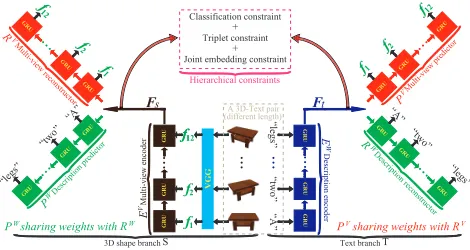
Overview. The framework of Y2Seq2Seq is illustrated in
Fig. 1.Y2Seq2Seqis formed by a 3D shape branchSand
a text branch T. Each branch is a “Y” like seq2seq model
which is formed by one RNN encoder and two RNN de-coders, and the two RNN decoders jointly reconstruct within
the modality and predict across modalities.SandTare
cou-pled by sharing weights involved in the decoders. Note that
in Fig. 1, the “Y” structure of the shape branch is rotated by
90 degrees in counter-clockwise orientation, and the one of the text branch is rotated in clockwise orientation.
GRU
GRU
GRU
...
GRU
GRU
GRU
... Description encoder
Multi-view encoder
VGG
GRU GRU
GRU ...
Description predictor
GRU
GRU GRU
... Multi-view reconstruc
tor GRU
GRU GRU ...
Multi-view predictor
GRU
GRU
GRU
... Description reconstruc
tor
3D shape branch Text branch
“legs”
“A”
“two”
f2
f1
f1
f12
... ...
“A”
“two”
“legs”
f1 f2 f12
f1
f2
f12
“A” “two”
“legs”
A 3D-Text pair (different length)
Classification constraint + Triplet constraint Joint embedding constraint+
Fs Ft
E
V
PW
EW
PV
RW
RV
S T
P sharing weights withW RW P sharing weights withV RV
Hierarchical constraints
Figure 1: The framework ofY2Seq2Seqconsists of a 3D
shape branchSand text branchT. Each branch jointly
re-constructs within the modality and predicts across modali-ties.
For each pair of 3D shape sand its descriptiont,(s, t)
is learned in both branches. In the shape branch S, the
multi-view encoder EV aims to learn the feature Fs of
s by aggregating N views v = [v1, ..., vi, ..., vN], where
i ∈ [1, N]. The first decoder in the shape branch is a
multi-view reconstructor RV to reconstruct the low-level
feature fi of each view vi. The second decoder is a
de-scription predictorPW to generatetby predictingM words
w = [w1, ..., wj, ..., wM], wherej ∈ [1, M]. On the other
hand, in the text branchT, the description encoderEW aims
to learn the featureFtoftby aggregating itsM wordsw.
The first decoder is a description reconstructorRWto
recon-structw, and the second one is a multi-view predictorPV
to predict the low-level featurefiof each viewvi.
Finally, we include additional hierarchical constraints to
learn the cross-modal representationsFsandFt. The
con-straints aim to capture the hierarchically discriminative in-formation at the class level (using a classification con-straint), at the instance pair level (using a triplet concon-straint), and at the instance level (using a joint embedding con-straint).
View sequence capturing.A view sequencevis formed by
uniformly capturingN sequential viewsvi around a shape
m on a circle. We render shapes that are represented
us-ing 3D voxel grids. The cameras are elevated30◦from the
ground plane, pointing to the centroid ofm. In our
experi-ments, we setNto 12.
3D shape branch S.Sis formed by a multi-view encoder
pre-dictorPW.
EV is implemented by a VGG19 (Simonyan and
Zisser-man 2014) and a RNN. The VGG19 first extracts low-level
feature fi of each view vi in the view sequence v from
the last 4096 dimensional fully connected layer. Then,EV
learns the feature Fs of shapes by aggregating all theN
view features, whereFsis the hidden state at theN-th step
of the RNN.
Starting from Fs, RV and PW, which are also
imple-mented by a RNN, jointly reconstruct the view features in
sequencev and predict the word sequencew. The
recon-structed view features fi′ and predicted word sequencew′
are expected to be close to the ground truth view featuresfi
and word sequencew. Thus, the loss of branchSis formed
by the lossLV2V from view to view and the lossLV2W from
view to word, as defined below,
LS=αLV2V +βLV2W,
LV2V =
1 N
∑
i∈[1,N]
∥fi′−fi∥22,
LV2W =−
∑
j∈[1,M]
logp(wj|w<j,v),
(1)
wherewjis thej-th word in the word sequencew,w<j
rep-resents the words in front ofwj,p(wj|w<j,v)is the
proba-bility of correctly predictingj-th word according to the
pre-vious wordsw<j and the view sequencev, andαandβ are
two balance weights.
Text branchT.Tis formed by a description encoderEW,
a description reconstructorRW and a multi-view predictor
PV. Note thatTis coupled withSby sharing weights inRW
with description predictorPW inSand sharing weights in
PV with multi-view reconstructorRV inS.
EW,RW andPV are all implemented by a RNN.EW
learns the featureFtof the descriptiontof shapesby
ag-gregating the embeddingejof wordswjin sequencew. The
word embeddingej is learned with the other parameters in
Y2Seq2Seq together. The featureFt is represented by the
hidden state at theM-th step ofEW.
Starting from Ft, RW and PV jointly reconstruct the
word sequencewand predict the view features in sequence
v. The reconstructed word sequencew′′and predicted view
featuresfi′′are expected to be close to the ground truth word
sequencew and view featuresfi. Thus, the loss of branch
Tis formed by the lossLW2W from word to word and the
lossLW2V from word to view, as defined below,
LT=γLW2W +δLW2V,
LW2W =−
∑
j∈[1,M]
logp(wj|w<j,w),
LW2V =
1 N
∑
i∈[1,N]
∥fi′′−fi∥22,
(2)
wherewjis thej-th word in the word sequencew,w<j
rep-resents the words in front ofwj,p(wj|w<j,v)is the
proba-bility of correctly reconstructingj-th word according to the
previous wordsw<j and the ground truth word sequencew,
andγandδare balance weights.
Hierarchical constraints.Y2Seq2Seqemploys three
con-straints onFsandFtto further increase the
discriminabil-ity of the learned cross-modal representations by employ-ing more detailed discriminative information. These con-straints provide hierarchically discriminative information at the class level, the instance pair level, and the instance level.
For the instance pair (s, t) from shape classc, the first
constraint makes each instance in the pair be correctly clas-sified using a softmax classifier. Here, we use only one
soft-max classifier to simultaneously classifyFsandFtin both
modalities. This helps push the two modalities together in the cross-modal representation space. The estimated shape
classc′ should be the ground truth shape classc. Thus, the
classification loss is the negative log likelihood as below,
LC1=−logp(c′=c|Fs)−logp(c′=c|Ft), (3)
wherep(c′ = c|Fs)andp(c′ = c|Ft)are probabilities of
correctly classifying 3D shapesand textt, respectively.
We use a triplet constraint (Schroff, Kalenichenko, and Philbin 2015) to leverage the relationships between instance pairs, such as(s+, t+)and(s−, t−). The instance pair level
constraint ensures the feature ofs+is closer to the feature of
t+than the feature of any others− ort−. Thus, our triplet
loss is defined as below,
LC2= [∥Fs+−Ft+∥22+∥Fs+−Ft−∥22+µ]+
+ [∥Ft+−Fs+∥22+∥Ft+−Fs−∥22+µ]+,
(4)
where [•]+ is a max(0,•) function, (s+, t+, t−) and
(t+, s+, s−)are two triplets in the training set,µis a
mar-gin that is enforced between instances within pairs and in-stances across pairs. The two triplets are formed by finding a(s−, t−)in another shape class for each(s+, t+).
Finally, we include a joint embedding constraint for dis-criminative information at the instance level. Although in-stance level information has been involved in the triplet
con-straint, two instances s and t in the same pair (s, t) are
merely required to be as close as possible there. Our joint embedding constraint further toughly pushes the two
fea-turesFsandFtof the instancessandtto the same point
in the cross-modal representation space. Thus, the joint em-bedding loss is defined as below,
LC3 =∥Fs−Ft∥22. (5)
Finally, the loss LC defined for our hierarchical
con-straints is shown below, where φ, ϕ and ψ are balance
weights for the hierarchical constraints at different levels.
LC=φLC1+ϕLC2+ψLC3, (6)
Objective function.Y2Seq2Seqis trained to minimize all
the above losses. Thus, the objective function is defined as,
minLS+LT+LC. (7)
We learn our learning targets, the cross-modal
Table 1: The balance weights employed in all the three datasets.
Set α β γ δ φ ϕ ψ
Prim 1 2 0.001 1 0.0001 0.1(µ= 1) 0.1
Shap 1 1 0.01 1 0.001 0.01(µ= 1.5) 0.1
Table 2: Effect of coupled “Y” like Seq2Seq under primitive subset.
Metrics Rec Pre R+P C-S C-T C-Y
S2T
RR@1 1.47 1.33 1.33 69.87 73.73 80.13 RR@5 1.73 2.67 4.27 70.40 81.60 82.53 NDCG@5 1.44 1.37 1.05 69.87 67.92 80.16
T2S
RR@1 2.27 2.06 1.85 46.92 72.57 92.45 RR@5 4.70 7.58 3.34 63.37 87.73 95.99 NDCG@5 1.76 3.01 0.97 41.79 70.21 88.52
them using back propagated gradients with a learning rateε,
i.e.,Fs←Fs−ε×∂L/∂FsandFt←Ft−ε×∂L/∂Ft.
Experiments and analysis
Dataset.We evaluateY2Seq2Sequnder the 3D-Text cross-modal dataset by (Chen et al. 2018), which consists of a primitive subset and a ShapeNet subset. Specifically, the primitive subset contains 7,560 shapes and 191,850 de-scriptions. The ShapeNet subset contains 15,038 shapes and 75,344 descriptions. We employ the same training/test split-ting under both subsets as (Chen et al. 2018).
Experimental setup. We first explore how each element of Y2Seq2Seq affects its performance under the primitive subset and the ShapeNet subset in 3D-Text cross-modal
re-trieval. Then, we evaluate the performance ofY2Seq2Seq
by comparing it with the state-of-the-art methods in cross-modal retrieval and 3D shape captioning under the two subsets, respectively. In all the experiments, the dimension
of the cross-modal representations Fs andFt is 128, the
dimension of the word embedding ej is set to 512, and
both branches inY2Seq2Seqare implemented using GRU
cells (Cho et al. 2014). All the experiments are conducted
with a learning rateεof 0.00001.
According to the descriptions involved in each subset, we employ dataset-dependent vocabulary. Under the prim-itive subset, we extract 77 unique words to form the vo-cabulary. Under the ShapeNet subset, the employed vocab-ulary is formed by 3587 unique words. All the RNNs for descriptions are dynamic, with varying length according to the length of the descriptions.
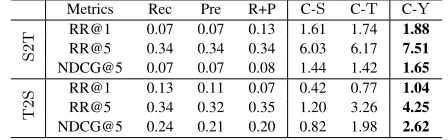
Table 3: Effect of coupled “Y” like Seq2Seq under ShapeNet subset.
Metrics Rec Pre R+P C-S C-T C-Y
S2T
RR@1 0.07 0.07 0.13 1.61 1.74 1.88 RR@5 0.34 0.34 0.34 6.03 6.17 7.51 NDCG@5 0.07 0.07 0.08 1.44 1.42 1.65
T2S
RR@1 0.13 0.11 0.07 0.42 0.77 1.04 RR@5 0.34 0.32 0.35 1.20 3.26 4.25 NDCG@5 0.24 0.21 0.20 0.82 1.98 2.62
Table 4: Effect of hierarchical constraints under primitive subset.
Metrics No +LC1 +LC1+LC2 +LC
S2T
RR@1 80.13 83.07 88.53 94.13 RR@5 82.53 85.73 88.80 94.13 NDCG@5 80.16 82.43 88.33 94.10
T2S
RR@1 92.45 93.20 95.99 96.66 RR@5 95.99 97.50 97.53 97.57 NDCG@5 88.52 89.36 95.52 95.87
Under each subset, according to the order of magnitude of
each loss inL, we set bothαinLSandδinLTto 1, since
the losses of reconstructing the view sequence inSand
pre-dicting the view sequence inTare similar. Subsequently, all
the other balance weights are set based on them. The balance weights used in both subsets are shown in Table 1, where the
marginµinvolved in the triplet loss is also presented.
In each cross-modal retrieval experiment below, we show the results in two directions to comprehensively evaluate the
performance ofY2Seq2Seq. One direction uses 3D shapes
as queries and aims to retrieve instances from the set of de-scriptions. We call this direction shape-to-text, which is ab-breviated as “S2T”. In contrast, the other direction uses de-scriptions as queries and aims to retrieve instances from the set of 3D shapes. Accordingly, we call this direction text-to-shape and abbreviate it as “T2S”. In addition, the recall
rate (RR@k) (Chen et al. 2018) and NDCG (Jrvelin and
Kek¨al¨ainen 2002) are used as the metrics. In addition, all the results shown in both the “T2S” and “S2T” directions in the same column in the following tables are obtained with
the same trainedY2Seq2Seq.
In each 3D shape captioning experiment below, ME-TEOR (Denkowski and Lavie 2014), ROUGE (Lin 2004), CIDEr (Vedantam, Zitnick, and Parikh 2015), and BLUE (Papineni et al. 2002) are used as the metrics to eval-uate the quality of generated descriptions according to the ground truth descriptions, where these metrics are abbrevi-ated as “M”, “R”, “C”, and “B-1”, “B-2”, “B-3”, “B-4”, re-spectively in the following tables.
Effect of the coupled “Y” like Seq2Seq. First, we con-duct experiments to show how the coupled “Y” like Seq2Seq structures contribute to the cross-modal representa-tion learning by joint reconstrucrepresenta-tion and predicrepresenta-tion of view and word sequences.
Table 5: Effect of hierarchical constraints under ShapeNet subset.
Metrics No +LC1 +LC1+LC2 +LC
S2T
RR@1 1.88 2.82 3.42 6.77
RR@5 7.51 10.19 10.59 19.30
NDCG@5 1.65 2.40 2.59 5.30
T2S
RR@1 1.04 1.83 1.92 2.93
RR@5 4.25 6.36 6.89 9.23
NDCG@5 2.62 4.07 4.40 6.05
Table 6: Effect of voxel resolution under ShapeNet subset.
Metrics 323 643 1283
S2T
RR@1 6.77 7.31 7.64
RR@5 19.30 19.97 20.64
NDCG@5 5.30 5.43 5.48
T2S
RR@1 2.93 2.37 2.70
RR@5 9.23 8.81 9.82
NDCG@5 6.05 5.61 6.27
with coupled branches but without joint reconstruction and prediction, i.e., the decoders of both branches regard either the view sequence or the word sequence as the target, as
de-noted as “C-S” or “C-T”, respectively. The last experiment
is conducted with coupled “R+P”, as indicated as “C-Y” in
the tables. Note that we use the same balance weights in Ta-ble 1 in all the four experiments.
Both the results of “Rec” and “Pre” in Table 2 and Table 3 show that merely reconstruction within the same modality or prediction across the modalities in the two branches can not learn satisfactory cross-modal representations. This is be-cause the two branches can not bridge the semantic mean-ing embedded in different modalities. The “R+P” results in the two tables still suffer from the same issue. Even with in-creasing the interactions across modalities, joint reconstruc-tion and predicreconstruc-tion in each branch can only slightly increase the discriminability of the learned cross-modal representa-tions in some metrics. With the two branches coupled, only using the features from one modality as the mapping target of the decoders achieves much better results than the results
without coupling, as shown by “C-S” or “C-T”. This means
the coupled branches are able to help bridge the semantic meaning embedded in different modalities by pushing the modalities together better. To explore how to learn more sat-isfactory cross-modal representations, we propose to jointly perform reconstruction and prediction by the coupled two branches through sharing the parameters in the decoders of
both branches. As shown by the “C-Y” results, the
outper-forming of other results demonstrates that the reconstruc-tion, the prediction and the coupling can all contribute to the performance, and both the reconstruction and prediction can only contribute based on the coupling.
Effect of the hierarchical constraints. Next, we explore how each hierarchical constraint contributes to the cross-modal representation learning under the two subsets.
As shown in Table 4 and Table 5, we conduct three ex-periments under the primitive subset and ShapeNet subset,
Table 7: The comparison in cross-modal retrieval under primitive subset.
Methods RR@1 RR@5 NDCG@5
S2T
ML 24.67 29.87 24.38
DS 80.50 85.87 80.36
MiViSE 17.87 24.13 16.44
SLR 1.20 2.80 1.15
LBAT 5.20 6.13 5.25
LBAM 89.20 90.53 89.48
FTST 92.00 92.40 91.98
FMM 93.47 93.47 93.47
Our 94.13 94.13 94.10
T2S
ML 25.93 57.24 25.00
DS 81.77 90.70 81.29
MiViSE 8.21 15.42 6.84
SLR 4.08 9.49 2.31
LBAT 5.06 15.29 5.92
LBAM 91.13 98.27 91.90
FTST 94.24 97.55 95.20
FMM 95.07 99.08 95.51
Our 96.66 97.57 95.87
respectively, where RR@1, RR@5 and NDCG@5 are used as metrics in all the experiments. Under each subset, each hierarchical constraint is incrementally added starting from “Coupled “Y”” in Table 2 or Table 3, which are indicated as “No” in the three experiments. These experiments are con-ducted with only the classification constraint, indicated as
“+LC1”, with the classification and triplet constraints,
indi-cated as “+LC1+LC2”, and with all hierarchical constraints,
indicated as “+LC”, respectively. Note that we use the
bal-ance weights in Table 1 in all the three experiments. Under both subsets, all the metrics are increasing along with adding an additional hierarchical constraint. The in-creasing results in terms of all metrics show that each hierar-chical constraint is able to contribute to the performance of
Y2Seq2Seq. However, the degree of contribution provided
by each constraint is slightly different, depending on the dataset. For example, according to the degree of increase, the three constraints contribute almost equally under the primi-tive subset, while the joint embedding constraint contributes more than the others under the ShapeNet subset.
Effect of voxel resolution. In the experiments above, the involved 3D shapes are represented by view sequences ren-dered from voxel representations of the 3D shapes with
a resolution of 323. However, Y2Seq2Seq can learn from
higher-resolution voxel representations without increasing the memory requirements of the neural networks because it performs view-based deep learning. This resolves the mem-ory issue of methods that perform learning directly from the voxel representations. We explore the effect of voxel
reso-lution on the performance ofY2Seq2Seqin cross-modal
re-trieval under ShapeNet subset. We use views captured from 3D shapes represented by voxel grids with a resolution of
323,643and1283.
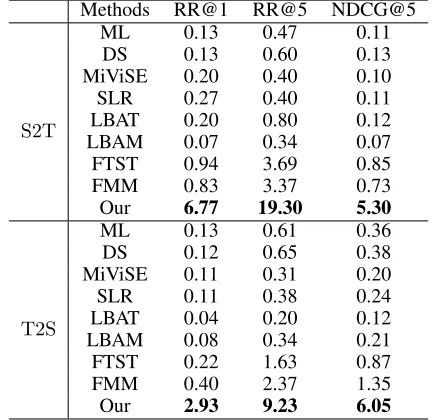
dis-Table 8: The comparison in cross-modal retrieval under ShapeNet subset.
Methods RR@1 RR@5 NDCG@5
S2T
ML 0.13 0.47 0.11
DS 0.13 0.60 0.13
MiViSE 0.20 0.40 0.10
SLR 0.27 0.40 0.11
LBAT 0.20 0.80 0.12
LBAM 0.07 0.34 0.07
FTST 0.94 3.69 0.85
FMM 0.83 3.37 0.73
Our 6.77 19.30 5.30
T2S
ML 0.13 0.61 0.36
DS 0.12 0.65 0.38
MiViSE 0.11 0.31 0.20
SLR 0.11 0.38 0.24
LBAT 0.04 0.20 0.12
LBAM 0.08 0.34 0.21
FTST 0.22 1.63 0.87
FMM 0.40 2.37 1.35
Our 2.93 9.23 6.05
Table 9: The comparison in 3D shape captioning under prim-itive subset.
Model M R C B-1 B-2 B-3 B-4 SLR-N 0.18 0.44 0.13 0.42 0.31 0.21 0.15 MiV-N 0.35 0.67 0.53 0.66 0.53 0.45 0.39 S2VT 0.47 0.87 0.96 0.88 0.82 0.75 0.70 Our-N 0.70 0.98 1.37 0.98 0.97 0.96 0.96 Our 0.54 0.92 1.21 0.92 0.88 0.84 0.80
criminative 3D shape features. This is verified by the con-tinuously increasing results of “S2T” in Table 6. However, because of the limited information embedded in the descrip-tion, voxels with higher resolution could not keep contribut-ing to more discriminative text features, as shown by the re-sults of “T2S”, although we have got the best “T2S” rere-sults
with the highest resolution of1283.
Cross-modal retrieval. To evaluate the performance of
Y2Seq2Seq, we compare our method with the state-of-the-art methods under the primitive subset and the ShapeNet subset in cross-modal retrieval. To conduct a fair
compari-son, our results are obtained from voxel grids of323
reso-lution under the primitive subset and the ShapeNet subset, which is the same as in the other methods.
Under the two subsets, we compare our method with metric learning (ML) (Song et al. 2016), deep symmet-ric structured joint embedding (DS) (Reed et al. 2016), MiViSE (Song and Soleymani 2018), SLR (Shen et al. 2018), association learning with only TST round trips (LBAT) (H¨ausser, Mordvintsev, and Cremers 2017), and several methods from (Chen et al. 2018), such as LBA-MM (LBAM), Full-TST (FTST), and Full-MM (FMM). Among all these methods, MiViSE, SLR and our method are view-based, and the rest are voxel-based.
As shown in Table 7 and Table 8, Y2Seq2Seq
outper-forms all the other methods in terms of all metrics.
Particu-Table 10: The comparison in 3D shape captioning under ShapeNet subset.
Model M R C B-1 B-2 B-3 B-4 SLR-N 0.11 0.24 0.05 0.40 0.17 0.08 0.04 MiV-N 0.16 0.36 0.14 0.61 0.35 0.21 0.12 S2VT 0.21 0.45 0.27 0.67 0.43 0.26 0.15 Our1-N 0.22 0.41 0.29 0.57 0.34 0.22 0.17 Our1 0.29 0.56 0.71 0.80 0.65 0.53 0.46 Our2-N 0.22 0.41 0.30 0.57 0.34 0.23 0.18 Our2 0.30 0.56 0.72 0.80 0.65 0.54 0.46 Our3-N 0.22 0.41 0.31 0.58 0.35 0.24 0.19 Our3 0.29 0.55 0.70 0.80 0.64 0.52 0.44
larly, our results significantly outperform other methods un-der the ShapeNet subset. For example, our result is about 6 times better in “S2T” retrieval and about 4 times better in “T2S” retrieval than the state-of-the-art FMM. We believe these experimental improvements come from our novel way of bridging the semantic meaning embedded in the cross-modal sequences in the process of joint reconstruction and prediction by the two coupled branches.
Furthermore, we visualize the “S2T” and the “T2S” re-trieval results under the primitive subset and the ShapeNet subset in Fig. 2 (a) and Fig. 2 (b) respectively, where the Top-5 retrieved items with their distances to the query are shown. The retrieved 3D shapes or descriptions highly match their description queries or 3D shape queries. The re-trieved results show that our learned discriminative repre-sentations can jointly represent 3D shapes and descriptions in the same cross-modal space. In addition, they are able to distinguish the subtle difference between shapes and de-scriptions. For example, the retrieved shapes in “T2S” re-trieval under ShapeNet subset are all matching the descrip-tion query, but there are still some style and appearance dif-ferences among them. Similarly, the retrieved descriptions in “S2T” retrieval under the primitive subset are all match-ing the 3D shape query, but the emphasized characteristics of the query 3D shape are still different.
3D shape captioning.To further evaluate the performance of Y2Seq2Seq, we compare our method with the
state-of-the-art methods under the primitive subset and the ShapeNet subset in 3D shape captioning. For the methods which can directly generate descriptions for 3D shapes, we will directly evaluate the generated descriptions according to the ground truth descriptions. Otherwise, we will use the feature of a 3D shape to retrieve the nearest description of the 3D shape as the generated description, where we use the suffix “-N” to denote these results. Note that the captioning results of different methods with either retrieval or generation are pro-duced by the same trained parameter in cross-modal retrieval experiments.
Under the primitive subset and the ShapeNet subset, we compare our method with SLR (Shen et al. 2018), MiV (Song and Soleymani 2018), and S2VT (Venugopalan et al. 2015). We show our results obtained by voxel grids
with different resolutions, such as323,643and1283under
Ta-(3.29) @1-It is a large blue ping pong table. It has a net that can be placed in the center. (3.37) @2-A blue colored table tennis table which has a metal frame.
(3.48) @3-A blue frame table with peach top and a glass partition in the center of the table along its length with blue frame work around it.
(3.53) @4-A blue flat surfaced unit standing on four short legs, of blue translucent plastic material, molded in one solid piece, having no separate parts.
(3.55) @5-This is a blue ping ball table with a blue glass top and brown legs.
...
A wooden and metal chair that is brown
and grey in color.
(1.97) @1- (2.04)
@2-...
...
...
...
...
(2.23)
@3- (2.24) @4- (2.25)
@5-Query Retrieved
S2T
T2S
(b)
(1.823660) @5-Retrieved
Query
S2T
T2S
...
(3.331241) @1-The large pyramid is tall narrow yellow.
(3.334018) @2-The large pyramid is high narrow yellow. (3.334379) @3-The large pyramid is tall thin yellow. (3.336639) @4-The pyramidal shape is large tall narrow yellow. (3.337065) @5-The large pyramid is high thin yellow.
(a)
A large short wide green
sphere
(1.733757)
@1- (1.811521) @2- (1.817731) @3- (1.820622)
@4-...
...
...
...
...
Figure 2: The demonstration of “S2T” and “T2S” retrieval results under (a) primitive subset and (b) ShapeNet subset. The top 5 retrieved results with their distances to the query are shown.
...
The cylindrical shape is large teal.The cylindrical shape is large teal.
...
The green rectangularshape is squat. The green rectangular shape is squat wide.
...
A rectangular table with a green top and brown leg table.(a)
...
A brown, wooden chair with a back restand a black cushion.
Brown colored, wooden, rest chair. Four legs and L shaped seat.
(b)
A table made of brown wood that has a colorful top made of green patterns.
...
A gray chair with a white cushion and a gray seat,two seater space with back rest and arm rest.Rectangular shaped wooden chair with sponge grey,black and brown in color,two seater space with back rest and arms rest.
...
The conical shape is nude colored.The large conical shape is nude-colored.
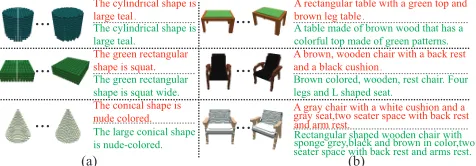
Figure 3: The demonstration of generated descriptions un-der (a) primitive subset, (b) ShapeNet subset, where the ground truth descriptions are shown in green (second one of each pair of descriptions).
ble 10. We use the description predictorPW in the 3D shape
branchSto generate a description of a 3D shape. In
addi-tion, we also show our results obtained by nearest neighbor retrieval.
From the results shown, we can see that all our results ob-tained by either retrieval or generation under the primitive subset are the best. In addition, our results with different voxel resolutions obtained by either retrieval or generation under the ShapeNet subset are also the best among all com-petitors.
In addition, although all our results obtained by genera-tion are good, they are always no better than the ones by retrieval under the primitive subset, while this phenomenon is reversed under the ShapeNet subset, as shown by the re-sults with different voxel resolutions. This is because the primitive subset only contains simple primitive shapes that are described by simple sentences with similar patterns.
Y2Seq2Seq obtains good cross-modal retrieval results, as
shown in Table 7, which makes the retrieved descriptions al-most the same as the ground truth. In contrast, the ShapeNet subset contains complex shapes with complex descriptions. It is not easy to retrieve the right description. However,
Y2Seq2Seqcan still generate some words for the key
char-acteristics of the shape, such as color and material, which leads to better results with generation.
Moreover, we find the voxel resolution only slightly in-creases the results with both retrieval and generation. This
phenomenon is similar to the one in the “T2S” retrieval in Table 6, where higher resolution mainly contributes to “S2T” retrieval but only provides a small contribution to “T2S” retrieval.
Finally, we also visualize the description generated by
Y2Seq2Seq under the primitive subset and the ShapeNet subset in Fig. 3. Compared to the ground truth, the 3D shape
branchSofY2Seq2Seqcan generate high quality
descrip-tion for the characteristics embedded in the view sequence according to the knowledge learned from joint
reconstruc-tion and predicreconstruc-tion in the two branches. Y2Seq2Seq
gen-erates almost the same descriptions as the ground truth un-der the primitive subset, while it generates descriptions with similar semantic meanings to the ground truth under the ShapeNet subset. The generated descriptions successfully represent the class, shape, color, and materials of the 3D
shapes, which indicates thatY2Seq2Seqcan jointly
under-stand 3D shapes and text quite well.
Conclusions
To resolve the issue of cubic complexity of 3D voxel grids for 3D-Text cross-modal representation learning, we pro-pose Y2Seq2Seq as a view-based model to learn
cross-modal representations by joint reconstruction and prediction of view and word sequences. The novel coupled “Y”-like Seq2Seq structures effectively bridge the semantic mean-ing embedded in the 3D shape and text modalities by si-multaneously reconstructing within the same modality and predicting across modalities. In addition, more detailed dis-criminative information can be successfully employed to further increase the discriminability of learned cross-modal representations by our novel hierarchical constraints. Our
experimental results show thatY2Seq2Seqis able to learn
more discriminative cross-modal representations from high-resolution voxels for 3D-Text cross-modal retrieval and 3D shape captioning compared to the competing state-of-the-art techniques.
Acknowledgments
(2018YFB0505400), the National Natural Science Founda-tion of China (61472202), and Swiss NaFounda-tional Science Foun-dation grant (169151). We thank all anonymous reviewers for their constructive comments.
References
Chen, K.; Choy, C. B.; Savva, M.; Chang, A. X.; Funkhouser, T.; and Savarese, S. 2018. Text2shape: Gen-erating shapes from natural language by learning joint
em-beddings.arXiv preprint arXiv:1803.08495.
Cho, K.; van Merrienboer, B.; Bahdanau, D.; and Bengio, Y. 2014. On the properties of neural machine translation:
Encoder-decoder approaches. InSSST@EMNLP, 103–111.
Denkowski, M., and Lavie, A. 2014. Meteor universal: Language specific translation evaluation for any target
lan-guage. InProceedings of the Ninth Workshop on Statistical
Machine Translation, 376–380.
Feng, F.; Wang, X.; and Li, R. 2014. Cross-modal retrieval
with correspondence autoencoder. InProceedings of ACM
International Conference on Multimedia, 7–16.
H¨ausser, P.; Mordvintsev, A.; and Cremers, D. 2017. Learn-ing by association - A versatile semi-supervised trainLearn-ing
method for neural networks. InIEEE Conference on
Com-puter Vision and Pattern Recognition, 626–635.
J¨arvelin, K., and Kek¨al¨ainen, J. 2002. Cumulated gain-based
evaluation of IR techniques.ACM Transactions on
Informa-tion Systems20(4):422–446.
Lin, C.-Y. 2004. Rouge: A package for automatic
evalua-tion of summaries. InProceeding of ACL workshop on Text
Summarization Branches Out.
Ngiam, J.; Khosla, A.; Kim, M.; Nam, J.; Lee, H.; and Ng,
A. Y. 2011. Multimodal deep learning. In Proceedings
of International Conference on International Conference on Machine Learning, 689–696.
Papineni, K.; Roukos, S.; Ward, T.; and Zhu, W.-J. 2002. Bleu: A method for automatic evaluation of machine
trans-lation. InAnnual Meeting on Association for Computational
Linguistics, 311–318.
Reed, S. E.; Akata, Z.; Lee, H.; and Schiele, B. 2016. Learn-ing deep representations of fine-grained visual descriptions.
InIEEE Conference on Computer Vision and Pattern
Recog-nition, 49–58.
Schroff, F.; Kalenichenko, D.; and Philbin, J. 2015. Facenet: A unified embedding for face recognition and clustering. In IEEE Conference on Computer Vision and Pattern Recogni-tion, 815–823.
Shen, X.; Tian, X.; Xing, J.; Rui, Y.; and Tao, D. 2018. Sequence-to-sequence learning via shared latent
represen-tation. In Proceedings of the Thirty-Second AAAI
Con-ference on Artificial Intelligence, New Orleans, Louisiana, USA, February 2-7, 2018.
Simonyan, K., and Zisserman, A. 2014. Very deep
convo-lutional networks for large-scale image recognition. CoRR
abs/1409.1556.
Song, Y., and Soleymani, M. 2018. Cross-modal retrieval
with implicit concept association.CoRRabs/1804.04318.
Song, H. O.; Xiang, Y.; Jegelka, S.; and Savarese, S. 2016. Deep metric learning via lifted structured feature
embed-ding. InIEEE Conference on Computer Vision and Pattern
Recognition, 4004–4012.
Vedantam, R.; Zitnick, C. L.; and Parikh, D. 2015. Cider:
Consensus-based image description evaluation. In IEEE
Conference on Computer Vision and Pattern Recognition, 4566–4575.
Venugopalan, S.; Rohrbach, M.; Donahue, J.; Mooney, R.; Darrell, T.; and Saenko, K. 2015. Sequence to sequence
– video to text. In Proceedings of the IEEE International
Conference on Computer Vision, 4534–4542.
Wang, B.; Ma, L.; Zhang, W.; and Liu, W. 2018.
Recon-struction network for video captioning. InIEEE Conference