www.biogeosciences.net/8/875/2011/ doi:10.5194/bg-8-875-2011
© Author(s) 2011. CC Attribution 3.0 License.
Biogeosciences
Technical Note: A comparison of two empirical approaches to
estimate in-stream net nutrient uptake
D. von Schiller1, S. Bernal2, and E. Mart´ı2
1Leibniz-Institute of Freshwater Ecology and Inland Fisheries, Berlin, Germany
2Biogeodynamics and Biodiversity Group, Centre d’Estudis Avanc¸ats de Blanes, CSIC, Blanes, Spain Received: 20 September 2010 – Published in Biogeosciences Discuss.: 15 October 2010
Revised: 26 March 2011 – Accepted: 28 March 2011 – Published: 8 April 2011
Abstract. To establish the relevance of in-stream processes
on nutrient export at catchment scale it is important to ac-curately estimate whole-reach net nutrient uptake rates that consider both uptake and release processes. Two empiri-cal approaches have been used in the literature to estimate these rates: (a) the mass balance approach, which consid-ers changes in ambient nutrient loads corrected by ground-water inputs between two stream locations separated by a certain distance, and (b) the spiralling approach, which is based on the patterns of longitudinal variation in ambient nutrient concentrations along a reach following the nutrient spiralling concept. In this study, we compared the estimates of in-stream net nutrient uptake rates of nitrate (NO3) and ammonium (NH4) and the associated uncertainty obtained with these two approaches at different ambient conditions using a data set of monthly samplings in two contrasting stream reaches during two hydrological years. Overall, the rates calculated with the mass balance approach tended to be higher than those calculated with the spiralling approach only at high ambient nitrogen (N) concentrations. Uncer-tainty associated with these estimates also differed between both approaches, especially for NH4due to the general lack of significant longitudinal patterns in concentration. The ad-vantages and disadad-vantages of each of the approaches are dis-cussed.
1 Introduction
Understanding the relevance of in-stream uptake on nutri-ent loads has become an important question over the past decades due to the need to establish reliable nutrient budgets
Correspondence to: D. von Schiller ([email protected])
at catchment scale and to evaluate the impact of downstream nutrient export on coastal ecosystems (Behrendt and Opitz, 2000; Alexander et al., 2000; Wollheim et al., 2008). Sev-eral studies have shown that in-stream processes can have a significant influence on nutrient downstream transport, espe-cially in headwater or relatively small-size streams (Alexan-der et al., 2000; Peterson et al., 2001; Bernhardt et al., 2003; Ensign and Doyle, 2006; Mulholland et al., 2008). Note-worthy, results from most of these studies are derived from estimates of gross nutrient uptake, which may overestimate the net influence of streams on nutrient downstream export because they do not consider processes associated to release of nutrients from biota to water column. Release processes (e.g. mineralization, nitrification, desorption), however, can be relevant in streams, and may counterbalance to some ex-tent nutrient uptake processes (e.g. assimilation, denitrifica-tion, and adsorption) or even result in a net downstream re-lease of nutrients. For instance, Brookshire et al. (2009) found no significant longitudinal patterns in ambient concen-tration (i.e. net uptake rates∼0) in about 80% of a selection of stream reaches from several biomes, and concluded that in-stream processes may be commonly irrelevant for water-shed nutrient balances because in-stream nutrient uptake is rapidly balanced by nutrient release. Nevertheless, Brook-shire et al. (2009) also suggested that streams could act as net sinks of nutrients (i.e. positive net uptake rates) under certain environmental conditions that favour denitrification or net biomass growth. Taking all this into consideration it becomes clear that, besides of characterizing stream ecosystems in terms of gross nutrient uptake rates, it is also important to estimate net nutrient uptake rates that provide more accurate information on actual nutrient export from a given stream reach and the relevance of in-stream processes at catchment scale.
(uptake>release), negative (uptake<release) or nil (up-take∼release). These rates have been commonly estimated using a mass balance approach considering changes in nu-trient loads (i.e. nunu-trient inputs minus outputs) between two stream locations separated by a certain distance (Meyer and Likens, 1979; Bernhardt et al., 2003; Roberts and Mulhol-land, 2007; Niyogi et al., 2010). In this approach, val-ues of nutrient fluxes from groundwater to the stream are needed to accurately estimate the net mass balance only as-sociated with uptake and release processes (i.e. in-stream net uptake rates). When groundwater nutrient concentra-tions are not available, a sensitivity analysis can be done using a range of potential values to examine the relevance of this nutrient source on estimated net nutrient uptake rates (Roberts and Mulholland, 2007).
Alternatively, in-stream net uptake rates can be estimated from patterns of longitudinal variation in ambient nutrient concentrations along a reach following the nutrient spiralling concept (Mart´ı et al., 1997, 2004). Rather than assuming a linear trend of stream nutrient concentration between two locations, net uptake rates obtained with the spiralling ap-proach are derived from the fit of ambient nutrient concen-trations along the reach to an exponential equation (i.e. first-order reaction model). This approach integrates all the up-take and release processes occurring along the stream reach and it works well regardless of nutrient groundwater in-puts when they are negligible or when concentrations in groundwater and in surface water are similar. The uncer-tainty associated to processes occurring along the stream reach and to groundwater inputs can be estimated based on the confidence intervals of the fit to the exponential equa-tion, yet, as for the mass balance approach, this procedure constitutes just a proxy to actual measurement uncertainty (Hanafi et al., 2007).
The aim of this study was to compare the estimates of in-stream net N uptake rates and the associated uncertainty ob-tained from the mass balance and the spiralling approaches aforementioned. To do so we took advantage of a data set from monthly samplings along a longitudinal transect in two contrasting stream reaches during two hydrological years, which allowed us to calculate net uptake rates of NO3 and NH4with both methods under distinct hydrological and en-vironmental conditions. The advantages and disadvantages of each method are discussed in view of the results from this comparison and the uncertainties associated with each method.
2 Methods
Data for this study were collected in two forested headwa-ter streams located in Catalonia (NE Spain): Santa Fe del Montseny and Fuirosos. The two streams have contrasted hydrological regimes and dissolved inorganic N (DIN) con-centrations (von Schiller et al., 2008). Santa Fe has
per-manent flow year round, whereas Fuirosos has intermit-tent flow regime with summer no flow periods of vari-able duration among years. During the study period, DIN was dominated by NO3 in both streams, but the concen-tration was higher and expanded a wider range of values in Fuirosos (mean±SD=368±397 µg N l−1, range=35 to 1468 µg N l−1,n=20) than in Santa Fe (125±83 µg N l−1, range=12 to 321 µg N l−1, n=25). The concentration of NH4was low (i.e. mean<15 µg N l−1)and showed no clear temporal pattern in both streams. More detailed informa-tion on the biogeochemical properties of these streams can be found in Bernal et al. (2005) and von Schiller et al. (2008). Representative reaches of 140 m in Santa Fe and 80 m in Fuirosos were selected. We collected water samples for am-bient concentrations of NO3 and NH4 and measured con-ductivity at eight locations along each reach. Discharge was estimated based on a mass balance approach by con-ducting short-term constant rate additions of a hydrological tracer (i.e. NaCl) and using the time-curve conductivity data recorded at the bottom of the reach (Gordon et al., 2004). This method also allowed estimating variation of discharge along the reach due to groundwater inputs. Wetted width was recorded at each sampling location and averaged to provide a value for the entire reach. Field samplings were conducted monthly from September 2004 until August 2006, except in Fuirosos during no flow conditions. A total of 25 and 20 longitudinal samplings were done in Santa Fe and Fuirosos, respectively. Water samples were analyzed for NO3and NH4 concentrations following standard colorimetric methods (von Schiller et al., 2008).
We calculated net uptake rates (U, in µg N m−2s−1) of each DIN form (NO3and NH4)for each sampling date using two alternative approaches: the mass balance approach and the spiralling approach.
The net uptake rates with the mass balance approach (here-after referred to as UMB)were calculated using ambient N concentrations from the sampling locations at the top and the bottom of the reach. We took into consideration the ground-water N inputs to correct stream changes for this additional N source influencing the variation of N mass between the two sites following Roberts and Mulholland (2007). TheUMB was calculated using the equation:
by assuming that it could range from 0.5 to 2 times the aver-age surface water N concentration (Roberts and Mulholland, 2007). Subsurface N concentrations measured sporadically in the hyporheic zone of both streams tended to be within this range of values. In Santa Fe, the median [quartiles] sub-surface/surface concentration ratio was 1.17 [1.05, 1.25] and 1.15 [0.94, 1.62] for NO3 (n=23) and NH4 (n=21), re-spectively. In Fuirosos, only NO3 was measured and was 1.08 ([0.54, 1.89],n=22). The CI was calculated as the dif-ference between the upper and the lower limit ofUMB. We assumed thatUMBwas not different from 0 when the upper limit was positive and the lower limit was negative.
The net uptake rates from the spiralling approach (here-after referred to asUSP)were calculated using the longitu-dinal variation in ambient N concentration along the reach. Stream ambient concentrations were corrected by the lon-gitudinal variation in ambient conductivity based on the method described by Mart´ı et al. (2004). We used conductiv-ity which correlates well with the concentration of chloride in the study streams (D. von Schiller, unpublished data); how-ever, measuring directly the concentration of a conservative tracer (e.g. chloride, bromide) is recommended. This method is an adaptation of the method used to estimate nutrient spi-ralling metrics using short-term nutrient additions (Newbold et al., 1981; Webster and Valett, 2006). The underlying as-sumptions are: (a) changes in stream ambient conductivity only occur if groundwater inputs differ in conductivity with respect to surface water, and (b) groundwater inputs dilute or enrich surface water conductivity and N concentration at the same longitudinal rate if groundwater concentrations are dif-ferent from those in surface water. Consequently, net uptake or release of N is considered to occur when the proportion of ambient N concentration over ambient conductivity increases or decreases significantly with distance downstream. From the longitudinal patterns in ambient concentrations, we esti-mated a net uptake coefficient per unit of reach length (kw, in
m−1)by solving the equation:
Nx=Ntop·(Cx/Ctop)·ekwx (2) whereN (in µg N l−1)is the ambient concentration of NO3 or NH4, andC (in µS cm−1)is the ambient conductivity at the top of the reach and at the downstream sites locatedx m from the top of the reach.USPwas then calculated using the following equation:
USP=(Q·Navg·kw)/a (3)
whereNavg(in µg N l−1)is the average of the N ambient con-centration measured at the eight locations along the reach and Q(in l s−1)is average discharge along the reach. We esti-mated the CI ofUSP based on thekw range obtained using
the±95% confidence interval of the regression between N concentration corrected by ambient conductivity (i.e. lnNx)
and the downstream distance (x)derived from Eq. (2). The value ofUSPwas not statistically different from zero when
the regression was not significant (i.e.p >0.05). The CI (in µg N m−2s−1)forUSPwas estimated as the difference in the USPvalues between the upper and lower 95% confidence in-tervals. We assumed thatUSPwas not different from 0 when the upper limit was positive and the lower limit was negative. We used Wilcoxon paired tests and Spearman rank corre-lations to compareUMBandUSPestimates for NO3and NH4. Non-parametric tests were chosen because data did not meet normality requirements even after data transformations. All statistical analyses where done with Statistica 7.0 (Statsoft, Tulsa, Oklahoma, USA).
3 Results and discussion
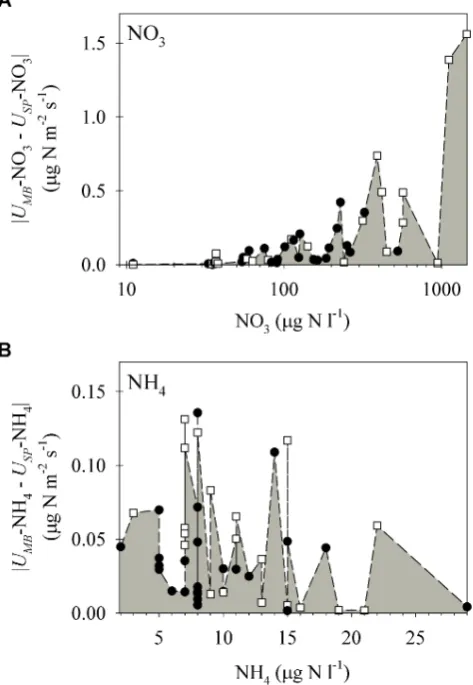
On many sampling dates, the concentrations of NO3 and NH4 showed a longitudinal decline or increase in both streams, suggesting non-equilibrium of in-stream processes (uptake6=release; Brookshire et al., 2009). The net uptake rates calculated using the mass balance and the spiralling ap-proaches fell close to the 1:1 line for both DIN forms (Fig. 1). For NO3, however,UMB(median [quartiles]=0.11 [−0.04, 0.25] µg N m−2s−1,n=45) was two times higher thanUSP (0.06 [−0.04, 0.23] µg N m−2s−1,n=45) (Wilcoxon paired test, Signed-Rank=239.5, df=44,p <0.01). The discrep-ancy in the estimation of U between the two approaches emerged under high ambient NO3concentrations. We found that absolute differences between theU for NO3calculated with the two approaches augmented as stream NO3 concen-tration increased (Spearman Rho coefficient=0.71, df=44, p <0.01) (Fig. 2a). In fact, there were no differences be-tweenUMB andUSP for those cases in which stream NO3 concentrations were<∼300 µg N l−1(Wilcoxon paired test, Signed-Rank=92, df=34,p >0.05). Consistent with the findings for NO3in which differences between the two ap-proaches were small when stream N concentrations were low, the values for NH4(in all cases ambient concentration <30 µg N l−1) of UMB (0.03 [−0.02, 0.06] µg N m−2s−1, n=45) and USP (0.03 [−0.01, 0.08] µg N m−2s−1, n= 45) showed no differences (Wilcoxon paired test, Signed-Rank= −60.5, df=44, p >0.05) and did not exhibit any consistent pattern in relation to stream NH4ambient concen-trations (Fig. 2b).
Fig. 1. Relationship between the net uptake rates estimated with the
mass balance approach (UMB)and the spiralling approach (USP)
for (A) NO3and (B) NH4. White squares and black circles
cor-respond to values from Fuirosos (n=20) and Santa Fe (n=25) streams, respectively. Error bars are the confidence intervals esti-mated with the two approaches (see text for details). The 1:1 line is shown in each case.
derived from Eqs. (2) and (3) thatUSPdepends on the aver-age N concentration as well as on the ratio in N concentration between the two stations (i.e.Navgln(Ntop/Nbot); see interac-tive discussion for details of derivations). Based on Eqs. (1)– (3), it is also worth considering that the distance between the two sampling stations (i.e. reach length) may influence the comparison ofU estimates between the two methods. We used a sensitivity analysis to examine how the difference be-tweenUMBandUSPchanged as a function of: (a) the average stream water N concentration, (b) the reach length consid-ered, and (c) the ratio in N concentration between the top and bottom stations (Fig. 3). Results from this analysis sup-ported our empirical results, showing that the difference be-tween both approaches increases linearly with increasing av-erage N concentration (Fig. 3a). Moreover, results show that the difference between both approaches decreases as a power law when the reach length increases (Fig. 3b). Finally, results
Fig. 2. Absolute differences between the net uptake rates estimated
with the mass balance approach (UMB)and the spiralling approach
(USP)sorted as a function of average stream N concentration for
(A) NO3and (B) NH4. White squares and black circles correspond to values from Fuirosos (n=20) and Santa Fe (n=25) streams, respectively. Note logarithmic scale on the x-axis of (A).
from the sensibility analysis indicate that theUMB−USP dif-ference is magnified as theNtop:Nbotratio increases.
[image:4.595.311.548.69.412.2]Fig. 3. Sensitivity analysis of the influence of (A) average stream
water N concentration and (B) reach length on the absolute dif-ference between net uptake rates estimated with the mass bal-ance approach (UMB)and the spiralling approach (USP). Constant
discharge (10 l s−1)and wetted width (2 m) were considered be-tween only two stream stations (top and bottom). In (A) reach length=100 m, and in (B) average N concentration=200 µg N l−1. Numbers on each dashed line correspond to different proportions of stream N concentration between the top and bottom stations.
results indicated either net in-stream uptake (U >0) or re-lease (U <0) of NO3(i.e. non-equilibrium of net in-stream processes) in 40% and 49% of the cases for the mass balance and the spiralling approach, respectively. These percentages suggest that the relevance of in-stream processes on NO3 ex-port can potentially be higher than previously reex-ported for other streams (Brookshire et al., 2009).
[image:5.595.49.293.65.407.2]Nonetheless, of the total cases with net uptake/release of NO3estimated with the mass balance approach (UMB6=0), 44% (8 out of 18) lead to net uptake/release (USP=0) when applying the spiralling approach. Thus, in these cases, the longitudinal change in ambient stream water N concentra-tion from the top to the bottom staconcentra-tions showed an unclear and statistically non-significant longitudinal pattern. In turn, of the estimates withUSP6=0 for NO3, 55% (12 out of 22)
Fig. 4. Box plots summarizing the confidence intervals (CI)
cal-culated for the net uptake rates using the mass balance approach (UMB)and the spiraling approach (USP)for (A) NO3and (B) NH4.
Data are from Santa Fe (n=25) and Fuirosos (n=20) streams. The centre horizontal line in each plot is the median value. Fifty percent of the data points lie within each box. The whiskers above and below the box indicate the 90% and 10% percentiles. Circles are outliers. See text for details on the calculation of the CI for each approach.
lead toUMB=0 when applying the mass balance approach. In these cases, net changes in ambient stream NO3 concen-tration between the top and the bottom stations could poten-tially be explained solely (without in-stream uptake/release) by groundwater inputs with a concentration within the range considered here (0.5–2 times the mean surface water con-centration). These results highlight the inherent uncertain-ties of both approaches, and show when values from the two approaches are comparable. Thus, applying both empirical approaches may help researchers to decide which method is most suitable for their particular case. In addition, if results from both methods are coincident, one might be more confi-dent of the obtained estimates.
obtained with the mass balance approach (Fig. 4b, Wilcoxon paired test, Signed-Rank= −427, df=44, p <0.01). The uncertainty associated with groundwater inputs for NH4was low compared to that associated with NO3 due to the rel-atively low NH4 concentration of these inputs. In relative terms, theUMBfor NH4decreased on average 2.2±2.4 times and increased 1.1±1.1 times when groundwater inputs were half and 2-fold those in surface water, respectively. For the spiralling approach,USPvaried on average 5.9±13.1 times due to the uncertainty associated with this calculation. In contrast to NO3, the longitudinal pattern of ambient NH4 concentrations across all sampling stations was rarely statis-tically significant. The mass balance approach, based only on a top and a bottom stations, suggested non-equilibrium of in-stream processes (i.e.U6=0) for 76% of the studied cases. Contrastingly, according to the spiralling approach there was only net uptake or release of NH4 in 29% of the cases. Of theUMB6=0 estimates for NH4, 68% (23 out of 34) coin-cided withUSP=0 estimates. In contrast, of theUSP6=0 estimates for NH4, only 15% (2 out of 13) coincided with UMB=0 estimates.
Overall, results from this study showed discrepancies in the estimates of in-stream net uptake rates of DIN forms between the mass balance and the spiralling approach, in particular under high (>300 µg N l−1)ambient N concentra-tions. For lower ambient N concentrations, however, net uptake rates obtained with the two alternative approaches were similar. Roberts and Mulholland (2007) reported a small effect of groundwater inputs on N in-stream net up-take rates in the West Fork of Walker Branch (Tennessee, USA), where stream ambient DIN concentrations were low (<100 µg N l−1). We showed, however, that groundwater in-puts could strongly influence estimation of in-stream net up-take rates when stream ambient concentrations are high, such in the case of NO3in our data set, or under largeNtop:Nbot ratios. When this is the case, riparian groundwater samples may be collected to constrain the range of uncertainty inU associated with this nutrient source (Roberts and Mulhol-land, 2007). However, reliable riparian groundwater concen-tration measurements are difficult to obtain due to the high spatial variability (Lewis et al., 2006) and the potential dif-ference between groundwater and the water found at the in-terface between the ground and surface water which really enters the stream (Brookshire et al., 2009). This limitation can be a disadvantage when using the mass balance approach under certain conditions, such as high lateral inflow or high stream nutrient concentrations. Conversely, for the alterna-tive spiraling approach the influence of additional ground-water sources can only be relevant in cases when nutrient concentration in groundwater is highly different from that in the surface stream because estimates are based on changes in nutrient concentration rather than in nutrient mass.
The spiralling approach is based on a whole-reach inte-grative measure of a longitudinal concentration trend across several sampling points, contrasting with the net change in
nutrient loads between only two sampling points considered by the mass balance approach. In addition, estimates ofU by the spiralling approach are based on a first-order reac-tion model, which is likely to be more representative for in-stream nutrient dynamics than the linear model used by the mass balance approach (Newbold et al., 1981; Webster and Valett, 2006). We showed that when longitudinal patterns are unclear, such as is often the case for NH4, the spiralling approach shows higher uncertainty and a higher proportion of estimates ofU=0 (i.e. equilibrium of net in-stream pro-cesses) compared to the mass balance approach, which may tend to overestimate those cases in which there is net uptake or release. An important limitation of the spiralling approach is the assumption that changes in stream water conductivity along the reach respond to groundwater inputs and, more im-portantly, that the effect of groundwater inputs on N stream concentration is proportional to that of conductivity. The lat-ter assumption may not consistently hold across streams. If groundwater data are not available along the reach, as it is often the case, this assumption is difficult to test, yet it seems reasonable to consider that changes in groundwater conduc-tivity could be associated with changes in nutrient concen-trations, especially in streams subjected to anthropogenic in-puts. Under these conditions, the spiralling approach will provide an estimate of overall net nutrient change rates rather than of in-stream nutrient uptake. However, becauseUSP es-timates are based on changes in nutrient concentration and not in mass, the influence of groundwater inputs on the lon-gitudinal patterns of stream ambient nutrient concentration might be smaller when groundwater inflow is low relative to stream discharge and also when groundwater concentrations are similar to those in stream water.
Another limitation of the mass balance and the spiraling approaches is that they do not allow determining the mecha-nisms driving nutrient uptake. For instance, using these ap-proaches we are not able to distinguish whether the removal of inorganic N is permanent (through denitrification), or tem-porary (through biotic assimilation and adsorption). More-over, a stream may have no net effect on total nutrient export, yet it may have large net uptake of inorganic nutrients which are stored for some time and then exported as organic forms (Bernhardt et al., 2003).
Although the spiralling approach has been less commonly used in the literature, data sets of ambient nutrient concen-tration collected along stream longitudinal transects are often available from nutrient uptake studies using the nutrient addi-tion methodology for which background nutrient concentra-tions are measured along the study reach (Webster and Valett, 2006; Ensign and Doyle, 2006). We encourage other re-searchers to profit from such data to obtain reliable in-stream net uptake rates and to compare the mass balance and the spiralling approaches across further systems. Furthermore, if data on both gross (e.g., from nutrient additions) and net nutrient uptake are available, rates of mineralization could potentially be inferred. This information is relevant to ex-pand our knowledge on broad temporal and spatial patterns of net in-stream nutrient uptake rates, which could be based on different sources of existing data.
Acknowledgements. We thank M. Ribot, A. Argerich, P. Fonoll`a
and S. Pla for field and laboratory assistance. We are also grateful to the direction of the Natural Parks of Montseny and Corredor-Montnegre (Diputaci´o de Barcelona) for allowing access to the sampling sites. Thoughtful comments by W. Wollheim, B. Hall and M. Gooseff improved the quality of this manuscript. D. von Schiller was supported by a postdoctoral fellowship of the German Academic Exchange Service and “laCaixa” Foundation. S. Bernal was supported by a Juan de la Cierva postdoctoral fellowship (JC2008-1777) from the Spanish Ministry of Sci-ence and Innovation. Financial support for data collection was provided by the European Union through the EURO-LIMPACS project (ref: GOCE-CT-2003-505540, www.eurolimpacs.ucl.ac.uk) and by the Spanish Ministry of Science and Innovation through the GRACCIE project (ref: CSD2007-00067, Consolider Program).
Edited by: T. J. Battin
References
Alexander, R. B., Smith R. A., and Schwarz, G. E.: Effect of stream channel size on the delivery of nitrogen to the Gulf of Mexico, Nature, 403, 758–761, 2000.
Behrendt, H. and Opitz, D.: Retention of nutrients in river systems: dependence on specific runoff and hydraulic load, Hydrobiolo-gia, 410, 111–122, 1999.
Bernal, S., Butturini, A., and Sabater, F.: Seasonal variations of dis-solved nitrogen and DOC:DON ratios in an intermittent Mediter-ranean stream, Biogeochemistry, 75, 351–372, 2005.
Bernhardt, E. S., Likens, G. E., Buso, D. C., and Driscoll, C. T.: In-stream uptake dampens effects of major forest disturbance on watershed nitrogen export, P. Natl. Acad. Sci. USA, 100, 10304– 10308, 2003.
Brookshire, E. N., Valett, H. M., and Gerber, S.: Maintenance of ter-restrial nutrient loss signatures during in-stream transport, Ecol-ogy, 90, 293–299, 2009.
Covino, T. P. and McGlynn, B. L.: Stream gains and losses across a mountain-to-valley transition: Impacts on watershed hydrology and stream water chemistry, Water Resour. Res., 43, W10431, doi:10.1029/2006WR005544, 2007.
Ensign, S. H. and Doyle, M. V.: Nutrient spiraling in streams and river networks, J. Geophys. Res., 111, G04009, doi:10.1029/2005JG000114, 2006.
Gordon, N. D., McMahon, T. A., Finlayson, B. L., Gippel, C. J., and Nathan, R. J.: Stream hydrology: an introduction for ecologists, Wiley, West Sussex, UK, 2004.
Hanafi, S., Grace, M., Webb, J. A., and Hart, B.: Uncertainty in nutrient spiraling: sensitivity of spiraling indices to small errors in measured nutrient concentration, Ecosystems, 10, 477–487, 2007.
Lewis D. B., Schade, J. D., Huth, A. K., and Grimm, N. B.: The spatial structure of variability in a semi-arid, fluvial ecosystem, Ecosystems, 9, 386–397, 2006.
Mart´ı, E., Grimm, N. B., and Fisher, S. G.: Pre- and post-flood retention efficiency of nitrogen in a Sonoran desert stream, J. N. Am. Benthol. Soc., 16, 805–819, 1997.
Mart´ı, E., Aumatell, J., Gode, L., Poch, M., and Sabater, F.: Nutri-ent retNutri-ention efficiency in streams receiving inputs from wastew-ater treatment plants, J. Environ. Qual., 33, 285–293, 2004. Meyer, J. L. and Likens, G. E.: Transport and transformation of
phosphorus in a forest stream ecosystem, Ecology, 60, 1255– 1269, 1979.
Mulholland, P. J., Helton, A. M., Poole, G. C., Hall, R. O., Hamil-ton, S. K., Peterson, B. J., Tank, J. L., Ashkenas, L. R., Cooper, L. W., Dahm, C. N., Dodds, W. K., Findlay, S. E., Gregory, S. V., Grimm, N. B., Johnson, S. L., Mcdowell, W. H., Meyer, J. L., Valett, H. M., Webster, J. R., Arango, C. P., Beaulieu, J. J., Bernot, M. J., Burgin, A. J., Crenshaw, C. L., Johnson, L. T., Niederlehner, B. R., O’Brien, J. M., Potter, J. D., Sheibley, R. W., Sobota, D. J., and Thomas, S. M.: Stream denitrification across biomes and its response to anthropogenic nitrate loading, Nature, 452, 202–205, 2008.
Niyogi, D. K., Bandeff, J. M., Selman, C., and Menke, D. E.: Nu-trient flux, uptake, and transformation in a spring-fed stream in the Missouri Ozarks, USA, Aquat. Sci., 72, 203–212, 2010. Newbold, J. D., Elwood, J. W., O’Neill, R. V., and Van Winkle,
W.: Measuring nutrient spiralling in streams, Can. J. Fish. Aquat. Sci., 38, 860–863, 1981.
Payn, R. A., Gooseff, M. N., McGlynn, B. L., Bencala, K. B., and Wondzell, S. M.: Channel water balance and exchange with subsurface flow along a mountain headwater stream in Montana, United States, Water Resour. Res., 45, W11427, doi:10.1029/2008WR007644, 2009.
Roberts, B. J. and Mulholand, P. J.: In-stream biotic con-trol of nutrient biogeochemistry in a forested stream, West Fork of Walker Branch, J. Geophys. Res., 112, G04002, doi:10.1029/2007JG000422, 2007.
Webster, J. R. and Valett, H. M.: Solute dynamics, in: Methods in stream ecology, edited by: Hauer, F. R. and Lamberti, G. A., Academic Press, San Diego, CA, USA, 169–185, 2006. von Schiller, D., Mart´ı, E., Riera, J. L., Ribot, M., Argerich, A.,
Fonoll`a, P., and Sabater, F.: Inter-annual, annual and seasonal variation of P and N retention in a perennial and an intermittent stream, Ecosystems, 11, 670–687, 2008.